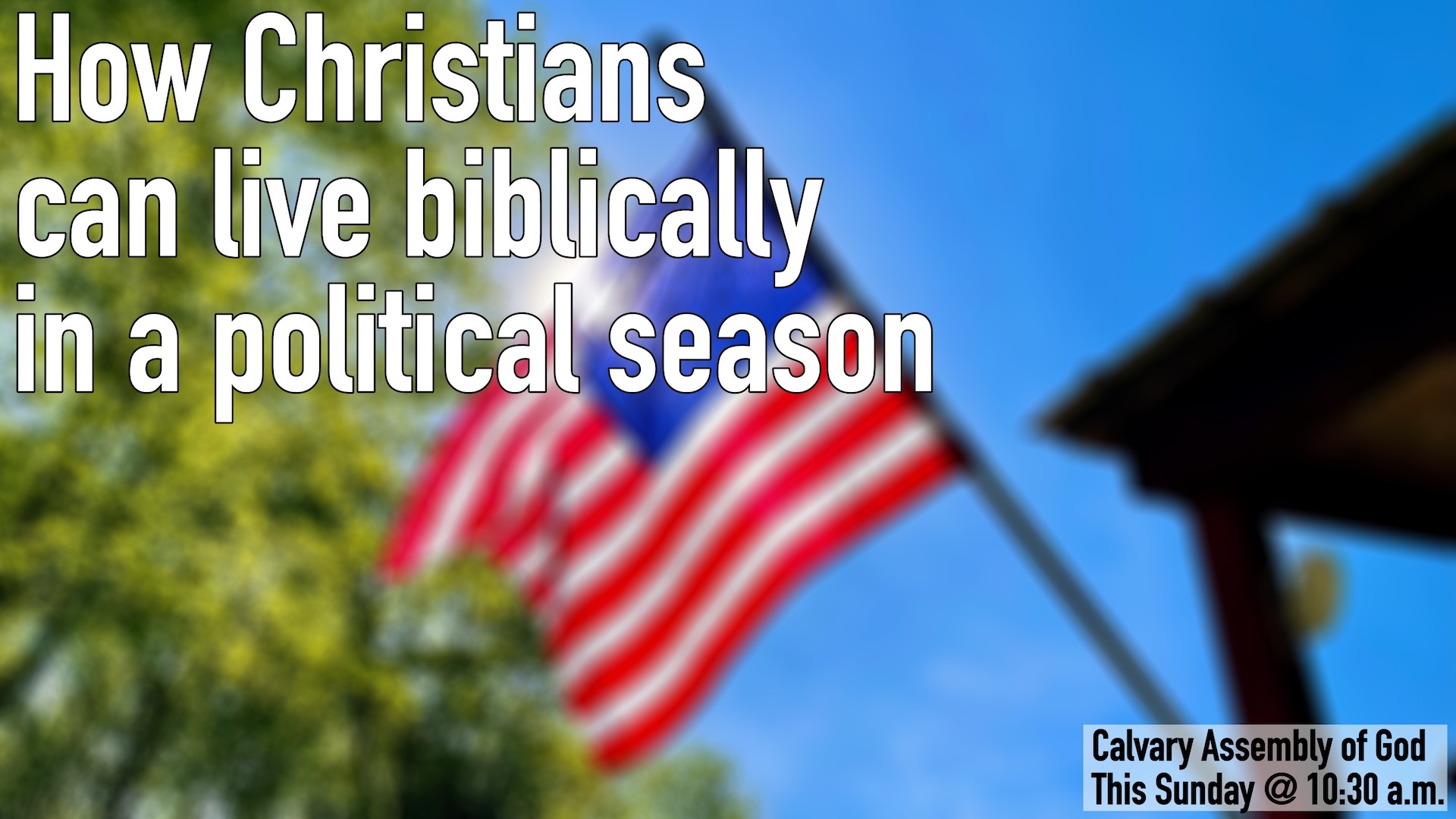
How Christians Can Live Biblically In An Election Season

Listen to the podcast of this post by clicking on the player below, and you can also subscribe on AppleSpotify, or Audible. 

Much like Jude who had a message he wanted to deliver to the saints, but was compelled by the Holy Spirit to address something concerning him (Jude 3-4), I, too, was excited to deliver the next message in our series on discovering your gifts and then living in your gift zone. But I am deeply concerned about the words and actions of Christian saints during these past election cycles. 

(Check out all of the Scriptures I reference in this post by clicking here.)

I recently heard John Stonestreet say, “Currently, politics is carrying far more cultural weight than it is able to bear.” I agree: Christians are putting far too much emphasis on political candidates than the Bible would suggest. 

I frequently quote something from Charles Colson that always makes people smile. He said, “Salvation will never arrive in Air Force One.” The flip side is true as well: Neither will the Apocalypse arrive on Air Force One. 

We have to remember that the Most High is sovereign over all the nations of the earth, and He gives them to whom He choose (Daniel 4:25, 32). When we think that our candidate or our party is the only way our nation can be saved, aren’t we elevating the political process above God’s plan? 

I hope this doesn’t come as a shock to anyone, but there are no perfect candidates, perfect political parties, nor perfect party platforms. We can study our Bibles, pray, study the candidates’ lifestyle and policies, but ultimately we will have to cast a ballot for an imperfect candidate. 

God doesn’t have an “R” or “D” next to His name. He has not endorsed a political candidate. You may be sitting next to someone right now that is going to vote for the opposite political party that you will be voting for. And the way we interact with those people—whether they are fellow Christians or not—is deeply concerning to me. 

Moses saw a couple of fellow Israelites fighting each other, and he asked them, “Why are you hitting your fellow Hebrew” (Exodus 2:13). The Hebrew word rea means a friend who is also a fellow citizen. These Hebrews were citizens of Zion, but they were living in Egypt, and they definitely weren’t treating each other in a way that would be a testimony to the Egyptians. 

When Stephen retold this portion of the story in his sermon, he phrased it this way, “Men, you are brothers” (Acts 7:25-26). Stephen used the Greek word adelphos which literally means “from the same womb.” But the Christians used this word to mean brothers and sister in Christ—people with whom we will spend eternity. 

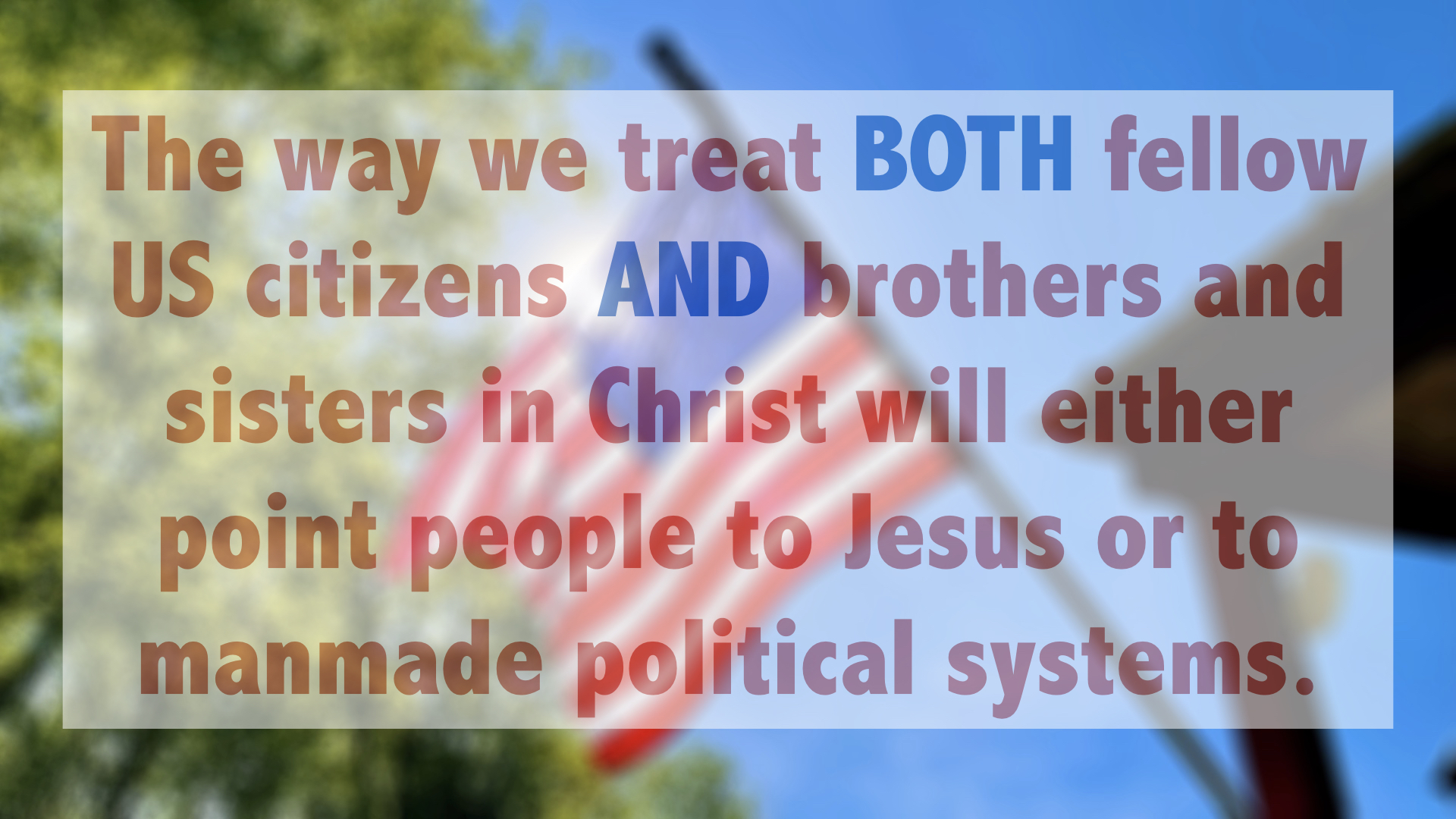
Let us always remember that others who are participating in the American political process are BOTH fellow US citizens AND brothers and sisters in Christ. 

In J.R.R. Tolkien’s Return of the King, when Gandalf sees fellow citizens and friends at each other’s throats, he exclaims, “Work of the enemy! Such deeds he loves: friend at war with friend, loyalty divided, and confusion of hearts.” Indeed, the enemy of our souls would love to see the chaos of a nation at war with itself; especially to see Christians at odds with each other. 

Paul said, “Therefore, as we have opportunity, let us do good to all people, especially to those who belong to the family of believers” (Galatians 6:10). On the flip side, Jesus said that when we think or speak poorly of a fellow human, we are in danger of judgment (Matthew 5:22). 

Listen to Paul’s appeal to his friends at Philippi—

Therefore if you have any encouragement from being united with Christ, if any comfort from His love, if any common sharing in the Spirit, if any tenderness and compassion, then make my joy complete by being like-minded, having the same love, being one in spirit and of one mind.

And then he specifically addressed a couple of sisters in Christ who were ad odds with each other

I plead with Euodia and I plead with Syntyche to be of the same mind in the Lord. Yes, and I ask you, my true companion, help these women since they have contended at my side in the cause of the gospel, along with Clement and the rest of my co-workers, whose names are in the book of life. (Philippians 2:1-2, 4:2-3) 

The politicians we have are always downstream from culture, which means we have allowed those sorts of politicians to be in place. 

John Stonestreet used a phrase I hadn’t heard before, but I think it’s appropriate: “Christian political engagement should hit its fever pitch not during elections. The only way to relieve the political pressures of our day is to build up the pre-political aspects of our life together, especially the family and the Church. When we care well for our children, our neighbors, and our communities, the state doesn’t have to.”  How true this is! 

I wrote something this summer based on Isaiah 3:4-5. In essence, I wrote that God gives nations the “leaders” they deserve. They are leaders in that they occupy an office, but they don’t lead people nor care for the citizens—they don’t have wisdom to lead nor do they care about anyone but themselves. This is the inevitable result for a nation that turns its back on God! So if we think our political and civic leaders are self-focused, unskilled, and childish, we should look in the mirror. It’s not “them,” it’s us. We have to change—turning wholeheartedly to God—and only then God can change our leadership. 

We need to be praying for our governmental leaders, not vilifying them. We need to be speaking well of our fellow US citizens. We need to be especially treating our fellow brothers and sisters in Christ well. 

Our hope is not in the results of an election. Our hope is in Jesus. The way we treat BOTH fellow US citizens AND brothers and sisters in Christ will either point people to Jesus or to manmade political systems. 

I pray we can do better at pointing people to Jesus! I pray I can do better! 

►► Would you please prayerfully consider supporting this ministry? My Patreon supporters get behind-the-scenes access to exclusive materials. ◀︎◀︎
What’s Your Passion?

Listen to the podcast of this post by clicking on the player below, and you can also subscribe on AppleSpotify, or Audible. 

A quick recap: We are all gifted by God, but we typically restrict ourselves to a comfort zone which is much smaller than our God-given gift zone. In order to maximize our impact for the Kingdom of God, we are going to have to get uncomfortable with staying comfortable—we are going to have to trust God as we push out further into our gifts. 

Last week I gave you a homework assignment to think about the things you love to do. Why do we need to know this? Because it is one of the indicators of our areas of giftedness. 

In the whole carrot-versus-stick discussion, you will find that most people are motivated by reward way more than they are by the fear of punishment. Look at how these God-fearing men were motivated by the God’s rewards:

  • David—1 Samuel 17:26-27, 29-30 
  • Paul—1 Corinthians 9:24; 2 Timothy 4:8 
  • Jesus—Hebrews 12:2; Philippians 2:9-11 

(Check out all of the Scriptures in this post by clicking here.)

Who’s more likely to get the reward: the one who loves what they are doing or the one who hates what they are doing? We are more likely to stick with what we love doing, and you are going to love doing what you are gifted by God to do. 

Why we do what we do is much more important that what we do (Isaiah 1:11, 13, 15; Matthew 7:22-23). 

We have been gifted by God to do great things. When we do those great things, we are rewarded and it brings God glory. That realization should answer the question of why we do what we do (Ephesians 2:10). 

The way we see the world, what motivates us, and how we act are all determined by our gifts. We are working on the same Great Commission, but how we live that out will be different because of our different gifts. 

In the Old Testament, the saints wanted Zion to be strong and God-glorifying: 

  • David fought battles and wrote worship songs 
  • Solomon gave wise proverbs 
  • Josiah brought about reforms 
  • Ezra encouraged the Israelite governor and high priest 
  • Daniel encouraged the Babylonian rulers 
  • Nehemiah built the wall

In the New Testament era, the saints should all want the Body of Christ to be strong and God-glorifying. Toward that goal, we still need warriors, worshipers, wisemen, reformers, teachers, counselors, workers. 

Toward that goal, we all have a part to play (Ephesians 4:12). Check out the example of Paul in…

  • …Thessalonica: Paul was in the synagogue on three Sabbaths (Acts 17:1-2; 2 Thessalonians 3:8)  
  • …Corinth: Paul was synagogue on the Sabbath days, but after Silas and Timothy arrived, Paul was able to be preaching every day for 18 months (Acts 18:1-5, 11) 

What’s the difference? Silas and Timothy used their gifts so that Paul could use his. Without the “enzyme” of Silas and Timothy’s gifting, the whole Body of Christ would have been impoverished. 

One of the things that will help your spot your areas of giftedness is noticing what you are passionate about—What do you love to do? 

Let me give you three things to consider:

  1. When can I do this again? vs. When will this be over? 
  2. When I do this, I’m tired but fulfilled vs. When I do this, I’m tired. 
  3. I would do this without pay vs. I would rather find something else to do. 

Our prayer should echo what Paul prayed:

For this reason, since the day we heard about you, we have not stopped praying for you. We continually ask God to fill you with the knowledge of His will through all the wisdom and understanding that the Spirit gives, so that you may live a life worthy of the Lord and please Him in every way: bearing fruit in every good work, growing in the knowledge of God. (Colossians 1:9-12)

If you’ve missed any of the messages in our series Living in Your Gift Zone, you can find them all here. 

►► Would you please prayerfully consider supporting this ministry? My Patreon supporters get behind-the-scenes access to exclusive materials. ◀︎◀︎
Blessing The Blesser

Listen to the podcast of this post by clicking on the player below, and you can also subscribe on AppleSpotify, or Audible. 

We’ve made it to the top step after a long climb. We’ve arrived! But arrived for what? Not for taking it easy, but for serving.  

Jesus was at the top, and consider what He did with that position:

  • He laid aside His prerogatives as God to serve us—Philippians 2:6-8 
  • He demonstrated this by becoming a servant of the servants—John 13:3-5 
  • He said, “For who is greater, the one who is at the table or the one who serves? Is it not the one who is at the table? But I am among you as One who serves.” (Luke 22:27) 

(Check out all of the Scriptures in this post by clicking here.) 

We strive for the top not to be served, but to serve. This is why the final Song of Ascent addresses those at the top as “servants of the Lord” (Psalm 134:1). 

The first duty of the servants is to praise (2x in vv. 1, 2). The KJV actually renders this word “bless,” which I believe is a good way for us to think about this. The word means: 

  1. praise God with a reverential mind and 
  2. celebrate God on bended knee 

In other words, both our heart and our body need to be in a posture of a praising servant. In the Septuagint, the word used for praise / bless is eulogeo, which means to say good words. In putting the two parts of the definition together, it mean we aren’t grumbling about our service (like “I have to do this”), but we are thankfully and worshipfully serving (as in “I get to do this!”). 

These servants are called to “minister…in the house of the Lord [and] in the sanctuary” (134:1-2), just as the priests in the tabernacle (1 Chronicles 9:33; Leviticus 6:13; 24:2, 4). 

This blessing and serving is itself a blessing which unlocks even more blessing. The final words of the final Song of Ascent is a prayer request (notice the word “may” in v. 3). 

The word bless in this final is the same word translated praise in vv. 1-2, except here the form of the verb means “to be shown divine favor”! 

We don’t get blessed by God because we have blessed God, but we bless God because He has already blessed us. I don’t command His blessing, but I bless Him in recognition of the blessing that continually flows from Him to me. 

To word minister as in v. 1 means to: 

  • endure all hardships 
  • continue until the task is done 
  • cause or help others to stand too 

God loves to bless people who love to bless people! 

As long as we’re here, keep blessing and serving others as your act of worship to God. Say good words to people about God and say good words to God about people. Lift up your hands, fall on your knees, sing out loud, or worship quietly in your heart. But keep on serving like Jesus. All of this blesses God. 

Your final and eternal reward in the Heavenly Zion is coming and it is beyond compare—

It will be good for those servants whose Master finds them watching when He comes. Truly I tell you, He will dress Himself to serve, will have them recline at the table and will come and wait on them. It will be good for those servants whose Master finds them ready, even if He comes in the middle of the night or toward daybreak. (Luke 12:37-38) 

In blessing others, we are blessing the God who has already blessed us and who longs to bless us for all of eternity! 

If you’ve missed any of the messages looking at the fifteen Songs of Ascent, you can find them all here. 

►► Would you please prayerfully consider supporting this ministry? My Patreon supporters get behind-the-scenes access to exclusive materials. ◀︎◀︎
Where This Book Originated

Listen to the podcast of this post by clicking on the player below, and you can also subscribe on AppleSpotify, or Audible. 

I would like to take you behind the scenes to the origin of my second book. In this video, you will hear how I first came up with the idea for When Sheep Bite, and how the Holy Spirit redirected my original book design.

Check out this episode of The Podcast.

I wrote this in the Introduction to Section One of When Sheep Bite

      I know that when you are in distress you are looking for immediate relief. You may be tempted to jump right to Section 2 of this book where I outline specific thoughts and strategies for handling the ways your sheep are biting and kicking, but I invite you to hold off. … It may appear from your perspective that the fault lies entirely with the attacking sheep—and that you feel that you haven’t done anything to provoke them. But these attacks can open our eyes to things we haven’t noticed before and teach us invaluable lessons, if we are willing to quiet ourselves before the Holy Spirit’s counsel. …

     If we don’t have the heart of a shepherd leader, we will not only treat every bite and kick as if it is completely their fault, but we will never be looking for ways to bring healthy correction and restoration to that wayward sheep. Let me remind you that all of us were those wayward sheep—biting God’s hand, running away from Him—when Jesus put His very life on the line to bring us into the sheepfold (Romans 5:6-8). This kind of shepherding doesn’t come just because we outwardly try to do the right thing, but because we have a right heart attitude (Philippians 2:5).

I truly believe that When Sheep Bite will be a healing resource for shepherd leaders who are still feeling the pain of their latest sheep bite. If you are a pastor—or if you love your pastor—please pick up a copy today! 

►► Would you please prayerfully consider supporting this ministry? My Patreon supporters get behind-the-scenes access to exclusive materials. ◀︎◀︎
The Pitfalls Of Prayerlessness

Listen to the podcast of this post by clicking on the player below, and you can also subscribe on AppleSpotify, or Audible. 

As the Israelites moved into the Promised Land, the Book of Joshua records how God helped them achieve victory after victory. 

  • God gave instructions for crossing the Jordan River—the Israelites crossed over on dry ground (3:7-8, 17) 
  • God gave instructions for conquering Jericho—the walls of the city collapsed and Israel was victorious (6:2-5, 20) 
  • God gave Joshua the battle plan for attacking Ai—the Israelite army was victorious (8:1-2, 18-22) 
  • God directed the Israelites to come to the aid of the Gibeonites—they defeated five Canaanite kings (10:7-10) 
  • Joshua asked God to make the sun stand still so the Israelites could complete their victory—the sun stood still (10:12-14) 
  • God blessed Joshua’s attack against the southern kings—the Israelites were successful in battle (10:29-30, 42) 
  • God directed Joshua to fight the Canaanite kings of the north—again they were victorious (11:1-15)

(Check out all of the above Scriptures by clicking here.) 

But we also read that twice Joshua acted without consulting God or receiving directions from Him, and the results were not good at all!

(1) The initial attack on the city of Ai. 

If Joshua had sought God first, I believe God would have revealed Achan’s treachery before 36 men were killed in battle (7:1-5). 

(2) Making a treaty with the Gibeonites. 

These clever people deceived the Israelites into making a treaty of peace with them. ”And [the Gibeonites] went to Joshua at the camp at Gilgal and said to him and to the men of Israel, ‘We have come from a far country; now then, make a covenant with us.’ … So the men of Israel took some of their provisions, and did not ask for the counsel of the Lord. And Joshua made peace with them and made a covenant with them, to let them live; and the leaders of the congregation swore an oath to them” (9:6, 14-15). 

Presumption is a tricky thing. Just because something was successful in the past—even something directed by God Himself—that doesn’t mean we can simply repeat it again without consulting God again. 

Paul wrote, “In everything by prayer and supplication, with thanksgiving, let your requests be made known to God” (Philippians 4:6). I looked up the word “everything” in the Greek language, and it means: Each and every thing! 

God doesn’t want us to seek Him for just the big things—but for everything. 

It’s definitely not true that God helps those who help themselves. Actually, God helps those who admit that they cannot help themselves! 

Beware of prayerlessness. Never simply assume you know what to do next, but pray about everything. God loves to give wise counsel to those who ask Him for it. 

►► Would you please prayerfully consider supporting this ministry? My Patreon supporters get behind-the-scenes access to exclusive materials. ◀︎◀︎

The Danger In Plenty

Listen to the podcast of this post by clicking on the player below, and you can also subscribe on AppleSpotify, or Audible. 

Jesus is teaching us to pray as citizens of the Kingdom of Heaven, and each phrase of this prayer is a reminder of how we interact with the King of Heaven—Our Father in Heaven, hallowed be Your name. Your Kingdom come, Your will be done on earth as it is in Heaven.  

We all have a desire to feel secure—to feel our needs are going to be met. In fact, our anxiety level is usually tied directly to how insecure we may feel. The problem for many of us, however, is that we have mistaken wants for needs, and when those aren’t met as we think they should be, we again experience increasing levels of anxiety. 

We see this on full display in Luke 12. First, Jesus addresses a man who is greedily desiring his share of his father’s inheritance. Jesus says, “Life does not consist in an abundance of possessions.” 

To illustrate this point, Jesus tells a parable of a rich landowner who harvested more crops than he knew what to do with—a harvest which he calls “plenty.” His solution was to build bigger barns for his abundant harvest, to which God announced, “You fool” (Luke 12:13-21). 

This man was not called a fool because he was successful. He was not called a fool because he had plenty. Rather, he was called a fool because his “plenty” caused him to forget his heavenly Father.   

This is an invaluable lesson. Sadly, we tend to be a very forgetful people! 

After God delivered His people from their bondage in Egypt, and they almost immediately start worrying and then complaining about whether their needs will be supplied. God tells them that He will supply every day exactly what they need (Exodus 16:1-35). 

This provision of manna every single morning when they got up was intended to keep them reliant on God and thankful for His provision. But after a while they thought they deserved more—they wanted plenty (Numbers 11:4-6). Later on, Asaph would pinpoints the main culprit of the Israelites’ stumbled throughout their history: forgetfulness (Psalm 78:11, 22-25). 

Jesus taught us to come to God in prayer as Our Father. Just as Jesus was daily dependent on His Father, so He teaches us to have that same level of daily abiding. 

Jesus reminds us what the daily supply of manna really signified; namely, that He would be our Bread from Heaven for all of eternity (John 6:28-40)! 

So that’s why we pray, “Give us today our daily bread.” Once again, this is an acknowledgement that no one else can provide for us, and it is a request that we would stay daily dependent on Him. It’s not, “Give us today our weekly bread.” Or, “Give us today our daily wants.” Or even, “Give us today plenty of things.” 

We need our Father for daily bread so that we never, ever forget or vital, indispensable connection to Him!  

Even when we don’t have plenty, we are told not to worry but instead to look to our Heavenly Father for His daily supply (Luke 12:22; Philippians 4:6-7).

If you’ve missed any of the other messages in this series on prayer, you can check them all out here. 

►► Would you please prayerfully consider supporting this ministry? My Patreon supporters get behind-the-scenes access to exclusive materials. Like some exclusive quotes from a book I just reviewed. ◀︎◀︎

WWLD?

Listen to the podcast of this post by clicking on the player below, and you can also subscribe on AppleSpotify, or Audible. 

An expert in Jewish law asked Jesus, “What must I do to inherit eternal life?” 

Jesus, knowing this man was an expert in the law, turned the question back on him, “What do you think is written in the law about this?” 

This man quoted to Jesus two passages in the mosaic law, and Jesus told him, “You have answered correctly. If you do that you will have eternal life.” 

The two things he quoted were loving God with all your heart, soul, mind, and strength, and loving your neighbor as yourself. But then comes an interesting phrase. Luke writes that, “He wanted to justify himself, so he asked Jesus, ‘And who is my neighbor?’” This tells me that this expert in the law was trying to figure out the least that he could do to be approved by God. 

In answer to his question, Jesus told the story that we now refer to as the parable of the good Samaritan. The Samaritan didn’t measure his love by the least he could do, and he didn’t limit himself to doing only what was comfortable or convenient. In fact, he didn’t measure his response at all—he simply did what was needed without any thought of the cost. 

This is exactly what Jesus did too. He gave all that was needed because He was motivated by love (Philippians 2:6–8; John 3:16–17, 15:13).

We often use WWJD to ask ourselves, “What would Jesus do?” 

Since Jesus embodied love, maybe a more clarifying question would be WWLD—What would love do?

Maybe we could combine this with the Golden Rule. If I was in need, how would I want my neighbor to treat me? Then, as Jesus said to the expert in the law, “Go and do likewise to all your neighbors.” This is what pleases God and glorifies Jesus. 

(Read this whole account for yourself in Luke 10:25-37.) 

Perhaps a good prayer for us would be: Heavenly Father, I want to love the way Jesus loved. Help me to do what Love would do in all my interactions with my neighbors today. Father, be glorified in my neighborly responses today. I want to follow the example Jesus gave me, so I pray this prayer in His name. Amen.

►► Would you please prayerfully consider supporting this ministry? My Patreon supporters get behind-the-scenes access to exclusive materials. ◀︎◀︎

Gratitude Is A Shield

Listen to the podcast of this post by clicking on the player below, and you can also subscribe on AppleSpotify, or Audible. 

Gratitude is a great attitude. It sets you apart from the crowd of complainers, and it causes people to ask, “What do you know that we don’t know?”      

Wouldn’t you just love to silence the complainers in your life? Maybe you can relate to this poem by Shel Silverstein called Complainin’ Jack

This morning my old jack-in-the-box
Popped out—and wouldn’t get back-in-the-box.
He cried, “Hey, there’s a tack-in-the-box,
And it’s cutting me through and through.
“There also is a crack-in-the-box,
And I never find a snack-in-the-box,
And sometimes I hear a quack-in-the-box,
‘Cause a duck lives in here too.”
Complain, complain is all he did—
I finally had to close the lid.

Since, as Christians, we can’t really “close the lid” on the complaining people around us, maybe there’s something else we can do. I can think of three possibilities. 

  1. We could entirely avoid complaining people. But to do this wouldn’t allow us to live our lives as the salt and light Jesus called us to (Matthew 5:13-16). After all, in order for salt to season or light to drive away darkness, the salt and light have to be in close proximity to those they are helping. 
  1. We could simply ignore the negativity. Be around it, but do nothing about it. But both Paul and Jesus call us to engage with people in a way that points them to the Good News of the Gospel (Philippians 2:14-16; Matthew 28:19). 
  1. If we cannot avoid complainers nor remain apathetic about them, we must find a way to engage them but protect our hearts in the process. 

We learn from the apostle Paul’s letter to Philippi that gratitude is our shield against anything that would seek to steal our joy! “Further, my brothers and sisters, rejoice in the Lord! It is no trouble for me to write the same things to you again, and it is a safeguard for you” (Philippians 3:1). 

In the Greek, the root word for “safeguard” means “fail.” But when we add the prefix it becomes cannot fail! So rejoicing makes us secure, firm, reliable.

Quite simply that means that gratitude is our attitude protector because gratitude is our shield against anything that would seek to steal our joy!

Jesus used the same word for rejoicing even when we are facing insults, exclusion, and persecution—

Blessed are you when people hate you, when they exclude you and insult you and reject your name as evil, because of the Son of Man. Rejoice in that day and leap for joy, because great is your reward in heaven. For that is how their ancestors treated the prophets. (Luke 6:22-23) 

Both Jesus in this passage and Paul in Philippians 3:1 remind us that our rejoicing is IN the Lord. We are not expected to rejoice in our circumstances, but in who God is for us. Matthew Henry noted, “The more we rejoice in Christ the more willing we shall be to do and to suffer for Him, and the less danger we shall be in of being drawn away from Him.” 

I also like both the proactive and reactive use of rejoicing that John Henry Jowett identifies when he says, “Gratitude is a vaccine, an antitoxin, and an antiseptic.” Rejoicing is never supposed to be a one-and-done action, but it is an ongoing lifestyle. As Paul wrote to the Christians in Philippi just a few verses later, “Rejoice in the Lord always. I will say it again: Rejoice!” (Philippians 4:4). 

Gratitude is a shield—a vaccine, an antitoxin, and an antiseptic—but it doesn’t protect us unless we use it!

In order to use this shield whenever it’s needed, we have to be constantly reminded to be grateful. This is where we can leverage the power of our brain’s reticular activating system. I shared a short video about how to do this on The Podcast last week—check it out here. 

Gratitude is a great attitude, and grateful people are a winsome testimony of God’s love and provision to those “complainin’ Jacks” we all encounter. Try it and see what a difference it will make with those you are around this week. 

To check out all of the sermons in this series, please click here. 

►► Would you please prayerfully consider supporting this ministry? My Patreon supporters get behind-the-scenes access to exclusive materials, like this exclusive video in which I take my supporters behind the scenes of my thought process in designing my confrontation flowchart. ◀︎◀︎

The Joy Of Giving

Listen to the podcast of this post by clicking on the player below, and you can also subscribe on AppleSpotify, or Audible. 

In our series on six important spiritual disciplines, our key phrase is “so that”—

  • I get stronger so that we can get stronger. 
  • For discipline #1: I study my Bible so that I have something to apply to my life. 
  • For discipline #2: I take time for solitude so that I can respond in a God-glorifying way in stressful situations. 

Our third spiritual discipline makes people nervous: Giving. So perhaps if I give you the “so that” up front that will help you stick with me. Here it is: I practice the spiritual discipline of giving so that I can encourage others and experience God’s greater blessings. 

Jesus has a caution about giving: Don’t give to get earthly recognition (Matthew 6:1-4). He states this with two don’ts and one do:

  • do not announce your giving 
  • do not calculate or reckon your reward for giving
  • do expect God’s reward for your giving

The stark contrast is seen between Joseph Barnabas and Ananias and Sapphira in Acts 4:34-5:4. Barnabas gave everything he had received from the sale of a piece of property without expecting anything in return. Ananias and Sapphira pretended to give everything they had received from the sale of a piece of property fully expecting some sort of recognition. The results are just as stark and clear: Barnabas was honored by both the church and God, while Ananias and Sapphira were severely punished by God. 

When Jesus tells us in Matthew 6 that our giving should be in “secret,” He clearly doesn’t mean that no one knows that we have given. Clearly, in our examples in Acts, people knew that Barnabas had given money to the church. 

In two of his public letters, Paul gave public thanks to the church at Philippi for their financial gifts to him, and he called out the church at Corinth for their failure to give as they had promised they were going to (Philippians 4:10; 2 Corinthians 8:11). 

Paul noted that the Philippians gave because they knew there was a need, and Paul praised them for this and told them that they would see God’s reward for their generosity (Philippians 4:10-20). We can see our “so that” idea here: Paul was encouraged, he said that the Philippians would have all their needs met, and God was glorified. 

Paul used this example of the Philippians as an encouragement to the Corinthians (see 2 Corinthians 8:1-12, 9:5-8). Paul encouraged them to make sure they had a “get to” attitude about giving, not a “have to” obligation. He noted that God blesses the cheerful, get-to giver. 

Notice how similar the blessings of God sound to these two churches: 

And God is able to bless you abundantly, so that in all things at all times, having all that you need, you will abound in every good work. (2 Corinthians 9:8) 

And my God will meet all your needs according to the riches of His glory in Christ Jesus. (Philippians 4:19) 

When the Bible talks about giving, it is never restricted to money, although that is part of it. The Bible talks about giving in three categories. We could call these The three Ts

  1. Treasure—our tithes and offerings.
  2. Time—giving our service to those in need. 
  3. Talent—using the abilities God has given each believer to build up the Kingdom of God.  

How much of our treasure, time, and talent should we give? We should never look for the bare minimum, but we should be lavish givers. C.S. Lewis said it this way in his book Mere Christianity:

“I do not believe one can settle how much we ought to give. I am afraid the only safe rule is to give more than we can spare. In other words, if our expenditure on comforts, luxuries, amusements, etc., is up to the standard common among those with the same income as our own, we are probably giving away too little. If our charities do not at all pinch or hamper us, I should say they are too small. There ought to be things we should like to do and cannot do because our charities expenditure excludes them.”

For myself, I am trying to think of spiritual discipline #3 as this prayerful declaration: 

I will allow the Holy Spirit to show me how much of my time, talent, and treasure I am privileged to invest in the Kingdom of God. I will gladly do this so that God will meet all my needs here, He will reward me in Heaven, and other saints will be encouraged by my giving. 

I hope you will join me in making this your declaration as well. 

If you have missed any of the messages in our series called Saints Together, you can find the full list of messages by clicking here. 

►► Would you please prayerfully consider supporting this ministry? My Patreon supporters get behind-the-scenes access to exclusive materials, like a map and an app I just shared to help with your personal Bible study time. ◀︎◀︎

Last Place

Listen to the podcast of this post by clicking on the player below, and you can also subscribe on AppleSpotify, or Audible. 

I was sitting with a couple of ladies in our school district who were trying to figure out the logistics for a food distribution program. I was offering them a couple of suggestions when one of them asked me, “Have you ever had any experience with something like this?” 

I told her that I had, and then she responded, “But this is going to be pretty big. Probably about 40 families.” 

I smiled and told her that the food distribution program I helped coordinate fed nearly 5000 people. 

She said, “Well, I guess we don’t have to worry anymore!” And from then on, whenever any logistical concerns came up, these ladies confidently handed off the situation to me. Once they knew that I had some relevant experience, they didn’t have any more moments of questioning. 

Unlike Jesus, I didn’t create all of the food from a few loaves and fish. I simply organized the distribution of the food others had donated. I am glad these ladies had confidence in me, but at the same time, I had to guard my heart against the pride that can so easily puff up my ego.

Can you imagine if you were one of the disciples of Jesus, and had seen all of the miraculous things He had done and heard all of the profound things that He had said, and then still had the audacity to ask, “Who is the greatest”?! 

And yet that is exactly what they did (Mark 9:33-35). 

How in the world could they argue about something like this when Jesus was right there with them? Maybe this thought finally sunk in a little because later on they pivoted a bit in their argument to ask who was the greatest after Jesus (Matthew 20:20-28). 

Jesus minced no words and left nothing vague in His answer: “Anyone wants to be first must be the very last, and the servant of all” (Mark 9:34). 

This is exactly what Jesus embodied. He literally lived and died to prove that the highest greatness is measured by the lowest of servanthood. 

…Christ Jesus: Who, being in very nature God, did not consider equality with God something to be used to His own advantage; rather, He made Himself nothing by taking the very nature of a servant, being made in human likeness. And being found in appearance as a man, He humbled Himself by becoming obedient to death—even death on a Cross! (Philippians 2:5-8)

The very last. Jesus made Himself nothing.

Not above some and beneath some, but the servant of all. 

A mark of a godly leader is one who strives to be last.

Not: “I am second.” But: “I am last.” 

This is not just a declaration, but it is a declaration followed by a lifetime of submitting and serving. Not trying to lead others, but trying to out-serve all. 

This is part 74 in my series on godly leadership. You can check out all of my posts in this series by clicking here.

►► Would you please prayerfully consider supporting this ministry? My Patreon supporters get behind-the-scenes access to exclusive materials, like this recent Bible study tip from the Book of Ecclesiastes. ◀︎◀︎