10 Quotes For Pastors From “Living A Prayerful Life”

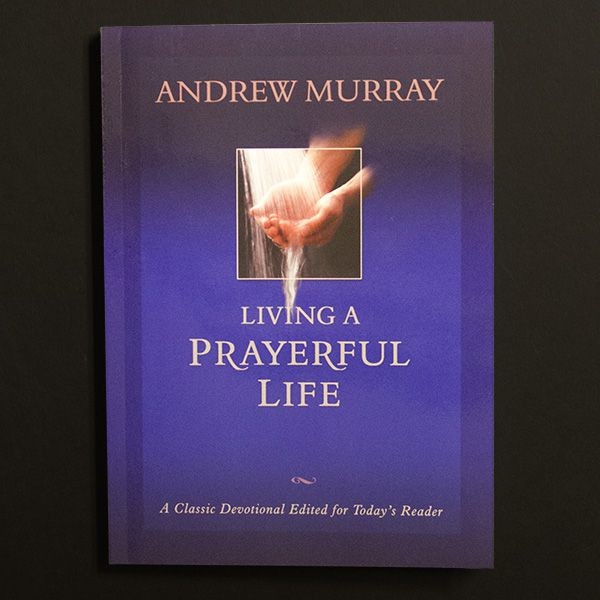
Living A Prayerful LifeAs I mentioned in my book review of Andrew Murray’s A Prayerful Life, this book was written as a response to pastors who were concerned about the lack of effectiveness in their ministry. Pastor Murray called out the sin of prayerlessness as the main factor in their struggles. Here are some quotes from this book specifically to pastors.

“The enemy uses all his power to lead the Christian—and above all, the minister—to neglect prayer. satan knows that however admirable the sermon may be, however attractive the service, however faithful the pastoral visitation, none of these things can damage him or his kingdom if prayer is neglected.”

“The pastor’s highest calling is not preaching, or speaking, or church visitation, but it is to cultivate the life of God in himself daily, and to be a witness of what the Lord teaches him and accomplishes in him.”

“Here on earth I may expend my time in exchange for money or learning. The minister exchanges his time for divine power and the spiritual blessings to be obtained from heaven. That, and nothing else, makes him a man of God and ensures that his preaching will be in the demonstration of the Spirit and power.”

“Many pray for the Spirit that they may make use of Him and His power for their work. This is an entirely wrong concept. It is He Who must use you. Your relationship toward Him must be one of deep dependence and utter submission. The Spirit must have you completely and always and in all things under His power.”

“When the Lord promised the apostles that they would receive power when the Holy Spirit came upon them, and commanded them to wait for Him, it was as though He said: ‘Do not dare to preach without this power. It is the indispensable preparation for your work. Everything depends on it.’”

“Little time in the Word together with little prayer is death to the spiritual life. Much of the Word but little prayer yields a less than healthy spiritual life. Time spent in prayer with little time in the Word yields life, but without steadfastness. A full measure of the Word and much prayer each day produces a healthy and powerful life.”

“The preacher must come to see that his preaching is comparatively powerless to bring new life until he begins to take time for prayer.”

“All you who long for blessing in your ministry, He calls you to abide in Him. Let it be the greatest delight of your life to spend time with God; it will be the surest preparation for fruitful service.”

“As a minister of the gospel, have you ever considered why you have a salary and a place to live, and so are freed from the need of holding a regular job? The reason is so that you can continue in prayer and the ministry of the Word. These will give you the necessary wisdom and anointing for your work. And that is the secret of a fruitful ministry. No wonder there are often complaints about the ineffective spiritual life of a minister and his congregation. That which is of prime importance—perseverance in prayer—does not occupy its rightful place.”

“The great question is: Shall we earnestly set ourselves to win back again the weapon of believing prayer that satan has, at least in a measure, taken away from us? Let us set before ourselves the serious importance of this conflict. As far as each minister is concerned, everything depends on whether or not he is a man of prayer—one who in the inner room is clothed each day with power from on high.”

To read some of the other quotes I shared from this book, please click here. And to read my full book review of Living A Prayerful Life, click here.
Matthew Henry On Prayer

Matthew HenrySome great quotes from Matthew Henry on prayer…

“It is good for us to keep some account of our prayers, that we may not unsay them in our practice.” —Matthew Henry

“God’s promises are to be our pleas in prayer.” —Matthew Henry

“Prayer time must be kept up as duly as meal time.” —Matthew Henry

“A truly religious life is a life of constant joy. And we should rejoice more, if we prayed more. Prayer will help forward all lawful business, and every good work. If we pray without ceasing, we shall not want matter for thanksgiving in every thing. We shall see cause to give thanks for sparing and preventing, for common and uncommon, past and present, temporal and spiritual mercies. Not only for prosperous and pleasing, but also for afflicting providences, for chastisements and corrections; for God designs all for our good, though we at present see not how they tend to it.” —Matthew Henry

“Prayer is a salve for every sore, a remedy for every malady; and when we are afflicted with thorns in the flesh, we should give ourselves to prayer. If an answer be not given to the first prayer, nor to the second, we are to continue praying. Troubles are sent to teach us to pray; and are continued, to teach us to continue instant in prayer.” —Matthew Henry

“The best we can say to God in prayer, is what He has said to us.” —Matthew Henry

“Here is a precept in three words to the same purport, Ask, Seek, Knock (Matthew 7:7); that is, in one word, ‘Pray; pray often; pray with sincerity and seriousness; pray, and pray again; make conscience of prayer, and be constant in it; make a business of prayer, and be earnest in it.’” —Matthew Henry

From This Day Forward (book review)

From This Day ForwardIt’s a simple maxim I live by: “Good, better, best, never let it rest until your good is better and your better is best.” This is the same theme I found in From This Day Forward by Craig and Amy Groeschel regarding marriages. Whether you are single and want to be married someday, or your marriage is struggling, or your marriage is doing great, the Groeschels want to help you make the bad good, the good better, and the better best.

Statistics say that 50 percent of first marriages will fail (and the stats are even uglier for second and third marriages). Research also tells us that many couples who do stay married don’t find much happiness in that marriages. Craig & Amy find those stats unacceptable and have given us five commitments to fail-proof our marriages:

  1. Seek God
  2. Fight fair
  3. Have fun
  4. Stay pure
  5. Never give up

The chapters are mainly written by Craig, in his style that is so readable. He uses personal examples from their marriage, and then presents evidence from Scripture and  easy-to-remember principles for how to improve our marriages. At the end of each chapter is “Amy’s Angle” where she rounds-out the picture with her feminine touch. As with all of Craig Groeschel’s books, this one is so easy to read and so easy to apply. The single person, those in a strained marriage and those in a wonderful marriage will all find something of value in From This Day Forward.

I am a Zondervan book reviewer.

Poetry Saturday—Difficulty

John BunyanThe hill, though high, I covet to ascend;
The difficulty will not me offend;
For I perceive the way to life lies here:
Come, pluck up, heart, let’s neither faint nor fear.
Better, though difficult, the right way to go,
Than wrong, though easy, where the end is woe. —John Bunyan’s Christian in Pilgrim’s Progress, as he is climbing the Hill Difficulty


Links & Quotes

link quote

Some good reading from today…

“Spread love everywhere you go; first of all in your house. Give love to your children, to your wife or husband, to a next door neighbor. Let no one ever come to you without leaving better and happier.” —Mother Teresa

“Many people don’t achieve their dream because it’s out of reach, but because they quit.” —John Maxwell

“Good things as well as bad, you know, are caught by a kind of infection. If you want to get warm you must stand near the fire: if you want to be wet you must get into the water. If you want joy, power, peace, eternal life, you must get close to, or even into, the thing that has them. They are not a sort of prize which God could, if He chose, just hand out to anyone. They are a great fountain of energy and beauty spurting up at the very centre of reality. If you are close to it, the spray will wet you: if you are not, you will remain dry.” —C.S. Lewis

Want some free music from U2? They released a new album free on iTunes.

More reasons to be skeptical of so-called “global warming” alarmists.

C.S. Lewis On Temptation

C.S. LewisAre you battling temptation? Do you feel like you keep giving in to it? This is part of a letter C.S. Lewis wrote to one who confessed to his ongoing battle—and seeming ongoing defeat—with temptation to sin.

“Perhaps, however, the most important thing is to keep on: not to be discouraged however often one yields to the temptation, but always to pick yourself up again and ask forgiveness. In reviewing your sins don’t either exaggerate them or minimize them. Call them by their ordinary names and try to see them as you would see the same faults in somebody else—no special blackening or whitewashing. Remember the condition on which we are promised forgiveness: we shall always be forgiven provided that we forgive all who sin against us. If we do that we have nothing to fear: if we don’t, all else will be in vain. Of course there are other helps which are more commonsense. We must learn by experience to avoid either trains of thought or social situations which for us (not necessarily for everyone) lead to temptations. Like motoring—don’t wait till the last moment before you put on the brakes but put them on, gently and quietly, while the danger is still a good way off. ” —C.S. Lewis

12 Quotes From “12 Huge Mistakes Parents Can Avoid”

12 Huge MistakesI highlighted a lot in Tim Elmore’s newest book 12 Huge Mistakes Parents Can Avoid … a lot! This is book that every parent (or grandparent) should read because it’s never too late to invest the best in our (grand)children. You can read my full book review of this must-read book by clicking here. Below are just a few of the quotes I highlighted in this book.

“I believe we have under-challenged kids with meaningful work to accomplish. We have overwhelmed them with tests, recitals, and practices, and kids report being stressed-out by these activities. But they are essentially virtual activities. Adults often don’t give significant work to students—work that is relevant to life and could actually improve the world if the kids rose to the challenge. We just don’t have many expectations of our kids today.” 

“Every parent and teacher wants to see their kids succeed in school, in sports, and in life, but making it impossible to fail isn’t the answer. Removing failure, in fact, is a terrific way to stunt maturity. … As parents, we’ve given them lots of possessions but not much perspective. As educators, we’ve given them plenty of schools but not plenty of skills. As coaches, we’ve taught them how to win games but not how to win in life. As youth workers, we provide lots of explanations but not enough experiences. As employers, we’ve mentored them in profit and loss but haven’t shown them how to profit from loss.”

“Truth be told, when kids have heard they are excellent without working hard or truly adding value to a team, the praise rings hollow to them. Our affirmation must match their performance.”  

“When people—especially young people—know they are free to try something and fail, their performance usually improves. It brings out the best in them. But if they are preoccupied with trying not to fail, they become paralyzed:

  • Failure can create resilience.
  • Failure can force us to evaluate.
  • Failure can motivate us to better performance.
  • Failure prompts creativity and discovery.
  • Failure can develop maturity.”

“Our constant caving begins to foster a constant craving in them. They want clarity. With boundaries unclear, they need more direct attention from Mom or Dad. Unwittingly, we actually breed insecurity and instability in our kids. This may sound strange, but consistency may be your best friend as a parent because it aids in your authority and in your child’s development.” 

“Removing the consequences takes one of two roads. We either excuse their behavior and remove negative outcomes, or we actually step in and pay the consequence for them. When we do this, we frequently relieve the stress. We bring immediate peace to the situation, so we get addicted to this pattern. Unfortunately, we don’t see the long-term problems we are causing. Removing the consequences from our children’s lives brings short-term tranquility but long-term trouble.”

“‘You can do anything you want.’ I recognize why we say this, but as our kids grow older, we must help them to see what we really meant. … We really meant, if they set their mind to do something, they’ll be amazed at what they can pull off. The catch is, it needs to be something with in their gift area. They cannot simply make up a dream or copy a friend’s dream and call it theirs. Dreams should be attached to strengths.” 

“We have created a world of conveniences, filled with smart phones, microwaves, Internet shopping, and online banking. The subtle message is that struggles are to be avoided. We want as much convenience as possible. In fact, we feel entitled to it. But we failed to see that when we remove the struggles from our children’s lives, we begin to render them helpless. They don’t have the opportunity to develop the life skills they’ll need later on. Further, when we step in to control their levels of struggle, they don’t learn how to be in control or under control themselves. In fact, all they learn is how to be controlled.”

“Ironically, the things young people want to avoid are necessary for them to mature authentically. Slow, hard, boring, risky, laborious… these are the very challenges that prepare me to become a good man, a good husband, a good father, a good employee, a good employer. Many life skills that once naturally developed in us now atrophy in today’s culture. So we must be far more intentional about leading our kids into opportunities to build these skills.” 

“When we affirm looks or clothing—external matters instead of internal virtues—kids values become skewed. Remember, what gets rewarded gets repeated. Without realizing it, we are reinforcing cosmetic features—usually features that are not in their control. … We should be doing just the opposite. We must affirm effort and behavior, which are in their control, instead of characteristics that are out of their control. If we do this, we begin to foster a growth mindset instead of a fixed mindset.”

“We mistake hurtful with harmful. Many times, hurting helps us. In fact, removing the hurt may be harmful. … When we hurt, we can learn important truths about ourselves and about others, truth that will be beneficial later in our lives. … We confuse disturbance with damage. We hate being disturbed. Our days are so full, we often hope and pray we won’t face any unexpected disturbances as we pursue our goals. The fact is, however, that on our way to those goals, we fall into unhealthy ruts. Interruptions force us out of those ruts. Interruptions are not damaging at all. They are the very items that save us from our tunnel vision. We need to be disturbed from time to time. Interruptions are wake-up calls that rouse us from our apathy or complacency.” 

“I know you think kids are tired of you talking about the good old days. But I’ve found most kids love hearing stories of how we adults struggled to learn the same life skills when we were young. It’s all part of growing up.”

5 Noteworthy Quotes In “Stand Strong”

Stand StrongNick Vujicic does an excellent job in his book Stand Strong in helping students, parents, and teachers learn how to overcome bullies. You can read my full review of Stand Strong by clicking here.

I have already shared some of Nick’s quotes from this book, and some quotes specifically relating to the emotional toll bullying can have on those being picked on. Nick also makes the point that there are some invaluable lessons to be learned by overcoming adversity in our lives. Here are some of the quotes that Nick shared in his excellent book.

“You don’t develop courage by being happy in your relationships every day. You develop it by surviving difficult times and challenging adversity.” —Epicurus

“All the adversity I’ve had in my life, all my troubles and obstacles, have strengthened me. … You may not realize it when it happens, but a kick in the teeth may be the best thing in the world for you.” —Walt Disney

“Comfort and prosperity have never enriched the world as much as adversity has.” —Billy Graham

“Most of the verses written about praise in God’s Word were voiced by people who were faced with crushing heartaches, injustice, treachery, slander, and scores of other difficult situations.” —Joni Eareckson Tada

“Friendships provide a context in which children develop, but of course so do negative peer relations. … We should expect that both types of relationships, as different as they are, present opportunities for growth.” — psychologist Maurissa Abecassis

Links & Quotes

link quote

Some good reading from this weekend…

“What most Americans—and the world—hear about the ongoing conflict between Israel and Hamas goes something like this: ‘125 Palestinians, most of them civilians, have been killed by Israel’s relentless assault on Gaza. No Israelis have yet been killed.’ This may be true, but there is absolutely no context to it. One must look at the methodologies of the two sides.” Read more in this post: The Moral Difference Between Israel And Hamas.

If Planned Parenthood did so much work to prevent women from needing abortions, then why are they the nationwide leaders in performing abortions?! Read how Planned Parenthood responded to their certificate of death award. 

“Christianity at any given time is strong or weak depending upon her concept of God. … Our religion is little because our god is little. Our religion is weak because our god is weak. Our religion is ignoble because the god we serve is ignoble. We do not see God as He is…. A local church will only be as great as its conception of God. An individual Christian will be a success or a failure depending upon what he or she thinks of God.” —A.W. Tozer

“You gain strength, courage and confidence by every experience in which you really stop to look fear in the face. You are able to say to yourself, ‘I have lived through this horror. I can take the next thing that comes along.’ You must do the thing you think you cannot do.” —Eleanor Roosevelt

“Give us a pure heart, that we may see Thee, a humble heart, that we may hear Thee, a heart of love, that we may serve Thee, a heart of faith, that we may live Thee, Thou, Whom I do not know, but Whose I am.” —Dag Hammarskjöld

“Whether we call ourselves classical evangelicals, traditionalists, fundamentalists, Pentecostals, or charismatics, we all have to face our lack of real power and call out for a fresh infilling of the Holy Spirit. We need the fresh wind of God to awaken us from our lethargy. We must not hide any longer behind some theological argument. The days are too dark and dangerous.” —Jim Cymbala

Rewards For Faithfulness

NunI unabashedly tell anyone who asks me what my favorite book is … It’s the Bible. I have yet to find such a collection of writings that work every single time they’re applied.

Two summers ago we began a series of messages on the 119th Psalm. It appears that the psalmist shares my passion for God’s Word, as he writes time and time again the difference Scripture makes in his life.

The other thing that makes this psalm so cool to me is the organization of the 176 verses into twenty-two 8-verse segments, with each verse in a segment beginning with the the same Hebrew letter as its title. In the Hebrew language, the letters in the alphabet had their own meaning. In English an “n” is simply spelled “n.” It has no other definition or meaning. But in Hebrew the letter nun has both a spelling and a meaning. Nun is spelled nun-vav-nun (final), and it means both faithfulness and the reward for faithfulness.

Look at the three Hebrew characters that spell nun. Reading right to left it tells a story and gives the meaning of the letter/word—the one who is humbled in faithfulness will be the one who stands in righteousness. The perfect example of this is Jesus, Who humbled Himself when He came to earth and to the Cross, and then was exalted by the Heavenly Father to wear the crown of righteousness (see Philippians 2:5-11 and Revelation 14:14). Paul starts this passage by calling on us to “have the same attitude as that of Jesus” (v. 5), and concludes with the call to stick with it all the way to the end (see vv. 12-13).

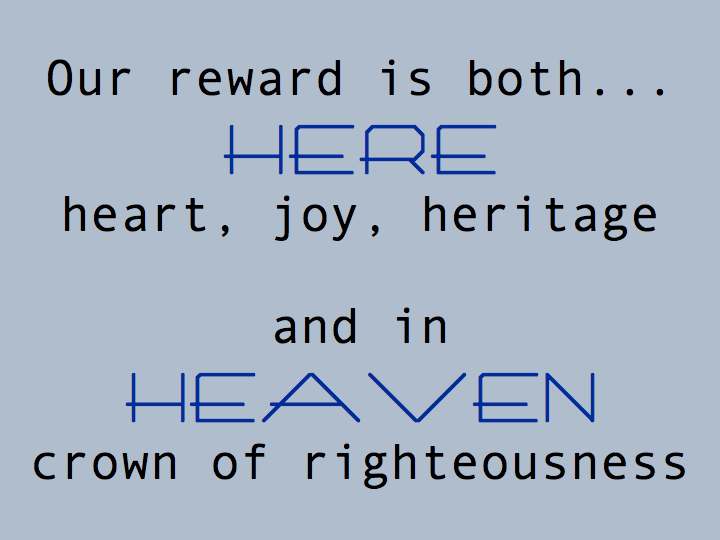
RewardsThe psalmist calls us to this same thing in nun (Psalm 119:105-112). The “bookend” verses say, “Your Word is a lamp for me… so my heart is set on keeping Your Word” (vv. 105 and 112). In between the psalmist commits himself to a life of humbly persevering to God’s ways, and reaps the rewards of a changed heart, the joy of the Lord, and a heritage to pass on to others.

I have fought the good fight, I have finished the race, I have kept the faith. Now there is in store for me the crown of righteousness, which the Lord, the righteous Judge, will award me on that day—and not only to me, but also TO ALL who have longed for His appearing (2 Timothy 4:7-8).

Humble yourself before the Lord, and He will lift you up (James 4:10).

My heart is set on keeping Your decrees to the very end (Psalm 119:112).

Rewards here (new heart, joy, heritage) AND rewards in Heaven (a crown of righteousness). How awesome is that!!

If you have missed any of the messages in our P119 series, you can access them all by clicking here.