Links & Quotes

Guys, you don’t have to “live down” to the poor male role models that Hollywood portrays, but you can create a beautiful culture in your marriage, your home, and your workplace. Check out the full sermon this clip came from.

I have lots of new content every week, which you can check out on my YouTube channel.

“Challenge yourself; it’s the only path which leads to growth.” —Morgan Freeman

Michael R. Emlet writes, “There are no easy answers here. In thinking about the juxtaposition of mental-health issues and church discipline, we want to be wary of two extremes. First, we don’t want to avoid corrective pastoral care out of fear that we will ‘add insult to injury’ for those struggling with mental affliction. Second, we don’t want to care for someone with mental illness exactly as we would care for someone without such a struggle. We want biblical truth and love to guide us.” This is a thoughtful post about how pastors should think about mental illness in church disciple. I shared a year-long series of messages on a Christian’s mental health, which you can find here.

Why does Paul call satan “the prince of the power of the air” (Ephesians 2:2)? Pastor John Piper gives us some excellent thoughts on Bible study in general and this verse in particular. 

Moderate Stress Is Healthy

Listen to the podcast of this post by clicking on the player below, and you can also subscribe on AppleSpotify, or Audible. 

We do ourselves and the world around us a huge disservice if we are constantly striving for a stress-free life. 

First, I don’t think that is even possible! Adam and Eve in the perfection of the Garden of Eden faced a stressful decision. And Jesus, the Perfect Man, was constantly dealing with the stressors that pushed in on Him. 

But more importantly, stress is vital for healthy growth. In this case, I am talking about the healthy stress that doctors call eustress. This is the push against the forces that would ultimately pull down our physical health, our relationships, our mental health, and a host of other things if we simply opt to “go with the flow.” 

I read this in a recent article from Fight The New Drug

“In a world that often sells ways to avoid stress, it’s crucial to remember that stress can be healthy in moderation. Stress and anxiety can trigger neural and chemical processes in your body designed to help you respond to challenges. Stress researcher Daniela Kaufer explains that ‘some amounts of stress are good to push you to the level of optimal alertness for behavioral and cognitive performance.’ Her research on stress in rats has even demonstrated that intermittent stressful events can create new brain cells in the rats that actually improve their future mental performances.”  

The Bible makes it clear that persevering through the stressors that come against us can make us stronger, healthier, and better equipped for the next challenge. We are also fortified to help others through their times of stress (James 1:2-4; Romans 5:3-5; 2 Corinthians 1:3-5). 

As I’ve often said, easy, stress-free roads teach very few valuable lessons! 

The poet Epictetus noted this about the mighty Hercules—

“What would have become of Hercules do you think if there had been no lion, hydra, stag or boar—and no savage criminals to rid the world of? What would he have done in the absence of such challenges?
“Obviously he would have just rolled over in bed and gone back to sleep. So by snoring his life away in luxury and comfort he never would have developed into the mighty Hercules.
“And even if he had, what good would it have done him? What would have been the use of those arms, that physique, and that noble soul, without crises or conditions to stir into him action?” —Epictetus, The Discourses 

So the next time you are thinking about avoiding something that causes stress in your life, why don’t you reframe that thought. Instead, think about how you can become stronger, healthier, and more empathetic toward others because you are committed to successfully navigating that stressful situation. 

Don’t ask God to get you out of this situation, but ask Him to help you get something out of this situation. 

►► Would you please prayerfully consider supporting this ministry? My Patreon supporters get behind-the-scenes access to exclusive materials. ◀︎◀︎

Links & Quotes

God’s blessings are not primarily for me, but they are through me for His glory. This is a short clip from an exclusive video I shared with my Patreon supporters. Become a supporter todayI have lots of new content every week, which you can check out on my YouTube channel.

“What to do with a mistake: recognize it, admit it, learn from it, forget it.” —Dean Smith

Until the mid-1800s, the historicity of King Sargon II (mentioned by Isaiah) was in doubt. Not only has archeology again affirmed the historical statements made in Scripture, but “the way Isaiah spelled Sargon’s name is an indicator that the prophet lived at the time of Sargon II, and that the book was not penned hundreds of years later.” Check out this archeological biography of Sargon II.

And then there is this archeological report about the destruction of Sodom and Gomorrah. Fascinating!

How sweet and gracious even in common speech,
Is that fine sense which men call Courtesy!
Wholesome as air and genial as the light,
Welcome in every clime as breath of flowers—
It transmutes aliens into trusting friends,
And gives its owner passport round the globe. —James T. Fields

“A person always doing his or her best becomes a natural leader, just by example.” —Joe DiMaggio

Not using the spiritual gift God has given you is selfish. He gave you these gifts on purpose so that His kingdom could be made more visible and desirable.

The Craig And Greg Show: The Power Of A Coach

Listen to the audio-only version of this podcast by clicking on the player below, or scroll down to watch the video.

Do you need to have a coach? If you answered “yes” then you’re already on the right track! If you said “no,” Greg and I would like to challenge you a little. Join us as they discuss how coaching isn’t just about correcting mistakes, it’s also about maximizing your existing skills to the highest level possible. 

  • [0:52] Does everyone need a coach?
  • [2:10] Having a coach doesn’t mean there’s something wrong with you.
  • [3:48] There’s great fulfillment in helping someone reach greater success.
  • [5:13] Proactive coaching versus reactive coaching.
  • [7:19] A good coach won’t micro-manage, they will train you, and then “put you in” to play the game on your own.
  • [8:24] Coaches can deliver a 10,000-foot view to highlight your greatest areas of strength.
  • [10:14]] An outside coach approaches your situation with a fresh perspective.
  • [11:12] Greg discusses Michael Jordan’s best skill.
  • [12:38] Coaching isn’t about highlighting your negatives, it’s about maximizing your strengths.
  • [13:13] If a particular area makes you defensive you really need to be examining it further.
  • [13:55] Maximize can help coach you! Please reach out to us at Maximize Leadership.
  • [14:55] Greg discusses a psychology experiment.
  • [15:42] Not being coachable is a huge impediment for leaders.
  • [18:30] Good competition pushes everyone around you to be better.
  • [19:21] Greg shares advice from Rich Devos.
  • [21:45] Good coaching is proactive and reactive.
  • [23:13] A quote from Tom Landry on the job of a coach.
  • [24:17] Greg discusses the investments that were made in his life in his book Sage Advice.
  • [26:24] We don’t have all the answers, but we can help steer you in the right direction.

Check out this episode and subscribe on YouTube so you can watch all of the upcoming episodes. You can also listen to our podcast on Spotify and Apple.

Links & Quotes

Unforgiveness keeps our eyes on our offenders and off our God. Free yourself by forgiving those who have hurt you. You can check out this full sermon hereI have lots of new content every week, which you can check out on my YouTube channel.

“At the moment of truth, there are either reasons or results.” —Chuck Yeager

As I have shared before, I am so impressed with the He Gets Us social media campaign! Some people are still trying to figure out exactly what this campaign is. Sean McDowell and his podcast partner Scott Ray had a great conversation with Ed Stetzer about this. Check out the video!

Some people have been critical of the He Gets Us commercials that aired during the Super Bowl, but I thought they were outstanding! This is a social media outreach designed and funded by some of the most biblically-grounded, evangelistically-minded people I know. It is a social media campaign. It is not designed as a sermon (which is why there are no Bible verses shown in the commercial). The idea is to get past the barriers and misconceptions skeptics have come to believe about Jesus, and then be enticed to go to the hegetsus.com website. It is at this site that the Gospel message is introduced and visitors are given Bible verses and other materials to go deeper.

John Stonestreet wrote, “Before it was the corporate creation of greeting card companies, it was a day to remember third-century Christian martyr Valentinus of Rome.” This post is a good reminder of what Christians really should be remembering on Valentine’s Day, as well as the higher definition of love.

“The important thing is to learn a lesson every time you lose.” —John McEnroe

Links & Quotes

Peter described the ministry of Jesus as “doing good and healing all who were under the power of the devil.” Historical records tell us the first Christians lived this exact same way! This clip is from our current series of sermons on prayerI have lots of new content every week, which you can check out on my YouTube channel.

John Piper has some great advice for finding the main point of a chapter in the Book of Psalms.

Belshazzar was unknown outside the Bible for quite awhile, prompting one biblical skeptic to say, “the whole story [in the Book of Daniel] is disfigured and falsified by the author, who was neither an eye-witness of the occurrences, nor accurately acquainted with the history of them.” Once again, archeology has confirmed the historicity of both Belshazzar and Daniel.

On YouVersion I shared this on Job 1:20-22. The Old English spelling of worship is “worthship.” We worship God because He has infinitely greater worth than any other person or thing. It’s not that Job wasn’t sad about his losses, but He saw Jehovah as the One of greatest worth in spite of his earthly losses.

“Leaders are responsible for building organizations where people continually expand their capabilities to understand complexity, clarify vision, and improve shared mental models—that is, they are responsible for learning.” —Peter M. Senge, in The Fifth Discipline

Never stopping praying for your loved ones. It could be that with their very last breath they will call on Jesus as their Savior!

How God Uses Pain

Listen to the podcast of this post by clicking on the player below, and you can also subscribe on AppleSpotify, or Audible. 

Romans 8:28 assures us that God uses everything for His glory. Even our pain. Here is when I learned this painful but precious truth.

On the Leading From Alignment podcast, John Opalewski asked me about lessons I have learned from painful experiences.

►► Would you please prayerfully consider supporting this ministry? My Patreon supporters get behind-the-scenes access to exclusive materials. Like this recent post where I shared a map and an app to help with your Bible study time. ◀︎◀︎

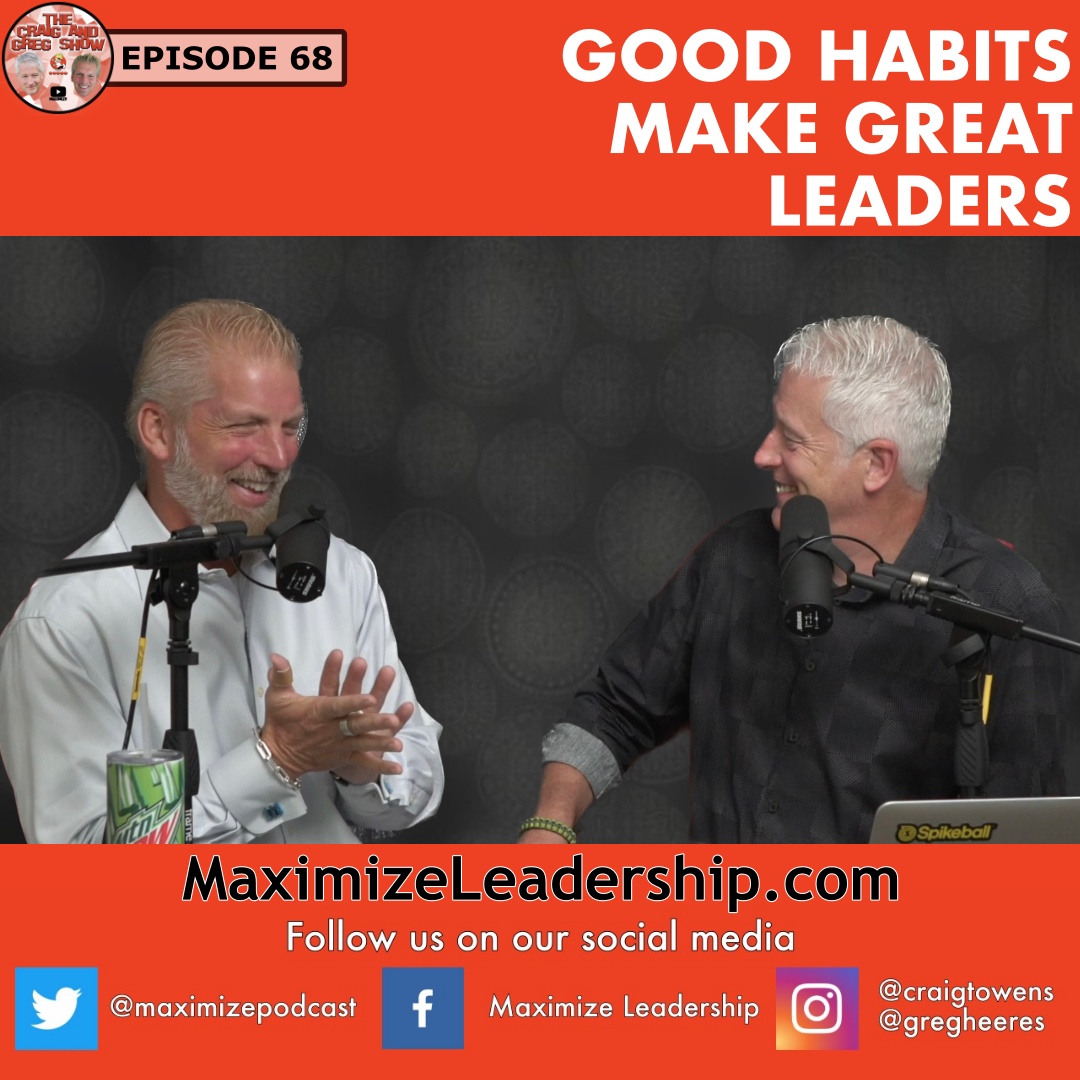
The Craig And Greg Show: Good Habits Make Great Leaders

Listen to the audio-only version of this podcast by clicking on the player below, or scroll down to watch the video.

Automatic habits are an integral part of our everyday lives. From driving a car to the way we tie our shoes, these habits help us all the time with very little thought. Of course, habits aren’t limited to these mundane tasks, we also form them in other areas, like our leadership. As a leader, it’s important to be self-reflective of our habits and make sure they are taking us in the direction we want to go. In this episode, Greg and I discuss how cultivating the right habits will help you flourish as a leader.

  • [0:19] Aristotle said excellence is a matter of our habits. 
  • [1:27] Our habits are mostly automatic—both the good and the bad habits.
  • [3:10] How do we keep our habits healthy during chaotic times?
  • [5:54] What about coping habits—should a leader use them or avoid them?
  • [7:15] My most beneficial leadership habit.
  • [9:13] Time-wasters are habits too.
  • [10:37] When we make changes in our habits, they should be incremental changes.
  • [12:17] We need to know why we want to make the change in a habit. The “why” determines the “what” and the “how.”
  • [15:24] How do leaders sustain their healthy habits?
  • [16:33] How can leaders regain their list momentum of good habits?
  • [19:27] Leaders need to be aware of the pull of their unintentional habits.
  • [22:23] How do we get our habits to serve us?
  • [23:30] I share two vital habits all high-performing leaders need.
  • [24:56] Leaders need to develop “muscle memory” to keep their healthy habits serving them.
  • [26:27] Greg shares some important quotes about a leader’s habits.

Check out this episode and subscribe on YouTube so you can watch all of the upcoming episodes. You can also listen to our podcast on Spotify and Apple.

The Craig And Greg Show: Are You A Micromanager?

Listen to the audio-only version of this podcast by clicking on the player below, or scroll down to watch the video.

If you said, “No,” are you sure? Sometimes micromanagement can come out of good intentions, or as we focus on a project, we as leaders can slide into it without even realizing it. In this episode, Greg and I discuss why micromanagement is bad for your leadership, how to identify if you’ve fallen into this trap, and, most importantly how to free yourself to soar into a place of macro-leadership.

  • [0:17] Greg and I break into song. 
  • [0:38] Micromanagers stunt the growth of others in the organization.
  • [1:45] There is a difference between intense focus and micromanagement. How do we find those differences?
  • [3:44] A definitive quote about the destructive nature of micromanaging.
  • [6:05] Micromanagers create an unhealthy environment.
  • [6:47] The Craig And Greg Show audience is exceptionally intelligent!
  • [8:36] How do we know if we are unconsciously crossing the line into micromanagement?
  • [9:50] Micromanagement needs to give way to macro-leadership.
  • [11:16] Two more telltale phrases that micromanagers use.
  • [12:30] Greg helped a struggling leader break free from his micromanagement trap.
  • [14:07] The value of an “outsider’s” perspective can be huge!
  • [15:03] Greg shares some natural consequences for the entire organization of micromanagement.
  • [17:31] Characteristics of macro-leaders
  • [19:34] Greg shares two very sad stories of micromanagers who created problems in their company.
  • [21:50] Some final quotes to bring it home.

Check out this episode and subscribe on YouTube so you can watch all of the upcoming episodes. You can also listen to our podcast on Spotify and Apple.

Micro-Adjustments

Listen to the podcast of this post by clicking on the player below, and you can also subscribe on AppleSpotify, or Audible. 

I had a great time on the Leading From Alignment podcast with Jim Wiegand and John Opalewski. 

One of the loudest, most persistent advertising messages is about speed: Take action now, get immediate results as soon as you sign up, don’t miss out, act today! Because of this sentiment that appears all around us, many people often think that any life changes they make should bring about immediate and lasting results. 

I’ve often joked that I wish I had the superpower to zap myself or a friend—“<Poof!> There, you’ve got it now. You’re all set!” Unfortunately, that’s usually not how it works. 

Instead, we need to be ready for a lengthy process—possibly even a lifelong process—of the Holy Spirit helping us to make the micro-adjustments that are necessary. 

Check out this part of my conversation with Jim and John as we discussed this idea. 

 I like this line from Henry Wadsworth Longfellow:

The heights of great men reached and kept,
Were not attained by sudden flight,
But they, while their companions slept,
Were toiling upwards in the night.

The Holy Spirit knows exactly where we need to change and how much we need to change. Let’s trust Him in this process. Then take some time to look back and celebrate how far the Holy Spirit has matured us so that we can be re-energized to stay in this lifelong process.  

If you would like to watch this full interview on the Leading From Alignment podcast, please go here.

I’ll be sharing more clips from this interview soon, so please stay tuned. My book Shepherd Leadership: The Metrics That Really Matter is available in print or ebook, and in audiobook through either Audible or Apple. 

►► Would you please prayerfully consider supporting this ministry? My Patreon supporters get behind-the-scenes access to exclusive materials. ◀︎◀︎