Listen to the audio-only version of this podcast by clicking on the player below, or scroll down to watch the video.
Automatic habits are an integral part of our everyday lives. From driving a car to the way we tie our shoes, these habits help us all the time with very little thought. Of course, habits aren’t limited to these mundane tasks, we also form them in other areas, like our leadership. As a leader, it’s important to be self-reflective of our habits and make sure they are taking us in the direction we want to go. In this episode, Greg and I discuss how cultivating the right habits will help you flourish as a leader.
[0:19] Aristotle said excellence is a matter of our habits.
[1:27] Our habits are mostly automatic—both the good and the bad habits.
[3:10] How do we keep our habits healthy during chaotic times?
[5:54] What about coping habits—should a leader use them or avoid them?
[7:15] My most beneficial leadership habit.
[9:13] Time-wasters are habits too.
[10:37] When we make changes in our habits, they should be incremental changes.
[12:17] We need to know why we want to make the change in a habit. The “why” determines the “what” and the “how.”
[15:24] How do leaders sustain their healthy habits?
[16:33] How can leaders regain their list momentum of good habits?
[19:27] Leaders need to be aware of the pull of their unintentional habits.
[22:23] How do we get our habits to serve us?
[23:30] I share two vital habits all high-performing leaders need.
[24:56] Leaders need to develop “muscle memory” to keep their healthy habits serving them.
[26:27] Greg shares some important quotes about a leader’s habits.
Check out this episode and subscribe on YouTube so you can watch all of the upcoming episodes. You can also listen to our podcast on Spotify and Apple.
Listen to the audio-only version of this podcast by clicking on the player below, or scroll down to watch the video.
If you said, “No,” are you sure? Sometimes micromanagement can come out of good intentions, or as we focus on a project, we as leaders can slide into it without even realizing it. In this episode, Greg and I discuss why micromanagement is bad for your leadership, how to identify if you’ve fallen into this trap, and, most importantly how to free yourself to soar into a place of macro-leadership.
[0:17] Greg and I break into song.
[0:38] Micromanagers stunt the growth of others in the organization.
[1:45] There is a difference between intense focus and micromanagement. How do we find those differences?
[3:44] A definitive quote about the destructive nature of micromanaging.
[6:05] Micromanagers create an unhealthy environment.
[6:47] The Craig And Greg Show audience is exceptionally intelligent!
[8:36] How do we know if we are unconsciously crossing the line into micromanagement?
[9:50] Micromanagement needs to give way to macro-leadership.
[11:16] Two more telltale phrases that micromanagers use.
[12:30] Greg helped a struggling leader break free from his micromanagement trap.
[14:07] The value of an “outsider’s” perspective can be huge!
[15:03] Greg shares some natural consequences for the entire organization of micromanagement.
[17:31] Characteristics of macro-leaders
[19:34] Greg shares two very sad stories of micromanagers who created problems in their company.
[21:50] Some final quotes to bring it home.
Check out this episode and subscribe on YouTube so you can watch all of the upcoming episodes. You can also listen to our podcast on Spotify and Apple.
One of the loudest, most persistent advertising messages is about speed: Take action now, get immediate results as soon as you sign up, don’t miss out, act today! Because of this sentiment that appears all around us, many people often think that any life changes they make should bring about immediate and lasting results.
I’ve often joked that I wish I had the superpower to zap myself or a friend—“<Poof!> There, you’ve got it now. You’re all set!” Unfortunately, that’s usually not how it works.
Instead, we need to be ready for a lengthy process—possibly even a lifelong process—of the Holy Spirit helping us to make the micro-adjustments that are necessary.
Check out this part of my conversation with Jim and John as we discussed this idea.
If you would like to watch this full interview on the Leading From Alignment podcast, please go here.
I’ll be sharing more clips from this interview soon, so please stay tuned. My book Shepherd Leadership: The Metrics That Really Matter is available in print or ebook, and in audiobook through either Audible or Apple.
Listen to the audio-only version of this podcast by clicking on the player below, or scroll down to watch the video.
Periodically, Greg and I like to revisit the topic of leadership builders and killers. In this episode, you get two leadership killers, as we tackle the two-headed monster of ignorance and arrogance.
[0:25] The two-headed monster that kills leadership potential.
[2:06] We are accepting bribes for our silence 😂
[2:23] Why are leaders held back by their ignorance?
[4:34] What happens when the followers sense that the leader above them is ignorant?
[6:22] What about when the leader admits a need for help?
[7:47] The toxicity of arrogance.
[9:32] Coachability is fed by humility. This is the leader’s litmus test.
[12:01] Our transparent leadership lessons are immensely helpful to our teammates.
[15:24] Greg shares a quote about this two-headed monster.
[17:35] We each share our personal examples of overcoming this monster.
[19:50] Sadly, many people who need the most help won’t seek it for themselves.
[21:07] If leaders are going to kill this two-headed monster, they have to stop talking and start listening.
[22:00] Know-it-alls are hard to cheer for, so successful leaders will have to eat some crow.
Check out this episode and subscribe on YouTube so you can watch all of the upcoming episodes. You can also listen to our podcast on Spotify and Apple.
Some of our best lessons are learned in difficult places, so let’s not be too quick to rush in and soften the blow for someone who has taken a tumble.Check out the full conversation I had with my podcast partner Greg. And be sure to check out all of my videos on my YouTube channel.
“A champion is one who gets up when he can’t.” —Jack Dempsey
Once again, archeological finds in Israel confirm the historicity of the biblical accounts of the kings of Judah and Israel. John Stonestreet shares some of the most recent finds. Jewish archeologist Nelson Gluek states, “It may be stated categorically that no archaeological discovery has ever controverted a biblical reference.”
“The reward for work well done is the opportunity to do more.” —Jonas Salk
Scott Hubbard writes, “Stepping into leadership means stepping into mistakes, regrets, and many small but stinging failures. And surviving in leadership, I am learning, means stepping upward on those mistakes—owning them, learning from them, and having the stability in Christ to keep leading after them.” Read more about how leaders can fail well.
J. Warner Wallace addresses the claim that all religions are true or are essentially the same.
“The Scriptures represent the Holy Spirit, not only as moving, and occasionally influencing, the saints, but as dwelling in them as His temple, His proper abode, and everlasting dwelling-place. And He is represented as being there so united to the faculties of the soul, that He becomes there a principle or spring of a new nature and life.” —Jonathan Edwards
Listen to the podcast of this post by clicking on the player below, and you can also subscribe on Apple, Spotify, or Audible.
Bruce Barton said, “When you’re through changing, you’re through!” I think the same thing could be said about a leader’s learning—when you think you’ve learned it all, your leadership is beginning to crumble.
I never want to get to the place where I think I have “arrived” as a leader, but I want to be humble enough to admit that there are so many things I have yet to learn. Jesus reminded us, “Every student of the Scriptures who becomes a disciple in the kingdom of heaven is like someone who brings out new and old treasures from the storeroom” (Matthew 13:52 CEV).
“New and old treasures” tells me that there’s some good stuff we need to protect, and also some good stuff we haven’t yet learned.
A mark of a godly leader is his commitment to being a lifelong learner.
Here are three new things the Holy Spirit has recently taught me:
Acts 6:3 says, “Choose seven men from among you who are known to be full of the Spirit and wisdom. We will turn this responsibility over to them.”
My lesson: The résumé for those that are to be placed in ministry leadership positions should include servant-heartedness, Christlike character, wise experience for the task, and reliance on the Holy Spirit.
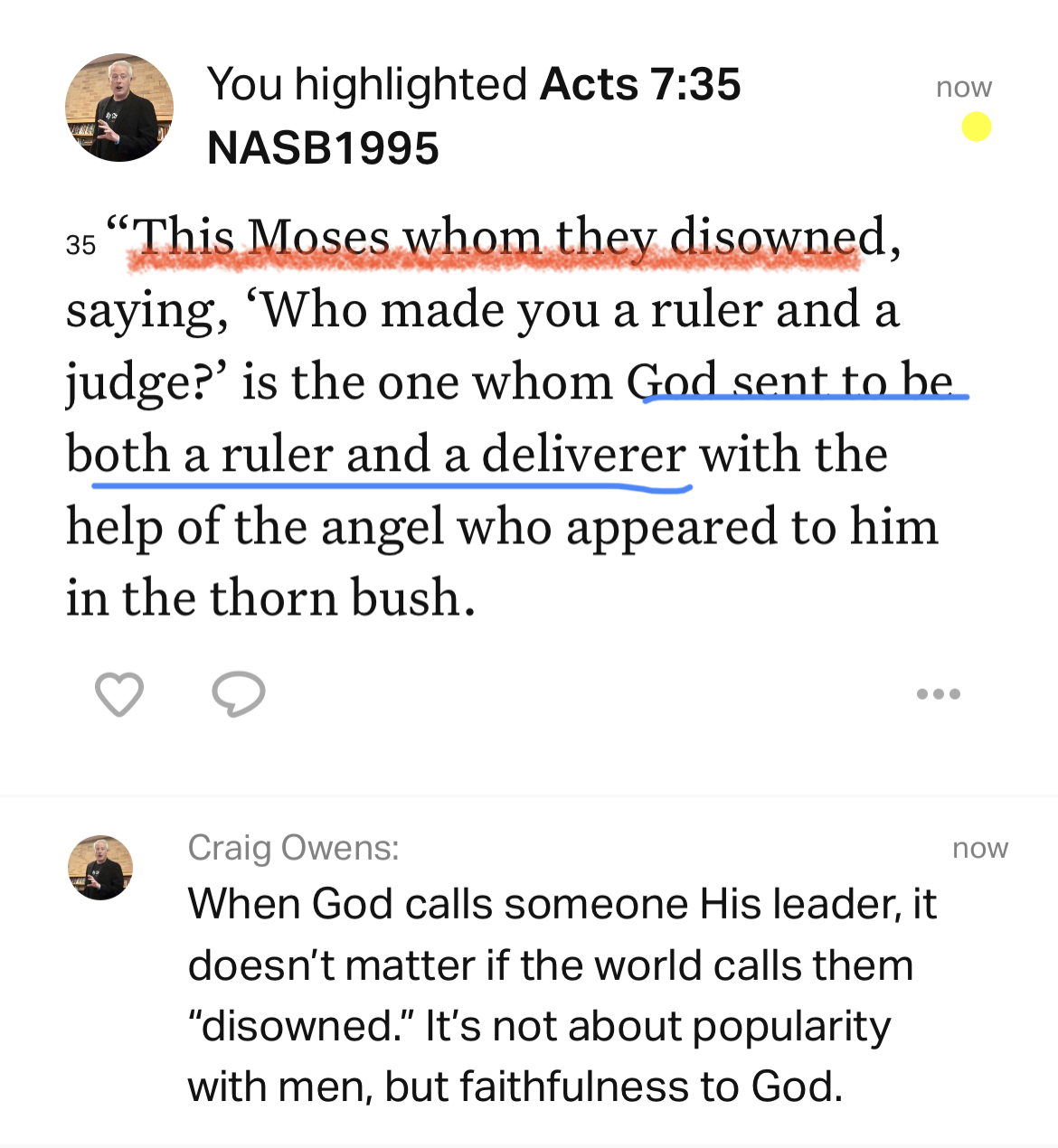
“This Moses whom they disowned…is the one God sent to be both a ruler and a deliverer” (Acts 7:35).
My lesson: When God calls someone His leader, it doesn’t matter if the world calls them disowned. It’s not about popularity with men, but faithfulness to God.
One of the best pieces of advice if you’re looking to regulate your emotions is very simple: SLOW DOWN! Constantly having your game face on or being “on a mission” can cause your emotional regulation to suffer, and seriously hurt your leadership. Be sure to check out all of my videos on my YouTube channel.
You may have heard the oft-repeated line that human beings and chimpanzees share 98-99% of our DNA with each other. This simply isn’t true, and yet it will not die. John Stonestreet has an idea of what is behind this claim in his post Of Primates and Percentages.
“The unprepared mind cannot see the outstretched hand of opportunity.” —Alexander Fleming
John Piper asks, “Why is anxiety about the future a form of pride?” Check out this faith-building post that concludes with these words, “The way to battle the unbelief of pride is to admit freely that you have anxieties, and to cherish the promise of future grace in the words, ‘He cares for you.’ And then unload your fears onto His strong shoulders.”
“Hold fast to eternal salvation through the eternal covenant carried out by eternal love to eternal life.” —Charles Spurgeon
“Celebrate what you’ve accomplished, but raise the bar a little higher each time you succeed.” —Mia Hamm
Listen to the podcast of this post by clicking on the player below, and you can also subscribe on Apple, Spotify, or Audible.
The disciples of Jesus heard His story and asked Him to explain to them what the parable meant. He said, “Don’t you understand this parable? How then will you understand any parable?” (Luke 8:9; Mark 4:13).
The parable in question was the one we refer to as the parable of the sower. According to Christ’s own words, this is the most basic and understandable of all of His parables. If this was a college class, this would be Parables 101.
The kingdom of heaven is so otherworldly, infinite, and utterly beyond a succinct description that even Jesus asked out loud, “What shall we say the kingdom of God is like, or what parable shall we use to describe it?” (Mark 4:30). Then time and time again, Jesus continued to reveal His kingdom with the phrase, “The kingdom of God is like….”
Before we move on to Parables 201 or Parables 301, let’s make sure we know this most basic parable intimately. According to Jesus, this parable is the key to unlocking the meaning of all of His other parables. Approach this one again as you ask the Holy Spirit to reveal something new to your heart.
For instance, as I read through this parable again this week I was captivated by those whom Jesus said had shallow roots. It reminded me that I need to temper my teaching with gentleness. If I’m too aggressive or too theologically deep, I may do damage these tender plants. On the other hand, if I’m too timid, I may leave these plants vulnerable to the ravages of disease or the scorching of the sun. Here again, I must rely on the Holy Spirit’s help. The message may be the same, but perhaps my delivery needs to be more appropriate to my audience.
Let me leave you with this challenge: When was the last time you saw something for the first time in this simplest of parables? If it’s been a while, it may be time for a quick refresher in Parables 101, then you will have the key to go deeper into the other parables. Try it and let me know how it works for you.
There are some long-lasting benefits in keeping a journal. Here’s one benefit I shared with some ministry interns. If you haven’t already done so, please check out my YouTube channel for more great content.
The James Webb Space Telescope (JWST) is causing problems for Big Bang proponents. In a recent post from the Institute for Creation Research, some of these problematic areas were laid out. “As noted in a previous Creation Science Update and Impact article, data from the JWST show that distant galaxies look more ‘mature’ and ‘developed’ than predicted by Big Bang theorists. Big Bang astronomers assume light from the most distant galaxies took almost 14 billion years to reach Earth. Although this may sound reasonable, creation scientists think this assumption is open to challenge. But in any case, by Big Bang reckoning, we should be seeing these very distant galaxies—not as they are now, but as they were almost 14 billion years ago. Hence, these galaxies should appear very “unevolved” and ‘immature.’ Yet, this expectation is routinely contradicted, and data from the JWST are making the disagreement even worse.” One thing the JWST has definitely done: It has shown the beauty and the power of our Creator!
John Piper said, “One of the greatest hope-killers is that you have tried for so long to change, and have not succeeded.” This is an encouraging word for anyone who has prayed, and prayed, and prayed for a breakthrough. “Take heart, struggler. Keep asking, seeking, knocking. Keep looking to Christ. If God gets glory by saving robbers in the eleventh hour, he surely has his purposes why he has waited till now to give you the breakthrough you have sought for years.”
This is pretty compelling evidence for the global Flood that is described in the Book of Genesis—