Listen to the podcast of this post by clicking on the player below, and you can also subscribe on Apple, Spotify, or Audible.
In preparing for our Be Thankful series at my church, I have been reading and studying quite a bit about gratitude. For example, my wife and I are reading a devotional on the YouVersion Bible app call “Practicing Gratitude.”
The other morning, our devotional writer shared this thought: “When the prophet Jonah was having a terrible day at work, he found gratitude by looking at God’s provision through the physical environment. God made a bush for shade and ‘Jonah was very happy about the bush’ (Jonah 4:6).”
In our shared notes, my wife had an insightful word. She wrote, “Jonah’s gratitude didn’t last long. This is a great reminder to pursue a lifestyle of gratitude. It is sometimes very challenging in the midst of hard days to recognize God’s blessings, but it forces me to take my eyes off myself and place them back on my Lord and Savior!”
My studies, this devotional plan, and Betsy’s insight got me thinking even more about the most valuable praise we can offer to our God.
Ah, yes, poor Jonah is a microcosm of the whole Old Testament: God’s blessings are only appreciated for a moment until the complaining starts up again.
Especially in the hard times where it feels like our difficulties are just so unfair.
Paul wrote, “In everything give thanks; for this is the will of God for you in Christ Jesus” (1 Thessalonians 5:18).
“In everything” is not the same thing as “for everything.” This means that I can still be God-focused in my painful circumstances, even though I may not be thankful for those circumstances.
But as I remain thankfully God-focused, perhaps I may begin to see what He is accomplishing because of my painful circumstances. Just as Jesus saw “the joy set before Him” (Hebrews 12:2) and knew that His Father would triumph even in that horrific time, perhaps as I keep my eyes on Jesus I can begin to get a glimpse of God’s coming glory.
Isn’t it “the will of God” that I know—beyond a shadow of a doubt—that I am irremovable from my position “in Christ Jesus”?
For I am convinced that neither death, nor life, nor angels, nor principalities, nor things present, nor things to come, nor powers, nor height, nor depth, nor any other created thing will be able to separate us from the love of God that is IN Christ Jesus our Lord. (Romans 8:38-39 NASB)
Shouldn’t my assurance of that truth produce a joy that prompts praise from my lips that brings glory to God? Isn’t that praise of greater value precisely because it comes from a person in a setting where thankfulness seems impossible?
God is magnified even more when praise comes from a thankful heart that is in a place where humanly there seems to be absolutely nothing praiseworthy.
It is in this place that my praise is to God simply because He is God and He is worthy to be praised simply because of who He is!
So I will praise Him no matter what—“in all things”—because I am secure that I am “in Christ Jesus.” That hope produces a reward that is invaluable. That hope produces a praise that is beautiful in God’s ears.
…And we boast IN the hope of the glory of God. Not only so, but we also glory IN our sufferings, because we know that suffering produces perseverance; perseverance, character; and character, hope. And hope does not put us to shame, because God’s love has been poured out INTO our hearts through the Holy Spirit, who has been given to us. (Romans 5:2-5)
We give God our MVP—our most valuable praise—when it is lifted to Him in that place and time where the natural response would be grumbling and complaining. In those moments, remind yourself that you are IN Christ Jesus, which means even here in this dark moment you can be thankful IN all things.
Let’s not let the candidate for whom we vote be something that separates us from others in the Body of Christ. As the apostle Paul says, “Let’s agree together in the Lord.” Check out my full sermon How Christians Can Live Biblically in an Election Season.
I have lots of new content every week, which you can check out on my YouTube channel.
“It was from Joppa (Acts 10:5) that God sent Jewish Peter to Gentile Cornelius. In this same Joppa, 800 years before, God had to use a little extra persuasion on Jewish Jonah to get him to go to Nineveh, a city of Gentiles (Jonah 1:3).” —Henry Halley, Halley’s Study Bible
“We don’t stop playing because we grow old; we grow old because we stop playing.” —George Bernard Shaw
“No big challenge has ever been solved, and no lasting improvement has ever been achieved, unless people dare to try something different.” —Tim Cook, CEO of Apple
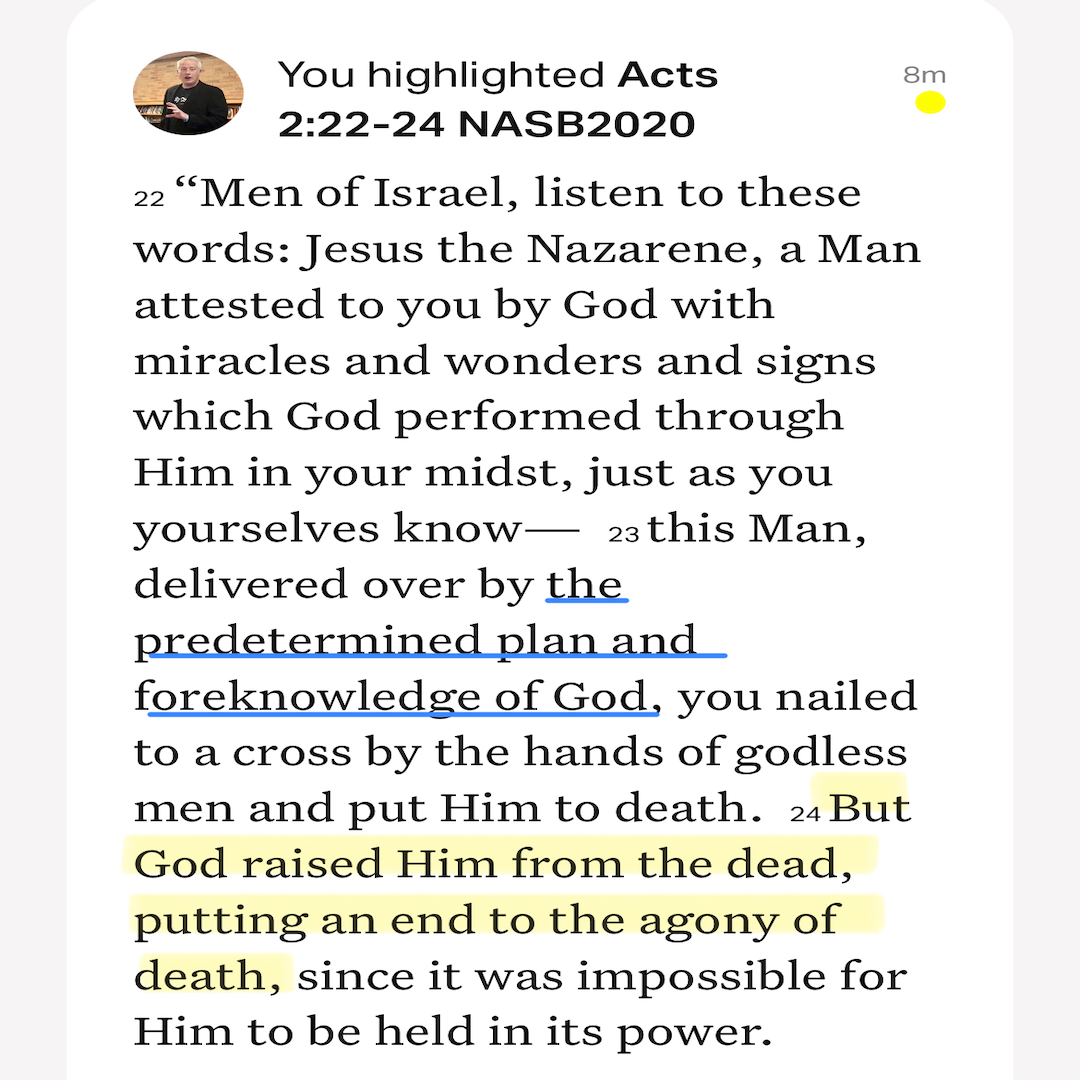
Jesus went to the Cross to fulfill His Father’s “predetermined plan.” This brought glory to God and joy to Jesus. God has a plan for your life, too. He sees you, He planned for you, He equipped you. As you live for Him, your life is also bringing glory to your Heavenly Father and joy to your heart. Unlike Jesus, you may not see how your part fits into God’s plan, but you will know it completely when you hear your Savior say, “Well done, good and faithful servant!”
Listen to the podcast of this post by clicking on the player below, and you can also subscribe on Apple, Spotify, or Audible.
I’m not a fan of rollercoasters, but I know a lot of people who really like them. Some even travel all over the world to experience unique rollercoasters. The anticipation as the cars climb slowly up the big hill, knowing that there’s no stopping this thing now! Then the rush of emotions, a deep breath and a laugh at the end (usually laughing at our friends’ responses while on the ride), and then we just walk away. The moment of anticipation leading up to the big drop was usually longer and more intense than the ride itself.
Not only do people travel all over to find rollercoasters, some people seem to have their emotions perpetually on rollercoasters.
One of the telltale signs of someone with an immature mental health is the way every situation gets blown out of proportion before anything even happens. Then as an event unfolds, their exaggerations continue: the molehills are mountains, every valley is the valley of the shadow of death, the night is a nightmare, the “crisis” is lasting forever, no one has ever gone through what they’re going through, and the list goes on.
To break out of this habit requires us developing emotional capacity. John Maxwell describes it like this: “Emotional capacity is the ability to handle adversity, failure, criticism, change, and pressure in a positive way.” Just as athletes have to develop lung capacity or muscle capacity, developing emotional capacity takes time, patience, and diligence.
Increased emotional capacity is not escaping from our problems or even learning coping skill. Escapism never allows us to confront the things that are keeping our emotional capacity immature. On the other hand, maturing emotional capacity is learning to pause to get perspective so that we can avoid turning every mountain into a molehill, and every challenge into a do-or-die battle.
Let me illustrate this by looking at two emotions which seem to be the most rollercoaster-ish.
(1) The first rollercoaster emotion is anger
Out-of-proportion anger can either burn everyone around us when we explode, or it can eat away inside us if we hold it in. Neither of these are healthy emotional responses. Jesus got angry at the religious crowd that was keeping people away from God’s kingdom, but He didn’t ride the rollercoaster that led to a sinful expression of His anger.
God asked Jonah a very helpful question: Have you any right to be angry? (Jonah 4:4). When we feel the Holy Spirit asking us this question, our defiant first response is almost always, “Yes! I didn’t do anything wrong! It was all him!” Solomon would counsel us to cross-examine that thought (Proverbs 18:17).
Sometimes God will bring someone else across our path to help us pause to get perspective—to flatten the rollercoaster. For instance, God used Abigail to help David (see the story in 1 Samuel 25). However the Holy Spirit cross-examines us, we need to learn to truly listen. James told us:
My dear brothers and sisters, take note of this: Everyone should be quick to listen, slow to speak and slow to become angry, because human anger does not produce the righteousness that God desires. (James 1:19-20)
(2) The second rollercoaster emotion is fear
Fear usually causes us to fight or flight. Those are the natural responses, but the supernatural response is to pause to evaluate. I love the reminder that F.E.A.R. means false evidence appearing real.
As with anger, our first pause to get perspective on this potential rollercoaster that can plunge us into a deep, dark valley should be to cross-examine the false evidence of fear.
When the group of ladies came to the tomb of Jesus on the Sunday following His crucifixion, they were already battered and bruised in their emotions. Finding an empty tomb brought even more fear in their hearts. But there is a keyword in this account that will help us:
In their fright the women bowed down with their faces to the ground, but the men [angels] said to them, “Why do you look for the living among the dead? He is not here; He has risen! Remember how He told you, while He was still with you in Galilee: ‘The Son of Man must be delivered over to the hands of sinners, be crucified and on the third day be raised again.’” Then they remembered His words. (Luke 24:5-8)
The Holy Spirit can help us remember the truth in God’s Word to counteract the fear-inducing false evidence (2 Timothy 1:7; John 14:26), but we must pause to listen to this evidence before this rollercoaster emotion picks up speed.
The bottom line: Don’t try to escape your strong emotions. Pause. Cross-examine the evidence with the help of God’s Word, the Holy Spirit, and a friend to get a healthy perspective. This can help you flatten the rollercoaster before your emotions run away with you.
Listen to the podcast of this post by clicking on the player below, and you can also subscribe on Apple, Spotify, or Audible.
God needed the Ninevites to hear the message of impending judgment, and He needed Jonah to deliver that message and call the Ninevites to repentance. In four short chapters, the phrases about God providing what was needed appear six times!
Because His messenger was running away and prejudiced against the Ninevites, God had to provide the means to get Jonah’s attention and provide a way to get him back on mission. So God provided…
…a great wind on the sea (1:4)
…a huge fish to swallow Jonah (1:17)
…the command to the fish of where and when to deposit Jonah (2:10)
…a green plant, a worm, and a scorching east wind to awaken Jonah to his prejudice (4:6-8)
The storm God provided caused the sailors to turn to God. The fish God provided caused Jonah to turn to God. And the sermon God provided Jonah to preach caused the Ninevites to turn to God.
What about the worm and the wind? Did those cause Jonah to turn his attention back to God? The Bible doesn’t tell us because I believe we each have to complete that story ourselves. When God provides trials, discomforts, and even disasters, they are intended to get our attention.
Let’s keep this in mind the next time things aren’t going the way we had planned. Instead of complaining—or even praying for God to remove us from those difficulties—let’s instead ask ourselves:
Have I been disobedient to something God has directed me to do?
Have I allowed myself to get off-track?
Is my attitude about my God-directed assignment God-honoring?
Is there something God is trying to bring to my attention?
God provides everything needed to keep us on mission for Him. Let’s not try to get out of these difficulties, but let’s ask Him what we need to get out of these difficulties.
Listen to the podcast of this post by clicking on the player below, and you can also subscribe on Apple, Spotify, or Audible.
I think the story of Jonah is pretty well-known. God calls Jonah to take His message to Nineveh. Jonah agrees to do this, but then promptly boards a ship heading in the opposite direction. To get his attention, God sends a storm that rocks this boat so violently that the sailors can do nothing to make any headway. Ultimately, Jonah asks the sailors to throw him overboard. As soon as Jonah hits the water, the storm stopped and Jonah is swallowed alive by a great fish that God had provided.
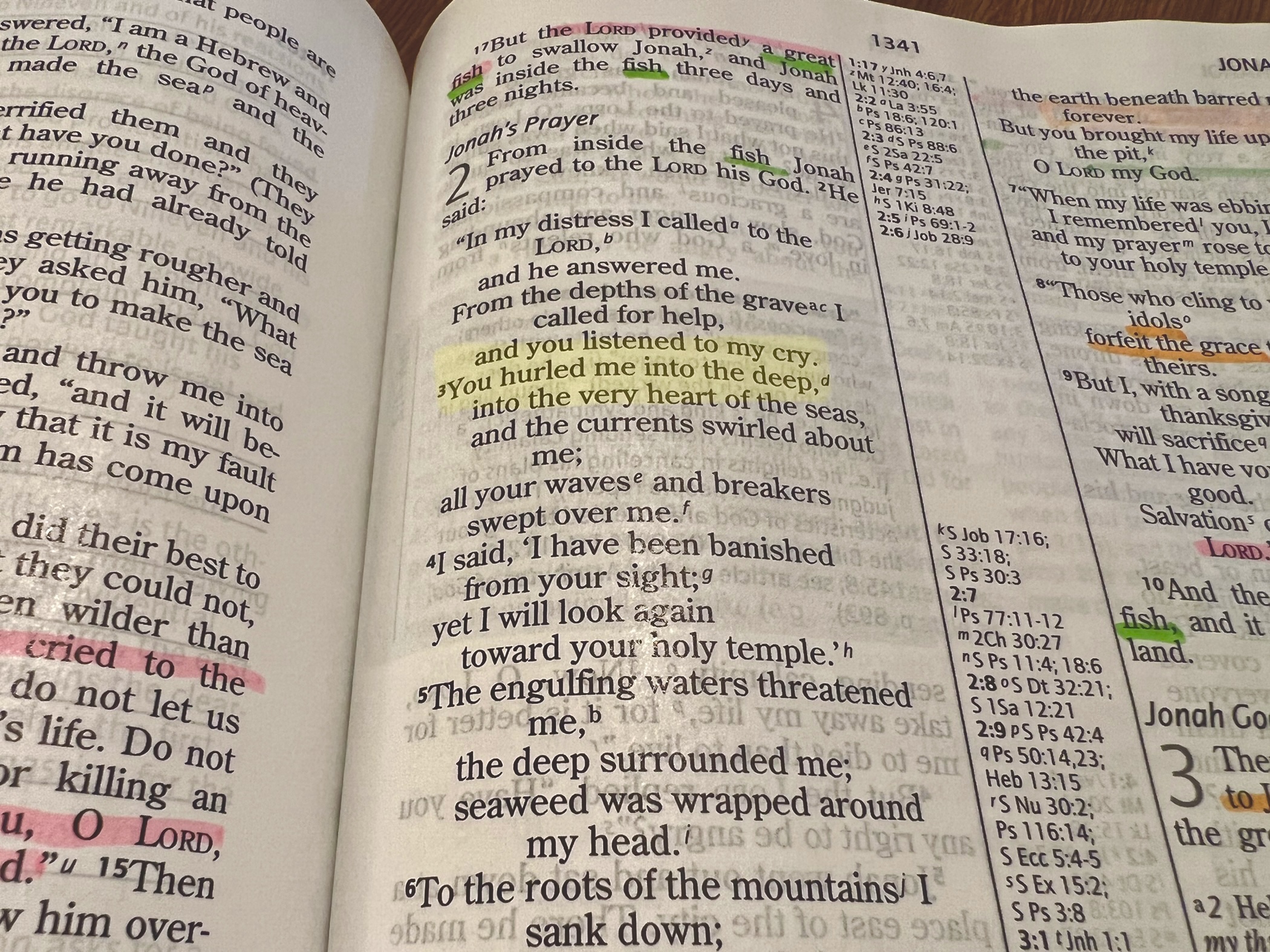
The story continues with this narrative: “From inside the fish Jonah prayed to the Lord his God” (Jonah 2:1). In the next verse, Jonah repeats, “In my distress, I called to the Lord, and He answered me.”
It appears that Jonah’s first prayer may have been on the deck of the storm-tossed ship. Perhaps he prayed something like, “God, I know I have sinned against You. Please have mercy and get me out of this! I promise I’ll obey You this time.”
How did God answer that prayer? Jonah says God answered like this: “You hurled me into the deep.”
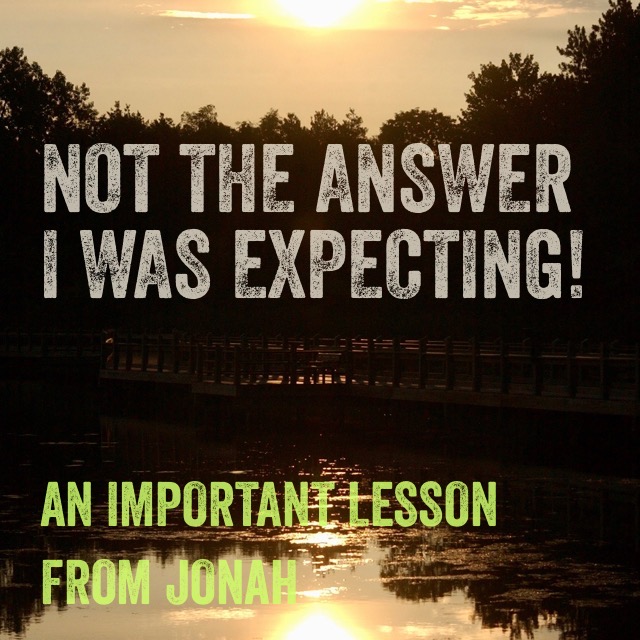
That probably is not the answer to prayer that Jonah was expecting!
I remember when my friend was in a similar place. He had sinned against both God and his employer, and found himself in a whole lot of hot water. As a result, he lost his job.
That probably is not the answer to prayer that my friend was expecting! And yet it was the best answer. He shared with me several months later that getting fired not only got his attention, it helped him put his focus back on God, and put him on a path where God could use him again.
My friend learned what Jonah also learned: Even in our sinful state, God hears our prayers and He answers our prayers. The answer may not immediately be what we would have selected! But our sovereign God knows the best answer, and we must always trust Him.
Jonah declared, “Salvation comes from the Lord,” and he also promised God, “What I have vowed I will make good” (Jonah 2:9). And he did. This time Jonah did go to Nineveh, he delivered the message God had given, and he called those people to repentance. They responded by humbly turning to God, and God showed them mercy.
My friend, the next time you find yourself in hot water, or in an inescapable storm at sea, or a dire situation at work, remember that you can always call to God. He will answer you. His answer may not be exactly what you expected, but it will be the best answer!
Listen to the podcast of this post by clicking on the player below, and you can also subscribe on Apple, Spotify, or Audible.
I love reading, and I love sharing my love of good books with others! Here is a list of the books I read and reviewed in 2021. Click on a title to be taken to that review.
Listen to the podcast of this post by clicking on the player below, and you can also subscribe on Apple, Spotify, or Audible.
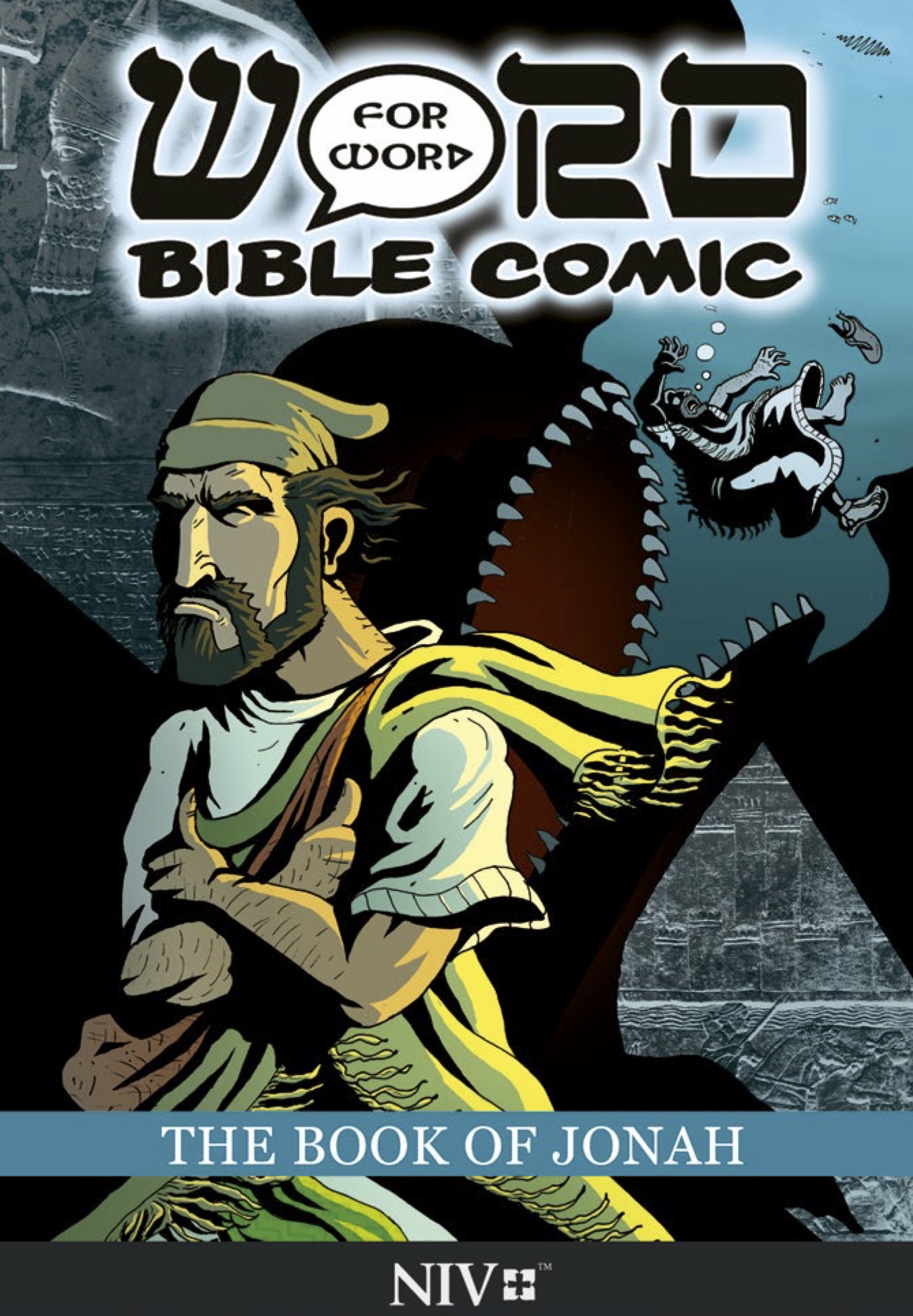
Some of my regular readers who check out my book reviews might be saying, “A comic book? Craig read and reviewed a comic book?” That’s because I’ve stated many times that with all of the wonderful books there are to read, I had to make a choice to be very discriminating in my reading. As a result, I almost exclusively read non-fiction books.
But Simon Amadeus Pillario has done something so wonderful with my all-time favorite Book—the Bible—by graphically illustrating the people, places, expressions, and activities of the biblical storyline. The Word-For-Word Bible Comic I read was The Book of Jonah.
When I was a parent with young children, I would tell them the story of Jonah in a very dramatic way, by giving voices to the characters and adding my own sound effects to the events. This is how Simon Pillario has helped all of us. He’s taking the amazing stories of Scripture, and helping us read and tell these accounts in memorable ways. I can envision these comic books engaging people into reading the Bible like nothing else has before.
Part of the title of this series of comic books is “word-for-word.” That is precisely what this comic book does. It contains every word of the story from the Bible, but Simon does it in such a clever way, that some of the descriptive text that is captured in a drawing is so seamlessly integrated into the page design that it never becomes distracting. Then at the back of the comic book you will find some additional historical information that went into the creative process of illustrating these books.
There are several books of the Bible already completed in word-for-word comic books, which you can check out here. Parents and youth pastors will especially want to check these out as a compelling way to draw young people into reading the Bible for themselves.
Listen to the podcast of this post by clicking on the player below, and you can also subscribe on Apple, Spotify, or Audible.
After all that Hezekiah had so faithfully done… (2 Chronicles 32:1).
After three very long chapters outlining Hezekiah’s faithfulness to obey God and restore worship in the temple, how would you expect this sentence to be completed:
“After all that Hezekiah had so faithfully done…
…God gave Hezekiah abundant blessings”?
…Hezekiah never had any problems”?
…all of Hezekiah’s enemies were afraid of him”?
Actually, the full sentence says, “After all that Hezekiah had so faithfully done, Sennacherib king of Assyria came and invaded Judah.”
What?! That doesn’t seem fair!
Shouldn’t it be something like, “If I do these good things then God will do good things for me”? Or even, “If bad guys do bad things then God will do bad things to them”?
But this wasn’t about Hezekiah. It wasn’t even about Sennacherib. It was about God’s glory.
Jonah had delivered God’s message of judgment on Nineveh and the people had repented. But then they had begun to backslide from that. God was mercifully giving them another chance to repent. Sennacherib felt he was invincible and didn’t need to turn to Yahweh. So God had to demonstrate “with [Sennacherib] is only the arm of flesh” (vv. 8, 10-19).
God’s judgment fell, Sennacherib was assassinated, Judah was delivered, and God was glorified (vv. 21-23).
It is shortsighted of me to say, “But God, I did everything faithfully so this bad thing shouldn’t be happening to me.”
It’s not about me! It never has been. It’s all about God’s glory.
Yes, Hezekiah reaped the benefit of Sennacherib’s defeat, but it wasn’t because God was “paying Hezekiah back” for the good he had done. God was still being glorified when “many brought offerings to Jerusalem for the Lord and valuable gifts for Hezekiah king of Judah. From then on he was highly regarded by all the nations.”
Sennacherib was defeated and Hezekiah was saved for the same reason: God was glorified in doing so!
Whenever you walk through a dark time, you too might be tempted to say, “God, this isn’t fair!” But remember, it’s not about you—it’s about God being glorified. Perhaps God gains greater glory and you gain greater rewards by Him delivering you through an enemy’s attack, not delivering you from the attack. Whatever God is doing, He is doing it for His glory.
Near the end of the movie The Princess Bride, the grandson learns that Wesley, the hero of the story, has apparently died. He asks his grandfather, “Who kills Prince Humperdink,” the arch-villain in the story.
His grandfather replies, “No one. He lives.”
“You mean he wins!?” blurts out the exasperated boy, “Grandpa, why did you read me this story??”
We love to see bad guys get what’s coming to them, don’t we? Some of the baddest bad guys—perhaps in all of history—are the kings of Assyria. When the Assyrians in Nineveh repented and God’s judgment didn’t fall on them, Jonah’s response was much like the grandson in The Princess Bride, “God, why did You send me here?!”
For Judah, this is a short-lived victory because the two kings which follow Sennacherib turn out to be two of the evilest and ruthless kings of Assyria. Yet Nahum’s prophecy still stands: an ultimate destruction is coming. In 605 BC Assyria was defeated by the Babylonians, and the destruction was so complete that Nineveh’s very existence was questioned until archeological discoveries were made in the 19th century.
Why is this prophecy given to us? What are we New Testament Christians supposed to do with this promise of judgment?
Nahum’s name means comfort, so it seems like God’s justice should comfort us. But, interestingly, the root word of his name means to regret or to feel sorry.
Why is this? Think about it: You cannot really know what peace is unless you have been through a period of turmoil. Likewise, you cannot truly understand the relief of being spared God’s judgment unless you fully understand the weight and totality of God’s judgment that should fall on you.
Assyria’s utter destruction is less than a drop in the bucket compared to eternal separation from God. As C.S. Lewis commented about the end of time:
“For this time it will be God without disguise; something so overwhelming that it will strike either irresistible love or irresistible horror into every creature. It will be too late then to choose your side. There is no use saying you choose to lie down when it has become impossible to stand up. That will not be the time for choosing: it will be the time when we discover which side we really have chosen, whether we realized it before or not. Now, today, this moment, is our chance to choose the right side. God is holding back to give us that chance. It will not last forever. We must take it or leave it.”
Today (and every day) is the day for heart-searching, acutely feeling the regret of our sin, and then knowing that our forgiven sins are forgotten sins!












 Craig T. Owens