Peter described the ministry of Jesus as “doing good and healing all who were under the power of the devil.” Historical records tell us the first Christians lived this exact same way! This clip is from our current series of sermons on prayer. I have lots of new content every week, which you can check out on my YouTube channel.
Belshazzar was unknown outside the Bible for quite awhile, prompting one biblical skeptic to say, “the whole story [in the Book of Daniel] is disfigured and falsified by the author, who was neither an eye-witness of the occurrences, nor accurately acquainted with the history of them.” Once again, archeology has confirmed the historicity of both Belshazzar and Daniel.
On YouVersion I shared this on Job 1:20-22. The Old English spelling of worship is “worthship.” We worship God because He has infinitely greater worth than any other person or thing. It’s not that Job wasn’t sad about his losses, but He saw Jehovah as the One of greatest worth in spite of his earthly losses.
“Leaders are responsible for building organizations where people continually expand their capabilities to understand complexity, clarify vision, and improve shared mental models—that is, they are responsible for learning.” —Peter M. Senge, in The Fifth Discipline
Never stopping praying for your loved ones. It could be that with their very last breath they will call on Jesus as their Savior!
Sextortion is when someone demands money or other favors in exchange for not sharing an explicit photo or video of the targeted victim. The sextortion of minor children runs into the thousands every month. Axis reported, “Most targets of sextortion are teen boys, who seem to be more likely than girls to send an explicit selfie to someone they aren’t having a romantic relationship with. Anonymous scammers will reach out to their target over social media, engaging in a flirtation and eventually asking for nudes.” Axis also shared these helpful resources, “Families can prepare by telling their teens about resources like TakeItDown, a free service which will remove nudes from the internet within two days, and the 24/7 Crisis Text Line, which connects teens with professional counselors via text at any time.”
“First, government is not God; instead, government is God’s servant for the good of those served. And second, the people are not God, and therefore must not be allowed the last word on what defines the terms of ‘good’ public policy. Only God can define what is good for people, for He alone is good (Mark 10:18; Psalm 119:68).” —T.M. Moore
“Since the Roe v. Wade U.S. Supreme Court decision more than 50 years ago, almost 40% of all abortions in America have been in the Black community, resulting in erasing the lives and destinies of an estimated 23 million Black babies.” The National Black Fellowship is aggressively working to change this.
“You gain strength, courage and confidence by every experience in which you really stop to look fear in the face. You are able to say to yourself, ‘I have lived through this horror. I can take the next thing that comes along.’ You must do the thing you think you cannot do.” —Eleanor Roosevelt
J. Warner Wallace uses forensic evidence to demonstrate why we should believe the New Testament was written much closer to the time of the actual event than most skeptics believe. Check out this video.
The Holy Spirit knows the best place to use us, the best time to use us, and the best way to use us. We must trust Him! I have lots of new content every week, which you can check out on my YouTube channel.
“In our rush to be thanked or appreciated, or even in our shortsighted compassion, we can undermine the good God is patiently working. In that sense our good is actually evil, for it resists the wisdom, love, and transformative lessons of God.” —Dick Brogden, in Proverbs: Amplified and Applied
I love this quote in J.R.R. Tolkien’s Fellowship of the Ring when Merry Brandybuck tells Frodo about the stick-to-it-iveness of his friends: “You can trust us to stick to you through thick and thin to the bitter end. And you can trust us to keep any secret of yours closer than you keep it yourself. But you cannot trust us to let you face trouble alone. … We are your friends, Frodo.”
I love this devotional from John Piper about God-given foes and God-given faith. “The logic of fearlessness in the face of adversity is this double truth: Both your adversity and your faith in the face of adversity are gifts of God.”
We can look back to learn or we can look back to relive. Looking back to learn is healthy, but looking back in regret to try to relive our past is unhealthy and unproductive. Learning vs. reliving makes all the difference. See my full message on this mental health thought here. I have lots of new content every week, which you can check out on my YouTube channel.
“I’ve learned one thing: You only really get to know a person after a fight. Only then can you judge their true character.” —Anne Frank
Lenny Esposito is an outstanding Christian apologist. Check out this podcast where Lenny discusses the historical facts about the crucifixion and resurrection of Jesus Christ.
“Life with God is not immunity from difficulties, but peace in difficulties.” —C.S. Lewis
“I believe it will only be known on the Last Day how much has been accomplished in missionary work by the prayers of earnest believers at home.” —James Fraser
This is a good reminder from Axis for parents with students returning to school. The heading of this section of Axis’ weekly Cultural Teanslator is “Back to Backpacking.”
“What it is: As a new school year begins, teens might have mixed feelings of excitement, anxiety, and feeling overwhelmed.
How to approach this season: As Hannah King writes in Christianity Today, all seasons of transition bring with them an element of loss. Starting a new school year might mean making new friends, meeting new teachers, or starting a new curriculum. It can also mean the loss of free time, increased stress levels, and more difficulty creating intentional moments as a family. For parents, the beginning of a new school year might also feel like a reminder that time with their teens living at home is dwindling down, a feeling which can bring its own set of griefs, pressures, and regret. King recommends allowing space for teens and adults to name the things they’re disappointed about or not looking forward to, noting that repressed sadness can keep us from ‘entering freely into [the] joy’ of a new thing.
“Start the conversation: What will you miss the most about this summer?”
“Either you deal with what is the reality, or you can be sure that the reality is going to deal with you.” —Alex Haley
When someone wants to “grow” an organization, what exactly does that look like? Is growth only numeric or is it something that’s perhaps a bit more difficult to count? The leader needs to have this clear in their mind, and they need to regularly communicate this metric to their team. I unpack this in greater detail in my book Shepherd Leadership. Check out more of this message here. And be sure to check out all of my videos on my YouTube channel.
It appears that creativity is largely fueled by two things: proper sleep and finding your “sweet spot” each day. If you are an early bird, protect that creative time. If you are a night owl, don’t try to become an early bird to emulate someone else, but lean into your productive time. Check out this full post.
I love reading, but even I have trouble finding time to sit down with my books. But this insight from John Piper totally rejuvenated my thinking about reading. “Suppose that you can read about 250 words a minute. Now, that’s not real fast; most of us can do that—250 words a minute. And suppose that you set aside fifteen minutes a day to read a great book—a classic or some book that you’d been longing to read that would help you grow in your wisdom, your understanding. Now, fifteen minutes a day for 365 days is 5,475 minutes a year. Now, you multiply 5,475 times 250, and you get 1,368,750 words that you could read in a year at fifteen minutes a day. Now, an average book has about 300 to 400 words on a page. So we’ll take 350, which is kind of in the middle, and divide that into 1,368,750. And you know what you get? You get 3,910—almost 4,000 pages a year. An average book has about 200 pages. You see the implication of that? You could read twenty books by this time next year by setting aside fifteen minutes a day.”
An ancient Hebrew inscription consisting of 48 letters was discovered on Mt. Ebal in Israel and is centuries older than any known Hebrew inscription from ancient Israel. This is yet another archeological discovery that speaks to the historicity of the Bible.
T.M. Moore wrote one of the endorsements of my book Shepherd Leadership. His thoughts here about the role of godly shepherds is right on the mark: “The work of shepherds consists of helping the people of God to connect with Him—to know, love, fear, and serve Him in every area of their lives. This work cannot be fulfilled by one who is merely a good speaker, an effective organizer, or an inspiring motivator. This work must be done by one who truly knows the Lord. For unless we know the Lord, the Lord will not know us, and He will not honor our labors.”
You are one-of-a-kind! There has never, ever been anyone like you, and there never will be. God made you on purpose and for a purpose. And God wants to reveal the purpose He has for your life. You be you—that is how God is most glorified through you.
The Holy Spirit can speak to us through other people. Be sure to check out all of my videos on my YouTube channel.
“A time will come when instead of shepherds feeding the sheep, the church will have clowns entertaining the goats.” —Charles Spurgeon
“It is possible to adopt an outward demeanor of great meekness, while inside our appetite for applause is insatiable. . . . Oh, what a constant companion, what a tyrannical commander, what a sly, subtle and insinuating enemy is this sin of pride!” —John Stott
“Every word from God comes with the power to make that word happen.” —Kevin Berry
“The question is not, ‘Should we pray for the lost people of our community?’ The question is, ‘Will we?’ Will we pray for our neighbors, our community, our nation, and our world? Will we seek the peace of the world and the wellbeing of all our fellow humans before the Lord in prayer? [Jeremiah 29:7]
“If we will not, then we must face up to the fact that we are disobeying a divine mandate, abandoning our neighbors to their folly, and stoking the fires of indifference—if not outright scorn—for the unbelieving world around. But if we will pray, who knows what God might be willing to do?
“Those prayers may be prayers of anguish and anger at times; but they must also be prayers for God to work in the hard hearts of our unsaved neighbors, just as He has worked in ours, to bring new life, forgiveness, and hope to those who now live apart from God in a world full of rebellion and sin.” —T.M. Moore
Axis is a great resource to help parents communicate effectively with their pre-teen and teenage children. In the wake of the school shooting in Nashville, Axis posted this: “We have created resources to help parents and caring adults have conversations about violence and school shootings. Consider our Conversation Kit on Violence, our Parent’s Guide to School Shootings, our Parent’s Guide to Talking About Violence, and our Parent’s Guide to Anxiety, for starters.”
“Failure is a part of success. There is no such thing as a bed of roses all your life. But failure will never stand in the way of success if you learn from it.” —Hank Aaron
I have a series of nearly 70 posts on the topic of godly leadership. Here is the latest installment about going all in. Be sure to check out all of my videos on my YouTube channel.
T.M. Moore writes persuasively to Christians to encourage them to build for the future. He wrote, “For most Christians today, the Kingdom which Daniel saw, Jesus proclaimed and brought near, and the Spirit inaugurated on that first Christian Pentecost—that Kingdom is little more than a theological idea, or a distant hope. It is not a daily reality to be sought, seized, shared, and strengthened in every nook and cranny of our Personal Mission Fields. Christians today are trapped in their past or mired in their present, and they have little or no sense of what it means to build for the future so that righteousness, peace, and joy in the Spirit increase wherever they live, move, and have their being.”
And another piece of research from both paleontologists and entomologists points to the Flood described in the Bible as historically viable. Researchers discovered fossilized giant ants in Canada where evolutionists claim they shouldn’t be. The Institute for Creation Research commented, “There is no need to postulate ants trekking across the Arctic to explain the distribution. Nor is there a need to inject short ‘hyperthermal’ episodes to allow passage from one continent to another. The global Flood explains what we observe the best. The warmer pre-Flood conditions and likely higher oxygen levels explain the large size of the ants. And their fossil distribution is best explained by their transport off the highest pre-Flood hills as the waters were receding.”
“If we were to look at Jesus’s death merely as a result of a betrayer’s deceit and the Sanhedrin’s envy and Pilate’s spinelessness and the soldiers’ nails and spear, it might seem very involuntary. And the benefit of salvation that comes to us who believe might be viewed as God’s way of making a virtue out of a necessity. But once you read Luke 9:51, all such thoughts vanish. Jesus was not accidentally entangled in a web of injustice. The saving benefits of His death for sinners were not an afterthought. God planned it all out of infinite love to sinners like us, and He appointed a time.” —John Piper, Love To The Uttermost reading plan on YouVersion
There is something very important that mature leaders need to remind themselves of so that they can help emerging leaders become successful. You can watch out this full conversation about mulligans and do-overs on the most recent episode of The Craig and Greg Show. Be sure to check out all of my videos on my YouTube channel.
In my sermon on Sunday, I talked about the sovereignty of God over world affairs and world leaders. This is a great reminder from John Newton:
Sovereignty is but another name for the unlimited exercise of wisdom and goodness.
Merat Sultan was born in the shah of Iran’s palace in 1876. He became the chief of police and of the army in Tabriz, Iran. When the Russians invaded and occupied that area, they made plans to execute Sultan. How he escaped actually led him to a relationship with Jesus as Sultan became a Christian. Check out this fascinating story from the website Praying For Muslims. I would also urge you to check out their weekly prayer guide.
“No voice. No contribution. No significance. No meaning.
“Invisible.
“That’s the way many women probably felt at the time Jesus lived. And every person with an illness—cancer, leprosy, epilepsy, mental disabilities—every one of those people were marginalized. In Jesus’ day, what careers were on the lowest rung of the corporate ladder?—fishermen and shepherds. Yet when you read every account of Jesus, who do you see Him hanging around? Fishermen, shepherds, women, and people dealing with health issues.
“Jesus wanted it that way. He took every opportunity He had to bring people in from the fringes and give them His full attention. He saw them. He listened to them. He loved them in ways they’ve never been loved before. They had never experienced anything like it.”
T.M. Moore wrote, “We are becoming so accustomed to the forsaking of traditional values, the undermining and fragmenting of long-established institutions, and the breakdown of morality and civility that we can begin to think that these conditions are the new normal, the best we can hope for in an age in flight from God. Everywhere we look in our day, the prophetic words of William Butler Yeats, in his 1919 poem, ‘The Second Coming,’ seem to be coming true: ‘Things fall apart; the centre cannot hold;/Mere anarchy is loosed upon the world./The blood-dimmed tide is loosed, and everywhere/the ceremony of innocence is drowned.’ But the appearances, which press upon us daily, are only a matter of perspective.” Check out the rest of his post.
When things are going well, how can we talk about our success in a way that glorifies God? John Piper had a thoughtful answer to a businessman who asked how he could talk about the success of his business and make God look great while he was doing so.
Listen to the podcast of this post by clicking on the player below, and you can also subscribe on Apple, Spotify, or Audible.
As we near the crucifixion of Jesus, we begin to see how politics plays a role in so many decisions. The Sanhedrin is trying to balance their popularity with the Jewish people and their standing with powerful leaders in the Roman government. Pontius Pilate is trying to balance how the Sanhedrin portrays him to the Jewish people and what those in Rome are telling Caesar Tiberius about him. King Herod Antipas also has issues with balancing the pressure from the Sanhedrin with the popularity of Jesus.
Luke gives us a very telling statement about the politics of the day when he writes, “That day Herod and Pilate became friends—before this they had been enemies” (Luke 23:12). How did they become friends over this issue of what to do with Jesus? Remember that the Sanhedrin is a common thorn-in-the-side for both of them, and the political axiom that still holds to this day says, “The enemy of my enemy is my friend.”
I point out all of the political maneuverings during this pivotal time because these political balancing acts are still being played out today and Christians will end up in the crosshairs.
Pilate was trying to appease the Sanhedrin but there was no Roman law that Jesus had broken that was deserving of the death penalty they were demanding. So twice Pilate tells these religious leaders, “I will punish Him and then release Him.” In fact, without waiting for their approval, Pilate subjects Jesus to the tortuous punishment known as flagellation (Luke 23:13-22; John 19:1-11).
I think Pilate believed that if they saw Jesus so humiliated and beaten down they would back off from their desire for His death. But Pilate miscalculated their commitment to seeing Jesus eliminated from the scene.
Pilate finally gives in and says, “You take Him and crucify Him. As for me, I find no basis for a charge against Him.” But the Jewish religious leaders insisted, “We have a law, and according to that law He must die, because He claimed to be the Son of God.”
If you have ever watched a movie about the gladiatorial games in the Roman Colosseum, you’ve probably viewed the scene where one combatant is disarmed and helpless. Before the victor strikes his deathblow he will look to Caesar in the stands. The Roman Caesar will either give a thumbs-up signal to pardon the victim or he will give a thumbs-down signal to send the defeated one to their death.
Pilate asks Jesus, “Don’t You realize I have power either to free You or to crucify You?”
There was another king who called himself “king of kings” but God called him “My servant.” He was King Nebuchadnezzar of Babylon. Daniel, an exile from Israel who was Nebuchadnezzar’s prime minister, reminded him where his authority originated, “The Most High is sovereign over all kingdoms on earth and gives them to anyone He wishes” (Daniel 4:17).
In the same way, Jesus addressed Pilate, “You would have no power over Me if it were not given to you from above.”
John Piper wrote: “This does not intimidate Jesus because Pilate’s authority over Jesus is subordinate to God’s authority over Pilate. Jesus gets His comfort at this moment not because Pilate’s will is powerless, but because Pilate’s will is guided. Not because Jesus isn’t in the hands of Pilate’s fear, but because Pilate is in the hands of Jesus’s Father.”
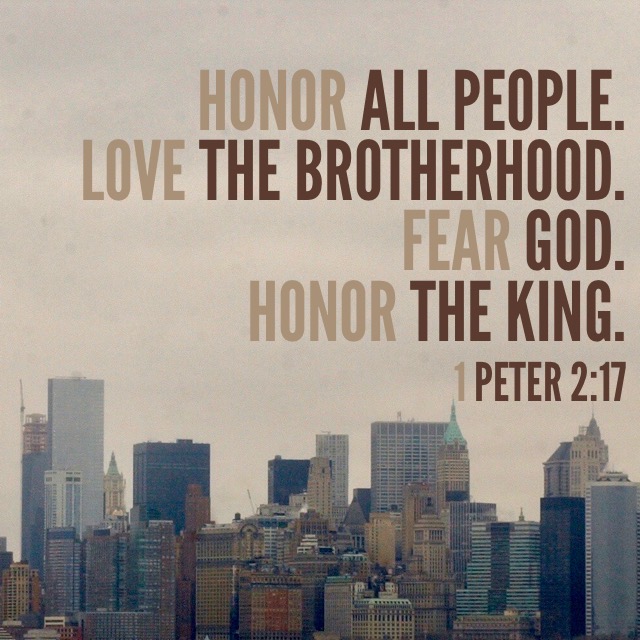
Jesus shows us an important principle: Should we respect our leaders (even the ungodly ones)? Yes! Should we fear them? No!
We don’t fear them because their power is limited to just this life and is under the control of the Most High God (Luke 12:4). Peter and John learned this lesson well, as we see in their interaction with the same Sanhedrin that turned Jesus over to Pilate (see Acts 4:1-10). What Jesus and these apostles demonstrate for us is respectful boldness.
In light of this, here are five things Christians should keep in mind. When persecution comes against us, we should respond like this:
Jesus taught us there is a time for eloquent silence, but when the Holy Spirit needs us to speak, He will give us the respectfully bold words to share. Jesus said,
On My account you will be brought before governors and kings as witnesses to them and to the Gentiles. But when they arrest you, do not worry about what to say or how to say it. At that time you will be given what to say, for it will not be you speaking, but the Spirit of your Father speaking through you. (Matthew 10:18-20)
Respectful? Yes. Fearful? No. Respectful, loving, prayerful boldness is how we will glorify the Most High God in the face of persecution.
One of the best pieces of advice if you’re looking to regulate your emotions is very simple: SLOW DOWN! Constantly having your game face on or being “on a mission” can cause your emotional regulation to suffer, and seriously hurt your leadership. Be sure to check out all of my videos on my YouTube channel.
You may have heard the oft-repeated line that human beings and chimpanzees share 98-99% of our DNA with each other. This simply isn’t true, and yet it will not die. John Stonestreet has an idea of what is behind this claim in his post Of Primates and Percentages.
“The unprepared mind cannot see the outstretched hand of opportunity.” —Alexander Fleming
John Piper asks, “Why is anxiety about the future a form of pride?” Check out this faith-building post that concludes with these words, “The way to battle the unbelief of pride is to admit freely that you have anxieties, and to cherish the promise of future grace in the words, ‘He cares for you.’ And then unload your fears onto His strong shoulders.”
“Hold fast to eternal salvation through the eternal covenant carried out by eternal love to eternal life.” —Charles Spurgeon
“Celebrate what you’ve accomplished, but raise the bar a little higher each time you succeed.” —Mia Hamm




 On YouVersion I shared this on Job 1:20-22. The Old English spelling of worship is “worthship.” We worship God because He has infinitely greater worth than any other person or thing. It’s not that Job wasn’t sad about his losses, but He saw Jehovah as the One of greatest worth in spite of his earthly losses.



 Craig T. Owens