Accountability To Saints

Listen to the podcast of this post by clicking on the player below, and you can also subscribe on AppleSpotify, or Audible. 

Sanctification (saint-ification) is an ongoing process that brings out fruitfulness, joy-fullness, and enhances our testimony to others. And an essential part of this process involves other saints. Notice that this word “saints” it plural. That’s because it is a plural word every place it appears in the Bible. 

Saints have gotten themselves into trouble when they tried to go solo. Like David’s sin with Bathsheba, Elijah’s slide into depression, or Peter’s denial of Jesus. But we also see saints thriving through difficult situations when they have a fellow saint alongside. Like how Barnabas gave Saul his start, Paul and Silas could sing together in prison, Silas and Timothy helped Paul minister, and how Jesus sent out His ambassadors by twos (Luke 10:1).  

(Check out all of the Scriptures in this post by clicking here.) 

I love the names of traveling companions John Bunyan uses in Pilgrim’s Progress: Christian travels with Faithful and Hopeful; Christiana travels with Mercy and Mr. Great-heart. And we get to travel along with some really great people as well (Proverbs 27:17; Ecclesiastes 4:9-12). 

How does accountability to other saints work? Since we see togetherness so much in the early Church (look for the phrases like “each other” or “one another”), think A.C.T.S.—

(1) Admit my need for accountability. James tells us that we all stumble and that even my so-called little slip-ups are major in God’s eyes (James 3:2, 2:10). So I need help. 

John Maxwell said, “Every person is undisciplined in some area of their life; in the area that I am undisciplined, that is the area where I need greatest accountability. I will not do well in my areas of weakness unless I am held accountable for better results.” We all have blind spots, we all have weak areas, and we must be humble enough to admit to those things. 

(2) Choose my accountability partners prayerfully and carefully (Proverbs 12:26; 2 Corinthians 6:14). These should be trustworthy people who have the emotional and spiritual capacity to be able to come alongside me (Proverbs 17:9; Galatians 6:2). 

(3) Trust my friend. Trust their counsel even when it stings a bit (Proverbs 27:6), and trust the effectiveness of their prayers for me (James 5:16). 

(4) Stick with them through thick and thin. Be your brother’s keeper and let them be your keeper (Hebrews 3:12-14). We need to keep at it especially in difficult times. Notice the phrase “let us” that appears five times in Hebrews 10:19-25.  

If we are living with a biblical worldview, we realize that the saints here on earth are those we will also be with for eternity. Our biblical worldview should form our understanding of both being accountable to another saint and holding other saints accountable as well. 

As Jack Hayford so wisely noted, “The believer’s best defense against self-deception is through mutual accountability to one another.” 

If you would like to check out the other messages in our series B.A.S.I.C. Christianity, you can click here. 

►► Would you please prayerfully consider supporting this ministry? My Patreon supporters get behind-the-scenes access to exclusive materials. ◀︎◀︎
7 Quotes From “High Road Leadership”

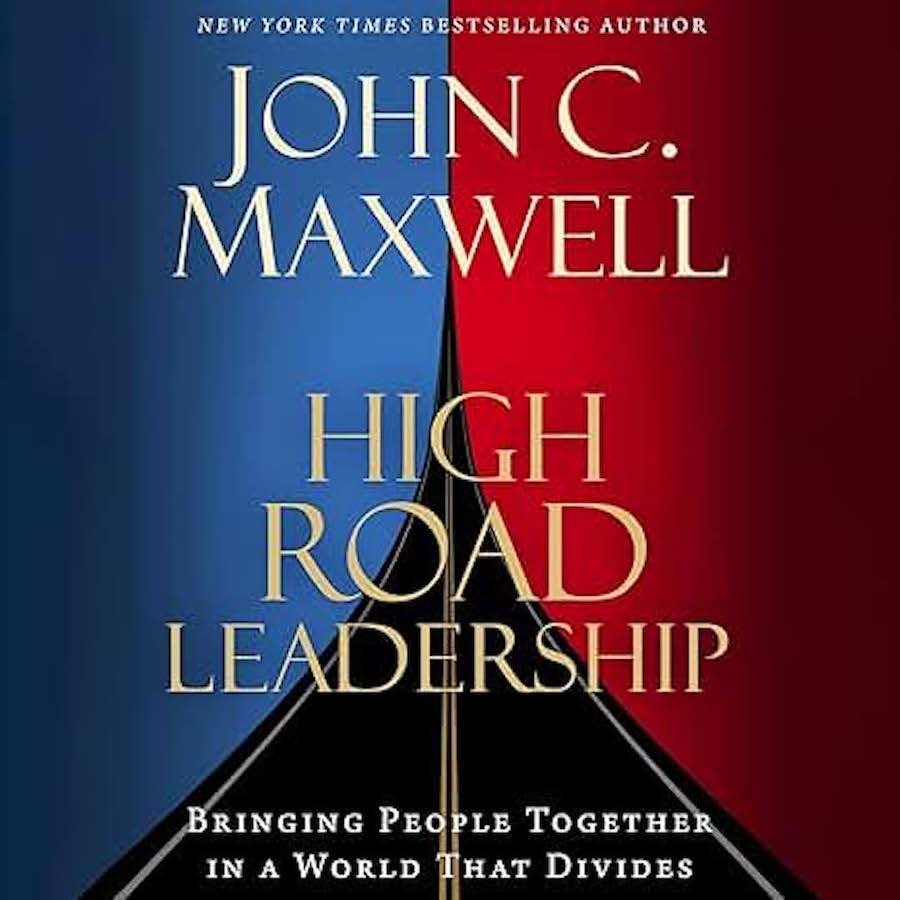
The subtitle of this John Maxwell book is “Bringing People Together in a World That Divides.” That is so needed today! Check out my review of High Road Leadership, and may these quotes inspire you to pick up a copy of this book to learn how you can be a part of healing a divided world. 

“Leadership can be a blessing or a curse. It can help people rise to a better life, or it can cause people to fall into despair.” 

“One of the reasons we don’t come together and work with one another is that we no longer see people on the other side as merely disagreeing. We see them as disagreeable human beings. We assume their motives are wrong. And the moment we think a person’s motives are wrong, we lose trust. … Good leaders need to rise above this attitude and help the people they lead do the same. How? We need to possess a strong collaboration bias. We need to bring people together to increase our understanding of each other and broaden our perspective.” 

“We can’t divide people and expect to accomplish positive results. Conversation and collaboration will always come up with better answers than isolation and exclusion.” 

“In my opinion, as a culture we lost our way when we went from simply disagreeing with others to devaluing them because we disagree. That’s when we crossed the line into low-road leadership. It’s one of the reasons so many people are so angry all the time. And when others take the low road with them, they become even angrier. It’s always easier to make a negative point than to make a positive difference.” 

“High-road leaders who value people have a strong, healthy sense of self-worth, yet at the same time they are humble, meaning they don’t think too much of themselves or about themselves too much.” 

“Accepting our humanness and possessing humble confidence does nothing to diminish our leadership ability. In a study of medical students, those who possessed doubts about their ability were just as effective in diagnosing illnesses as their more confident counterparts. Furthermore, the more humble students rated higher in bedside manner, empathy, respect, and professionalism.” 

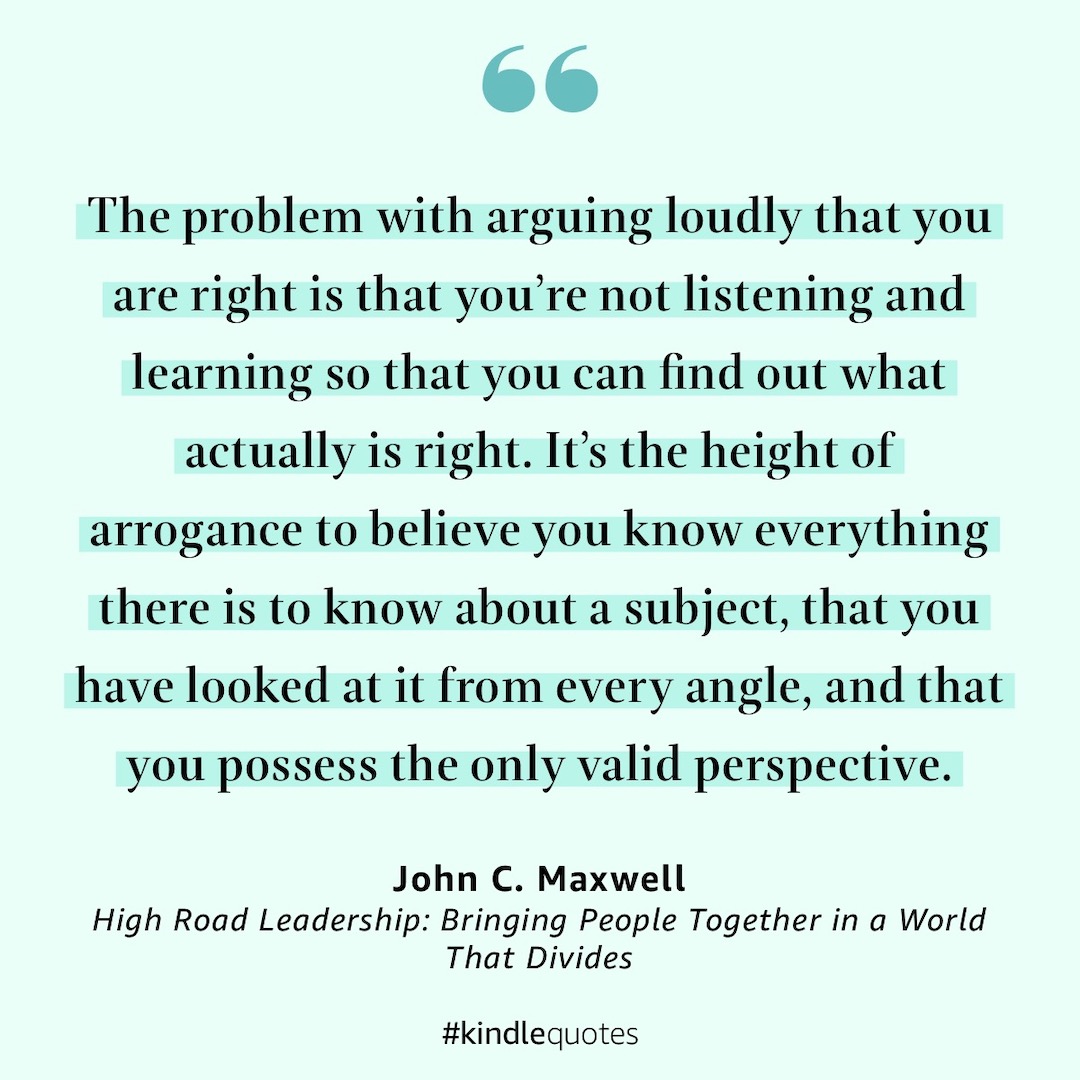
“The problem with arguing loudly that you are right is that you’re not listening and learning so that you can find out what actually is right. It’s the height of arrogance to believe you know everything there is to know about a subject, that you have looked at it from every angle, and that you possess the only valid perspective.”

My Patreon supporters have access to 25+ quotes from this book. They also get exclusive content and early access to public content. Join them today.

High Road Leadership (book review)

Listen to the podcast of this post by clicking on the player below, and you can also subscribe on AppleSpotify, or Audible. 

I have been a longtime fan of John Maxwell. His ability to distill so many insights into accessible action steps is a true gift. High Road Leadership is no exception to this, and it is a timely read at this cultural moment. 

I was recently talking with a friend about the stark divide in American politics today. I was recalling a time when a US President would nominate someone for a cabinet position or an opening on a judicial bench, and the vote in the Senate would be something like 89-8 in favor of the nominee. Now it is more likely that the vote will end in a 50-50 tie with the vice president stepping in to cast the tie-breaking vote. It’s become axiomatic that a senator’s vote has to be a “nay” if the president making the nomination was of a different political party.

As a pastor, I’ve even experienced people moving to a different church because someone else in the church is perceived to support something that they are against. It’s heartbreaking, to say the least! 

This is why I said that Maxwell’s book is timely in this cultural moment. 

As with all of his books, the focal point is leadership. More specifically, John Maxwell calls leaders to continue to grow in their ability to serve more people; with the emphasis on “serve.” 

High Road Leadership challenges leaders on ways to take the high road. One illustration that encapsulates the ideas in this book comes from Maxwell’s observation on the well known story of the good Samaritan. The thieves took the low road by saying to the man they robbed, “What’s yours is mine.” The leaders who passed by the man who was injured took the middle road by exempting themselves from action by saying, “What’s mine is mine.” However, the good Samaritan who helped the injured man at his own expense took the high road in saying, “What’s mine is yours.” 

High road leaders are always looking for ways to bring people together, to go above and beyond what would be culturally expected of them, to embrace those who are different, to find common ground that can unite disparate groups. 

This is the consistent example and teaching of Jesus Christ Himself, but it is an attitude and lifestyle that is routinely ignored. Everyone seems to be waiting for “them” to go first, but high road leaders always take the Christ-like initiative of going first.

High Road Leadership is a practical guide to help all of us consistently operate on the high road. If you are ready to help heal what divides us, this book will become your go-to resource. 

►► Would you please prayerfully consider supporting this ministry? My Patreon supporters get behind-the-scenes access to exclusive materials. ◀︎◀︎
Listen, Listen, And Listen Some More

Listen to the podcast of this post by clicking on the player below, and you can also subscribe on AppleSpotify, or Audible.

We rob ourselves and diminish the other person with whom we’re conversing if we aren’t fully listening. Listen, listen, and (really!) listen some more before you share your opinion.

Solomon said, “He who states his case first seems right, until his rival comes and cross-examines him” (Proverbs 18:17 AMPC).

And I like this thought from John Maxwell:

     “The best way to understand people is to listen. The best way to learn from others is to listen. The best way to receive people’s best contribution is to listen. The best way to learn what others need from you is to listen. The best way to gain people’s buy-in is to listen.” —from John Maxwell’s book High Road Leadership 

I shared several quotes on this topic in the posts Leaders Listen and How to be Wise with your Mouth and Ears. 

►► Would you please prayerfully consider supporting this ministry? My Patreon supporters get behind-the-scenes access to exclusive materials. ◀︎◀︎
P.S. After posting this, I came across an article on the Desiring God website called Listen Well to Love Well. She wrote, “Listening is hard work. While our ears automatically welcome sound waves and ship them to our brains, it doesn’t mean we always hear other people. We might even wonder if listening well is worth the effort. … We have a long history with listening that makes it essential to who we are yet difficult to get right. Sarah Clarkson writes, ‘We are by nature a listening people. If we were spoken into being by the Word of God, then at our core we are to be listeners, and to attend to the word that spoke us into life.’”

Praying For Our Fellow Saints

Listen to the podcast of this post by clicking on the player below, and you can also subscribe on AppleSpotify, or Audible. 

We tend to be pretty self-centered creatures, filtering everything through our lens. This becomes especially true when we are going though a difficult time. 

When I walked through a dark valley, I battled both physical and spiritual forces. People attacked me, but so did my own thoughts. “Why me?” and “I didn’t do anything to deserve this!” led to prayers like, “God, why didn’t You protect me from this? Why won’t you get me out of this?” 

Do you hear a common theme? I didn’t while I was in the midst of the battle, but perhaps you hear it—“Why me? I didn’t do anything to deserve this! God, why didn’t You protect me from this? Why won’t You get me out of this?” 

In his book Winning With People, John Maxwell shared ‘The Big Picture Principle’: “The entire population of the world, with one minor exception, is composed of others.” 

On the other side of my dark valley I learned something about my time in the dark valley—I had grown:

  • I could help others diagnose depression 
  • I could empathize with others
  • I could share helpful strategies to those who were struggling 
  • I could intercede for them in prayer 

My definition for intercede is to pray for people in a meaningful way because they are too beat up to pray for themselves. 

In order to pray for them, I have to know what and how to pray. I can’t know what and how to pray unless I have firsthand experience. So perhaps my dark valley wasn’t for me, but for someone else (see Romans 8:28; 2 Corinthians 1:3-11). 

(Check out all of the Scriptures in this post by clicking here.)

As Christians, we’re in this life together. 

I have talked and blogged so many times about the phrases “one another” and “each other” throughout Scripture. That means that Christian faith is best seen when we are with each other, supporting one another. 

Jesus taught us to pray, “Our Father” (Matthew 6:9). The “our” signifies we are praying…

  • …with Jesus—John 14:13-14 
  • …with other saints—Matthew 18:18-20 

Even more than praying with us, Jesus intercedes for us (Hebrews 4:15-16). And Jesus gives us the Holy Spirit (John 14:26) who also intercedes for us and with us (Romans 8:26-27). 

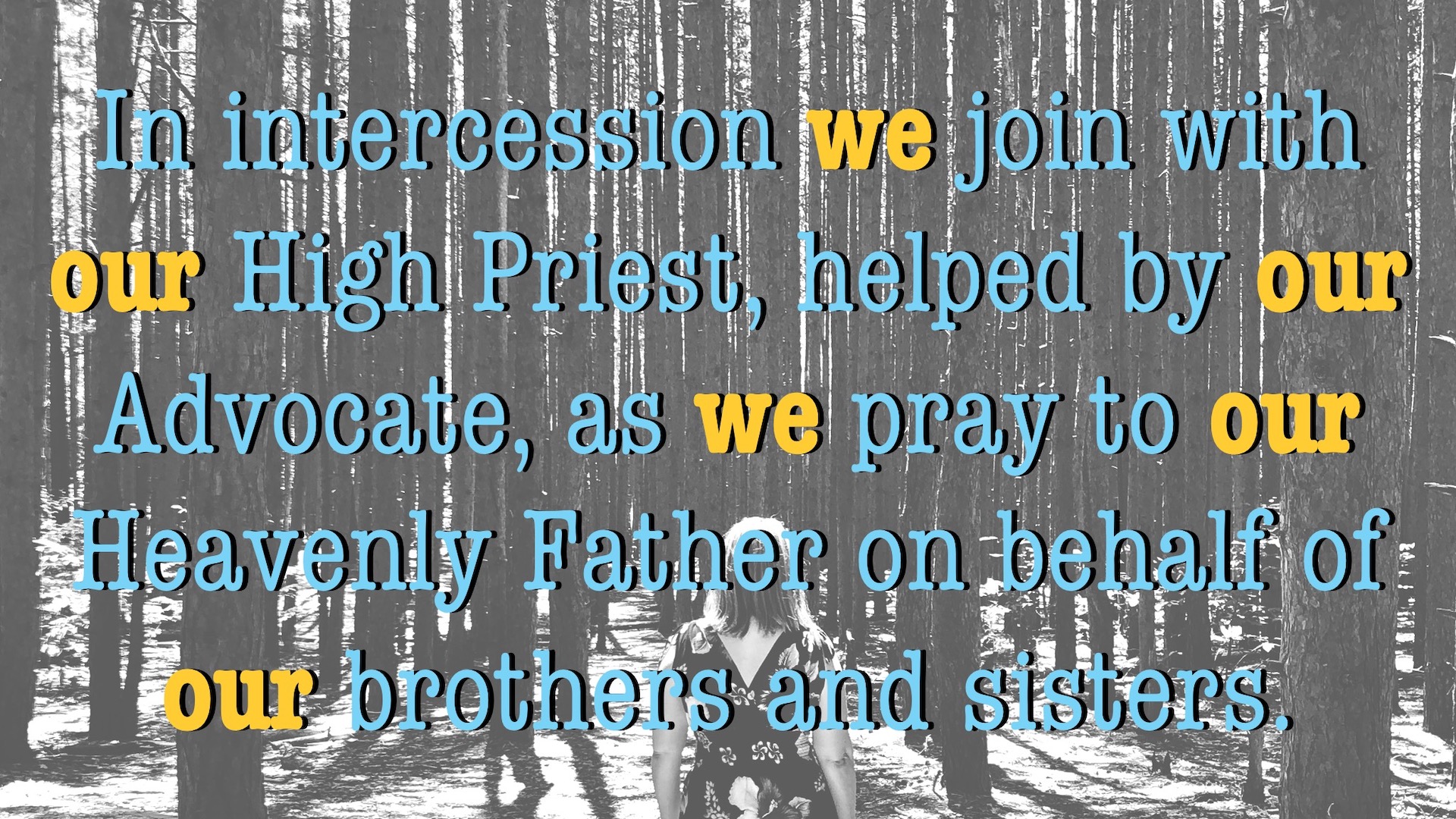
We join with our High Priest, helped by our Advocate, as we pray to our Heavenly Father on behalf of our brothers and sisters.  

Listen to the interceding and expectation of a joyful answer that David writes in Psalm 20, and also notice how the saints are together—

    May the LORD answer you when you are in distress; may the name of the God of Jacob protect you. May He send you help from the sanctuary and grant you support from Zion. May He remember all your sacrifices and accept your burnt offerings. May He give you the desire of your heart and make all your plans succeed. May we shout for joy over your victory and lift up our banners in the name of our God. May the LORD grant all your requests. Now this I know: The LORD gives victory to His anointed. He answers him from His heavenly sanctuary with the victorious power of His right hand.  Some trust in chariots and some in horses, but we trust in the name of the LORD our God. They are brought to their knees and fall, but we rise up and stand firm. LORD, give victory to the king! Answer us when we call!

My cousin Dick Brogden wrote, “Jesus never intended us to suffer alone. We may not physically be able to cross oceans or deserts and sit in lonely cells with colleagues—but we are intended to traverse that distance spiritually and to bear the burdens of our brothers in prayer. Followers of Jesus under duress are empowered to bear unimaginable suffering when they know that they do not agonize alone.” 

In your prayer time, I encourage you to ask the Spirit to show you lessons you have learned in your dark valleys, and then begin to intercede for your fellow brothers and sisters with the help you have already received. 

If you’ve missed any of the messages in this prayer series, you can find them all here. 

►► Would you please prayerfully consider supporting this ministry? My Patreon supporters get behind-the-scenes access to exclusive materials. ◀︎◀︎

Links & Quotes

Shepherd leaders cannot allow past hurts to negatively impact their current situations. Don’t give in to the natural fight-or-flight response, but ask God to help you response with supernatural faithfulness. I unpack this idea in greater depth in my book When Sheep Bite.

I have lots of new content every week, which you can check out on my YouTube channel.

In responding to an evolutionary biologist’s claims that the material world is all that matters, John Stonestreet invokes the timely wisdom of G.K. Chesterton and C.S. Lewis. One of my favorite quotes from Lewis appears in this post: “A theory which explained everything else in the whole universe but which made it impossible to believe that our thinking was valid, would be utterly out of court… It would be an argument which proved that no argument was sound—a proof that there are no such things as proofs—which is nonsense.”

“Good leaders love leading the people they lead more than they love leading people.” —John Maxwell 

Gerrit Scott Dawson writes about how the Bible helps us see ourselves more clearly. “The truth-telling mirror of Scripture exposes and composes us. Imagine a mirror that would make you as appealing as you could hope to be. Imagine a well of clear water that not only reflected but washed you clean of dirt and blemishes. When we read Scripture with open hearts and in reliance on the Spirit, that’s what happens.”

“Twice in the book of Hebrews we are urged to ‘consider Jesus.’ In Hebrews 3:1, the writer exhorts us to consider Jesus (κατανοήσατε) so that we will continue believing in and confessing Him throughout our lives. This word means to pay attention to something through direct observation, with the implication of also thinking about it, meditating on it, and returning to it often, just as one might carefully observe an object in creation or a work of art. … In Hebrews 12:3, the writer calls us again to consider Jesus, but this time as a work of rational analysis (ἀναλογίσασθε), a theological analysis, as opposed to an aesthetical contemplation. This suggests the need to study, read, think deeply, meditate, talk with others, and know Jesus in terms appropriate to His uniqueness and mission.” —T.M. Moore 

“Be silent, if you choose; but when it is necessary, speak—and speak in such a way that people will remember it.” —Wolfgang Amadeus Mozart 

Links & Quotes

It’s easy to get along with those we like. But God calls on Christians to do the hard—but rewarding—work of getting along with everyone! Check out this full sermon about the strength in Christian unity.

I have lots of new content every week, which you can check out on my YouTube channel.

“Dad always said you could fall off the same ladder you climbed up.” —Hank Aaron

Paleontologists have noted that what Creationists would call pre-Flood mammals lived longer than similar mammals today. “This research should be of interest to Bible-believing Christians because, as chronicled in Genesis 5, humans in the pre-Flood world were experiencing much greater lifespans. Moreover, the advanced ages of the Genesis 5 patriarchs at the births of their sons strongly suggest delayed sexual maturation and possible delayed skeletal maturation, too. The Bible gives no hint that this amazing longevity was in any way supernatural.”

“If we leave our failure, we don’t learn from our failure. If we learn from our failure, we seldom have to leave because of our failure.” —John Maxwell 

Dr. Steve Nichols hosts a great podcast called 5 Minutes In Church History. In the episode this week, he talked about the church politics Jonathan Edwards had to confront when he first arrived in Stockbridge. It came to a head in a letter Edwards received: “All it did was go into, again, politics, accusing Edwards of mis-running the school, which wasn’t true, and deflecting the blame and the focus away from the Williams family. And now Edwards needs to vindicate himself. Well, all that to say, we think of these church history figures, and we see their portraits, we sometimes forget that they’re actually people, and they had to deal with challenges too.” These types of faultfinding accusations are what I address in my book When Sheep Bite.

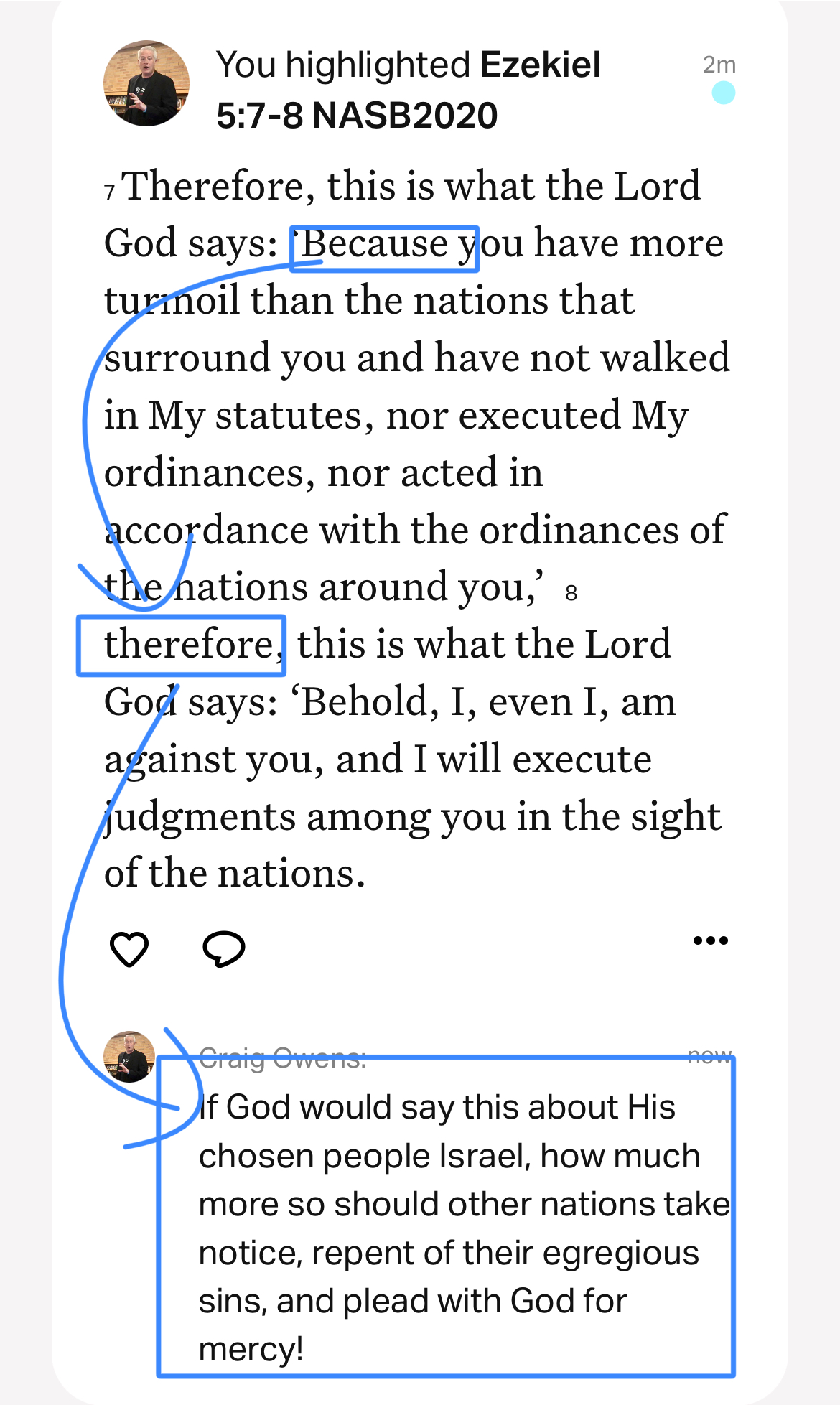
If God would say this (Ezekiel 5:7-9) about His chosen people Israel, how much more so should other nations take notice, repent of their egregious sins, and plead with God for mercy!

Takin’ Him To The Samaritans

Listen to the podcast of this post by clicking on the player below, and you can also subscribe on AppleSpotify, or Audible. 

Jesus sent us to all nations—to all the streets in all the world (Luke 24:47-49; Acts 1:8). We are to begin in Jerusalem and move outward. As we have seen, Jerusalem is like out Main Street, where there are more similarities than differences between us and the people to whom we are taking the Good News of Jesus. Judea is our Lombard Street & Rodeo Drive, where we are starting to see more differences. 

Then we move to Samaria where there are now way more differences than similarities. But still, let’s never forget that Jesus sent us and the Holy Spirit empowers us to be effective in our witness on every street—even those with whom we have very little in common. 

Jesus literally traveled to Samaria in John 4.

Jesus was baptizing in the Judean countryside (John 3:22) and now He is heading back to Galilee. “The shortest route from Judea in the south to Galilee in the north went through Samaria. The journey took three days if one wanted to travel the direct route. The Jews often avoided Samaria by going around it along the Jordan River. The hatred between the Jews and Samaritans went back to the days of the exile” (Dr. Henry Halley). 

There were wide differences between Jesus and this woman of Sychar:

  1. Cultural differences—The Jews considered the Samaritans to be no longer “pure” Jews, but half-breeds and traitors (vv. 5-9). 
  1. Personal differences—She was female, Jesus was male; she was a divorcée, Jesus was single (vv. 9, 16-18). 
  1. Religious differences—The Samaritans only recognized the Pentateuch; the Jews recognized the entire Old Testament Scripture. And the Samaritans saw Mt. Gerizim as the center of worship and the place the Messiah would reign; the Jews believed Jerusalem to be the center of worship (vv. 19-20). 

Our first task is to find common ground with whoever we can. Jesus used the word “whoever” three times in John 3:16, 18, 36, saying that whoever believed in Him would have eternal life. We need to have this same mindset. It’s not His desire that any should perish—not even the Samaritans!—but that all should come to know Him as Savior. 

In his book Winning With People, John Maxwell presents The 101% Principle: Find the 1% we can agree upon and give that 100% of your effort. 

Jesus found the 1% and gave 100% to it. For He and this Samaritan woman their common connection was water and worship (John 4:9-15, 21-26). Jesus used both of those things to open a conversation about eternal matters. 

Who are the Samaritans in my life? They are people…

  • …I have very little in common with 
  • …I go out of my way to avoid talking to 
  • …I think are never going to “get it” 
  • …who make me angry, defensive, or combative 

But they are also people…

  • …for whom Jesus died
  • …who are dearly loved by our Heavenly Father 
  • …who need to hear the Gospel 
  • …to whom I have been sent 

Our prayer should be this: 

Holy Spirit, help me to notice the people to whom I have been blind or whom I have been avoiding. Help me to find the 1% on which we can agree, and then empower me to give 100% of my effort to that 1%. I want my heart to beat with the heart of my Savior: Whoever believes on Him will not perish but will have eternal life.

If you’ve missed any of the others messages in our Takin’ Him to the Streets series, you can find them all by clicking here. 

►► Would you please prayerfully consider supporting this ministry? My Patreon supporters get behind-the-scenes access to exclusive materials. ◀︎◀︎

Links & Quotes

The Holy Spirit loves to give us those “lightbulb moments” when the Word of God almost leaps off the page! I have lots of new content every week, which you can check out on my YouTube channel.

It has long been believed that some migratory animals use the earth’s magnetic force to help them navigate. Some researchers discovered that moths can see both the magnetic fields and the stars to plot their course. The lead researcher wrote, “If you have this tiny insect with a brain a tenth the volume of a grain of rice and eyes smaller than a pinhead, that they can do this is surprising.” The protein in their eyes that allow them to do this is unevolved—it’s always been there, implant from the beginning by our awesome Creator!

In the God Speaks Science reading plan on YouVersion, John Von Sloten wrote, “Creation is God’s first book. To read it we need science. Science is not the enemy of the Christian faith; it’s an ally! … We need to read biblical creation references with the Author’s omniscience and original intent in mind. To do that, we need science. … What if you try to connect the next scientific truth you encounter to an attribute of our ever-near God? If everything comes from God’s mind, then everything has something to say about God’s nature.”

Competitive leaders need to keep both winning and losing in perspective. Check out the full conversation Greg and I had about competition on The Craig and Greg Show.

I love studying the archeological discoveries that confirm the historicity of the Bible. Check out this compilation of the kings of Judah and Israel from The Bible Archeology Report. You may also be interested in this side-by-side chart I created of the timelines of these kings.

“Men of peace must not think about retribution or recrimination. Courageous people do not fear forgiving.” —Nelson Mandela

“Leaders inspire others because they are inspired by others.” —John Maxwell

“The most important single ingredient in the formula of success is knowing how to get along with people.” —Teddy Roosevelt

Links & Quotes

Don’t give in to F.E.A.R. When the devil’s lies make us afraid, remember that F.E.A.R. stands for false evidence appearing real. The Holy Spirit can help you find the true evidence in God’s Word that will confront and dismantle the false evidence. Check out this full message here. I have lots of new content every week, which you can check out on my YouTube channel.

“Meanwhile it is also necessary for the ruler [pastor] to keep wary watch, lest the lust of pleasing men assail him; lest, when he studiously penetrates the things that are within, and providently supplies the things that are without, he seek to be beloved of those that are under him more than truth…” (Gregory the Great). Check out how T.M. Moore unpacks this quote.

The Culture Translator” newsletter from Axis has this sobering reminder of the dangers of pornography. 

What it is: An eye-opening essay in The Free Press describes the impact of pornography on a teen’s developing brain.

What it tells us: The author of this piece, Isabel Hogben, is a homeschooled high schooler living in Redford City, California. In one of several devastating lines, Hogben details how she stumbled upon PornHub when she was only ten years old, even as her very present mother was “making sure I was eating nine differently colored fruits and vegetables on the daily.” Hogben goes on to explain that today’s pornography depicts a synthetically augmented and physically brutal type of sex that makes Playboy magazine look “like an American Girl Doll catalog.” She notes that teens who have never had a physical sexual encounter can’t know the difference between what fake sex and real sex is supposed to be like, skewing their expectations, and that her peers think selling nudes online is normal. As she examines the way porn causes scientifically-measurable changes in the brain, Hogden concludes that porn is not “content” as much as it is a dangerously addictive substance not unlike street drugs.

“Do nothing that you would not like God to see. Say nothing you would not like God to hear. Go no place where you would not like God to find you. Never spend your time in such a way that you would not like God to say, ‘What are you doing?’” —J.C. Ryle

“Learning to say no is not just about courage, but also learning how to prioritize your life and become more productive.” —John Maxwell