12 Lessons From The Good Samaritan

Listen to the podcast of this post by clicking on the player below, and you can also subscribe on iTunes or Spotify.

Dwight Moody was passionate about telling others how they could have a relationship with Jesus. In his book To The Work! he encourages other Christians to share this passion with him, and he counters any hesitations that Christians have to this work. Using the story Jesus told about the good Samaritan, Moody made these noteworthy observations: 

“Some people seem to think that all the world needs is a lot of sermons. Why, the people of this land have been almost preached to death. What we want is to preach more sermons with our hands and feet—to carry the Gospel to the people by acts of kindness. … 

“The Jews considered that the Samaritans had no souls; that when they died they would be annihilated. Their graves would be so deep that not even the sound of Gabriel’s trump would wake them on the resurrection morning. He was the only man under heaven who could not become a proselyte to the Jewish faith, and become a member of the Jewish family. …  

“You observe there are twelve things mentioned in the narrative that the Samaritan did. We can dismiss in a word all that the priest and the Levite did—they did nothing.

(1.) He ‘came to where he was.’ 

(2.) He ‘saw him;’ he did not, like the priest, pass by on the other side. 

(3.) He ‘had compassion on him.’ If we would be successful winners of souls we, too, must be moved with compassion for the lost and the perishing. We must sympathize with men in their sorrows and troubles, if we would hope to gain their affections and to do them good. 

(4.) He ‘went to him.’ The Levite went toward him, but we are told that he, as well as the priest, ‘passed by on the other side.’ 

(5.) He ‘bound up his wounds.’ Perhaps he had to tear up his own garments in order to bind them up. 

(6.) He poured in oil and gave some wine to the fainting man. 

(7.) He ‘set him on his own beast.’ Do you not think that this poor Jew must have looked with gratitude and tenderness on the Samaritan, as he was placed on the beast, while his deliverer walked by his side? All the prejudice in his heart must have disappeared long before they got to the end of their journey. 

(8.) He ‘brought him to an inn.’ 

(9.) He ‘took care of him.’ … 

(10.) When he departed on the morrow, the good Samaritan asked the host to care for him. 

(11.) He gave him some money to pay the bill. 

(12.) He said: ‘Whatever thou spendest more, when I come again I will repay thee.’ …  

“Do you want to know how you can reach the masses? Go to their homes and enter into sympathy with them; tell them you have come to do them good, and let them see that you have a heart to feel for them. When they find out that you really love them, all those things that are in their hearts against God and against Christianity will be swept out of the way.” 

To read my full book review of To The Work!, please click here. You can also check out some other quotes that I have shared from this book by clicking here. 

Thursdays With Spurgeon—God Wants To Bless You

This is a weekly series with things I’m reading and pondering from Charles Spurgeon. You can read the original seed thought here, or type “Thursdays With Spurgeon” in the search box to read more entries.

Listen to the podcast of this post by clicking on the player below, and you can also subscribe on iTunes or Spotify.

God Wants To Bless You

     It delights God to bestow His goodness. The cost was paid long ago on Calvary’s Cross, and that is over. Since the great sacrifice has been presented, God freely gives all the blessings of divine grace to us with a willingness that shows that His heart goes with them. …  

     Come along with you, you needy saint or sinner. The more you can take in, the better pleased will the Lord be with you. … The Lord desires you to open your mouth wide and He will fill it—it is easier for Him to give than for you to open your mouth. He encourages and requests you to bring large petitions with you when you come before His mercy seat. …  

     ‘How can I apprehend these blessings and make them my own?’ … ‘The natural man does not receive the things of the Spirit of God’ (1 Corinthians 2:14). The power to receive the things of God lies not in high gifts or attainments. … Do not sit down and say, ‘I am a poor stupid man and cannot be taught of God.’ Or, ‘I am a humble countryman, or a poor woman keeping house for others. I cannot know these precious things.’ It is not so. Read the words of Paul in the first chapter of this Epistle: ‘For you see your calling, brethren, that not many wise according to the flesh, not many mighty, not many noble, are called’ (1 Corinthians 1:26). The power to receive the blessings of God does not lie in talent at all, but it lies in the Spirit of God. …

     Grace is not tied to the rare gifts of genius, nor to the precious acquirements of experience, nor to the high attainments of learning. … The power to receive is still of the Holy Spirit, and the Holy Spirit does not find good in us but brings it to us.

From Grace For Grace

I truly believe that God wants to bless us more than we want to receive God’s blessings. Far too many times I encounter people who want to talk themselves out of their worthiness to receive anything from God. 

But remember this verse: Since He did not spare even His own Son but gave Him up for us all, won’t He also give us everything else? (Romans 8:32). If God the Father would give up His Son to make it possible for you to be reconciled to Him, why would He hold anything back from you. 

God’s doesn’t want to blast you, He wants to bless you!

Please, my friend, let Him bless you. His blessings aren’t because of anything you or I have done to deserve them. The definition of “grace” is an undeserved gift. God gives and He enables us to receive. Let Him pour out His blessings on you today!

The Prayerful Heart Of Our Testimony

Listen to the podcast of this post by clicking on the player below, and you can also subscribe on iTunes or Spotify.

The best way to be a first responder in prayer is to work on making prayer a habit. Prayer needs to come first. Remember: I can do more than pray, but I shouldn’t do anything until I have prayed. 

King David showed us his nearly-identical “bookend prayer” that he prayed both at the beginning of his reign as king and again just before he died. We can pray similar bookend prayers when we begin with a petitionary prayer—“God, please help me”—and finish with a thankful prayer—“God, thank You for helping me.” We can also try to expand those bookends toward the middle, allowing us to live as the apostle Paul admonished in 1 Thessalonians 5:17: 

  • Pray without ceasing 
  • Pray continually 
  • Never stop praying 

Jesus gave us a model prayer at the heart—the very middle—of His Sermon on the Mount. This sermon has 107 verses of Christ’s words, making the middle verse Matthew 6:6, which starts, “When you pray….” Notice the model Jesus gave us: 

  • Hallowing God—Our Father in heaven, hallowed be Your name
  • Bringing our petitions—Give us our daily bread, help us forgive, deliver us from evil
  • Worshiping God for His answers and for Who He is—Yours is the kingdom and the power and the glory forever. Amen!

Surrounding this prayer is a Christ-centered life that is:

  • Blessed (the beatitudes) 
  • God-glorifying—so they may see your good works and glorify your Father in heaven
  • Perfect—be perfect, even as your heavenly Father is perfect
  • Compassionate—when you give to the needy

—Model Prayer—

  • Disciplined—fasting, handling your treasures 
  • Anxiety-free—do not worry
  • Fruitful—every good tree bears good fruit
  • Secure—your foundation is on the rock

You see: Prayer helps us live out a God-honoring testimony, and that God-honoring testimony is empowered by prayer. Prayer is both the bookends AND at the heart of a Christ-centered life. 

The heart of a God-honoring prayer is to live out a God-honoring testimony.

David’s bookend prayer follows the same model Jesus gave us: hallowing God, making petitions, and then worshipping God. 

Christians need to be BOTH first responders in prayer AND continual responders in prayer—prayer at the beginning, prayer at the heart, and prayer at the end. This way, when God does answer, there is no doubt that He was the One who answered, and it wasn’t just because of something we did. 

Prayer fuels our testimony. Our testimony glorifies God. At the heart of this testimony, our answered prayers glorify our heavenly Father and point others to Him. 

Let me say it again: The heart of a God-honoring prayer is to live out a God-honoring testimony.

If you’ve missed any of the messages in our series called Be A First Responder, you can access the full list by clicking here.

Thursdays With Spurgeon—The Greatest Gift

This is a weekly series with things I’m reading and pondering from Charles Spurgeon. You can read the original seed thought here, or type “Thursdays With Spurgeon” in the search box to read more entries.

Listen to this post as a podcast by clicking here:

The Greatest Gift

Come…buy wine and milk without money and without price. … The gift of God is eternal life in Christ Jesus our Lord…. (Isaiah 55:1; Romans 6:23) 

     The free grace of God would be insulted by being put up for auction or set forth for sale. … It is a gift and not a prize. There are heavenly prizes to be run for, to be fought for, and to be obtained by divine help. There is a recompense of reward to which we are to look and a crown for which we are to strive, but the divine grace that forgives sin and works faith is no prize for exertion but rather a gift for those without strength. ‘It is not of him who wills, nor of him who runs, but of God who shows mercy’ (Romans 9:16). … 

     The blessings of salvation are freely given us of God; therefore they are not a loan, handed to us for a time and to be one day recalled. Our heavenly heritage is not held on lease, upon terms of annual payment. It is an unencumbered freehold to every man who has by faith put his foot upon it. … When He has given it, the deed is done outright and can never be reversed. O believer, if your sin is blotted out, it can never be written in again! God has declared that He has forgiven our transgressions. And then He adds, ‘Their sins and iniquities will I remember no more’ (Hebrews 10:17). … 

     God is unchangeable, and therefore what He has given He will give again. ‘Still there’s more to follow’ is a popular way of putting a great truth. The stream that has begun to flow will never cease flowing. The more the Lord gives, the more we may expect. Every blessing is not only in itself a mercy, but it is a note for more mercies.

From Grace For Grace

I shared a series of messages on God’s favor—His free gift that we call grace—that was one of the most downloaded and watched of any series I have presented. It almost seems inconceivable to people that God would give so freely and lavishly without expecting some sort of payment in return. 

Why would God “not spare even His own Son but [give] Him up for us all” (Romans 8:32)? Because if you feel distant from Him, how can you glorify Him? If you feel disconnected from His love, how will you draw others to Him? If you feel like your relationship with Him is hanging by a thread, how can you happily abide in His presence? 

Knowing God’s favor—His free gift—is the key to living the abundant life Jesus purchased for you on the Cross!

Do I Have Standing?

Listen to this post as a podcast by clicking here:

If it is true that I have gone astray, my error remains my concern alone (Job 19:4).

Why do we find it necessary to stick our noses in where they are not wanted? Why do we feel like the other person needs to hear our opinion? 

The law dictionary defines “standing” as the right to file a lawsuit or file a petition under the circumstances. In legal terms, Job’s three friends had no standing to bring charges against him. Job himself even said he didn’t want to hear their opinions. Instead, all Job asked for was, “Have pity on me, my friends, have pity.” He goes on to ask, “Why do you pursue me as God does? Will you never get enough of my flesh?” 

And then Job gives this warning: “If you say, ‘How we will hound him, since the root of trouble lies in him,’ you should fear the sword yourselves.” Despite this warning, Zophar still begins his argument by stating, “I hear a rebuke that dishonors me so I have to speak up.” 

There are indeed times when our friends may be going astray and the loving thing we can do for them is speak a word of truth, but that is something entirely different than feeling compelled to share an opinion or sticking our noses in where they don’t belong. A good question to ask ourselves before speaking: Do I have standing here?

Far better for us to apply the Golden Rule this way: Treat others in their condition the way I would want to be treated in the same condition. And if I do feel as though I have standing, and need to speak a loving word, I need to examine myself first.

Job tells his friends, “You are miserable comforters, all of you!” (16:2). One of the best things they did for him was to simply sit silently in mourning alongside him. It was when they felt compelled to argue that they not only disappointed Job, but they dishonored God too. 

My checklist before speaking:

  1. Do I have standing? 
  2. Have I examined myself? 
  3. Can I speak truth in love (and not just air my opinion)? 
  4. Have I considered the Golden Rule? 

If I can answer “Yes” to all four questions, then speak; otherwise, it’s far more loving to remain silent. 

Think, Do, Evaluate, Propose

Listen to the podcast of this post by clicking on the player below, and you can also subscribe on AppleSpotify, or Audible.

The seed thought for me was this quote from John Maxwell: 

“Nothing you do will be perfect, so embrace the reality and benefits of failure by releasing yourself from the burden of not making mistakes.” 

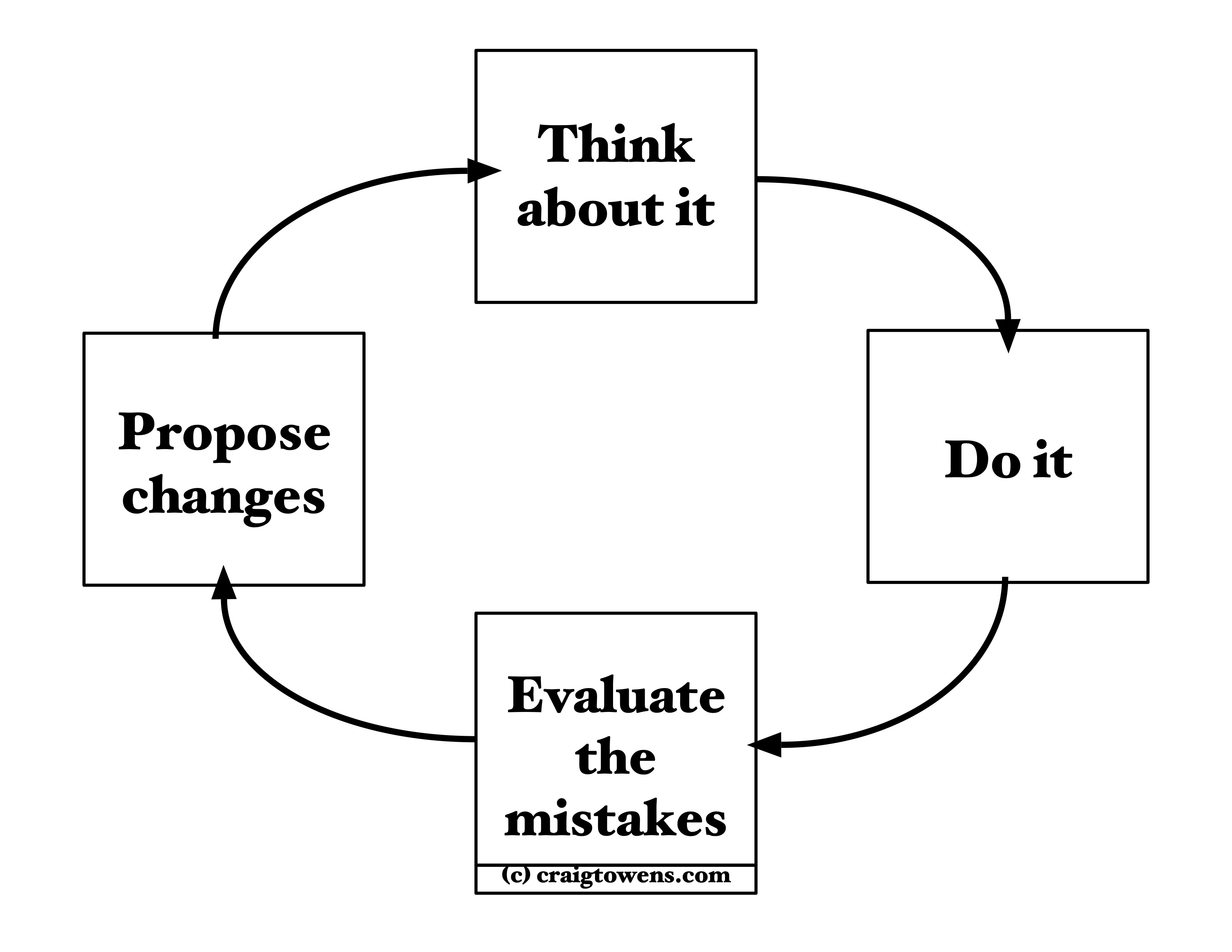
Here’s what I am endeavoring to implement: Think, Do, Evaluate, Propose. And then Repeat. 

THINK ABOUT IT—It’s important to put some thought into what you want to do before you do it, but we cannot camp-out here forever. I like to think in terms of goals I want to accomplish, whether those are for me personally or for organizations I lead. 

DO IT—At some point, I must launch out. Many people point out that Peter began to sink under the waves when he took his eyes off Jesus and began to look at the storm. But let’s not forget that Peter was the only one of the disciples who actually got out of the boat and walked on water! I often remind people who are hesitant to begin something that you cannot steer a parked car. We have to get moving first. 

EVALUATE THE MISTAKES—Let’s remove all doubt: you will make mistakes. But those mistakes are beneficial because it gives you something on which to work. Get some wise friends around you that can help you evaluate your mistakes. And always remember I failed ≠ I am a failure (here’s another post where I elaborate on this point). 

PROPOSE CHANGES—After evaluating your mistakes or shortcomings, you now have evidence that can be processed for your next attempt. This evidence can be taken back into the laboratory of the “Think” box as you prepare to try again, except now you are more informed than you were in your first attempt. 

REPEAT THE PROCESS AGAIN—No one is an overnight success, so keep trying again and again and again.

Leaders, walk through this process with your team members. Help guide their thinking, and then move them to action. Let them know that mistakes are okay because they have given you some invaluable feedback you can use as you make your proposals for your next attempt. 

Success is a continual run through the Think-Do-Evaluate-Propose cycle, with each revolution moving you closer to success. 

►► Would you please prayerfully consider supporting this ministry? My Patreon supporters get behind-the-scenes access to exclusive materials. ◀︎◀︎

Thursdays With Spurgeon—The Plan Of The Cross

This is a weekly series with things I’m reading and pondering from Charles Spurgeon. You can read the original seed thought here, or type “Thursdays With Spurgeon” in the search box to read more entries.

The Plan Of The Cross

What we have received is not the spirit of the world, but the Spirit who is from God, so that we may understand what God has freely given us. (1 Corinthians 2:12) 

     The course of our fallen race has been a succession of failures. Whenever there has been an apparent rise, it has been followed by a real fall. Into ever-increasing darkness the human mind seems resolved to plunge itself in its struggles after a false light. When men have been fools, they have danced in a delirium of sin. When they have been sober, they have given themselves up to a phantom wisdom of their own that has revealed their folly more than ever. It is a sad story, the story of mankind! Read it in the light of God’s Word and it will bring tears from your very heart.

     The only hope for man was that God should interpose. And He has interposed, as though He began a new creation or worked a resurrection out of the kingdom of death. God has come into human history and here the bright lights begin. … See yonder avalanche rushing down the steep mountainside? Such is humanity left to itself. Lo, God in Christ Jesus throws Himself in the way. He so interposes as to be crushed beneath the descending rocks. But beloved, He rises from the dreadful burial. He stops the avalanche in its terrible path. He hurls back the tremendous mass and changes the whole aspect of history. … 

     The plan of the Cross is to conquer death by death, to remove sin by the endurance of the penalty, to work mightily by suffering terribly, and to glorify Christ by shame.

From Grace For Grace

This sermon reminds me of the poignant words from Isaac Watts—

When I survey the wondrous Cross 
On which the Prince of Glory died, 
My richest gain I count but loss, 
And pour contempt on all my pride. 
Forbid it, Lord, that I should boast, 
Save in the death of Christ my God! 
All the vain things that charm me most, 
I sacrifice them to His blood.
 

All of man’s attempts to control his universe, or determine his fate, or even make himself acceptable to God have been an abysmal failure. So God Himself stepped in, but He came in a way that no one could have imagined and no one could claim as their idea. The prophet Isaiah said it this way, “The Lord looked and was displeased that there was no justice. He saw that there was no one, He was appalled that there was no one to intervene; so His own arm achieved salvation for Him, and His own righteousness sustained Him” (Isaiah 59:15-16). 

It is by grace alone, through faith alone, in Christ alone that we have hope of our salvation. And for that we give all glory to God alone. Sola Deo gloria!


9 Quotes From “To The Work!”

D.L. Moody passionately and persuasively dismantles all of the hesitations Christians have to being active and outspoken about their relationship with Jesus. Check out my full book review by clicking here. 

“I have often said that if I had to convict men of sin I would have given up the work long ago. That is the work of the Holy Ghost. What we have to do is to scatter the good seed of the Word, and expect that God will bless it to the saving of men’s souls.” 

“One of the great obstacles in the way of God’s work today is this want of love among those who are the disciples of the Lord Jesus Christ. … To address men well they must be loved much.” 

“Those who have been greatly used of God in all ages have been men of courage. If we are full of faith we shall not be full of fear, distrusting God all the while. That is the trouble with the Church of Christ today—there are so many who are fearful, because they do not believe that God is going to use them. What we need is to have the courage that will compel us to move forward.” 

“If you cannot engage in any active work yourselves you can do a good deal by cheering on others.” 

“Let us not be discouraged, but let us use all these wonderful opportunities, and honor God by expecting great things. If we do we will not be disappointed. God is ready and willing to work, if we are ready and willing to let Him, and to be used by Him.” 

“A good many people are afraid of the word enthusiasm. Do you know what the word means? It means ‘In God.’ … People say that if we go on in that way many mistakes will be made. Probably there will. You never saw any boy learning a trade who did not make a good many mistakes. If you do not go to work because you are afraid of making mistakes, you will probably make one great mistake—the greatest mistake of your life—that of doing nothing. If we all do what we can, then a good deal will be accomplished.” 

“When God wanted to bring the children of Israel out of bondage, He did not send an army; He sent one solitary man. So in all ages God has used the weak things of the world to accomplish His purposes.” 

“If this world is going to be reached, I am convinced it must be done by men and women of average talent. After all there are comparatively few people in the world who have great talents. … I do not believe, either, that all God’s work is going to be done by ministers, and other officers in the Churches. This lost world will never be reached and brought back to loyalty to God, until the children of God wake up to the fact that they have a mission in the world.” 

“Philip was called away from a great work in Samaria to go and speak to one man in the desert. Christ’s great sermon on Regeneration was addressed to one man; and that wonderful discourse by our Lord on the Water of Life was spoken to one poor sinful woman. I pity those Christians who are not willing to speak to one soul; they are not fit for God’s service. We shall not accomplish much for God in the world, if we are not willing to speak to the ones and twos. … The Lord expects us to do what we can. We can all do something.”

God Delights In Me

It’s been said that the bookends of success are starting well and finishing well. I believe that! 

David started well when he lifted up a prayer of thankfulness to God when he became king over the united nation of Israel. Prayer at the the beginning puts us on a path toward success. 

Have you ever begun to assemble a child’s toy or a piece of furniture, gotten completely stumped, and only then read the instruction manual? We’ve all been there! There are many things in life that we start on our own and then hit our knees in prayer only after we’ve exhausted all of our human resources. Fortunately, after we pray and God answers, we often end up finishing well with a prayer of praise and thanksgiving. The question is: what do we do when we again get ready to start something else? Do we pause to start well with prayer, or do we dive in on our own again? 

I think one of the biggest reasons we don’t go to prayer quickly is because we feel unworthy to go into the presence of a holy, righteous God. 

One commentator said about Psalm 18 that David probably prayed this “before he committed his terrible sin” with Bathsheba and Uriah. That may be, but with very few minor changes, David prayed this exact same prayer (2 Samuel 22) at the very end of his reign. His reign as king was bookended with the same prayer. 

Between the bookend prayers of Psalm 18 and 2 Samuel 22, David prayed another prayer—this one was after he had sinned against God, Bathsheba, and Uriah. David truly believed that God forgave that sin and wiped the slate clean, so much so that he noted this great blessing on his life: “He brought me out into a spacious place; He rescued me because He delighted in me. 

He rescued me because He delighted in me?! Yes! 

David knew that God had told us that He delights in those who obey Him. The example of God’s delight was seen in Jesus. Because Jesus paid the price for the forgiveness of my sins, I can be completely cleansed. Then Jesus comes in me, and takes me into Him, and takes both of us into the Father. So now when our Heavenly Father looks at a forgiven sinner, He sees only the righteousness of Jesus—something He utterly delights to see! (Check out all of the biblical passages I’m referencing by clicking here.)  

David said his sin had been washed “whiter than snow” (Psalm 51:7), So now look at what he could claim—

The Lord has dealt with me according to my righteousness; according to the cleanness of my hands He has rewarded me. For I have kept the ways of the Lord; I am not guilty of turning from my God. All His laws are before me; I have not turned away from His decrees. I have been blameless before Him and have kept myself from sin. The Lord has rewarded me according to my righteousness, according to my cleanness in His sight” (2 Samuel 22:21-25). 

…according to my cleanness in His sight. 

In GOD’S sight! The devil wants to accuse me. He wants my sight to dominate. The devil doesn’t want me to see myself as God sees me. But I declare it out loud: I am clean IN HIS SIGHT! 

This cleanness allows me full, bold, confident access to Almighty God! I can take everything to God in prayer because I am clean in His sight! 

If you would like to read more of the posts in our prayer series called Be A First Responder, please click here. 

Thursdays With Spurgeon—The Wonderful Works Of God

This is a weekly series with things I’m reading and pondering from Charles Spurgeon. You can read the original seed thought here, or type “Thursdays With Spurgeon” in the search box to read more entries.

The Wonderful Works Of God

Now there were staying in Jerusalem God-fearing Jews from every nation under heaven. … Utterly amazed, they asked “Are not all these men who are speaking Galileans…declaring the wonders of God in our own tongues!” (Acts 2:5-11) 

     The Holy Spirit being thus at work, what was the most prominent subject that these full men begin to preach about with words of fire? Suppose that the Holy Spirit should work mightily in the church. What would our ministers preach about? We should have a revival, should we not, of the old discussions about predestination and free agency? I do not think so! These are happily ended, for they tend toward bitterness, and, for the most part, the disputants are not equal to the task. We should hear a great deal about the premillennial and the postmillennial advent, should we not? I do not think so! I never saw much of the Spirit of God in discussions or dreams upon times and seasons that are not clearly revealed. Should we not hear learned essays about advanced theology? No, sir. When the devil inspires the church, we have modern theology—but when the Spirit of God is among us, that rubbish is shot out with loathing! 

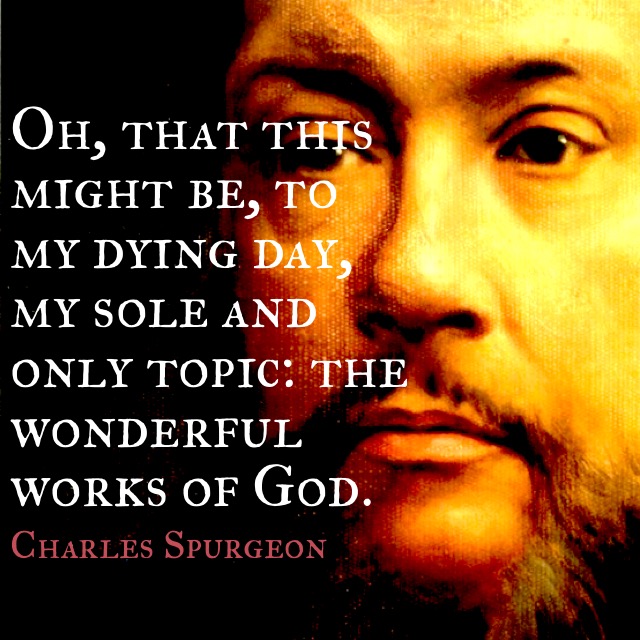
     What did these men preach about? Their hearers said, ‘We hear them speaking in our own tongues the wonderful works of God’ (Acts 2:11). The subject was the wonderful works of God! Oh, that this might be, to my dying day, my sole and only topic: ‘the wonderful works of God.’

From Pentecostal Wind And Fire

Whether we are pastors or parishioners, may our heart cry echo that of Charles Spurgeon: May all that comes from my lips be words that tell of the wonderful works of God! 

After the Church was born on that Pentecost Sunday, their message wasn’t one of doctrinal differences or the ills of society. No! These Spirit-baptized Christians went everywhere proclaiming how wonderful it was to be in a personal relationship with our Heavenly Father through the way opened to us by the death and resurrection of Jesus. 

May we emulate their example today: Empowered by the Holy Spirit to go everywhere and tell everyone how wonderful our God is!