Inspiration, Illumination, And Boldness

Listen to the podcast of this post by clicking on the player below, and you can also subscribe on AppleSpotify, or Audible. 

David declared that the Holy Spirit inspired the words he penned. “The Spirit of the Lord spoke in and by me, and His word was upon my tongue” (2 Samuel 23:2). 

Both Jesus and Peter affirm this in the New Testament as well when they make mention that David’s words were given to him by the Holy Spirit (Matthew 22:43; Mark 12:36; Acts 1:16, 4:25). 

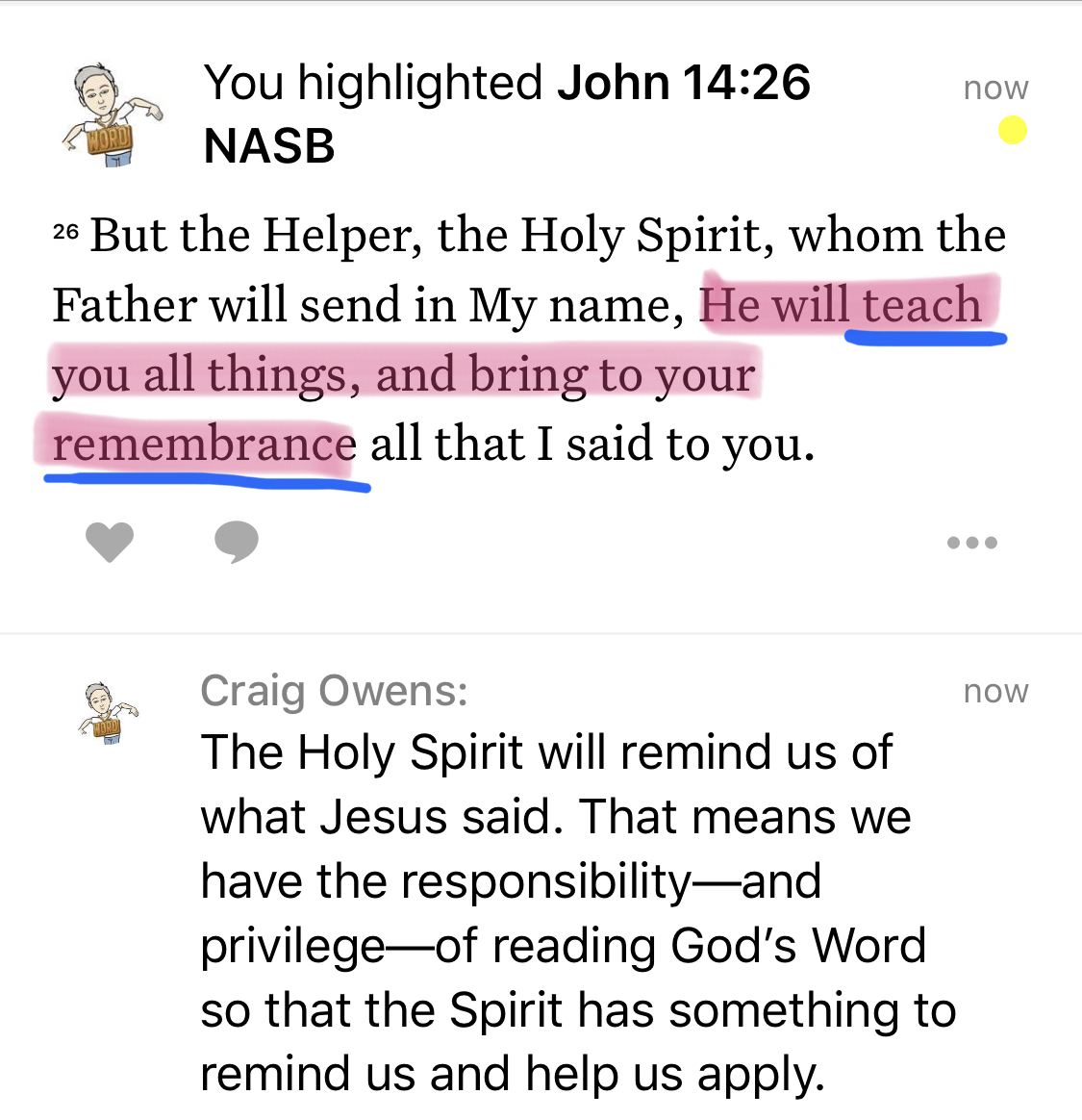
It’s not just the words of David, but all Scripture is God-breathed (2 Timothy 3:16; 2 Peter 1:21)! This is why we would be wise to pray before reading our Bibles to ask the One Who inspired the Scripture to illuminate our minds to understand it and guide us into its daily application (John 14:26, 16:13). 

Jesus desired that we go even farther than this. His directive to His followers was for them to be baptized in the Holy Spirit. This initial baptism took place on the first Pentecost celebration after Jesus had ascended to Heaven. Luke records it this way—

And they were all filled (diffused throughout their souls) with the Holy Spirit and began to speak in other (different, foreign) languages (tongues), as the Spirit kept giving them clear and loud expression in each tongue in appropriate words. (Acts 2:4 AMPC) 

And in the subsequent verses Luke makes it clear that these were intelligible languages and intelligent words that served as a testimony to the worldwide visitors that were in Jerusalem—

And when this sound was heard, the multitude came together and they were astonished and bewildered, because each one heard them—the apostles—speaking in his own particular dialect. And they were beside themselves with amazement, saying, “Are not all these who are talking Galileans? Then how is it that we hear, each of us, in our own (particular) dialect to which we were born? Parthians and Medes and Elamites and inhabitants of Mesopotamia, Judea and Cappadocia, Pontus and the province of Asia, Phrygia and Pamphylia, Egypt and the parts of Libya about Cyrene, and the transient residents from Rome, both Jews and the proselytes to Judaism from other religions, Cretans and Arabians too—we all hear them speaking in our own native tongues and telling of the mighty works of God!” (vv. 6-11 AMPC) 

In his sermon that followed this event, Peter states that the baptism in the Holy Spirit—with the physical evidence of speaking in tongues—is an evidence of Christ’s resurrection. “Being therefore lifted high by and to the right hand of God, and having received from the Father the promised blessing which is the Holy Spirit, He has made this outpouring which you yourselves both see and hear” (v. 33). 

Later on, when the Christians were facing the threat of persecution from the Jewish leadership, they prayed. In their prayer, they noted again the Spirit-inspired words that David penned and the desire of Jesus for them to be His missionaries (see Acts 4:24-30). 

God answers their prayer powerfully! “And when they had prayed, the place in which they were assembled was shaken; and they were all filled with the Holy Spirit, and they continued to speak the word of God with freedom and boldness and courage” (v. 31). 

The Holy Spirit gave us the Scripture, and He illuminates the Scripture to us. 

The Holy Spirit assures us of our salvation, and He empowers us to share this Good News with others. 

The Holy Spirit gives us words to speak, and He gives us the boldness and courage to speak them. 

He speaks, He illuminates, He empowers, He emboldens! If your theology limits the work of the Holy Spirit to some obscure corner of your world, you are robbing yourself of the power to live a God-glorifying, Jesus-promoting life. 

You may be interested in some additional posts and sermons where I discuss more about the initial physical evidence of speaking in tongues as the Holy Spirit empowers Christians—

You may also be interested in an extensive series of messages I have shared called We Are: Pentecostal. 

►► Would you please prayerfully consider supporting this ministry? My Patreon supporters get behind-the-scenes access to exclusive materials. ◀︎◀︎

Clearing Up The Confusion

Listen to the podcast of this post by clicking on the player below, and you can also subscribe on AppleSpotify, or Audible. 

The apostle Peter had a very unusual encounter with a vision and with the voice of Jesus. 

It was so unusual that Luke records that Peter was “wondering“ and later on “still thinking“ about what he had seen and heard, and what the implications of the vision were (Acts 10:17, 19). In the KJV, the word for “wondering” is translated “doubted within himself.” The Greek words that Luke uses here mean perplexed and entirely at a loss. In essence, Peter was asking, “What did I just see? What in the world does this even mean?!” 

(Check out all of the Scriptures in this post here.) 

The vision came to Peter as he was praying on the roof of Simon‘s house. Because he was still on the roof when some men from Cornelius the centurion arrived, I believe this means that Peter stayed in an attitude of prayer while he was still wondering. That is an excellent posture for us to remain in as well when we are unclear as to what to do next. 

As I mentioned, Luke says that Peter “was still thinking” about what he had seen and heard (v. 19). This is a different Greek word which means to revolve in mind. In other words, Peter didn’t brush it off or think it was simply too complex for him to grasp, but he continued to look at it, wondering about what it could mean. 

I believe Peter is desirous to obey God, but he just doesn’t know what that obedience is supposed to look like. Instead of shutting down or launching out too quickly, Peter continues to wait for some illumination. 

It was at this point—while still in a prayerful, thoughtful posture—that the Holy Spirit could speak to him. The Holy Spirit simply said, “there are some men here to see you. You must not hesitate to go with them“ (vv. 19-20). 

Although Peter couldn’t see this yet, his obedience would actually be the first step toward understanding and applying the vision. 

It was as Peter talked with his visitors that afternoon, and then as he heard Cornelius‘ story the next day, that the application became clear to him. We can gather this when we hear Peter say, “God has shown me“ (v. 28). As he was retelling this story to some Jewish Christians later, he also said, “then I remembered what the Lord had said” (11:16). 

For Peter and his companions that traveled with him, God’s message in the vision became crystal clear when they all saw “that the gift of the Holy Spirit had been poured out even on Gentiles” (10:45-47). 

Here are some important takeaways for all of us. When God speaks a word to us that seems to be confusing, we must stay in a prayerful, expectant posture. Don’t brush it off, and don’t jump to any conclusions. Like Peter, stay in prayer and wait for a clearer word from the Holy Spirit. When the Holy Spirit reveals something else to you, walk forward in the part that is clear. It is as you are walking in obedience that God‘s full message will become clear to you. 

►► Would you please prayerfully consider supporting this ministry? My Patreon supporters get behind-the-scenes access to exclusive materials. ◀︎◀︎
Power-Packed Sermons

Listen to the podcast of this post by clicking on the player below, and you can also subscribe on AppleSpotify, or Audible. 

Jesus began to speak to them in parables… (Mark 12:1). 

What Jesus relates here in the 12th chapter of Mark’s Gospel is only the fourth parable that Mark records, and as the final parable that Jesus shares, it brings His public ministry to a close. 

Jesus concludes this parable by quoting from Psalm 118. This Psalm is the last of the “Hallel Psalms” that were sung at the conclusion of the Passover celebration. This song specifically looks eagerly forward to the arrival of the Messiah. It contains the words that the crowd used on Palm Sunday: “Lord, save us! Lord, grant us success! Blessed is He who comes in the name of the Lord” (Psalm 118:25-26). By quoting from the same Psalm—that was perhaps hundreds of years old, but had just been sung and shouted by the crowd—Jesus was claiming to be the Messiah longed for in that Hallel Psalm. 

As you may recall, these shouts from the crowd and the activities of Jesus as He cleansed the temple got the religious leaders riled up! They, in essence, asked Jesus, “Who do You think You are?!” His answer is contained in this parable of Mark 12. 

At the conclusion of this parable, the religious leaders “knew He had spoken this parable against them” (Mark 12:12).

Mark’s observation about the response of the religious leaders is, in a nutshell, the essence of a Holy Spirit-anointed sermon. The connection of Scripture to current events is powerful! The Holy Spirit is also the One who brings the application of Scripture to bear on the hearts of the audience.

Pastors, if you want to deliver soul-shaking, life-transforming, eye-opening, heart-melting sermons, you must follow this example of Jesus: Stick with the Scripture! 

We don’t need to try to be clever or witty or even memorable. We just need to speak the Word of God that is inspired by the Holy Spirit, and then allow the Holy Spirit to illuminate that inspired Word to each person’s needs. As Randy Pope noted, “Preaching is not talking to people about the Bible; it is talking to people about themselves from the Bible.” 

I don’t want to try to make my voice impress people, but I am desperate for God’s voice to impact people. Nearly every week as I prepare a sermon, I’ll pray this prayer from Oswald Chambers: “In my preaching, cause Thy glorious voice to be heard, Thy lovely face to be seen, Thy pervasive Spirit felt.” My dear pastor, I would encourage you to make this your prayer as well. 

►► Would you please prayerfully consider supporting this ministry? My Patreon supporters get behind-the-scenes access to exclusive materials. ◀︎◀︎

Links & Quotes

“…and let us all hasten to approach to perfect manhood, to the measure of the completed growth of the fullness of Jesus Christ, in Whom let us love one another, praise one another, correct one another, encourage one another, pray for one another, that with Him in one another we may reign and triumph.” —Columbanus, Letter to Certain Bishops, Irish, early 7th century

This is pretty cool: Mastodon bones were discovered in our community. It is cool to think that these amazing creatures were wandering around in our neighborhood.

Have you ever wondered how the laws of the Old Testament era should be applied to New Testament Christians? Theologian T.M. Moore has an excellent series of articles on this, but I think his post The Church is not Ancient Israel is especially informative.

Here is one way the Holy Spirit can speak to us—

“It is not the body of truth that enlightens; it is the Spirit of truth who enlightens. If you are willing to obey the Lord Jesus, He will illuminate your spirit. He will inwardly enlighten you. The truth you have known intellectually will now be known spiritually. Power will begin to flow up and out, and you will find yourself changed—marvelously changed.” —A.W. Tozer

“The greatest tragedy of life is not unanswered prayer, but unoffered prayer.” —F.B. Meyer

This is pretty cool: some fossilized human footprints in the salt flats of Utah. “Both creationist and uniformitarian scientists agree that these tracks were made during the Ice Age, although they disagree about when the Ice Age occurred. Creationists think these footprints are just a few thousand years old. However, evolutionists think the tracks are more than 10,000 years old, because they believe the wet conditions needed to form and preserve the footprints have been absent from the Great Salt Lake area for at least that long. … wet Ice Age deserts are extremely difficult for evolutionary scientists to convincingly explain. However, the Bible’s real history makes much better sense of both these wet deserts and preserved Ice Age footprints.”

Don’t cut corners to get more. Instead, be faithful, do your best work, and the “more” will follow at the right time—

Thursdays With Spurgeon—Top Priority

This is a weekly series with things I’m reading and pondering from Charles Spurgeon. You can read the original seed thought here, or type “Thursdays With Spurgeon” in the search box to read more entries.

Listen to the podcast of this post by clicking on the player below, and you can also subscribe on AppleSpotify, or Audible. 

Top Priority

…For the mouth of the Lord has spoken (Isaiah 1:20).

     Every word that God has given us in the Bible claims our attention because of the infinite majesty of Him who spoke it. … See that you refuse not Him who speaks. O my hearer, let it not be said of you that you went through this life, God speaking to you in His book, and you refusing to hear! It matters very little whether you listen to me or not. But it matters a very great deal whether you listen to God or not. It is He who made you. In His hands is your breath. And if He speaks, I implore you, open your ears and be not rebellious. There is an infinite majesty about every line of Scripture, but especially about that part of Scripture in which the Lord reveals Himself and His glorious plan of saving grace in the Person of His dear Son Jesus Christ. …  

     For what He has spoken He still speaks to us, as freshly as if He spoke it for the first time. … 

     God’s Word has a claim, then, upon your attention because of its majesty and its condescension. But, further, it should win your ear because of its intrinsic importance. ‘The mouth of the Lord has spoken,’ so it is no trifle. God never speaks vanity. No line of His writing treats of the frivolous themes of the day. That which may be forgotten in an hour is for mortal man and not for the eternal God. When the Lord speaks, His speech is Godlike, and its themes are worthy of one who is dwelling in infinity and eternity. … 

     He speaks to you of great things that have to do with your soul and its destiny. It is not a vain thing for you, because it is your life. Your eternal existence, your happiness or your misery, hang on your treatment of that which the mouth of the Lord has spoken. … Treat not the Word of the Lord as a secondary thing that might wait your leisure and receive attention when no other work is before you. Put all else aside and hearken to your God.

From The Infallibility Of Scripture

Charles Spurgeon is so on-target with these words. Believe it or not, this sermon was actually delivered to his fellow pastors. But the words are true for all of us—we must make listening to God’s Word our first priority. 

Every single word of Scripture is inspired by the Holy Spirit. And I do mean every single word. Even the order in which the words are listed is inspired. So when you read your Bible, ask the Holy Spirit—the Author of the text—to illuminate the words to you. Ask questions like:

  • What did that mean then? 
  • What does it mean now? 
  • What does it mean for me? 
  • Does something in my life need to change? 

If you make your time with God a priority, He will reveal more of Himself to you each time you open your Bible.

►► Would you please prayerfully consider supporting this ministry? My Patreon supporters get behind-the-scenes access to exclusive materials. ◀︎◀︎

Thursdays With Spurgeon—Context Is King

This is a weekly series with things I’m reading and pondering from Charles Spurgeon. You can read the original seed thought here, or type “Thursdays With Spurgeon” in the search box to read more entries.

Listen to the podcast of this post by clicking on the player below, and you can also subscribe on iTunes or Spotify.

Context Is King

And the glory that You gave Me I have given them, that they may be one just as We are One: I in them, and You in Me; that they may be made perfect in one, and that the world may know that You have sent Me, and have loved them as You have loved Me. (Jesus in John 17:22-23)

     Some words serve many uses and have many meanings. We are very apt to make mistakes if we give the same sense in all places to the same word. The word world throughout Scripture is used with a very remarkable variety of meaning, and one had need to have his wits about him and to read carefully in order to know what is the precise source of the term in each place where it occurs. …  

     I say again, the word world, therefore, has many shades of meaning ranging from that jet black meaning in which the world lies in the wicked one—‘Love not the world, neither the things that are in the world’ (1 John 2:15)—upward to the milder sense in John 1:10, ‘He was in the world, and the world was made through Him, and the world did not know Him.’ And yet higher to the bright meaning, ‘The kingdoms of this world have become the kingdoms of our Lord and of His Christ’ (Revelation 11:15). It is not in the worst sense that our text speaks of the world, but in the same manner as we find it used in such passages as these: ‘The Lamb of God who takes away the sin of the world!’ (John 1:29). ‘God was in Christ reconciling the world to Himself, not imputing their trespasses to them’ (2 Corinthians 5:19). And again in 1 John 2:2, ‘And He Himself is the propitiation for our sins, and not for ours only but also for the whole world.’ 

     It is certain that ‘God so loved the world that He gave His only begotten Son, that whoever believes in Him should not perish but have everlasting life’ (John 3:16), and we cannot suppose that the great Redeemer would refuse to pray for those whom He was given. I understand in this particular place by the word world the whole mass of mankind upon the face of the earth who are not as yet converted. … 

     For the sake of the world, He would have the church in a high state of holy beauty and strength. May His gracious prayer be answered in all of us by the working of the Holy Spirit! … Our wish is to bring multitudes to the Savior and to conquer province after province of this revolted world for King Jesus. ‘Let the whole earth be filled with His glory’ (Psalm 72:19) is a prayer that we cannot, we dare not, we would not fail to pray! 

From The Glory, Unity, And Triumph Of The Church

When we are studying our Bibles, we must remember that context is so vital. We have to read each inspired word in its proper context so that we know how to believe, think, live, and pray. I urge you to slow down in your Bible reading—aim for better and richer comprehension than to just try to read a lot in one sitting. Sometimes in my own personal Bible study time, I may spend several minutes just thinking about one phrase, and that may be the only part that I read on that particular morning. 

I would also counsel you to use some trustworthy Bible study tools. I have a list here of 8 must-have Bible study tools, and you can find some new ways to use these tools in this post about three types of Bible studies you may not have considered before. 

However you read your Bible, make sure you are reading each part in its proper context. Pray before you begin reading and ask the Holy Spirit—Who inspired the Scriptures—to illuminate them to your heart and mind. These thoughtful Bible studies will do more to grow your spiritual maturity than simply rushing through your reading time.

5 Truisms From Psalm 62

Listen to the podcast of this post by clicking on the player below, and you can also subscribe on Apple or Spotify.

When I see words like truly (3 times), surely (2 times), and yes (1 time) occurring so frequently in a rather short psalm, it catches my attention. Combined with the call for a Selah pause another two times in this twelve-verse psalm, and this is clearly a chapter that we should read slowly and deliberately. 

Because of these words truly and surely, I find five truisms that David makes clear to us, and I also find that they are linked together in a beautiful circular chain. 

Truism #1—God keeps me secure. He alone is my source of security (vv. 1-2). 

Truism #2—Evil people are envious of a righteous person’s secure position and will try to pull them down (vv. 3-4). When this happens I need to take a Selah pause to remember Who holds me secure. 

Truism #3—These attacks by evil people do not put my security in jeopardy, but instead it gives me a been-there-done-that testimony to share with others (vv. 5-8). Again, I need to Selah to remember that my challenges are often for the benefit of others as much as they are for my strengthening. 

Truism #4—Poor people are not excluded from God’s help, and rich people are not above God’s help (vv. 9-10). God sees every human being as infinitely valuable. 

Truism #5—God is both All-Loving and All-Powerful. He gets the final word on both judgment and reward (vv. 11-12). This fifth truism should refuel my understanding of the first truism—that God holds me securely—which continues my confident journey through this chain of beautiful truisms all over again. 

Friends, I urge you to go slowly through your personal Bible reading time. Pray for the Holy Spirit’s illumination before you begin reading, and then watch to see how He will point out to you patterns, repeated words, and other insights that will allow you to apply God’s Word to your daily life.

►► Would you please prayerfully consider supporting this ministry? ◀︎◀︎

Thursdays With Spurgeon—The Joyful Journey To Realization

This is a weekly series with things I’m reading and pondering from Charles Spurgeon. You can read the original seed thought here, or type “Thursdays With Spurgeon” in the search box to read more entries.

Listen to the podcast of this post by clicking on the player below, and you can also subscribe on iTunes or Spotify.

The Joyful Journey To Realization

And [Abram] believed in the Lord, and [God] accounted it to him for righteousness. (Genesis 15:6) 

     Brothers and sisters, this everyday faith is the faith of God’s elect! There are persons who imagine saving faith to be a barren conviction of the truth of certain abstract propositions, leading only to a quiet contemplation upon certain delightful topics, or separating ourselves from all sympathy with our fellow creatures. But it is not so! Faith, restricted merely to religious exercise, is not Christian faith. It must show itself in everything. … 

     There may be some of you here today who have been called by divine grace from darkness into marvelous light. You have been led to look to Jesus and you believe you have received pardon of your sin, and yet, for lack of knowledge, you know little of the sweet meaning of such words as these: ‘accepted in the Beloved’ (Ephesians 1:6); ‘perfect in Christ Jesus’ (Colossians 1:28); ‘complete in Him’ (Colossians 2:10). You are doubtless justified, though you scarcely understand what justification means. And you are accepted, though you have not realized your acceptance. And you are complete in Jesus Christ, though you have, today, a far deeper sense of your personal incompleteness than of the all-sufficiency of Jesus. … 

     But there will come a time, beloved, when you who are called will clearly realize your justification and will rejoice in it! It will be intelligently understood by you and will become a matter of transporting delight—lifting you to a higher platform of experience and enabling you to walk with a firmer step, sing with a merrier voice, and triumph with an enlarged heart!  

From Justification By Faith

I was once asked, “If you could have a superpower, what would it be?” After a moment’s thought, I answered, “I’d like the power to just go <poof> for someone and they would be able to fully comprehended God’s love for them, or they would instantly realize how to live out their Christian faith.” 

Alas, there is no such superpower. But you and I have something far, far better: the Holy Spirit! 

Abram (who would later become Abraham) obediently followed God, even though the Bible said he didn’t fully grasp where he was going nor how God was going to give him many descendants. But he followed, and he trusted, and he listened, and slowly God began to reveal more and more to him. 

Jesus said the Holy Spirit would guide us into all truth. He didn’t say, “The Holy Spirit will go <poof> and you will immediately and fully understand everything.” Like Abram, we believe what God says about us, we follow, we trust, we listen, we obey, and the Spirit will begin to illuminate God’s Word to us. We’ll discover more each day what He’s asking of us, and we will notice that both our joy in Him and our effectiveness for the Kingdom of God are increasing along the journey! 

Don’t bail out early! Stick with it! I promise you that the joy still to be revealed along this journey is beyond compare with anything which would tempt you to stay behind to acquire.

►► Would you please prayerfully consider supporting this ministry? ◀︎◀︎


Thursdays With Spurgeon—Do I Have Faith?

This is a weekly series with things I’m reading and pondering from Charles Spurgeon. You can read the original seed thought here, or type “Thursdays With Spurgeon” in the search box to read more entries.

Listen to the podcast of this post by clicking on the player below, and you can also subscribe on iTunes or Spotify.

Do I Have Faith? 

     Man cannot please God without bringing to himself a great amount of happiness…. It is because [God] gives him the blessings of adoption, pours upon him the bounties of His grace, makes him a blessed man in this life, and ensures him a crown of everlasting life, which he will wear and which will shine with unfading luster when the wreaths of earth’s glory have all been melted away. … If, then, we are right in saying that to please God is to be happy, the one important question is, how can I please God? … 

     Without faith it is impossible to please [God]’ (Hebrews 11:6). That is to say, do what you may, strive as earnestly as you can, live as excellently as you please, make what sacrifices you choose, be as eminent as you can for everything that is lovely and of good repute—yet none of these things can be pleasing to God unless they are mixed with faith. …  

     Have you faith? Shall I help you to answer that question? I will give you three tests, as briefly as ever I can, not to weary you….

    1. He who has faith has renounced his own righteousness. 
    2. Then true faith may be known by this: It begets a great esteem for the person of Christ. Do you love Christ? Could you die for Him? Do you seek to serve Him? Do you love His people? 
    3. He who has true faith will have true obedience. If a man says he has faith and has no works, he lies. If any man declares that he believes in Christ and yet does not lead a holy life, he lies.

From Faith

Both my parents and my grandparents on both sides of my family tree were Christians. They had faith in the God of the Bible. In my younger years, I thought just believing what they believed was good enough. But I had to come to a point where I could say, “I don’t have faith in God because my parents and grandparents do, but because I really believe it is true.” In other words, not just Jesus is the Savior, but Jesus is MY Savior. 

Does having faith mean I have no doubts? No, there are still things I don’t fully understand. Faith means believing God for the things I do understand and still trusting Him with the things I don’t understand yet. 

That’s pretty much the resume of every person in the great faith chapter of the Bible (Hebrews 11). For instance, Noah didn’t understand what a worldwide flood was, but he built an ark in faith; Abraham didn’t know how God would make him the father of many nations, but he moved from his homeland by faith; Joseph didn’t know how God would deliver the Israelites from Egypt, but he gave instructions by faith; and on and on the list goes. 

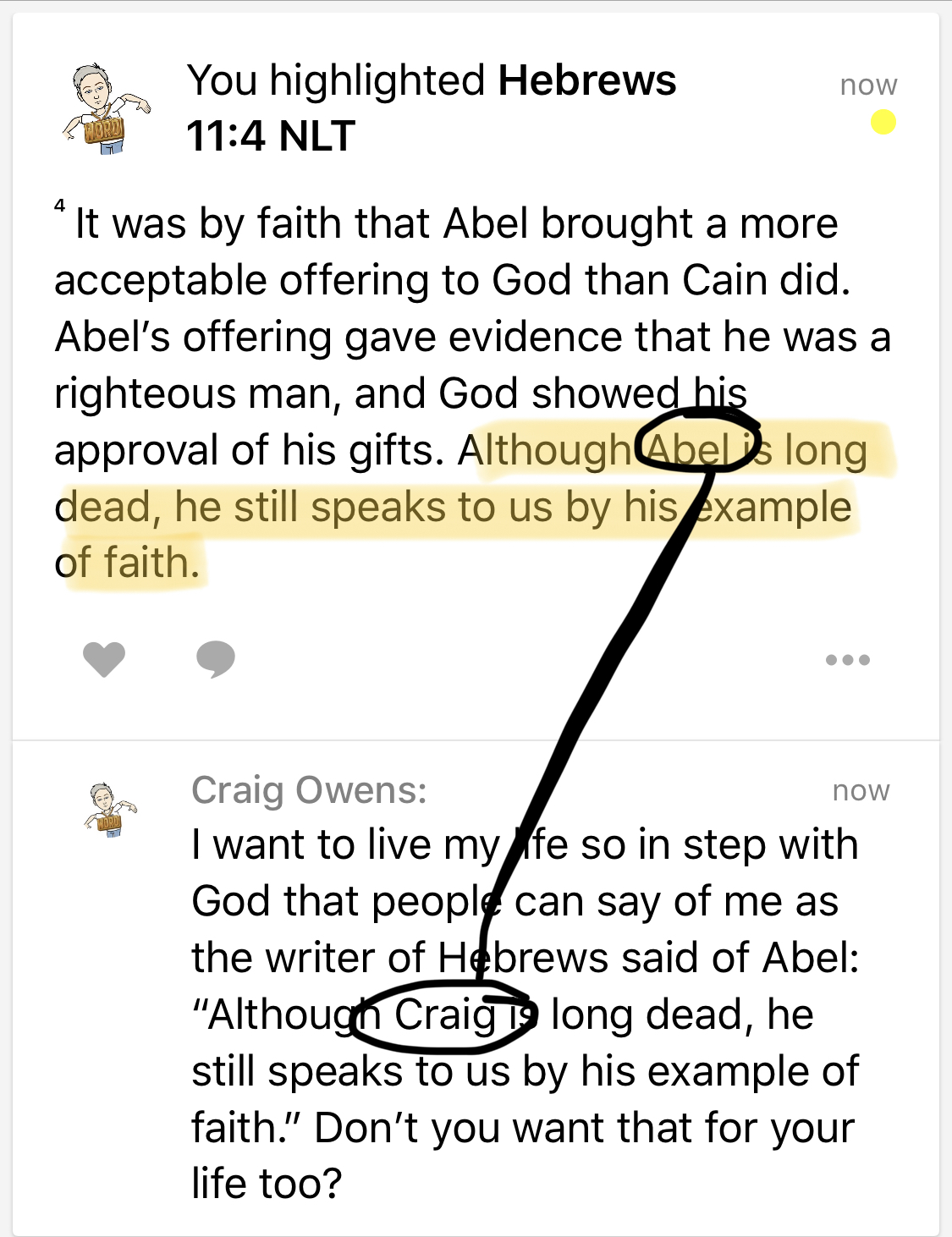
I commented on Hebrews 11:4 on YouVersion, “I want to live my life so in step with God that people can say of me as the writer of Hebrews said of Abel: ‘Although Craig is long dead, he still speaks to us by his example of faith.’ Don’t you want that for your life too?” 

The Bible itself tells us that faith comes into our heart by hearing the Word of God. If your faith is struggling, I would encourage you to open your Bible, ask the Holy Spirit to illuminate the Word to you, and begin reading with an open heart and mind. That’s exactly what I did, and I came to the conclusion that I believed the God of the Bible not because my parents did, but because He showed Himself to me to be Real. 

If you are struggling with your faith in God, I’d love to talk with you. Please get in touch with me and let’s begin a dialogue.

Thursdays With Spurgeon—An Exhortation To Preachers

This is a weekly series with things I’m reading and pondering from Charles Spurgeon. You can read the original seed thought here, or type “Thursdays With Spurgeon” in the search box to read more entries.

An Exhortation To Preachers 

He will glorify Me, for He will take of what is Mine and declare it to you. All things that the Father has are Mine. Therefore I said that He will take of Mine and declare it to you. (John 16:14-15) 

     Ah, brothers, the Holy Spirit never comes to glorify us, or to glorify a denomination, or, I think, even to glorify a systematic arrangement of doctrines! He comes to glorify Christ! If we want to be in accord with Him, we must preach in order to glorify Christ. May we never have this thought: ‘I will put that bit in. It will sound well….’  No, no! 

     I would say, ‘Brother, though it is a very delightful piece, strike that out, because if you have had a thought of that kind about it, you had better not put yourself in the way of temptation by using it.’ … 

     Well then, it may be very admirable, and further, it might be a very right thing to give them that precious piece; but if you have that thought about it, strike it out! Strike it out ruthlessly! Say, ‘No, no, no! If it is not distinctly my aim to glorify Christ, I am not in accord with the aim of the Holy Spirit and I cannot expect His help!’ … 

     How then does the Holy Spirit glorify Christ? It is very beautiful to think that He glorifies Christ by showing Christ’s things. If you wanted to do a honor to a man, you would, perhaps, take him a present to decorate his house. But here, if you want to glorify Christ, you must go and take the things out of Christ’s house ‘the things of Christ.’ … 

     Again, I think that the blessed Spirit glorifies Christ by showing us the things of Christ as Christ’s. Oh, to be pardoned! Yes, it is a great thing, but to find that pardon in His wounds, that is a greater thing! Oh, to get peace! Yes, but to find that peace in the blood of His Cross! … That it came from Christ is the best thing about the best thing that ever came from Christ! …  

     He will glorify Me, for He will take of what is Mine and declare it to you.’ Yes, it does glorify Christ for the Holy Spirit to show Christ to us. … Since it is for the honor of Christ for His things to be shown to men, He will show them to us, that we may go and show them to other people.

From Honey In My Mouth

My fellow pastor, I cannot add anything to these wise words except this simple exhortation: Read these words again and ask the Holy Spirit to show you how you can more accurately live this out in your sermon preparation and preaching. 

God bless you, my friend!