Links & Quotes

Even if the world’s legal system seems unjust, Jesus says by continuing to press our case with the public servants He has put in place, we are really trusting God to bring us His perfect justice. Check out my full sermon on how the Bible from Moses to Jesus explains how to define the legal term, “An eye for an eye, a tooth for a tooth.”

I have lots of new content every week, which you can check out on my YouTube channel.

“A significant amount of research and scholarship (both scientific and theological) indicates that a young Earth is the most straightforward, conservative way to interpret God’s Word. … The most unambiguous way to interpret the Bible is according to its grammatical-historical sense, or the intended meaning of the authors. A literal interpretation accounts for all figures of speech in the text, providing the most straightforward method of exegeting Scripture. To this point, when Jesus quoted the Old Testament, it was always clear that He considered its passages as factual and true.”  Check out the post Long Ages and the Bible—What’s the Problem? 

“Your brain is made up of neurons that communicate with each other through synapses. Delta-FosB is one of the chemicals that creates neural circuits—i.e., ‘pathways’—to help those neurons communicate more quickly and efficiently. … Basically, what you experience as getting better and better at something is your brain ‘rewiring’ itself to become faster and more efficient at sending the same messages between the same neurons.” This works for both healthy and unhealthy activities. In this article from Fight The New Drug, research shows how regular consumption of pornography is hampering your brain’s ability to have normal, healthy relationships.

Dr. Henry Halley, in his Halley’s Study Bible, observed, “Note, too, the unceasing emphasis on the resurrection throughout this book. It was the pivotal point in Peter’s sermon on Pentecost (2:24, 31-32), in his second sermon (3:15), and in his defense before the Sanhedrin (4:2, 10), It was the burden of the apostles’ preaching (4:33). It was Peter’s defense in his second arraignment (5:30). A vision of the risen Christ converted Paul (9:3-6). Peter preached the resurrection to Cornelius (10:40). Paul preached it in Antioch (13:30-37), Thessalonica (17:3), Athens (17:18, 31), and Jerusalem (22:6-11), to Felix (24:15, 21), and to Festus and Agrippa (26:8, 23).” You can check out all of the Scriptures he mentions in this quote here.

Stephen Witmer asks an important question: “Which is closer to the center of your life as a Christian: what you’re doing for God, or what God has already done for you through Jesus Christ? Which one grounds your identity more deeply, affects your mood more frequently, rouses your passions more highly? Your answer to these questions will deeply shape the stability, tenacity, happiness, boldness, and humility of your Christian experience. Jesus wants to provide you grounds for unshakable joy.” Check out this example Witmer shares from an exchange between Jesus and His followers. 

“Informing your opinion of the comparative merits of Christian men, never forget the old rule: ‘distinguish between times.’ Place yourself in each man’s position. Do not judge what was a right course of action in other times, by what seems a right course of action in your own.” —J.C. Ryle
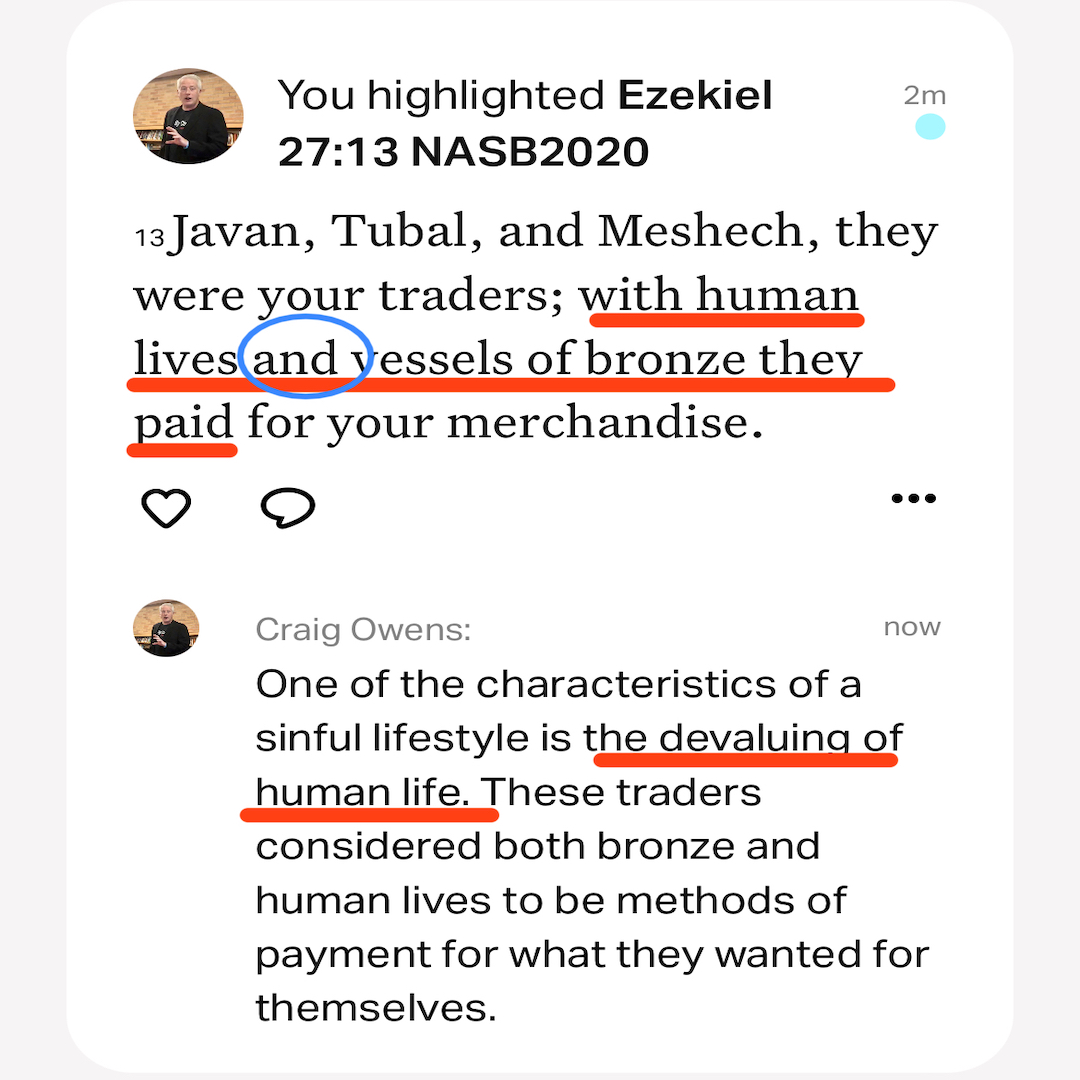
God holds human life as precious in His sight. Whenever anyone asks me why I support the sanctity of human life, my answer is simple, “Because God holds it sacred.” Consequently, God punishes those who devalue human life.

My friend, Pastor Tim Dilena, shares a thought about how God often uses people as the answer to our prayers.

Takin’ Him To The Samaritans

Listen to the podcast of this post by clicking on the player below, and you can also subscribe on AppleSpotify, or Audible. 

Jesus sent us to all nations—to all the streets in all the world (Luke 24:47-49; Acts 1:8). We are to begin in Jerusalem and move outward. As we have seen, Jerusalem is like out Main Street, where there are more similarities than differences between us and the people to whom we are taking the Good News of Jesus. Judea is our Lombard Street & Rodeo Drive, where we are starting to see more differences. 

Then we move to Samaria where there are now way more differences than similarities. But still, let’s never forget that Jesus sent us and the Holy Spirit empowers us to be effective in our witness on every street—even those with whom we have very little in common. 

Jesus literally traveled to Samaria in John 4.

Jesus was baptizing in the Judean countryside (John 3:22) and now He is heading back to Galilee. “The shortest route from Judea in the south to Galilee in the north went through Samaria. The journey took three days if one wanted to travel the direct route. The Jews often avoided Samaria by going around it along the Jordan River. The hatred between the Jews and Samaritans went back to the days of the exile” (Dr. Henry Halley). 

There were wide differences between Jesus and this woman of Sychar:

  1. Cultural differences—The Jews considered the Samaritans to be no longer “pure” Jews, but half-breeds and traitors (vv. 5-9). 
  1. Personal differences—She was female, Jesus was male; she was a divorcée, Jesus was single (vv. 9, 16-18). 
  1. Religious differences—The Samaritans only recognized the Pentateuch; the Jews recognized the entire Old Testament Scripture. And the Samaritans saw Mt. Gerizim as the center of worship and the place the Messiah would reign; the Jews believed Jerusalem to be the center of worship (vv. 19-20). 

Our first task is to find common ground with whoever we can. Jesus used the word “whoever” three times in John 3:16, 18, 36, saying that whoever believed in Him would have eternal life. We need to have this same mindset. It’s not His desire that any should perish—not even the Samaritans!—but that all should come to know Him as Savior. 

In his book Winning With People, John Maxwell presents The 101% Principle: Find the 1% we can agree upon and give that 100% of your effort. 

Jesus found the 1% and gave 100% to it. For He and this Samaritan woman their common connection was water and worship (John 4:9-15, 21-26). Jesus used both of those things to open a conversation about eternal matters. 

Who are the Samaritans in my life? They are people…

  • …I have very little in common with 
  • …I go out of my way to avoid talking to 
  • …I think are never going to “get it” 
  • …who make me angry, defensive, or combative 

But they are also people…

  • …for whom Jesus died
  • …who are dearly loved by our Heavenly Father 
  • …who need to hear the Gospel 
  • …to whom I have been sent 

Our prayer should be this: 

Holy Spirit, help me to notice the people to whom I have been blind or whom I have been avoiding. Help me to find the 1% on which we can agree, and then empower me to give 100% of my effort to that 1%. I want my heart to beat with the heart of my Savior: Whoever believes on Him will not perish but will have eternal life.

If you’ve missed any of the others messages in our Takin’ Him to the Streets series, you can find them all by clicking here. 

►► Would you please prayerfully consider supporting this ministry? My Patreon supporters get behind-the-scenes access to exclusive materials. ◀︎◀︎

Winning Souls, Not Arguments

Listen to the podcast of this post by clicking on the player below, and you can also subscribe on AppleSpotify, or Audible. 

The men who were guarding Jesus mocked Him and beat Him. They blindfolded Him and hit Him again and then demanded, “Prophesy! Who hit You?” And it wasn’t just the physical abuse, but they heaped mocking insult upon mocking insult upon Jesus (Luke 22:64-65). 

All four of the Gospel writers recount how Jesus responded to both the physical and verbal abuse: 

  • To the false charges before the Sanhedrin, Jesus remained silent (Matthew 26:57-63) 
  • To the spitting and hitting by the members of the Sanhedrin, Jesus remained silent (Matthew 26:67-68) 
  • To the physical abuse of the guards, along with their mocking insults, Jesus remained silent (Mark 14:65; Luke 22:64-65) 
  • To the mocking He endured before King Herod, Jesus remained silent (Luke 23:9-11) 
  • To the false charges announced to Governor Pilate, Jesus remained silent (Matthew 27:12-14) 
  • To the insults and mocking thrown His way as He hung on the Cross, Jesus remained silent (Matthew 27:38-44; Mark 15:29-32; Luke 23:35-36) 

His only verbal response was after being slapped in the face by one of the officials in the Sanhedrin. Jesus said, “If I said something wrong, testify as to what is wrong. But if I spoke the truth, why did you strike Me?” (John 18:22-23). 

These are what we call an ad hominem attack. That is attacking the person, instead of confronting the ideas or arguments the person is presenting. 

The self-control of Jesus here is absolutely astounding! Peter records, “When they held their insults [and their fists and their spit] at Him, He did not retaliate; when He suffered, He made no threats. Instead, He entrusted Himself to Him who judges justly” (1 Peter 2:23). 

Even as His trial got underway, Luke records, “the council of the elders of the people…met together, and Jesus was led before them” (Luke 22:66).

Dr. Henry Halley points out that extra-biblical sources have told us that this trial violated at least four of the Sanhedrin’s own rules:

  1. Meeting on the morning of a festival 
  2. Meeting in Caiaphas’ personal residence 
  3. Trying a defendant without defense 
  4. Passing the verdict of a death sentence in one day instead of two days 

I would add a fifth rule which is found in Scripture: At least two witnesses need to be in agreement with their testimony for there to be a death sentence (Deuteronomy 17:6, 19:5; Mark 14:55-59). 

When the Sanhedrin then hauled Jesus before Pontius Pilate, even their charges made before the governor in Luke 23:1-2 were flimsy at best: 

  1. Subversion—there is no proof for this 
  2. Opposing taxes to Rome—this was false (see Luke 20:20-25) 
  3. Jesus was a rival to the Roman throne—not true 

And still Jesus remained almost completely silent! He only spoke when asked a direct question, but He remained silent throughout the false accusations, the verbal taunts, and the physical abuse. 

When I am treated unfairly, when the rules are bent against me, when false charges are lodged against me, I get angry! I want to defend myself! I want to put my accusers or abusers in their place! 

Could Jesus have prevented His arrest? Yes (Matthew 26:53)! 

Could Jesus have defended Himself before the Sanhedrin, Pilate, and King Herod? Yes! 

Could Jesus have come down from the Cross to prove His power? Yes! 

But Jesus wasn’t trying to win a momentary argument; He was winning souls for eternity! 

Jesus came not to be served, but to serve, and to give His life as a ransom for many (Mark 10:45). So, “for the joy set before Him He endured the Cross, scorning its shame, and sat down at the right hand of the throne of God.” 

When anger boils up because of the mistreatment we are enduring, we must “consider Him who endured such opposition from sinners, so that you will not grow weary and lose heart” (Hebrews 12:2-3). 

Like Jesus, let’s not try to win just a momentary argument that may result in the loss of a soul for all of eternity. There is a time to speak and there is a time for silence. As we keep our eyes on Jesus, we will know what time it is. 

(You can check out all of the Scriptures I referenced in this post by clicking here.)

P.S. You may also be interested in a previous blog post Winning the Argument or the Battle or my short video How Should Leaders Handle Pushback. 

►► Would you please prayerfully consider supporting this ministry? My Patreon supporters get behind-the-scenes access to exclusive materials. ◀︎◀︎

Links & Quotes

Don’t let fear keep you standing still. Take a swing and give yourself or your coach something to tweak. Check out this full conversation hereI have lots of new content every week, which you can check out on my YouTube channel.

“Our human minds cannot comprehend the immensity of [Christ’s] task and His sacrifice. We simply know that it was to save us, and that Jesus’ suffering is the most blessed influence the world has ever known.” —Dr. Henry Halley, Halley’s Study Bible 

The Hill, though high, I covet to ascend,
The Difficulty will not me offend;
For I perceive the Way to life lies here.
Come, pluck up Heart, let’s neither faint nor fear;
Better, though difficult, the Right Way to go,
Than wrong, though easy, where the End is Woe. —Christian in John Bunyan’s The Pilgrim’s Progress 

“Nearly half the Law of God is devoted to directing God’s people in how to worship Him. And while the specific practices of that portion of God’s Law have been replaced (Hebrews 7:11-18), the emphasis on worship and the idea that worship and life are related remains. The more faithful we are in worshiping the Lord the more we will love our neighbors with the justice His Law prescribes.” —T.M. Moore

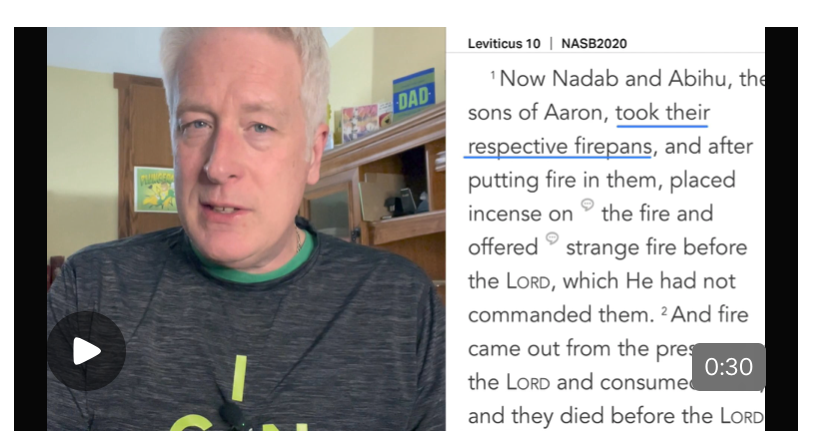
The deaths of Nadab and Abihu is a tragic story, but I think there are some important leadership insights to be gleaned from it. I shared an exclusive video with my Patreon supporters. Will you prayerfully consider joining?

An Unimpressive But Praiseworthy Resume

Listen to the podcast of this post by clicking on the player below, and you can also subscribe on AppleSpotify, or Audible. 

In my book Shepherd Leadership, I have a chapter entitled ‘The Wrong Ladder.’ Let me share two short paragraphs with you to set the stage—

Maybe, like many people, you’ve been working on a plan to climb your own ladder of success. You’ve been careful to get the best education, meet the right people, and put in the right amount of time on each level, all while keeping your eyes and ears open for the next “rung” of the ladder. 

Perhaps this is successful in the corporate world, but I wonder how this idea has crept into the ministry world. Make no mistake: this mindset is prominent in our churches and nonprofit organizations. We may dress it up in churchy language, but the attitude is still there. 

On the pages of Luke’s Gospel, we read a very unimpressive but praiseworthy resume of a vital ministry leader: John the Baptizer. 

His first ministry job begins when “the word of the Lord came to John son of Zechariah in the wilderness” (Luke 3:2). 

A word from God had already been spoken about John’s life that was pretty impressive (Luke 1:13-17, 76-77). From birth, John knew that he was to be the forerunner of the long-awaited Messiah. John could have walked around with quite an ego, but instead, we read, “And [John] grew and became strong in spirit; and he lived in the wilderness until he appeared publicly to Israel” (1:80).

No special education, no ladder-climbing positions, no getting to know all the right people who could open doors for him. He was simply alone with God in the wilderness for nearly 30 years! 

Then just as quickly as he burst on the scene, God took John off the scene (Luke 3:20; Matthew 14:3-11). John knew this would happen—that he was merely a herald, and that his ministry would decrease as Christ’s increased. John shows us that it’s not about how many people are in your church, how big of a budget you’ve raised, or how long you’ve been in a particular position. It’s about faithful obedience. 

It’s about being comfortable with anonymity, if that’s what God chooses. It’s about allowing God to place and remove him when and how He chooses. 

Listen to this observation from Dr. Henry Halley

Assuming that John began his ministry shortly before he baptized Jesus, it lasted about a year and a half. Thirty years in seclusion, one and a half years of public preaching, a year and four months in prison—and then the final curtain. 

This is the resume of the man who ushered in the Savior of the world, and of whom Jesus said there had not been born anyone greater (Matthew 11:11). 

In ‘The Wrong Ladder’ chapter, I concluded with this—

God frequently picks people we would consider the least qualified. He sometimes has one in an unglamorous position for years, and sometimes He catapults somebody immediately to the top. Sometimes God will keep His hand-selected individual in a prominent leadership position until death, and sometimes He will remove that person to a place of obscurity after only a short time. 

God’s ladder of success is nothing like ours! 

May all of us in leadership positions make this our prayer: Father, this is for Your glory, not my advancement. I’m not here to build my following, my resume, my fame. I only want to live and lead and minister for Your glory and for Your fame. Holy Spirit, help me keep this example of John at the forefront of my mind anytime I think about building my own resume. In the name of Jesus I ask. Amen.

►► Would you please prayerfully consider supporting this ministry? My Patreon supporters get behind-the-scenes access to exclusive materials. ◀︎◀︎

Links & Quotes

God made you uniquely YOU on purpose. So you can ask Him to show you why He put you together as He did—with all of the gifts that make you YOU. Please subscribe to my YouTube channel.

In my Halley’s Study Bible, I read this commentary on Matthew 24-25—

“It is best not to be too dogmatic about the events surrounding [Christ’s] second coming. But if language is a vehicle of thought at all, it certainly takes a good deal of explaining and interpreting to make anything else out of Jesus’ words than that He Himself looked forward to His coming again as a definite historical event in which He will personally and literally appear to gather to Himself and to eternal glory those who have been redeemed by His blood.

“And it is best not to cloud the hope of His coming with too detailed a theory as to what is going to happen when He comes. Some people may be disappointed if Jesus does not follow the schedule they have mapped out for Him.”

“The future doesn’t belong to the fainthearted; it belongs to the brave.” —Ronald Reagan

“We are not called to punish the people for whom Jesus was already punished.” —Kevin Berry

Daniel B. Wallace, a New Testament professor at Dallas Theological Seminary, wrote, “If you could stack up all handwritten manuscripts of the New Testament—Greek, Syriac, Latin, Coptic, all languages—how tall would the stack be? … I have said in many lectures that it would be the equivalent of c. 4 & 1/2 Empire State Buildings stacked on top of each other. How did I come up with that number?” Check out his post to read how he calculated this astounding number. This is just another link in the chain of evidence for the historicity of the Bible.

I shared this commentary on YouVersion this week: We are made in God’s likeness. Ever since sin entered the world, man’s sinful nature is to flip this around—to make God in our likeness. Literally to say, “This is what I want God to be. I want Him to approve what I want.”

“Pure humor is the most difficult of all of comedy. Late night humor is funny because it is mean. It is relatively easy to be crude, cynical, and sarcastic. It comes naturally to our fallen natures to criticize, tease, mock, and scoff. It’s much harder to make people laugh by lifting others up.” —Dick Brogden, in his book Proverbs: Amplified and Applied, commenting on Proverbs 1:22

Forgive Like You’ve Been Forgiven

Listen to the podcast of this post by clicking on the player below, and you can also subscribe on AppleSpotify, or Audible. 

Jesus said that the devil’s agenda was to steal, kill, and destroy (John 10:10). We see this on full display in the aftermath of the first sin in the way relationships humans had with each other changed. 

God said to Eve, “Your desire will be for your husband, and he will rule over you” (Genesis 3:16). Dr. Henry Halley commented, “The last two lines of this verse could be paraphrased, ‘You will now have a tendency to try to dominate your husband and he will have the tendency to act as a tyrant.’” And to Adam, God said that he would now have to work harder than ever before to harvest the food he needed for survival, which undoubtedly caused stress in his relationship with Eve. In the very next chapter, the strained relationship between Cain and Able resulted in the first homicide (Genesis 3:17-19, 4:1-8). 

In these relationships, intimacy was stolen, closeness was killed, and life was destroyed. 

An irreplaceable tool for avoiding this heartache and destruction that sin causes in our relationships is forgiveness. 

Peter asked Jesus, “How many times should I forgive my brother or sister who sins against me? Up to seven times?” (Matthew 18:21). In reply, Jesus told a story about a man who owed the equivalent of 20 years of a day laborer’s wages and a man who owed about three months of a day laborer’s wages. The first man who owed so much was forgiven entirely of his debt, but he wouldn’t forgive the paltry amount that was owed to him by the second man. 

To the forgiven but unforgiving man, Jesus said, “Shouldn’t you have had mercy on your fellow servant just as I had on you?” (see Matthew 18:22-35). 

That should be our standard: Not how others treat me, but how God has treated me! Not how much others owe me, but how much God has forgiven me!

Do I want God to put a quota on how many times I can be forgiven? Do I want there to be a limit on how big of an offense God will forgive in me?

Of course not!

That’s my standard. I must show the same mercy to others as I have been shown by God. 

If my forgiven sins are forgotten sins (and they are), then I need to treat my brother and sister the same way. This is why Jesus told Peter to stop counting the number of offenses. We are to treat every offense as though it was the first and only offense.

The man who owed so much money asked for more time to repay his debt. But the master did more than that: He forgave the debt—he wiped it off the books completely, as though it had never happened! 

When God forgives our sin, He separates our sin from us as far as the east is from the west. He keeps no record of the offense ever having occurred (Psalm 103:10-12). 

This is to be our standard too. We are to forgive others as God has forgiven us. Forgiveness will restore intimacy, closeness, and life to our relationships. 

This is difficult to do. As Peter pointed out, a brother or sister—someone close to his heart—had sinned against him. But this is why Jesus taught us to pray, “Forgive us our sins, as we have forgiven those who sin against us” (Matthew 6:12). Or as Eugene Peterson paraphrases that verse in The Message, “Keep us forgiven with You and forgiving others.” 

May the Holy Spirit help us in this important work of ongoing, complete, and restoring forgiveness!

►► Would you please prayerfully consider supporting this ministry? My Patreon supporters get behind-the-scenes access to exclusive materials. ◀︎◀︎

Links & Quotes

“…when it comes to following Jesus, life is never as good as it gets. There is always more righteousness, more peace, and more joy in the Spirit to know, and more love and truth to share, as long as we are willing to press on.” Read more of this post from T.M. Moore here.

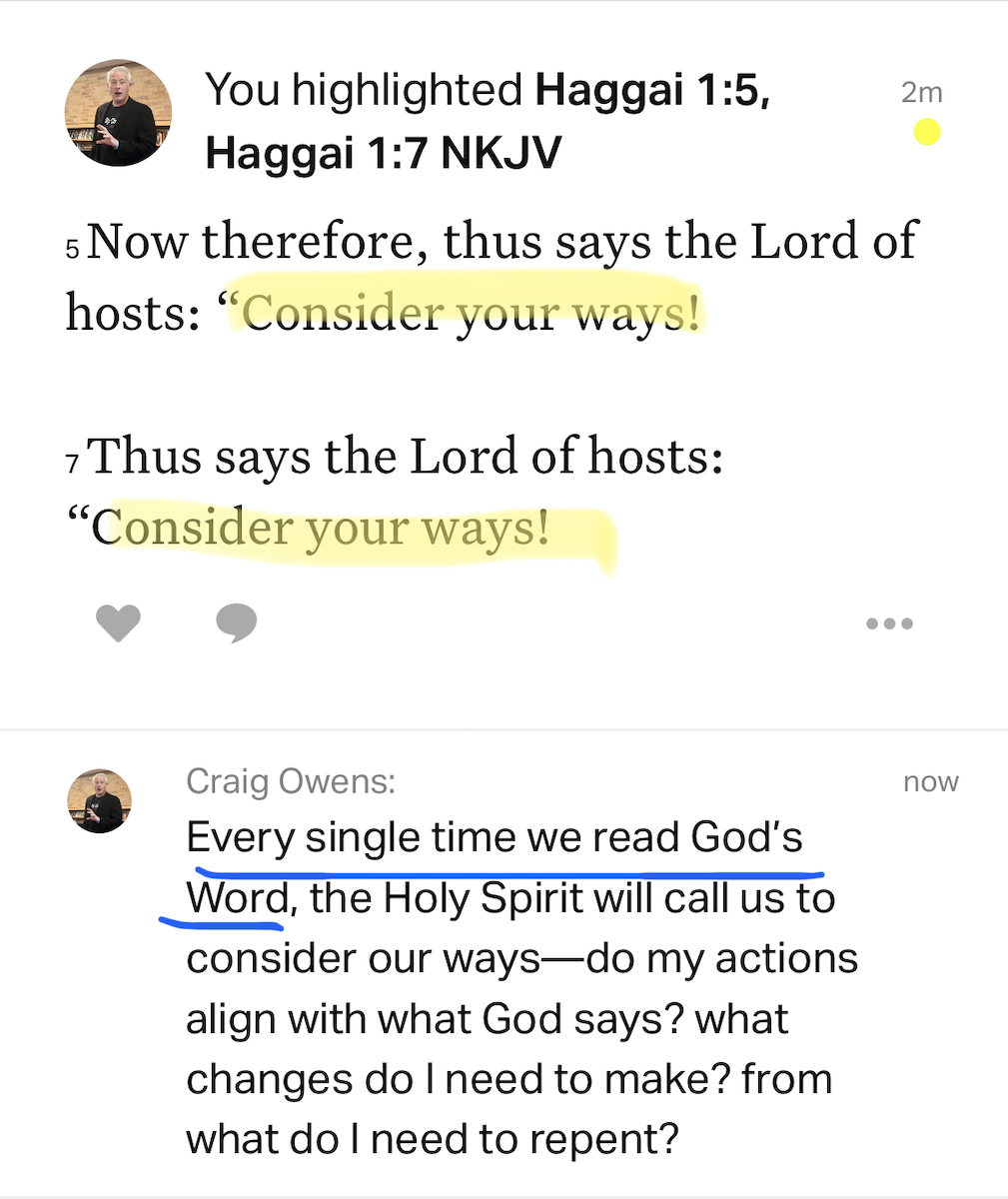
Commenting on Haggai 1, Dr. Henry Halley reminds us, “One of the most insistent Old Testament teachings is that national adversity is due to national disobedience to God.” In a series of messages I shared from the minor prophets, I noted the precision of the fulfillment of God’s prophecies, especially in the book of Haggai. So when God promises punishment for disobedience, we should take notice. Revival will come when we repent from those sins.

J. Warner Wallace understands why the church is often confused about the role of apologetics in evangelism. In this video he does a marvelous job of explaining the value of apologetics—

Responding To National Adversity

Listen to the podcast of this post by clicking on the player below, and you can also subscribe on AppleSpotify, or Audible.

Although the Jews had been released from exile in Babylon to return to their homeland, things still were not going well for them. The prophet Haggai came on the scene and offered this solution from God to their national adversity.

Check out the text of Haggai 1 here.

You may also be interested in the posts I have previously shared about Haggai’s ministry, which overlapped with the prophetic ministry of Zechariah.

►► Would you please prayerfully consider supporting this ministry? My Patreon supporters get behind-the-scenes access to exclusive materials. ◀︎◀︎

Links & Quotes

C.S. Lewis identifies one of the harmful effects of pornography. “For me the real evil of masturbation would be that it takes an appetite which, in lawful use, leads the individual out of himself to complete (and correct) his own personality in that of another (and finally in children and even grandchildren) and turns it back: sends the man back into the prison of himself, there to keep a harem of imaginary brides. And this harem, once admitted, works against his ever getting out and really uniting with a real woman. For the harem is always accessible, always subservient, calls for no sacrifices or adjustments, and can be endowed with erotic and psychological attractions which no woman can rival.” —C.S. Lewis

“Joy is not a requirement of Christian discipleship; it is a consequence.” —Eugene Peterson

Dan Reiland has an excellent post for leaders entitled 4 Layers To Gaining Wisdom.

In my personal devotional time, I came across a sobering idea in the book of Amos about God’s love. I am reading through the Bible in Halley’s Study Bible, where I also read this: “The basket of ripe fruit [Amos 8] is another symbol that the sinful kingdom was ripe for ruin. And Amos reiterates the causes: greed, dishonesty, and merciless brutality toward the poor. Over and over, through many images, the Bible makes it plain that there is no possible way to escape the consequences of persistent sin.” —Dr. Henry Halley

The Institute for Creation Research has a powerful post explaining how seafloor spreading matches Creation predictions.

J. Warner Wallace wrote, “The historic development of language and communication prepared the way for the birth of Jesus. God orchestrated this timing, along with the development of roads, postal services and a 200-year period peace within the Roman Empire (known as the Pax Romana) to prepare the world for the arrival of Jesus.”

Our church is taking time on Fridays to fast and pray. Here is a reminder of the expected results that I shared with our church family—