A Perspective On Problems

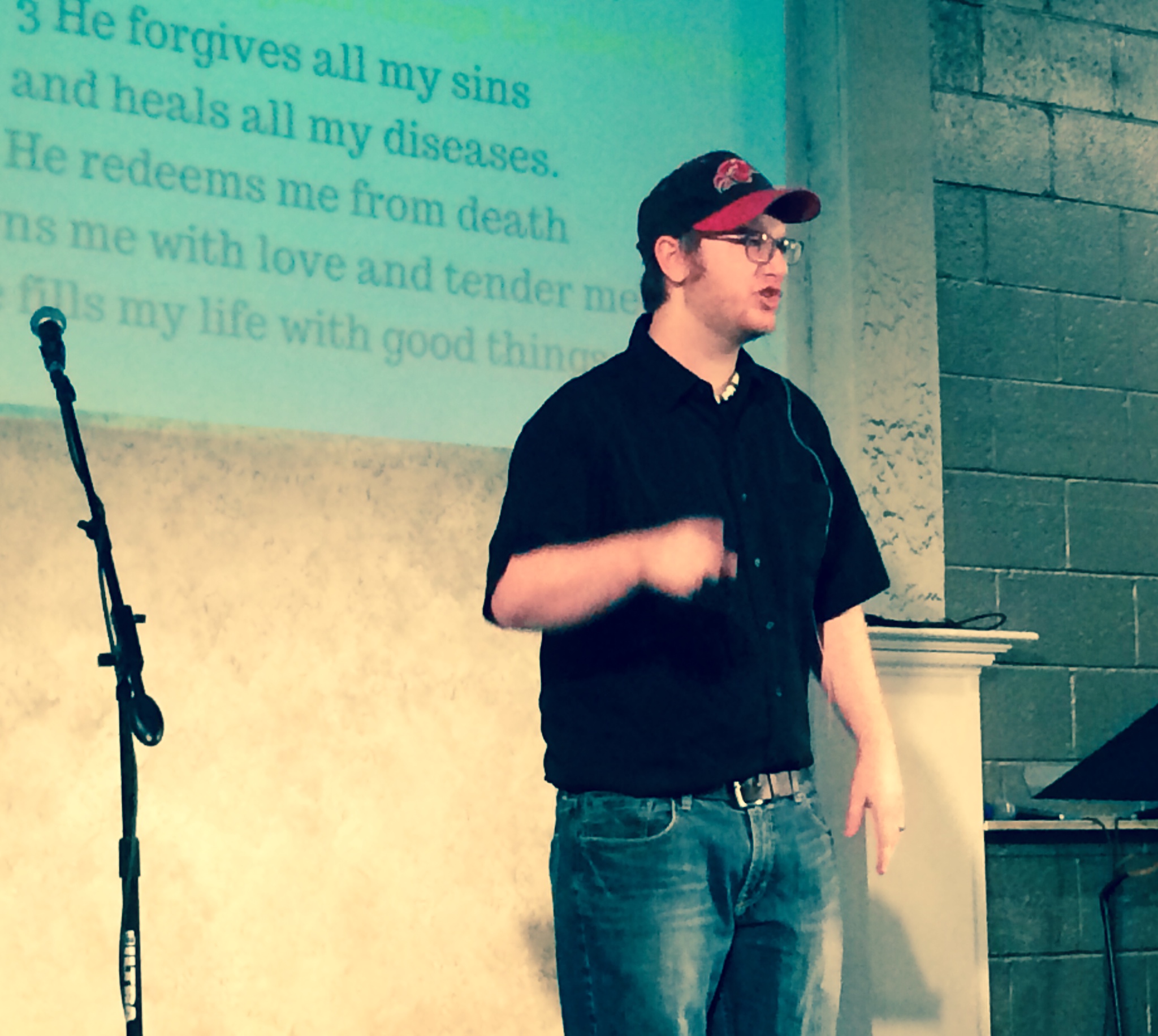
False ideas on problemsWe were blessed to have a special guest speaker yesterday morning: Jeff Hlavin. Wow, what a great word he shared with us! He continued in our series called Aliens and Strangers, on how Christians are to live in this world as citizens of Heaven. Below are a few notes I jotted down.

Dear friends, do not be surprised at the fiery ordeal that has come on you to test you, as though something strange were happening to you. (1 Peter 4:12)

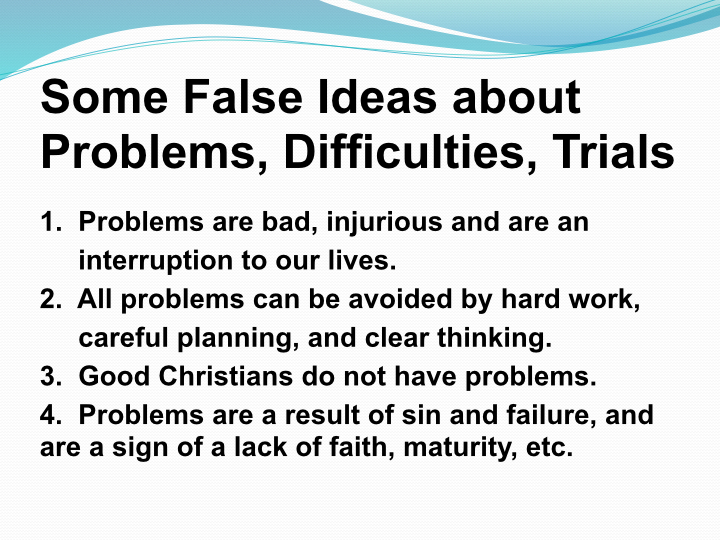
Using this verse as his introduction, Pastor Jeff shared four false ideas about problems:

  1. Problems are bad and are an interruption to our lives.
  2. All problems can be avoided by hard work, careful planning and clear thinking.
  3. Good Christians don’t have problems.
  4. My problems are a result of sin or are a sign of a lack of faith/maturity.

Instead I should see from a biblical perspective that…

“The Holy Spirit is the greatest Change Agent in a Christian’s life. I can only resolve this tension by obedience. … The devil tries to invoke turmoil in my life, but I can overcome this turmoil by submitting to God (James 4:7).” —Jeff Hlavin

“Trials develop spiritual/emotional/mental muscles that we need to have to soar into the place God has for us.” —Jeff Hlavin

If you would like to download a copy of the outline Pastor Jeff handed out to us, click here → Perspective on Problems Outline ←

We will be continuing in our Aliens and Strangers series this Sunday, and I’d love to have you join us. If you’ve missed any messages in this series, you may find the complete list by clicking here.

Links & Quotes

link quote

“The Kingdom of God, as Jesus envisioned it, was not simply for then and there. Jesus announced a Kingdom that had come. His preaching and teaching lead us to understand that the Kingdom is very much a ‘here and now’ reality [Matthew 4:17], that which is to be sought above, within, and through everything else in our lives.” —T.M. Moore

“Sexual sin is a symptom, not the disease. People give way to sexual sin because they don’t have the fullness of joy and gladness in Christ. Their spirits are not steadfast and firm and established. They waver. They are enticed, and they give way because God does not have the place in our feelings and thoughts that He should. David knew this about himself. It’s true about us too. David is showing us, by the way he prays [Psalm 51:8, 12], what the real need is for those who sin sexually—joy in God.” —John Piper

“For the day may come when false prophets shall arise, and delude the people, and by this shall we be able to discover them; if they claim anything beyond what Christ has revealed, put them aside, for they are false prophets, wolves in sheep’s clothing. The Spirit only teaches us that which Christ has taught beforehand either by Himself or by the inspired apostles.” —Charles Spurgeon

“From many modern sermons would you know that there was a Holy Spirit? If it were not for the benediction or the doxology you might go in and out of many churches and meeting-houses by the year together, and scarcely know that there was such a Person as that blessed, blessed Giver of all good, the Holy Spirit. Sometimes we hear a little about His influences, as if the Holy Spirit were not as truly a Person as even Jesus Christ Himself, Who in flesh and blood trod this earth. Oh, dear friends, I fear the first danger, that of running wild with whimsies and fancies about inner lights and new revelations; but I equally dread this last, this going forth to work with the sword, forgetting that it is the sword of the Spirit, and only mighty as the Holy Spirit makes it mighty ‘to the pulling down of strongholds.’” —Charles Spurgeon

No surprises here: Planned Parenthood spends a lot of money to buys votes from your U.S. Senator.

By the way, don’t buy into the lie that if Planned Parenthood is defunded women won’t have access to healthcare. First of all, PP makes way too much money from abortions already. Second, there are 20 comprehensive healthcare centers for every one PP office, so the options are plentiful.

[VIDEO] Jesus in the New Testament is the same as Jehovah in the Old Testament—

If you would like a written form of the charts he shares in this video, click here.

8 Quotes From Horatius Bonar

Horatius BonarThere is a series of book by Horatius Bonar called Light And Truth. I am currently reading one of the books in the series as I read through the New Testament in my personal devotional time. Typically I post a book review after I’ve finished a book (which I will do with Light And Truth [update: the review is posted here]), and then I share some quotes from that book. In this case I’m mixing things up a bit: I’m sharing some quotes from the first half of this book today, and then I’ll post a review and more quotes after I finish the book. Enjoy!

(Note: Scripture references appearing in brackets following the quote reflects the passage or verse on which Bonar was commenting.)

“What is at the bottom of all the persecutions of various ages? It is Christ troubling the world. If He would let it alone, it would let Him alone. What means the outcry, and alarm, and misrepresentation, and anger, in days of revival? It is Christ troubling the world. What means the resistance to a fully preached gospel? It is Christ troubling the world. A fettered gospel, a circuitous gospel, a conditional gospel—a gospel that does not truly represent Christ—troubles no man; for in such cases it is another Christ that is announced, and not the Christ, the King of the Jews, that troubled Jerusalem. But a large, free, happy, unconditional gospel, that fully represents Jesus and His grace, Jesus and His completeness, does trouble men. It troubles all to whom it comes, in some measure. Some it troubles and then converts; some it only troubles. … The world’s only hope is to be ‘troubled’ by Christ. … Yet all this troubling is in love. He sounds His trumpet to awake the sleepers.” [Matthew 2:3]

“The Lord ends speaking and begins working; He comes down from the pulpit and enters the hospital. Such is His whole life: words and deeds intermingled; words of health and deeds of health. His lips breathe fragrance, and in His hand is the balm of Gilead. … [The leper] wants to be made clean, and he casts himself on Christ for this. He is the hyssop, the water, the blood, the ashes, the priest, the physician, all in one. Thus we still come, doubting neither the willingness nor the power, yet casting ourselves on the will of the Lord; not presuming to dictate, yet appealing to His sovereign Grace. As the needy, the sick, the unclean, we come; for the whole need not a physician, but they that are sick.” [Matthew 8:1-3]

“It is the voice of authority. It reminds us of Genesis 1:2-3. He speaks as one who knew that He could cure. Not hesitatingly. Nor are the words a prayer, but a command. He speaks, and it is done. … Thus love, authority, and power are all conjoined. It is the voice of Omnipotence. … He is the same Christ still; with the same love, and authority, and power. He is still a Healer, and the worst of diseases fly from His touch and voice. Let us go to Him with all that afflicts us. He calls and He will heal us of all. … Be persuaded to present thyself to Him, just as thou art give this divine Healer thy simple confidence. Take Him for what He is, and He will take thee for what thou art. Thus shalt thou meet in love; thou to be healed, and He to heal; thou to have the joy of being healed, and He to have the joy of healing thee, and to announce to heaven, in the presence of the angels of God, that another leper has been healed!” [Matthew 8:1-3]

“And is not this oftentimes the very point of the difficulty we experience in believing? We cling to the visible, the palpable prop—the human rope which we hold in our hand, unwilling to let go. We speak of our inability to believe; but what is this save our tenacity in holding on to the very things which God asks us to quit? We say that we ‘cannot lay hold’; should we not rather say that we ‘cannot let go’? We complain that we have no power to cling and grasp; whereas it should be that we have no will to let go.”

“As iniquity increases, faith decreases. … As iniquity increases, truth decreases. … As iniquity increases, righteousness and holiness decrease. … As iniquity increases, religion decreases. … As iniquity increases, delight in the things of God decreases. … But the special thing of which Our Lord predicts the decrease is love—love to God, love to himself, love to one another.” [Matthew 24:12]

“Our Lord will come! This is one of the great certainties of the unknown future. He may tarry, but He will come at last. Many obstacles made seem to rise up, but He will come. Men may not desire Him, but He will come. The Church may be cold, but He will come. Earth may think she has no need of Him, but He will come! The scoffer may say, where is the promise of His coming? but He will come. satan may do His utmost to oppose; but He will come. This is the great future certainty which Christ and His apostles have proclaimed to us. Our Lord will come! … The hour is, no doubt, fixed in God’s purpose, but the knowledge of that time is kept from us. They do wrong, then, who try to fix the hour, thus seeking to extract a secret from God. They do wrong who neglect the whole subject because this secret is connected with it. They do wrong who scoff at the whole subject because of the rash attempts or wretched failures of some pretended interpreters of prophecy. Thus, ‘we know,’ and ‘we know not’: we know that He will come, we do not when. … Beware of falling under any influences that would make you indifferent to the Lord’s appearing. Beware of worldly arguments; beware of pretended spiritual arguments; beware of confounding death and Christ’s coming; beware of the errors and seductions of the age.” [Matthew 22:42, 44]

“Ah, does not our faith often thus fail just at this point? We can go to Him for a little thing; we cannot go to Him for a great thing. We count it presumption to expect much. Instead of feeling that the worse the case, the greater the glory to His power and love, we stop short, and cease to expect anything from Him at all. I need not trouble the Master, we say, my case is so desperate; instead of saying, because my case is so desperate, I will trouble Him, I will give Him this opportunity of magnifying His skill and grace.” [Mark 5:36]

“Understand what is passing day by day; interpret events; connect them with the coming of the Son of Man. You see false Christs; you hear a Babel of opinions; you mark the new forms of immorality and infidelity; you are startled with the bold assaults made on Scripture, and on the Christ of God, on His blood, and Cross, and righteousness—connect all these with the coming of the Lord; interpret them as signs of the last days; do not treat them as common things; do not close your eyes upon them; do not be indifferent to them; do not admire them as tokens of intellectual development and human progress. Understand them all according to God’s purpose and mind. Examine them in the light of apostolic teachings and warnings. Be not deceived concerning them. Beware of the strong delusion. … Pray, then, for a needy church, that in all these respects God would visit her; raising her up; reviving her; rekindling her light; reinvigorating her strength; re-adorning her with all gifts and graces; reclothing her in apostolic raiment, and sending her forth to do His work with the old power and success of primitive days. Pray for a needy world. It is blind, and knows it not; poor, and thinks itself rich; foolish, and thinks itself wise. It is doubly needy. It is not aware of the extent of its ruin, and alienation, and depravity; not alive to its danger and hopeless prospects; not anticipating its doom. There is a hardening, and searing, and blinding process going on in connection with ‘modern progress.’” [Mark 13:33]

C.S. Lewis On Agape

C.S. Lewis“Of course taking in the poor illegitimate child is ‘charity.’ Charity means love. It is called Agape in the New Testament to distinguish it from Eros (sexual love), Storgë (family affection) and Philia (friendship). So there are 4 kinds of ‘love,’ all good in their proper place, but Agape is the best because it is the kind God has for us and is good in all circumstances. There are people I mustn’t feel Eros towards, and people I can’t feel Storgë or Philia for; but I can practice Agape to God, Angels, Man and Beast, to the good and the bad, the old and the young, the far and the near. You see Agape is all giving, not getting. Read what St. Paul says about it in First Corinthians Chap. 13. Then look at a picture of Charity (or Agape) in action in St. Luke, chap 10 v. 30-35. And then, better still, look at Matthew chap 25 v. 31-46: from which you see that Christ counts all that you do for this baby exactly as if you had done it for Him when He was a baby in the manger at Bethlehem: you are in a sense sharing in the things His mother did for Him. Giving money is only one way of showing charity: to give time and toil is far better and (for most of us) harder. And notice, though it is all giving—you needn’t expect any reward—how you do gets rewarded almost at once.” ―C.S. Lewis

3 Reasons Why We Don’t Ask Largely Of God

Ask LargelyI don’t have a clever introduction for this post, so let me just give you the conclusion right up front―God has more desire to give than most of us have desire to ask.

Elisha told King Jehoash that God was ready to give him complete victory over Israel’s enemy, but Jehoash had a hard time grasping this (see 2 Kings 13:14-19). He was hesitant to ask God for too much, so he only asked for a little. This made Elisha mad!

I think the reasons why Jehoash was timid in his asking of God are some of the same reasons we wrestle with today.

(1) Elisha was dying, so maybe he thought God’s Spirit would depart with him.

Maybe you’ve had a spiritual giant in your life, and when they died you thought, “Who is going to be able to pray for me now?” God doesn’t have favorites. He desires that all of us come to Him.

(2) Jehoash was sinful and didn’t think God would want to help him.

You can’t increase your value in God’s sight because you live perfectly. God loves you perfectly just as you are. Don’t get me wrong: the Holy Spirit will speak to you if you need to repent, but God doesn’t only listen to “perfect” people.

(3) Jehoash thought God had a limited supply, or he thought he had a quota in how many requests he could make of God.

The whole genie-in-the-lamp concept has crept into the mindset of too many Christians. We think our genie-God will grant us a limited number of wishes, or we think He will try to find a loophole to get out of a difficult request. God desires that we keep on asking Him, keep on seeking Him, and keep on knocking on His door (see Matthew 7:7-11).

God is glorified when we ask Him to do what only He can do.

God is pleased when we keep asking of Him largely.

Again. And again. And again. AND AGAIN!

I’ll say it again―

God has more desire to give than most of us have desire to ask

If you would like to read some other thoughts on prayer from our series The Prayers Of Elishaplease click here and check out all the links in the comments.

Pray Like Jesus

Private prayerThere’s a really interesting story recorded in the gospels of Matthew, Mark and Luke. It’s the one where a father brings his demon-possessed boy to nine of Jesus’ disciples to ask for their help. But the father sadly reports back to Jesus, “But they could not help.”

Jesus calls His disciples out. He says that their faith is lacking. Even the boy’s father is short on faith. He says to Jesus, “If you can do anything, please help us.” To which Jesus says, “‘If you can’? Anything is possible if you believe.” Jesus rebukes the demon, which immediately comes out of the boy.

Now here’s the interesting part: His disciples asked Him, “Why couldn’t we do that?” Jesus says, “This kind comes out only by prayer.” Let’s review all the words Jesus said to the father and his boy:

  • “How long has he been like this?”
  • “‘If you can’? Anything is possible if you believe.”
  • “Demon, come out of him and never enter again.”

So here’s my question―Jesus said the demon was cast out by prayer. So when did Jesus pray? Look at those words He said again … which of those was His prayer?

Actually, if you look through all four gospels you won’t find Jesus laying His hands on people and saying, “Heavenly Father, will You please heal this leprosy?” Or, “Please bring life back into this little girl.” Instead He says, “Be clean” or “Little girl, get up.

So I ask again: When did Jesus pray? The answer is―He prayed all the time.

  • Very early in the morning, while it was still dark, Jesus got up, left the house and went off to a solitary place, where He prayed. (Mark 1:35)
  • After He had dismissed them, He went up on a mountainside by Himself to pray. When evening came, He was there alone. (Matthew 14:23)
  • But Jesus often withdrew to lonely places and prayed. (Luke 5:16)

Do you want to pray like Jesus? He prayed all the time. He had times of prayer with His Heavenly Father, but He was in unbroken communication with Him.

Private prayer leads to public power! 

That’s how we can pray like Jesus!

We will be learning more about prayer in our series The Prayers Of Elisha next Sunday. Please join us!

Links & Quotes

link quote

Some good reading from today…

“As long as you set yourself up as a little god to which you must be loyal there will be those who will delight to offer affront to your idol. How then can you hope to have inward peace? … Such a burden as this is not necessary to bear. Jesus calls us to His rest, and meekness is His method. The meek man cares not at all who is greater than he, for he has long ago decided that the esteem of the world is not worth the effort.” —A.W. Tozer

[PHOTOS] Some great photographs from the scientific world.

Dave Barringer has a great post about marriage and adultery: Affairs And Fruit.

[PHOTOS] Today marks the 73rd anniversary of Franklin D. Roosevelt’s “day of infamy” speech. Here are some memorable photos remembering that horrific day.

“It will not bother me in the hour of death to reflect that I have been ‘had for a sucker’ by any number of impostors: but it would be a torment to know that one had refused even one person in need. After all, the parable of the sheep and goats [Matthew 25:31-46] makes our duty perfectly plain, doesn’t it? Another thing that annoys me is when people say ‘Why did you give that man money? He’ll probably go and drink it.’ My reply is ‘But if I’d kept [it] I should probably have drunk it.’” —C.S. Lewis

Mobile, Messy & Meaningful

21st-century Americans in Christ's timeI think we have made the Church and Christianity something different than what the New Testament shows us. We’ve created far too many “things” which simply aren’t in the Bible. That’s not to say these things are wrong, but they may become stumbling blocks to us if we make secondary things the primary thing.

So what is the primary thing about church?

It might surprise you to know that the word church is only used twice by Jesus (Matthew 16:18, 18:17). He used a Greek word ekklesia, which meant a gathering of people called out from their homes into some public place. This word originally had more of a “town hall” meaning to it, but Jesus used this as a starting point to show us true church.

In Christ’s time the church for Him was…

Mobile—wherever He was, church was. Look at the extensive traveling He did. He held as many “church services” in people’s dining rooms as He did in the synagogues.

Messy—often as Jesus was speaking…

  • People constantly coming and going
  • Pharisees yapping and interrupting
  • Kids playing
  • Women sitting at His feet, anointing Him, crying over Him
  • Food and drink were usually involved
  • Foot washing was taking place
  • When He was outdoors: wind, waves, farmers, passers-by…
  • When He was indoors: food being served and eaten, roofs being ripped off…
  • People constantly interrupted His sermons: “Blessed is Your mother…”; “Tell my brother to give me my inheritance…”; “My daughter is dying!…”

Meaningful

  • “I must go through Samaria.”
  • “It’s not the healthy who need a doctor, but the sick.”
  • “Zaccheus, today I’m eating dinner at your house.”
  • “The Spirit of the Lord is upon Me to preach good news to the poor, freedom to the captive, sight to the blind, favor to the oppressed.”

Jesus asked His disciples Who they thought He was (see Matthew 16:13-18). The correct answer was Peter’s declaration, “You are the Christ, the Son of the living God!” Jesus said, “You’re right, and on that declaration I will build My church.”

Our job is to make Jesus known as the Christ, the Son of the living God (v. 16).

Christ’s job is to build His Church (v. 18).

He didn’t tell us to build a building and invite people to come on Sundays.

He didn’t tell us to start a Sunday School or a feeding program or a youth group.

There’s nothing wrong with these things, but they are not the main thing. 

The main thing is Jesus being seen as the Son of the living God. Where we are gathered together in that confession and purpose—even just two or three of us—that’s where His church is (see Matthew 18:20).

We must be mobile, taking a meaningful message into people’s messy lives. That is true church.

Don’t Forget The Most Important Thing

Pastor JoshPastor Josh continued the Boating Lessons series yesterday, which Pastor Tom began last week. What a great word Josh brought us! Here are my “raw notes” just as I took them during his message.

Boating Lessons—part 2 (Psalm 103:1-5Matthew 8:23-27)

How many of us have been in a storm where we felt out of control or distant from God? When we are in the midst of that storm, we must remember Who’s in the boat with us.

Jesus challenged the disciples, “Have you forgotten Who I am?” They had seen Him heal leprosy (8:1-4), heal paralysis (8:5-13), raise up the sick and set the demon-possessed free (8:14-17). But now they were more focused on the situation than on the Savior.

One symptom of forgetting Who God is: complaining (the disciples asked Jesus, “Don’t You care about us?!” [Mark 4:38]).

The storm is part of God’s process to change us and to bring glory to God—Be strong, courageous, and firm; fear not nor be in terror before them, for it is the Lord your God Who goes with you; He will not fail you or forsake you (Deuteronomy 31:6).

Don’t forget Who’s in the boat … He never leaves us. The most important thing is not the storm rocking the boat but Who is in the boat with me!

I might feel like I have no control, but I must remember that Jesus is in the boat with me and He has all control!

Storms may come “without warning” to me (Matthew 8:24), but remember God Who is in my boat is All-Knowing and He’s never taken by surprise. 

Pastor Josh closed his message the same way I’d like to close this post: in prayer. If you are in the midst of a storm—or if you feel like God is distant—this is the best time to cry out to Him in prayer. The Holy Spirit can remind you of Who is in the boat with You. He will never leave you nor forsake you!

Please join us next Sunday as Pastor Tom and Pastor Josh continue this series.

7 Bible Study Ideas From D.L. Moody

Pleasure & ProfitAs I read D.L. Moody’s book Pleasure & Profit In Bible Study, I made note of several ideas that could stimulate a great Bible study. Check out my review of this book by clicking here, then check out these great study-starters:

“If you are impatient, sit down quietly and commune with Job. If you are strong-headed, read of Moses and Peter. If you are weak-kneed, look at Elijah. If there is no song in your heart, listen to David. If you are a politician, read Daniel. If you are getting sordid, read Isaiah. If you are chilly, read of the beloved disciple. If your faith is low, read Paul. If you are getting lazy, watch James. If you are losing sight of the future, read in Revelation of the promised land.” —Richard Baxter 

“Every chapter [of Mark] but the first, seventh, eighth and fourteenth begins with ‘And,’ as if there was no pause in Christ’s ministry.”

“Matthew begins with Abraham; Mark with Malachi; Luke with John the Baptist; but John with God Himself. Matthew sets forth Christ as the Jew’s Messiah. Mark as the active worker. Luke as a man. John as a personal Savior.”

“[In John’s Gospel] the word repent does not occur once, but the word believe occurs ninety-eight times.”

“Dr. A. T. Pierson says: Let the introduction cover five P’s; place where written; person by whom written; people to whom written; purpose for which written; period at which written.” 

“Some time ago a man wanted to take my Bible home to get a few things out of it, and when it came back I found this noted in it:

  • Justification, a change of state, a new standing before God.
  • Repentance, a change of mind, a new mind about God.
  • Regeneration, a change of nature, a new heart from God.
  • Conversion, a change of life, a new life for God.
  • Adoption, a change of family, new relationship towards God.
  • Sanctification, a change of service, separation unto God.
  • Glorification, a new state, a new condition with God.”

“I was wonderfully blessed by taking the seven ‘Blesseds’ of the Revelation. … Or you may take the eight ‘overcomes’ in Revelation…. I have been greatly blessed by going through the ‘believings’ of John. Every chapter but two speaks of believing. … Take the six ‘precious’ things in Peter’s Epistles. And the seven ‘walks’ of the Epistle to the Ephesians. And the five ‘much mores’ of Romans 5. Or the two ‘receiveds’ of John 1. Or the seven ‘hearts’ in Proverbs 13, and especially an eighth. Or ‘the fear of the Lord’ in Proverbs.” 

“No scripture is exhausted by a single explanation. The flowers of God’s garden bloom, not only double, but seven-fold: they are continually pouring forth fresh fragrance.” —Charles Spurgeon