Listen to the podcast of this post by clicking on the player below, and you can also subscribe on Apple, Spotify, or Audible.
Christians need to be known more for what is good than for what is bad. Jesus hasn’t called us to point out what’s bad, but to point out how good Jesus is.
Listen to the podcast of this post by clicking on the player below, and you can also subscribe on Apple, Spotify, or Audible.
The second-to-last book of the New Testament is a short letter to the Church in which Jude felt urged by the Holy Spirit to challenge Christians to “contend for the faith that was once for all entrusted to the saints.” Does contend mean Christians are supposed to be combative about sharing their faith? We can learn a lot from the way Jude opens this letter.
First, let’s look at who wrote this book.
The names of the brothers of Jesus are listed twice (Mark 6:3; Matthew 13:55), and Jude is either the youngest or second youngest of these male siblings. He was a part of the family delegation that went to bring Jesus home because they thought He was out of His mind (Mark 3:21, 31). Later on, Jude would also mockingly taunt Jesus (John 7:5).
James is the oldest brother after Jesus. When Paul writes that Jesus appeared to James after the resurrection (1 Corinthians 15:7), it’s possible that it means Jesus appeared to all of his brothers, because Paul also mentions that the brothers of Jesus had become evangelists (9:5). It’s not surprising that Jude calls himself a brother of James, but it is quite shocking that he calls himself a servant of Jesus Christ.
In fact, he calls Jesus:
our only Sovereign and Lord (v. 4)
the One who gives us eternal life (v. 21)
the only One who is our entrance into Heaven (vv. 24- 25)
We need to adopt this servant’s mindset as we interact with others.
Second, let’s notice who Jude’s audience is.
Jude writes to people who are called, sanctified, preserved (NKJV).
called = invited to the banquet
sanctified = hagiazo = holy ones or saints
preserved / kept = carefully attended to
Finally, let’s consider how Jude expects saints to be living each day.
Jude says in verse 2 that we are to live…
mercifully = not wanting people to get the punishment they deserve
peacefully = having our soul so secure that we fear nothing from God
lovingly = agape love like Jesus (John 3:16, 13:1) and like us (13:35, 15:9)
And all of these things are to be in abundance—ever multiplying!
After all of this, we are now in a place to consider how to live contending for the faith (v. 3).
We are servants of Jesus, called to His banquet, set apart and preserved for His glory; we are intimately aware of His mercy, peace, and love, which we want others to know for themselves.
Before we learn how to contend, let’s ask the Holy Spirit to check our attitude to ensure we indeed have the attitude of a secure servant.
Listen to the podcast of this post by clicking on the player below, and you can also subscribe on Apple, Spotify, or Audible.
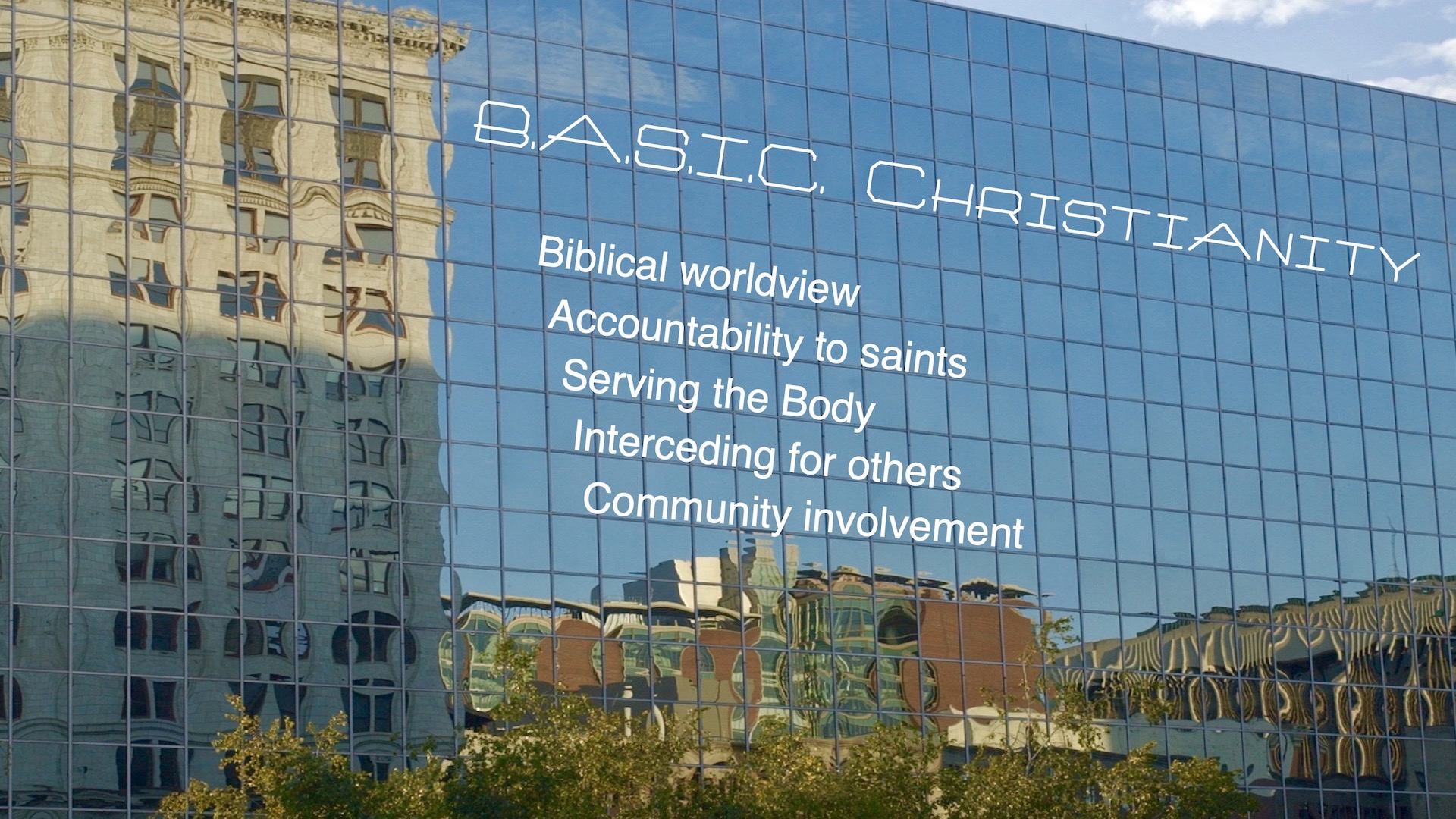
The letters we’ve looked at so far—B, A, S, and I—are bringing about greater fruitfulness and joy-fullness in our lives, which is then enhancing our personal testimony. So the B, A, S, and I all lead up to the C—community involvement.
One of the first things we need to consider about our community is our role—both what the Bible says is and isn’t our area of concern. Jesus helps us with a parable about wheat and weed and its explanation a few verses later (Matthew 13:24-30, 36-43).
From Jesus we learn that the world was created good—that’s what God said at each day of Creation. Since the fall of man, satan has sown his evil seeds alongside Christ’s good seeds.
Our responsibility isn’t about pointing out what’s wrong in the world
It isn’t about rooting out the evil in the world
It isn’t about judging the evil or even the evildoers in the world
Our responsibility is to proclaim how good our God is
Our responsibility is to bear as much God-honoring fruit as we can
Our responsibility is to embody biblical principles and proclaim the benefits of God’s Kingdom to others
The apostle Paul helps us see our role in our community with his payer in Ephesians 1:17-20. Paul desires that we know…
The hope to which God has called us. A rock-solid, irrevocable, eternal hope!
The riches of His inheritance in His saints. The treasure is in us. We get to be God’s blessing to those around us.
God’s incomparably great power for us. We’re never lacking anything because His power is for us—God Himself is for us!
When our eyes are opened to this, we can see better how to live in our communities. God has placed us and equipped us to proclaim His glorious Gospel in our Personal Mission Field. The PMF includes places like our:
Family—John 1:35-42
Friend group—John 1:43-46
Neighborhood—Colossians 1:3-8
Workplace—Ephesians 6:5-9
How do we do this?
We talk about the daily interactions you have with Jesus—make it clear that He is a real Person with Whom you have a relationship.
We live out our biblical worldview.
We stay in fellowship with out saints so that we are sharpened and prepared to give an answer for the reason for the hope we have.
We continually monitor our conversation and attitude to make sure they are Christ-like.
Let us saints be known for what we’re for more than for what we’re against!
Instead of railing on the evil, proclaim the favor of God, proclaim the soul-satisfying joy of a relationship with Jesus, and proclaim the advantages of the Holy Spirit’s continual counsel.
If you’ve missed any of the previous messages in our series B.A.S.I.C. Christianity, you can find them all here.
Listen to the podcast of this post by clicking on the player below, and you can also subscribe on Apple, Spotify, or Audible.
Confuse them, Lord, and frustrate their plans, for I see violence and conflict in the city. Its walls are patrolled day and night against invaders, but the real danger is wickedness within the city… (Psalm 55:9-14 NLT)
David sees violence and conflict, but he is quick to conclude that the enemy is not “out there” but “in here.” Notice the phrases “in the city” and “within the city.”
This is why Jesus tells us to deal with the plank in our own eye first (the things in here), and then I can see clearly to address what may be out there (see Matthew 7:1-5). He also tells us to pay attention to the clear indicators that something is wrong “in here” in Matthew 15:18-20.
Yes, we should address false gods and evil practices. But G.K. Chesterton warns us to make sure we are addressing the right things—
“Idolatry is committed, not merely by setting up false gods, but also by setting up false devils; by making men afraid of war or alcohol, or economic law, when they should be afraid of spiritual corruption and cowardice.”
God-fearing leaders must always address their own areas of corruption as the first and highest priority. It’s only after this heart-check that we can truly lead people away from things which are holding them back from fully following God.
Holy Spirit, if I feel the need to point my finger at what’s wrong “out there,” may I first yield to Your finger pointing out what’s wrong “in here” in my own heart. Once I have recognized, confessed, and corrected what’s wrong in me, equip me to be a lovingly-strong and empathetic guide to help others around me.
Listen to the podcast of this post by clicking on the player below, and you can also subscribe on Apple, Spotify, or Audible.
We had our final service of the summer joining with Hillcrest Community Church in Morley Park. Pastor Caleb Claybaugh shared a message that challenged me.
He started out with a simple question: Why do we do ministry? “Because the Bible says so” is a good start but it’s not enough. It’s not just doing but having the right attitude.
God is more interested in the attitude of our hearts than He is the actions of our hands.
First, we have to love others as Jesus loved: So now I am giving you a new commandment: Love each other. Just as I have loved you, you should love each other. Your love for one another will prove to the world that you are My disciples (John 13:34-35 NLT).
When people hurt, Jesus hurts. When Jesus saw her weeping and saw the other people wailing with her, a deep anger welled up within Him, and He was deeply troubled. … Then Jesus wept (John 11:33, 35 NLT). So, too, when we see people hurting, we should hurt with them, and our pain should move us to action—When [Jesus] saw the crowds, He had compassion on them because they were confused and helpless, like sheep without a shepherd (Matthew 9:36 NLT).
Christ’s compassion prompted Him to preach the Good News and to heal the sick (v. 35). And then Jesus prayed that more of us would be involved in this type of compassion-driven ministry (vv. 37-38).
Although this was a word Peter spoke to pastors, it’s a good challenge for all of us about checking out attitude: Care for the flock that God has entrusted to you. Watch over it willingly, not grudgingly—not for what you will get out of it, but because you are eager to serve God (1 Peter 5:2 NLT).
May our prayer be for God to give us both the heart of compassion that Jesus has, and also the hands of compassion that meet the needs of hurting people.
Listen to the podcast of this post by clicking on the player below, and you can also subscribe on Apple, Spotify, or Audible.
The definition of salvation comes from Romans 10:9. When we believe in our heart that Jesus paid the penalty for our sins and we confess that with our mouth, we are now justified. I can now stand before God just as if I had never sinned. But the Christian life is more than merely going to heaven at some point. It’s about glorifying God and pointing others to Jesus while we’re on our way to heaven.
Paul wrote to saints in Corinth (1 Corinthians 1:2; 2 Corinthians 1:1) but he also called them “mere human beings” in 1 Corinthians 3:1-3. Paul points out that there is a difference between viewing this life from a worldly viewpoint and a biblical viewpoint (2 Corinthians 5:16).
A naturalistic world view is constantly shifting as new discoveries are made. A biblical worldview knows there is nothing new under the sun, that everything is addressed in Scripture.
In order to not view this world through the lens of “mere human beings” we have to read, study, meditate on, and apply the whole counsel of God’s Word. We put it in and the Holy Spirit helps us live it out. Just like our prescription glasses won’t do a thing to correct our vision of they aren’t on our face, Scripture won’t help us navigate this world in a God-glorifying way if we haven’t put it in our heart.
Each day before I ready my Bible I pray Psalm 119:18, which asks the Holy Spirit to open my eyes to the amazing things in Scripture. I read, I journal, and I pray over the passage that I have read. Then the Holy Spirit makes good application of that Scripture (John 14:26, 16:13; 1 John 4:6). I want to be sure to read the whole counsel of God’s Word, not just cherrypicking my favorite parts. And I always want to be going deeper (Hebrews 6:1).
One place that we see contrasting world views—the natural worldview versus the biblical worldview—is in 2 Timothy 2:14-19.
Natural worldview #1—quarreling about words
Biblical worldview #1—correctly handling the Word of truth
Natural worldview #2—engaging in godless chatter
Biblical worldview #2—standing on the firm foundation of Scripture
The results of a biblical worldview are amazing:
A sure foundation (Matthew 7:24-27)
The attention of others (Matthew 7:28-29)
Useful treasures to share with others (Matthew 13:52)
A strong defense against critics (Acts 6:9-10; Psalm 119:99)
Let’s not get stuck in the “mere human being” level of a natural worldview, but let’s commit to studying our Bibles diligently so that the Holy Spirit can develop a robust biblical worldview in us. This worldview is fruitful, joyful, and enhances our testimony.
Follow along with all the other messages in our series on B.A.S.I.C. Christianity by clicking here.
Listen to the podcast of this post by clicking on the player below, and you can also subscribe on Apple, Spotify, or Audible.
Most of our Royal Psalms have taken us from King David to King Jesus. Psalm 72 is a bit different because King David is speaking some of his last words as a blessing and a reminder to King Solomon. Jesus, Peter, and those in a church prayer meeting all affirmed that David’s words were inspired by the Holy Spirit (Matthew 22:43; Acts 1:16, 4:25), so these words in Psalm 72 are just as inspired.
The introduction to this psalm in the NIV says “Of Solomon.” But because the Hebrew word for “of” can also be “for” and since v. 20 says these are the final words of David, I think we can say that this psalm is of David and for Solomon.
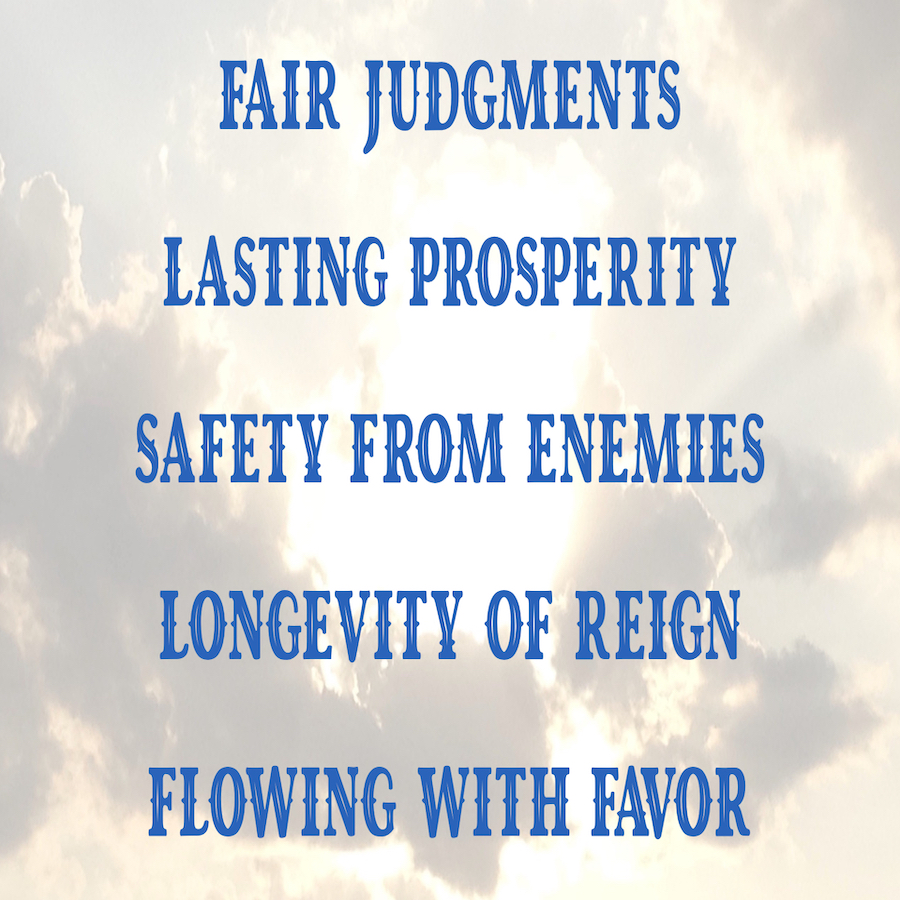
David has received God’s promise of an heir always on the throne of his kingdom. Here is the first transfer of power, and David is foreseeing the blessing that Solomon will be to the Israelite nation because of the endowment of God’s righteousness. Those blessings for his subjects include:
fair judgments (v. 2; 1 Kings 10:1-3)
prosperity (v. 3; 1 Kings 10:7, 27)
safety from enemies (v. 4; 1 Kings 10:26)
longevity (v. 5; 1 Kings 10:8)
favor (vv. 6-7; 1 Kings 10:9)
Historically, we know of the fulfillment of these things. We can especially see it in the visit of Queen Sheba in 1 Kings 10.
In this next paragraph, as we have seen with other royal psalms, there is a modulation back-and-forth between King Solomon and King of kings Jesus (vv. 8-11). Verse 8 is the ends of the earth rule of Jesus; vv. 9-10 are the local rule under Solomon; v. 11 then speaks of all kings…all nations bowing to Jesus as the King of kings.
This modulation reminds us that no earthly king can ever stand-in for the Eternal King. After the static of switching back-and-forth, from our perspective at this point in history a flashback event becomes crystal clear.
David gives instructions and a warning to Solomon (1 Kings 2:1-4)
Solomon wields his power in Israel (2 Chronicles 1:1)
Solomon falters under his power by becoming intoxicated by it (1 Kings 3:3; 11:1-4)
Solomon’s kingdom is diminished (1 Kings 11:10-13)
This is not the case for our King of kings! His kingdom has no end because His rule has no end (Isaiah 9:6-7; Luke 1:32-33).
The devil tried to limit Jesus by offering Him a shortcut, but Jesus stood firm. So the remainder of this Royal Psalm can only be fulfilled by Jesus:
vv. 12-14 foreshadow the prophecy of Jesus Isaiah 61:1-2 and its fulfillment in Luke 4:21
vv. 15-17 foretell all nations being blessed forever under the lordship of King Jesus
Don’t get caught up in looking at what’s before your eyes right now. Don’t get discouraged by the voice that’s in your ears right now. Don’t get mesmerized by the glittery things of earth. Keep your focus on the Eternal King. David’s conclusion to this Royal Psalm is that we worship our King above all else (Psalm 72:18-19).
And David’s final words should echo from our lips as well: Amen and Amen!
You may also want to check out my blog post and video The Value of Journaling where I talk about how I capture thoughts, prayers, conversations from others, Scripture verses and more when I’m facing a big decision.
Psychologists call it “projection” when I see so quickly in others what’s really in myself.
If I see sin in others, my first response would be to hit my knees and ask the Holy Spirit to search me to point out the same sin in myself.
It’s only after confessing my sin and receiving God’s complete forgiveness that I am equipped with the empathy and mercy to help someone else find the same freedom I have found.
Lord, may I be more sensitive to the sin in my life than I am aware of the sin in the world.
Leaders would do well to remember that they lead a group of unique individuals. Let the unique gifts of those unique people be used in unique ways, and watch both the individuals and the organization grow!
“As Tyler Cowen wrote in The Free Press, ‘Whether or not you work in the AI sector, if you put any kind of content on the internet, or perhaps in a book, you are likely helping to train, educate, and yes, morally instruct the next generation of what will be this planet’s smartest entities. You are making them more like you—for better or worse.’ Now, maybe someone thinks, ‘I’ve hardly got any followers, who cares what I post? It probably won’t matter.’ But the principle means we should care. The philosopher Immanuel Kant famously offered his ‘categorical imperative’ as a test for ethical decisions: ‘Act only according to that maxim whereby you can at the same time will that it should become a universal law.’ In other words, we should only do what we think would be good for everyone to do.” —Axis.org
How much good inside a day?
Depends how good you live ’em.
How much love inside a friend?
Depends how much you give ’em. —Shel Silverstein
A fantastic mini-biography of Otto J. Klink who went from being a Christian, to an atheist socialist, to failed presidential assassin, to a Pentecostal author and evangelist. Wow!
“My acceptance of the universe is not optimism, it is more like patriotism. It is a matter of primary loyalty. The world is not a lodging-house at Brighton, which we are to leave because it is miserable. It is the fortress of our family, with the flag flying on the turret, and the more miserable it is the less we should leave it. The point is not that this world is too sad to love or too glad not to love; the point is that when you do love a thing, its gladness is a reason for loving it, and its sadness a reason for loving it more.” —G.K. Chesterton
Marshall Segal said this about our daily Bible reading time, “I want to walk through a five-step prayer you could pray when you sit down with your Bible to meet with God. The five steps are built on an acronym for FEAST. Focus my mind; Enlighten my eyes; Address my sin; Satisfy my soul; Train my hands.”
“A man of character will make himself worthy of any position he is given.” —Mahatma Gandhi
“A retentive memory may be a good thing, but the ability to forget is the true token of greatness. Successful people forget. They know the past is irrevocable. They’re running a race. They can’t afford to look behind. Their eye is on the finish line. Magnanimous people forget. They’re too big to let little things disturb them. They forget easily. If anyone does them wrong, they consider the source and keep cool. It’s only the small people who cherish revenge. Be a good forgetter. Business dictates it, and success demands it.” —Elbert Hubbard
“Leadership is not about being in charge, but about taking care of the people in your charge.” —Simon Sinek
Flowing Data has a fascinating look at how people spend their time during the day. Their adjustable chart shows activities by age, sex, and time of day. It reminds me of a blog post I shared about time management, where I noted, “You cannot add more Tick, Tocking! time to your day, but you can keep more of your day from Drip, Dropping! away.”
“We might think, ‘Well, hey, if I’m devoting myself all the time to looking out for others’ needs, who’s going to be looking out for mine?’ The Lord, of course, because He knows what you need even before you ask Him, and He has ways of meeting your needs that are more wonderful than you in your cleverness or strength could ever conjure or provide (cf. Matthew 6:25-34).” —T.M. Moore
“We all know that exercise makes us feel better, but most of us have no idea why. We assume it’s because we’re burning off stress or reducing muscle tension or boosting endorphins, and we leave it at that. But the real reason we feel so good when we get our blood pumping is that it makes the brain function at its best, and in my view, this benefit of physical activity is far more important—and fascinating—than what it does for the body. Building muscles and conditioning the heart and lungs are essentially side effects. I often tell my patients that the point of exercise is to build and condition the brain.” —Dr. John Ratey
T.M. Moore has a hard but good word for Christians: “If this day, and this expectation and hope [when we heard King Jesus say, ‘Well done, good and faithful servant’], are not the driving force for every aspect of our lives and work, then it is doubtful we have really understood the Good News of the Kingdom or received the salvation freely offered to us by the King. I say this again: If we are not motivated and driven, day by day, by the prospect of hearing ‘Well done, good and faithful servant,’ then we need to examine ourselves, whether we truly know the Lord of glory. That’s pretty hard language, I know, but let’s face the reality: If we have not submitted to Jesus as Lord of every area of our life, all the work we’ve been given to do, then we are still living for ourselves, not Him.” —T.M. Moore











![Joshua 3.5 and Psalm 19.12 [commentary]](https://i0.wp.com/craigtowens.com/wp-content/uploads/2025/08/joshua-3.5-and-psalm-19.12-commentary.jpg?w=386&h=386&crop=1&ssl=1 "Joshua 3.5 and Psalm 19.12 [commentary]")





 Craig T. Owens