Thursdays With Spurgeon—The Mouth Of The Lord Has Spoken

This is a weekly series with things I’m reading and pondering from Charles Spurgeon. You can read the original seed thought here, or type “Thursdays With Spurgeon” in the search box to read more entries.

Listen to the podcast of this post by clicking on the player below, and you can also subscribe on AppleSpotify, or Audible. 

The Mouth Of The Lord Has Spoken

…For the mouth of the Lord has spoken (Isaiah 1:20).

     However this sacred Book may be treated nowadays, it was not treated contemptuously, nor negligently, nor questioningly by the Lord Jesus Christ, our Master and Lord. It is noteworthy how He reverenced the written Word. The Spirit of God rested upon Him personally, without measure, and He could speak out of His own mind the revelation of God, and yet He continually quoted the Law, and the Prophets, and the Psalms…. I am sure, brethren, we cannot be wrong in imitating the example of our divine Lord in our reverence for that Scripture, which cannot be broken. … 

     The New Testament writers sit reverently down before the Old Testament and receive God’s words as such without any question whatever. You and I belong to a school that will continue to do the same, let others adopt what behavior they please. As for us and for our house, this priceless Book will remain the standard of our faith and the ground of our hope so long as we live.

From The Infallibility Of Scripture

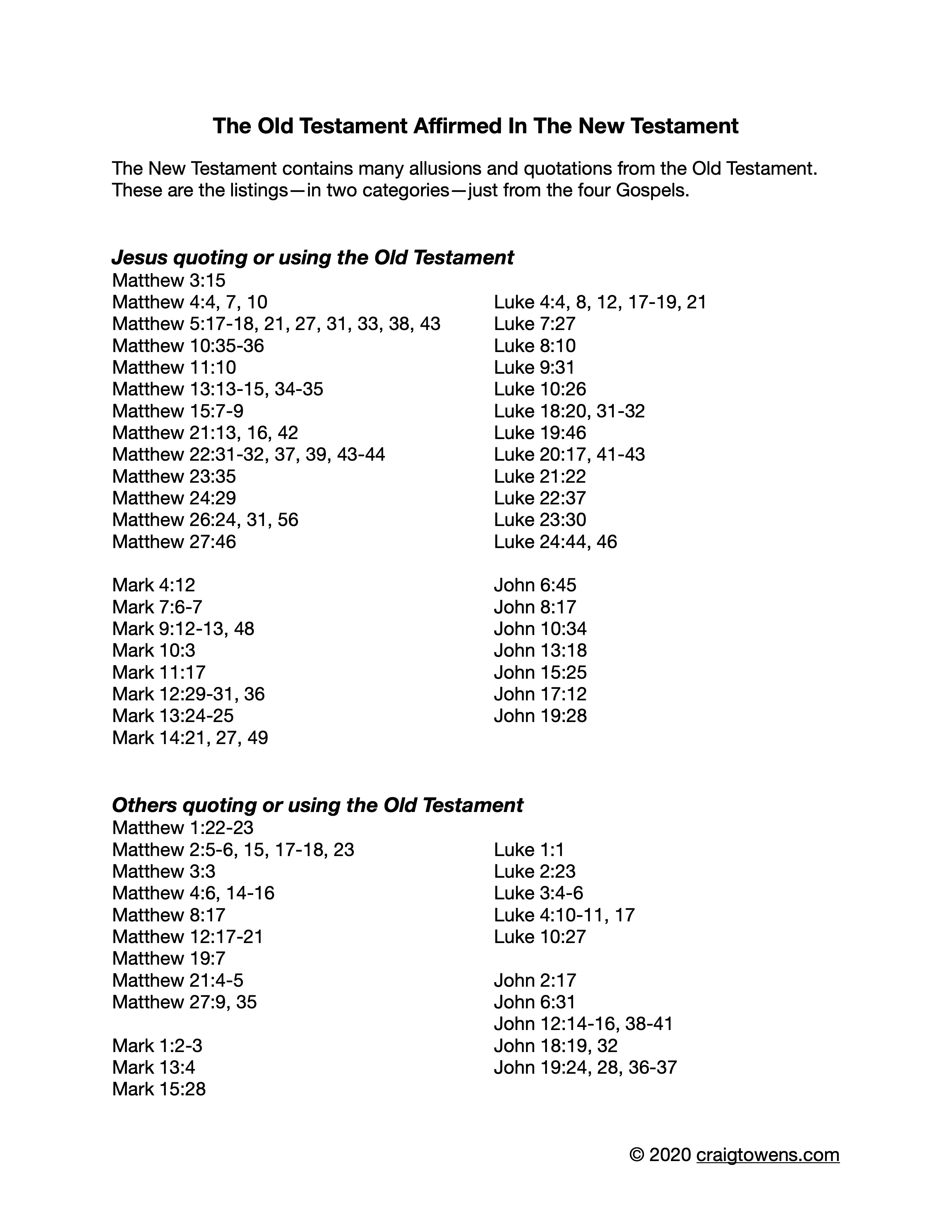
As I have discussed before, the 39 books of the Old Testament were called “Scripture” by Jesus and those living in that same era. The New Testament writers saw Jesus as the fulfillment of those Old Testament Scripture, and what they wrote for us then became Scripture also (Luke 4:18-21; 24:27, 44-45; John 2:22, 17:12; Acts 1:16, 8:35; Galatians 3:8, 16, 22; James 2:8, 23, 4:5-6; 1 Peter 2:6; 2 Peter 3:16). 

When we read the Bible, we are reading words from the mouth of God Himself! 

This Book is the measure of truth, the guide for our lives, and the blessed assurance we need as we anticipate the second advent of Jesus. We need to be much in this Sacred Book!

►► Would you please prayerfully consider supporting this ministry? My Patreon supporters get behind-the-scenes access to exclusive materials. ◀︎◀︎

Epiphany

Listen to the podcast of this post by clicking on the player below, and you can also subscribe on AppleSpotify, or Audible. 

After the outpouring of the Holy Spirit on that Day of Pentecost immediately following Christ’s ascension, Christians were speaking in languages that they had not learned. As they did so, they were “declaring the wonders of God” in all the languages of the world. Some people mocked, saying they were merely babbling drunks, but everyone in Jerusalem was “amazed and perplexed” at this remarkable event, which prompted Peter to preach a powerful sermon (Acts 2:8-21). 

Peter began his sermon by quoting words “spoken by the prophet Joel” (Joel 2:28-32). It’s unlikely that Peter had a copy of Joel with him, so this quotation was delivered from memory and Peter’s sermon was given spontaneously as the Holy Spirit empowered him. In looking at the passages in both Joel and Acts, I see three notable differences.

  1. Joel begins by saying, “And afterward I will pour out My Spirit,” but Peter begins with the words, “In the last days…I will pour out My Spirit.” I’ll address this point further in just a moment. 
  2. Peter inserts “and they will prophesy” at the end of verse 18, a phrase that Joel didn’t say at the end of Joel 2:29. I think this is the Holy Spirit emphasizing that what the crowd heard was indeed prophecy, not mindless babbling. 
  3. Joel concludes with “before the coming of the great and dreadful day of the Lord,” but Peter says, “before the coming of the great and glorious day of the Lord.” The word Joel uses for “dreadful,” meaning an awesome day worthy of reverence, was a day of sorrow for those about to be judged guilty, and a day of supreme rejoicing for those about to be judged innocent in God’s sight. The word Peter uses for “glorious” is the only time this Greek word is used in the New Testament. The word is epiphanes: where we get our English word “epiphany”—a light has dawned and the truth is finally realized! 

Let’s go back to the difference between “afterward” in Joel and “in the last days” in Acts. In a sense, the “afterward” for Peter was what everyone was experiencing right then—after the death, burial, and resurrection of Jesus, and after the outpouring of the Holy Spirit that Jesus had promised (John 16:7; Acts 1:4-5). 

Let’s also consider the “afterward” in Joel’s day. What came before was a disaster of locusts consuming the land, which prompted Joel to call for the solemn response of prayer and fasting. This heartfelt response from godly people trigged God’s outpouring of His Spirit—the afterward—that led to a blessing “before the coming of the great and dreadful day of the Lord” (Joel 2:1-3, 10-13). 

Both Joel and Peter conclude that it is God’s desire that “everyone…be saved”! The outpouring of the Holy Spirit was to help people have an epiphany of both their sin and the salvation that Jesus purchased on His Cross.

The word “disaster” comes from the Latin word disastros. The root word astros pertains to the heavenly lights (star, sun, moon), and the prefix “dis-” is a pejorative (something that has a belittling effect). So disaster really means no guiding lights, or hopeless darkness. 

Jesus was prophesied to step into this hopeless darkness and bring light and hope—“The people walking in darkness have seen a great light; on those living in the land of deep darkness a light has dawned” (Isaiah 9:2). Zechariah prophesied that Jesus was the fulfillment of this: “Because of the tender mercy of our God, by which the rising sun will come to us from heaven to shine on those living in darkness and in the shadow of death, to guide our feet into the path of peace” (Luke 1:78-79).  

Jesus is THE Epiphany, THE Ultimate Light, but He also tells us, “You are the light of the world (John 8:12; Matthew 5:14).  

In a world of hopeless darkness, Christians are to be Christ’s Light-bearers. 

We cannot do this on our own. 

The Holy Spirit’s empowerment ignites and then aligns our light-bearing to a disaster-prone world. 

When Joel saw disaster coming, he called for a fast. This fast led to the outpouring of God’s empowerment on godly people, so they could take the Light to those lost in deep darkness. I think the same response is needed from Christians today. 

When it appears this world is plunging deeper into darkness—when we hear of disasters (remember that disastros means people are without Light)—we need to pray and fast so that the Holy Spirit can be reignited in us, so that we can then be realigned to best shine the light of Jesus brightly. 

Our lives can and should be the epiphany of Christ’s love for the world to see! Let’s all pray: “Holy Spirit, make us Your epiphany to a dark world!” 

If you’d like to check out the other messages in our series We Are: Pentecostal, please click here. 

►► Would you please prayerfully consider supporting this ministry? My Patreon supporters get behind-the-scenes access to exclusive materials. ◀︎◀︎
Thursdays With Spurgeon—The Whole Counsel Of God’s Word

This is a weekly series with things I’m reading and pondering from Charles Spurgeon. You can read the original seed thought here, or type “Thursdays With Spurgeon” in the search box to read more entries.

Listen to the podcast of this post by clicking on the player below, and you can also subscribe on AppleSpotify, or Audible. 

The Whole Counsel Of God’s Word

The words of the Lord are flawless, like silver purified in a crucible, like gold refined seven times. (Psalm 12:6) 

     Beloved friends, consider the quality of the words of God. ‘The words of the Lord are pure words.’ From this statement I gather, first, the uniformity of their character. No exception is made to any of the words of God, but they are all described as pure words. They are not all of the same character. Some are for teaching, others are for comfort, and others for rebuke. But they are so far of a uniform character that they are all pure words. I conceive it to be an evil habit to make preferences in Holy Scripture. We must preserve this volume as a whole. …  

     Above all, do not drop into the semi-blasphemy of some, who think the New Testament vastly superior to the Old. … They are of equal authority, and they cast such light upon each other that we could not spare either of them. … In the whole Book, from Genesis to Revelation, the words of Jehovah are found, and they are always pure words. … 

     Whether the Holy Spirit speaks by Isaiah, or Jeremiah, or John, or James, or Paul, the authority is still the same. Even concerning Jesus Christ our Lord this is true. For He says of Himself, ‘The word which you hear is not Mine, but the Father’s who sent Me’ (John 14:24). In this matter He puts Himself upon the level of others who were as the mouth of God.

From The Bible Tried And Proved

Because my parents were such amazing hosts, we had a steady stream of evangelists and missionaries that dined in our home. As a young man, I was so blessed to sit at the dining room table and listen to some of the wisest and godly preachers of their time. 

One such evangelist was C.M. Ward, who hosted the “Revivaltime” radio broadcast for a quarter of a century. I remember listening intently to a conversation in our home when he turned and looked right at me. “Young man,” he said, “The Word of God is pure. You can devour it and feed on all of it. But anything else you read is like eating chicken: There’s some meat that’s good, but you have to watch out for the bones that can choke you.” 

Those words have stuck with me for nearly 50 years. I delight in reading my Bible as my daily Bread—both Old Testament and New Testament, the words of the prophets, the words of Jesus, and the words of the apostles. It’s all so beneficial! 

In a recent sermon, I talked about the value in reading and studying the whole counsel of God’s Word.

I encourage you not to pick and choose the biblical passages that you like best, but to read, study, and meditate on the whole Book. Find a study Bible to use, get into a Bible-preaching church, and make God’s Word your daily Source of wisdom. 

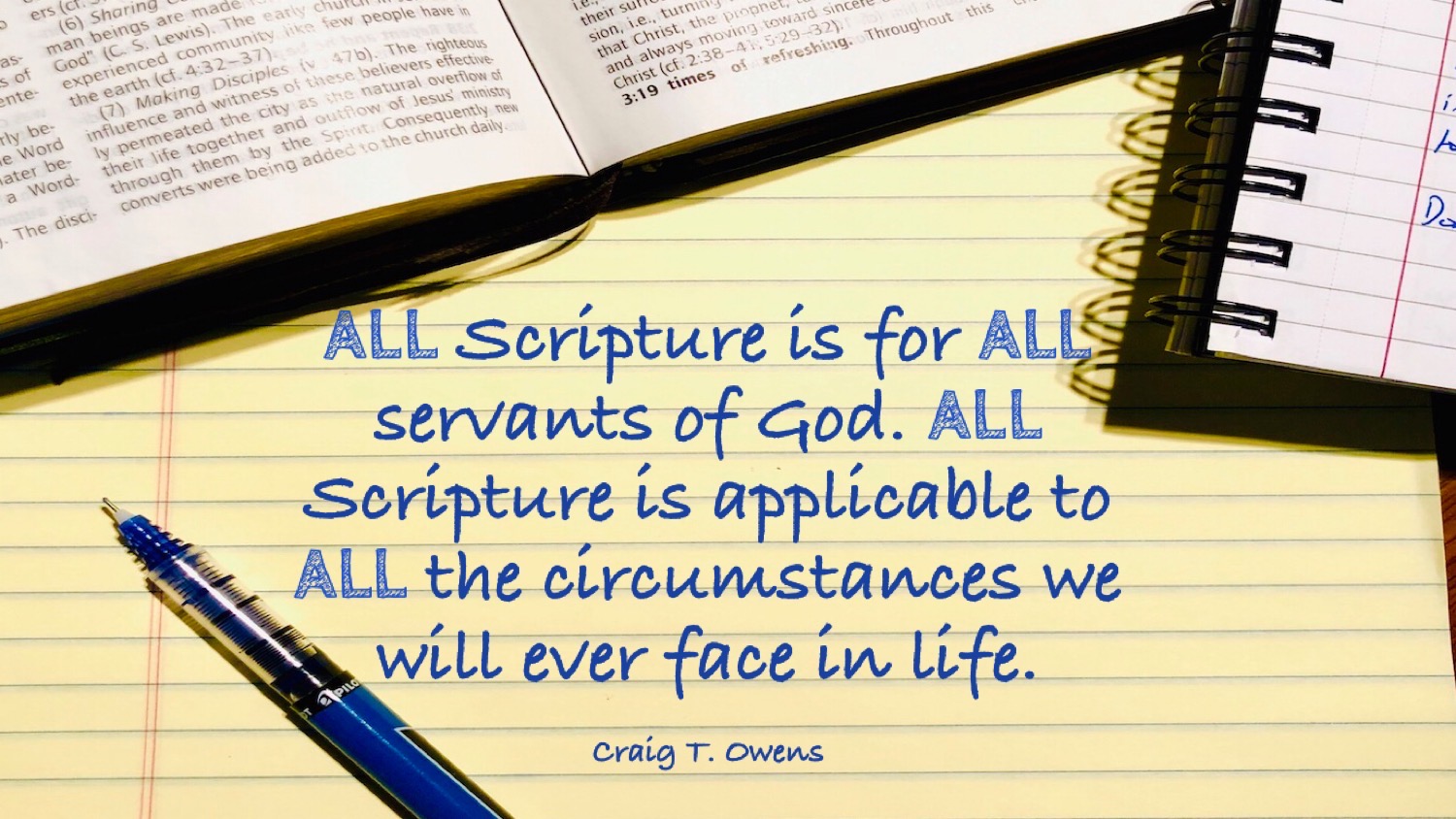
ALL Scripture is for ALL servants of God. ALL Scripture is applicable to ALL the circumstances we will ever face in life.

►► Would you please prayerfully consider supporting this ministry? My Patreon supporters get behind-the-scenes access to exclusive materials. ◀︎◀︎

The Gift At Work In Us

Listen to the podcast of this post by clicking on the player below, and you can also subscribe on AppleSpotify, or Audible. 

Last week I said, “You are God’s gift to the world IF you are revealing God’s Gift to the world in everything you say and do.” 

That “IF” is a big one. 

I’ll be the first one to admit that I struggle with consistency in this! But before we all get frustrated, throw up our hands and say, “This is so hard! Why even try?” I’ve got a word of encouragement for you: God’s Gift in us is both perfect and being perfected. 

In order to explain this, I need to go back in time. In fact, I need to go all the way back to when Time began. The opening words of the Bible are, “In the beginning God created the heavens and the earth” (Genesis 1:1). God the Father, the Nicene Creed says, is “the Maker of heaven and earth.” 

But God the Son is involved in Creation, as is God the Holy Spirit (John 1:1-3; Genesis 1:2). Again, the Nicene Creed quotes John 1 about Jesus, “Through Him all things were made,” and the Creed also says the Holy Spirit is “the Giver of life.” 

So the Father created everything through His Word and by His Spirit. 

All of the Godhead is also involved in our salvation too. The Father loved us and gave us His Son. Jesus paid the price for our atonement and justified us with the Father. And the Holy Spirit draws us to the Father through the Son as He sanctifies us. 

The reason I said the Gift in us is both perfect and being perfected is because when Jesus said, “It is finished,” nothing was left to be done: it is a perfect Gift, fully paid for. “The law is only a shadow of the good things that are coming—not the realities themselves. For this reason it can never, by the same sacrifices repeated endlessly year after year, make perfect those who draw near to worship. … [But] by one sacrifice He [Jesus] has made perfect forever those who are being made holy” (Hebrews 10:1, 14). 

Do you see those verb tenses? Jesus made our atonement perfect, but we are now being made holy by the Holy Spirit. 

The process of sanctification (or as I like to remember it: “saint-ification”) isn’t a one-and-done work. It’s an ongoing work. The Father wants us to remain IN Jesus and bear fruit, so the Holy Spirit remains IN us to bring out that fruitfulness (see John 14:16-17, 20; John 15:1-7). 

This is often an uncomfortable work. 

When I serve as a coach or a consultant, I tell people up front, “There is going to be a time that you won’t like me very much because I’m going to keep uncovering things that you’ve overlooked. It’s going to get uncomfortable before we see improvement. But if you will stick with me, I promise you that there will be a noticeable improvement on the other side of this uncomfortableness.” 

God disciplines those He loves. He wants His Son’s Gift to be seen by the world, so the Spirit must keep saint-ifying us. He will continue to hover over us, never letting us get complacent, vivifying us so that more and more of Jesus is increasingly seen in our lives. 

It’s going to get uncomfortable before we see improvement! 

So don’t lose heart. Don’t get discouraged. Don’t beat yourself up. Don’t let satan turn the Holy Spirit’s conviction into his condemnation. 

Instead, listen to this prayer from the apostle Paul and make it your own prayer—

For this reason we…have not ceased to pray and make special request for you, asking that you may be filled with the full, deep, and clear knowledge of His will in all spiritual wisdom—in comprehensive insight into the ways and purposes of God, and in understanding and discernment of spiritual things. 

That you may walk, live, and conduct yourselves in a manner worthy of the Lord, fully pleasing to Him and desiring to please Him in all things, bearing fruit in every good work and steadily growing and increasing in and by the knowledge of God with fuller, deeper, and clearer insight, acquaintance, and recognition.

We pray that you may be invigorated and strengthened with all power according to the might of His glory, to exercise every kind of endurance and patience, perseverance, and forbearance with joy, giving thanks to the Father, Who has qualified and made us fit to share the portion which is the inheritance of the saints—God’s holy people—in the Light. (Colossians 1:9-12 AMP) 

You are God’s gift to the world IF you are revealing God’s gift to the world in everything you say and do. The Gift in you has already been made perfect, and now the Holy Spirit is going to help you demonstrate this Gift more perfectly. Your fruitfulness is being made holy through His loving work in you. 

If you’ve missed any of the messages in this series Christmas Unwrapped At Easter, you can find a list of all of the messages here. 

►► Would you please prayerfully consider supporting this ministry? My Patreon supporters get behind-the-scenes access to exclusive materials. ◀︎◀︎

The Gift Preached To The World

Listen to the podcast of this post by clicking on the player below, and you can also subscribe on AppleSpotify, or Audible. 

Ever since Resurrection Day, we can continually celebrate the greatest Gift ever—the death and resurrection of Jesus! 

After making His bodily resurrection abundantly clear, Jesus ascended back to heaven. And now we await His second advent. But here’s an important question: If Jesus ascended back into heaven, where is our Gift now? Quite simply: If you have invited Jesus into your heart, YOU are the gift! 

Remember on Good Friday I talked about what Jesus perfectly completed when He said, “It is finished!” It was an inside job. He came to change us at our core—we have been brought into at-onement with God and we stand in His presence just-as-if-I’d-never-sinned. 

But there is one more step, an ongoing process called sanctification or as I like to say it, “saint-ification.” 

Even as we are in this process, Jesus commissioned all of His disciples to Go…preach (Mark 16:15; Matthew 28:18-20). That means “as you are going” or “wherever you go” tell everyone the good news of the greatest Gift ever. 

Jesus also told us that the Holy Spirit would empower us to be effective at this preaching (Acts 1:4-5, 8). Notice that in Acts 1:8 Jesus said, “You will BE My witnesses,” not you will do witnessing. The Holy Spirit empowers us to BE God’s gift to the world, and to use Christ’s authority properly. 

The apostle Paul echos this. He tells us how everyone can receive the Gift of Jesus. Paul then notes that people hear about this Gift because those who have received the Gift are preaching to them (Romans 10:8-15). 

We are all preachers or proclaimers of the Greatest Gift. Don’t confuse preaching with being a pastor. Preaching is a lifestyle for all Christians, whereas pastoring is an office that only some Christians are called to. Francis of Assisi said, “Preach always; if necessary, use words.” 

Here are three things that I think preach unmistakably. 

(1) Loving, practical service to those in need (John 13:34-35; Matthew 25:34-40)

Jesus said it pretty simply: If someone is hungry, give them something to eat. This practical love is an unmistakable sermon. 

(2) Loving, practical service to those you dislike—or who dislike you (Luke 6:27-36) 

Anyone can do loving things for people they like, but when you bless people who are mean to you, another unmistakable sermon is being preached. 

(3) Jesus-exalting fruitfulness (Galatians 5:19-25) 

Paul contrasts the fruit of those who haven’t invited Jesus into their hearts with those who have. Our fruits of kindness in an unkind world, or self-control in a hedonistic world also preach an unmistakable sermon. 

(check out all of the above Bible verses by clicking here)

If the Gift of Jesus is in you, then your life IS the sermon. Preach it well! 

You are God’s gift to the world IF you are revealing God’s Gift to the world in everything you say and do. 

If you’ve missed any of the messages in our series Christmas Unwrapped At Easter, you can find all of them listed here. 

►► Would you please prayerfully consider supporting this ministry? My Patreon supporters get behind-the-scenes access to exclusive materials. ◀︎◀︎
New Inside

Listen to the podcast of this post by clicking on the player below, and you can also subscribe on AppleSpotify, or Audible. 

In the movie Groundhog Day, Bill Murray’s character (Phil) is stuck in a small town where February 2 keeps repeating. Phil tries desperately to get out of this town and out of this day, but nothing he seems to do gets him out of the endless loop. He becomes smarter and richer each day, but at the end of the day, everything resets to the beginning. 

It’s frustrating! 

God’s people of the Old Testament had their own “Groundhog Day”—the Day of Atonement that came every single year. This was the day their sins were confessed, forgiven, and atoned for, and had a very specific set of sacrifices and rituals. Much like Phil in the movie, they began to go through these motions almost entirely without thinking. 

Year after year, millennia after millennia “the same sacrifices repeated endlessly year after year, [couldn’t] make perfect those who draw near to worship” (see Hebrews 10:1-4). 

Even those who were God-fearing and tried their best to live perfectly righteous lives could find in the law provision for those who “sin unintentionally” (Leviticus 4:2, 13, 22, 27; 5:15, 18, 22, 24, 27-29). It was just another reminder that the loop of sin-confession-repentance-forgiveness-atonement was never ending. 

And as if all the requirements of the Torah weren’t enough, Jesus came on the scene and seemed to raise the bar, telling us even though our outward actions might look righteous, our inward thoughts and attitudes made us just as sinful (Matthew 5:21-22, 27-28). And then Jesus even dropped this on us, “Be perfect, therefore, as your heavenly Father is perfect” (Matthew 5:48)! 

Perfect?! As perfect as God?! This could easily make people throw their hands up in resignation, “I give up! Why even try?” 

Through Ezekiel, God prophesied an internal change. This wasn’t something I must do, but something GOD will do—

I will give you a new heart and put a new spirit in you; I will remove from you your heart of stone and give you a heart of flesh. And I will put My Spirit in you and move you to follow My decrees and be careful to keep My laws. (Ezekiel 36:26-27) 

The solution to our endless loop of sin-confession-repentance-forgiveness-atonement must become internal. It’s no use trying to correct the fruit if the root is still evil! That requires an inside job. 

On Good Friday, the last words Jesus spoke before His death were, “It is finished” (John 19:30). 

What was finished? Our struggle to get ourselves out of this endless loop. The writer of Hebrews had this to say about Jesus: 

But when this Priest had offered for all time one sacrifice for sins, He sat down at the right hand of God. … For by one sacrifice He has made perfect forever those who are being made holy. (Hebrews 10:12, 14) 

Remember Jesus told us we had to be perfect like God? The root word for “perfect” in that verse is telos. When Jesus cried out, “It is finished,” He said one word in Greek: tetelestai. This also comes from the root word telos. Jesus perfectly finished all that was necessary for us to become perfect in God’s sight. 

Christians often use the the phrase “I invited Jesus into my heart” as an expression of their faith in what Jesus did for them on the Cross. That word “IN” is a good reminder. 

Jesus comes IN and the fear of punishment—the fear of being eternally stuck in the endless loop—has to go out. “There is no fear IN love. But perfect love drives out fear, because fear has to do with punishment. The one who fears is not made perfect IN love” (1 John 4:18). 

The word “perfect” in that verse is also from the same root word telos. 

Not only does Jesus come IN to our hearts to make them new, but He also takes us IN to His perfection. “Looking away from all that will distract to Jesus, Who is the Leader and the Source of our faith—giving the first incentive for our belief—and is also its Finisher—bringing it to maturity and perfection…” (Hebrews 12:2 AMP). 

Jesus shared a last supper with His disciples. His last supper was the first Communion. At this time Jesus told them He was establishing a “new covenant.” How do we square this with His previous statement that He didn’t come to abolish the law but to fulfill it? 

Jesus said this new covenant was IN His blood. His blood doesn’t abolish the law, but it perfects the law. His perfect blood makes out hearts new and takes us out of the external loop and IN to His prefect righteousness. 

Jesus accomplished all that was needed to make us perfect inside, and then to perfectly take us into God’s presence. As the hymn The Old Rugged Cross reminds us, “In that old rugged Cross, stained with blood so divine, a wondrous beauty I see. For ’twas on that old Cross Jesus suffered and died to pardon and sanctify me!” 

May we always cherish the perfection that was purchased for us on that Cross. 

►► Would you please prayerfully consider supporting this ministry? My Patreon supporters get behind-the-scenes access to exclusive materials. ◀︎◀︎
The Gift Unmistakably Seen

Listen to the podcast of this post by clicking on the player below, and you can also subscribe on AppleSpotify, or Audible. 

We saw last week that John 3:16 tells us of God’s greatest Gift—Jesus! 

This Gift was not an after-thought. God didn’t say, “I’ve tried everything else and nothing has worked so I guess I have to send My Son.” NO! The Gift was foretold right from the very moment Adam and Eve sinned (Genesis 3:15, 21). In fact, we can even say it was planned before the beginning of Time, as John describes Jesus as “the Lamb who was slaughtered before the world was made” (Revelation 13:8). 

John also writes for us one of the most beautiful and succinct statements of God: God IS Love (1 John 4:8). 

Paul wrote an inspired definition of love. Check out what happens when we put “God” in place of “love” in 1 Corinthians 13:4-8

God is patient, God is kind. God does not envy, God does not boast, God is not proud. God does not dishonor others, God is not self-seeking, God is not easily angered, God keeps no record of wrongs. God does not delight in evil but rejoices with the truth. God always protects, God always trusts, God always hopes, God always perseveres. God’s love never fails. 

This description of God means that He wasn’t forced to send Jesus as the ransom for our sins, but rather that His love foreknew the perfect moment to send this Gift for us. 

Neither did Jesus feel trapped by this plan His Father made. Calvary didn’t happen to Jesus, but Jesus came to make Calvary happen (John 17:24; Hebrews 12:2; John 10:17-18). 

Jesus made His Gift unmistakable:

  • He predicted the unmistakable events leading up to Calvary—Matthew 20:17-19, 26:2; Mark 10:32-34; Luke 18:31-33; John 13:19 
  • He predicted the unmistakable way He would die—John 3:14, 12:32-33 
  • And His Father unmistakably confirmed all of this—John 12:27-28

(check out all of the above verses by clicking here) 

Just before His crucifixion, Jesus gave His followers an unmistakable example of love to follow. He said that His love radiating out of His followers would show the world an unmistakable picture of His love (see John 13:3-5, 12-17, 34-35). 

I may say, “Thank you so much” when I open someone’s gift, but my true gratitude is seen in what I do with their gift after that. Do I put it on a shelf and forget about it? Or do I cherish it, use it, and tell others all about the one who gave the gift to me? This is just as true with how I treat the Love Gift that I was given in Jesus. 

Q: How unmistakable is my gratitude for the Gift of Jesus? 

A: It is unmistakably seen in how I love others. 

Here’s the test: Can I put my name in 1 Corinthians 13:4-8—

Craig is patient, Craig is kind. Craig does not envy, Craig does not boast, Craig is not proud. Craig does not dishonor others, Craig is not self-seeking, Craig is not easily angered, Craig keeps no record of wrongs. Craig does not delight in evil but rejoices with the truth. Craig always protects, Craig always trusts, Craig always hopes, Craig always perseveres. Craig’s love never fails.

The Holy Spirit wants all Christians to be able to truthfully insert their names in that statement. He wants to help us make necessary changes that will allow the amazing Gift of Jesus to be unmistakably seen by everyone. 

God’s plan is unmistakable. The death of Jesus is unmistakable proof of God’s love. Now, let’s make sure that our love is also empowered by the love of God shining unmistakably out of everything we say and do. 

If you’ve missed any of the messages in our series Christmas Unwrapped At Easter, you can find the complete list by clicking here. 

►► Would you please prayerfully consider supporting this ministry? My Patreon supporters get behind-the-scenes access to exclusive materials. ◀︎◀︎
Crucifixion Events

Listen to the podcast of this post by clicking on the player below, and you can also subscribe on AppleSpotify, or Audible. 

The death of Jesus may be the most attested execution in all of history. It’s certainly the most meaningful execution, as the death of Jesus brought a fulfillment to prophecy that was made in the immediate aftermath of humanity’s first sin. 

I have frequently written about the historicity of the Bible. The crucifixion of Jesus is not a “once upon a time” or “in the make-believe land of Israel” story, but an actual event, which involved actual people, at an actual moment in history. Even the way the four Gospel writers record the crucifixion of Jesus attests to the historicity of this event.

Check out this chart of the events that show how Matthew, Mark, Luke, and John record this historical moment. 

When did this moment in history occur? Consider this scholarly insight from The Archeological Study Bible

“In what year was Jesus born, and when was He crucified? These are long-standing historical questions. The seemingly obvious answer to the first—that He was born in A.D. 1 (there is no year 0)—is incorrect, however, since the calculations on which our modern calendar is based were faulty. …

“The chronology of Jesus’ life, though clear in outline, cannot be fixed with absolute precision. Matthew and Luke both inform us that Jesus was born before the death of Herod (4 B.C.), though it would appear that His birth occurred toward the final years of Herod’s reign, suggesting an approximate date of 6-4 B.C. The next chronological marker comes from Luke 3:1, where we learn that John the Baptist’s ministry began during the fifteenth year of the reign of the emperor Tiberius. Since A.D. 14 is the generally accepted date for Tiberius’ accession to the throne, John’s ministry would have commenced between August A.D. 28 and December of 29. Jesus began His own ministry shortly after John had embarked on his, at some point in A.D. 28 or 29, making Jesus about 32 or 33 years old at the time. This fits well with Luke’s statement that Jesus was ‘about 30 years old’ (Luke 3:23).

“The duration of Jesus’ public ministry was approximately three years. While the exact chronology of this period is difficult to ascertain, the final phase of His ministry allows for closer scrutiny. It is clear that Jesus was crucified under Pontius Pilate, who governed Judea from A.D. 26-36. …

“Taking Friday, Nisan 14, as the day of the crucifixion, astronomical data informs us that the only years from A.D. 29-36 that could have seen Nisan 14 on a Friday are A.D. 30, 33 and 36. A.D. 36 is easily dismissed as too late, while A.D. 30 seems too early (although some who begin Jesus’ ministry in A.D. 28 and shorten His public ministry find it acceptable). This leaves A.D. 33 as the most likely date for the year of Jesus’ death and resurrection.” 

As you celebrate the victory over sin and death that Jesus won by His sacrificial death on the Cross, rejoice also that this is an actual historical event that bought your freedom from your sin. It is indeed miraculous, but it is also historic. Let’s never lose sight of either of those facets. 

►► Would you please prayerfully consider supporting this ministry? My Patreon supporters get behind-the-scenes access to exclusive materials. ◀︎◀︎

Which Engine Drives You?

Listen to the podcast of this post by clicking on the player below, and you can also subscribe on AppleSpotify, or Audible. 

There’s a little song that makes me chuckle every time I hear it, and I may have even sung this song a couple of times myself. It goes like this, “I had a lot to do today, but you know what I did instead? I took a nap. It was a very good nap.” 

We’ve all been there. There are things we know that we should do, but we simply don’t feel like doing them. We let our feelings drive our actions. There are several seemingly innocent things that we can handle this way, with no apparent problems created for ourselves. 

The real problem comes in when our feelings continually drive our actions. Because the caboose which must follow that engine can easily become “my truth.” It goes like this:

  • I let my feelings take the lead
  • I act on my feelings
  • I now believe what I felt was truthful

This could be called pragmatism—allowing a positive outcome to determine what I believe to be truth. 

But our feelings may lie to us. Our feelings can make us believe something is harmless, when in fact it may be putting us on a path from which it may be extremely difficult to recover. 

Jesus taught us a different way. He prayed this way to His Father, “Your Word is truth” (John 17:17). He may have had in mind these words from the psalmist:

The sum of Your word is truth—the total of the full meaning of all Your individual precepts; and every one of Your righteous decrees endures forever. (Psalm 119:160 AMP) 

When we let truth drive our actions, we are performing those actions in faith that good feelings will follow. Now the progression goes like this:

  • I let what I know to be true take the lead
  • I act on that truth
  • I feel good for doing the right thing

I may not feel like exercising, but I know it’s good for me. So I do it and then I feel good for doing it, and my body is healthier for doing it. 

I may not feel like forgiving the one who wronged me, but I know God says I should. So I do it and then I feel good for doing it, and my emotions are healthier for doing it. 

I may not feel like speaking the tough word in love to my friend, but I know the Bible says I should. So I do it and then I feel good for doing it, and my relationship is healthier for doing it.

Letting God’s truth be the engine that drives our actions will result in healthiness and good feelings. But letting my emotions be the engine that drives my actions may sometimes result in temporary good feelings, but the longterm consequences may not be healthy or God-honoring. 

We should not say, “God, please bless what I’m doing so that I can feel good about it,” but instead we should say, “God please help me to do what You say is right, and I know I will feel good because Your blessing will be on it.” 

►► Would you please prayerfully consider supporting this ministry? My Patreon supporters get behind-the-scenes access to exclusive materials. ◀︎◀︎
Who Can Claim God’s Promises?

Listen to the podcast of this post by clicking on the player below, and you can also subscribe on AppleSpotify, or Audible. 

It’s a bit scary to me to realize how many people have a scarcity mindset. As a result, far too many people are trying to figure out how to get their piece of the pie, but they don’t really want others to have their piece too. This should never be the mindset of a Christian! Our God has an unlimited supply, so we should be the most generous and abundance-minded people. 

Sadly, sometimes I still encounter Christians who think that only some people can claim some of God’s promises. 

This is part 5 in our series “Is that in the Bible?” 

Statement #5—Old Testament promises are for the Jews, New Testament promises are for the Christians. Is that in the Bible? No! 

First of all, this assumes a dichotomy between the Old Testament and the New Testament. Second, it reveals a lack of understanding of what Jesus has done for everyone who places their faith in Him. 

Jesus Himself said, “Do not think that I have come to do away with or undo the Law or the Prophets; I have come not to do away with or undo but to complete and fulfill them” (Matthew 5:17 AMP). 

Plato told a story about people chained in a cave in such a way that they could only see the shadows on the wall. He said that if the chains were unlocked, some would turn toward the opening of the cave, see the solid figures that had been creating the shadows, and move out of the cave. Plato also said that some would see the reality and choose to stay trapped in the cave—they would prefer shadows over reality. 

Both John and the writer of Hebrews describe how Jesus came as the incarnate Reality of God. Jesus reveals that He is the Substance behind all of the shadows of worship in the First Testament (Hebrews 1:1-2; John 1:1-14). 

Look at the worship practices of the tabernacle, specifically the practices on the Day of Atonement. Two goats or lambs were brought into the outer court on that day—one had all of the sins of the people transferred to it and was sent into the wilderness as the scapegoat, and the other was sacrificed so its blood could make atonement for the sins of the people. The high priest would take this blood past the curtain separating the Holy Place from the Holy of Holies, and would sprinkle it on the atonement cover (also called the mercyseat) of the ark of the covenant of the Lord. 

John said that Jesus came to make His dwelling among humans. The word John uses for “dwelling” is the same word for “tabernacle.” Jesus Himself became not only our High Priest, but every single item the earthly high priest used on the Day of Atonement. Jesus is the…

  • scapegoat—Leviticus 16:20-22; John 1:29 
  • sacrificial lamb—Leviticus 16:15; 1 Peter 1:18-19
  • curtain in front of the Holy of Holies—Hebrews 10:22 
  • mercyseat—Exodus 24:8; Leviticus 4:6, 5:9; Hebrews 4:16

(Check out all of the above references by clicking here.)

By His life, death, and resurrection the shadows became Substance through Jesus. Hebrews 10:1-14 describes this, but especially note verse 12: “But when this High Priest [Jesus] offered for all time one sacrifice for sins, He sat down at the right hand of God.” 

Look again at the picture of the tabernacle and note that there are no chairs. That was because the earthly priest’s work was never done. But our fully human, fully divine High Priest completed everything that needed to be done, so He could sit down. 

This High Priest not only sits down in God’s presence, but He takes us with Him into the Holy of Holies: “God raised us up with Christ and seated us with Him in the heavenly realms in Christ Jesus” (Ephesians 2:6)! 

So now ALL God’s promises are for ALL who are in Jesus! “For no matter how many promises God has made, they are ‘Yes’ in Christ. And so through Him the ‘Amen’ is spoken by us to the glory of God” (2 Corinthians 1:20). 

I like how the Personalize Promise Bible turns that verse into this prayer: “My heavenly Father is faithful to His every Word. No matter how many promises He has made, in Jesus, He makes good on every one. I have God’s Word; therefore, I have God’s will. Every time that I pray in line with His Word, the answer is guaranteed.” 

My friend, if you have placed your faith in the completed work of Jesus, then EVERY promise in the Bible is a promise you can claim for your life. Hallelujah! What an amazing thing God has done for us through His Son Jesus Christ! 

If you’ve missed any of the topics we have covered in this series, you can find the full list by clicking here. 

►► Would you please prayerfully consider supporting this ministry? My Patreon supporters get behind-the-scenes access to exclusive materials. ◀︎◀︎