Listen to the podcast of this post by clicking on the player below, and you can also subscribe on Apple, Spotify, or Audible.
My leadership podcast partner Greg Heeres and I were discussing a leader’s epitaph. Greg asked me an unusual question: What did I want to be said on my own epitaph?
Take a listen to this snippet from The Craig and Greg Show—
Listen to the podcast of this post by clicking on the player below, and you can also subscribe on Apple, Spotify, or Audible.
Mother’s Day messages seem to set a lofty expectation for women. When a pastor flips to Proverbs 31 and begins to read the description of the noble wife, I’m afraid many women—both moms and not-yet-moms—wonder how they could measure up to this list! The proverb itself really starts out with a question, “Who could find such a woman?!” (Proverbs 31:10).
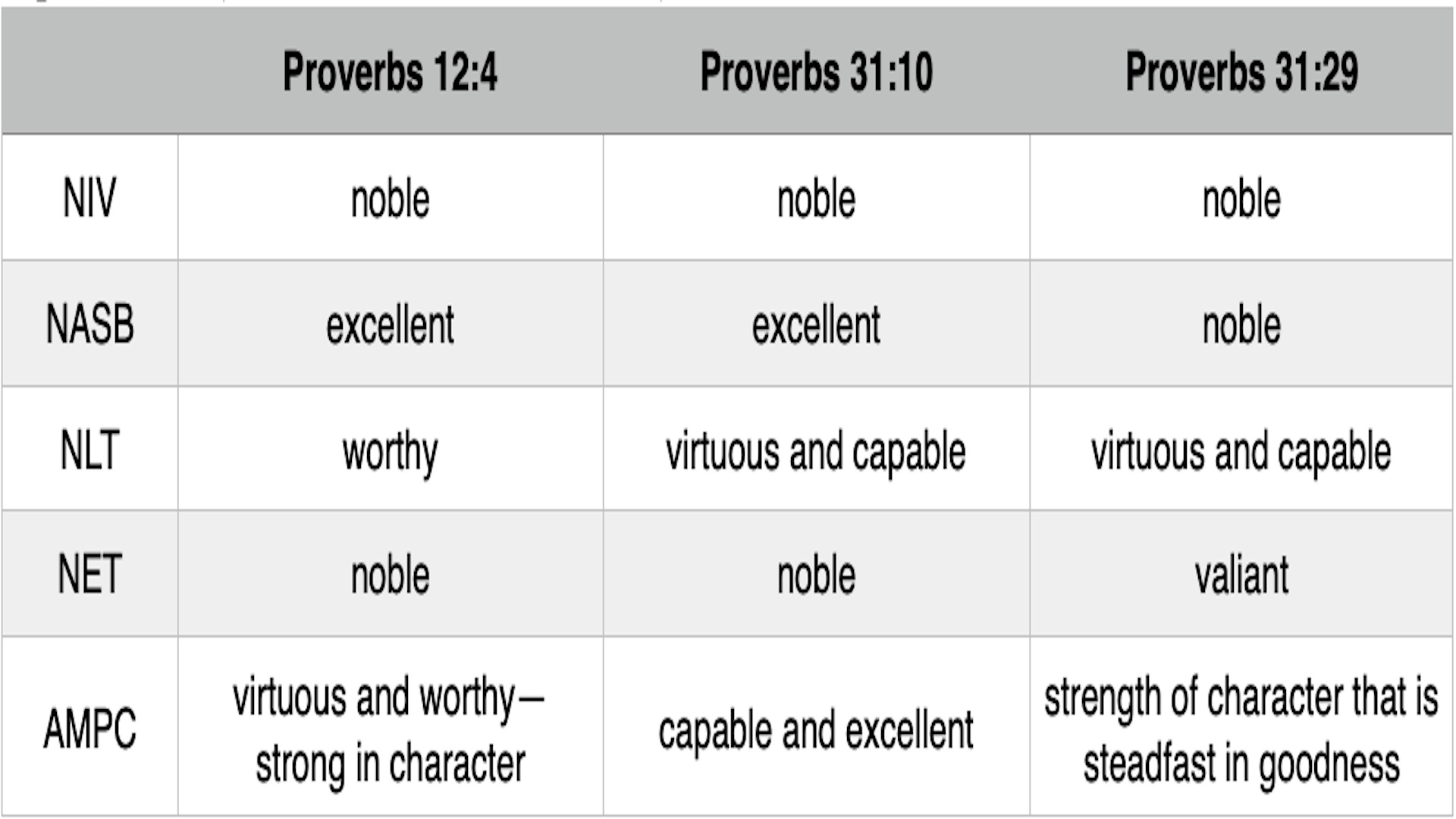
The Hebrew word for noble is used five times in Proverbs. Three of those are for this kind of superwoman (Proverbs 12:4, 31:10, 31:29).
This same word is also used twice for men in Proverbs—A good man leaves an inheritance to his children’s children (13:22); do not spend your strength on women, your vigor on those who ruin kings (31:3).
A woman’s nobility and virtue either unleashes strength OR her vices deplete strength and bring ruin. In the language of Proverbs 31:3, she is either a king-maker or a king-breaker.
This picture of empowerment is seen in the very first couple (Genesis 2:18-24). In the King James Version language, the word for helper is help meet. This means that Eve is the key that unlocks Adam’s potential. The godly woman makes possible what the godly man cannot do on his own.
As a kid, I always suspected my Mom had superpowers. I remember digging through the hair on the back of her head to find “the eyes” she said she had in the back of her head! She could kiss my boo-boo and instantly I was better, and she could help me understand the things that perplexed me the most.
As I got older, I realized that my Mom actually did have superpowers:
She faithfully loved her God—Proverbs 31:30
She diligently served her husband—31:11-12, 23
She consistently cared for her children—31:27-28
Ladies, that is the superpower that you have—you complete us, you elevate us, you unlock our potential! This brings both elevation for your family and honor for yourself(see Proverbs 31:29-31, and notice the phrase “city gate” in vv. 23 & 31 which symbolizes a leadership position).
Women who ignore their God-given superpower of nobility unleash the vicious cycle of king-breakers.
Women who use their God-given superpower of nobility unlock a virtuous cycle of king-makers.
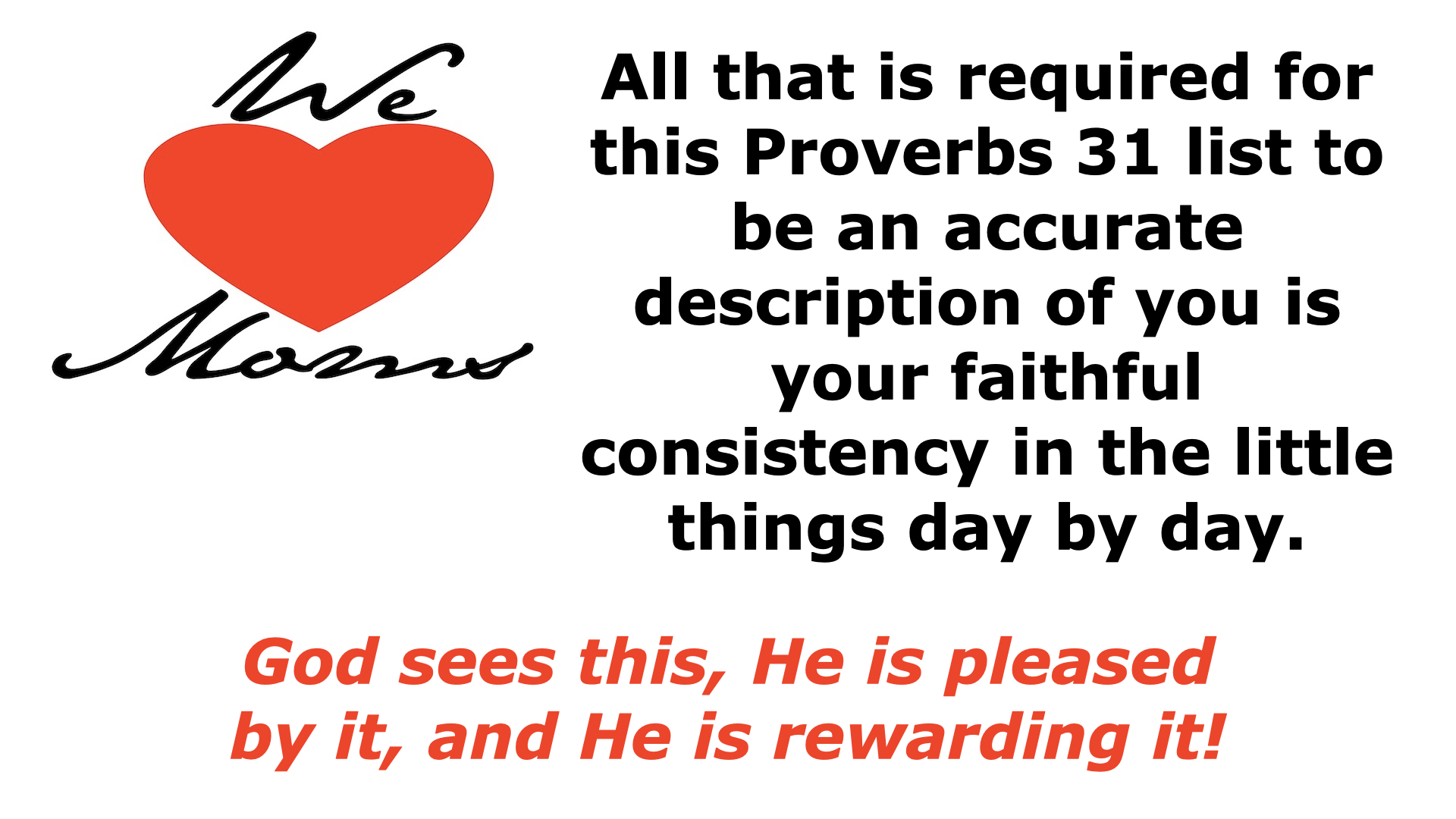
Ladies, be encouraged today that all that is required for this Proverbs 31 list to be an accurate description of you is faithfully loving your God and faithfully serving your family in the consistent, little things day after day after day. God sees this, He is pleased by it, and He is rewarding it!
Guys, you have a part to play in this too. What you do with the potential that your mother and your wife have unlocked for you also plays a vital role in your family and in your community. I talked about this on Father’s Day, which you can check out here.
Listen to the podcast of this post by clicking on the player below, and you can also subscribe on Apple, Spotify, or Audible.
If we are wise, we can learn invaluable leadership lessons even from those who fell short in their attempts. For example, consider Lot, the nephew of Abraham.
Lot was found “sitting at the gate” in Sodom. This was a place of leadership, the place where legal and business matters were discussed. That means Lot appeared to be accepted by the townsfolk (see Genesis 19:1-14).
But that also means Lot had compromised his values.
Lot didn’t walk right into this leadership role. The Bible tells us how Lot first lived in the vicinity of Sodom and Gomorrah, but then steadily moved closer and closer to the city, until eventually he compromised his values enough to be accepted into a civic leadership position.
Lot obviously did not live or speak according to God’s righteous standards because when he attempted to appeal to a depraved mob of Sodomites, they ridiculed him, reminding him that he was not one of them. And then when Lot tried to warn his future sons-in-law (men who were also Sodomites) about God’s impending judgment on the city, they only laughed at him.
Jesus warned us, “Woe to you when all men speak well of you, for so did their fathers to the false prophets” (Luke 6:26).
The Sodomites spoke well of Lot when he was in the city gate, going along with them, not standing up for righteousness.
So too for us: People of the world will appear to be your friend as long as you don’t make them uncomfortable by standing up and speaking up for the truth. As soon as Lot tried to stand for God, the Sodomites showed him their true colors.
On the other hand, look at the examples of Joseph, Mordecai, Esther, Daniel, and Nehemiah to see righteous people who didn’t compromise their commitment to God’s ways in order to achieve a leadership position in earthly governments. Instead, their righteousness was blessed by God, and He gave them favor.
Ironically, Lot compromised God-honoring values to try to earn favor with men, and in the end, lost favor with them. Those other godly leaders resolutely stood for God regardless of what anyone may have said about them and God gave those leaders favor with men.
A mark of an ungodly leader is one who compromises godly values to gain a leadership status in the world’s eyes.
This is part 76 in my series on godly leadership. You can check out all of my posts in this series by clicking here.
Listen to the podcast of this post by clicking on the player below, and you can also subscribe on Apple, Spotify, or Audible.
There’s an interesting verb used with both Enoch and Noah that denotes intimate fellowship—the word is “walked.”
Enoch walked with God; and he was not, for God took him. (Genesis 5:24)
These are the records of the generations of Noah. Noah was a righteous man, blameless in his generation. Noah walked with God. (Genesis 6:9)
David uses this same verb when he prays, “Vindicate me, Lord, for I have walked in my integrity, and I have trusted in the Lord without wavering. Examine me, Lord, and put me to the test; refine my mind and my heart. For Your goodness is before my eyes, and I have walked in Your truth” (Psalm 26:1-3).
And Solomon uses the same verb to say that anyone who walks in righteous integrity leaves a legacy of righteousness for his family: “A righteous person who walks in his integrity—how blessed are his sons after him” (Proverbs 20:7).
There is something important that is implied in this walking. God tells us what it is in this question: How can two walk together unless they agree to do so? (Amos 3:3).
But make no mistake, God doesn’t agree with whatever path I choose to walk, but I must agree to walk God’s path.
I must agree that God’s path is best, despite what everyone else is doing—“Then the Lord saw that the wickedness of mankind was great on the earth, and that every intent of the thoughts of their hearts was only evil continually” (Genesis 6:5). Yet Noah didn’t walk with the wicked, but he was commended because he walked with God.
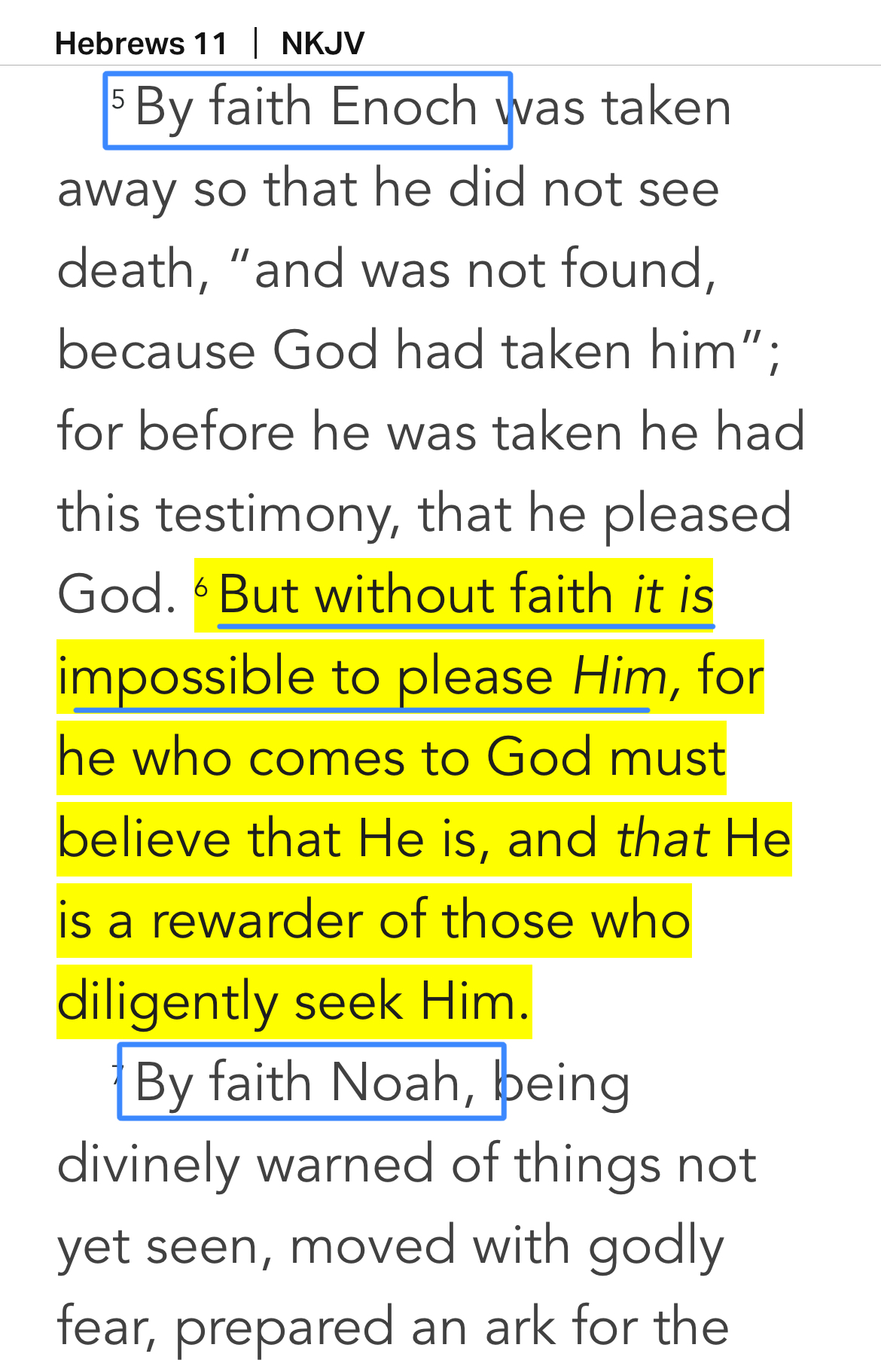
In the New Testament, Enoch and Noah are listed as back-to-back examples of faith (Hebrews 11:5, 7). The verse that connects these two men speaks of the faith-filled integrity that kept them walking with God—
And without faith it is impossible to please Him, for the one who comes to God must believe that He exists, and that He proves to be One who rewards those who seek Him. (Hebrews 11:6)
That word “seek” means to diligently crave. Enoch and Noah and David show us examples of men who diligently craved walking with God above all else. Their faithful, diligent walking made them stand out from all those around them.
What about us? Hebrews 11:6 says we can follow their example. We can choose to walk with God by faith. We can diligently crave Him above all else. When we walk righteously with God, He “rewards those” who do—for ever and ever!
We have added a lot of “stuff” to our prayer language, almost like God wouldn’t know that we were praying to Him unless we used these special words! Jesus made it simple by giving us two words: “Our Father.” I have lots of new content every week, which you can check out on my YouTube channel.
“Immersing ourselves in the Psalms and turning them into prayers teaches our hearts the ‘grammar’ of prayer and gives us the most formative instruction in how to pray in accord with God’s character and will.” —Tim Keller, in Prayer
“We best take care of others when we are judicious about self-care. We only pour our lives out for others well over time if we have taken care of our own bodies and souls well in time. … Folly neglects soul care and leaves us empty, powerless to effectively serve others. We only have resources to constantly give out if we have been diligent to constantly receive in.” —Dick Brogden, in Proverbs: Amplified and Applied
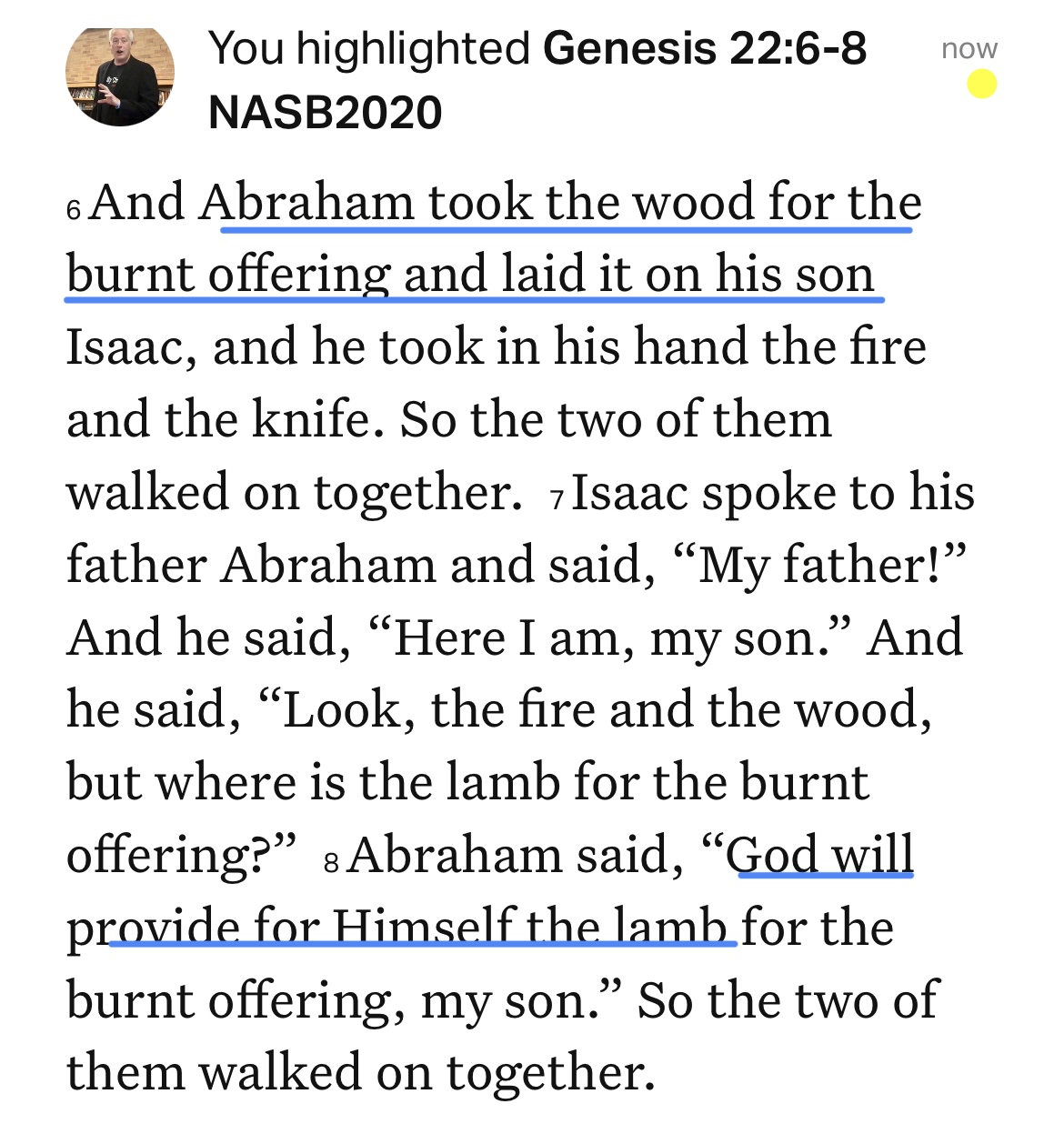
Issac is an amazing foreshadowing of Jesus. Consider these aspects:
the wood for the sacrifice is on his back
the father placed the wood on his son’s back
the son was to be the lamb offered in sacrifice as God commanded
John Stonestreet and Dr. Glenn Sunshine write, “Constantine has been a controversial figure throughout Church history. Both the genuineness of his conversion and his impact on the Church have been consistently questioned and scrutinized. Many think that Constantine’s actions to tie the Church to the empire compromised the Gospel. Often, these arguments are based on a misunderstanding of what Constantine did and fail to consider what followed from the legalization of Christianity.” Check out more of the history and the impact of Emperor Constantine.
Listen to the podcast of this post by clicking on the player below, and you can also subscribe on Apple, Spotify, or Audible.
And God said, “Let there be light,” and there was light (Genesis 1:3).
“God said.” His words literally became substance!
Those who deny a Creator claim that this whole universe came into being by chance. But they still cannot get away from the fact that there was “something” there—some basic elements—that interacted to start the process. The Bible tells us that the “something” was actually Someone—Jehovah God!
“No other cosmogony, whether in ancient paganism or modern naturalism, even mentions the absolute origin of the universe. All begin with the space/time/matter universe, already existing in a primeval state of chaos, then attempt to speculate how it might have ‘evolved’ into its present form. Modern evolutionism begins with elementary particles of matter evolving out of nothing in a ‘big bang’ and then developing through natural forces into complex systems.”
Which requires more faith? To believe that all of the order and perfection in our universe—from the astronomical to the sub-atomic—came to be by mere chance? Or that the perfect design we see came into being by a Perfect Designer? It seems to me that it takes tremendously more faith to be an atheist.
Check out this recent post from the Institute for Creation Research:
“It is appropriate for Christians to begin the New Year by referring back to the beginning of the very first year. The first verse of God’s Word is also its most important verse, since it is the foundation on which everything else is built. Even God’s great work of salvation is irrelevant and futile without His prior work of creation, for only the Creator of all things could ever become the Savior of all things. If a person really believes Genesis 1:1, he or she should have no difficulty believing anything else in the Bible.”
“Hard times create strong men. Strong men create good times. Good times create weak men. Weak men create hard times.” —G. Michael Hopf
“Luck is when an opportunity comes along and you’re prepared for it.” —Denzel Washington
“Ministers are set to be lights to the souls of men in this respect, as they are to be the means of imparting divine truth to them, and bringing into their view the most glorious and excellent objects, and of leading them to and assisting them in the contemplation of those things that angels desire to look into…by which they may know God and Jesus Christ, whom to know is life eternal.” —Jonathan Edwards
“Scripture the unus sermo Dei—the one sermon of God.” —Augustine
T.M. Moore is presenting another outstanding series of posts, this one about the dignity of work. In one post, he wrote, “A just society requires all members to contribute love for their neighbors, whether they are poor or wealthy. Those who will not work when they can do so should be left to the consequences of their sluggardliness (2 Thessalonians 3:10). It is incumbent on local community leaders to discover ways, analogous to the work of gleaning, of helping to meet the needs of local poor. These might include keeping part-time work available, identifying ‘community work’ opportunities and helping to fund them, offering job counseling and training, and so forth. Churches certainly could pioneer the way in this, creating opportunities for work on their campuses, on behalf of needy members, and for the community at large.”
“The Holy Spirit responds to our walking according to the Word, not merely talking about the Word.” —Dr. Tony Evans
After this genealogy, we read that an angel says to Joseph, “Joseph son of David, do not be afraid to take Mary home as your wife, because what is conceived in her is from the Holy Spirit” (Matthew 1:20). And then notice this commentary from Matthew—
All this took place to fulfill what the Lord had said through the prophet: “The virgin will conceive and give birth to a Son, and they will call Him Immanuel”(which means “God with us”). (Matthew 1:22-23)
Matthew says, “all this took place to fulfill what the Lord had said.” All what? Everything that came before that statement: the genealogy with all its exceptional items, the 70-year exile of the Jewish people, the Immaculate Conception, the fulfillment of a 700-year-old prophecy.
I find this absolutely astounding! And so, apparently, did Joseph!
But remember that Jesus is not only “the son of David” but He is also called a “son of Abraham.” This means that Jesus came to be more than just the King of the Jews.
We have a cliché that says something like, “Don’t miss the forest for the trees.” By this, we mean that sometimes in the moment we only see one large tree or obstacle in front of us and we miss seeing the majesty of the whole forest. Or maybe we only see the obstacle and not the path that would take us where we need to go.
We are living between the Advents now so you would think that we have a good “forest” perspective, but even we sometimes get bogged down in the moment, wondering what God is doing. The story of Abraham should help us to see the whole forest of God’s plan a little better.
In Genesis 12:1-3 we read God’s promise to Abraham that all people on earth would be blessed by his obedience to God’s call. Listen to the opening words of Stephen’s sermon as he looked back on this—
The God of glory appeared to our father Abraham while he was still in Mesopotamia, before he lived in Harran. “Leave your country and your people,” God said, “and go to the land I will show you.” So he left the land of the Chaldeans and settled in Harran. After the death of his father, God sent him to this land where you are now living. (Acts 7:2-4)
Stephen reminds us that God spoke to Abraham while he was still living in Mesopotamia. Abraham must have shared this promise with his father because in Genesis 11:31 we read that Terah takes Abraham, Sarah, and Lot with him to make this journey, but they only traveled as far as Harran.
Why did they stop here? We’re not sure. Perhaps Terah was still grieving the death of his youngest son who had died before they left. Maybe Terah was concerned about his middle son Nahor who chose not to travel with them. Or maybe Terah was paralyzed by the magnitude of the journey still ahead of them. Whatever the reason, Terah allowed a “tree” to obscure his view of the whole “forest” of God’s plan.
Stephen then says that Abraham continued the journey to Canaan “after the death of his father.” But if we do the math, it appears that Terah was still biologically alive when Abraham left (see Genesis 11:26, 32; 16:3, 16).
Abraham had to trust God more than he respected his father, even to the point of considering his father as dead.
Later on, God gave Abraham a similar test with his own son. Abraham passed this test and God repeated His promise about blessing all people through Abraham(see Genesis 22:1-18).
In Romans 4, Paul explains that Abraham’s faith in God’s promise was rewarded, and that through our faith in Jesus we are connected to this same promise.
Just as there was an “all this took place to fulfill what the Lord had said” about Jesus—including the faith-filled obedience of Abraham and David—God has an “all this” for your life too.
God saw you before you were born. He had a plan for your life. He gave you gifts and talents to be used for His glory. There is not a single part—not a single experience—of your life that is accidental (Psalm 139:16; Ephesians 2:10; Romans 8:28).
Just as He used all this for Jesus, He is using all this for your life too. Will you trust Him?
Through David, God fulfilled the promise that Jesus would be King of the Jews. Through Abraham, God fulfilled the promise that Jesus would be King of all nations. Through Jesus, God fulfilled the promise that Jesus would be our Righteousness.
Abraham died without seeing the promise fulfilled. But we have seen the promise fulfilled, and that should fuel our faith to trust God to fulfill the promise He has for each of us. I pray that this assurance will be renewed in your heart as you celebrate Advent this year.









 Craig T. Owens