The Compliance Of Silence

Listen to the podcast of this post by clicking on the player below, and you can also subscribe on AppleSpotify, or Audible.

A couple of weeks ago I shared a recap from my sermon called Eloquent Silence. Jesus serenely remained silent when He was being falsely accused by those who wanted Him out of the way. Yet, His silence was eloquent and convicting. 

We would do well to learn this lesson from our Savior. 

There is a flip side to this: Sometimes our silence can signal compliance or acceptance of those who are speaking or perpetrating evil. 

David wrote, “Do you indeed speak righteousness, you silent ones? Do you judge uprightly, you sons of men? No, in heart you work wickedness; you weigh out the violence of your hands in the earth” (Psalm 58:1-2 NKJV). 

Commenting on this psalm, Charles Spurgeon wrote, “It would be well, if people would sometimes pause and candidly consider this: ‘Do you indeed speak righteousness, you silent ones?’ Some of those who surrounded Saul were passive rather than active persecutors—they held their tongues when the object of royal hate was slandered. In the original, this first sentence appears to be addressed to them, and they are asked to justify their silence. Silence gives consent. People who refrain from defending the right are themselves accomplices in the wrong.”  

Silence does have its place. King Solomon wrote, “He who despises his neighbor lacks sense, but a man of understanding keeps silent. He who goes about as a talebearer reveals secrets, but he who is trustworthy conceals a matter” (Proverbs 11:12-13 NASB1995). But to remain silent in the face of evil or falsehood could also be a sin. 

Consider a few other wise words:

“No one wants to be thought of as holding to a ‘minority position’ on anything, so, rather than speak up in the face of many who are doing so, most will remain silent. This is where the Christian community finds itself at this time, trapped in a spiral of silence before a blustering but empty secular and unbelieving worldview. So it is very important that believers in Jesus Christ make the best use of every opportunity to talk about what is good and pleasing to God.” —T.M. Moore 

“Don’t be a bystander, be on stand by. I will not allow a bully to bully others. I will not laugh at his jokes, I will not remain silent. I will stand up and say ‘Enough is enough.’” —Nick Vujicic 

“As Christians we are tempted to make unnecessary concession to those outside the Faith. We give in too much. Now, I don’t mean that we should run the risk of making a nuisance of ourselves by witnessing at improper times, but there comes a time when we must show that we disagree. We must show our Christian colors, if we are to be true to Jesus Christ. We cannot remain silent or concede everything away.” —C.S. Lewis 

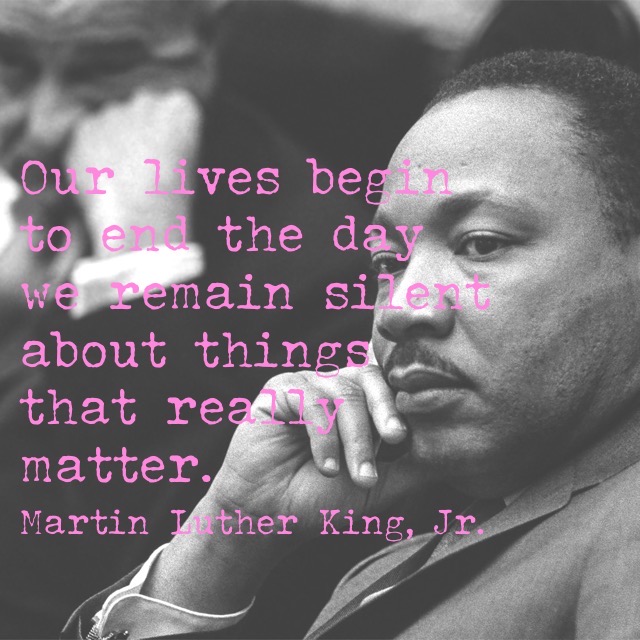
“Our lives begin to end the day we remain silent about things that really matter.” —Martin Luther King, Jr.

When to speak up and when to remain silent is a huge issue for Christians. This is why we need to be sensitive to the Holy Spirit telling us when to hold our tongues and when to speak out boldly.

►► Would you please prayerfully consider supporting this ministry? My Patreon supporters get behind-the-scenes access to exclusive materials. ◀︎◀︎

Links & Quotes

One of the best pieces of advice if you’re looking to regulate your emotions is very simple: SLOW DOWN! Constantly having your game face on or being “on a mission” can cause your emotional regulation to suffer, and seriously hurt your leadership. Be sure to check out all of my videos on my YouTube channel.

You may have heard the oft-repeated line that human beings and chimpanzees share 98-99% of our DNA with each other. This simply isn’t true, and yet it will not die. John Stonestreet has an idea of what is behind this claim in his post Of Primates and Percentages.

“The unprepared mind cannot see the outstretched hand of opportunity.” —Alexander Fleming

John Piper asks, “Why is anxiety about the future a form of pride?” Check out this faith-building post that concludes with these words, “The way to battle the unbelief of pride is to admit freely that you have anxieties, and to cherish the promise of future grace in the words, ‘He cares for you.’ And then unload your fears onto His strong shoulders.”

“Hold fast to eternal salvation through the eternal covenant carried out by eternal love to eternal life.” —Charles Spurgeon

“Celebrate what you’ve accomplished, but raise the bar a little higher each time you succeed.” —Mia Hamm

Links & Quotes

When you say, “I don’t know how to do this,” your mind stops looking for answers. But if we simply add one word—“I don’t know how to do this yet”—your mind will stay active. Adding this one word will unleash the creative, solution-finding part of your mind.

“Our preaching ought to have a voice for all classes, and all should have an ear for it. To suit our word to the rich alone is wicked sycophancy, and to aim only at pleasing the poor is to act the part of a demagogue. Truth may be so spoken as to commend the ear of all, and wise teachers seek to learn that acceptable style.” —Charles Spurgeon, Spurgeon And The Psalms

“How did Jesus live among us? He was different things to different people. See if you find yourself on this list.
To the victim, Jesus defended.
To the rebel, He held out mercy.
To the brutalized, Jesus comforted with kindness.
To the questioning, He spoke truth.
To the fearful, Jesus stood beside.
To the lonely, He nodded, ‘I’ve been there.’
To the sick, Jesus revitalized.
To the outlier, He welcomed in.
To the forgotten, Jesus remembered in detail.
To the filthy, He washed clean.
To the broken, Jesus empathized.
To the doubting, He listened.
To the isolated, Jesus joined company.
To the discouraged, He drew near.
To the cynic, Jesus answered.
To the rejected, He restored.
To the anxious, Jesus calmed.
To the betrayed, He identified.
To the betrayer, Jesus forgave.
To the wounded, He sympathized.
To the wanderer, Jesus pointed the way.
To the shattered, He rebuilt dreams.
To the lost, Jesus led home.
To the abandoned, He was home.
To the destitute, Jesus deepened.
To the single again, He completed.
To the tempted, Jesus was available.
To the courageous, He gave purpose.
To the one in trouble, Jesus led out.
To the exhausted, He was wholeness.
To the hurried, Jesus patiently waited.
To the over-committed, He built margin.
To the weak, Jesus fortified.
To the one in debt, He released.
To the searching, Jesus satisfied.
To the foolish, He said, ‘Turn around.’
To the pure in heart, Jesus blessed.
To the one who keeps on going, He rewarded.” —He Gets Us (part 2) reading plan on YouVersion

This is a pretty long article, but it’s quite fascinating to see the engineering behind the artificial intelligence (AI) of ChatGPT.

“God is not afraid of my questions. Am I afraid of His answers?” —Betsy Owens

C.M. Ward was the speaker for the Revivaltime radio broadcast for a quarter of a century. Dan Betzer, who was also involved in these broadcasts, once said that he heard Rev. Ward preach on the story of the prodigal son in Luke 15 more than a dozen times without ever repeating himself. Here is a quick biographical sketch of this influential man’s ministry. I have also shared before my brief encounter with Rev. Ward when I was a young man.

A bonus quote from Charles Spurgeon: “‘No God’ means no law, no order, no restraint to lust, no limit to passion. Who but a fool would be of this mind? What a bedlam, or rather what a battleground, would the world become, if such lawless principles came to be universal!” —Charles Spurgeon, commenting on Psalm 53:1

A reminder of just how amazing our Sun is! Our Creator perfectly fashioned our Sun and Earth and solar system to sustain the life we enjoy. Check out this amazing article from The Institute for Creation Research.

Come To God As A Brother

Listen to the podcast of this post by clicking on the player below, and you can also subscribe on AppleSpotify, or Audible. 

Being the firstborn, I didn’t have a big brother, but I took being the big brother to my little sister very seriously! Like when young men would come to pick her up for a date, I would meet them on the front porch and say, “I hope you have a really nice evening. Just so you know, I will be home all evening waiting by the phone. You’d better pray that my little sister doesn’t have to call me!” Hopefully, that let my sister know I was ready to protect her whenever she may need it. 

 Whenever we go into any situation for the first time, there is always a natural fear of the unknown. What’s going to happen? How do I behave? What do I say? How will others treat me? How will I know who to trust? Or even, how will I know what to pray for? 

Those unknowns cause fear, and fear prevents intimacy. The Bible says, “There is no fear in love” (1 John 4:18). Where there is love, fear has to leave. But when there is fear, love is pushed aside. 

We learned that we can come to God in prayer as a Father—we can bring Him all our fears and concerns and problems—but did you know that we can also come to God in prayer as coming to a Brother? 

Jesus loves the fact that we can come to our Abba Father just as He did, which is why He taught us to begin our prayers with, “Our Father in heaven.” 

How wonderful it is to have a “big brother” to show us the ropes, to walk with us, to give us his counsel! One that says, “I’ve already been to that high school … I know that employer … I have experience with that kind of relationship … I’ve solved that problem … I’ve tasted that pain.…” That’s exactly what Jesus does for us. He is our perfect Big Brother! 

Jesus knows everything we will experience in life. There might be unknown things that we walk into, but they are never unknown to Him. And more importantly, they are never unexperienced by Him. Check out these assuring words from the Book of Hebrews—

Both the One who makes people holy and those who are made holy are of the same family. So Jesus is not ashamed to call them brothers and sisters. … For this reason He had to be made like them, fully human in every way, in order that He might become a merciful and faithful high priest in service to God, and that He might make atonement for the sins of the people. Because He Himself suffered when He was tempted, He is able to help those who are being tempted. (2:11, 17-18) 

For we do not have a high priest who is unable to empathize with our weaknesses, but we have one who has been tempted in every way, just as we are—yet He did not sin. Let us then approach God’s throne of grace with confidence, so that we may receive mercy and find grace to help us in our time of need. (4:15-16) 

Jesus has been there, done that, and has the scars to prove that He is victorious! 

  • We never have to be at a loss of what to say (John 12:49-50)
  • We never have to be at a loss of what path to take (John 14:6) 
  • We never have to be at a loss of what prayer to pray (John 16:23)

(Check out all of those verses by clicking here.) 

Charles Spurgeon said, “The Lord Jesus Christ is always ready to take the most imperfect prayer and perfect it for us. If our prayers had to go up to heaven as they are, they would never succeed; but they find a Friend on the way, and therefore they prosper.” 

Solomon wrote, “Trust in the Lord with all your heart; do not depend on your own understanding. Seek His will in all you do, and He will show you which path to take (Proverbs 3:5-6). 

Commenting on these verses in his book Proverbs: Amplified and Applied, Dick Brogden wrote:

“We tend to crave God’s explicit direction for the momentous choices of life—marriage, study, career, transition, promotion, change—but sail through a thousand daily choices independent of consultation with Him. Functionally, we act as if we only need God’s help for big things because we can handle the small things without Him. The error in this dichotomy of dependence (thinking we only need God’s help for big decisions) is twofold. First, big decisions are not divorced from small decisions; they are simply the crowning act, the summary of a legion of choices. Second, big decisions are not more important than small decisions. It is the small, simple, silent, serial choices of daily living that make one wise. When we acknowledge the Lord in all the minutia, our course is chosen and our path is set, and we do not stand bewildered at the critical crossroads of life.” 

Walking with Jesus as our Brother keeps us free from fear. His perfect love opens our hearts to have intimate conversation with our Heavenly Father. You can trust our Brother to help you with every single decision at every single moment. Let’s learn to lean on Him more! 

If you’ve missed any of the messages in our series on prayer called Intimate Conversation, you can find all of the messages by clicking here. 

►► Would you please prayerfully consider supporting this ministry? My Patreon supporters get behind-the-scenes access to exclusive materials. ◀︎◀︎

Book Reviews From 2022

Listen to the podcast of this post by clicking on the player below, and you can also subscribe on AppleSpotify, or Audible.

I love reading, and I love sharing my love of good books with others! Here is a list of the books I read and reviewed in 2022. Click on a title to be taken to that review.

Autobiography of Calvin Coolidge

Cary Grant

Contending For Our All

Father Sergius

Hank Greenberg: The Story Of My Life

Living In A Gray World

Out Of The Depths

Roots Of Endurance

Simple Truths Of Leadership

Spurgeon And The Psalms

Susanna Wesley

The Holy War

The Legacy Of Sovereign Joy

The Poetry Of Prayer

The Self-Aware Leader

Who Says Elephants Can’t Dance?

Who’s Pushing Your Buttons?

Here are my book reviews for 2011.

Here are my book reviews for 2012.

Here are my book reviews for 2013.

Here are my book reviews for 2014.

Here are my book reviews for 2015.

Here are my book reviews for 2016.

Here are my book reviews for 2017.

Here are my book reviews for 2018.

       Here are my book reviews for 2019.

Here are my book reviews for 2020.

Here are my book reviews for 2021.

►► Would you please prayerfully consider supporting this ministry? My Patreon supporters get behind-the-scenes access to exclusive materials. ◀︎◀︎

Links & Quotes

Every Monday I share a 1-minute thought to get your week started. It’s my weekly Monday Motivation series of videos. Check out this week’s video and subscribe on YouTube.

“The Lord Jesus Christ is always ready to take the most imperfect prayer and perfect it for us. If our prayers had to go up to heaven as they are, they would never succeed; but they find a Friend on the way, and therefore they prosper.” —Charles Spurgeon

I love this thought from T.M. Moore: “We sometimes use the word reflect to express what we want to see happen in our lives as Christians. We say we want to reflect Jesus to the world, like a mirror reflects an image. As agents of Jesus Christ and His Kingdom, believers are not so much like mirrors as they are like prisms. Mirrors reflect light. The light strikes them and bounces off, without bringing anything of the mirror with it. Prisms refract light.” Please take a couple of minutes to read Moore’s post Prisms of the Light.

Thursdays With Spurgeon—Judging By First Appearances

This is a weekly series with things I’m reading and pondering from Charles Spurgeon. You can read the original seed thought here, or type “Thursdays With Spurgeon” in the search box to read more entries.

Listen to the podcast of this post by clicking on the player below, and you can also subscribe on AppleSpotify, or Audible. 

Judging By First Appearances 

     A good horse cannot be a bad color, and a really good preacher can wear what he likes, and none will care much about it; but though you cannot know wine by the barrel, a good appearance is a letter of recommendation even to a plowman. Wise men neither fall in love or take a dislike at first sight, but still the first impression is always a great thing even with them; and as to those weaker brethren who are not wise, a good appearance is half the battle.

     What is a good appearance? Well, it’s not being pompous and starchy and making oneself high and mighty among the people, for proud looks lose hearts, and gentle words win them. … When a man is as proud as a peacock, all strut and show, he needs converting himself before he sets up to preach to others. The preacher who measures himself by his mirror may please a few silly girls, but neither God nor man will long put up with him. The man who owes his greatness to his tailor will find that needle and thread cannot long hold a fool in a pulpit. …  

     At the same time, the preacher should endeavor, according to his means, to dress himself respectably; and, as to neatness, he should be without spot, for kings should not have dirty footmen to wait at their table, and they who teach godliness should practice cleanliness. … A worn coat is no discredit, but the poorest may be neat, and the men should be scholars rather than teachers till they are so.

From John Ploughman’s Talks of Plain Advice For Plain People

Like it or not, people do form first impressions on external appearances, and all leaders (and especially pastors) would do well to measure these words from Charles Spurgeon. 

I think Spurgeon is talking about honesty here. I need to be honest with who I am, while at the same time being honest about the office that I hold. I’m not playing dress-up, but I also need to be aware that I am representing the King of kings so an appropriate dress and lifestyle are required. 

I also need to be honest that people are forming first impressions the moment they see me, but also that I cannot try to dress or act in a way to please or attract people. 

I remember meeting a group of “seasoned saints” who all showed up at our church one morning. When I engaged them in conversation, they told me that their new pastor appeared to be too young for their style. They formed an opinion about him before ever giving him a chance. I told them that I knew their pastor and that I liked him a lot. I directed them to return to their home church and give their best support to their pastor for at least six months before they made any decisions. Thankfully, during that time they got to know this pastor and remained in that church with him. 

I am in the position I am in because God placed me there. I am working to hear Him say, “Well done, good and faithful servant.” I don’t want my appearance to get in the way of people hearing the message. I don’t want to try to be someone I’m not. I need to remain sensitive to the Holy Spirit’s direction in how I should dress, talk, and live. If my conscience is clear before God, then I won’t have to pay attention to the opinions of others.

►► Would you please prayerfully consider supporting this ministry? My Patreon supporters get behind-the-scenes access to exclusive materials. ◀︎◀︎

Thursdays With Spurgeon—Our Tricky Tongues

This is a weekly series with things I’m reading and pondering from Charles Spurgeon. You can read the original seed thought here, or type “Thursdays With Spurgeon” in the search box to read more entries.

Listen to the podcast of this post by clicking on the player below, and you can also subscribe on AppleSpotify, or Audible. 

Our Tricky Tongues

I said, “I will guard my ways, lest I sin with my tongue; I will restrain my mouth with a muzzle, while the wicked are before me.” I was mute with silence, I held my peace even from good; and my sorrow was stirred up. My heart was hot within me; while I was musing, the fire burned…. (Psalm 39:1-3)

     Tongue sins are great sins; like sparks of fire ill words spread and do great damage. ‘I will guard my ways, lest I sin with my tongue’ (v. 1). If believers utter hard words of God in times of depression, the ungodly will take them up and use them as a justification for their sinful courses. If parents’ own children rail at them, no wonder if their enemies’ mouths are full of abuse. 

      Our tongue always wants watching, for it is fidgety as an ill-broken horse, but especially must we hold it in when the sharp cuts of the Lord’s rod excite it to rebel. 

     David was not quite so wise as our translation would make him; if he had resolved to be very guarded in his speech, it would have been altogether commendable. When he went so far as to condemn himself to entire silence, ‘even from good,’ there must have been at least a little sullenness in his soul.

From Spurgeon And The Psalms

Oh, how often our tongues trip us up! More times than we would like to admit, our tongues completely undo the good example we have previously shown. James spends almost an entire chapter talking about the fire our tongues can kindle, concluding that our tongues are “a restless evil, full of deadly poison” (James 3:1-18)! 

Part of David’s solution was to notice who was around him so that his words would not add fuel to their skepticism about God. But notice that he went too far because he didn’t speak out the good that he should have spoken. 

Clearly, there is a time to speak and a time to be silent. David’s son Solomon talked about the wisdom of speaking the appropriate words at the appropriate time (see especially Proverbs 10).  

In Mere Christianity, C.S. Lewis talks about a valuable discipline: A personal review of our words and actions at the end of the day. After all, it’s hard to correct something of which we are unaware. Here’s what Lewis wrote—

“When I come to my evening prayers and try to reckon up the sins of the day, nine times out of ten the most obvious one is some sin against charity; I have sulked or snapped or sneered or snubbed or stormed. And the excuse that immediately springs to mind is that the provocation was so sudden or unexpected. I was caught off my guard, I had not time to collect myself…. Surely what a man does when he is taken off guard is the best evidence of what sort of man he is. Surely what pops out before the man has time to put on a disguise is the truth. If there are rats in the cellar you are most likely to see them if you go in very suddenly. But the suddenness did not create the rats; it only prevents them from hiding. In the same way the suddenness of the provocation does not make me an ill-tempered man: it only shows what an ill-tempered man I am.” 

We would do well to pause and ask the Holy Spirit to show us the rats in our cellar—evil words spoken that shouldn’t have been uttered, and helpful words left unspoken at the moment they should have been said. If we will humbly listen, the Holy Spirit will help us mature in this vital area of taming our tricky tongues. 

►► Would you please prayerfully consider supporting this ministry? My Patreon supporters get behind-the-scenes access to exclusive materials. ◀︎◀︎

Thursdays With Spurgeon—Beware Of Grumblers

This is a weekly series with things I’m reading and pondering from Charles Spurgeon. You can read the original seed thought here, or type “Thursdays With Spurgeon” in the search box to read more entries.

Listen to the podcast of this post by clicking on the player below, and you can also subscribe on AppleSpotify, or Audible. 

Beware Of Grumblers 

     None is so wise as the man who knows nothing. His ignorance is the mother of his impudence and the nurse of his obstinacy; and though he does not know a bee from a bull’s foot, he settles matters as if all wisdom were at his fingers’ ends—the pope himself is not more infallible. Hear him talk after he has been at a meeting and heard a sermon, and you will know how to pull a good man to pieces if you never knew it before. He sees faults where there are none; and if there be a few things amiss, he makes every mouse into an elephant. … 

     Those who know nothing are confident in everything; hence they are bullheaded beyond measure. Every clock and even the sundial must be set according to their watches. … Venture to argue with them, and their little pots boil over in quick style; ask them for a reason, and you might as well go to a sandpit for sugar. … 

     Faultfinding is dreadfully catching: One dog will set a whole kennel howling, and the wisest course is to keep out of the way of a man who has the complaint called the grumbles. … Dogs, however, always will bark; and what is worse, some of them will bite, too. But let decent people do all they can, if not to muzzle them, yet to prevent them from doing any great mischief.

From John Ploughman’s Talks of Plain Advice For Plain People

Charles Spurgeon—the prince of preachers—could also use a sarcastic tone to a great effect when it was needed! This whole book was supposed to be a sort of “shop talk” to the everyday working man. These are not flowery sermons, but straight-shooting for decent people. 

I have just completed a short series of messages on the distinct ways grateful people stand out from the crowd. But isn’t it just as true that those who constantly grumble about anything and everything also stand out from the crowd? 

Spurgeon was right that grumbling and faultfinding are dreadfully catching! King Solomon says that we waste our time trying to reason with such foolish people who believe themselves to be smarter than the rest of us. So Solomon’s advice is to simply leave them alone. 

Indeed, the best way to avoid catching the contagion of grumbling is to stay away from grumblers. If you have the misfortune of living with a grumbler or perhaps working next to a grumbler, the best way to “walk away” is to simply not engage in their faultfinding “barking.” Maybe you could even answer their complaint by pointing out something for which you are grateful. 

Let’s all make sure we’re not the grumbling, barking, growling dogs that Spurgeon identifies in this passage, and then let’s do all we can to keep the contagion of a grumbler contained. To paraphrase the apostle Paul, “Don’t be overcome by grumbling, but overcome grumbling by walking away or with gratitude” (Romans 12:21).

►► Would you please prayerfully consider supporting this ministry? My Patreon supporters get behind-the-scenes access to exclusive materials. ◀︎◀︎

Thursdays With Spurgeon—Heart’s Desire

This is a weekly series with things I’m reading and pondering from Charles Spurgeon. You can read the original seed thought here, or type “Thursdays With Spurgeon” in the search box to read more entries.

Listen to the podcast of this post by clicking on the player below, and you can also subscribe on AppleSpotify, or Audible. 

Heart’s Desire

Do not fret because of evildoers, nor be envious of the workers of iniquity. For they shall soon be cut down like the grass, and wither as the green herb. Trust in the Lord, and do good; dwell in the land, and feed on His faithfulness. Delight yourself also in the Lord, and He shall give you the desires of your heart. (Psalm 37:1-4) 

     There is no room for fretting if we remember that God is ours; there is every incentive for sacred enjoyment of the most elevated and ecstatic kind. Every name, attribute, word, or deed of Jehovah should be delightful to us, and in meditating on it our souls should be as glad as the epicurean who feeds delicately with a profound relish for his dainties. 

     A pleasant duty is here rewarded with another pleasure. People who delight in God desire or ask for nothing but will please God; hence it is safe to give them carte blanche.

From Spurgeon And The Psalms

When we only have eyes for our God, when our heart craves for only what our Savior can provide, when we have ears that tune out all but what the Holy Spirit whispers to us, then we are living in a place where our hearts are continually delighted with what God provides. 

We have to trust the One who gave us His unshakable promises—Be delighted with the Lord. Then He will give you all your heart’s desires (v. 4 TLB). Be delighted with Him and He will—not “may” or “hopefully He will” but He will—give you ALL your heart’s desires! That’s because your desires align with His. 

There is an ultimate reward in Heaven but there are incredibly satisfying rewards along the journey to Heaven as well. Take time every day to meditate on the boundless love that God has toward you, and let your heart be transformed so that you only crave the very best that your Heavenly Father has for you!

►► Would you please prayerfully consider supporting this ministry? My Patreon supporters get behind-the-scenes access to exclusive materials. ◀︎◀︎