Anxiety makes people feel overwhelmed. We over-burden ourselves with worries like…
Can I do it?
Am I good enough?
Do people really like me?
What if I fail?
Jesus said, “Which of you by being anxious can add a single hour to his span of life?If then you are not able to do as small a thing as that, why are you anxious about the rest?” Jesus went on to say that this type of worry and anxiety was exactly the opposite of what His followers should be doing: “People who don’t know God and the way He works fuss over these things.”
Instead, Jesus said, we are to turn our focus on Him: “Your Father already knows your needs. Seek the Kingdom of God above all else, and He will give you everything you need.” (see Luke 12:22-31)
Instead of worrying … pray!
My friend Josh Schram said,
“When we worry, we communicate to God that we don’t really trust Him to take care of us.”
OUCH!
You might be saying, “If I’m supposed to pray every time I worry about something, I’d be praying all the time!” You know what? That’s actually a good thing because it’s exactly what the Bible instructs us to do—
Always be joyful. Never stop praying. (1 Thessalonians 5:16-17)
Give all your worries and cares to God, for He cares about you. (1 Peter 5:7)
Don’t worry about anything; instead, pray about everything. Tell God what you need, and thank Him for all He has done. (Philippians 4:6)
“We have the power to turn our…
anxiety into prayer
worry into worship
struggles and trials into testimonies.” (Josh Schram)
We have the power to turn our… anxiety into prayer worry into worship struggles and trials into testimonies
Are you using that power God has given you? Don’t let worry cause you to feel overwhelmed. Keep turning your worries over to God again and again and again and again….
Just to be clear, we’re not talking about a problem-free nor a stress-free life. That’s simply not possible. Our bodies were created to deal with stress in a healthy way. But stress that is unhealthy, or unnecessarily prolonged, or not flushed properly from the body becomes anxiety. Anxiety is the culprit responsible for a whole list of bad things!
When we face a stressor, our bodies release a hormone called cortisol. The main function of this hormone is to prepare us to fight or flight. Sometimes this looks like over-engaging in problem-solving, and sometimes it looks like a complete withdrawal from life. Sometimes cortisol leads to sleeplessness and a diminished appetite, and sometimes it makes people sleepy and craving comfort food.
But the bottom line is the fight-or-flight response is very me-focused!
The strategies Paul lists for us take the focus off me and put it on God. He especially counsels us to pray to God and to praise God. Between these two healthy responses is something unexpected. He writes, “Let your gentleness be evident to all. The Lord is near.”
What in the world does gentleness have to do with relieving stress?!
First, let’s consider the motivation: The Lord is near. I think this could mean:
The Lord’s name is near, as in we are called “Christians” and so we should act in a way that glorifies God.
The Lord is near to help us.
The Lord’s return is closing in where we will have to give an account of how we have lived our lives.
Then there is this word gentleness. This word means:
moderation
considerate of others
patience toward our situation and toward others
or as The Message says: Make it as clear as you can to all you meet that you’re on their side, working with them and not against them.
Cortisol is naturally removed from our physical bodies through rest and exercise. Anxiety is naturally removed from our emotional lives the same way—resting in God’s presence (honk!) and gently and considerately exercising a blessing for someone else.
THE BEST WAY TO DE-STRESS IS TO BLESS!
When anxiety builds:
Honk
Bless
Repeat
Don’t let stress win by making you self-centered. Defeat stress and anxiety by praising God and blessings others. And then make that a daily habit!
Rejoice in the Lord always. I will say it again: Rejoice! … Do not be anxious about anything, but in everything, by prayer and petition, with thanksgiving, present your requests to God (Philippians 4:4, 6).
Paul isn’t playing around here—when he says to rejoice, it’s not a suggestion or a good idea. He says REJOICE with the force of a commandment!
Even the Greek word for rejoice isn’t a mild “yea!” It carries with is the idea of big joy! It’s the kind of rejoicing that is…
exceedingly great!
overflowing!
bubbling up!
never ending!
continuously gushing!
Why would Paul make this kind of rejoicing a command? Because God is serious about pointing us to the only path that will guard our hearts and minds. When we are rejoicing, praying, and thanksgiving, then the peace of God, which transcends all understanding, will guard your hearts and minds in Christ Jesus (Philippians 4:7).
Do you realize how much of our worrying is pointless? My friend Scott pointed out the following research:
40% of the things we worry about will never even happen
30% of the things we worry about happened in the past and cannot be changed
12% of our worries are regarding health issues we don’t even have
10% of our worries are about our friends and loved ones which are based on rumors
That means … only 8% of the things we worry about have any basis in reality!
Think about that—9 out of 10 things that consume our minds with worry aren’t even worth our time!
That’s why Paul commands rejoicing as a means to freedom and peace.
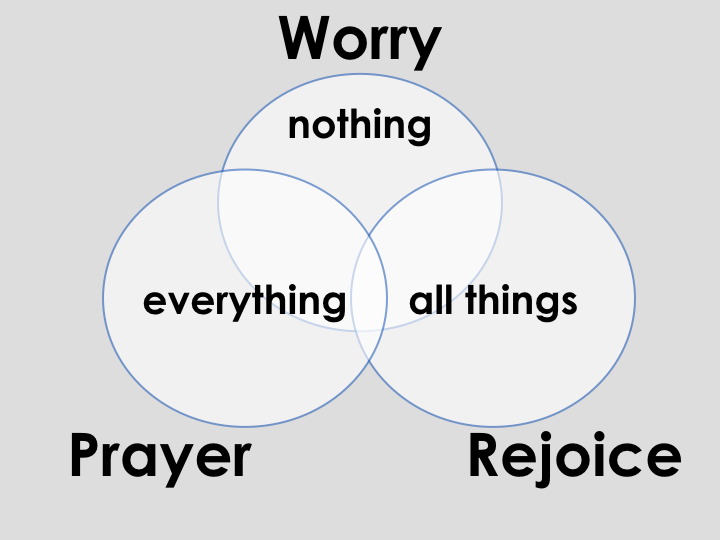
What should we worry about? Nothing!
What should we pray about? Everything!
What should rejoice about? All things!
This is the one and only path to transcendent peace!
This is part two in our series The Antidote For Anxiety. Be sure to check out the video below, and also check out the first part of this series—Honk! Honk! Honk!
First of all, I encourage you to watch the first few minutes of the video below for an amazing story about honking horns. Trust me on this one—it’s a memorable story that will go along way toward helping you defeat anxiety when it rears its ugly head in your life.
What kills joy and happiness and gratitude? Anxiety is the killer.
What makes people so full of joy-killing anxiety? In a word: fear. Fear of missing out … Fear of falling short … Fear of not measuring up … Fear of bad things that might happen.
If anxiety kills joy, what kills anxiety? Anxiety—the joy-killer—is itself killed when joy is expressed.
Being grateful forwhat you have kills the anxiety of what you don’t have.
Being thankful forwhat you have kills the fear of what you may be missing.
Being grateful forwhat you have kills the anxiety of the bad stuff that may never even happen.
If joy kills anxiety, how can we develop more of it? Most people would say, “If you’re happy, give thanks” or “If you’re happy, honk.” But really it’s the other way around: “If you want to be happy, honk!”
Don’t fret or worry. Instead of worrying, pray. Let petitions and praises shape your worries into prayers, letting God know your concerns. Before you know it, a sense of God’s wholeness, everything coming together for good, will come and settle you down. It’s wonderful what happens when Christ displaces worry at the center of your life. (Philippians 4:6-7)
Honking your thanks is not only good for you, but it’s good for everyone around you who hears your “honk! honk!” of gratitude. David experienced this in Psalm 34:1-3. Even when he was at a low point, when he started praising God other anxious people began to experience joy as well.
Can I challenge you to join me in doing two things for at least the rest of this month:
Keep a gratitude journal in a notebook, on your computer, or in your phone or tablet. Regularly write down those things for which you are grateful.
Don’t keep your gratitude to yourself, but share it with the world. Use hashtag #honk to let people know you are using joy to kill anxiety in your heart.
Honk! Honk! Honk! It’s good for you; it’s good for others; and it brings glory to God.
Anxiety is a joy-crushing, life-sapping, happiness-draining burden. Anxiety is also something that plagues more people around us than we care to admit.
But there is hope in our anxiety, because there is an antidote for our anxiety.
The Bible outlines a simple strategy that helps us not only recover from the downward pull of anxiety but also shows us how to quickly fight off anxiety the next time it rears its ugly face in our hearts.
Join me at Calvary Assembly of God every Sunday in November as we share the antidote for anxiety that will set you free and restore your happiness.
How do you handle a hard passage in the Bible? Peter wrote this about Paul, “His letters contain some things that are hard to understand….” But if we don’t take the time to wrestle with that passage, Peter says this is what happens next: “…which ignorant and unstable people distort, as they do the other Scriptures, to their own destruction” (2 Peter 3:16).
So here’s a 5-step plan I use when I am working through a challenging passage of Scripture.
Ask the Holy Spirit to help you
All Scripture is inspired by the Holy Spirit (2 Timothy 3:16), and the same Holy Spirit lives in a Christian (1 John 2:20). Think about that: the same Holy Spirit that inspired an author to write the words of Scripture is the same Spirit that will illuminate them to you!
Read the difficult passage in context
We will make our task much easier when we “zoom out” from the difficult text and read the whole passage surrounding the difficult verse/phrase. Perhaps we need to “zoom out” even farther to understand why the whole chapter or book was written.
Identify the parts that are clear
Start off by identifying the parts that you do understand, and then see what light that shines on the tricky text.
Cross reference with other Scriptures
Never, ever, ever draw a conclusion from just one passage of Scripture. Paul reminded his audience that he used the “whole counsel of God’s Word” (Acts 20:27) in forming his sermons. If the challenging passage contains an Old Testament passage, look it up; if it references an historical event, read that history. I also like to use biblegateway.com’s excellent search feature to find cross references.
Draw conclusions on what appears to be the main point
Only after you have done step #1-4 should you attempt to draw some conclusions. You will set yourself up for error if you draw a conclusion first, and then try to find other texts in the Bible that agree with you.
The Apostle Peter writes something rather challenging in his first letter. In fact, Martin Luther said this about 1 Peter 3:18-22: “A wonderful text is this, and a more obscure passage perhaps than any other in the New Testament, so that I do not know for a certainty just what Peter means.” If you would like to see how I walk through the 5-step plan on this “obscure passage,” please check out the video below.
Have you ever had a really bad job? How about a job that you said, “This job is killing me”? They probably weren’t as bad as the job Ernest Shackleton advertised for:
“Men Wanted for Hazardous Journey. Small wages, bitter cold, long months of complete darkness, constant danger, safe return doubtful. Honor and recognition in case of success.”
And probably not as bad as the help wanted ad for the Pony Express:
“Wanted. Young, skinny, wiry fellow not over 18. Must be expert riders, willing to risk death daily. Orphans preferred.”
Several times in his letter to Christians, the Apostle Peter tells Christians that living in a Christ-honoring way on earth is going to be tough. So are Christians just supposed to grin and bear it? Are they just supposed to slap a smile on their face and hang on until the end?
In a word: No!
Instead, Peter points out seven ways Christians can live so that they will point others to Jesus.
Live in reverent fear of an All-Righteous Judge who doesn’t miss a thing we say or do (1:17)
Live such good lives that consistently glorify God (2:12)
Live as the best of citizens, respecting those in leadership (2:13-17)
Live as good employees (2:18)
Live as Christ’s ambassadors by following the example of Jesus (2:19-24)
Live with your spouse faithfully and submissively (3:1, 7)
When the first Christians lived this way, everyone spoke well of them and held them in high regard because Christians…
Transformed life for women
Built the first hospitals
Founded the first free medical dispensaries
Established orphanages and homes for the aged
Made life better for children
Brought a dignity to marriage
“Anyone who asks the question: ‘What has Christianity done for the world?’ has delivered himself into a Christian debater’s hands. There is nothing in history so unanswerably demonstrable as the transforming power of Christianity and of Christ on the individual life and on the life of society.” —William Barclay
Bottom line—We need to live so that people will say “I♥ those Christians!”
There was a story circulating that a physicist once claimed that the bumblebee was defying the laws of physics and aerodynamics in its flight. Apparently, he calculated that the ratio of the bumblebee’s wing size in comparison to his body size just didn’t make the math work.
But entomologists and physicists quickly jumped in to say, “Hey, look, the bumblebee is flying, so clearly it works!” And then they went to work to try to explain it. They figured out that the bumblebee flaps its wings more back-and-forth than up-and-down, creating tiny hurricanes the propel them through the air. But then that created a whole new set of problems, like how does the bumblebee control a hurricane so precisely as it turns, stops, dives, and climbs. So then they had to create a new explanation, which they named dynamic stall.
All the while, the bumblebee is flapping its too-small wings 230 times per second(!), and going about its daily activities without being able to explain tiny hurricanes, the laws of physics or aerodynamics, or even knowing what dynamic stall is. It simply flies!
The ultimate argument for anything is doing something that critics say is impossible.
Peter tells Christians to be prepared to answer anyone for the reason for the hope that they have (1 Peter 3:15-16). The Greek word for “give an answer” is apologia, from which we get our word apologetic. Here are three apologetics for Christians to use for the hope that they have.
It really comes down to this: My hope is based on the resurrection from the dead of Jesus Christ, which I believe because of the Bible AND because of the change in my life.
The Bible’s authenticity
“No other work in all literature has been so carefully and accurately copied as the Old Testament. The particular discipline and art of the Jewish scribes came out of a class of Jewish scholars between the fifth and third centuries BC. They were called the Sopherim, from a Hebrew word meaning ‘scribes.’ The sopherim, who initiated a stringent standard of meticulous discipline, were subsequently eclipsed by the Talmudic scribes, who guarded, interpreted, and commented on the sacred texts from AD 100 to AD 500. In turn, the Talmudic scribes were followed by the better-known and even more meticulous Masoretic scribes (AD 500-900).” —Josh McDowell, God-Breathed
“No other ancient text is substantiated by such a wealth of ancient textual witnesses as is the New Testament. Roughly 5,500 separate manuscripts are available, variously containing anything from the entire New Testament corpus to a slight fragment of a single verse. … This textual support is far superior to that available for any other ancient documents, such as the classical texts from Greek and Roman writers (e.g., Plato, Aristotle, and Cicero). Only partial manuscripts have survived for many works of antiquity, and it is not unusual to find that the only complete manuscript for some ancient writing is a copy dating from 1,000 years after its composition.” —Archaeological Study Bible, “The New Testaments Texts” (page 1859)
“The biblical Dead Sea Scrolls are up to 1,250 years older than the traditional Hebrew Bible, the Masoretic text. We have been using a one-thousand-year-old manuscript to make our Bibles. We’ve now got scrolls going back to 250 BC. … Our conclusion is simply this—the scrolls confirm the accuracy of the biblical text by 99 percent.” —Dr. Peter Flint
I have shared other apologetic evidence for the authenticity of Scripture here and here.
Christ’s resurrection
In1 Corinthians 15:1-8 Paul lists all of the eyewitnesses to Christ’s resurrection, giving critics ample opportunity to challenge these witnesses in person. If these witnesses would have been perpetrating a hoax, skeptics of their day would have been able to uncover the inconsistencies in their story. If the account of Christ’s resurrection was made-up, it’s doubtful the early Christian martyrs would have “stuck to their story” as they were being tortured, but none recanted.
Josh McDowell notes, “By AD 100, the apostles had died, but the Christian Church was still in its infancy, with fewer than twenty-five thousand proclaimed followers of Christ. But within the next two hundred years, the fledgling church experienced explosive multiplication of growth, to include as many as twenty million people. This means the church of Jesus Christ quadrupled every generation for five consecutive generations!”
My personal experience
“I am a changed person. I am not who I was before I met Jesus” and “My life tends to go better when I live by biblical principles” are both excellent apologetics!
Let others argue that God doesn’t exist, or that you shouldn’t have hope, and then you—like the bumblebee—just keep flying with Jesus! (see 2 Timothy 3:14)
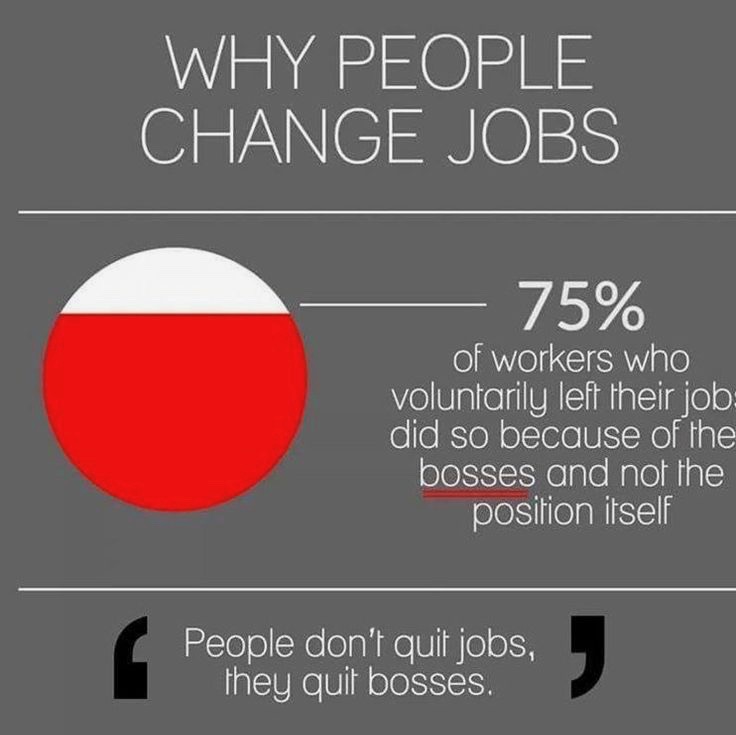
I read a statistic that 75% of people who voluntarily left their jobs did so because of a problem with their boss. In other words, 3-out-of-4 people didn’t quit their job, they quit their boss. In my personal experience this is equally as true in the church world—Most people don’t quit their church, they quit a bad pastor.
Sadly, those who do quit their church usually do so the wrong way. As a result they become either de-churched (they don’t attend anywhere), or cynical in the next church they do attend.
Who is a bad pastor?
One who is no longer effective because he is stuck in an old way of doing things
One who is theologically off
One who is unwilling to admit an error, ask forgiveness, and make amends
One who uses his position to build his kingdom instead of God’s kingdom
We have a great example of how to handle a bad spiritual leader in the story of David and Saul (see 1 Samuel 24). David had done nothing wrong, yet Saul was trying to kill him. At one point David’s men urged David to take matters into his own hands, and he almost did. He got close enough to Saul to cut off a corner of his robe, but quickly discovered that was too close. Immediately after doing so David was conscience-stricken!
Then look how David responded:
David rebuked his men as he reminded them that Saul was their “master” and “the Lord’s anointed.”
David “bowed down and prostrated himself” before Saul as he apologized.
David called him his “master,” “father,” and “the Lord’s anointed.”
David said he would leave the matter in God’s hands, allowing God to “judge between you and me.”
And twice David declared, “My hand will not touch you!”
This humble reply got Saul’s attention. Saul wept as he said, “You have treated me well, but I have treated you badly.” Saul then asked David to be kind to his descendants.
Then this conclusion—David gave Saul his oath, and then went away to a safe place.
The New Testament captures these same ideas for today’s Christians. We are told not to lightly entertain an accusation against spiritual leaders (1 Timothy 5:19), but to submit and obey to biblically-correct leaders (Hebrews 13:17).
The Bible gives us only two options for dealing with spiritual leaders…
SUBMIT & OBEY or WALK AWAY
Two wrongs don’t make a right. Responding in an unscriptural way to an unscriptural pastor’s way is just as wrong as what the pastor was doing wrong in the first place!
So give the bad pastor your oath that you will not lay a hand (or a word!) on them, and then remove yourself to a safe place. Submit and obey, or walk away and leave them in God’s capable hands.
God’s plan has always been for His leaders to organize and oversee His ministry.
The important thing for us to distinguish is “His.” It’s not a man or woman saying, “I will be a leader,” or even a God-appointed leader saying, “I am going to build up my ministry.”
The New Testament gives us a fourfold purpose for the Body of Christ:
Mobilizing for evangelism
Organizing for more meaningful ministry
Making disciple-makers
Caring for one another
We see God’s leaders involved in all of these aspects—
Mobilizing for evangelism—Peter pointed out the need for an apostle to be appointed to replace Judas, thus returning their ranks to the 12 apostles just as Jesus had originally said (Acts 1:15-22).
Organizing for more meaningful ministry—Everywhere Paul founded a church, he also appointed leaders to oversee and shepherd that church.
Making disciple-makers—Paul tells us that God appointed five offices of leaders in the church who had the specific task of preparing church members to do the ministry of building maturity in the church (Ephesians 4:11-16).
Caring for one another—The First Church set the pace for providing care for all who were in need, including organizing leaders to oversee specific care ministries (Acts 6:1-5).
What about a church congregation’s responsibility to their leaders? I see five areas:
Hold them accountable to the Word (Acts 17:11). The Bible has to be THE standard to which leaders are held.
Give them your confidence and submission after they have shown accountability to their biblical mandate (Hebrews 13:17).



 Anxiety makes people feel overwhelmed. We over-burden ourselves with worries like…











 Craig T. Owens