Paths To Power (book review)

As I read A.W. Tozer’s words I find myself saying two things: (1) “Ouch!” and (2) “Amen!” Tozer’s Paths To Power is a continuation in those responses as he outlines what robs the Church and individual Christians of the power God wants them to have.

Right at the outset, Tozer identifies a key element robbing the Church of power: a lack of obedience in the things God has commanded us. “A knowledge of the truth is not enough,” he writes. “The truth must be followed if we would realize in actual experience the blessedness which is here described.”

Another power-blocker is an unwillingness to let God confront us and help us change. We get stuck in a this-is-how-it’s-always-been rut and then shut our eyes to the times of refreshing God wants to send to us. Other blockers include poor doctrine, putting the Holy Spirit in a box, justifying our sin, and not unleashing our faith, to name just a few.

Thankfully, Tozer also points us to the straightforward cures for all of the blockages to power. If we are willing to open our eyes, ears, and hearts to God’s voice, His unlimited blessings could flow uninterrupted into our lives and churches.

Paths To Power contains only seven short chapters, but the digestion, contemplation, and implementation of Tozer’s cures will be something that will involve a lifetime commitment for those ready for God’s fresh power to be poured into their lives.

I am a Moody Publishers book reviewer.

Man—The Dwelling Place Of God (book review)

It’s an awesome thing to ponder that Almighty God wants to live and commune with you and me! I can think of no better person to illuminate this amazing thought than the prophetic voice of A.W. Tozer in his book Man—The Dwelling Place Of God.

Although this book is 50 years old, the message still rings true for this generation. Tozer points out that God wants to dwell with man, to reveal Himself to us in powerful and personal ways, but this comes at a price. That price is not trying to control God, but letting Him be in charge.

The book is made up of 39 chapters, the majority of which are fairly short and can be read in just a few minutes. But the application of the truths in these short chapters will be something that you will need to ponder for quite awhile. God is Lord and Master; He is not a genie in a bottle that grants us our wishes if we rub the bottle the right way. God has laid out for us how He will bless us in His Word and, Tozer says, it’s time for us to take God’s Word more seriously.

Tozer makes it clear that we cannot live however we want to live and then ask God to bless our life with His presence. Instead, God has already shown us in His Word, in the life of His Son Jesus, and in the ongoing witness of the Holy Spirit the kind of life He longs to bless. It’s now up to us to place our lives in that place where God’s blessings and presence will flow.

A.W. Tozer speaks with the authority of a prophet of God, and for those who are willing to listen and apply his words, God’s presence and blessing can be expected.

6 Quotes From “The Dawn Of Christianity”

Robert J. Hutchinson makes the history around the birth, life, death, and resurrection of Jesus, as well as the history of Christ’s followers after His resurrection, come to life in The Dawn Of Christianity. Check out my full review by clicking here.

“Skeptics make much of the fact that historians have no independent corroboration from outside sources of most of the events described in the Gospels, but this is common with ancient history and hardly unique to Christianity. For example, virtually everything historians know about the Three Hundred, the Spartan warriors who held off a Persian invasion at the mountain pass of Thermopylae in 480 BC, comes from the writings of a single Greek author, Herodotus. What’s more, the earliest copy historians have of Herodotus’s chronicle of this event, The Histories, dates to the tenth century AD—or more than 1,350 years after it was written! In comparison, historians have a cornucopia of historical sources and archaeological evidence about Jesus of Nazareth and the early Christian community. For example, more than fifty papyrus manuscripts of New Testament texts exist that date before AD 300. The earliest of these manuscripts, a papyrus fragment from the Gospel of John known as P52, dates to around AD 125 or just thirty years after the original was likely written.”

“Around 20 BC, the half-Jewish King Herod the Great set himself the task of renovating and expanding the temple and surrounding area. There had been a small natural plateau there before, fixed atop the ridge in the northeastern corner of Jerusalem; but Herod wanted something far more spectacular. He therefore enclosed this natural plateau on all sides with four immense retaining walls, some more than one hundred feet high, made up of massive rectangular ashlars, or cut stones, that weighed as much as 415 tons each. These stones are so large that even modern cranes and bulldozers would have some difficulty moving them. Herod then filled in this entire quadrangle with stones and dirt, creating an artificial hilltop plaza—roughly 1,500 feet long by 1,000 feet wide—of more than thirty-five acres. In modern terms, Herod’s Temple Mount is so large that about twenty-six American football fields could fit in the space available. This massive engineering marvel has endured for two thousand years and still stands today, almost wholly intact.”

“Simon the Rock continued to loudly protest that he was willing to die, if need be, but would never deny Jesus. The other disciples said the same. This is one of those incidents that even many skeptics believe must be historical under the ‘criterion of embarrassment,’ which means that the Christian community was unlikely to invent a story that cast such a bad light on its leaders; therefore, it must have actually happened.” 

“Recent archaeological discoveries are showing that the New Testament in general, and the Gospels in particular, are far more reliable historical sources than previous generations of New Testament experts realized.”

“All four Gospels report that this board, what the Romans called the titulus, held the inscription ‘The King of the Jews.’ John’s Gospel alone reports that Jesus’ name was also on the titulus, ‘Jesus of Nazareth, the King of the Jews,’ and that it was written in Hebrew, Latin, and Greek (19:19-20). In Latin the charge read Iesus Nazarenus Rex Iudaeorum, which is why, to this day, the letters INRI appear at the top of crucifixes.”

“In 1968, archaeologists uncovered a first-century tomb at Giv’at ha-Mivtar, northeast of Jerusalem. Inside the tomb they found in ossuary containing the skeleton of a crucified man—the first and only relic of a crucified man found in Israel. Inscribed on the ossuary was his name in Hebrew: Yehochanan. On top of the bone of his right heel was a wooden board, and through the board, and his heel, was a 4.5-inch iron nail.”

The Dawn Of Christianity (book review)

Sometimes when people are reading the Gospels and the Book of Acts in the New Testament of the Bible they forget what an accurate history is presented at a pivotal time in world events. In The Dawn Of Christianity, Robert J. Hutchinson makes the history behind, surrounding, and after the biblical accounts come to life in a fresh way.

The Dawn Of Christianity tells the history surrounding Jesus of Nazareth and His followers almost in a novel-like format. Hutchinson masterfully puts together the four Gospel accounts and Luke’s history of the early church in chronological order, and then brings in archaeological, geographic, and anthropological resources like a supporting cast to the biblical account. Along the way, we are introduced to extra-biblical characters, places, and customs that add a new depth of understanding to the history presented in Scripture.

Hutchinson notes, “Recent archaeological discoveries are showing that the New Testament in general, and the Gospels in particular, are far more reliable historical sources than previous generations of New Testament experts realized.” Indeed, he makes good use of as many pertinent finds as possible to enhance his storytelling.

The Dawn Of Christianity spans the time from just before the birth of Jesus Christ of Nazareth and then tracks the spread of Christianity for about 20 years following Christ’s ascension into heaven. It’s a fascinating and enlightening story for both Bible aficionados and skeptics alike.

I am a Thomas Nelson book reviewer.

#Truth (book review)

Josh McDowell has consistently pursued two things: (1) Teaching people how to find and defend truth, and (2) Equipping students to overcome the challenges they will face. His book #Truth is the perfect convergence of these two pursuits.

#Truth is a 365-day devotional specifically written for teens. Each day’s reading starts off with a statement of truth from the Bible. Then Josh gives insight from his years of study and experience which shines a light on that biblical passage. Each devotional then concludes with a prayer that is designed to help the student settle the illuminated thought in his or her heart.

But for me the real payoff in each day’s devotional is the paragraph that starts off “Truth is….” This is not a man’s opinion. It’s not some touchy-feely sentiment. It’s not even some hard-to-grasp philosophy. It is a real-life, where-the-rubber-meets-the-road application. Each and every day Josh is pouring into students’ lives words of truth to help them see how biblical truth and real life intersect.

Although this book is written to teenagers, I would encourage adults who love teenagers to read it with them. Parents, youth pastors, grandparents, and mentors will all find great material each day to have a meaningful conversation with their teen.

I would highly recommend #Truth as a study guide to stimulate life-impacting conversations.

I am a Barbour Publishing book reviewer.

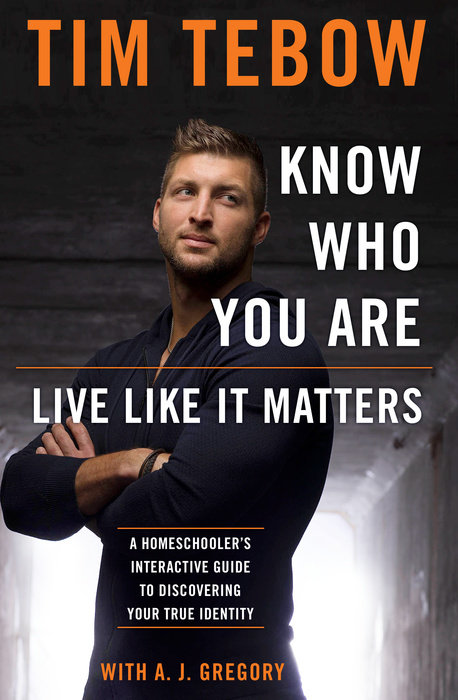
9 Quotes From “Know Who You Are”

Tim Tebow is not only an upbeat athlete, he is an enthusiastic encourager to others too. His latest book is called Know Who You Are—Live Like It Matters. Although mainly written to help homeschool families with some journaling ideas, this book is jam-packed with uplifting thoughts. You can check out my full book review by clicking here.

“The world does not define you: Not the clothes you wear. Not the kind of music you listen to. Not the mistakes you’ve made. Not the trophies you’ve won. You are not defined by what others think of you, good or bad, or how many people follow or like you on Instagram or Snapchat or Facebook. You are not defined by the talents you have or don’t have. There is only one thing, one Person, who defines your identity. His name is Jesus Christ.”

“If you do the right thing just to do the right thing, you’re going to wear yourself out at some point. We should always do the right thing because we want to honor Jesus, because we want to be like Him in everything we think, say, and do. … This is why we seek to have integrity. This is why we build good character. This is why we do the right thing. Because Jesus did it first and our mission is to be like Him.”

“What happens when we hide God’s Words in our hearts? We grow our faith. When we grow our faith, we root our identity deeper and deeper in Whose we are. We become empowered with what we need so we can face the highs and lows of life.”

“When our identity is grounded in God, we live differently. Our priorities change. Our relationships reflect this truth—or at least they should. We aren’t desperate for attention because God fulfills all our needs. Instead of using people to make us look good, we learn how to be faithful friends. We treat others with love, respect, and kindness. We watch what we say. We apologize when we make mistakes.”

“If you hear a rumor about someone else, stop it from going any further. Don’t repeat it. You can also turn the conversation into something positive. Say something nice about that person. Show some grace. That’s a sure way to honor God and fan the flames of love.”

“If we mean it when we say ‘I’m sorry,’ do you know what that does for us? It keeps our hearts tender. Not weak, just open to God shaping us into the young men and women He has created us to be.”

“We live in such a me-focused world. We take pictures of ourselves all the time. We tell the world on Facebook and Instagram what we’re doing, what we like, where we are going. We want all eyes on us. But that’s not what we’re called to do as Christians. We’re called to be others-minded. We are called to love others. We’re called to serve others. We are called to be like Jesus to a world who doesn’t know Him.”

“The stand you take may not be the biggest deal to the entire world, but it can be a big deal for one person. For instance, you don’t have to feed all of Africa, but feeding one person can have more of an impact than you may realize.”

“We are never going to be perfect in this life. But we can stretch and we can change. If you want to live bigger, you need to grow. No matter how many times you get knocked down or mess up, you need to hold on to God’s promises. You need to believe that He has a better plan. You need to cling to His truth. And day by day, moment by moment, you will become more and more like Jesus.”

Know Who You Are (book review)

Tim Tebow continues to astound me! Few people have used their celebrity status to promote other people like he has. In his latest book—Know Who You Are—he turns his sights on something near and dear to his heart: homeschool students and parents.

A key component of any student’s education is learning to articulate their thoughts in writing. At the beginning of his book Tim shares about some research on this topic:

“An esteemed professor of psychology at the University of Texas at Austin studied the impact of journaling. Through a handful of studies, this expert found that expressive writing in a personal and meaningful way positively impacts health, well-being, and self-development. It can put us in a better mood. It can help us process tough situations. It can challenge us to make good changes. It can pave the way for a more impactful future.”

Know Who You Are helps students journal their thoughts by giving them some positive things to ponder. Tim shares his personal stories, many of which involve mistakes he’s made or things which have caused him to second-guess himself, and then talks about the life lessons he learned from those experiences. He then gives students an opportunity to apply those same lessons to their own life. Each week’s lesson wraps up with a couple of writing prompts for the student’s journaling exercises.

This book is designed to take a student through their entire school year, but will help students to think better about themselves and their circumstances for a lifetime. Know who you are—Live like it matters is an excellent resource!

I am a Waterbrook book reviewer.

P.S. If you would like to check out other Tim Tebow books, my review for Through My Eyes is here, and my review for Shaken is here.

The Power Of Laughter

“Laughter increases the number and activity of some white blood cells called ‘T’ and ‘B’ cells, natural killers that fight viral infections and some types of cancer cells. It multiplies the antibody IgA, which fights upper respiratory tract infections. A hearty chuckle builds up gamma interferon, which stimulates the various components of the immune system.

“Laughing speeds up our heart rate, and some have likened this to ‘internal jogging.’ It’s an aerobic activity that works the diaphragm and increases the body’s ability to use oxygen. That’s why after a big laugh you often feel the need to sigh and take a big breath of air. It sure beats thirty minutes on the treadmill.

“As we laughed, our blood pressure temporarily is elevated; however, that is followed by a prolonged, mild decrease in blood pressure. Laughter also lowers various hormone levels—the kind associated with the fight-or-flight response—and makes us feel less stressed, more relaxed. That’s why people say things like ‘I laughed so hard I couldn’t get up’ or ‘I laughed so hard I fell over.’

“Science is figuring out that laughter is good for the body, something the Bible told us long ago—Proverbs 15:30; Proverbs 17:22.” —Lynn Eib, in Peace In The Face Of Cancer

To read other quotes from this exceptional book, click here and here.

10 Quotes From “The Servant As His Lord”

Whenever I read an Oswald Chambers’ book, I know I’m going to get exceptional content that is really going to make me think. The Servant As His Lord lived up to my expectations! I have shared several passages from this book already in my weekly “Thursdays With Oswald” posts (more about that in a moment), but here are a few more quotes I wanted to pass along to you.

“I continually come across people with rusty ‘thinkers,’ they think about their business but about nothing else, and the forces within have become desperately weak; consequently when tribulation comes their minds are confused, and the result is that errors come into the life. If the forces within are strong and healthy they give us warning and enable us to crush in a vice on the threshold of the mind everything that ought not to come there. God can impart to a man the power to select what his mind thinks, the power to think only what is right and pure and true.”

“God has no favorites, but when we let Him have His right of way through us He begins to unveil something more of His purposes in our lives. … Is tribulation making you wilt? making you swoon for sympathy? making you stagnate? It is an easy business to want to get away from tribulation, but fighting makes us strong, gloriously strong.”

“God grant we may be so filled with the Holy Spirit that we listen to His checks along every line. No power can deceive a child of God who keeps in the light with God. I am perfectly certain that the devil likes to deceive us and limit us in our practical belief as to what Jesus Christ can do. There is no limit to what He can do, absolutely none. ‘All things are possible to him that believeth.’ Jesus says that faith in Him is omnipotent. God grant we may get hold of this truth.”

“Look at the world either through a telescope or a microscope and you will be dwarfed into terror by the infinitely great or the infinitely little. Naturalists tell us that there are no two blades of grass alike, and close inspection of a bee’s wing under a microscope reveals how marvelously it is made. What do I read in the Bible? I read that the God of heaven counts the hairs of our heads. Jesus says so. I read that the mighty God watches the sparrows so intimately that not one of them falls on the ground without His notice. I read that the God who holds the seas in the hollow of His hand and guides the stars in their courses, clothes the grass of the field. Through the love of God in Christ Jesus we are brought into a wonderful intimacy with the infinitely great and the infinitely little.”

“The great need today amongst those of us who profess sanctification is the patience and ability to work out the holiness of God in every detail of our lives.”

“We are only safe in taking an estimate of ourselves from our Creator, not from our own introspection.”

“There is no one in the world more easy to get to than God. Only one thing prevents us from getting there, and that is the refusal to tell ourselves the truth.”

“God does not do what false Christianity makes out—keep a man immune from trouble, there is no promise of that; God says, ‘I will be with him in trouble.’ … No matter what actual troubles in the most extreme form get hold of a man’s life, not one of them can touch the central citadel, that is, his relationship to God in Christ Jesus.”

“The afflictions after sanctification are not meant to purify us, but to make us broken bread in the hands of our Lord to nourish others.”

“If we are self-willed when God tries to break us and will do anything rather than submit, we shall never be of any use to nourish other souls; we shall only be centers of craving self-pity, discrediting the character of God.”

“Thursdays With Oswald” is a weekly feature where I share a longer section from an Oswald Chambers book, along with a thought or two of my own. You can subscribe to my blog and get notified each time I share one of these posts, or you can type Thursdays With Oswald in the search box.

You can read my review of The Servant As His Lordclicking here by .

The Servant As His Lord (book review)

One of the most straight-talking, tell-it-like-it-is Christian speaker and author is Oswald Chambers. No one could ever accuse him of sugar-coating the Christian walk! In The Servant As His Lord, Chambers takes an unflinching look at the difficulty a Christian will have in living as his Lord, Jesus Christ, did.

As is the case with nearly all of Oswald Chambers’ books, The Servant As His Lord is a compilation of three sources: lectures, sermons, and essays for some small pamphlets. Biddy Chambers, his wife, often recorded Oswald’s sermons via shorthand and then put them into a book form at a later date.

The material in this book was all recorded during the height of The Great War (or what we now refer to as World War I). Many Christians were quite shaken in their faith during this time, questioning why God’s followers should have to go through such horrific things. Oswald Chambers, as he always did, never dodged the question nor made excuses, but simply stated: Jesus suffered pain, ridicule, and injustice while on earth, and His followers will too. The servant will be as his Lord.

Even though this book addresses some heavy topics, it’s not at all a “downer” for the reader. Quite the contrary! This book is actually very encouraging for the Christian going through any kind of difficulty or trial, knowing that Jesus not only went through the same thing, but that He is walking with us through our own trials.

This is definitely one of Chambers’ meatier books, but it is well worth the mature Christian’s time to study these wise and encouraging words.