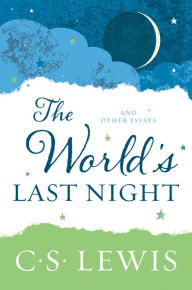
8 Quotes From “The World’s Last Night”

In seven essays expressly shared to get the reader to think in terms of eternity, C.S. Lewis masterfully practices his craft. Check out my full book review of The World’s Last Night by clicking here. Below is just a small sampling of a few of the outstanding quotes in this book.

“Simply to say prayers is not to pray; otherwise a team of properly trained parrots would serve as well as men.”

“Prayer is not a machine. It is not magic. It is not advice offered to God. Our act, when we pray, must not, any more than all our other acts, be separated from the continuous act of God Himself, in which alone all finite causes operate.”

“Scientists are mainly concerned not with believing things but with finding things out. And no one, to the best of my knowledge, uses the word believe about things he has found out. The doctor says he ‘believes’ a man was poisoned before he has examined the body; after the examination, he says the man was poisoned. No one says that he believes the multiplication table. No one who catches a thief red-handed says he believes that man was stealing. The scientist, when at work, that is, when he is a scientist, is labouring to escape from belief and unbelief into knowledge. Of course he uses hypotheses or supposals. I do not think these are beliefs.”

“Since most men, as Aristotle observed, do not like to be merely equal with all other men, we find all sorts of people building themselves into groups within which they can feel superior to the mass.”

“‘Good works’ in the plural is an expression much more familiar to modern Christendom than ‘good work.’ Good works are chiefly alms-giving or ‘helping’ in the parish. They are quite separate from one’s ‘work.’ And good works need not be good work, as anyone can see by inspecting some of the objects made to be sold at bazaars for charitable purposes. This is not according to our example. When our Lord provided a poor wedding party with an extra glass of wine all round, He was doing good works. But also good work; it was a wine really worth drinking.”

“Christ died for men precisely because men are not worth dying for; to make them worth it.”

“It would be difficult, and, to me, repellent, to suppose that Jesus never asked a genuine question, that is, a question to which He did not know the answer. That would make of His humanity something so unlike ours as scarcely to deserve the name. I find it easier to believe that when He said ‘Who touched Me?’ (Luke 7:45) He really wanted to know.”

“For what comes [after Christ’s Second Coming] is Judgment: happy are those whom it finds labouring in their vocations, whether they were merely going out to feed the pigs or laying good plans to deliver humanity a hundred years hence from some great evil. The curtain has indeed now fallen. Those pigs will never in fact be fed, the great campaign against White Slavery or Governmental Tyranny will never in fact proceed to victory. No matter; you were at your post when the Inspection came.”

The World’s Last Night (book review)

I am a huge C.S. Lewis fan! His perspective on the spiritual world is unequaled in any other author I have read. In The World’s Last Night, Lewis shares seven essays ranging from how our prayers really impact things, to life on other planets, to the end of our world as we know it.

The title of this book (and the title of the concluding chapter) are taken from a question by John Donne: “What if this present were the world’s last night?” So all of Lewis’ essays are written from that perspective. If this is the world’s last night, why should we keep praying? If demons knew this was the world’s last night, why would they keep on tempting? If atheists knew this was the world’s last night, would they keep arguing the same way?

As with all of his writings, C.S. Lewis has a unique knack of giving his readers a perspective that is totally original. His skills in philosophy, literature, and understanding the human heart are unparalleled! If you are ready to have your horizons expanded, these essays will not disappoint!

(And for any fans of The Screwtape Letters, Screwtape himself makes a special appearance as he gives a toast in hell that is sure to evoke both smiles and chagrins.)

11 Quotes From Important Islam Booklets

I recently read four very insightful booklets on how Christians can best prepare themselves to share their faith in Jesus with their Muslim neighbors. You can read my complete review of these booklets by clicking here. Below are just a few quotes that caught my attention.

“‘America’s mosques are loaded with people who grew up in church’ [says Carl Ellis]. Ellis says that many converts to Islam are African-American males who see traditional churches as male unfriendly and as failing to address their real needs.”

“God is bringing thousands of Muslim immigrants to our shores every year. These people are coming from Islamic nations where they could not be evangelized before. Yet here in America, they are free to listen and respond to the Gospel. In this ‘land of the free’ they do not have to fear horrible consequences if they believe the gospel and accept Jesus Christ as their Savior.”

“Our hearts should be increasingly burdened not only by the enormous spiritual need of the 1.4 billion Muslims, but also by the apathy of the missionary movement towards them. …  Instead of being evangelized, Muslims are evangelizing. …

“It is reported that Muslims are counting on Europe, the birthplace of the Reformation and the modern missionary movement, to become completely Islamic within the next few decades. In England more than 300 closed churches have been converted into mosques. … Muslims are now a majority in 44 countries of the world.”

“When you are discussing the Bible with the Muslim, it is important that you read the Bible verses in context. The Muslim has developed an intricate system of ‘abrogation’ or substitution of one verse for another, due to the random way the Qur’an is written. He will have a tendency to try to find verses in the Bible that ‘contradict’ each other. Anyone witnessing to a Muslim must know the Scriptures thoroughly and be able to lead the Muslim to understand the meaning of passages in relation to the setting in which they are found.”

“The Muslim will be impressed with a Christian’s words only if he experiences genuine friendship from the Christian and sees him living a consistent moral life. A Christian’s lifestyle must match his testimony.”

“It is better to win the Muslim as a friend than to win an argument and lose his friendship.”

“Christians should be aware that Muslims are people who seek after God!”

“Here, surely, is a key to witnessing to Muslims, both in the United States and around the world: Love them as Jesus loves us. … You must give your SELF to your Muslim friend—not just the gospel!”

“A cardinal rule is: Never become involved in arguments—especially theological ones! Nominal and even irreligious Muslims often become fanatical advocates of their faith when pushed by argument. The truth is: We have argued and debated for hundreds of years without success. Let us now become witnesses—not debaters!”

“No religion on the face of the earth deals with forgiveness of sins except Christianity. … The concept of God as a loving Heavenly Father is completely foreign to a Muslim. … Show him from the Bible how God has provided a way whereby all sins can be forgiven, and every trace of guilt can be completely removed. This is a very powerful tool in witnessing.”

“One way the power of the Holy Spirit is demonstrated is through physical healing. If your Muslim friend or a member of his family is sick, offer to go and pray for him. He will deeply appreciate your concern, and when the person is healed, this demonstration of the Holy Spirit’s power will be convincing—often the key to his accepting Christ as Savior and Lord.” 

Some other helpful resources on this topic are two books from Nabeel Qureshi: Seeking Allah, Finding Jesus and Answering Jihad. Also, check out Praying For Muslims.

Islam Booklets (book review)

Last week I reviewed a book calling Christians to pray for Muslims to come to a personal relationship with Jesus Christ. Prayer must be our first priority. But often times prayer will open the door for us to speak and act in love to share our faith with our Muslim friends.

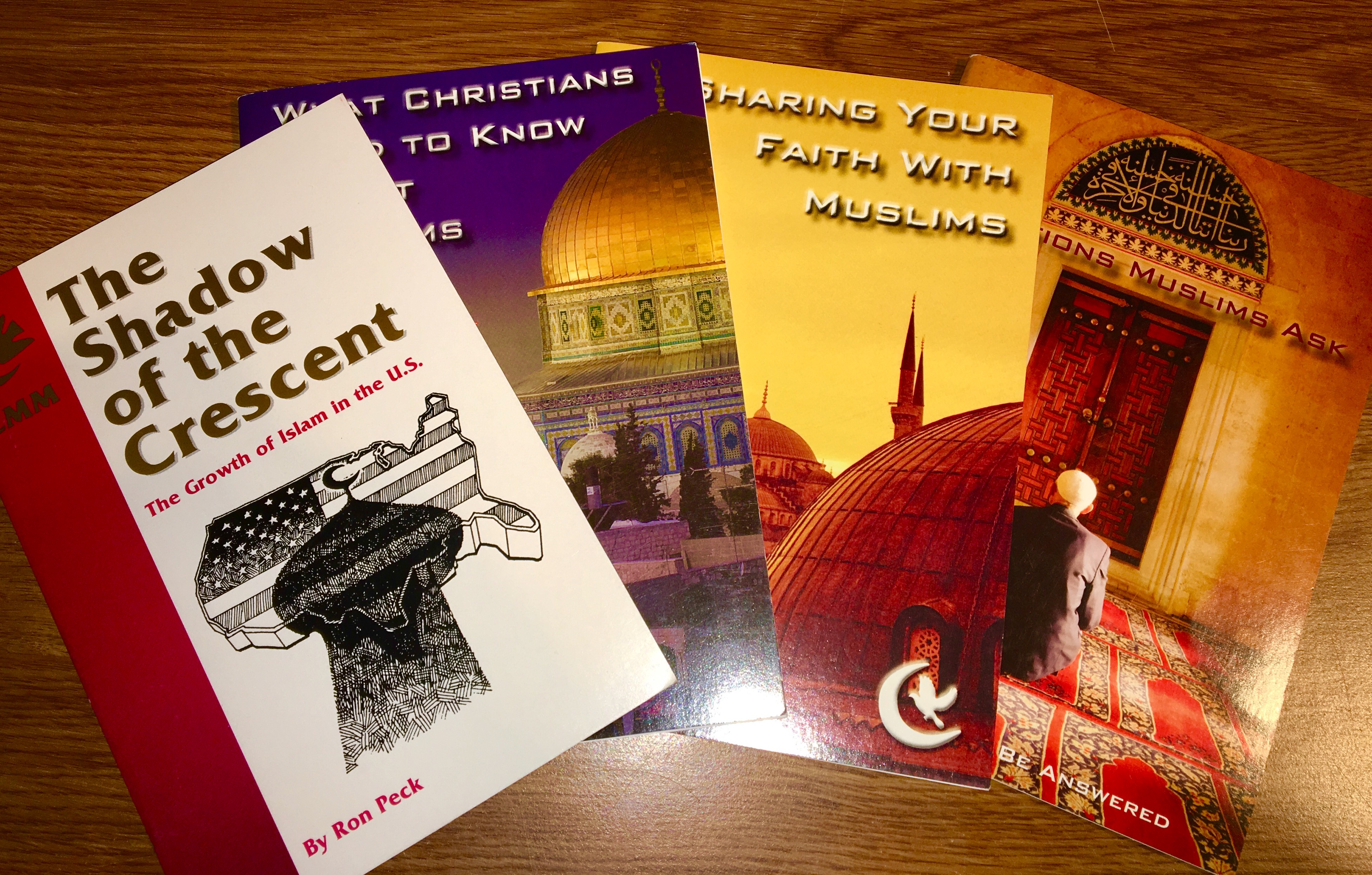
I recently read a quarter of booklets that I would highly recommend to you—

  • The Shadow Of The Crescent 
  • What Christians Need To Know About Muslims
  • Sharing Your Faith With Muslims
  • Questions Muslims Ask

These booklets will help you understand the mindset of Muslims, learn more about the questions Muslims ask of Christians, some thoughtful ways to answer those questions, and the lifestyle that will be the most appealing for Muslims to open their hearts to Christians.

In one of the booklets, Ron Peck says, “It is our prayer that this knowledge [in these booklets] will encourage true believers in Jesus to reach out in love and share the life-changing gospel of Christ with Muslims God has brought to our shores. We also pray it will challenge Christ’s followers to take a stand against the missionary efforts of Islamic governments overseas as they endeavor to Islamize our nation.”

Given the fact that about 15 percent of all U.S. immigrants each year are followers of Islam, and that most statisticians agree that in the United States there are about 25,000 converts to Islam every year, now is the optimal time for Christians to be prepared to share their faith in Jesus with their Muslim neighbors.

Praying For Muslims (book review)

During 2017 I wanted to spend more time in prayer for our Muslim friends around the world, that they would accept Jesus as their Lord and Savior. My prayer guide every Friday afternoon this year has been Praying For Muslims by Sobhi Malek.

This book has opened my eyes and ears, and softened my heart, for Muslims. Each Friday I read a short, informative devotional that gives me greater insight into the Islamic community, and then I use the included prayer as a way to ask God to shine the light of His Son Jesus into dark places around the globe.

Sobhi Malek reminds us:

“This warfare is not against people of any religion or affiliation. Christ, who died for all human beings, instructed us to love our neighbors. Rather, this war is against the evil powers which control people and hinder them from seeing the light of the Gospel of Christ (Ephesians 6:12). In other words, we are warring against satan who ‘has blinded the minds of unbelievers.’ His goal is to keep people from seeing ‘the light of the Gospel of the glory of Christ, who is the image of God’ (2 Corinthians 4:4). When we pray and ask others to pray, this does not mean that we feel superior. We do not think we are better than Muslims or any other people.  Rather, we believe we are fallen human beings like all others, but we have been saved by God’s grace.”

I urge Christians everywhere to get a copy of this book and join other prayer warriors around the world in this concerted effort to see a revival breakout in Muslim strongholds.

9 More Quotes From “Marching Off The Map”

Tim Elmore’s insights on the youth culture are amazing. To synthesize such great insights he obviously needs to read lots and lots of research. In all of his books, Dr. Elmore freely shares the cream-of-the-crop quotes he’s uncovered in his research. Here are a few of those quotes which I appreciated.

“In the modern world we have invented ways of speeding up invention, and people’s lives change so fast that a person is born into one kind of world, grows up in another, and by the time his children are growing up, lives in still a different world.” —Margaret Mead

“We are morphing so fast that our ability to invent new things outpaces the rate we can civilize them.” —Kevin Kelly

“I beseech you to treasure up in your hearts these my parting words: Be ashamed to die until you have won some victory for humanity.” —Horace Mann

“The greatest gifts we can give our children are the roots of responsibility and the wings of independence.” —Denis Waitley

“Strangely, the world seems to be growing both more charitable and more selfish at the same time. I have a lot of faith that our children’s generation has the potential to rise to the unimaginable challenges that lie ahead. But at this fascinating crossroads in human history there’s also a sense that a traditional worldview and ethic will come under increasing assault in the western world.” —Chris Arias 

“[Generation Z] are the most connected, educated and sophisticated generation in history. They don’t just represent the future, they are creating it.” —Mark McCrindle

“In every society since the start of history, whenever you broke down any population this way, you’d always get a pyramid. But from 1960-2060, our pyramid will turn into a rectangle. We’ll have almost as many Americans over age 85 as under age 5. This is the result of longer lifespans and lower birthrates. It’s uncharted territory, not just for us, but for all of humanity. And while it’s certainly good news over the long haul for the sustainability of the earth resources, it will create political and economic stress in the short-term, as smaller cohorts of working age adults will be hard-pressed to finance the retirements of larger cohorts of older ones.” —Paul Taylor, Pew Research Center

“We are now at a point where we must educate our children in what no one knew yesterday, and prepare our schools for what no one knows yet.” —Margaret Mead

“The military tells us we must offer diversity training, but it seems to me what our sailors most need is unity training. How can we mesh our differences into a single unit and get results?” —Navy Captain Michael Abrashoff

Check out my review of Marching Off The Map by clicking here. And read some of Tim Elmore’s quotes which I shared here. I will be sharing more quotes from this book soon, so stay tuned!

15 Quotes From “Run Today’s Race”

Oswald Chambers mastered the art of stimulating deep thinking and introspection with just a few short statements. Run Today’s Race is designed to be read each day for a full year. Trust me, the short seed thoughts you read each morning will keep you thinking all day long. Check out my full book review by clicking here.

“It is a great moment when we realize we have the power to trample on certain moods, a tremendous emancipation to get rid of every kind of self-consciousness and heed only one thing: the relationship between God and myself.”

“It is easy to turn our religious life into a cathedral for beautiful memories, but there are feet to be washed, hard flints to be walked over, people to be fed. Very few of us go there, but that is the way the Son of God went.”

“Prayer with most of us is turned into pious platitude, it is a matter of emotion, mystical communion with God. It is no use praying unless we are living as children of God. Then Jesus says—‘Every one that asketh receiveth.’”

“There is only one purpose for your life, and that is the satisfaction of the Lord Jesus Christ.”

“If there is the tiniest grudge in your mind against any one, from that second, your spiritual penetration into the knowledge of God stops.”

“We have judged our fellow men as sinners. If God should judge us like that we would be in hell. God judges us through the marvelous Atonement of Jesus Christ.”

“God delights to put me in a place where He can make me wealthy. ‘Follow Me, and thou shalt have treasure in heaven.’”

“The more complicated the actual conditions are, the more delightfully joyful it is to see God open up His way through.”

“When we try to reserve our strength it works out in weariness. Spend to the hilt all we have got and God’s recreating power is greater than all the expended power.”

“My personal life may be crowded with small, petty incidents altogether unnoticeable and mean [commonplace], but if I obey Jesus Christ in the haphazard circumstances, they become pinholes through which I see the face of God and when I stand and face to face with God I shall discover that through my obedience thousands were blessed.”

“Whenever the insistence is on the point that God answers prayer, we are off the track. The meaning of prayer is that we get hold of God, not of the answer.”

“One of the most amazing revelations of God comes when we learn that it is in the commonplace things that the Deity of Jesus Christ is realized.”

“As long as there is a human being who does not know Jesus Christ, I am his debtor until he does. The mainspring of [the Apostle] Paul’s service is not love for men but love for Jesus Christ.”

“As long as the devil can keep us terrified of thinking, he will always limit the work of God in our souls.”

“By prayer and Bible reading and meditation, the drab life (drab externally) has glorious holiday hours with God in which the soul is restored even in the valley of deep darkness.” 

More quotes coming soon, so stay tuned.

Run Today’s Race (book review)

It’s amazing the thoughts you can think if only the right “seed thought” is first planted in your mind. In Run Today’s Race that’s exactly what Oswald Chambers does for us.

Run Today’s Race is a 365-day seed-planting book designed to send your mind exploring the applications of each day’s short statement or question. At most, each day’s reading is expressed in three sentences, but many of them are expressed in just a handful of words.

The original publication in 1918 was called Seed Thoughts Calendar. In the introduction we read:

“Oswald Chambers firmly believed in the concept of ‘seed thoughts’—brief, pithy sayings designed to arrest attention and stimulate thinking. The entry for December 9 perhaps best expresses his conviction on how to affect a person’s mind and behavior: ‘Our Lord was never impatient. He simply planted seed thoughts in the disciples’ minds and surrounded them with the atmosphere of His own life….’”

Each day’s entry in Run Today’s Race will take you only a few seconds to read, but you will have some excellent thought material to keep your mind occupied all day long. Make an investment in your spiritual growth by picking up a copy of this excellent book.

As an example from November 14:

“The proof that we are rightly related to God is that we do our best whether we feel inspired or not.”

This might stimulate questions like:

  • Do I do my best only when someone is watching me, or do I do my best because God is always watching me?
  • Do my work ethic and pursuit of excellence make God look good to others?
  • Do I have to wait until I’m “inspired” to do my best, or can simply doing my best make me feel inspired?

7 Quotes + 1 Infographic From “Marching Off The Map”

Once again, Tim Elmore has given us invaluable insight into the emerging youth culture. If you have kids or work with kids, you must read Marching Off The Map. You can check out my full book review by clicking here. Below is the first set of quotes I want to share with you, but there will be plenty more coming in the future, so stay tuned!

“Thanks to technology, information streams into their lives 24/7 and often has no filter on it, even for young children. When we determined not to censor content in the media, we had no idea (understandably) how it would affect our kids. We’re removing the opportunity for them to experience innocence and wonder. However, because they’re still maturing emotionally, socially, cognitively and biologically in their first 25 years, we have now begun to witness a strange paradox in our young: the extinction of childlikeness and the extension of childishness. …

“Since they are exposed to so much adult information, so early in their lives, they can prematurely lose (1) their sense of innocence, (2) their sense of wonder and (3) their sense of trust …

“Biologically, the graduate is an adult. Emotionally, the graduate may be unprepared for the adult world.” 

“If you think our kids are pitifully impulsive on social media—just look at the adult population. … If you think teens are addicted to Facebook, just study the hours their mothers spend on it. If you think young athletes on the Little League baseball field act childish, just look at their dads. The behavior of adults and children has become more and more similar. Society has baptized ‘youthfulness.’ We want to look young, feel young, dress young, talk young and act young. We argue with our children’s teachers. We push our kid’s coaches to get them special treatment. We are not good at delaying gratification, and we frequently don’t keep commitments we make … very much like children. The result? Adulthood has lost much of its aura and authority.”

“As you stand in front of your classroom or your own children—you are, in a sense, Galileo. You are Magellan. You are Christopher Columbus. You are Lewis and Clark. You are Neil Armstrong. Ready or not, they need you to play this role.

“Our world is both expanding and shrinking. Our past maps and methods are antiquated. Like it or not, we’re moving into unfamiliar territory and many think it’s too difficult to explore. We have fallen in love with our old maps. … 

“For educators, our role must change as we teach a generation of students who don’t need adults to get information.

“For parents, our role must change as we raise kids in a time of terrorism, economic recession, racial unrest, underemployment and ubiquitous technology.

“For coaches, our role must change as we train young athletes who have eight-second attention spans, and may arrive at practice with little resilience or grit.

“For youth workers, our role must change as we mentor students who have few life skills or values because adults either over-functioned or were absent.

“For employers, our role must change as we onboard young employees who may have never had a real job before, and may ask when ‘spring break’ will be.”

“Adults must enable the students to leverage what is new, yet at the same time, hold on to what is ancient, yet valuable. We must be both timeless and timely. So, our job as we serve the next generation is two-fold:

  • To adopt or adapt. We must seize what is new and help kids leverage it well.
  • To explain and equip. We must relate to them the timeless ideals every generation needs.”

“I believe we must cultivate one significant skill set in ourselves: we must be able to either adapt to the new world that’s emerging, or we must explain why a timeless virtue or value is still relevant in our 21st century world.”

“A third of young Americans say they don’t belong to any religion. I’ve found, however, they’ve traded in one God for many gods. They want to ‘feel’ spiritual, so they’ve created a buffet—seeking something to satisfy their soul. I often hear students say, ‘I don’t believe in religion, but I want to be a spiritual person.’ Today—pluralism is expanding across the landscape. It’s easier to say ‘no’ to one and enjoy a mixture of many.”

“A third of young Americans say they don’t belong to any religion. I’ve found, however, they’ve traded in one God for many gods. They want to ‘feel’ spiritual, so they’ve created a buffet—seeking something to satisfy their soul. I often hear students say, ‘I don’t believe in religion, but I want to be a spiritual person.’ Today—pluralism is expanding across the landscape. It’s easier to say ‘no’ to one and enjoy a mixture of many.”

“The Latin root word for ‘educate’ is ‘ducere’ which means to ‘push out.’ … We should not put students in a passive mode as we teach. We must be inspirers of learning. We must help pull ambition out of them, not push information into them.”

I’ll be posting some more quotes from Marching Off The Map next week.

Marching Off The Map (book review)

In my mind, Tim Elmore stands head-and-shoulders above the rest in giving the most meaningful insights into the minds of today’s youth. Parents, coaches, teachers, and youth pastors will do themselves and the students with whom they work a huge service by using Dr. Elmore’s newest book—Marching Off The Map—as their guiding light in working with this young generation.

Never before have so many youth been exposed to so much information at such young ages. As a result, today’s students are both more prepared and less prepared to take on the future than any generation before them. Does this sound contradictory to you?

Consider the case of Alexander the Great. He conquered territory so quickly that he literally marched off the map; that is to say, there were no known maps for the new territory in to which he took his armies. Alexander’s mapmakers were pressed into duty to draw the maps as they were discovering new lands. They were both more and less prepared to move forward, just like today’s generation of students.

Those who work with today’s students can probably relate! Parents and teachers are attempting to write new maps as they go. They are being called upon to be both timeless and timely; to bring timeless principles into a territory where they’ve never been before in a timely way.

“This book is about moving into unknown territory as caring adults, and leading the way for the younger generations behind us. It’s all about inspiring students to learn in this brand new world. Whether you are an educator, a parent, a coach, an employer, a youth worker or just someone who cares about kids, this book was created to help you chart the course into the future.” —Tim Elmore 

Along the way Dr. Elmore will introduce you to some of today’s youth, help you see the world through their eyes, and give you invaluable insight into how best to educate, train, and equip them to be the leaders of the next generations. All of Dr. Elmore’s books are well-documented with research, statistics, graphics, and suggestions which are guaranteed to open your eyes and your mind.

If you truly care about seeing the next generation of youth be as prepared to face the future as possible, Marching Off The Map has to be a must-read! 

I am a Poet Gardener Publishing book reviewer.