


 “Grieve the Holy Spirit, and you will lose all Christian joy; the light shall be taken from you, and you shall stumble in darkness; those very means of grace which once were such a delight, shall have no music in your ear. Your soul shall be no longer as a watered garden, but as a howling wilderness. Grieve the Spirit of God, and you will lose all power; if you pray, it will be a very weak prayer—you will not prevail with God. When you read the Scriptures, you shall not be able to lift the latch and force your way into the inner mysteries of truth. When you go up to the house of God, there shall be none of that devout exhilaration, that running without weariness, that walking without fainting. You shall feel yourself like Samson when his hair was lost, weak, captive, and blinded. Let the Holy Spirit depart, and assurance is gone, doubts follow, questionings and suspicions are aroused. Grieve the Spirit of God, and usefulness will cease: the ministry shall yield no fruit….” —Charles Spurgeon
Charles Spurgeon On Grieving The Holy Spirit
March 9, 2015 — Craig T. OwensNo Plan B
March 9, 2015 — Craig T. Owens In my family, what starts off as Plan A at the beginning of the day is highly likely to end up as Plan K-13 by the end of the day! We just try to be flexible and roll with the changes.
But we must be careful about giving the characteristic of “flexibility” to God—He doesn’t need to be flexible and modify His plans. He has no Plan B; everything is His Plan A.
Jesus is described as being the sacrificial Lamb from before the dawn of Creation (1 Peter 1:18-20). And in Heaven Jesus is still known as the Lamb that was slain (Revelation 13:8 and 5:5-6). Jesus coming to earth to die on an old rugged Cross was always God’s Plan A. The whole time Jesus Christ was on earth, He knew what was happening.
Here are 5 things Jesus knew. He knew…
- …when His time had come, and that all things were about to be fulfilled through His crucifixion—John 13:1, 3
- …the exact sequence of events leading up to His death on Calvary—Matthew 20:17-19
- …the immutability of the Scriptures—Matthew 26:53-56
- …the infallibility of the Scriptures—Luke 24:25-27
- …that God would be glorified in fulfilling His Plan A—John 12:27-28
With this in mind, here are 5 things we should know. We should know…
- …that all my days were written down before the dawn of Creation—Psalm 139:16
- …God loves me more than I can fathom—Psalm 139:17
- …my life was always intended to be a part of God’s Plan A—Ephesians 2:10
- …no weapon formed against God’s Plan A for me will succeed—Isaiah 54:17
- …that God will be glorified in fulfilling His Plan A in my life—Romans 8:28
The old rugged Cross reminds us that God’s Plan A was always for Christ’s death to make it possible for our lives to make sense!
As Andrew Murray wrote: “God fully relied on His Son to see to it that His honor was respected. And in Jesus we too may bravely enter this covenant without fear that we will not be able to fulfill it. We can rely upon Jesus to see to it that He will bring everything to completion. Jesus has not only discharged our old debt but also undertaken the responsibility for whatever else may be required.”
I’ll be continuing our series on The Old Rugged Cross this Sunday, and I hope you can join me.
Links & Quotes
March 6, 2015 — Craig T. Owens
“When the body is about to be led into a sinful action by some fear or craving, we are to take the sword of the Spirit and kill that fear and that craving. In my experience, that means mainly severing the root of sin’s promise by the power of a superior promise. … Having promises at hand that suit the temptation of the hour is one key to successful warfare against sin…. Be constantly adding to your arsenal of promises. But never lose sight of the chosen few that God has blessed in your life. Do both. Be ever-ready with the old. And every morning look for a new one to take with you through the day.” —John Piper
“At the heart of the Hebrew concept of marriage is the notion of covenant—a legally binding agreement with spiritual and emotional ramification (Proverbs 2:17). God serves as a witness to the marriage covenant, blessing its faithfulness but hating its betrayal (Malachi 2:14-16). The Lord’s intimate involvement renders this legal commitment a spiritual union, ‘so they are no longer two, but one’ (Matthew 19:6). The purpose of marriage as articulated in the Bible is to find true companionship (Genesis 2:18; Proverbs 18: 22), produce godly offspring (Malachi 2:15; 1 Corinthians 7:14) and fulfill God’s calling upon an individual’s life (Genesis 1:28). … Marriage binds husband and wife together into an entity greater than either partner as an individual, and it does so in order to assure continuity of the family lineage.” —Archeological Study Bible
“To educate a man in mind and not in morals is to educate a menace to society.” —Theodore Roosevelt
Eric Metaxas, in his commentary A Murderous Mother, tells how the environmentalists have gotten off track, and how Christians are really the only one who can help us.
“In our esteem, the joys of earth are little better than husks for swine compared with Jesus the Heavenly Manna. I would rather have one mouthful of Christ’s love, and a sip of His fellowship, than a whole world full of carnal delights. What is the chaff to the wheat? What is the sparkling paste to the true diamond? What is a dream to the glorious reality?” —Charles Spurgeon
I really like this post—Is There A Spiritual Side To Sex?
Abortion, Inc. documents the $500 million Planned Parenthood gets in your tax dollars to keep killing innocent children.
4 Notes On Haggai
March 4, 2015 — Craig T. Owens
(c) Laura Kranz at The Overview Bible Project (see my note below)
The prophet Haggai wrote one of the shortest books in the Old Testament, and his recorded ministry only spans five months(!) in 520 B.C. But in this short book I find four really cool things—
(1) God uses His people at specific times for specific purposes. All of Haggai’s messages from God have a very precise date stamp on them, so we know exactly when they were delivered. Also, most of his messages say something like, “The word of God came through Haggai to Zerubbabel [or to Joshua, or to the people, or to the priests].” If God used Haggai like this, isn’t it likely that He is using you or I at specific times and for specific purposes?
(2) God invites us to “give careful thought” to His messages. Five times God says, “Give careful thought to your ways” (1:5, 7; 2:15, 18). This phrase literally means to take a strong hold on each thought and examine it intensely. This thought process is always connected to another phrase: “This is what the Lord Almighty says….” In other words, we are to thoughtfully examine our lifestyle with God’s Word being the standard of measurement (cf. 2 Corinthians 10:5).
(3) Obeying God’s Word brings God’s “stirring.” When God says move and we move, His Spirit will energize our spirit, and empower our lives for action. God never calls us to do something without giving us the empowerment to do it.
(4) I need to act courageously. God calls us to “be strong” (three times in 2:4) “and work, for I am with you.” Courageous action after God has stirred us up drives out fear. On the flip side, inactivity because of fear almost always leads to more fear and more inactivity.
Don’t ever let the category “minor prophet” trick you into thinking God doesn’t have a major message to share with you. Just one word from God is more powerful than we can ever imagine!
(The portrait of Haggai in this post was created by Laura Kranz at The Overview Bible Project. She and her husband Jeffrey do some amazing things that will add insight to your Bible study time. Click here to read my review of their book The Illustrated Guide To The Authors Of The Bible. And while you’re on their website, subscribe to some of the cool guides that regularly get emailed out.)
E.M. Bounds On Prayer
March 3, 2015 — Craig T. Owens An amazing passage from E.M. Bounds’ book The Necessity Of Prayer—
“Here, let it be said, that no two things are more essential to a Spirit-filled life than Bible reading and secret prayer; no two things more helpful to growth in grace; to getting the largest joy out of a Christian life; toward establishing one in the ways of eternal peace. The neglect of these all-important duties, presages leanness of soul, loss of joy, absence of peace, dryness of spirit, decay in all things that pertain to spiritual life. Neglecting these things paves the way for apostasy, and gives the evil one an advantage such as he is not likely to ignore. Reading God’s Word regularly, and praying habitually in the secret place of the Most High puts one where he is absolutely safe from the attacks of the enemy of souls, and guarantees him salvation and final victory, through the overcoming power of the Lamb.” (emphasis added)
What God Is Building
March 2, 2015 — Craig T. Owens I love the drawings of M.C. Escher. But some of his sketches are clearly optical illusions we all know couldn’t work in the real world. We don’t have to be architects or engineers or builders to know that for a building to be functional it has to have (1) a solid foundation, (2) it must be built with quality materials, and (3) it must be constructed by someone who knows what he/she is doing.
The Apostle Paul tells us that (1) Jesus Christ is the cornerstone of the sure foundation, (2) you and I—God’s saints—are the quality building materials that are being used, and (3) the Holy Spirit knows exactly what He is doing as He joins us together.
A cornerstone is the first stone set in the construction, the reference point for all other stone, which determines the position of the entire structure. Christ Jesus Himself is the cornerstone of His Church (Ephesians 2:20b). Orientated to that cornerstone we have the foundation of the apostles and prophets (2:20a).
This foundation is the Word of God (2 Peter 1:19-2:3 and 2 Timothy 3:14-4:5). We dare not try to replace, nullify, update, or change His Word. Not would this cause the foundation to crumble, but there are dire consequences for the one who tries to do so (Revelation 22:18-19).
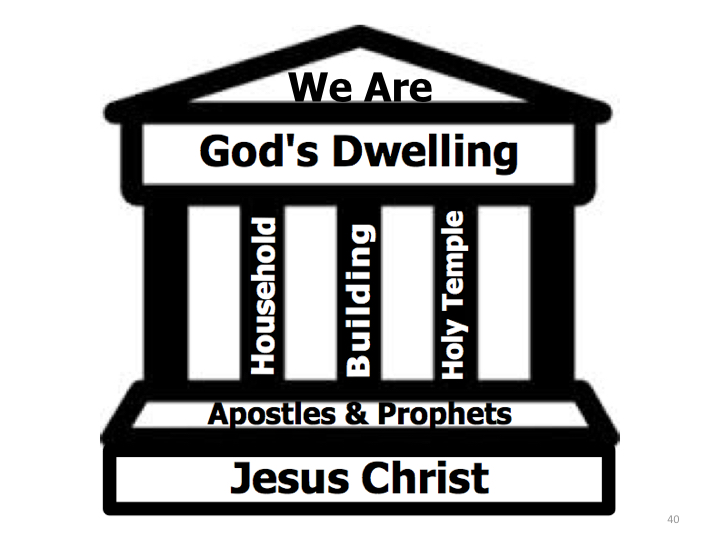 On this foundation, God is constructing three things, each one growing in its level of intimacy with Him and with the surrounding saints:
- God’s household (Ephesians 2:19)—this Greek word means a family home.
- the whole building (Ephesians 2:21a)—this is a specific part of the family home used for prayer and fellowship.
- a holy temple (Ephesians 2:21b)—this is the same word used for the Holy Place and Holy of Holies in the tabernacle.
God’s Presence dwells in us individually, but collectively we make a more powerful statement (1 Corinthians 3:16). There is a far greater testimony to the world when individuals willingly and actively allow themselves to be built together; when Christians give up their personal agendas to say, “I want to be a part of something bigger than me—I want to be a part of we.”
We must study God’s Word to make sure we are building on the same foundation. We must allow our lives to be quality building materials. We must allow the Holy Spirit to build us together through prayer and fellowship! This becomes the fulfillment of the prayer Jesus Himself prayed for us (John 17:20-23).
This was the last message (for this time) in our series on the Book of Ephesians. I hope to be able to continue this study next year.
Links & Quotes
March 1, 2015 — Craig T. Owens
“May we have none of our own-manufactured graces about us. May we have nothing but that which is minted in Heaven, and is therefore made of the pure metal. May we have no grace, pray no prayer, do no works, serve God in nothing except as we depend upon His strength and receive His Spirit.” —Charles Spurgeon
“Above God, there are no higher courts. If God is the One Who acquits you—declares you righteous in His sight—no one can appeal, no one can call for a mistrial, no one can look for other counts against you. God’s sentence is final and total. So hear this, all who will believe on Jesus, and become united to Christ, and show yourself among the elect: God is the One who justifies you. Not a human judge. Not a great prophet. Not an archangel from heaven. But God, the Creator of the world and Owner of all things and Ruler of the universe and every molecule and person in it, God is the One Who justifies you [Romans 8:33].” —John Piper
Here is a very nice article about the En Gedi Youth Center, the organization for which I have the privilege of serving as the director.
“It is very possible that if we were more thoroughly Christians the world would more heartily detest us, and if we would cleave more closely to Christ we might expect to receive more slander, more abuse, less tolerance, and less favor from men.” —Charles Spurgeon
[VIDEO] Amazing time-lapse pictures of solar activity from NASA—
9 More Quotes From “The Blood Of The Cross”
February 28, 2015 — Craig T. Owens There were way too many quotes from The Blood Of The Cross by Horatius Bonar that I wanted to share, so here is the second installment. You can read the first set of quotes by clicking here, and you can read my review of this must-read book by clicking here.
“It is not my looking to the blood in conjunction with my looking to my own act of seeing that brings this peace. It is my simple and direct looking to the blood. It is in looking that I am blessed; not in thinking about my looking. To look to the blood is to be cleansed; to look away from the blood, or too self, or to the world, or to sin, is to arrest the cleansing process and to neutralize the healing power. The more I see of the matchless value of that blood, and understand the substitution of life for life, which that blood proclaims, and to which it is ever pointing, the more will my peace be like a river.”
“The Lamb has been slain, the Lamb of God, as it is written, ‘It pleased the Lord to bruise Him’ (Isaiah 53:10). His blood has been shed, and sprinkled, and accepted; and that shed blood is for the remission of sin, and for reconciling us to God. That blood is intended to set us in the place of the innocent; to bring us nigh to God just as if we had never separated; to be our recommendation to God, so that coming with it as our plea, we may expect to be treated by God as HE is treated Whose blood we thus recognize and rest on.”
“To come with anything else than the blood as our introduction is most certainly to secure or for ourselves rejection; but to come with it alone is to ensure that blessed welcome which the blood has never yet failed to obtain for the vilest sinner that ever went to God with it as his only plea.”
“That blood is valuable enough to answer for yours, and God is willing to accept the exchange. Nay, it was He Who first proposed it; it is He Who is pressing this exchange upon your notice and entreating you to receive it, so that there maybe nothing left for you to pay.”
“It loses none of its efficacy by time or repetition. It is the same in this age as when it was shed at first. It is the same today as when first we applied to it for healing and for cleansing. Nothing can rob it of its potency. It has cleansed millions; it can cleanse millions more; it has washed out stains, in number past calculation, in dye most thoroughly crimson. Yet it is unpolluted. It has taken on no stain. It is still as able to pacify the conscience and to release the soul from guilt.”
“Realizing these things, the saint moves on his joyful course. The blood is ALL to him. It is his peace; it is his medicine; it is his daily comforter. And resting in it he rejoices in hope hope of the glory to be revealed.”
“Thou hast gone near enough to the gates of hell; yet go not in. Turn back. It is not yet too late. Even thou mayest be saved. The gate of light stands as widely open as the gate of darkness. The way of life, the narrow way, is as free to thee as is the way of death. There is still forgiveness. And the glad tidings of it are as glad as ever. No sin of thine has altered that gladness or made the tidings a forbidden joy to thee. We can tell you as truly as ever that ‘these things are written that thou mightest believe that Jesus is the Christ, and that believing thou mayest have life through His name’ (John 20:31).”
“That nonconductor is unbelief. It interposes between the soul and all heavenly blessing, all divine intercourse. It may seem a thing too slight to effect so great result; yet it does so inevitably. It shuts off the communication with the source of all glad tidings. It isolates man, and forbids the approach of blessing. That conductor is faith. In itself it is nothing, but in its connection everything. It restores in a moment the broken communication; and this, not from any virtue in itself, but simply as the conducting link between the soul and the fountain of all blessing above.”
“In Jesus there is salvation—salvation without a price—salvation for the most totally and thoroughly lost that this fallen earth contains. Go and receive it.”
Links & Quotes
February 26, 2015 — Craig T. Owens
In The Screwtape Letters, C.S. Lewis has one demon giving advice to his young protege demon. This is profound wisdom: “You will say that these are very small sins; and doubtless, like all young tempters, you are anxious to be able to report spectacular wickedness. But do remember, the only thing that matters is the extent to which you separate the man from the Enemy. It does not matter how small the sins are provided that their cumulative effect is to edge the man away from the Light and out into the Nothing. Murder is no better than cards if cards can do the trick. Indeed the safest road to Hell is the gradual one—the gentle slope, soft underfoot, without sudden turnings, without milestones, without signposts.” —C.S. Lewis
Two surveys seem to be related: First, “Fifty-four percent of U.S. teens 15-to-17-years-old do not live in a home with their married mother and father.” Read more in this post. (2) Lee Strobel reports on some findings from a Barna Group survey he commissioned: “Two findings emerged in a new national poll that I commissioned on fatherhood and faith: the younger the generation, the more people report having difficult relationships with their fathers. At the same time, the younger generation reports the highest percentage of people who are struggling with belief in God.” You can read Lee’s thoughts on this in Fathers & Faith.
Frank Viola shared this great story—In light of their doctrinal disagreements, someone once asked George Whitefield if he thought he’d see John Wesley in heaven. Whitefield replied, “I fear not, for he will be so near the eternal throne and we at such a distance, we shall hardly get sight of him.”
“Grace is simply another word for God’s tumbling, rumbling reservoir of strength and protection. Grace comes to us not occasionally or miserly but constantly and aggressively, wave upon wave. We’ve barely regained our balance from one breaker, and then, bam, here comes another.” Read more in Max Lucado’s post Grace—A Never Ending Supply.
Astronomers are perplexed by the size of a black hole. Apparently it is challenging their views on the origins of the universe. Perhaps there is a better explanation….
Thursdays With Oswald—Concealing And Revealing
February 26, 2015 — Craig T. Owens This is a periodic series with things I’m reading and pondering from Oswald Chambers. You can read the original seed thought here, or type “Thursdays With Oswald” in the search box to read more entries.
Concealing And Revealing
One of the most delicate issues in the history of the human soul is that of concealing what ought to be made known and of making known what ought to be concealed. When concealing is a great relief, question it; when revealing is a great relief, question it. The only guiding factor is obedience to the highest we know. The wriggling we indulge in to escape from being humiliated prevents our being right with God.
For instance, you have a wrong attitude of mind towards another, and the Spirit of God tells you to put it right between yourself and that one (cf. Matthew 5:24), and you say—No, I will put it right between myself and God. You cannot do it; it is impossible. Instead of deliberately obeying God, irrespective of what it costs, we use the trick of prayer to cover our own cowardice. It is a very subtle subterfuge to prevent ourselves being humiliated, but God will bring us into a place of humiliation externally, and others will see we are humiliated. If, on the other hand, there is something between yourself and God, and you feel it would be an enormous relief to tell someone else about it, don’t. “Immediately I conferred not with flesh and blood” [Galatians 1:16]. It is never a question of giving an explanation to someone else, but of maintaining obedience to the highest we know at all costs. [bold font added by me for emphasis]
From Not Knowing Where
Enough said!
My most-viewed posts


 Craig T. Owens