Notes From The Global Leadership Summit

I had an amazing time last week at the Willow Creek Global Leadership Summit. Every year I came away with some many thoughts, and a brand new passion for the various leadership roles in which I get to serve.

Below are just a few of my notes that I jotted down during an intense two days.
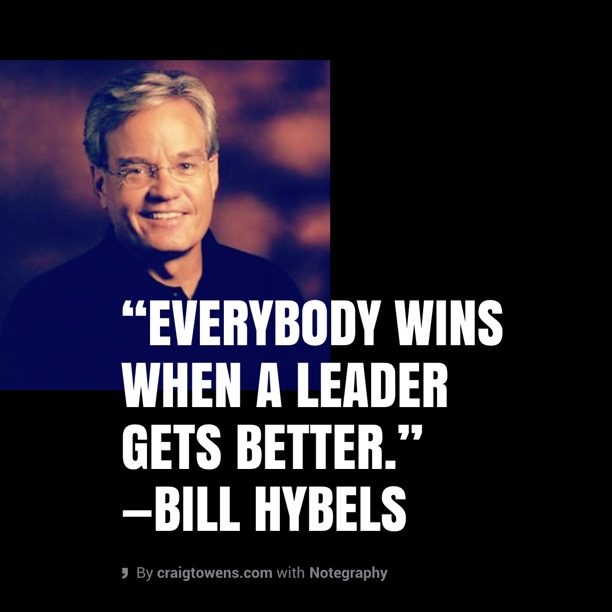
Hybels - everybody winsBill Hybels—The Lens Of Leadership

“Everybody wins when a leader gets better.”

“Armed with enough humility, leaders can learn from anyone.”

Hybels discussed four leadership lenses:

1.   Passionate leader (depicted by vibrant bright red frames)

  • They understand unbridled passion in leadership.
  • “Passion is like protein for the team.”
  • A motivated worked will outperform an unmotivated worker by 40%.
  • People are more motivated by working for a passion-filled leader than they are by compensation or perks.
  • Passion comes from a mountain-top dream, or a valley-deep frustration of current settings.

2.   People leader (cool frames, but cracked lenses)

  • An organization will only be as healthy as the top leader wants it to be.
  • This world needs more pastors of businesses, factories, medical offices, military units, etc.

3.   Performance leader (self-adjusting glasses)

  • Leaders ask: what progress should be made? how do we measure this? what doesn’t need to be measured?
  • Every worker wants to know how they are doing. For the leader, it’s cruel to hire someone and never let them know how they’re doing. Every staff member should get an update at least every six months.

4.   Legacy leader (sunglasses with a rearview mirror [cyclist])

  • Every once in awhile we need to look behind to see what legacy we’re leaving behind.
  • Leaders should reflect on this annually.
  • If my leadership assignment were to end today, what legacy would I leave?
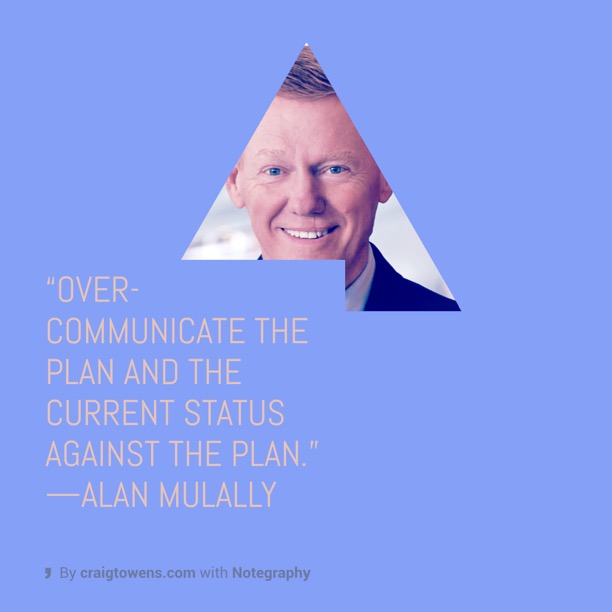
Mulally - overcommunicateAlan Mulally—CEO Boeing and Ford Motor Company

An average commercial airline has 4 million parts!

  • People first
  • Include everyone
  • Create a compelling vision
  • Present a workable strategy
  • Set clear performance goals
  • Relentless implementation
  • Share lots of data
  • “Over-communicate the plan and the current status against the plan.”
  • Instill a positive can-do attitude
  • Keep your emotional resilience
  • Have fun


Melinda Gates - hear the criesMelinda Gates—Gates Foundation

Melinda says of herself, “I am an impatient optimist. We are changing the world, but we need to change it faster.”


“At the end of the day, you have to hear the cries of those in need, let your heart break and act in courage.”

Jossy Chacko—Empart

“All of us have been entrusted with something. What are we doing to leverage it?”

In thinking about the parable of the talents … “To Jesus, faithfulness is not just sitting with what you have been given, but multiplying what you have been given. God’s mission is not maintaining.”

“Playing it safe is not enough for a follower of Jesus Christ.”

Three principles for expanding our leadership reach:

Jossy Chacko - faithfulness1. Enlarge your vision

  • “When people hear my vision, they should know the size of my God.”
  • “An enlarged vision should keep us driven.”
  • “Do not be confused about what people say about your vision; trust what God has said to you.”

2. Empower your people

  • “Leadership is about taking wise chances and giving people opportunities.”
  • “Your leadership reach will be determined by your empowerment choices.”
  • Three things to keep in mind: (1) Focus on building their character before empowering them; (2) Empowerment has to be through relationship; and (3) Make sure we have agreed on the right outcomes, and have the right way to measure them.

3. Embrace risk

  • Faith = risk. Without faith it is impossible to please God = without taking risks it is impossible to please God.
  • Paradigms to be changed: (1) See risk as your friend to love, not as your enemy to be feared; (2) See comfort and safety as your enemies; and (3) Increase your pain threshold.
  • “Your leadership capacity is in direct relationship to your pain threshold.”
  • “Don’t allow the fear of losing what we have to lose what God has in store for you.”
  • “By me not taking risks, who is missing out?”

Bradberry - EQDr. Travis Bradberry—TalentSmart

All inputs into the brain travel through the limbic system first (emotional center) before the inputs travel to the frontal cortex. The EI (emotional intelligence) center is in the front of the brain, just above the left eye.

Only 36% of people are able to accurately identify their emotions as they happen.

EQ (the Emotional Quotient that measures emotional intelligence) is not IQ.

EQ can be improved all throughout life.

Four components of emotional intelligence:

 1. Self-awareness: knowing my emotions, and knowing my tendencies. I need to lean into my discomfort if I want to improve.

   2. Self-management: what I do with this increased self-awareness. This is not “stuffing” my feelings. The biggest mistake is only trying to manage negative emotions; positive emotions need to be managed too.

   3. Social awareness: focusing more on others than on myself.

   4. Relationship management: using the first three skills in concert. Seeing how my behavior is affecting the other person, and then adjusting accordingly.


How to increase my EQ:

  1. Control stress—stress under control is healthy; chronic stress is unhealthy. Gratitude reduces the stress hormone cortisol.
  2. Clean up my sleep hygiene—sleep cleans up toxic hormones in the brain. To get better sleep: (1) Don’t take any kind of sleeping pill; and (2) Reduce “blue lights” in the evening.
  3. Reduce my caffeine input—especially after noon.
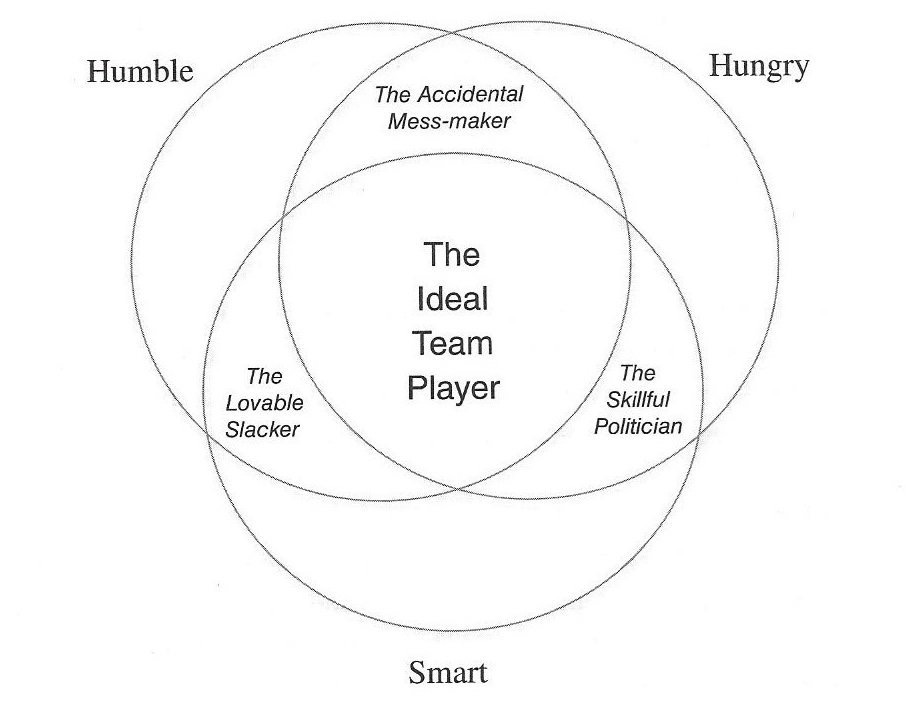
Ideal team playerPatrick Lencioni—Author

Three qualities of an ideal team player:

1.   Humble

  • Lacking self-confidence is not humility.
  • “Denying skills and downplaying abilities is not humility.”

2.   Hungry

  • Strong work ethic
  • Driving hard

3.   Smart

  • Not intellectual smarts, but people smarts = EQ

“To develop people, we have to have the courage to humbly and constantly talk to people about their ‘stuff.’”
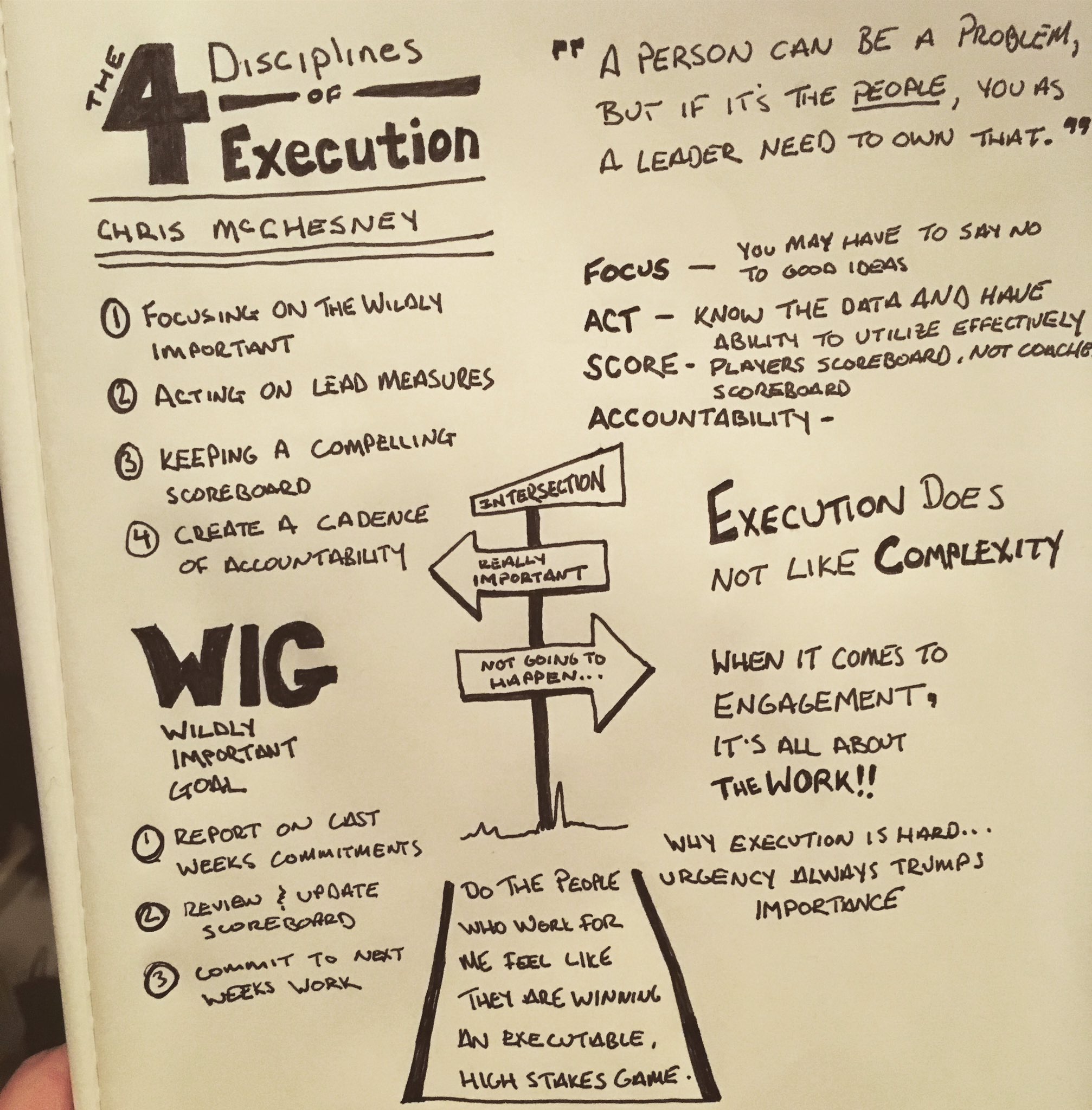
McChesney - execution disciplinesChris McChesney—Franklin Covey

Rahm Charan asked:

  • Q: Do leaders struggle more with strategy or execution? A: Execution.
  • Q: Are leaders more educated in strategy or execution? A. Strategy.

“The hardest thing a leader will ever do is drive a strategy that changes someone’s behavior.”

There are four disciplines for making changes in human behavior:

1.  Focus

  • “Focus on the wildly important.”
  • If a team focuses on 2-3 goals, they are likely to get them done. But if there are 4-10 goals, momentum is killed. At 11+ goals, the team is going backward.
  • We narrow the focus by coming up with a WIG: wildly important goal (this lives at the intersection of ‘really important’ and ‘not going to happen’).

2.  Leverage

  • “What are the fewest number of battles necessary to win the war?”
  • “When you want to go big, don’t think big, think narrow.”
  • One WIG per team at the same time. Everything else is in sustainment mode.
  • Make goals like this—“From x to y by when.”

3.  Engagement

  • “The biggest driver of engagement is when people feel like they’re winning.”
  • “Do the people who work for me feel like they’re playing a winnable game?”

4.  Accountability

  • Everyone needs to answer: “What are the things I do that have the biggest impact on the WIG?”
  • After sharing the scoreboard, allow people to determine what they need to do next. The people need to determine their own next moves, not the leader. The leader pulls this out of people.
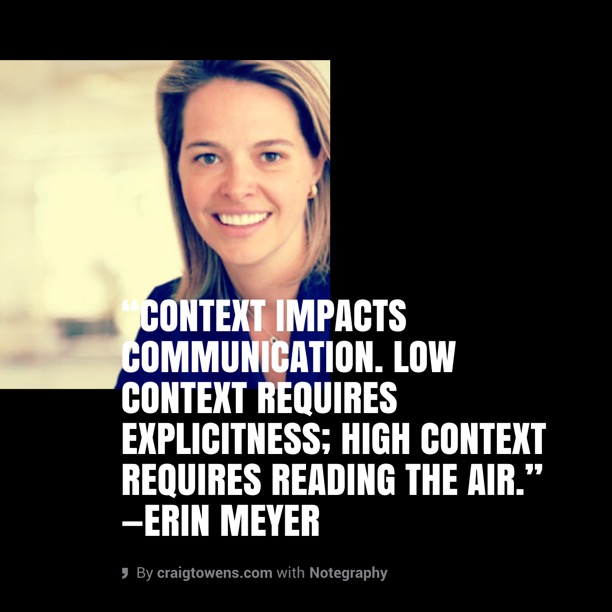
Erin Meyer - contextErin Meyer—INSEAD

On The Culture Map communication is divided into Low vs. High Context:

  • Low = feel we don’t have the same context or relationship. We feel we need to explain things very simply and explicitly.
  • High = we assume we have a larger body of shared reference points. We feel communication is more implicit or nuanced.

Anglo-Saxon countries are typically low context.

Latin American are mid-low.

Asian countries are usually high context.

In low context we tend to nail things down in writing, where in high context we leave things more open to later interpretation.

“Context impacts communication. … We need to read both the messages ‘in the air’ as well as the explicitly stately messages.”

“In a high context culture, repeat things less, ask more questions, learn to ‘read the air.’”
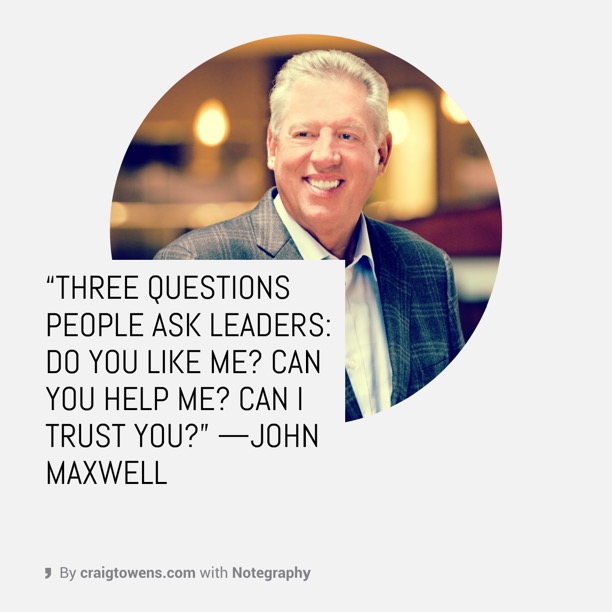
 

Maxwell - 3 questionsJohn Maxwell—Author 

“Good leaders lift.”

“You have to find the people before you lead the people.”

“The one thing leaders have to get right—they must intentionally add value to people every day.”


Five things that intentionally adds value to people:

  1. Value people—“God values people I don’t know; He even value people I don’t like.” “Are we going to spend our lives connecting with people, or correcting them?”
  2. Think of ways to add value to people—“Intentional living is thinking upfront on how to help people.”
  3. Look for ways to add value to people.
  4. Do things that add value to people.
  5. Encourage others to add value to people.

If you attended the GLS, please share in the comments below something amazing / challenging / paradigm-busting that you learned. Let’s all keep on learning!
Thursdays With Oswald—Working Out God’s Will

Oswald ChambersThis is a weekly series with things I’m reading and pondering from Oswald Chambers. You can read the original seed thought here, or type “Thursdays With Oswald” in the search box to read more entries.

Working Out God’s Will

     We do not enter into the life of God by imitation, or by vows, or by ceremonies, or by Church membership; we enter into it by its entering into us at Regeneration. The Cross of Jesus Christ is the gateway into His life. … 

     The world is that system of things which organizes its life without any thought of Jesus Christ. … 

     Nothing blinds in the mind to the claims of Jesus Christ more effectually than a good, clean-living, upright life based on self-realization. For a thing to be satanic does not mean that it is abominable and immoral. The satanically managed man is moral, upright, proud, and individual; he is absolutely self-governed and has no need of God. … 

     When by the Cross of Christ we have entered into the experience of identification with our Lord, then there comes the practical working out of Matthew 11:29, “Take My yoke upon you, and learn of Me; for I am meek and lowly in heart.” … 

     God will bring across our path people who embody the characteristics that we have shown to Him—stubbornness, pride, conceit, opinionatedness, sensuality, a hundred little meannesses. “Now,” He says, “love them as I have loved you.” 

From The Psychology Of Redemption

So God’s will is not something we learn by going to church, or imitating someone we think to be a godly person. God’s will is living like Jesus:

  • Totally abandoned to God’s will
  • Staying linked to Jesus
  • Loving the people that God brings across our path like God loves us

How are you doing?

The Rewards For Getting Along With Difficult People

How To Get Along With OthersHere’s a shocking statement—Difficult people are difficult to get along with. I know, I probably just blew your mind with that one, but sometimes it’s important to state the obvious.

Christians should be the best at getting along with others. First of all, because they have the Holy Spirit to help them, and, second, because the world is watching to see if having a relationship with Jesus really does make a difference.

We’ve already learned that in order to change our behavior toward difficult people, we can’t change our behavior (check out my post on that topic here). Instead, we need to change our thoughts first. One thought to change is about ourselves, and another thought to change is the fact that Jesus promised rewards for those who loved difficult people—

If you love those who love you, what credit is that to you? Even sinners love those who love them. And if you do good to those who are good to you, what credit is that to you? Even sinners do that. And if you lend to those from whom you expect repayment, what credit is that to you? Even sinners lend to sinners, expecting to be repaid in full. But love your enemies, do good to them, and lend to them without expecting to get anything back. Then your reward will be great, and you will be children of the Most High, because he is kind to the ungrateful and wicked. (Luke 6:32-35)

One way to love others is by learning to “speak their language.” Most of us communicate with four different accents: Doer, People, Planner, Vision.

You can watch the video where I explain these styles in more detail, but you can learn their accent by listening for…

(1) How they handle stressful situations:

  • Doer—get hyper-focused
  • Planner—withdraw to plan
  • People—call a meeting
  • Vision—take time to daydream

(2) How they listen to others:

  • Doer—take short bullet points and then quick action
  • Planner—take detailed notes, and ask lots of detailed questions
  • People—make good eye contact, take very little notes, and then reiterate what was said
  • Vision—doodle, and express “ping pong ball” thoughts

(3) How they speak about folks with other “accents”:

  • Doer—this is taking too long; nothing ever gets done; they’re daydreamers
  • Planner—they jump the gun; they’re swayed by emotions; they’re unpredictable
  • People—why don’t they want to meet; they’re too aggressive; they’re too robotic
  • Vision—they don’t see the big picture; they’re too rigid; they’re too emotional

You CAN get along better with everyone. Romans 12:18 tells us that peaceful living with others depends on you and me. Let’s do this well so that Jesus is glorified!

Don’t Try To Change Your Bad Behavior

Thoughts to beahviorsAs I wrote previously, I believe Christians should be the best at getting along with others. First of all, Christians have been empowered by the Holy Spirit with the skills necessary to live at peace with everyone, IF we will only allow the Spirit to do the necessary work in us. And second, the way Christians treat others goes a long way toward either attracting or repelling others from a relationship with Jesus.

But here’s an important thing: If you don’t get along well with others now, don’t try to change your behavior!

Stephen Covey wrote, “To try to change outward behaviors does very little good in the long run if I fail to examine the basic paradigms from which those attitudes and behaviors flow.”

You see, behavior is the fruit. If we want to change the fruit, we need to back up a few steps.

The Apostle Paul used the life of Jesus as an example for Christians on how we can get along with others. But notice this: most of what Paul discusses is the “inside stuff.”

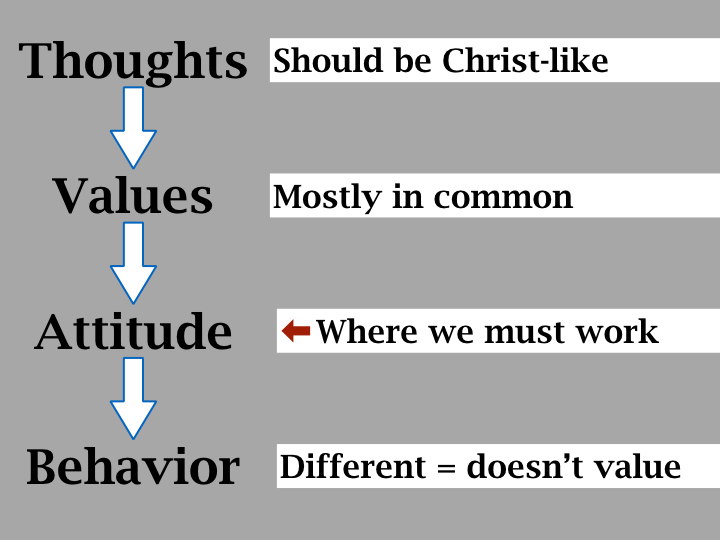
The progression goes like this (see Philippians 2:1-13)—

Thoughts → Values → Attitudes → Behaviors

(1) Thoughts—These need to be humble thoughts about God’s love toward us (v. 1).

(2) Values—Paul tells us to be “one in spirit and purpose” with others (v. 2). The definition of the Greek words here mean valuing the well-being of everyone. Paul then explains how our humility can lead to these win-win relationships (vv. 3, 4).

(3) Attitudes—“Your attitude should be the same as Christ Jesus” (v. 5). Jesus showed us what it was to have an attitude related toward obedience to God’s will.

(4) Behavior—If our thoughts, values and attitudes are rightly aligned to God, then our behavior will naturally be Christ-like as well. We see the example of Jesus in verses 6-8, and God’s reward for that behavior in verses 9-11. Then Paul calls on Christians to follow that pattern in our own lives (vv. 12, 13).

Most decent, reasonably-thinking human beings share the same values. Harry Truman said, “When we understand the other fellow’s viewpoint—understand what he is trying to do—nine times out of ten he is trying to do right.”

The problem is this: When the other person behaves differently from me, my natural tendency is to assume he doesn’t value what I value. In other words, I’m judging his value system on the way I normally behave.

The break-down is in my attitude. That’s the area I need to address. That’s the attribute of Jesus that Paul told us to copy.

So if I want to get along better with others, I shouldn’t try to change my behavior, but my attitude. My prayer should be: “I want this same attitude to be in me which was also in Christ Jesus. He served God and others, so I too want to follow His example of obedience, and I want to demonstrate my appreciation for all that Jesus has done for me by working hard to better get along with others. Help me change my attitude!”

Check out this video of the full message…

I hope you can join us next Sunday as we continue learning how to get along with others. Please join us in person or on Periscope.

Thursdays With Oswald—Work Out What God Has Worked In

Oswald ChambersThis is a weekly series with things I’m reading and pondering from Oswald Chambers. You can read the original seed thought here, or type “Thursdays With Oswald” in the search box to read more entries.

Work Out What God Has Worked In

     If we have experienced regeneration, we must not only talk about the experience, we must exercise it and work out what God has worked in (Philippians 2:12-13). We have to show it in our finger-tips, in our tongue, and in our bodily contact with other people, and as we obey God we find we have a wealth of power on the inside. … 

     The practicing is ours, not God’s. God regenerates us and puts us in contact with all His divine resources, but He cannot make us walk according to His will. If we will obey the Spirit of God and practice through our physical life all that God has put in our hearts by His Spirit, then when the crisis comes we shall find that we have not only God’s grace to stand by us but our own nature also, and the crisis is passed without any disaster, but exactly the opposite happens, the soul is build up into a stronger attitude towards God.

From The Psychology Of Redemption

God doesn’t make us a new person, but He gives us the power to become a new person. The key is our obedience to what the Holy Spirit reveals to us from the Bible. Will we obey what He shows us? If we do, we can expect “a wealth of power on the inside.” If we don’t, people will probably call us hypocrites.

Will you obey? Will you work out what God has worked in?


You Are An Empowered Peacemaker

My new attitude“The whole world—with one minor exception—is made up of others,” says John Maxwell. The ‘one minor exception’ is that person who’s looking back at you from the mirror every morning, so if you want to be successful in life, you better learn to get along with ‘the others.’

I believe this is especially important for those who call themselves Christians. Here are three reasons why—

  1. Our interaction with other Christians is a testimony to outsiders—John 13:34-35.
  2. Our positive interaction with outsiders can draw others to Christ—Colossians 4:5.
  3. Our negative interaction with outsiders can repel others from Christ—1 Peter 2:12.

So although it can be very (sometimes very, very!) challenging, we are called to find ways to get along with others. The Apostle Paul said:

Be careful to do what is right in the eyes of everybody. If it is possible, as far as it depends on you, live at peace with everyone (Romans 12:17-18, emphasis added).

When you see the phrase “if it is possible” you may think that Paul has given us an “out.” We could say, “I tried really hard to get along with that guy, but it just hasn’t worked, so I’m off the hook!”

But consider how another translation of the Bible states this phrase: Do all that you can to live in peace with everyone.

Jesus was asked to do something that had never been done before: heal two men born blind. Jesus asked these men, “Do you believe I am able to do this?” (Matthew 9:28). The men answered an emphatic, “Yes!” On another occasion a father asked Jesus to heal his son by saying, “If You can, please help us.” Jesus said, “‘If I can? All things are possible to those who believe.” The father immediately replied, “I do believe; please help my unbelief” (Mark 9:22-24).

If you are Christian, the Spirit of Jesus lives in you. So the question Jesus asks us about our difficult relationships is, “Do you believe I am able to help you?” Or perhaps more accurately He asks us, “Will you let Me help you?”

So the part of the verse which says, “if it is possible, as far at it depends on you” is really saying, “If you really believe Jesus is stronger than this strained relationship, will you let Him do something in you to bring about peace?”

We aren’t asking Jesus to change the other person; we’re asking Him to change us. We aren’t asking someone else to get on our page, or to see the world from our perspective; we’re asking the Holy Spirit to help us get on their page, to help us see the world they way they see it.

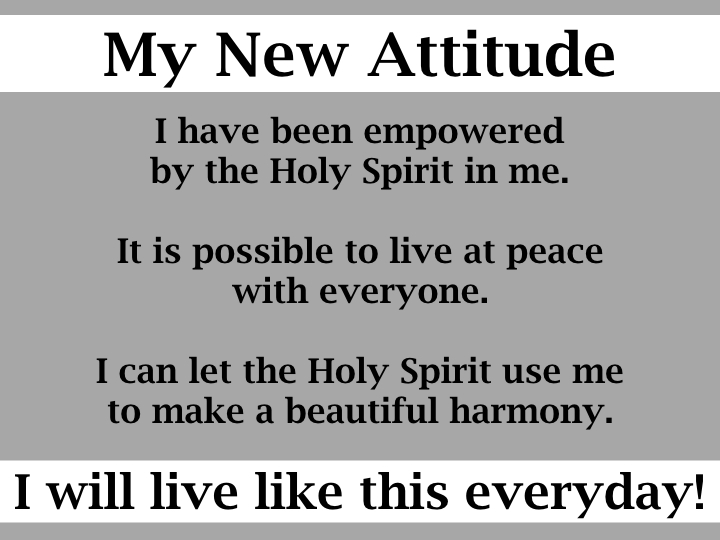
We need to have a new attitude. And I believe that attitude comes from a prayer like this—

I have been empowered by the Spirit of Christ in me. 
It is now possible for me to live at peace with everyone. 
I can let the Holy Spirit use to me make a beautiful harmony. 
I will keep on living like this every day.

Next Sunday we will be looking at some practical techniques and more biblical insights to help us excel in getting along with all ‘the others’ that make up the world. Please join us in person or on Periscope.

Thursdays With Oswald—The Long Trail

Oswald ChambersThis is a weekly series with things I’m reading and pondering from Oswald Chambers. You can read the original seed thought here, or type “Thursdays With Oswald” in the search box to read more entries.

The Long Trail

     When we are busy with our own outlook on life, it seems as if God were indifferent. Our human patience, as well as our impatience, gets to the point of saying—‘Why does not God do things?’ Redemption is complete; we believe that Our Lord has all power in heaven and on earth, then why is it such a long while before things happen? Why is God so long in making actual His answers to our prayers? When in such a state of mind we are capable of becoming bitter against God unless we are led into the inner secret of Our Lord’s own attitude. …

     Each of the temptations presented to Our Lord by satan had this as its center: ‘You will get the Kingship of men and the Saviorhood of the world if you will take a “shortcut”—put man’s needs first, and he will crown You King; do something extraordinarily wonderful, indicative of Your power, and man will crown You King; compromise with evil, and You will get the Kingship of men.’ Jesus could have brought the whole thing about suddenly (cf. John 6:15); but He did not. He withstood satan and took the stupendously long way. … 

     It takes a long time to realize what Jesus is after, and the person you need most patience with is yourself. God takes deliberate time with us, He does not hurry, because we can only appreciate His point of view by a long discipline.

From The Place Of Help

Do you trust that God knows what He’s doing? He has something great in mind for your life, something that will bring Him glory. That is the reason He created you (see Ephesians 2:10).

Hang in there … something good will come of this long trail (see Romans 5:3-5).

New Year, New Attitude

Listen to the podcast of this post by clicking on the player below, and you can also subscribe on Apple, Spotify, or Audible.

If you’re looking to challenge yourself to be a better person in the New Year, you couldn’t go wrong with this list—

  1. Hate what is evil
  2. Cling to what is good
  3. Love others with real compassion
  4. Honor others above yourselves
  5. Work hard
  6. Keep growing spiritually
  7. Find new ways to serve the Lord
  8. Be joyful in hope
  9. Be patient in hard times
  10. Be faithful in prayer
  11. Share with others who are in need
  12. Practice hospitality
  13. Bless those who persecute you
  14. Laugh with your friends when they’re happy
  15. Cry with your friends when they’re sad
  16. Live in harmony with everyone
  17. Make friends with those others call “nobodies”
  18. Don’t try to be somebody you’re not
  19. Don’t respond to insults with insults, but with love
  20. Try to do what is right in the eyes of everyone
  21. Live at peace with everyone
  22. Don’t take revenge, but let God handle it
  23. Don’t let evil get the best of you, but get the best of evil by doing good

(Hat tip to the apostle Paul for this list taken from Romans 12:9-21)

►► Would you please prayerfully consider supporting this ministry? ◀︎◀︎

Links & Quotes

link quote

“It’s easy to label what we consider ‘good things’ in our lives as gifts from God and to welcome them with gratitude. But when difficult things happen, we don’t look at them as part of God’s good plan for us. Mary’s example [Luke 1:38] shows us we can also welcome those things we would not necessarily label ‘good,’ confident that God’s gifts sometimes come in perplexing and even painful packages. When we belong to God, we know He will use whatever He allows into our lives for good. Somehow, in God’s hands, these things also become gifts of His grace toward us.” —Nancy Guthrie

“Unless we intend completely to forfeit our holy seasons, and to allow them to be taken captive for the purposes of crass commercialism and narrow-minded narcissism, we need to make the best use of these times as God intends….” —T.M. Moore

“No one who is lost has lost one ounce of value to God. Even if you don’t have a relationship with Him, you have immense value to God. Lostness implies value. Whatever someone is willing to spend to recover something that’s lost shows how valuable that item is. In the most famous verse in the Bible, Jesus clearly explains our value: ‘God loved the world so much that He gave His one and only Son so that whoever believes in Him may not be lost, but have eternal life’ (John 3:16).” —Rick Warren

If you have trouble knowing whether to use their, there, or they’re, this may help.

“By giving to You what You do not need, and what I might enjoy, I am saying more earnestly and more authentically, ‘You are my treasure, not these things.’” —John Piper on fasting

I was going through an Advent reading plan on YouVersion, and I came across this quote: “Each Christmas is practice for the moment of Christ’s second coming, when every knee will bend, either in worship or terror.”

In this video, Brett Kunkle explains from Scripture and from personal observation how we know humans are born into sin.

“Many Christians today…choose to listen only to soft, flesh-assuring preaching. Where there is no convicting word, there can be no godly sorrow over sin. Where there is no godly sorrow for sin, there can be no repentance. And where there is no repentance, there is only hardness of heart.” —David Wilkerson

“We are tempted in our day to be ashamed of the gospel. It is thought to be bare, unintellectual, almost childish by many. Hence, they would overlay it with argument and eloquence, to make it more respectable and more attractive. Every such attempt to add to it is being ashamed of it [Romans 1:16].” —Horatius Bonar

Check out some absolutely stunning pictures from the Hubble Space Telescope!

Links & Quotes

link quote

“A man may be perfected through suffering or be made worse through suffering, it depends on his disposition.” —Oswald Chambers

“The only option for French atheists (among whose ranks I used to count myself), is to maintain that there isn’t really any such thing as evil. When one denies the existence of God as a transcendent Creator of the universe who ordains how humans ought to live their lives, one is left only with conflicting opinions about what individuals like and dislike. If there is no God then there is no objective truth about the good and the bad…. [I]n reality, to be a consistent atheist one must affirm that the Islamic terrorists in Paris didn’t do anything ‘wrong’, as such. They only acted out of line with our personal preferences, (and in line with theirs). If there’s no ultimate arbiter of right and wrong, that’s all we are left with.” —Guillaume Bignon, a former atheist, after the ISIS attacks in Paris. Read more here.

Josh McDowell answers the question: “If my friends and I have a disagreement, what’s the right way to handle it?”

Planned Parenthood asked people on Twitter to give them one word that describes what they do. I’m not sure they liked many of the (true) responses they received. What one word would you use? I would say: evil.