This is a weekly series with things I’m reading and pondering from Oswald Chambers. You can read the original seed thought here, or type “Thursdays With Oswald” in the search box to read more entries.
Passion For Souls
You hear people say that Paul showed his wonderful breath of mind, his culture and generosity, his gentleness and patience, by becoming all things to all men [1 Corinthians 9:22]. He did nothing of the sort; he said, “I am become all things to all men” for one purpose only—“that I may by all means save some.” He did not say, “I became all things to all men that I might show what a wonderful being I am.” There is no thought of himself in the whole matter.
The phrase “a passion for souls” is a dangerous one; a passion for souls may be either a diseased lust or a Divine life. Let me give you a specimen of it as a diseased lust—“Woe to you, teachers of the law and Pharisees, you hypocrites! You travel over land and sea to win a single convert, and when he becomes one, you make him twice as much a son of hell as you are” (Matthew 23:15). …
But have we got clearly in our minds what the passion for souls as a Divine life is? Read James 5:19-20: “My brothers, if one of you should wander from the truth and someone should bring him back, remember this: Whoever turns a sinner from the error of his way will save him from death and cover over a multitude of sins.” …
God grant we may understand that the passion for souls is not a placid, scientifically worked-out thing, it compresses all the energy of heart and brain and body in one consuming drive, day and night from the beginning of life to the end—a consuming, fiery, living passion. …
God grant we may understand that the mainspring of our passion for souls must be a personal, passionate devotion to the Lord Jesus Christ.
From Workmen Of God
The root of our passion really does make a difference in our Christian activity. Is my passion to make converts so that people can say, “Look what a good guy he is”? Or is my passion to save a soul from death so that people can say, “Look what a great God He is”?
Fellow Christian, I pray our passion is always the latter.
This is a weekly series with things I’m reading and pondering from Oswald Chambers. You can read the original seed thought here, or type “Thursdays With Oswald” in the search box to read more entries.
The Powerful Witness Of Your Life
Jesus Christ came to do what no human being can do, He came to redeem man, to alter their disposition, to plant in them the Holy Spirit, to make them new creatures. Christianity is not the obliteration of the old, but the transfiguration of the old. Jesus Christ did not come to teach men to be holy: He came to make men holy. His teaching has no meaning for us unless we enter into His life by means of His death. The Cross is the great central point. Jesus Christ is not first a Teacher, He is first a Savior. …
To preach the Gospel is to proclaim that God saves from sin and regenerates into His Kingdom anyone and everyone who believes on the Lord Jesus. It means even more—it means to disciple all the nations not only on the authority of Jesus, but on the flesh and blood evidence of entire sanctification in the life of the missionary.
From So Send I You
The Apostle Paul noted, “Then it pleased God to reveal His Son to me so that I would proclaim the Good News about Jesus to the Gentiles” (Galatians 1:15-16).
This is the exact same message Oswald Chambers has for Christians—If you have allowed Jesus to transform your life, that witness of Him in you is an undeniably powerful testimony! Yes, we need to preach what we believe, but this preaching needs to be backed up and amplified by living what we believe.
Christian, can you honestly say that your life is giving clear “flesh and blood evidence of entire sanctification”?
Give to Caesar what belongs to Caesar, and give to God what belongs to God (Matthew 22:21).
The Bible has much to say to God-followers about how to interact with earthly governments:
Wise King Solomon told us to “fear the Lord and the king” and not go along with rebels against the government (Proverbs 24:21)
Daniel said several times that “the Most High is sovereign over all kingdoms on earth and gives them to anyone He wishes” (Daniel 4 & 5)
The Apostle Paul declared he was no rebel to either the civil or religious governors: “I have done nothing wrong against the Jewish law or against the temple or against Caesar” (Acts 25:8)
Later on, Paul reminded the church that government officials are God’s servants, and that we need to give them the respect that is owed to them (see Romans 13:1-7)
Peter counseled Christians: “Submit yourselves for the Lord’s sake to every human authority: whether to the emperor, as the supreme authority, or to governors … Show proper respect to everyone, love the family of believers, fear God, honor the emperor” (1 Peter 2:13-17)
But a man that exemplifies this balance between fearing God and honoring the king best is Mordecai. Mordecai was a Jew who served the Babylonian king faithfully—
He protected the king from would-be assassins
But disobeyed the king when the law of the land conflicted with God’s law
Then Mordecai helped the king get out of a bad law written by an evil man
A mark of a godly leader is one who knows the difference between fearing God and honoring earthly kings.
How can today’s leaders live out this principle? This is something that should lead us to prayerfully search the Scriptures, and then boldly live out what the Holy Spirit reveals to us.
This is Part 13 in my series on godly leadership. You can check out all of my posts by clicking here.
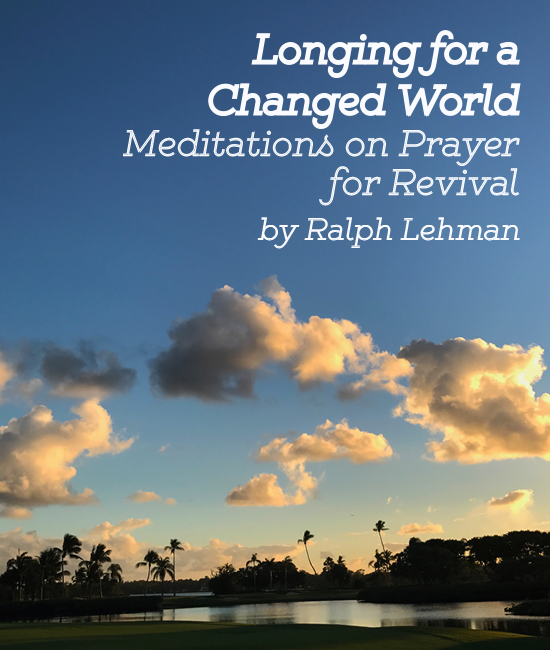
Longing For A Changed World will help you (re)establish a prayer focus that could be the beginning of the next great revival! You can check out my full book review here, and then enjoy some of the quotes that especially caught my attention.
“Our age, severed from its Biblical moorings, is neglecting history’s lessons.”
“Another characteristic of today’s Church is a lack of prayer. Instead of communing and listening to God, lifting our needs and concerns to the Lord, we rely on our own abilities and in technology to compensate for any inadequacy we may have. Thus armed, we are confident in taking on the challenges of our day, even those spiritual in nature.”
“True revival impacts all aspects of life, even to the concerns of the last, the least, and the lost. A people who uphold justice and righteousness and seeks to alleviate the plight of the poor and needy, are a people truly gripped with revival. For when we are consumed with God’s holiness and how blessed we are by His grace, we are compelled to take this Gospel to all aspects of our culture.”
“Our propensity is to focus on being doers—to be on the battlefield, sword in hand, fighting for the Kingdom and for righteousness. But as in the battle with the Amalekites, battles are won by God’s people lifting up their arms to the Lord.”
“I have been more focused on what I wanted to say in my prayer than on Whom I am approaching in prayer. This often leads to prayer that amounts to a tallying-up of my wants, without proper regard for the One into Whose presence I have come.”
“Our prayers as a whole, and prayers for revival, should reflect our poverty and powerlessness before a God who is forgiving and gracious.”
“Pray for boldness in the church—boldness to proclaim God’s Word and to firmly stand on it. Pray for boldness to confront sin yet boldness accompanied with humility as the church is aware (painfully aware) of its own sinfulness. And pray for boldness to present Christ as the Way and the Truth.”
“Praying expectantly requires us to pray to God in line with His Word and His promises. Thus a decline in biblical literacy has resulted in our prayer life wavering as well.”
“Our pleas for revival will go unheeded until we stand up for God’s Word, forsake the idols of our age, shake off the trappings of our secular and materialistic age, and embrace God’s truth.”
“As we pray for revival—for changed lives, renewed churches, and a transformed culture—our tendency might be to enlist the charismatic, the eloquent, and those who project confidence and success, traits that so readily appeal to us. But God’s manner of bringing revival has often been through ordinary people who endure affliction, hardship, and suffering, much as he did with Paul and Timothy and the Apostles.”
I’ll be sharing more resourced and thoughts from this book soon, so stay tuned!
There was a story circulating that a physicist once claimed that the bumblebee was defying the laws of physics and aerodynamics in its flight. Apparently, he calculated that the ratio of the bumblebee’s wing size in comparison to his body size just didn’t make the math work.
But entomologists and physicists quickly jumped in to say, “Hey, look, the bumblebee is flying, so clearly it works!” And then they went to work to try to explain it. They figured out that the bumblebee flaps its wings more back-and-forth than up-and-down, creating tiny hurricanes the propel them through the air. But then that created a whole new set of problems, like how does the bumblebee control a hurricane so precisely as it turns, stops, dives, and climbs. So then they had to create a new explanation, which they named dynamic stall.
All the while, the bumblebee is flapping its too-small wings 230 times per second(!), and going about its daily activities without being able to explain tiny hurricanes, the laws of physics or aerodynamics, or even knowing what dynamic stall is. It simply flies!
The ultimate argument for anything is doing something that critics say is impossible.
Peter tells Christians to be prepared to answer anyone for the reason for the hope that they have (1 Peter 3:15-16). The Greek word for “give an answer” is apologia, from which we get our word apologetic. Here are three apologetics for Christians to use for the hope that they have.
It really comes down to this: My hope is based on the resurrection from the dead of Jesus Christ, which I believe because of the Bible AND because of the change in my life.
The Bible’s authenticity
“No other work in all literature has been so carefully and accurately copied as the Old Testament. The particular discipline and art of the Jewish scribes came out of a class of Jewish scholars between the fifth and third centuries BC. They were called the Sopherim, from a Hebrew word meaning ‘scribes.’ The sopherim, who initiated a stringent standard of meticulous discipline, were subsequently eclipsed by the Talmudic scribes, who guarded, interpreted, and commented on the sacred texts from AD 100 to AD 500. In turn, the Talmudic scribes were followed by the better-known and even more meticulous Masoretic scribes (AD 500-900).” —Josh McDowell, God-Breathed
“No other ancient text is substantiated by such a wealth of ancient textual witnesses as is the New Testament. Roughly 5,500 separate manuscripts are available, variously containing anything from the entire New Testament corpus to a slight fragment of a single verse. … This textual support is far superior to that available for any other ancient documents, such as the classical texts from Greek and Roman writers (e.g., Plato, Aristotle, and Cicero). Only partial manuscripts have survived for many works of antiquity, and it is not unusual to find that the only complete manuscript for some ancient writing is a copy dating from 1,000 years after its composition.” —Archaeological Study Bible, “The New Testaments Texts” (page 1859)
“The biblical Dead Sea Scrolls are up to 1,250 years older than the traditional Hebrew Bible, the Masoretic text. We have been using a one-thousand-year-old manuscript to make our Bibles. We’ve now got scrolls going back to 250 BC. … Our conclusion is simply this—the scrolls confirm the accuracy of the biblical text by 99 percent.” —Dr. Peter Flint
I have shared other apologetic evidence for the authenticity of Scripture here and here.
Christ’s resurrection
In1 Corinthians 15:1-8 Paul lists all of the eyewitnesses to Christ’s resurrection, giving critics ample opportunity to challenge these witnesses in person. If these witnesses would have been perpetrating a hoax, skeptics of their day would have been able to uncover the inconsistencies in their story. If the account of Christ’s resurrection was made-up, it’s doubtful the early Christian martyrs would have “stuck to their story” as they were being tortured, but none recanted.
Josh McDowell notes, “By AD 100, the apostles had died, but the Christian Church was still in its infancy, with fewer than twenty-five thousand proclaimed followers of Christ. But within the next two hundred years, the fledgling church experienced explosive multiplication of growth, to include as many as twenty million people. This means the church of Jesus Christ quadrupled every generation for five consecutive generations!”
My personal experience
“I am a changed person. I am not who I was before I met Jesus” and “My life tends to go better when I live by biblical principles” are both excellent apologetics!
Let others argue that God doesn’t exist, or that you shouldn’t have hope, and then you—like the bumblebee—just keep flying with Jesus! (see 2 Timothy 3:14)
God’s plan has always been for His leaders to organize and oversee His ministry.
The important thing for us to distinguish is “His.” It’s not a man or woman saying, “I will be a leader,” or even a God-appointed leader saying, “I am going to build up my ministry.”
The New Testament gives us a fourfold purpose for the Body of Christ:
Mobilizing for evangelism
Organizing for more meaningful ministry
Making disciple-makers
Caring for one another
We see God’s leaders involved in all of these aspects—
Mobilizing for evangelism—Peter pointed out the need for an apostle to be appointed to replace Judas, thus returning their ranks to the 12 apostles just as Jesus had originally said (Acts 1:15-22).
Organizing for more meaningful ministry—Everywhere Paul founded a church, he also appointed leaders to oversee and shepherd that church.
Making disciple-makers—Paul tells us that God appointed five offices of leaders in the church who had the specific task of preparing church members to do the ministry of building maturity in the church (Ephesians 4:11-16).
Caring for one another—The First Church set the pace for providing care for all who were in need, including organizing leaders to oversee specific care ministries (Acts 6:1-5).
What about a church congregation’s responsibility to their leaders? I see five areas:
Hold them accountable to the Word (Acts 17:11). The Bible has to be THE standard to which leaders are held.
Give them your confidence and submission after they have shown accountability to their biblical mandate (Hebrews 13:17).
Listen to the podcast of this post by clicking on the player below, and you can also subscribe on Apple, Spotify, or Audible.
Before ascending back to Heaven, Jesus commissioned His followers. He gave them a mission that Christians often refer to as The Great Commission.
Jesus said, “All authority in heaven and on earth has been given to Me. Therefore go and make disciples of all nations, baptizing them in the name of the Father and of the Son and of the Holy Spirit, and teaching them to obey everything I have commanded you. And surely I am with you always to the very end of the age.”
There are several pictures in the New Testament of how the Church could live out this Great Commission, but one of the pictures that I find the most helpful is that of a Body.
The human body is an amazing creation! Just to accomplish the simple task of picking up something between our thumb and forefinger is a miracle in itself. The structure of bones and ligaments and tendons, the interaction of nerves in the fingers coordinating with the optical nerve, not to mention the enzymes and blood vessels that are all doing their part.
Yet if any part is not functioning properly, that simple action becomes more difficult. Maybe it even becomes impossible.
The Church is the same way. Every part of the Church Body has to be functioning in healthy order for the whole Body to be effective.
Here are four aspects of a healthy Church Body that the Apostle Paul lists in Ephesians 4:
Caring for one another
Mobilizing for evangelism
Making disciple-makers
Helping organize for more meaningful ministry
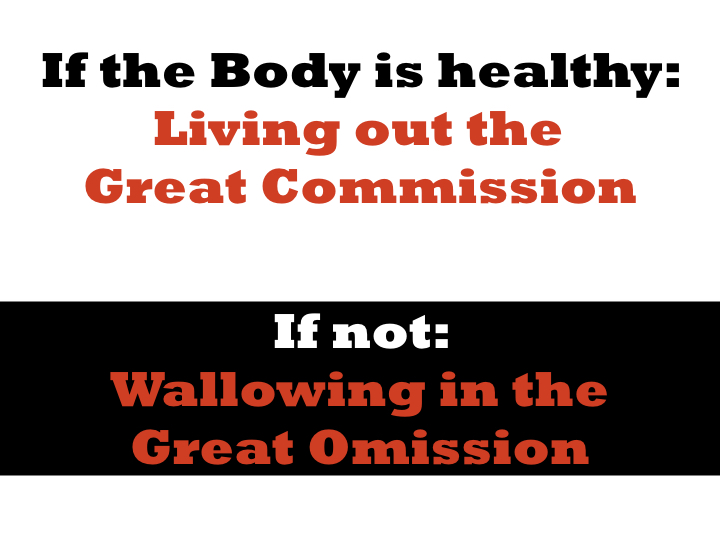
If every part of the Body is doing its part, we’re Living out the Great Commission.
If some parts are missing or unhealthy, we’re Wallowing in the Great Omission.
It’s not about your church (small “c”) or my church. It’s about all Christian disciples being a part of one Church—one Body—going into all the world and making disciples of all peoples. That’s what the Church is supposed to be doing!
This is a weekly series with things I’m reading and pondering from Oswald Chambers. You can read the original seed thought here, or type “Thursdays With Oswald” in the search box to read more entries.
Spiritual Honor
“I am a debtor to Greeks and to Barbarians” (Romans 1:14). Do I feel this sense of indebtedness to Christ Paul felt with regard to every unsaved soul I meet, every unsaved nation? Is it a point of spiritual honor with me that I do not hoard blessings for myself? The point of spiritual honor in my life as a saint is the realization that I am a debtor to every man on the face of the earth because of the Redemption of the Lord Jesus Christ.” …
Am I doing anything to enable Jesus Christ to bring His Redemption into actual manifestation in other lives? I can do it only if the Holy Spirit has wrought in me this sense of spiritual honor. When I realize what Jesus Christ has done for me, then I am a debtor to every human being until they know Him too.” …
Is it my conviction among men that every man can be presented “perfect in Christ Jesus”? Or do I allow men’s sins and wrongs so to obliterate the power of the Redemption that I sink under them?
From So Send I You
Some powerful questions for every Christian to honestly answer:
Does my salvation mean enough to me that I am burning with passion for others to know this salvation too?
Am I hoarding God’s blessings, or am I passing them on?
What am I doing to make sure everyone knows about Jesus?
Do I write some people off as “unsavable,” or do I believe Jesus can reach every single person?
This is a weekly series with things I’m reading and pondering from Oswald Chambers. You can read the original seed thought here, or type “Thursdays With Oswald” in the search box to read more entries.
God Has A Plan For Your Life
“Before I formed thee…I knew thee…” [Jeremiah 1:5]. There are prenatal forces of God at work in a man’s life which he may be unconscious of for long enough; but at any moment there may break upon him the sudden consciousness of this incalculable, supernatural surprising power that has got hold of his life before he has got hold of it himself.
Another force at work is the prayers of other people. You are born into this world and will probably never know to whose prayers your life is the answer. … Our lives are the answers not only to the prayers of other people, but to the prayer the Holy Spirit is making for us, and to the prayer of Our Lord Himself. …
When once Paul realized God’s call and knew the meaning of his life, there was no competitor for his strength. Is there anything competing for our strength in our devotion to the call of God?
From So Send I You
Isn’t it amazing to think that not only has God had a plan for your life before you even arrived on earth, but that your life is an answer to prayer?!
The Apostle Paul lived the first part of his life oblivious to God’s call. But once he had his encounter with Jesus, his whole focus and passion changed (see Acts 9:15-16; Galatians 1:15-16).
What about you?
Have you realized that God has a plan for your life?
Are you living like you are an answer to prayer?
Is there anything competing for your attention that is keeping you from being “all in” for God?
Our annual Q Series is where folks send their questions to me on a variety of subjects and we do our best to answer them. This week many of the questions were about the Bible. Questions like:
What books should be included in the Bible?
What about Bible translations?
Is it okay for the Bible to have pictures in it?
Here’s what we discussed, along with the time this discussion appears on the video:
How was it decided what books would be included in the New Testament? [5:38] **Be sure to check out this post: How We Got The Bible on Biblegateway.
J. Warner Wallace’s list of criteria for New Testament books [9:45]
Did contemporary sources support or refute the New Testament authors? [11:45]
How did the final 27 books of the New Testament make the list? [15:02]
How was it decided what books would be included in the Old Testament? [18:22]
How do we know the Scriptures were accurately transcribed? [22:50] **Be sure to check out this post: Why Trust The Bible? on Biblegateway.
The history surrounding the complete Latin Bible and the Dead Sea Scrolls [23:45]
What are Bible translations and paraphrases (with references to the Wycliffe Bible and the discovery of the Rosetta Stone)? [25:45]
Some cautions about Bible paraphrases [33:23]
Is it okay for a Bible to have pictures in it? [35:16]
Are icons of the Cross acceptable or a blasphemy? [37:42]
How can someone better understand the Bible when they read it for themselves? [41:32]
Why ask questions? [48:39]
We’ll be discussing more questions this upcoming Sunday, so be sure to send them my way. For all of the ways you can send questions, please click here.



 This is a weekly series with things I’m reading and pondering from Oswald Chambers. You can read the original seed thought here, or type “Thursdays With Oswald” in the search box to read more entries.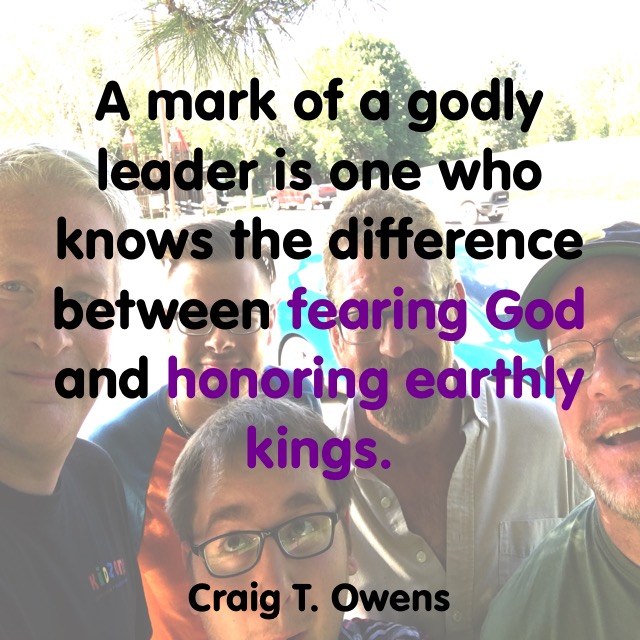





 Craig T. Owens