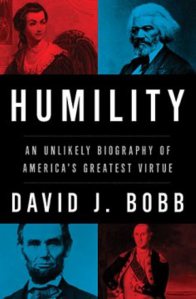
10 Quotes On Humility From “Humility”

HumilityI thoroughly enjoyed Dr. David Bobb’s book Humility (you can read my full book review by clicking here). The book was partially a challenge for us to cultivate this virtue in our individual lives and in the fabric of our nation. So Dr. Bobb uses several biographies of notable Americans to illustrate the power of humility. These are some of the best quotes in the book on humility.

“Healthy pride is tied to truth, and pride devoid of merit is arrogance. Humility’s opposite that is arrogance, not pride. … The personal significance of this idea is radical: to be truly great, one has to be humble. The political significance of this idea is profound: to be truly and enduringly great, a nation’s hallmark must be humility.” 

“In reality, humility is strength, not weakness. It is the crown of the virtues. Humility enables courage and points wisdom in the right direction. It is the backbone of temperance, and it makes love possible.”

“Humility offers the promise of excellence, but it does not guarantee power when power is the proud domination of human beings. The power promised by humility is power over oneself in self-government. It is much harder to achieve. Humility’s strength is hidden, obscured by our blindness in the age of arrogance in which we live.” 

“Instead of responding to God’s love and drawing closer to Him, the first human beings retreated into the recesses of their hearts. In so doing they became less themselves—less like God created them to be. They departed from their nature, which was perfect until they turned from God. Unhealthy pride pushes man away from God; it destroys his ability to cling to his Creator as he should, not in miserable self-debasement, but in worshipful humility.”

“True humility enables true compassion.” 

“The key was not creating a government in which a leader could feign goodness and get away with it, but rather in creating one in which goodness could not be counted on, but was nevertheless sought. … America’s Founders knew the importance of humility and desired to be humble, but they also wished to make their mark. They were ambitious. They wanted to be great, but only if greatness came not at the expense of goodness.”

“The truly great person will be a servant. No less committed to excellence in everything, and still as dedicated to the highest achievements, the magnanimous man as servant can accomplish even more than when he tries to do it alone. Service is not servility. Meekness is not weakness. Humility is an essential part of true greatness of soul.”

“Contrary to popular misconceptions, modesty is not the underestimation of one’s worth. Rather, it acts as a restraint against the inordinate desire for recognition. While everyone desires recognition, a modest person quells the longing for fleeting fame. Modesty checks the impulse to claim credit and crave praise. It is the anti-vanity.”

“As a virtue, humility has an ordering quality to it. Arrogance has the opposite effect, as it loosens the grip of self-control and throws a human soul into disorder. … Ambition is not evil itself, but when an individual lets ambition run wild, it has the tendency to take over his soul. When this happens, a person loses sight of limitations. He is deluded into thinking himself unbeatable. Arrogance gives rise to unchecked ambition and begins a vicious cycle. Unchecked ambition leads to make those in its thrall more and more arrogant. And the arrogant continue to grow in misdirected ambition. This cycle—arrogance feeding ambition, and ambition giving way to more arrogance—can produce a tyrant. … Ambition is like pride in one decisive respect. Held in check, it is immensely important to the accomplishment of high and difficult tasks. Left unchecked, it is a debilitating force. Pride in check can be balanced with humility. One can be properly proud of some accomplishment and at the same time humble. … Like healthy pride, there is also worthy ambition.”

“Humility is a virtue prerequisite to prudence. If one lacks humility, the advancement of self or the substitution of an immoral end can overwhelm the pursuit of a just end. … Prudence allows the statesman to consider all alternatives and to make a decision not based upon who garners glory but upon the proper demands of the situation at hand. Prudence requires the submersion of one’s ego.”

Links & Quotes

link quote

Some great reading I came across today.

I am so blessed to work at the En Gedi Youth Center every day. Here’s a great article on the youth center in Mlive.

[INFOGRAPHIC] Where Did Your Tax Money Go?

“Are you becoming more sweet-spirited, more like Jesus? Are you looking soberly in the mirror each day and praying, ‘Lord, I want to conform to Your image in every area of my life’? Or has your bitterness taken root, turning into rebellion and hardness of heart? Have you learned to shield yourself from the convicting voice of God’s Spirit?” —David Wilkerson

“Prayer at its holiest moment is the entering into God to a place of such blessed union as makes miracles seem tame and remarkable answers to prayer appear something very far short of wonderful by comparison.” —A.W. Tozer

“I find that when I think I am asking God to forgive me I am often in reality (unless I watch myself very carefully) asking Him to do something quite different. I am asking Him not to forgive me but to excuse me. But there is all the difference in the world between forgiving and excusing.” —C.S. Lewis

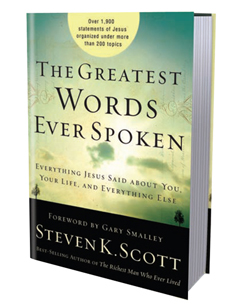
7 Quotes From “The Greatest Words Ever Spoken”

The Grestest Words Ever SpokenObviously the best quotes from The Greatest Words Ever Spoken are from Jesus Himself. But Steven K. Scott, who complied the words of Christ into this unique format (you may read my book review by clicking here) had some good things to say too.

“No occurrence in history or physical science has been verified with a higher degree of statistical certainty than the fact that Jesus is exactly who He claimed to be—the Messiah, the Son of the living God.” 

“We cannot worship the Father in spirit or in truth unless we see Him for who He really is and understand His relationship with the Son.”

“Agnostics hold the position that they simply do not know if God exists. Atheists, on the other hand, claim intellectual superiority over all others, saying they know there is no God.”

“If you want to know what God thinks and feels, how He acts and works, what grieves Him and what pleases Him, all you have to do is read the words and observe the behavior of Jesus Christ.”

“Several years ago a string of four letters took the Christian community by storm. It seemed like WWJD, which stands for ‘What would Jesus do?’ was everywhere—and why not? When a choice has to be made, is any other question more important to ask? The answer is ‘Yes, one question is more important. One question Christians should ask before choosing any course of action, making any spiritual decision, or adopting any value or belief.’ That question is ‘WDJS: what did Jesus say?’ This is the question Christians need to ask because in many situations we simply can’t know for sure what Jesus would do, so we are left to figure it out for ourselves. And figuring it out may require more wisdom, revelation, insight, and spiritual maturity than we possess at the time. … Jesus made more statements about how His followers should live and what they should believe than about any other group of topics.”

“By nature, we evaluate nearly every situation according to its immediate impact on our desires, and we make our choices accordingly. Consequently, we often sacrifice that which would bring infinite eternal benefit in exchange for temporary gratification.”

“Jesus shows us that blaming others for our failures is not only offensive to God; it is detrimental to our relationships. While we all want healthier relationships, most of us have a hard time breaking free from our natural inclinations. The words of Christ… can bring about extraordinary change in every relationship in your life, for the rest of your life. … We can have better relationships with anyone who crosses our path, but it doesn’t happen naturally. Jesus provides both the revelation and the power that frees us from our human nature.”

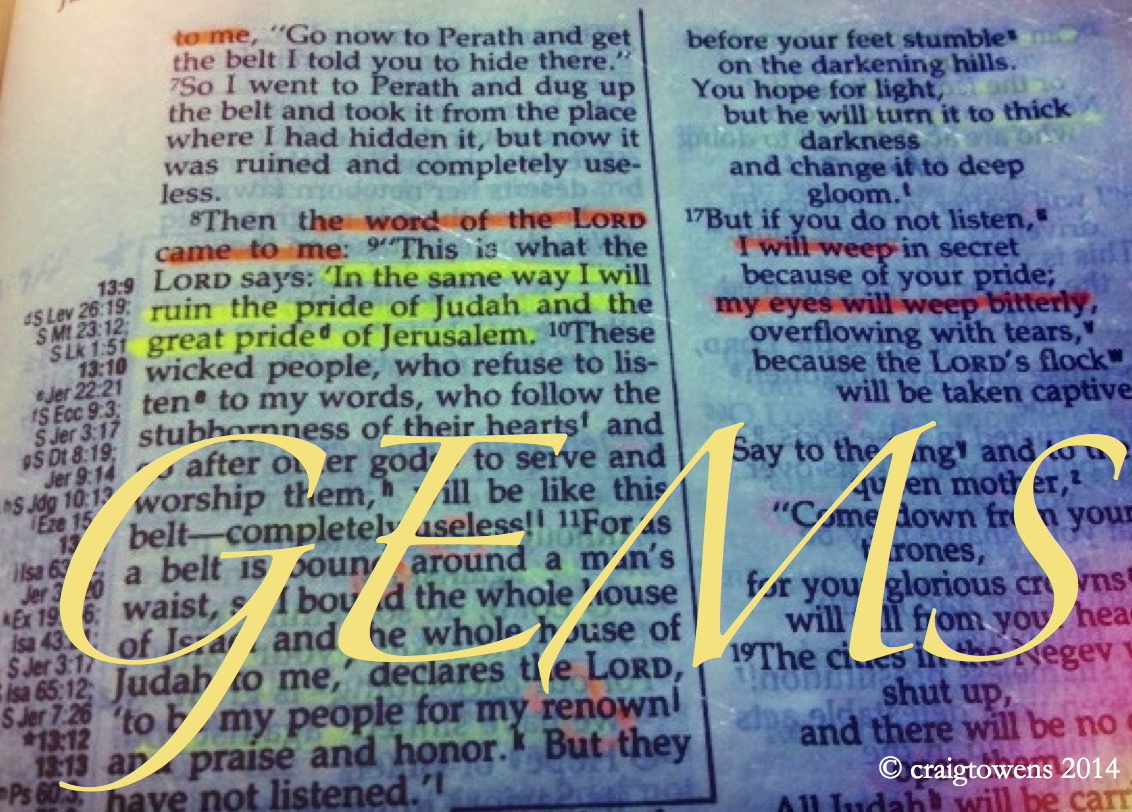
Gems

GemsDo you ever get lost in the “begats” of the Bible? You know those long, tedious lists of who was born to whom? In 1 Chronicles there’s an equally long list of names that goes on for five chapters(!) of who’s in charge of what. But be careful not to skip over these lists. The Holy Spirit included them in the inspired Word of God for a reason, and sometimes you find some real gems buried in these lists.

Here are a few that I recently unearthed…

For David had said… (1 Chronicles 23:25)—David’s heart was so closely knit with God’s heart that the words he spoke were God’s words coming through David’s mouth, as he gave instructions about how worship in the tabernacle should be conducted.

David, together with the commanders of the army, set apart some of the sons of Asaph… (25:1, 3, 7)—Asaph, Hemen and Jeduthun prophesied through their singing in the tabernacle. They didn’t compose music and sing to entertain, but to call people to God. Notice, too, that all of the worship leaders in the tabernacle were “trained and skilled in music for the Lord.” Those God calls, He equips.

For God had blessed Obed-Edom… (26:5-8)—The Ark of the Covenant—the symbol of God’s presence—had been housed in Obed-Edom’s home. God’s presence produces blessing! Listen to how Obed-Edom’s descendants are described:

  • Leaders
  • Capable men
  • Able men
  • Capable men with the strength to do the work

Elihu… (27:18)—Even David’s older brother chose to serve him.

Hushai the Arkite was the king’s friend… (27:33)—In the listing of all the court officials, here is a man with no other title than David’s friend.

God’s Word is alive! Ask the Holy Spirit, Who inspired the men who penned these words, to give you fresh revelation as you read the Bible. Then prepare to be amazed at the gems He will reveal to you!

Links & Quotes

link quote

These are links to articles and quotes I found interesting today.

“Be sure you put your feet in the right place, then stand firm.” —Abraham Lincoln

The “settled science” of the origin of the universe is far from settled: Einstein’s Lost Theory Uncovered

“Pastors must be students of God’s Word, continually reviewing and digging deeper into the Scriptures in order to discern what is right and true and essential for the equipping of the saints. The pastor’s study of the Word must be, first, for his own edification and enrichment. From there, he must consider the application of Scripture to the needs of his congregation and the temper of the times. The more we are furnished with the sure Word of God, the more we will grow to be like Jesus, and be equipped to help others in this same calling.” —T.M. Moore

“Jesus observed the law and fulfilled the law. He did not throw the law away, for the sake of love. For the sake of love, He threw Himself away. That’s another counterintuitive lesson He gave to us, as we all proceed together, slouching toward ‘tolerance’ and carrying our consciences along the way ” —Elizabeth Scalia. Read more of her post Jesus Might Bake The Cake, But Would He Perform The Nuptials?

Disgusting! Michigan’s ‘House Of Horrors’

“God wants worshipers before workers; indeed the only acceptable workers are those who have learned the lost art of worship.” —A.W. Tozer

Listen, O My Soul

Listen O my soulDavid wraps up the 35th Psalm with a thought that is familiar to him—

My tongue will speak of Your righteousness and of Your praises all day long. (Psalm 35:28)

Praise is good for the soul! But in the midst of enemies gloating over David, hating him without reason, devising false accusations against him, and making plans to do him in (see verses 19-21), where could David get the strength to sing about God’s goodness?

As I said, it’s the last verse where David declares his unending praise. This verse is the result of seeing God move. But much earlier in this psalm David says, “Say to my soul, ‘I am your salvation’” (v. 3).

Before David could speak it, he had to hear it! He had to quiet himself in the midst of all the assaults on him to hear God say, “I AM your salvation!”

Not “my ears,” but “my soul”: the very center of my being, my mind, my emotions. I need the I AM to reassure the soul He created that He is still there. Unless I hear that assurance at the core of my being, I can only go through the motions. True worship comes from a real, personal encounter with the I AM.

O, listen my soul! Hear your Savior speak the assurance of His salvation. Only then can I open my lips in endless praises all day long.

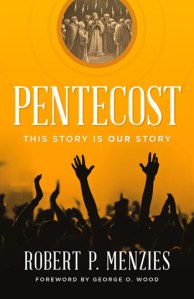
14 Quotes From “Pentecost”

Pentecost

I thoroughly enjoyed reading Pentecost by Robert P. Menzies, and learned quite a bit. You can read my full book review by clicking here. Here are a few quotes that stood out to me.

“It’s because Pentecostals fuse the biblical and contemporary horizons that we link baptism in the Holy Spirit with speaking in tongues, since that’s what Acts 2 does. It’s why we associate Spirit-baptism with empowerment for mission rather than with spiritual regeneration. And it’s why we expect God to perform ‘signs and wonders’ and to manifest spiritual gifts in worship services. All these things happened in the first Pentecostal community, and their story is our story.” 

“At its heart, the Pentecostal movement is not Spirit-centered but Christ-centered. The work of the Spirit, as Pentecostals understand it, centers on exalting and bearing witness to the Lordship of Christ.”

“Pentecostals are ‘people of the Book.’ Although Pentecostals certainly encourage spiritual experience, they do so with a constant eye to Scripture.”

“So, the stories of Acts are our stories, and we read them with expectation and eagerness: stories of the Holy Spirit’s power, enabling ordinary disciples to do extraordinary things for God. … The hermeneutic of the typical Pentecostal believer is straightforward and simple: the stories in Acts are my stories—stories that were written to serve as models for shaping my life and experience.”

“In Luke’s view, every member of the church is called (Luke 24:45–49; Acts 1:4–8/Isaiah 49:6) and empowered (Acts 2:17–21; cf. 4:31) to be a prophet. Far from being unique and unrepeatable, Luke emphasizes that the prophetic enabling experienced by the disciples at Pentecost is available to all of God’s people. … Through his two-volume work, Luke declares that the church, by virtue of its reception of the Pentecostal gift, is nothing less than a community of prophets. It matters not whether we are young or old, male or female, rich or poor, black or white; the Spirit of Pentecost comes to enable every member of the church, each one of us, to fulfill our prophetic call to be a light to the nations.” 

“Not long ago a Chinese house church leader commented, ‘When Western Christians read the book of Acts, they see in it inspiring stories; when Chinese believers read the book of Acts, we see in it our lives.’”

“Luke’s theology of the Spirit is different from that of Paul. Unlike Paul, who frequently speaks of the soteriological dimension of the Spirit’s work, Luke consistently portrays the Spirit as a charismatic or, more precisely, a prophetic gift, the source of power for service.” 

“Luke crafts his narrative so that the parallels between Jesus’ experience of the Spirit (Luke 3–4) and that of the disciples on the day of Pentecost (Acts 1–2) cannot be missed. Both accounts: 1. Are placed at the outset of Luke’s Gospel on the one hand, and the book of Acts on the other; 2. Associate the reception of the Spirit with prayer; 3. Record visible and audible manifestations; 4. Offer explanations of the event in the form of a sermon that alludes to the fulfillment of Old Testament prophecy.”

“Luke’s understanding of baptism in the Holy Spirit, I have argued, is different from that of Paul. It is missiological rather than soteriological in nature. … The tendency in Protestant churches has been to read Luke in the light of Paul. Paul addresses pastoral concerns in the church; Luke writes a missionary manifesto.” 

“Bold witness for Jesus is recognized as our primary calling and the central purpose of our experience of the Spirit’s power. Missions is woven into the fabric of our DNA.”

“I do not wish to minimize in any way the significance of the great doctrinal truths of Paul’s writings. I merely point out that since Paul was, for the most part, addressing specific needs in various churches, his writings tend to feature the inner life of the Christian community. His writings, with some significant exceptions, do not focus on the mission of the church to the world. … It is probably fair to say that while Paul features the ‘interior’ work of the Spirit (e.g., the fruit of the Spirit, Gal. 5:22–23); Luke features His ‘expressive’ work (Acts 1:8). Thus, by appropriating in a unique way the significant contributions of Luke-Acts, Pentecostals have developed a piety with a uniquely outward or missiological thrust.”

“The clarity of the Pentecostal message flows from the simple, straightforward manner in which we read the Bible. As I have noted, Pentecostals love the stories of the Bible. We identify with the stories that fill the pages of the Gospels and Acts, and the lessons gleaned from these stories are easily grasped and applied in our lives. For Pentecostals, the New Testament presents models that are to be emulated and guidelines that are to be followed. It should be noted that our approach to doing theology is not dependent on mastering a particular set of writings, say, the works of Luther; or coming to terms with a highly complex theological system. Pentecostals also do not worry much about cultural distance or theological diversity within the canon. We do not lose sleep over how we should understand the miracle stories of the Bible or how we might resolve apparent contradictions in the Bible. Our commitment to the Bible as the Word of God enables us to face these questions with a sense of confidence.”

“We must remember that whatever we do, God is measuring the work we do for Him in a qualitative, not quantitative way. … Only the work which is done by the power of the Holy Spirit can be acceptable in the Kingdom of God.” —David Yonggi Cho

“Some will still remain skeptical. They will ask: Is not this approach to church life, with its emphasis on ecstatic experience, emotional response, and spiritual power, filled with inherent dangers? Might it not encourage us to feature emotionally manipulative methods and to focus on superficial matters? Yes, undoubtedly, there are dangers. However, there is more danger in an approach that fails to make room for the full range of human experience, including the emotions, in our encounter with God.”

Forethought Or After-Thought?

What is man that You are mindful of him, the son of man that You care for him? You made him ruler over the works of Your hands; You put everything under his feet. (Psalm 8:4-5)

forethoughtafterIn mythology, humans are an after-thought, a nuisance, slaves and servants of the gods, and usually pawns in the gods’ scheming against each other.

But Jehovah God created man as a part of His creation. He created mankind in His own image and breathed His own life into him. After the first five days of creation, God said, “It is good.” But on the sixth day, after creating man, He said, “It is very good!”

Jehovah God has man at the forefront of His mind. He not only calls us into a relationship with Him, but the Trinity works in divine cooperation to make it possible for us to come to Him.

He doesn’t see a mass of humanity, but He sees each one of us individually and uniquely. And He is attentive to us—“For the Lord has heard my cry for mercy; the Lord accepts my prayer” (Psalm 6:9).

As David burst into praise with this realization of God’s forethought of us, let us echo this praise (Psalm 8:9)—

O Lord, our Lord, how majestic is Your name in all the earth!

24 Quotes from “Andrew Murray’s Daily Reader”

Andrew Murray Daily ReaderOver the course of the last year in reading Andrew Murray’s Daily Reader, I literally took down over 40 pages of Murray’s quotes! The quotes I have listed below are not my favorites, but just some of the quotes from the first few pages of my notes. You can read my book review of this truly amazing devotional book by clicking here.

“The true practice of Christianity strives toward having the character of Christ so formed in us that in our most common activities His temper and disposition will be displayed.”

“May this high privilege awaken your desire for relationship with God, to dwell in sweet fellowship with Him and He with you. May it become impossible for you to be satisfied with anything less.”

“The power to believe a promise depends entirely on our faith in the one who promises. It is only when we enjoy a personal loving relationship with God Himself that our whole being is opened up to the mighty influence of His holy presence and the capacity will be developed in us for believing that He gives whatever we ask.” 

“Sin consists in nothing but this, that man determined to be something and would not allow God to be everything.”

“Even as believers we often make it our first aim to find out who we are, what we desire, what pleases us and makes us happy. Then we bring in God in the second place to secure this happiness.” 

“Nothing except constant fellowship with God can teach you as His child to hate sin as God hates it. Nothing but the close fellowship of the living Christ can make it possible for you to understand what sin is and to detest it. Without this deeper understanding of sin, we cannot truly appropriate the victory that Christ made possible for us.”

“To pray constantly only for ourselves is a mark of failure in prayer. It is in intercession for others that our faith and love and perseverance will be stirred up and that the power of the Spirit will be found to equip us for bringing salvation to people.” 

“Here is God’s provision for our holiness, God’s response to our question ‘How can we be holy?’ When we hear the call ‘Be holy, even as I am holy,’ it seems as if there is, and ever must be, a great gulf between the holiness of God and that of humankind. But in Christ is the bridge that spans the gulf—or better, His fullness has filled it up.”

“To worship is our highest privilege. We were created for fellowship with God: of that fellowship, worship is the most sublime expression. All the disciplines of the Christian life—meditation and prayer, love and faith, surrender and obedience—culminate in worship. Recognizing what God is in His holiness, His glory, and His love; realizing what I am as a sinful creature and as the Father’s redeemed child, in worship I gather up my whole being and present myself to my God. I offer Him the adoration and the glory that is due Him. The truest, fullest, and nearest approach to God is worship.”

“We are in such a habit of evaluating God and His work in us by what we feel that it is very likely that on some occasions we will be discouraged because we do not feel any special blessing. Above everything, when you wait on God, do so in the spirit of hope. It is God in His glory, His power, and His love who is longing to bless you.”

“I would like to convince every believer that Jesus loves you; He does not wish to be separated from you for a moment. He cannot bear it. No mother has delighted more in the baby in her arms than does Christ delight in you. He wants both intimate and unceasing fellowship with you. Receive it, dear believer, and say, ‘If it is possible, God helping me, I must have this filling of the Holy Spirit so that I may know and sense the presence of Jesus always dwelling in my heart.’” 

“Discovering the New Testament standard of commitment is not an easy matter. Our preconceived opinions blind us; our surroundings will exercise a powerful influence. Unless there is a sincere desire to truly know the entire will of God, and a prayerful dependence on the Holy Spirit’s teaching, we will search in vain.”

“If you would be full of the Spirit, be full of the Word. … Just as the Scriptures were spoken and written down as men were moved by the Spirit of God, it is only by the Spirit of God that they can be fully understood.” 

“Our waiting on God can have no higher goal than to have His light shine on us and in us and through us all day.”

“May our daily lives be the bright and blessed proof that a hidden power dwells within, preparing us for the glory to be revealed. May our abiding in Christ the Glorified One be our strength to live to the glory of the Father, our enabling to share in the glory of the Son.” 

“Take every opportunity to humble yourself before God and man. Accept with gratitude everything that God allows from within or without, from friend or enemy, in nature or in grace, to remind you of your need for humbling and to help you in it. Reckon humility to be the mother-virtue, your very first duty before God, the one perpetual safeguard of the soul, and set your heart upon it as the source of all blessing. The promise is divine and sure: He that humbles himself shall be exalted.”

“Love for God and love for our neighbor are inseparable; prayer from a heart that is not right with God or that cannot get along with others can have no real effect. Faith and love are interdependent.”

“In the annoyances of daily life, we must be careful not to excuse a hasty temper, sharp words, or rash judgment by saying that we meant no harm, that we did not hold the anger long, or that it is too much to ask of our human nature not to behave in such a manner. Instead, we must seek to forgive as God in Christ has forgiven us, diffusing anger and judgment.”

“God has called us to live a life in the supernatural. Allow your devotional time each day to be as the open gate of heaven through which light and power stream into your waiting heart and from which you go out to walk with God all day.”

“Every soul is worth more than the world and nothing less than the price paid for it by Christ’s blood. Each is within reach of the power that can be tapped through intercession. We have no concept of the magnitude of the work to be done by God’s intercessors or we would cry out to God for an outpouring of the Spirit of intercession.”

“Prayer and the Word are inseparably linked; power in the use of either depends upon the presence of the other. The Word gives you a subject for prayer. It shows you the path of prayer, telling you how God would have you come. It gives you the power for prayer—courage in the assurance that you will be heard. And it brings you the answer to prayer as it teaches what God will do for you. On the other hand, prayer prepares your heart to receive the Word from God himself, to receive spiritual understanding from the Spirit, and to build faith that participates in its mighty working.” 

“God’s purpose was to bring us back to Himself as our Creator, in whose fellowship and glory our happiness can alone be found. God could attain His purposes and satisfy the love of His own heart only by bringing us into complete union with Christ, so that in Him we can be as near to God as Christ is. Oh, the mystery of the love of God!”

“The knowledge of God’s Father-love is the first and simplest—but also the last and highest—lesson in the school of prayer. It is in personal relationship to the living God and fellowship with Him that prayer begins.” 

“As one of His redeemed ones you are His delight, and all His desire is to you, with the longing of a love that is stronger than death, and which many waters cannot quench. His heart yearns for you, seeking your fellowship and your love. If it were needed, He would die again to possess you. As the Father loved the Son, and could not live without Him—this is how Jesus loves you. His life is bound up in yours; you are to Him inexpressibly more indispensable and precious than you can ever know.”

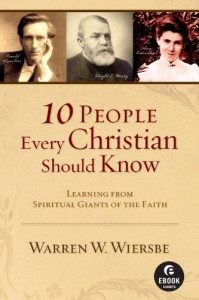
12 Quotes From “10 People Every Christian Should Know”

10 People Every Christian Should KnowWarren Wiersbe’s book 10 People Every Christian Should Know was filled with lots of quotes by and about the notable historical figures he covered in his book. You can read my book review by clicking here, but these are some of the quotes I highlighted while I was reading.

“You have been asked to take notice of the sayings of dying men—this is mine: that a life spent in the service of God and communion with Him is the most pleasant life that anyone can live in this world.” —Matthew Henry, on his deathbed 

“I am greatly persuaded that the generality of preachers talk of an unknown, unfelt Christ. And the reason why congregations have been so dead is because dead men preach to them.” —George Whitefield

“To quicken the conscience by the holiness of God, to feed the mind with the truth of God, to purge the imagination by the beauty of God, to open up the heart to the love of God, to devote the will to the purpose of God.” —William Temple, giving his definition of worship

“There are men called by God to preach on the issues of the hour, and we need their ministry. But for permanent strengthening of the church, we also need preachers who will dig again the old wells and lead us intelligently down the old paths and who, renouncing cheap pulpit rhetoric, will focus the white light of revelation on the human heart and examine us in that light.” —Warren Wiersbe

“Want of trust is at the root of almost all our sins and all our weaknesses, and how shall we escape it but by looking to Him and observing His faithfulness. The man who holds God’s faithfulness will not be foolhardy or reckless, but he will be ready for every emergency.” —J. Hudson Taylor

“I’d rather be able to pray than to be a great preacher. Jesus Christ never taught His disciples how to preach, but only how to pray.” —D.L. Moody

“The work will never go deeper than we have gone ourselves” —Amy Carmichael

“My Vow: Whatsoever Thou sayest unto me, by Thy grace I will do it.
My Constraint: Thy love, O Christ, my Lord.
My Confidence: Thou art able to keep that which I have committed unto thee.
My Joy: To do Thy will, O God.
My Discipline: That which I would not choose, but which Thy love appoints.
My Prayer: Conform my will to Thine.
My Motto: Love to live—live to love.
My Portion: The Lord is the portion of mine inheritance.” —Amy Carmichael

“You can be much more for Him than ever you know by just being yourself and relying on Him…. Keep praying and playing and being yourself.” —Oswald Chambers 

“You can never give another person that which you have found, but you can make him homesick for what you have.” —Oswald Chambers

“Stop having a measuring rod for other people. There is always one fact more in every man’s case about which we know nothing.” —Oswald Chambers

“The best book is not one that informs merely, but one that stirs the reader up to inform himself.” —A.W. Tozer