You are the most effective evangelist in the areas where you already operate everyday. You can tell the story of Jesus better to your family members, coworkers, and friends than an outside can. Keep shining brightly for Jesus!
“They think that if you ask them to forgive someone who has cheated or bullied them you are trying to make out that there was really no cheating or no bullying. But if that were so, there would be nothing to forgive. They keep on replying, ‘But I tell you the man broke a most solemn promise.’ Exactly: that is precisely what you have to forgive. (This doesn’t mean that you must necessarily believe his next promise. It does mean that you must make every effort to kill every taste of resentment in your own heart—every wish to humiliate or hurt him or to pay him out.) The difference between this situation and the one in which you are asking God’s forgiveness is this. In our own case we accept excuses too easily; in other people’s we do not accept them easily enough.” —C.S. Lewis, in The Weight of Glory
T.M. Moore tells us, “Conversations can build relationships; thus, Christians should be actively involved in seeking to start and maintain conversations with many people, especially those we encounter each week…. But the Christian conversationalist does not engage others merely for the sake of conversation, as though conversation were an end in itself.”
“Information never fights fear. Revelation does.” —Tim Dilena
“Saints find themselves at home in the next life, not in this one.” —J. Stephen Lang
“Do not imagine that there is any love to your souls in the heart of the preacher who preaches smooth things, and who flatters you with his ‘Peace, peace,’ when there is no peace. No, the highest, deepest, most heaven-inspired love is that which searches and tries the heart that there should be any deception there.” —Charles Spurgeon
Listen to the podcast of this post by clicking on the player below, and you can also subscribe on Apple, Spotify, or Audible. Check out the video content in this post by clicking here.
Journaling is more than just something for women in rom-coms, it’s a practice that has been utilized by many important people throughout history. In our country the journals of the Founding Fathers are full of writings that became the basis of the government we still have today. While your journals might not be the beginnings of a new country, they are still a valuable tool that can help enhance your leadership. Join Greg and me as we discuss the leadership-enhancing power of journaling.
[0:00] Introduction
[2:13] Greg highlights some values in journaling.
[3:48] When did I start journaling?
[6:07] Let’s clarify what journaling isn’t.
[7:58] How we can use our journals to leverage our ideas.
[10:16] Writing and thinking are powerfully linked.
[13:07] Greg has an interesting way he discovered to generate thinking points for his journal.
[14:58] History often repeats itself so journals can help us rediscover successful strategies.
[16:22] Journals can help us do new things better.
[18:47] Journaling can help us not get stuck on the busyness treadmill.
[21:27] I share a quote from Tim Tebow.
[23:03] Make journaling work for you.
[24:39] How I turned journal entries into an impactful book.
[25:47] Greg shares a quote about how he journals.
Listen to the podcast of this post by clicking on the player below, and you can also subscribe on Apple, Spotify, or Audible. Check out the video content in this post by clicking here.
This may be the single most well-known word in the world!
Listen to the podcast of this post by clicking on the player below, and you can also subscribe on Apple, Spotify, or Audible. Check out the video content in this post by clicking here.
I worked for my friend’s Dad on his lawn service for a few summers. This was a side business for him, and we worked with normal push mowers. The first stop of the early morning was always a challenge to get the mower started. I’d pull on that ripcord and listen to the engine sputter and then stop. Then I’d give it another pull, and perhaps it would run just a bit longer. Eventually the flywheel would keep on spinning, the engine would roar to life, and I could get to work.
Question: which pull started the mower? I really needed all of the pulls, didn’t I? In other words, I had to put in some effort in order to get the mower to work. Then I could actually be productive in my work.
Last week we talked about the dual blessings Peter says that God wants to send us—grace and peace. Notice that Peter longs for us to know these in abundance. Not just a small sampling, but overflowing blessings—sort of like my lawnmower that is running at full speed.
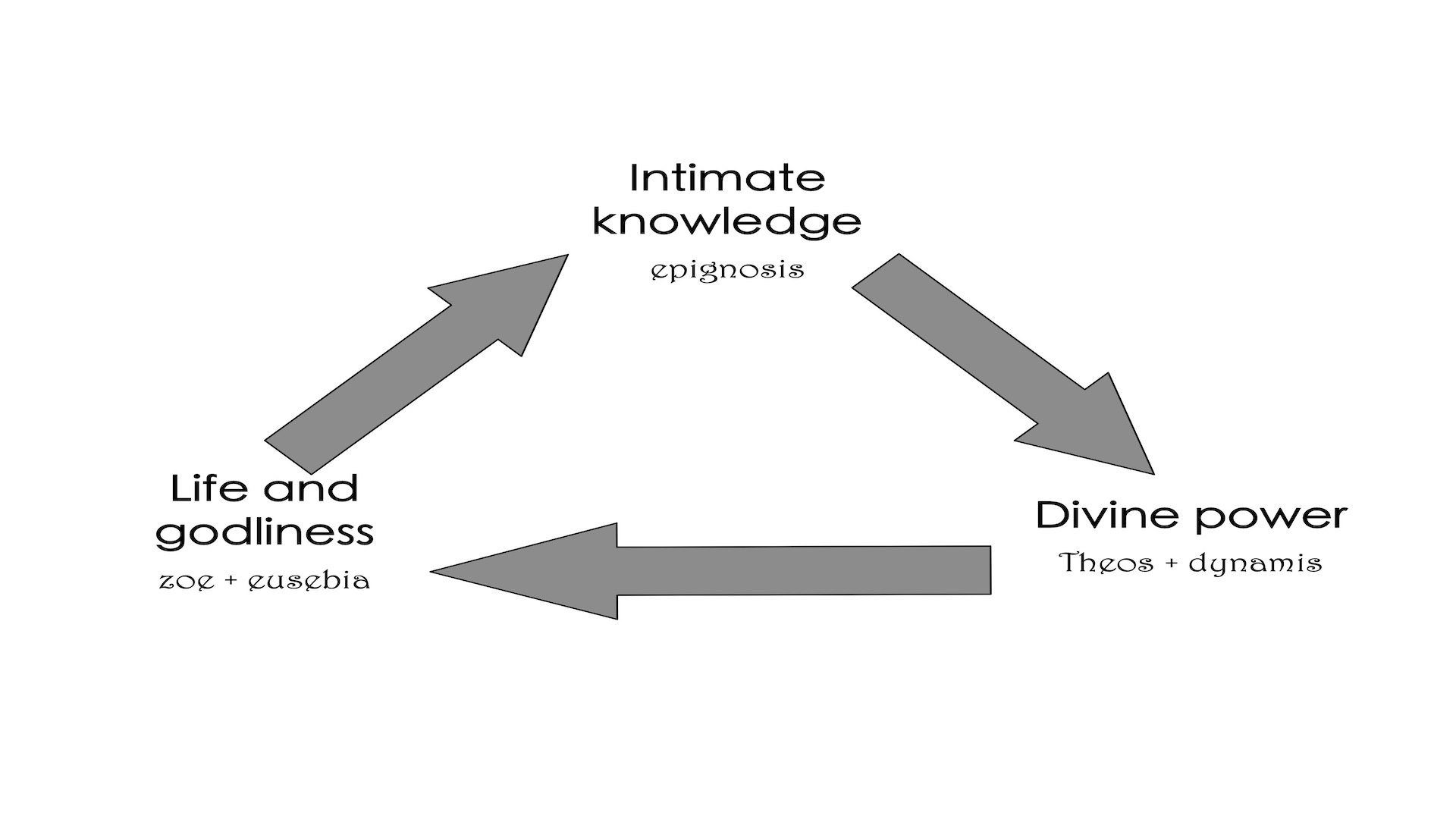
2 Peter 1:3 tells us it is “His divine power has given us everything we need for a godly life through our KNOWLEDGE of Him Who called us by His own glory and goodness.”
Remember that Greek word means our personal, intimate, experiential knowledge of Jesus. God allows us to know Him intimately (Jeremiah 29:13-14a). Notice it is “His divine power [that] has given us EVERYTHING we need for a godly life.”
“Divine power” literally means God’s power—Theois dynamis. This is the power which Jesus promised in Acts 1:8. Then His followers were able to live like Jesus, as we see in Acts 3:12; 4:7, 33.
But Jesus is the One Who got this started for us. HIS divine power has given us everything we need for A GODLY LIFE.
“Godly life is two words in Greek: “life” and “godliness.” The word for life is zoe. This is everlasting life that is deeper and richer than biological or psychological life. And the word for godliness is eusebia, which is the reverence, respect, and holy fear that gives evidence of one’s assured relationship with God through Jesus.
Check out two other translations of this verse.
The AMPC says: For His divine power has bestowed upon us all things that are requisite and suited to life and godliness, through the full personal knowledge of Him….
And The Message paraphrase says: Everything that goes into a life of pleasing God has been miraculously given to us by getting to know, personally and intimately, the One who invited us to God.
Here’s the power cycle for saints of God. The more intimately I know Jesus, the more the Holy Spirit’s dynamis power is unleashed in my life. The more His power flows through me, the more godly I can live. The more godly I live, the more I grow in intimacy with Jesus!
This is a flywheel that can really start spinning! Look at some of the blessings in the next few verses:
Participating in Christ’s divine nature—becoming more and more Christlike (v. 4a). The Greek word is defined as a way of feeling and acting which by long habit has become more and more natural to me.
Escaping the corruption in the world (v. 4b).
Becoming increasingly effective and productive in your knowledge—that’s the word epignosis again—of Jesus (v. 8).
I had to put the effort in to get the mower’s flywheel spinning so that I could actually do my job.
Peter says, Jesus got this poem cycle started so that I could be productive for Him. Peter introduces a phrase that we are going to see three more times in this letter: Make every effort (v. 5).
We are not saved by good works, but we are saved in order to do good works.
Jesus was empowered to do good works (see Luke 4:18-19 and Acts 10:38), and Jesus calls us to live the same way with the same anointing (John 20:21-22; Acts 4:30-31).
The cycle of power and godliness and greater intimacy is for you. Make every effort to keep it spinning so that you can bring more glory to God by increasing your capacity to be a blessing to those around you.
Please check out the other messages in the Friends of the Faith series by clicking here.
Keep putting in the effort. If someone in your organization doesn’t see your work ethic and your leadership capacity, someone outside your organization will. Your hard work will be rewarded!
“Good philosophy must exist, if for no other reason, because bad philosophy needs to be answered. … Most of all, perhaps, we need intimate knowledge of the past. Not that the past has any magic about it, but because we cannot study the future, and yet need something to set against the present, to remind us that the basic assumptions have been quite different in different periods and that much which seems certain to the uneducated is merely temporary fashion. A man who has lived in many places is not likely to be deceived by the local errors of his native village; the scholar has lived in many times and is therefore in some degree immune from the great cataract of nonsense that pours from the press and the microphone of his own age.” —C.S. Lewis, in The Weight of Glory
“O child of God, as thou wouldst fear to drink poison, as thou wouldst flee from a serpent, dread sin!” —Charles Spurgeon
“We pray in Jesus’ Name not just by ending our prayer with that default phrase, but by making sure our requests line up with what He teaches and what will glorify both Jesus and His Father. When we pray this way, we can know that Jesus will do what we have asked, and He will do it by His Spirit at work within us.” —T.M. Moore
Listen to the podcast of this post by clicking on the player below, and you can also subscribe on Apple, Spotify, or Audible. Check out the video content in this post by clicking here.
It’s a good question: Why would I put all of this effort into writing yet another book? The simple answer: This book basically wrote itself!
In their book Spiritual Leadership, Henry and Richard Blackaby wrote, “Biblical praying can be the most challenging, exhausting, laborious, and yet rewarding thing leaders do. … More than any other single thing leaders do, their prayer life determines their effectiveness.”
This is exactly why I wrote Amen Indeed—I wanted to help shepherd leaders with this laborious yet rewarding discipline. You can pick up a copy by clicking here.
Listen to the podcast of this post by clicking on the player below, and you can also subscribe on Apple, Spotify, or Audible. Check out the video content in this post by clicking here.
Remember that Peter’s first letter was to instruct Christians how to interact with non-Christians, but his second letter is about Christians interacting within the community of faith. It’s a precious faith that we share with precious friends. Our dear friends encourage us to think wholesomely, have informed perseverance, remain pure, and stay on guard until the very end.
You can sense Peter’s longing for his dear friends of the faith to grasp this. He even says in this letter that it is his second letter to keep reminding the saints about the richness in Jesus, and he says as long as he has breath in his lungs he will keep on reminding us (2 Peter 1:12-15).
Peter uses an almost identical greeting in both letters: “Grace and peace be yours in abundance” (1 Peter 1:2; 2 Peter 1:2). This sentiment of linking grace and peace was almost universal, with all but five New Testament books greeting their audiences with the dual blessing of grace and peace.
Let’s talk about these dual blessings.
James Thayer defines this Greek word for peace: “According to a conception distinctly peculiar to Christianity, the tranquil state of a soul assured of its salvation through Christ, and so fearing nothing from God and content with its earthly lot, of whatsoever sort that is.”
This means that Christians who have put their faith in Jesus as their Savior have peace with God (Romans 5:1), and that peace guards our hearts against all fear (Philippians 4:7).
The other blessing in Peter’s greeting is grace (see also Romans 5:2). This is—quite simply and quite profoundly—God’s favor toward us. God’s grace is unearned by our efforts, undeserved despite our sins, and unending for all eternity. And it comes coming in wave after wave (see John 1:16; I especially like it in the AMPC).
Peter’s greeting in his second letter adds a phrase from his first letter: “…through the knowledge of God and of Jesus our Lord.” It’s fitting that this is in his second letter, showing he is still growing in his knowledge of Jesus.
We don’t get more grace and peace through knowledge, but we realize and can apply more grace and peace through this growing knowledge. The tap of God’s blessing is already open full—no more can come out. As we grow in the knowledge of this, we find it increasingly precious and valuable.
The Greek word for knowledge here is epignosis. This is knowledge through personal experience.
I once worked with a man who was a retired Air Force officer. Before flying one mission, he walked into the flight control building—a huge hanger-like structure—where dozens and dozens of personnel sat staring at screens to forecast the weather.
Lou asked a private for the forecast: “Sir, you have clear skies and excellent visibility for your mission,” he dutifully reported.
“Private,” Lou shouted, “on your feet!” The young man snapped to attention. “Follow me,” Lou ordered and began marching toward the door of the hanger. When they got there, Lou ordered the private to open the door, step outside, close the door behind him, and not to re-enter the hanger for 60 seconds.
One minute later that private stepped back inside and stood before Lou dripping wet. “Now, private,” Lou demanded, “what is my weather forecast.”
“It looks like rain, sir,” the young private reported.
Epignosis is not book knowledge about Jesus, but personal, intimate, experiential knowledge of Jesus. That Air Force meteorologist only knew about weather from his radar screen, but once he got drenched outside, he knew of the weather conditions from personal experience.
Peter says this epignosis is ours (2 Peter 1:3-5).
There’s only one thing that keeps us from growing in our knowledge of God’s abundant grace and peace: Complacency. In v. 5, Peter says we are to “make every effort.”
It’s not our effort that brings God’s grace, but it is our effort that allows us to know His grace—to know Jesus personally. Notice the progression:
(v. 3) Christ’s divine power has give us everything we need by His own glory and goodness
(v. 4a) Through these gracious gifts He has given us His great and precious promises
(v. 4b) Through His promises we can participate in His divine nature
(v. 5) For this very reason, we are to bring our best effort, our diligent interest, and our total attention
Peter concludes his letter exactly as he starts it: Keep growing in your epignosis (3:18).
The more you grow in epignosis, the more intimate knowledge you will have to encourage your dear friends of the faith—
And we know that the Son of God has come, and He has given us understanding so that we can know the true God. And now we live in fellowship with the true God because we live in fellowship with His Son, Jesus Christ. He is the only true God, and He is eternal life. (1 John 5:20 NLT)
Then like Paul, we can pray for ourselves and for our dear friends for a continual growing in this intimate knowledge of Jesus (see Ephesians 1:15-19).
Check out the other messages in this series from 2 Peter called Friends of the Faith.
The terms used in the New Testament for followers of Jesus aren’t typically the same terms we use today. As Christians, we need to ask ourselves, “Is my life showing the biblical definition of what it means to know Jesus as my Lord and Savior?”
“The trouble is that what we call ‘asking God’s forgiveness’ very often really consists in asking God to accept our excuses. What leads us into this mistake is the fact that there usually is some amount of excuse, some ‘extenuating circumstances.’ We are so very anxious to point these out to God (and to ourselves) that we are apt to forget the really important thing; that is, the bit left over, the bit which the excuses don’t cover, the bit which is inexcusable but not, thank God, unforgivable. And if we forget this, we shall go away imagining that we have repented and been forgiven when all that has really happened is that we have satisfied ourselves with our own excuses.” —C.S. Lewis in The Weight of Glory
“There is a place for anger. Without it, we would become passive against injustice. Anger helps us turn away from accepting blame that does not belong to us. It allows us to gain needed emotional distance from the one who hurt us. But anger requires safeguards. In this psalm, David had two: (1) He told his anger to God. … (2) He let God handle the execution of anger.” —Dr. George O. Wood, in A Psalm in my Heart
T.M. Moore speaks to the church in this post called Equipped For Good Works. A couple of comments that especially caught my attention: “A local church grows as it increases in the likeness of Jesus Christ” and “Churches grow as individual church members grow in zeal for good works, and do good to others at every opportunity, beginning within the household of faith.”
“I believe that the prophesies in the Revelation, and in the books of Daniel and Ezekiel are very much of this character, and that, while it is quite right to watch for and expect the coming of the Lord, we shall spend our time more profitably in preaching the doctrines of the gospel than in meditating upon the mysterious prophecies of the Word. They will be understood when they are fulfilled, but we do not think they will be fully understood before that time.” —Charles Spurgeon
The name of God is an important topic. Dr. Kaspars Ozolins writes, “What, then, is the actual name of Israel’s God? In biblical Hebrew it is represented by a sequence of four consonants, the famous tetragrammaton: YHWH. This name occurs a total of 6,828 times in the Old Testament.” Learn more about this name in this post.
This year marks the 500th anniversary of the printing of the Tyndale Bible. This is an important event in Christian and world history. Check out this short overview of how this Bible came to be, and its impact that is still being felt today.
Listen to the podcast of this post by clicking on the player below, and you can also subscribe on Apple, Spotify, or Audible. Check out the video content in this post by clicking here.
How do most people finish this phrase: “With friends like these…”? You probably said, “…who needs any enemies!”
But isn’t that rather sad? If this cliche is so well-known, it must be because so many people have experienced false or fickle friends. Maybe a lot of people have experienced what Christian Bovee noted: “False friends are like our shadow, keeping close to us while we walk in the sunshine, but leaving us the instant we cross into the shade.”
I much prefer the words of Ralph Waldo Emerson: “The glory of friendship is not the outstretched hand, not the kindly smile, nor the joy of companionship; it is the spiritual inspiration that comes to one when you discover that someone else believes in you and is willing to trust you with a friendship.”
I think the apostle Peter would agree with Emerson.
Peter wrote his first general epistle to Christians who are interacting with worldlings. Peter calls Christians “aliens and strangers” because of citizenship is heavenly—we are simply sojourners on earth as we make our way to our home in Heaven. Along this journey, 1 Peter gives us invaluable wisdom on how to behave ourselves as citizens of Heaven.
Peter probably has this journey in mind when he addresses his second epistle: “To those who through the righteousness of our God and Savior Jesus Christ have received a faith as precious as ours” (2 Peter 1:1).
“Precious” is defined here as highly esteemed. And when he says, “as ours” he is saying the saints in the Kingdom of God have equal honor with anyone who may have a title or a position of leadership in the Church. Paul would agree with Peter (see 1 Corinthians 3:5, 21-23; 12:27).
Peter emphasizes this point by using the phrase “dear friends” four times in this letter (2 Peter 3:1, 8, 14, 17). Let me give you another quote from Emerson: “God evidently does not intend us all to be rich, or powerful or great, but He does intend us all to be friends.”
Peter uses the Greek word agapetos—with the root word for servant-hearted love at the root. This makes me think about our precious faith that we defined as highly esteemed, because agapetos also means esteemed, highly valued, beloved.
Precious friends encourage us in our precious faith on our long journey as we travel toward Heaven.
(1) They encourage us to think wholesomely (3:1).
They pray for our minds, as Paul did for his friends at Philippi (Philippians 1:9-10), and they practice—or live out—what they preach (Philippians 4:8-9).
(2) They encourage us to have informed perseverance (vv. 8-11).
They help us look backward see how faithful God has been in past times and how trustworthy God is now, and then ask us, “What kind of man or woman ought you to be in this moment? How can you continue to persevere in holiness and godliness until the very end?”
(3) They encourage us to remain pure (vv. 11-14).
They prompt us to be looking forward in hopeful expectation, and they encourage us to make every effort to be pure. These things require the development of habits. Andrew Murray said the habits that keep us pure are formed over the long haul: “The entrance of divine truth into the mind and heart, the formation of habits and the training of character—these are not attained by sudden and isolated efforts, but by regular and unceasing repetition.”
Sometimes our precious friends have to speak a lovingly hard word to us (see Proverbs 27:6).
(4) They encourage us to remain on guard (v. 17)
They don’t want us to be disqualified in our race (1 Corinthians 9:24-27), so they come to our rescue if we do stumble (James 5:19-20).
Let’s make this something new:
With friends like these I can live a victorious, God-honoring, Christ-glorifying life!
Let’s be those precious friends to others who share in the same precious faith.
Check out all of the message in this series from the book of 2 Peter by clicking here.
“Our prayers can go where we cannot. There are no borders, no prison walls, no doors that are closed to us when we pray.” —Brother Andrew
The historicity of the Bible is well documented. Here is another archeological biography from The Bible Archeology Report, this one of Ben-Hadad III.
“I do not want the walls of separation between different orders of Christians to be destroyed, but only lowered, that we may shake hands a little easier over them.” —Rowland Hill (1744-1833)
“Those who are seriously attempting chastity are more conscious, and soon know a great deal more about their own sexuality than anyone else. They come to know their desires as Wellington knew Napoleon, or as Sherlock Holmes knew Moriarty; as a rat-catcher knows rats or a plumber knows about leaky pipes. Virtue—even attempted virtue—brings light; indulgence brings fog.” —C.S. Lewis, in Mere Christianity
Marvin Olasky begins this informative article, “The war against abortion did not begin with the now-overturned 1973 Roe v. Wade decision.” He then gives us a comprehensive history of women of science who have stood on the front lines of the pro-life movement. Check out The Women Who Guarded the Womb.
J. Warner Wallace debunks that myth that Christianity is anti-science. Wallace actually makes that case the Christianity is the reason behind science’s remarkable growth.



 You are the most effective evangelist in the areas where you already operate everyday. You can tell the story of Jesus better to your family members, coworkers, and friends than an outside can. Keep shining brightly for Jesus!