Listen to the podcast of this post by clicking on the player below, and you can also subscribe on Apple, Spotify, or Audible. Check out the video content in this post by clicking here.
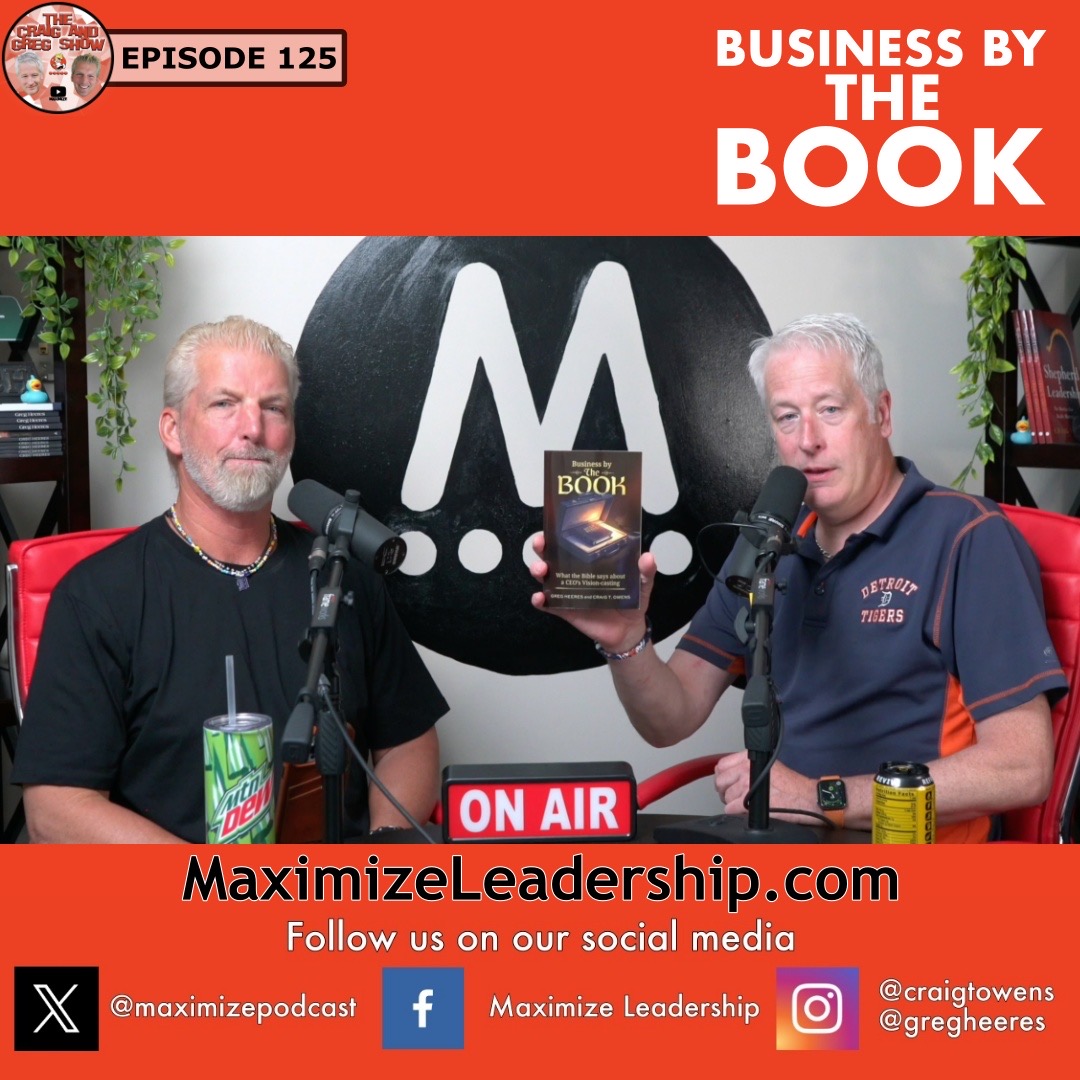
It seems like many people put business and faith in two separate boxes, considering them entirely different topics of discussion. Greg and I completely disagree—the Bible is a resource for all areas of our lives, from the board room to the living room. That’s why we wrote our Business By The Book series. This is a guide to help you apply biblical principles to the corporate world. In today’s episode we preview the first book in this series: Business by the Book: What the Bible says about a CEO’s vision-casting.
[0:00] Introduction
[2:10] What does it mean for the leader to cast vision for his or her organization?
[3:07] Here’s what you can expect from Business by the Book—What the Bible says about a CEO’s vision-casting
[4:13] After a leader has cast a vision, that leader then needs to empower his or her entire team to help them achieve the vision.
[6:46] Leaders must be self-aware of their strengths and weaknesses, and help their teammates learn about themselves as well.
[9:06] Organization chart maneuvering can help empower teammates to accomplish great things. And I also share a teaser about a new project on which Greg is working.
[10:26] Greg talks about two vastly different roles: Commander and Includer.
[12:27] I share an excerpt from a chapter that Greg wrote in this book, and then Greg elaborates on how this helps a team pursue the vision.
[16:37] Leaders can move from doing to facilitating, which will help others set up into new roles.
[18:21] Some counsel for leaders who are first time vision-casters.
[19:26] Greg shares a tip for facilitating meetings to get more people involved.
[21:44] “Leaders become great not because of their power, but because of their ability to empower others.”
[24:18] HERE’S HOW TO WIN A FREE COPY OF OUR NEW BOOK!
Listen to the podcast of this post by clicking on the player below, and you can also subscribe on Apple, Spotify, or Audible. Check out the video content in this post by clicking here.
Looking at King David, we can see an imperfect picture of our perfect King Jesus.
Let’s be honest: Coming into the king’s presence can be a fearful activity. Does he know something about you that you don’t know? Is he in a good mood? For the law-abiding citizen of Israel, coming before King David was without fear or punishment, but with a healthy respect of who he was. But with King David, we see a healthy, loving attitude that the people had.
David and all Israel celebrated when the ark of the covenant of the Lord came to Jerusalem (2 Samuel 6:5).
And the way David blessed all the people following this would have raised the level of esteem they had for him.
God was pleased with David too: The Lord gave David victory wherever he went (8:6).
David continued to do the right thing (8:15).
At the end of David’s life the eyes of all Israel were on David to see who he would select to sit on his throne after him.
Psalm 99 appears to be one that was written during the reign of King David. This royal psalm looks at the limited reign of David to see a better picture of the throne room of King Jesus.
The opening words tell us “the LORD reigns” (v. 1a). The word tremble can have two definitions. The first is to be perturbed or disquieted. This is addressed to the nations who don’t bow their knee to Yahweh, as a result they shake in fear. Second, this word tremble can also mean to be excited about coming before the King.
King Jesus is called “great, exalted over all the nations” (not just Israel), and He is said to have a “great and awesome name.”
“He IS holy,” which means He is the undisputed standard of all that is right and wrong, and no one can question His ruling. The nations that don’t know the King as their King tremble and shake, but those who do know Him as their King praise His awesome name (Revelation 5:13).
In many translations the word King is capitalized in v. 4, but we don’t know if this is referring to God or David. Since v. 2 refers to the “LORD in Zion,” that would appear to be a capital “K” King. But v. 4 mentions Jacob (not Zion), so I believe this is a lower case “k” referring to David. Let me restate verse 4 this way: “David is mighty, David loves justice—David has established equity; in Jacob David has done what is just and right.”
David’s own prayers also bear out this interpretation (see Psalm 20:6-9; 21:1-7). This is what the royal psalms do: Point us to David to show us a better picture in Jesus.
This is the end of stanza 1 which ends with this call to worship (v. 5).
Verses 6-7 give us another example (prior to the era of the kings) of Moses, Aaron, and Samuel. These priests could call on God’s name and expect to receive an answer from Him. They lived obediently to all God spoke to them (v. 7b). Then v. 8 reminds us that God still speaks and forgives, but He is also the final Judge who will punish “misdeeds.” These verses clearly speak to Jesus who is both King and Priest before God’s throne.
This is the end of stanza 2, which has a similar call to worship as stanza 1 (v. 9).
I want you to also notice some places of worship:
between the cherubim (v. 1)—God’s mercyseat. This is where sin was atoned every year under the old system of David’s era, but where Jesus has has presented the once-for-all atonement for all who will believe on Him.
His footstool (v. 5)—another name for the ark of the covenant of the LORD (1 Chronicles 28:2).
the pillar of cloud (v. 7)—the covering of God’s presence and the reminder of His protection.
His holy mountain (v. 9)—see Hebrews 12:18-29.
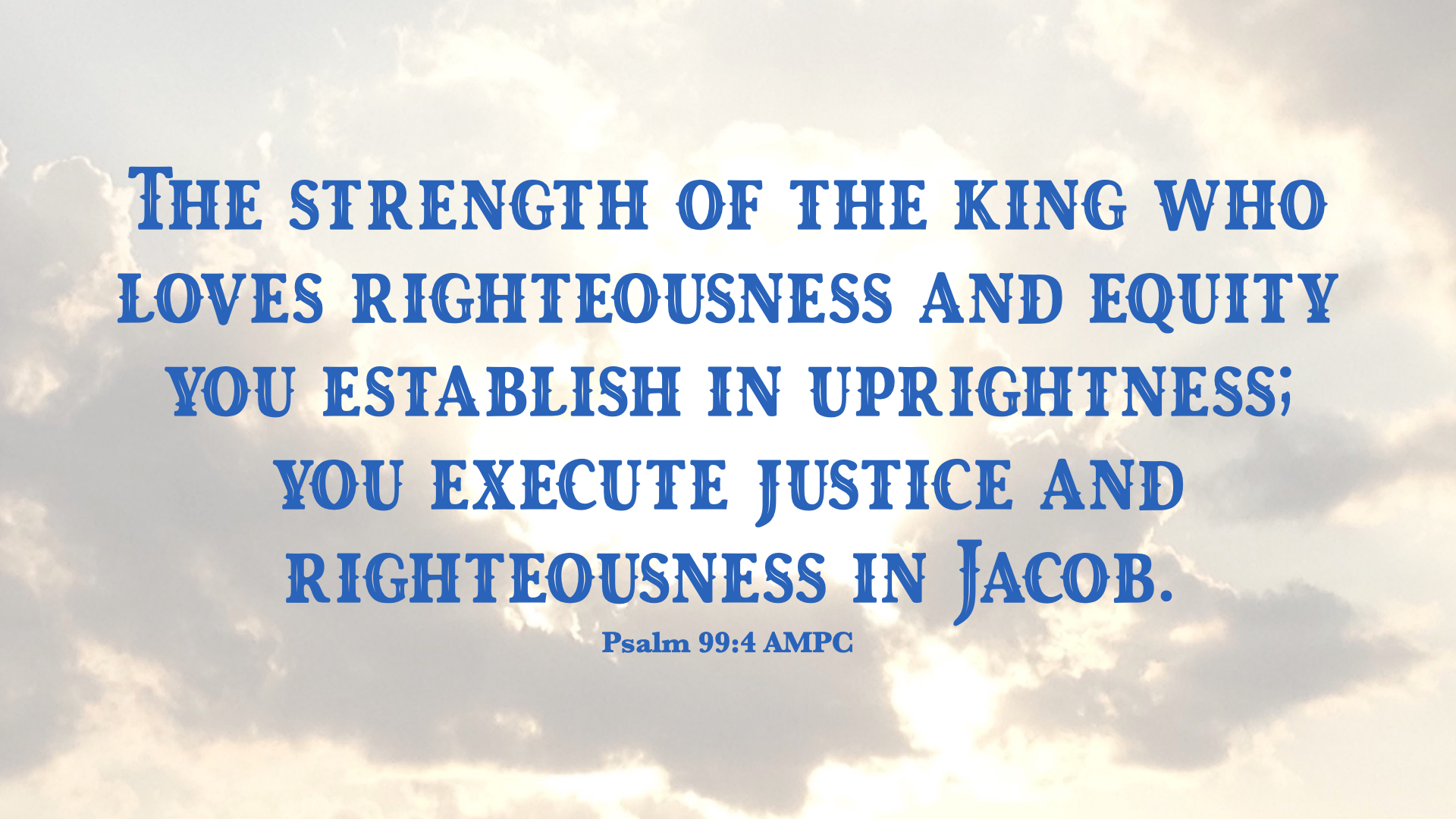
Remember Psalm 99:4 in the AMPC—The strength of the king who loves righteousness and equity You establish in uprightness; You execute justice and righteousness in Jacob (Israel).
King Jesus is the perfect King of justice and righteousness (Isaiah 9:7; Revelation 5:12).
One day every knee will bow at the footstool of God’s holy mountain. They will either bow in despair and shaking because they did not put their faith in Jesus, or they will bow in humble adoration for the atonement that King Jesus made for them.
For those who don’t know Jesus—Away from Me, all you evildoers! There will be weeping there, and gnashing of teeth, when you see Abraham, Isaac and Jacob and all the prophets in the kingdom of God, but you yourselves thrown out. (Luke 13:27-28)
For those who know King Jesus, there is no fear (Luke 12:4-5; 1 Corinthians 15:55-57)!
Christians must live every day exalting and worship God, bowing gratefully at His footstool. This lifestyle of adoration of the great and awesome King is our testimony to a skeptical and searching world.
“Expect great things from God: Attempt great things for God.” —William Carey
“God gave us a self, not so that we would have something to exult in, but something to exult with. He gave us a self, not to be the object of our joy, but the subject of joy. That is, not to be the focus of happiness in front of the mirror or the selfie, but the furnace of happiness in front of Jesus. He gave us a self, not as an instrument of self-worth but as an instrument of worship.” —John Piper
“In reference to this command [Leviticus 19:17], the rabbis teach that if we feel offended by someone, we must go to him, tell him how we feel, give him a chance to explain and possibly apologize, and then forget and forgive.” —Rabbi Kirt A. Schneider
“Resolved, never to give over, nor in the least to slacken my fight with my corruptions, however unsuccessful I may be.” —Jonathan Edwards
“The struggle itself is not proof that something is wrong with your faith. Rather, it is evidence that something is alive in you that now opposes sin. Before Christ, there was no real fight. Now there is tension, resistance, even grief over sin.” —Dr. Mike Paalz, commenting on Romans 7:14-23
Listen to the podcast of this post by clicking on the player below, and you can also subscribe on Apple, Spotify, or Audible. Check out the video content in this post by clicking here.
When it comes to leaders being hurt by those under their care, it is not a matter of if but when. How leaders respond to these attacks reveal three key attributes that must be addressed.
On the Ailbe Podcast, T.M. Moore and Rusty Rabon asked me what attributes pastors needed to develop to respond to sheep bites in a God-honoring way. I believe the three most important attributes are:
Humility
Vulnerability
Accountability
Humility is the ability of a leader to be open to the possibility that the sheep bite may have been in reaction to something the shepherd did or failed to do. To go a little deeper on this point, check out Pay Attention to the Bites.
Vulnerability is used in the context of bearing our souls to a true friend. T.M. Moore has written extensively about “soul friends,” and we discussed that in more detail in a previous appearance on the Ailbe Podcast which you can check out here. [soul friends]
Accountability is really a direct result of our humility with ourselves and our vulnerability with a soul friend. As the Bible tells us over and over again, we need to remain in relationship with fellow saints that can encourage us, empower us, and sometimes correct us. Check out the blog post and video Accountability to Saints.
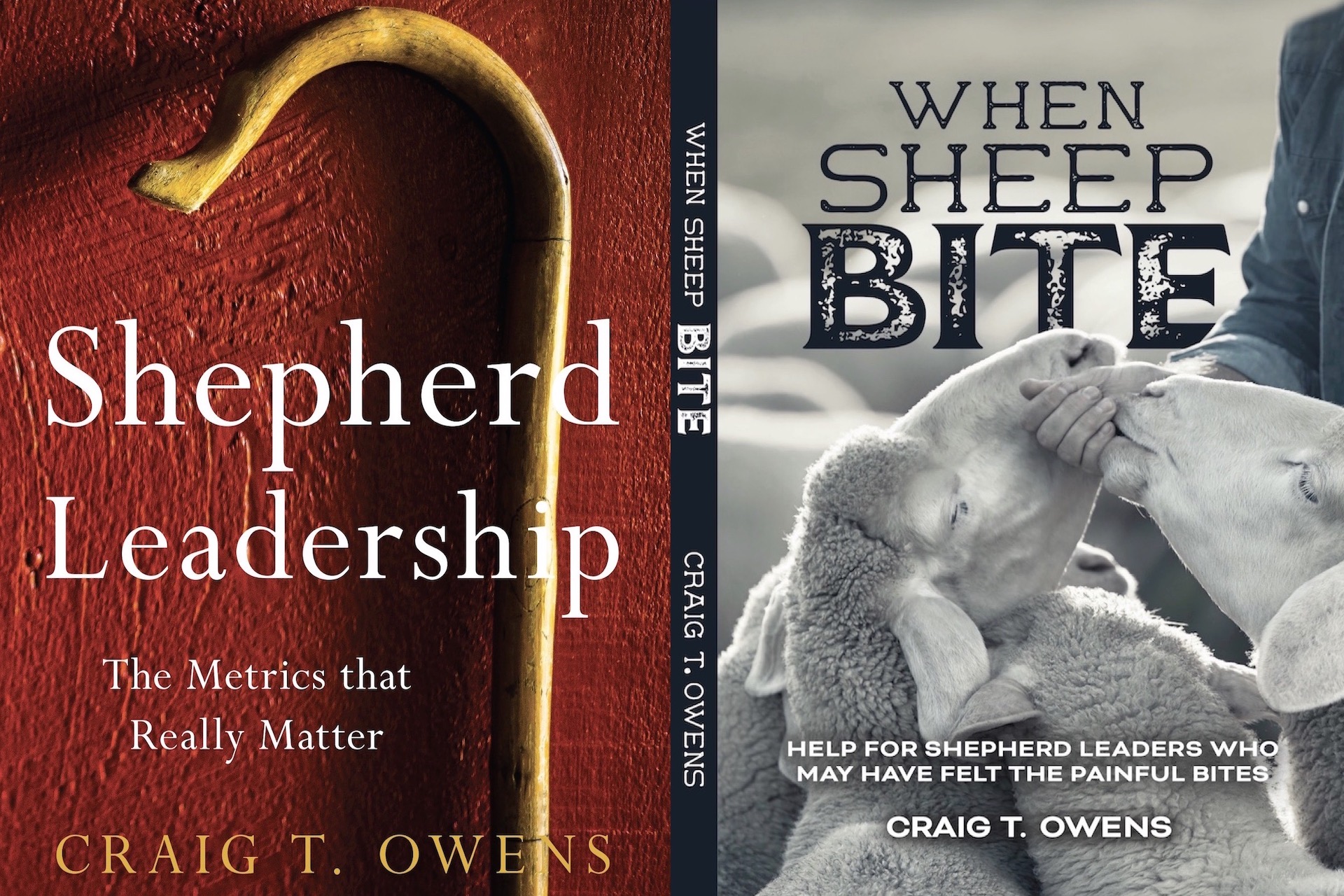
If you desire to grow as a godly shepherd leader, please check out my book Shepherd Leadership.
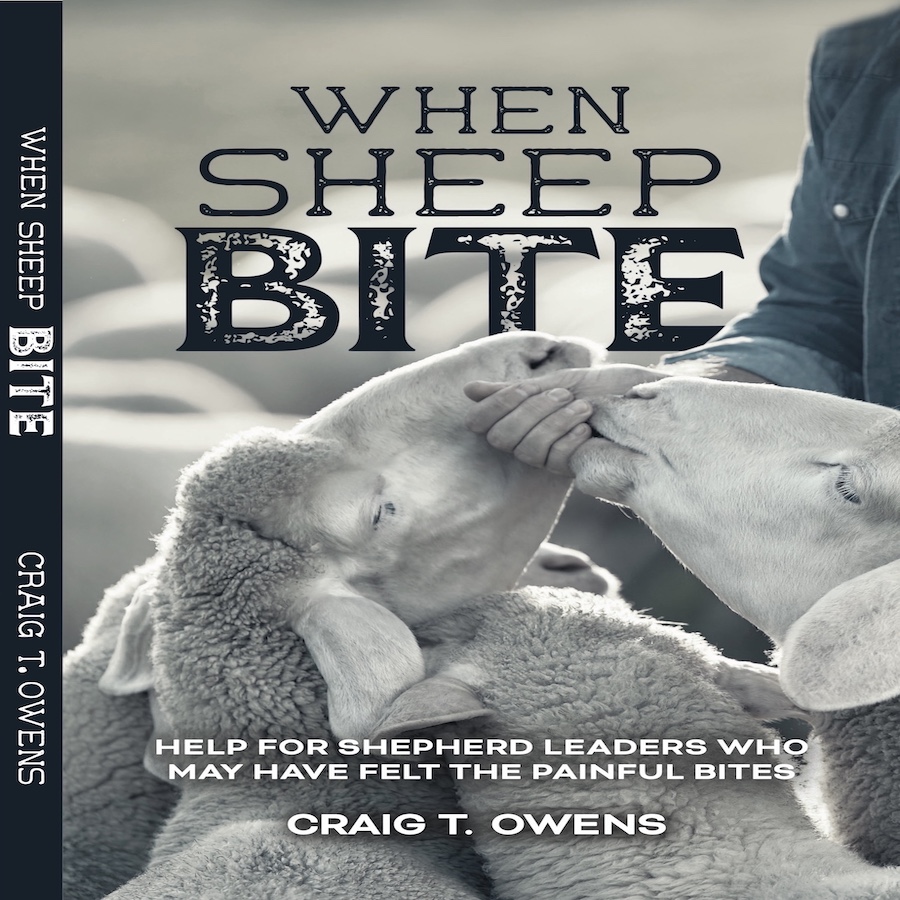
If you want to learn more about how to recover from sheep bites and how to handle future attacks in a biblical, Christ-like way, please pick up a copy of When Sheep Bite.
Listen to the podcast of this post by clicking on the player below, and you can also subscribe on Apple, Spotify, or Audible. Check out the video content in this post by clicking here.
Alexander the Great startled a dozing soldier on guard duty and learned that his name was also Alexander. Clearly, this soldier’s conduct was not representative of his leader who had the same name.
Brennan Manning astutely noted: “The greatest single cause of atheism in the world today is Christians: who acknowledge Jesus with their lips, walk out the door, and deny Him by their lifestyle. That is what an unbelieving world simply finds unbelievable.”
Whenever I am confronted by the Holy Spirit with something I have read or heard from God’s Word, I need to stop to ask, “Do I need to change my conduct or do I need to change my name?”
If I call myself a CHRISTian, I want to make sure that people see Christ in me.
You can check out the full sermon from which this clip came by clicking here.
“The only person who dares wake up a king at 3:00 a.m. for a glass of water is a child. We have that kind of access.” —Timothy Keller
Abdu Murray addressed an audience about what it means to be human, and how modern culture has “began to under-spiritualize and over-psychologize what it meant to be human.” I found his history lesson and applications to be quite fascination.
T.M. Moore is presenting a series of posts about the use of our time. “The only time we ever have is the present moment, supplied as an act of free grace by the eternal God and His Word. He has a purpose for the time He gives us: to know Him, enjoy His Presence and blessings, do His work, express His glory, and spread His grace in every moment of our everyday Christian lives. … Time is precious. We can make better use of it than we do.”
“Remember that you can never be really whole till you are holy, for holiness is spiritual sanity; it is the curing of the mind and heart from the disease which sin brought upon them.” —Charles Spurgeon
“What we call ‘being in love’ is a glorious state, and, in several ways, good for us. It helps to make us generous and courageous, it opens our eyes not only to the beauty of the beloved but to all beauty, and it subordinates (especially at first) our merely animal sexuality; in that sense, love is the great conqueror of lust.” —C.S. Lewis, in Mere Christianity
“A man is about as big as the things that make him angry.” —Winston Churchill
Listen to the podcast of this post by clicking on the player below, and you can also subscribe on Apple, Spotify, or Audible. Check out the video content in this post by clicking here.
When I would be struggling with stick-to-it-iveness, my Mom would say to me, “Anything worth having is worth working for.” From a young age, she was encouraging me to grind through the tough work to get to the payoff on the other side.
This is a great leadership principle, not only for leaders but for the teams they lead as well. Check out this clip where Greg and I talk about the grind necessary to achieve greatness.
You can watch the full Craig and Greg Show episode where we discuss how the leadership builder of resilience can keep at bay the leadership killer of resignation.
My book When Sheep Bite will help pastors who are trying to grind through the painful experience of biting sheep. This book has helped so many pastors see the factors that led up to the bite, the biblical responses to bites, and the resilience we can discover to help these shepherd leaders stay faithful to God’s calling. Check it out!
Listen to the podcast of this post by clicking on the player below, and you can also subscribe on Apple, Spotify, or Audible. Check out the video content in this post by clicking here.
What’s more impactful: living a good life or doing good deeds? Let’s talk about that on this episode of The Podcast.
I mentioned that the apostle Peter’s first letter was written to Christians who are citizens of heaven while living on earth. I taught a whole series about this called Aliens and Strangers.
Listen to the podcast of this post by clicking on the player below, and you can also subscribe on Apple, Spotify, or Audible. Check out the video content in this post by clicking here.
There’s a scene in The Princess Bride that rings true for us. As the grandfather is reading the story to his sick grandson, he has just revealed that the hero in the story has died. The grandson stops his grandfather, “Wait, grandpa, you’re reading that wrong.” This young man wants what all of us want: For the good guys to be vindicated and for the bad guys to get what’s coming to them.
The next Royal Psalm assures us that our Judge will perfectly balance His scales of justice. King David (sort of) gives us a picture of this.
King David’s son Absalom had usurped the throne, and David is fleeing the city with his trusted inner circle. Along the way he is confronted by a man named Shimei, who was from the same family as King Saul (2 Samuel 16:5-12). David gives us a good foretaste of King Jesus in the way he initially responds to this attack (19:18b-23). Sadly, David apparently hung on to these slights and asked his son Solomon to keep an eye on Shimei (1 Kings 2:8-9). So I’m going to guess that our Royal Psalm was written between these two incidents.
Psalm 98 is a call to sing our praise to our King and Judge. First, we are to sing to Him and about Him because of what Hehas already done:
He has done marvelous things (v. 1)
He has provided salvation (v. 1)
He has made His salvation known (v. 2)
He has revealed His righteousness (v. 2)
He has remembered His love for us (v. 3)
He has remembered His faithfulness toward us (v. 3)
the earth has seen His salvation (v. 3)
Then we are called to keep on singing in anticipation of what He is going to do: we shout for joy and burst into jubilant song (v. 4), make music (vv. 5-6a), shout for joy (v. 6b), and see creation praising all around us (vv. 7-9a).
All of this singing because He comes to judge? Does that sound right?
It sounds right when judgment is in the hand of the Perfect Judge. The Bible describes judges who are looking for bribes, or who are swayed by personal feelings (like King David), or Jesus even identified a judge who didn’t fear God or care about people.
But God on His throne isn’t any of these things! Isaiah prophesies Christ’s first Advent as one of peace (Isaiah 42:1-4). Even when Jesus was maligned and mistreated even more hatefully—and without having done anything wrong—than David, He still didn’t retaliate (1 Peter 2:21-23).
Jesus entrusted Himself to Him Who judges justly, which is what Psalm 98 calls us to do.
He comes to judge [vindicate] the earth [creation], which has been groaning for this (Romans 8:21-22).
He will judge [acquit or declare guilty] the world and its peoples (Matthew 25:31-32; Revelation 20:12).
His judgement will be with righteousness and equity—
righteousness = the perfect standard
equity = the perfect consequence (see also Isaiah 42:10-13)
In light of the perfect judgment from the perfect King that is coming, how should we live today?
He will handle retribution then—so don’t retaliate today (Isaiah 11:1-5).
He will handle vindication then—so forgive today (1 Peter 2:23; Luke 23:34).
He will call you to give an account then—so change your words and actions today (Matthew 12:36).
He will forgive blood-washed saints then—so forgive today (Matthew 6:14-15).
He will judge perfectly then—so don’t be judgmental today (James 5:9; Romans 2:1-3).
He will reward perfectly then—so don’t look for applause from the world today (2 Timothy 4:7-8; Matthew 25:34).
Our King has won our salvation, and He is going to balance the scales perfectly when He returns, so we should be singing His praise every day until His return!
T.M. Moore wrote, “I’m persuaded that one reason the work of personal evangelism has fallen on hard times in our day is that the people of God are simply fearful of the task. We find no joy in bearing witness to Jesus. Instead, we’re afraid that others won’t receive us kindly, that they’ll lash out or, worse, talk about us to others. We fear we might mess up the Gospel presentation and permanently offend someone. We fear the questions and challenges others might pose, that we might not be able to answer them. We’re afraid of being laughed at, yelled at, or dismissed as foolish or deceived or mad.”
“Do not be satisfied, dear brethren and sisters in Christ, with the grace that you already have. Be thankful for it, but ask for the divine multiplication of it; regard the grace which you have already received as being like the boy’s loaves and fishes, and expect that Christ will continue to multiply it for you and for thousands of others round about you: ‘Grace unto you, and peace, be multiplied.’” —Charles Spurgeon, commenting on 1 Peter 1:2
“Come to Me with a teachable spirit, eager to be changed. A close walk with Me is a life of continual newness. Do not cling to old ways as you step into a new year. Instead, seek My face with an open mind, knowing that your journey with me involves being transformed by the renewing of your mind.… Give yourself fully to this adventure of increasing attentiveness to My presence.” —Sarah Young, in Jesus Calling [she formed this quote from Romans 12:2; Jeremiah 29:11]
“Until you value yourself, you won’t value your time. Until you value your time, you will not do anything with it.” —M. Scott Peck
Clinton Manley gives us two bad excuses that people give for either not reading their Bible or not applying what they did read. He says, “God woos us to His word with unblushing promises of reward; take hold of them.”
“The simple step of a courageous individual is not to take part in the lie. One word of truth outweighs the world.” —Alexander Solzhenitsyn
Geneticists have found a single-cell pond ciliate that uses its RNA to send unexpected signals to the cell. “Surface-level study may make cells seem like simple chemistry, but deeper study reveals coded instructions, used by molecular tools and monitored by timing controls. Those tools operate as part of a larger biological network. This detailed process reflects sound engineering principles.” Even this tiny creature shows the flawless design of our Creator.



 It seems like many people put business and faith in two separate boxes, considering them entirely different topics of discussion. Greg and I completely disagree—the Bible is a resource for all areas of our lives, from the board room to the living room. That’s why we wrote our Business By The Book series. This is a guide to help you apply biblical principles to the corporate world. In today’s episode we preview the first book in this series: Business by the Book: What the Bible says about a CEO’s vision-casting.