Come And See What Our God Has Done

Check out the opening verses of Psalm 66—

Shout joyful praises to God, all the earth!
Sing about the glory of His name!
Tell the world how glorious He is.
Say to God, “How awesome are Your deeds!
    Your enemies cringe before Your mighty power.
    Everything on earth will worship You;
    they will sing Your praises,
    shouting Your name in glorious songs.” Interlude 
Come and see what our God has done,
    what awesome miracles He performs for people! (66:1-5 NLT)

I’d like to explore with you this phrase—come and see what our God has done. 

In so many of the Psalms we get at least a little context. We might be told the type of song it is or the kinds of musical instruments to be sung. We might know who wrote the psalm or at least why he wrote it. We might even hear what was happening in the psalmist’s world at the time he wrote the song or maybe at what event he wanted the song to be sung. All of these things would give us context clues into when/where to use the song—when I’m afraid? when I’m under attack? when I’m happy? when I’m depressed? 

For this psalm all the context we know is—For the choir director: A song. A psalm. 

But let me ask you: does it really matter? If you’re up or down, flush with cash or barely hanging on, winning the fight or feeling like you’re being beaten down—in any circumstance, can you still say come and see what our God has done? 

I think the answer is yes. I think this is the reason why no context is given us, because this psalm is appropriate regardless of the circumstances.

Just as the apostle Paul wrote, “I know how to live on almost nothing or with everything. I have learned the secret of living in every situation, whether it is with a full stomach or empty, with plenty or little. For I can do everything through Christ, who gives me strength” (Philippians 4:12-13).

As Christians, we’ve been called to step alongside people in their messy, broken lives. Yes, we are to weep with those who weep, but we’re not to keep them there but to take them to the One who can heal their messy, broken lives. 

The reasons to say, “Come and see what our God has done” are all around us. 

Earth’s crammed with heaven, 
And every common bush afire with God; 
But only he who sees, takes off his shoes, 
The rest sit round it and pluck blackberries, 
And daub their natural faces unaware. —Elizabeth Barrett Browning

Don’t just pluck blackberries; realize that those berries are the produce of a loving Creator. Don’t miss the opportunities to give God glory. Good times are wonderful opportunities to start. But those are just the starting points. Find the reasons even in hard times—I have learned the secret of being content in any and every situation, whether well fed or hungry, whether living in plenty or in want.

Anywhere … everywhere … no matter the context … HE IS STILL GOD. He is still worthy to be praised. There is still ample reason for us to say, “Come and see what our God has done!” 

People Are Watching 👀

 “…they watched Him closely… (Luke 14:1). 

The skeptics were always watching Jesus. As with our Master, so with us.

They wanted to find an inconsistency with which they could discount all that Jesus stood for. Thankfully, they found none! May the same be said of you and me.

May our lives and speech (or silence) never cause skeptics to discount the Gospel or—even worse—blaspheme God, nor may our lives cause a weak Christian to doubt or stumble.

This requires from us—

  • Self-awareness … I have to know my tendencies and avoid those things that cause offense.
  • Boldness … to speak the truth in love.
  • Knowledge of the Scripture … and its correct application.
  • God-confidence … so that we’re not intimidated by man’s disapproval.
  • Humility … to not seek things for our own benefit.
  • Charity … as we demonstrate our faith in loving action.
  • Focus … on eternity and on the greater treasure in Heaven.

Holy Spirit, empower us to live like our Master every day. “Adam’s likeness now efface, stamp Thine image in its place.” May people see and hear Jesus in us. No matter how closely they watch us, may they see no inconsistencies.

Poetry Saturday—Exhortation To Prayer

William CowperWhat various hindrances we meet
In coming to a mercy-seat!
Yet who that knows the worth of prayer,
But wishes to be often there?

Prayer makes the darken’d cloud withdraw,
Prayer climbs the ladder Jacob saw,
Gives exercise to faith and love,
Brings every blessing from above.

Restraining prayer, we cease to fight,
Prayer makes the Christian’s armor bright;
And satan trembles when he sees
The weakest saint upon his knees.

While Moses stood with arms spread wide,
Success was found on Israel’s side;
But when through weariness they fail’d,
That moment Amalek prevail’d.

Have you no words? Ah! think again,
Words flow apace when you complain,
And fill your fellow-creature’s ear
With the sad tale of all your care.

Were half the breath thus vainly spent
To Heaven in supplication sent,
Your cheerful song would oftener be,
“Hear what the Lord has done for me.” —William Cowper


Thursdays With Oswald—Getting The Order Right

Oswald ChambersThis is a weekly series with things I’m reading and pondering from Oswald Chambers. You can read the original seed thought here, or type “Thursdays With Oswald” in the search box to read more entries.

Getting The Order Right

     Beware of walking in the spiritual life according to your natural affinities. We all have natural affinities—some people we like and others we do not; some people we get on well with and others we do not. Never let those likes and dislikes be the rule of your Christian life. “If we walk in the light, as He is in the light, we have fellowship one with another” [1 John 1:7], i.e., God gives us fellowship with people for whom we have no natural affinity. …  

     Our example is not a good man, not even a Christian man, but God Himself. We do not allow the big surprise of this to lay hold of us sufficiently. Jesus nowhere says, “Follow your Father which is in heaven—that you may be good men? that you may be lovable to all men?” No, “that you may be the children of your Father which is in heaven” [Matthew 5:44-45], and that implies a strong family likeness to Jesus Christ. …  

     It takes a long time to get the full force of our Lord’s statements. “I say unto you, love your enemies”—an easy thing to do when you have no enemies; an impossible thing when you have. “Bless them that curse you”—easy when no one is cursing you, but impossible when someone is. “Do good to them that hate you, and pray for them that despitefully use you.” It seems easy to do all this when we have no enemies, when no one is cursing or persecuting us; but if we have an enemy who slanders and annoys and systematically vexes us, and we read Jesus Christ’s statement “I say to you, Love your enemies”—how are we going to do it? Unless Jesus Christ can remake us within, His teaching is the biggest mockery human ears ever listened to. …

     “I say unto you, love your enemies.” Jesus does not say, “Love every one.” The Bible never speaks vaguely, it always speaks definitely. People speak about loving “mankind,” and loving “the heathen”; Jesus says, “Love your enemies.” Our Lord does not say, “Bless your enemies,” He says, “Love your enemies.” He does not say, “Love them that curse you”; He says, “Bless them that curse you.” “Do good to them that hate you”—not bless them. He does not say, “Do good to them that despitefully use you”; He says, “Pray for them that despitefully use you.” Each one of these commands is stamped with sheer impossibility to the natural man. If we reverse the order Jesus has given it can be done with strain, but in His order I defy any man on earth to be able to do it unless he has been regenerated by God the Holy Ghost. When a man does love his enemies, he knows that God has done a tremendous work in him, and everyone else knows it too. 

From Studies In The Sermon On The Mount

It’s impossible to do what Jesus commands if we’re trying to do it solely in our own strength. But when we allow the Holy Spirit to remake us from within, we can do what Jesus says:

  • If someone is your enemy—love them.
  • If someone persecutes you—pray for them. 
  • If someone curses you—bless them.
  • If someone hates you—do good to them. 

When we operate this way, we know that God has made this possible in us—and everyone else knows it too!

Thursdays With Oswald—No Undercover Christians

Oswald ChambersThis is a weekly series with things I’m reading and pondering from Oswald Chambers. You can read the original seed thought here, or type “Thursdays With Oswald” in the search box to read more entries.

No Undercover Christians

     The illustrations our Lord uses are all conspicuous—salt, light, and a city set on the hill. There is no possibility of mistaking them. …  

     “You are the salt of the earth.” Some modern teachers seem to think our Lord said, “You are the sugar of the earth,” meaning that gentleness and winsomeness without curativeness is the ideal of the Christian. Our Lord’s illustration of a Christian is salt, and salt is the most concentrated thing known. Salt preserves wholesomeness and prevents decay. It is a disadvantage to be salt. Think of the action of salt on a wounded, and you will realize this. If you get salt into a wound, it hurts, and when God’s children are amongst those who are “raw” their presence hurts. The man who is wrong with God is like an open wound, and when “salt” gets in it causes annoyance and distress and he is spiteful and bitter. … How are we to maintain the healthy, salty tang of saintliness? By remaining rightly related to God through Jesus Christ. …  

     “You are the light of the world.” Light cannot be soiled; you may try to grasp a beam of light with the sootiest hand, but you leave no mark on the light. A sunbeam may shine into the filthiest hovel in the slums of the city, but it cannot be soiled. … Thank God for the men and women who are spending their lives in the slums of the earth, not as social reformers to lift their brother men to cleaner sties, but as the light of God, revealing a way back to God. 

From Studies In The Sermon On The Mount

God wants you to be His salt and light in the world. Are you willing to do that? 

Salt preserves, but it also stings as it does so. Some people will lash out at you for being salt in their presence, but keep on loving them with the love of Jesus. 

Light guides, but it also reveals unpleasant things. Some people will lash out at you for revealing sinful things, but keep on loving them with the love of Jesus. 

Don’t let the hostile reaction of people send you “underground.” Keep being conspicuously, unmistakably God’s salt and light in a world that is in desperate need of cleansing and illumination! 

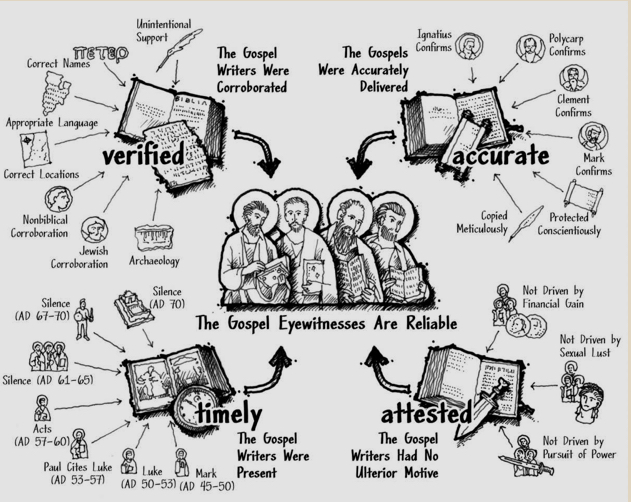
10 Quotes + 1 Infographic From “Cold-Case Christianity”

Cold-Case Christianity by J. Warner Wallace is educational in a number of ways. Not only will you learn more about police investigations and courtroom deliberations, but Christians and skeptics alike will learn about the reliability of the biblical account concerning Jesus. You can check out my full book review by clicking here. 

“The Christian tradition is actually intellectually robust and satisfying, even if we believers are occasionally unable to respond to your challenges. The answers are available; you don’t have to turn off your brain to be a believer. Yes, it is possible to become a Christian because of the evidence rather than in spite of the evidence.” 

“Faith is actually the opposite of unbelief, not reason. … The biblical definition of faith is a well-placed and reasonable inference based on evidence.” 

“What about cases that have no direct evidence connecting the suspect to the crime scene? Can the truth be proved beyond a reasonable doubt when all the evidence we have is circumstantial? Absolutely. 

“Jurors are instructed to make no qualitative distinction between direct and circumstantial evidence in a case. Judges tell jurors, ‘Both direct and circumstantial evidence are acceptable types of evidence to prove or disprove the elements of a charge, including intent and mental state and acts necessary to a conviction, and neither is necessarily more reliable than the other. Neither is entitled to any greater weight than the other.’” 

“William Dembski (the well-known mathematician, statistician, theologian, and intelligent-design advocate) has argued that specified complexity (and, therefore, the intervention of an intelligent agent) can be identified by using an ‘explanatory filter.’ If an object or event (1) cannot be explained by some natural law that necessitates its appearance, (2) exists in spite of the high improbability that it could occur as the result of chance, and (3) conforms to an independently existing and recognizable pattern, the most reasonable inference is that it is the product of an intelligent designer.” 

“The early church fathers and leaders recognized that the Gospels were the eyewitness testimony of the apostles, and they set the Gospels apart for this reason. The ancient Christian author Tertullian wrote in AD 212: ‘The same authority of the apostolic churches will afford evidence to the other Gospels also, which we possess equally through their means, and according to their usage—I mean the Gospels of John and Matthew—whilst that which Mark published may be affirmed to be Peter’s whose interpreter Mark was’ (Against Marcion). 

“Skeptics cannot reject the reasonable inferences from the evidence we do have, simply because there may possibly be some evidence we don’t have; skeptics also need to defend their doubt evidentially.” 

“The reasonable inference from the circumstantial evidence is that the Gospels were written very early in history, at a time when the original eyewitnesses and gospel writers were still alive and could testify to what they had seen.” 

“Some have argued that the Gospels are late because none of the authors specifically identifies himself in the accounts. … BUT … The Gospels are not the only ancient documents that fail to identify the author within the text of the manuscripts. Tacitus (the Roman senator and historian who lived from AD 56 to AD 117) wrote a history of the Roman Empire from the reign of Augustus Caesar to Nero entitled Annals. Tacitus was, in fact, present during much of this period of time, but failed to include himself in any of his descriptions or identify himself as the author.” 

“While it is possible that the Gospels were not written by the traditional first-century authors and were given these attributions only much later in history, it is not evidentially reasonable. If skeptics were willing to give the Gospels the same ‘benefit of the doubt’ they are willing to give other ancient documents, the Gospels would easily pass the test of authorship.” 

“The most reasonable inference is that the gospel writers were present, corroborated, accurate, and unbiased. If this is the case, we can conclude with confidence that their testimony is reliable.” 

“Love’s Labor”

Work is no curse; from the beginning we
were made for work, to seek the goodness of
the Lord, to multiply His beauty, love,
and truth, and serve His creatures happily.
When work is as a gift and ministry
received, a sacred calling from above,
then will each labor be engaged with love
and excellence, imparting dignity
and grace to those it serves, that they may see
in every labor a reflection of
the God who by His sacrifice of love
has worked the miracle that sets us free.
   You are love’s labor, everyone can see,
   especially as you labor long with Me. —T.M. Moore, from his book Bricks And Rungs

Do People Know That You Know That God Is Good?

Listen to the podcast of this post by clicking on the player below, and you can also subscribe on AppleSpotify, or Audible.

If you’ve been reading or watching my series on God’s favor the last few weeks, I hope you truly know this: God is for you! 

But the key question for Christians comes down to this—Do others know that you know that God is for you? 

You see, God is for you because God is joyful and happy, and He wants you to not only know this but to radiate this joy and happiness to those around you. 

Here’s how it works:

(1) Joy is an inside job. The dictionary defines joy as “a feeling of great delight caused by something exceptionally good or satisfying.” When we know by our personal experience with Him how good God is, joy is birthed in our hearts as we see Him as All-Good and All-Satisfying. 

(2) Joy is regardless of my external circumstances. Some people try to pursue happiness apart from joy. Trying to get happy without having the foundation of joy is like having a flower that has been picked from the plant. Happiness may be pretty for a short while, but it is already fading because it is completely dependent on the environment around it. True happiness isn’t dependent on external circumstances because it is rooted in something far greater. 

(3) Knowing God’s favor fuels our joy. There is a Hebrew word for know which means “knowledge through intimate, personal experience.” Psalm 100 describes happy people and their joyful praise. Their joy comes from this: They know that their Lord is God and that He is good. This joy comes from seeing and savoring God’s favor.  

(4) Our internal joy should bubble up into external happiness. All throughout the Bible, we read how those who are filled with joy as they get to know this exceptionally good, all-satisfying God cannot help but burst out in songs of happy praise (see Psalm 28:7 and Luke 10:21).

(5) Our external happiness becomes our testimony. In Psalm 126 we read that God’s people who were full of God’s joy burst out into happy praise. When they did the people around them recognized that God had done great things for them. 

Check this out—

“I don’t think it’s a stretch to say that to be a Christian and to be unhappy is a sin. An unhappy Christian gives God no praise, robs Him of glory, and paints God in a bad light. A happy Christian knows the Lord is his strength, his comfort, his supply. The happy Christian lifts God high and invites others to know this All-Good, All-Happy God too!” —Craig T. Owens 

So let me ask you again: If you call yourself a Christian, do people know that you know that God is for you? Are you making God look All-Good and All-Satisfying by your deeply fueled joy and your face-brightening happiness? 

What a testimony it is when God’s people are happy in Him! 

►► Would you please prayerfully consider supporting this ministry? ◀︎◀︎

If you have missed any of my other posts about God’s favor, you may check them out by clicking here.

Thursdays With Oswald—Isaiah 30

Oswald ChambersThis is a weekly series with things I’m reading and pondering from Oswald Chambers. You can read the original seed thought here, or type “Thursdays With Oswald” in the search box to read more entries.

Isaiah 30 

[These are the notes on Oswald Chambers’ lecture on Isaiah 30.] 

     The test of true religion is the knowledge of the character of God. As long as you think of God in the quietness of a religious meeting you will never know God—what kind of God have you got when you are in touch with the wrong, bad, evil things? God’s Book reveals that it is right in the midst of the very opposite of God that His blessings occur. The very things which seem to be making for destruction become the revealers of God. It is an easy business to preach peace when you are in health and have everything you want, but the Bible preaches peace when things are in a howling tumult of passion and sin and iniquity; it is in the midst of anguish and terror that we realize Who God is and the marvel of what He can do. …  

     God makes His people sing where in the eyes of the world it seems ironical to sing—in a besieged city where things are going to ruin, in the suburbs of hell, in the valley of the shadow of death. When you see lives in the midst of turmoil and anguish full of amazing brightness and uncrushable elasticity of faith in God, if you do not know God you will say, “However can they go through it? how is it that they remain undiscouraged and undismayed?” The explanation is the presence of God made real in His promises.” 

From Notes On Isaiah 

When you go through a “howling tumult” there are some things to remember:

  1. God is with you
  2. God is in control 
  3. God will help you sing through the storm
  4. Others are watching you
  5. God can be glorified in your undismayed faith in His presence through the tumult 

Thursdays With Oswald—The Powerful Witness Of Your Life

Oswald ChambersThis is a weekly series with things I’m reading and pondering from Oswald Chambers. You can read the original seed thought here, or type “Thursdays With Oswald” in the search box to read more entries.

The Powerful Witness Of Your Life

     Jesus Christ came to do what no human being can do, He came to redeem man, to alter their disposition, to plant in them the Holy Spirit, to make them new creatures. Christianity is not the obliteration of the old, but the transfiguration of the old. Jesus Christ did not come to teach men to be holy: He came to make men holy. His teaching has no meaning for us unless we enter into His life by means of His death. The Cross is the great central point. Jesus Christ is not first a Teacher, He is first a Savior. … 

     To preach the Gospel is to proclaim that God saves from sin and regenerates into His Kingdom anyone and everyone who believes on the Lord Jesus. It means even more—it means to disciple all the nations not only on the authority of Jesus, but on the flesh and blood evidence of entire sanctification in the life of the missionary.

From So Send I You

The Apostle Paul noted, “Then it pleased God to reveal His Son to me so that I would proclaim the Good News about Jesus to the Gentiles” (Galatians 1:15-16).

This is the exact same message Oswald Chambers has for Christians—If you have allowed Jesus to transform your life, that witness of Him in you is an undeniably powerful testimony! Yes, we need to preach what we believe, but this preaching needs to be backed up and amplified by living what we believe.

Christian, can you honestly say that your life is giving clear “flesh and blood evidence of entire sanctification”?