Are You Available?

Have you ever had someone walk into your life—even if it was just for a moment—and say something you needed to hear? You might not have liked what they had to say, but it was definitely something you needed to hear. 

My hunch is that those timely messengers were not necessarily “experts” in the area in which they talked to you. They may have been a doctor talking about a medical need, or it may have been a friend talking about some health issues. Most of the time our valuable messengers are just everyday people. 

God loves using “everyday people”! 

  • You don’t have to be a trained pastor to minister to people. 
  • You don’t have to be a trained theologian to tell people what you believe about God.
  • You don’t have to be a trained counselor to encourage someone.

You just have to be who God created you to be. And you have to be available. Like Amos. 

Amos was simply taking care of his farm and his herds when God called him to deliver a timely message to His people.

Amos introduces himself as just one of the shepherds of Tekoa (1:1) and tells another priest that he was simply minding his own business when God said, “Go, prophesy to My people” (7:10-15). 

Amos’ name means burden-bearer—he had a burden for his kinsmen. He saw their sin and knew what defiance of God would mean for them. This burden made him available to hear God’s voice say, “Go.” 

“But I’m not a trained prophet,” Amos could have said. “You are telling me to ‘prophesy’ but all I really know is farming and shepherding.” 

God said, “Say what you know.” 

What did Amos know?

  1. Amos knew God’s voice—In this short book, 43 times(!) Amos uses phrases like says the Lord, declares the Lord, or hear the word of the Lord. 
  2. Amos knew his business—This book is filled with language about sheep and shepherds, farmers and farm equipment, gardens and vineyards. 
  3. Amos knew God had told him “Go and speak” so Amos had boldness. 

You can put your name in all three of those places that say Amos. You can know God’s voice through the Bible, you know your “business” (whether it’s parenting, or coaching, or your own profession), and you can hear God saying, “Go, tell people about Me.” 

God wants to use you for His glory. He just needs your availability. Will you be open to being that person? 

Join me next week as we continue to learn the major lessons from that the minor prophets teach us. 

Poetry Saturday—Give Me The Love

Give me the love that leads the way, 
The faith that nothing can dismay, 
The hope no disappointments tire, 
The passion that will burn like fire.
Let me not sink to be a clod: 
make me Thy fuel, flame of God. —Amy Carmichael

Am I The Genuine Article?

Examine and test and evaluate your own selves to see whether you are holding to your faith and showing the proper fruits of it. Test and prove yourselves… (2 Corinthians 13:5). 

The root word for discern in the New Testament Greek is dokimazō. This word means to examine something—scrutinize it closely—to see if it is genuine. We’re instructed to take a close, scrutinizing look at…

  • …our beliefs about God (Romans 1:28)
  • …our understanding of God’s will for our lives (Romans 12:2)
  • …our relationship with God and others (1 Corinthians 11:28) 
  • …our faith (2 Corinthians 13:5)
  • …our motives (2 Thessalonians 2:4)
  • …the teaching we are listening to (1 John 4:1) 

In his book Romans: God’s Glory, Donald Grey Barnhouse discussed the root word for discern (the Greek word dokimos). He said, 

“In the ancient world there was no banking system as we know it today, and no paper money. All money was made from metal, heated until liquid, poured into moulds and allowed to cool. When the coins were cooled, it was necessary to smooth off the uneven edges. The coins were comparatively soft, and of course many people shaved them closely. In one century, more than eighty laws were passed in Athens to stop the practice of whittling down the coins then in circulation. But some money-changers were men of integrity, who would accept no counterfeit money; they were men of honour who put only genuine, full-weight money into circulation. Such men were called dokimos, and this word is used here for the Christian as he is to be seen by the world.” (emphasis mine)

This should be said of every Christian: “They are dokimos—men and women who are honorable and are the real deal. They don’t shave anything off; they don’t water anything down. They can be scrutinized closely and found to be the genuine article.” 

The Bible makes it clear that before the world can call us dokimos, the Holy Spirit first has to stamp that word on us. It’s only after we have allowed Him to scrutinize (and correct) our beliefs, relationships, faith, and motives that we can be labeled dokimos. When we are the real deal in His presence, the world cannot help but see the genuine article when they examine us. 

Let’s live this way! May both God and the watching world be able to call us dokimos! 

Thursdays With Spurgeon—Our Fight For Faith

This is a weekly series with things I’m reading and pondering from Charles Spurgeon. You can read the original seed thought here, or type “Thursdays With Spurgeon” in the search box to read more entries.

Our Fight For Faith

     Our faith at times has to fight for its very existence. The old Adam within us rages mightily, and the new spirit within us, like a young lion, disdains to be vanquished; and so these two strong ones contend, till our spirit is full of agony. …

     Christ alone was tempted in all points as we are, though without sin. No one man is tempted in all points exactly like another man, and each one has certain trials in which he must stand alone amid the rage of war, with not even a book to help him, or a biography to assist him—no man ever having gone that way before except that one Man whose trail reveals a nail-pierced foot. He alone knows all of the devious paths of sorrow. Yet even in such byways, the Lord is with us, helping us, sustaining us, and giving us grace to conquer at the close. … 

     So satan, loath to leave a soul, pursues it hotfoot. He will have it back if he can; and often, soon after conversion, there comes a time of dreadful conflict, when the soul seems as if it could not live. … 

     Once, when the tempter had grievously assailed me, I went to see my dear old grandfather. I told him about my terrible experience, and then I wound up by saying, “Grandfather, I am sure I cannot be a child of God, or else I should never have such evil thoughts as these.” 

     “Nonsense, Charles,” answered the good old man. “It is just because you are a Christian that you are thus tempted. These blasphemies are no children of yours; they are the devil’s brats, which he delights to lay at the door of a Christian. Don’t you own them as yours; give them neither house-room or heart-room.” 

From The Autobiography Of Charles Spurgeon

The apostle Peter says our adversary the devil continually prowls around looking for a follower of Jesus that he can devour. This shouldn’t be surprising to us since Jesus said that the devil’s agenda was to steal, kill, and destroy. (See 1 Peter 5:8-9; John 10:10.)

But the apostle Paul also tells us that we aren’t supposed to be unaware of the devil’s schemes. Instead, we are to capture every thought and make them obedient to Jesus (2 Corinthians 10:5). That means, as Spurgeon’s grandfather counseled him, we recognize those evil thoughts as the devil’s brats and don’t allow them to take up room in our house nor our heart. 

Stand firm—those who are in Christ are more than conquerors! 

Everyday Evidence

Last week we learned that speaking in tongues was one of the most noticeable and consistent characteristics of those who were baptized in the Holy Spirit. 

Speaking in tongues as the Spirit enables you is the unmistakable, objective, outward, initial physical evidence. The Bible makes clear that continuing to pray in tongues has huge benefits for both our personal prayer lives and for the corporate church body. But don’t stop there! 

The initial, outward evidence is primarily for the individual Christian—it’s a way of knowing that you know that you have indeed been baptized in the Spirit. But there also needs to be some everyday evidence for others that testifies to them that something is different about your life. 

Consider the disciples of Jesus before and after being baptized in the Holy Spirit…

Their vocabulary

Before being baptized in the Spirit they said stupid things because they didn’t know what to say (Mark 9:5-6) But after being baptized in the Spirit there was no more foot-in-mouth disease. Just as the Holy Spirit enabled them to praise God in an unlearned tongue, He also empowered their natural dialect. The same Greek word is used in Acts 2:4 (enabled by the Holy Spirit), 2:14 (Peter addressed the crowd), and 26:25 (what I am saying is true and reasonable). 

Their spiritual power

Before it was limited, and often thwarted, but afterward, it was limitless and effortless (Mark 9:17-18; Acts 3:1-8; 5:15; 6:8).

Their understanding of servanthood

Before they argued about who was the greatest. Afterward, they gladly gave all that they had to others (Mark 9:33-34; Acts 2:44-45). 

Their boldness in the face of adversity

Before they abandoned Jesus, ran away, and hid in locked rooms. Afterward, there was no intimidating or silencing them (Acts 4:8, 13, 18-20). 

Their understanding of Scripture

Before they had virtually no understanding of Scripture’s application. Afterward, they understood how to apply God’s Word in almost every situation (Acts 2:16, 33-35; 4:24-26). 

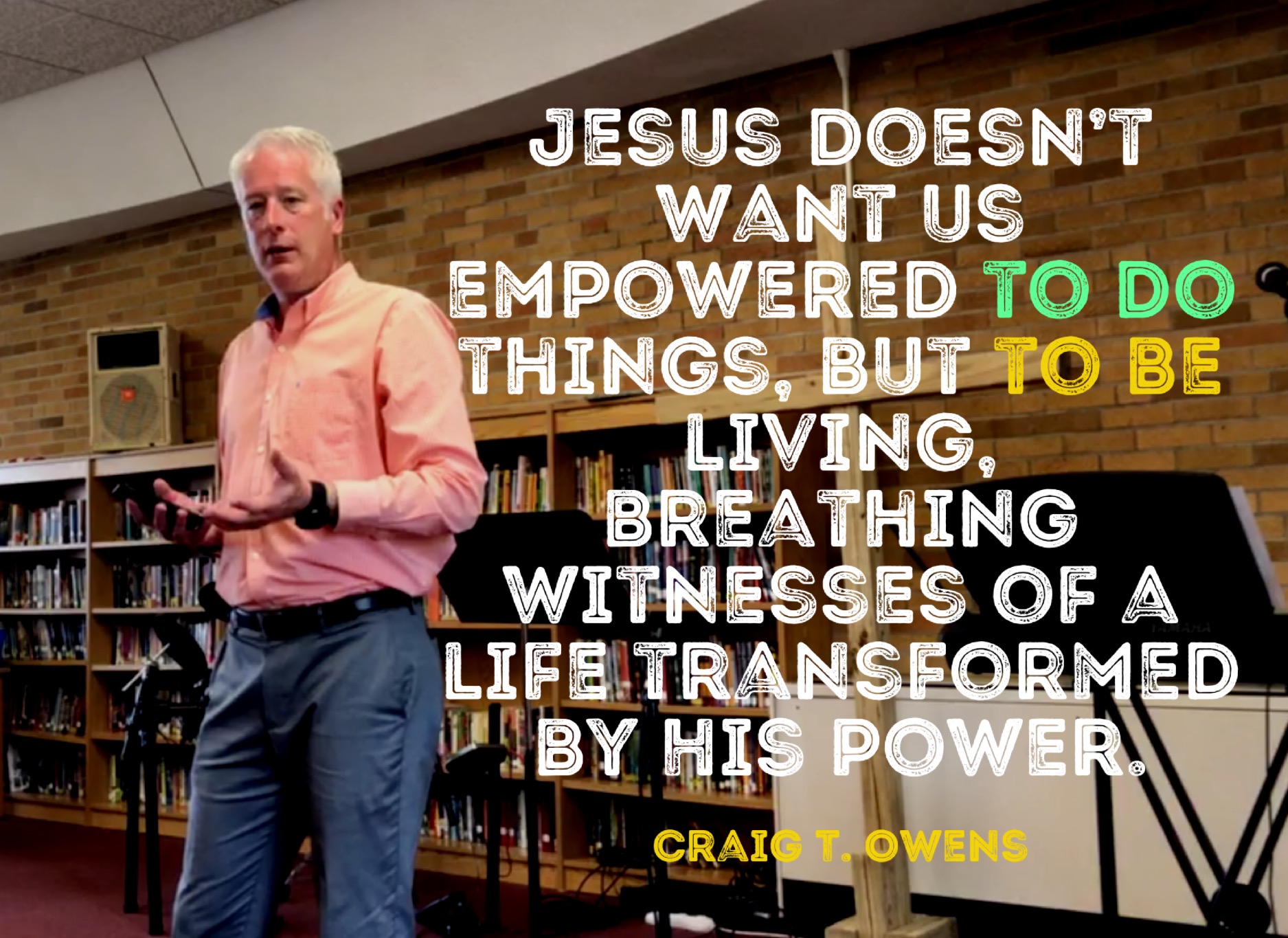
Jesus promised that the baptism in the Holy Spirit would empower us TO BE His witnesses (Acts 1:8). Not just to do things for Him. There’s nothing wrong about doing Jesus-glorifying things, but in themselves, they are too short-sighted. Jesus doesn’t want us empowered to do things, but TO BE a living, breathing, walking, talking witness of a life transformed by His power. That’s the reason why I say to you again and again: Don’t stop at salvation. Press on and press in to be baptized in the Holy Spirit so that you can BE an empowered, transformed and transforming witness for Jesus!

If you missed any of the messages in this series, you can access the full list of messages by clicking here

Thursdays With Spurgeon—Blessed Assurance

This is a weekly series with things I’m reading and pondering from Charles Spurgeon. You can read the original seed thought here, or type “Thursdays With Spurgeon” in the search box to read more entries.

Blessed Assurance

     The Holy Spirit, who enabled me to believe, gave me peace through believing. I felt as sure that I was forgiven as before I felt sure of condemnation. I had been certain of my condemnation because the Word of God declared it, and my conscience bore witness to it; but when the Lord Jesus justified me, the same witnesses made me equally certain. The Word of the Lord in the Scripture says, “He who believes in Him is not condemned” (John 3:18), and my conscience bore witness that I believed, and that God in pardoning me was just. Thus I had the witness of the Holy Spirit and also of my own conscience, and these two agreed in one. …  

     I find the apostle Paul speaking by the Holy Spirit and saying, “Having been justified by faith, we have peace with God” (Romans 5:1). If I know that my trust is fixed on Jesus only, and that I have faith in Him, were it not ten thousand times more absurd for me not to be at peace than for me to be filled with joy unspeakable? It is but taking God at His Word, when the soul knows as a necessary consequence of its faith that it is saved. …  

     Has Jesus saved me? I dare not speak with any hesitation here; I know He has. His word is true; therefore I am saved. My evidence that I am saved does not lie in the fact that I preach, or that I do this or that. All my hope lies in this, that Jesus Christ came to save sinners. I am a sinner, I trust Him, then He came to save me, and I am saved. I live habitually in the enjoyment of this blessed fact, and it is long since I have doubted the truth of it, for I have His own Word to sustain my faith.

From The Autobiography Of Charles Spurgeon

The joy that Spurgeon recounts in his conversion is the same joy that is available to all who call on Jesus in faith. As Spurgeon was prone to quoting passages of hymns in his sermons and books, these words of his remind me of a favorite hymn as well—

Blessed assurance, Jesus is mine;
Oh, what a foretaste of glory divine! 
Heir of salvation, purchase of God,
Born of His Spirit, washed in His blood. 
This is my story, this is my song,
Praising my Savior all the day long!

Thursdays With Spurgeon—Keep The Focus On The Savior

This is a weekly series with things I’m reading and pondering from Charles Spurgeon. You can read the original seed thought here, or type “Thursdays With Spurgeon” in the search box to read more entries.

Keep The Focus On The Savior

     I have heard men tell the story of their conversion, and of their spiritual life, in such a way that my heart has loathed them and their story, too, for they have told of their sins as if they did boast in the greatness of their crime, and they have mentioned the love of God, not with a tear of gratitude, not with the simple thanksgiving of the really humble heart, but as if they as much exalted themselves as they exalted God. Oh! When we tell the story of our own conversion, I would have it done with great sorrow, and with great joy and gratitude, remembering how little we deserve these things. … 

     My Master, I cannot understand how You stoop Your awful head to such a death as the death of the Cross, how You could take from Your brow the coronet of stars that from old eternity had shone resplendent there. But how You should permit the thorn-crown to gird Your temples astonishes me far more. That You should cast away the mantle of Your glory, the azure of Your everlasting empire, I cannot comprehend. But how You should have become veiled in the ignominious purple for a while and then be mocked by impious men who bowed to You as a pretended king; and how You should be stripped naked to Your shame, without a single covering, and die a felon’s death. This is still more incomprehensible. But the marvel is that You should have suffered all this for me! … 

     I, a lad, found the Lord of glory. I, a slave to sin, found the great Deliverer. I, the child of darkness, found the Light of Life. I, the uttermost of the lost, found my Savior and my God. I, widowed and desolate, found my Friend, my Beloved, my Husband. Oh, how I wondered that I should be pardoned! It was not the pardon that I wondered at so much; the wonder was that it should come to me. 

From The Autobiography Of Charles Spurgeon

How sad that many times the story of our salvation focuses more on how bad we were, and gives so little glory to how amazing our Savior’s rescue was. 

Just as the Apostle Paul called himself the chief of sinners, and stood in amazement that Christ’s love would reconcile him to God, so Spurgeon stood amazed that Jesus would stoop to die for “the uttermost of the lost.” 

It’s fine to tell people what used to be, but please make sure your story focuses more on how amazing it is that God’s love saved you from those sins. Amazing love! How can it be that You, my King, would die for me? 

Let’s keep the focus on the Savior! 

Your Incense…

…to God and the world.

Let’s follow this thread from the Old Testament into the New Testament—

“When Aaron trims the lamps at twilight, he shall burn incense. There shall be perpetual incense before the LORD throughout your generations.” (Exodus 30:8)

“Therefore I urge you, brethren, by the mercies of God, to present your bodies a living and holy sacrifice, acceptable to God, which is your spiritual service of worship.” (Romans 12:1)

“For we are a fragrance of Christ to God among those who are being saved and among those who are perishing.” (2 Corinthians 2:15)

“The incense which you shall make, you shall not make in the same proportions for yourselves; it shall be holy to you for the LORD.” (Exodus 30:37)

“Our lives are not to be about us, lived out in private and for self-glory. Our lives are to be about God, lived out in full view of the nations and for His name’s sake.” —Dick Brogden

What incense is your life—your witness, your testimony—sharing with those around you?

Thursdays With Oswald—Swine And Testimonies

Oswald ChambersThis is a weekly series with things I’m reading and pondering from Oswald Chambers. You can read the original seed thought here, or type “Thursdays With Oswald” in the search box to read more entries.

Swine And Testimonies

     Jesus Christ is inculcating the need to examine carefully what we present in the way of God’s truth to others [Matthew 7:6]. … 

     Over and over again men water down the Word of God to suit those who are not spiritual, and consequently the Word of God is trampled under the feet of “swine.” Ask yourself, “Am I in any way flinging God’s truth to unspiritual swine?” “Be careful,” Jesus says, “not to give God‘s holy things to ‘dogs.’” …  

     Our Lord never tells us to confess anything but Himself, ‘Whosoever…shall confess ME before men…’ (Matthew 10:32). Testimonies to the world on the subjective line are always wrong, they are for saints, for those who are spiritual and who understand; but our testimony to the world is our Lord Himself, confess Him, “He saved me, He sanctified me, He put me right with God.” … 

     If we are only true to a doctrine of Christianity instead of to Jesus Christ, we drive our ideas home with sledge-hammer blows, and the people who listen to us say, “Well, that may be true”; but they resent the way it is presented. When we follow Jesus Christ the domineering attitude and the dictatorial attitude go and concentration Jesus comes in. 

From Studies In The Sermon On The Mount

The apostle Paul also talked about wanting to make sure that Jesus was seen above all else. More harm than good is done when we talk about our personal experiences with God, which have now become our personal doctrines about God. 

Let God be as unique with others as He is with you. Don’t make other people fall in line with what you believe. Just point them to Jesus. As Chambers says, our testimony should be nothing but “He saved me, He sanctified me, He put me right with God.” Anything else, and we run the risk of casting pearl before swine. 

13 Quotes On The Gospel Of Luke

J.C. Ryle has given us a wonderful commentary on the Gospels in his Expository Thoughts On The Gospels. Check out my full book review here, and then enjoy a few quotes from Ryle’s insights on the Gospel of Luke.

“Lay firm hold on Bible promises. It is of the deepest importance to our peace to do so. Promises are, in fact, the manna that we should daily eat and the water that we should daily drink as we travel through the wilderness of this world.” 

“Christ’s loving kindness to His people never changes and never fails. It is a deep well of which no one ever found the bottom.” 

“There is not enough of a missionary spirit among Christians. It should not satisfy us to be safe ourselves. We ought also to try to do good to others. All cannot go to the heathen, but every believer should strive to be a missionary to his fellow man.” 

“No man shall ever be a loser in the long run by deeds of self-denying charity and patient love. At times he may seem to get nothing by his conduct. He may appear to reap nothing but ridicule, contempt, and injury. His kindness may sometimes tempt men to impose on him. His patience and forbearance may be abused. But at the last he will always be found a gainer.” 

“Have we the word of Christ’s promises? Then let us rest on it and fear nothing. Let us not doubt that every word that Christ has spoken shall be made good. The word of Christ is a sure foundation. He that leans upon it shall never be confounded.” 

“How much we ought to hate sin! Instead of loving it, cleaving to it, dallying with it, excusing it, playing with it, we ought to hate it with a deadly hatred. Sin is the great murderer, and thief, and pestilence, and nuisance of this world. Let us make no peace with it. Let us wage a ceaseless warfare against it.” 

“We must give up the vain idea of trying to please everybody. The thing is impossible and the attempt is mere waste of time. We must be content to walk in Christ’s steps and let the world say what it likes. Do what we will we shall never satisfy it or silence its ill-natured remarks. It first found fault with John the Baptist and then with his blessed Master. And it will go on caviling and finding fault with that Master’s disciples so long as one of them is left up on earth.” 

“Occasional retirement, self-inquiry, meditation, and secret communion with God are absolutely essential to spiritual health. The man who neglects them is in great danger of a fall. To be always preaching, teaching, speaking, writing, and working public works is, unquestionably, a sign of zeal. But it is not always a sign of zeal according to knowledge. It often leads to untoward consequences. We must make time occasionally for sitting down and calmly looking within, and examining how matters stand between our own selves and Christ. The omission of the practice is the true account of many a backsliding which shocks the church and gives occasion to the world to blaspheme.” 

“Let us beware of allowing traditions, old preconceived notions, unsound interpretations, or baseless theories in religion to find a root in our hearts. There is but one test of truth: ‘What says the Scripture?’” 

“The kindness of a Christian towards others should not be in word and in tongue only, but in deed and in truth. His love should be a practical love, a love which entails on him self-sacrifice and self-denial, both in money, and time and trouble. His charity should be seen not merely in his talking but his acting—not merely in his profession but in his practice. He should think it no misspent time to work as hard in doing good to those who need help as others work in trying to get money. … Such brotherly love the world may not understand. The returns of gratitude which such love meets with may be few and small. But to show such brotherly love is to walk in the steps of Christ. … What are we doing to help those who are troubled in mind, body, or estate? There are many such in this world. There are always some near our own door. What are we doing for them? Anything, or nothing at all? May God help us to answer these questions! The world would be a happier world if there was more practical Christianity.” 

“Never let us forget that to be content with sitting in the congregation and hearing sermons, while we bear no fruit in our lives, is conduct which is most offensive to God.” 

“Let us endeavor to live daily in the sight of a holy God. So living, it will matter little how much we are ‘watched’ by an ill-natured and malicious world. Let us exercise ourselves to have a conscience void of offense toward God and man, and to do nothing which can give occasion to the Lord’s enemies to blaspheme.” 

“An idea appears to prevail in some men’s minds that true religion may be separated from common honesty, and that soundness about matters of doctrine may cover over swindling and cheating in matters of practice! Against this wretched idea our Lord’s words were a plain protest. Against this idea let us watch and be on our guard.” 

You can read Ryle’s quote on The Gospel of Matthew here, and on the Gospel of Mark here.