Christlike Wives And Husbands

like-jesusTime after time Peter calls Christians to live a counter-cultural lifestyle. The most countercultural example we have ever seen is Jesus Christ.

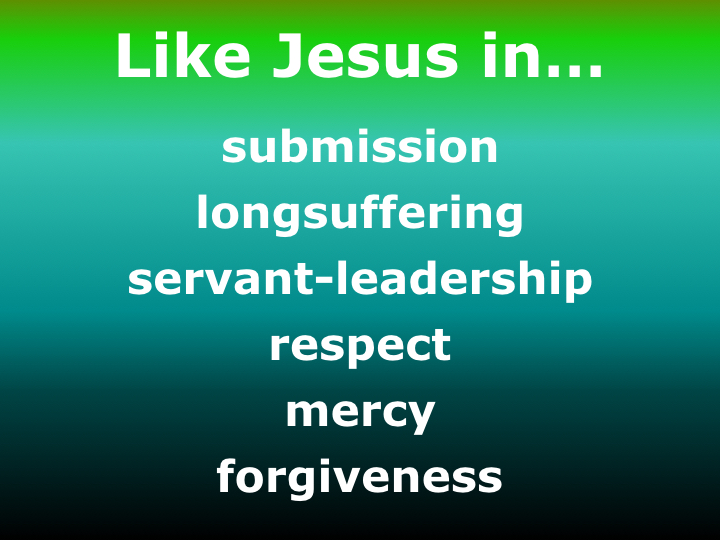
Peter shows us how Jesus—in the most excruciating situation possible—lived. Heading into the torture of crucifixion

  • He was submissive to His Father’s will
  • He remained focused on the future glory, not just the immediate pain
  • He continued to be a servant-hearted leader
  • He spoke to those around Him respectfully
  • He extended mercy to His tormentors
  • He prayed for (and purchased with His blood) His tormentors’ forgiveness

Peter then tells Christian wives and husbands they are to behave in the same way as Jesus. Wow!

More specifically Peter challenges Christlike wives to be:

  1. Submissive to their husbands—I like how the Amplified Bible says this in verse 1: “subordinate, not as inferior, but out of respect for the responsibilities entrusted to husbands and their accountability to God, and so partnering with them.
  2. Christlike in their behavior.
  3. Distinctive by their purity.
  4. Reverent to God, by honoring the image of God in their husbands.
  5. Beautiful from the inside out.
  6. Consistently doing what is right
  7. Not swayed by fear—“do what is right without being frightened by any fear [that is, being respectful toward your husband but not giving in to intimidation, nor allowing yourself to be led into sin, nor to be harmed]” (v. 6 AMP).

Likewise Peter challenges Christlike husbands to be:

  1. Submissive to their wives—remember the in the same way phrase? That applies to the men too. Submit to one another out of reverence for Christ. … Husbands, love your wives, just as Christ loved the church and gave Himself up for her (Ephesians 5:21, 24).
  2. Considerate of her—the King James Version says, “dwell with them according to knowledge.” That word for knowledge means to study your wife and know what she likes and doesn’t like.
  3. Respectful in the way he treats his wife.
  4. Treating her as a partner and heir in your spiritual heritage.
  5. Understanding the part she plays in your spiritual development—“The same goes for you husbands: Be good husbands to your wives. Honor them, delight in them. As women they lack some of your advantages. But in the new life of God’s grace, you’re equals. Treat your wives, then, as equals so your prayers don’t run a ground” (v. 7 MSG).

Here are two questions I think Christian wives and husbands need to seriously consider: Are you thinking about your role as a husband or wife in biblical terms or cultural terms? If you are thinking in cultural terms, are you willing to try it God’s way?

Our Christian marriages should be “alien” to the way the world operates; they should be counter-cultural. That kind of marriage is what points people to a relationship with Jesus!

If you’ve missed any messages in this series, you may find the complete list by clicking here.

5 Ways To Be A Christlike Employee

Work like JesusHave you ever had a bad boss? One who was harsh, unreasonable, overly demanding, or just a plain meany? Do you think working for a “bad boss” means that you get to lower your standards?

Not if you are a Christian!

Christians are on Earth to represent Jesus. We are aliens and strangers here for a short time, but here to also point people toward Heaven. One place we have tremendous opportunity to do this is on our jobs.

Think about it: most people will work 30-40 hours per week, and probably work 40-50 years of their life. That’s a lot of hours in which to show that living for Jesus makes all the difference in the world. 

Peter addresses our work situation in his first epistle. In essence he says, “You may not be able to control your boss’s actions, but you can control your reactions. A Christian has a different attitude about workplace employers than Earthlings do.”

The two things that set Christian employees apart is their submission and their respect.

Submission means understanding the proper order. This isn’t just showing up on time, wearing the right uniform and checking off the right things on your job description. All of those things can be done with a lousy attitude, with an attitude that’s nothing like Christ’s attitude.

Submission means viewing our employers differently—

  • Obeying them like we would obey Jesus (Ephesians 6:5).
  • Being sincere when we say, “Yes, I’d be happy to do that” (Ephesians 6:5).
  • Working hard even when our employer isn’t watching us (Ephesians 6:6).

With that in mind, here are five ways to be an “alien employee.” That is, someone who honors God on-the-job…

  1. Work for God.
  2. Trust God to be your Provider, not your employer.
  3. Trust God to keep perfect records of your faithful service.
  4. Pray for God’s blessing on your employer.
  5. Pray for your employer to see Jesus in your work ethic.

Here’s a great question to ask yourself: If Jesus were filling out my employee evaluation, what would He say about my work ethic? 

If you’ve missed any messages in this series, you may find the complete list by clicking here.

Misbehaving Government

Misbehaving governmentChristians are to have an “alien” response to earthly governments. Simply stated: the Bible says we should not rail against governing authorities the way Earthlings do. Christians should respond with proper submission (check this out).

But what if those earthly governors are misbehaving? What then?

We can still be in God-honoring submission to them in the way we call out their misbehavior. 

Look at some examples—

  • Daniel asked permission to go against the king’s wishes (Daniel 1:8), proposed an alternative plan (v. 12), but ultimately agreed to submit to the authority’s decision (v. 13).
  • Shadrach, Meshach and Abednego didn’t argue with King Nebuchadnezzar (Daniel 3:16-18), but respectfully took their stance for God (notice the use of the phrase “O king” as a title of respect).
  • Peter and John simply stated, “We must obey God rather than human authority” (Acts 5:29).

This is exactly what Jesus told us to do when He said, “Give to Caesar what is Caesar’s, and to God what is God’s” (Luke 20:25). Jesus said something very similar to Pilate, when that governor said, “Don’t you realize I have the power to set You free?” Jesus said, “You would have no authority over Me if it were not given to you from above” (John 19:10-11).

So how do we respond to misbehaving governors?

[1] With respect to their office.

[2] With reverent fear of God (see 1 Peter 2:17). “Because we reverence God as the Lord of history, we see beyond the fear and intimidation of the moment.” —James W. Thompson

[3] Leaving the results to GodDaniel 3:26-29, 6:16-27; Acts 5:40-42.

[4] With lots of prayer1 Timothy 2:1-4.

Throughout history, Christians have always had the opportunity to confront ungodly governors. HOW they did it is what set them apart from the Earthling response, and what brought glory to God.

Here’s the video of my full message on this topic—

Next Sunday, November 8, is a day of prayer for those facing persecution for their Christian faith around the world. Join us in a time of prayer for them. If you’ve missed any messages in this series, you may find the complete list by clicking here.

Alien Government

Are we submittingPerhaps you can relate to one or more of these quotes about our government:

  • “Government is like a baby: …a big appetite at one end and no sense of responsibility at the other.” —Ronald Reagan
  • “If you ever injected truth into politics you have no politics.” —Will Rogers
  • “The word ‘politics’ is derived from the word ‘poly,’ meaning ‘many,’ and the word ‘ticks,’ meaning ‘blood sucking parasites.’” —Larry Hardiman
  • “Politics have no relation to morals.” —Nicolo Machiavelli

But if you are a Christian, the Bible calls you to not give in to the cynicism that many feel toward our government. As aliens and strangers on Earth, we are called to to interact with government officials in a peculiar way.

In a single word, the Bible calls us to submit. The Greek word that both Peter (1 Peter 2:13) and Paul use (Romans 13:1, 5) has a couple of definitions. On the one hand it carries a military meaning to arrange troops under the command of a leader. On the other hand, it’s also a voluntary attitude of cooperating, assuming responsibility, and carrying a burden for the common good.

No where does submission imply letting leaders abuse us, or remaining silent and uninvolved if their activities are immoral or unbiblical. Instead submission recognizes that government officials have been placed in their positions by God (Daniel 4:25, 32the Most High is sovereign over all the kingdoms of men, and gives them to anyone He wishes), and that they are God’s servants (Romans 13:4, 6) who have to give an accounting to God for their actions.

Our alien response of properly submitting is our way of supporting them in their God-given responsibilities. How do we do this?

  1. Treat them with respect (Romans 13:7; 1 Peter 2:17).
  2. Separate the person [loved by God] from the policy [may or may not line up biblically], then disagree with the policy, not with the person.
  3. Pray for them (1 Timothy 2:1-4).

This way of interacting with them will bring glory to God (1 Timothy 2:3; 1 Peter 2:15).

Here’s a good question to ask ourselves: Are we submitting like servants of the King of kings?

If you’ve missed any messages in this series, you may find the complete list by clicking here.

You may also be interested in my video The Church should be pre-political.

Authority Comes From Submission

Authority comes from submissionOut of all the unlikely places, I never would have expected that guy to be a theologian! After all, the ones with the amazing insight into how God works are supposed to be deep into Scripture, know the ancient biblical languages, and be able to preach profound sermons. This guy had none of that.

He was simply an officer in the military who had an aide-de-camp who was sick. He had enough basic knowledge to see that Jesus could do something for his faithful assistant, but—strangely enough—he didn’t think he was worthy of having Jesus come into his home.

He said something that caused Jesus to be amazed. When Jesus is amazed by something a man does, that gets my attention!

This military officer said, “Although I’m an officer who can tell people what to do—when I say, ‘Jump!’ they say, “How high, sir?’ When I say, ‘Go!’ they say. ‘Yes, sir!’—I’m also a man under authority. I recognize that you too, Jesus, are a Man of authority. So if You simply say, ‘Go!’ to this disease, it will go.”

Jesus was amazed!

What theology came from that guy—a Roman centurion! This military officer saw that authority came from being under authority. Jesus had authority because He remained under the authority of His Heavenly Father (see John 12:49-50; Philippians 2:5-11).

We can learn a valuable lesson from this unlikely theologian. Authority comes NOT from trying to get our way, but from doing things God’s way … from staying under His authority. All the authority you will ever need is found in the Word of God (see Matthew 9:6-8; 10:1; 16:19).

This is a great story. Check it out for yourself here.

10 Quotes For Pastors From “Living A Prayerful Life”

Living A Prayerful LifeAs I mentioned in my book review of Andrew Murray’s A Prayerful Life, this book was written as a response to pastors who were concerned about the lack of effectiveness in their ministry. Pastor Murray called out the sin of prayerlessness as the main factor in their struggles. Here are some quotes from this book specifically to pastors.

“The enemy uses all his power to lead the Christian—and above all, the minister—to neglect prayer. satan knows that however admirable the sermon may be, however attractive the service, however faithful the pastoral visitation, none of these things can damage him or his kingdom if prayer is neglected.”

“The pastor’s highest calling is not preaching, or speaking, or church visitation, but it is to cultivate the life of God in himself daily, and to be a witness of what the Lord teaches him and accomplishes in him.”

“Here on earth I may expend my time in exchange for money or learning. The minister exchanges his time for divine power and the spiritual blessings to be obtained from heaven. That, and nothing else, makes him a man of God and ensures that his preaching will be in the demonstration of the Spirit and power.”

“Many pray for the Spirit that they may make use of Him and His power for their work. This is an entirely wrong concept. It is He Who must use you. Your relationship toward Him must be one of deep dependence and utter submission. The Spirit must have you completely and always and in all things under His power.”

“When the Lord promised the apostles that they would receive power when the Holy Spirit came upon them, and commanded them to wait for Him, it was as though He said: ‘Do not dare to preach without this power. It is the indispensable preparation for your work. Everything depends on it.’”

“Little time in the Word together with little prayer is death to the spiritual life. Much of the Word but little prayer yields a less than healthy spiritual life. Time spent in prayer with little time in the Word yields life, but without steadfastness. A full measure of the Word and much prayer each day produces a healthy and powerful life.”

“The preacher must come to see that his preaching is comparatively powerless to bring new life until he begins to take time for prayer.”

“All you who long for blessing in your ministry, He calls you to abide in Him. Let it be the greatest delight of your life to spend time with God; it will be the surest preparation for fruitful service.”

“As a minister of the gospel, have you ever considered why you have a salary and a place to live, and so are freed from the need of holding a regular job? The reason is so that you can continue in prayer and the ministry of the Word. These will give you the necessary wisdom and anointing for your work. And that is the secret of a fruitful ministry. No wonder there are often complaints about the ineffective spiritual life of a minister and his congregation. That which is of prime importance—perseverance in prayer—does not occupy its rightful place.”

“The great question is: Shall we earnestly set ourselves to win back again the weapon of believing prayer that satan has, at least in a measure, taken away from us? Let us set before ourselves the serious importance of this conflict. As far as each minister is concerned, everything depends on whether or not he is a man of prayer—one who in the inner room is clothed each day with power from on high.”

To read some of the other quotes I shared from this book, please click here. And to read my full book review of Living A Prayerful Life, click here.

Thursdays With Oswald—Thoughtful Questions

Oswald ChambersThis is a weekly series with things I’m reading and pondering from Oswald Chambers. You can read the original seed thought here, or type “Thursdays With Oswald” in the search box to read more entries.

Thoughtful Questions

Oswald Chambers usually sprinkles questions into his lectures, but in this passage, the questions came one right after another—

  • Are we lazy spiritually because we are so active in God’s work?
  • When the problems of the body face us, do we stop going with Jesus?
  • Do we listen to the tempter’s voice to put our bodily needs first—‘Eat bread, be well, first look after what you were going to wear, and then attend to God?’
  • Have we given God as much ‘elbow room’ in our lives as Our Lord gave Him in His?
  • Have we the one set purpose… not to do our own will but the will of God?
  • Are we going with Jesus in the life we are living now?
  • When we are tempted as He was, do we continue to go with Him?
  • What are we like where nobody sees?
  • Have we a place in our heart and mind and life where there is always open communion between ourselves and God so that we can detect the voice of the devil when he comes as ‘an angel of light’?
  • Are we compromising in the tiniest degree in mental conception with forces that do not continue to go with Jesus, or are we maintaining the attitude of Jesus Christ all through?
  • Are we departing from Jesus in the slightest way in connection with the world to which we belong?
  • Have we this past week choked the Son of God in our life by imperceptible degrees?

From The Love Of God

Yeah, I’m going to have to ponder these for awhile…

God & Government

Remind the believers to submit to the government and its officers. They should be obedient, always ready to do what is good. (Titus 3:1 NLT)

According to this verse I don’t see a conflict between the Church and the State. 

God calls us as Christians to arrange ourselves properly under the government hierarchy. Submission is not blind followership; submission is obeying all moral laws.

God also calls us to show proper respect to the governing officials, and to be ready to lend a hand to them when we can.

The Church is not in competition with the government. Both the governments of men and the Church are instituted by God. There is a proper role for both. There are some things that should be left to the government, and other things that should be left to the Church, and still other things that both should attend to together.

We need wisdom to know which institution should handle which item. In the meantime, may we Christians always be submissive, obedient, respect, and ready to help.

Check out some other thoughts about a biblical view of government here.

Pastoral Submission

What do you think of when you hear those words pastoral submission?

We may not be on the same page about this yet. I don’t mean people in a congregation submitting to a pastor. I mean something deeper than that.

Allow me to start with an unusual verse for this topic. Paul wrote,

When Peter came to Antioch, I opposed him to his face… (Galatians 2:11).

First of all, this is the proper way to handle an issue like this. Paul didn’t talk to others, nor run to the leaders in Jerusalem, but he went one-on-one with Peter.

Consider Paul’s relationship to Peter if there was a “corporate flowchart” for the First Century Church—Peter would have been Paul’s superior. Yet, Peter not only received this correction from Paul but continued to speak highly of Paul.

Beginning in the first chapter of Galatians we see Paul’s level of accountability. He answered to God, but he also submitted to other church leaders. Not only that, but this passage (Galatians 2:7-9) tells us that other church leaders submitted to Paul.

When I know God has called me, and I am doing my work for His approval alone, and when I know God has called others, and they too are ministering only for His approval then we can mutually submit to one another.

It’s not a top-down hierarchy in the church, except for Jesus being the Head and all others are below Him. All others (clergy and congregation) in the Body of Christ are on equal standing—no one is more important than any other. Therefore, as we submit to Christ’s Headship, we can also mutually submit to others in the Body.

What keeps us from doing this? Pride! We say, “What will others think of me if I submit?” Pastors think, “If I submitted to someone in my congregation, how could I ever lead this church? People will take advantage of me! No one will ever listen to me again!”

Not true!

When I am fully submitted to Christ, there is no stronger grounds for SERVANT leadership.

I don’t pastor to lead; I pastor to serve. 

I’m not building my church; I’m building Christ’s church. 

I’m not growing my followers; but followers of Jesus. 

Holy God, help me to know who I am in You. You have called me to pastor, so I am Your servant. Help me kill my pride! Help me serve and submit. Help me to build Your Church.

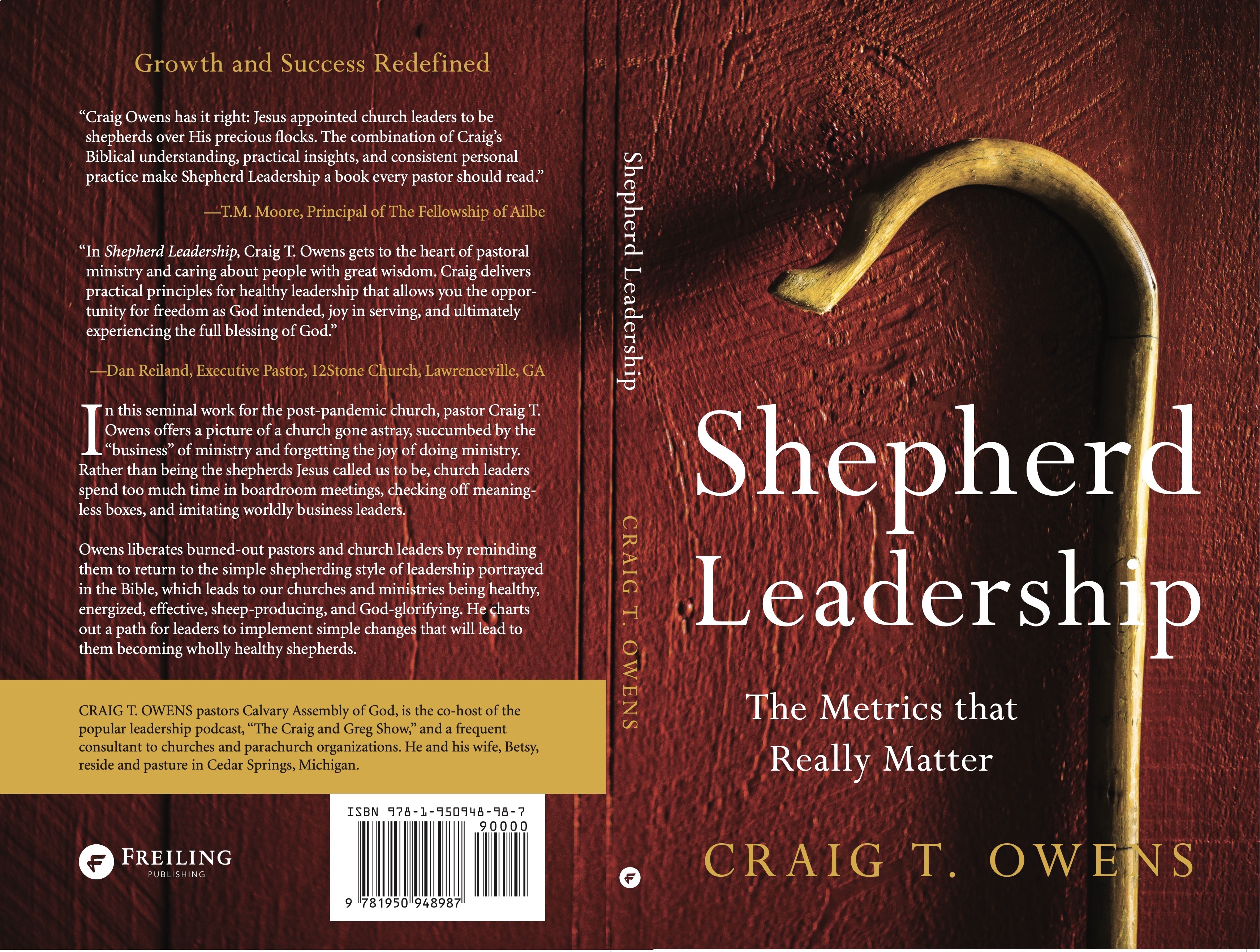
UPDATE: This post was one of the seed thoughts that went into fashioning my book Shepherd Leadership: The Metrics That Really Matter.

Conformed To His Image (book review)

Oswald Chambers challenges my thinking about the Christian walk like few other authors can. His insights are always so profound, and yet at the same time awaken me to the realization that I am the one who makes the Christian walk something complex. In Conformed To His Image, I was yet again challenged to simply follow Jesus.

Chambers brilliantly turns secular psychology upside down. He takes what psychology wants to ascribe to our minds and emotions, and brings it back to a Scriptural basis that puts these things where they are supposed to be: in the soul.

The thought of being “conformed” rubs against the human desire to be free and in charge of our own destiny. Somehow being “conformed” feels like being controlled and giving up our unique personality. So Chambers contrasts the natural human tendencies for freedom and calling our own shots with what the Bible says about surrendering to God.

Chambers presents Jesus not as some superhuman, extraordinary Man. But He shows the life of Jesus to be what we should all be able to live out daily. Jesus was perfectly conformed and submitted to the will of His Father. And, he says, if we will submit as well, the Holy Spirit will conform us into the image of Jesus.

Beware: this book is not light reading. This is a heavy-duty, confrontational book that will challenge you to submit to the Holy Spirit as perhaps you never have before in your Christian walk. However, if you are ready to take the plunge into a much deeper, more intimate relationship with your Heavenly Father, Conformed To His Image is the resource for you.