13 Quotes On The Gospel Of Luke

J.C. Ryle has given us a wonderful commentary on the Gospels in his Expository Thoughts On The Gospels. Check out my full book review here, and then enjoy a few quotes from Ryle’s insights on the Gospel of Luke.

“Lay firm hold on Bible promises. It is of the deepest importance to our peace to do so. Promises are, in fact, the manna that we should daily eat and the water that we should daily drink as we travel through the wilderness of this world.” 

“Christ’s loving kindness to His people never changes and never fails. It is a deep well of which no one ever found the bottom.” 

“There is not enough of a missionary spirit among Christians. It should not satisfy us to be safe ourselves. We ought also to try to do good to others. All cannot go to the heathen, but every believer should strive to be a missionary to his fellow man.” 

“No man shall ever be a loser in the long run by deeds of self-denying charity and patient love. At times he may seem to get nothing by his conduct. He may appear to reap nothing but ridicule, contempt, and injury. His kindness may sometimes tempt men to impose on him. His patience and forbearance may be abused. But at the last he will always be found a gainer.” 

“Have we the word of Christ’s promises? Then let us rest on it and fear nothing. Let us not doubt that every word that Christ has spoken shall be made good. The word of Christ is a sure foundation. He that leans upon it shall never be confounded.” 

“How much we ought to hate sin! Instead of loving it, cleaving to it, dallying with it, excusing it, playing with it, we ought to hate it with a deadly hatred. Sin is the great murderer, and thief, and pestilence, and nuisance of this world. Let us make no peace with it. Let us wage a ceaseless warfare against it.” 

“We must give up the vain idea of trying to please everybody. The thing is impossible and the attempt is mere waste of time. We must be content to walk in Christ’s steps and let the world say what it likes. Do what we will we shall never satisfy it or silence its ill-natured remarks. It first found fault with John the Baptist and then with his blessed Master. And it will go on caviling and finding fault with that Master’s disciples so long as one of them is left up on earth.” 

“Occasional retirement, self-inquiry, meditation, and secret communion with God are absolutely essential to spiritual health. The man who neglects them is in great danger of a fall. To be always preaching, teaching, speaking, writing, and working public works is, unquestionably, a sign of zeal. But it is not always a sign of zeal according to knowledge. It often leads to untoward consequences. We must make time occasionally for sitting down and calmly looking within, and examining how matters stand between our own selves and Christ. The omission of the practice is the true account of many a backsliding which shocks the church and gives occasion to the world to blaspheme.” 

“Let us beware of allowing traditions, old preconceived notions, unsound interpretations, or baseless theories in religion to find a root in our hearts. There is but one test of truth: ‘What says the Scripture?’” 

“The kindness of a Christian towards others should not be in word and in tongue only, but in deed and in truth. His love should be a practical love, a love which entails on him self-sacrifice and self-denial, both in money, and time and trouble. His charity should be seen not merely in his talking but his acting—not merely in his profession but in his practice. He should think it no misspent time to work as hard in doing good to those who need help as others work in trying to get money. … Such brotherly love the world may not understand. The returns of gratitude which such love meets with may be few and small. But to show such brotherly love is to walk in the steps of Christ. … What are we doing to help those who are troubled in mind, body, or estate? There are many such in this world. There are always some near our own door. What are we doing for them? Anything, or nothing at all? May God help us to answer these questions! The world would be a happier world if there was more practical Christianity.” 

“Never let us forget that to be content with sitting in the congregation and hearing sermons, while we bear no fruit in our lives, is conduct which is most offensive to God.” 

“Let us endeavor to live daily in the sight of a holy God. So living, it will matter little how much we are ‘watched’ by an ill-natured and malicious world. Let us exercise ourselves to have a conscience void of offense toward God and man, and to do nothing which can give occasion to the Lord’s enemies to blaspheme.” 

“An idea appears to prevail in some men’s minds that true religion may be separated from common honesty, and that soundness about matters of doctrine may cover over swindling and cheating in matters of practice! Against this wretched idea our Lord’s words were a plain protest. Against this idea let us watch and be on our guard.” 

You can read Ryle’s quote on The Gospel of Matthew here, and on the Gospel of Mark here. 

Saturday In The Proverbs—Lifelong Learning (Proverbs 30)

[Each chapter in the Book of Proverbs contains thoughts that fit into a theme; they are not just random thoughts gathered together. In this “Saturday In The Proverbs” series, I will share a theme that I see in each chapter. But the cool thing about God’s Word is that you may see an entirely different theme. That’s great! If you do, I would love for you to share it in the comments below.]

Surely I am more stupid than any man… (Proverbs 30:2).

That’s what he said, and then Agur records some incredibly wise words for us! I think Agur is a man who is continually learning, and realizing how little he knew before he learned something new. 

He’s learning things like…

…how vast, and powerful, and wise God is (vv. 3-6).

…how frail and dependent on God he is (vv. 7-9). 

…how disrespectful people undermine their own success and happiness (vv. 10-14, 17).

…how destructive greed is (vv. 15, 16).

…how wonderfully God has made things (vv. 18, 19).

…how sin deceives (vv. 20-23). 

…how observing even the littlest of things can teach big lessons ( vv. 24-28).

…how boastful proud people are (vv. 29-33). 

What lessons are you learning? 

When was the last time you learned something new? 

What Is Sin?

“What is sin? It is not an accident, nor in impudence, nor a misfortune, nor a disease, nor a weakness. It may be all these, perhaps; but it is something beyond all these; something of a more fatal and terrible character. It is something with which law has to do, which righteousness abhors, which the judge condemns, which calls for the infliction of punishment from God. In other words, it is guilt—it is crime. Man’s tendency is either to deny it or extenuate it. He either pleads not guilty, or he smooths over the evil; giving it specious names. Or if he does not succeed in these, he casts the blame off himself; he shifts the responsibility to his nature, his birth, his circumstances, his education; nay, to God Himself. But human sin is not thus to be diluted or transformed into a shadow. It is infinitely real, true, deep—terrible in the eyes of Him with whom we have to do. It is the transgression of law; and as such must be dealt with by God, and felt by ourselves. Let us not trifle with sin, either in the conscience or the intellect. Let us learn its true nature from the terribleness of the wrath and condemnation threatened by God against every sin, great or small. … 

“But there is such a thing as forgetfulness with God. ‘Their sins will I remember no more.’ This is the true oblivion; divine oblivion of sin; perfect and eternal oblivion. And how is this? The prophet in the Old Testament, and the apostle in the New Testament, tell us that this is one of the provisions and results of the New Covenant; that covenant which has been sealed with the blood of the Son of God. It is the blood that enables God to forget sin; that blots out all sin of ours from His eternal memory; so that it becomes as if it had never been. But this oblivion is no accident; no mere result of time and intervening circumstances. It is righteous oblivion! … Sin is buried beyond the possibility of resurrection.

“But when does God cease to remember sin in my individual case? When I have accepted the covenant; when I have fixed my eyes upon the blood; when I have received the divine testimony to that great propitiation which has made it a righteous thing in God to remember my sins no more!” —Horatius Bonar, Light & Truth: The Old Testament

Saturday In The Proverbs—Don’t Judge By Outward Appearances (Proverbs 23)

[Each chapter in the Book of Proverbs contains thoughts that fit into a theme; they are not just random thoughts gathered together. In this “Saturday In The Proverbs” series, I will share a theme that I see in each chapter. But the cool thing about God’s Word is that you may see an entirely different theme. That’s great! If you do, I would love for you to share it in the comments below.]

…they are deceptive food (Proverbs 23:3).

Jesus said, “Stop judging by mere appearances, but instead judge correctly” (John 7:24). That means we have to look beyond the surface; we have to see things as they really are, not as we want them to be. 

Things like…

…the outward appearances of wealth aren’t the same thing as true riches (vv. 1-3, 6, 8)

…overwork doesn’t mean it’s good work or a noble work ethic (vv. 4-5) 

…just because someone hears you doesn’t mean they are truly listening to you (v. 9)

…just because you can do something doesn’t mean you should do it (vv. 10-11)

…children may grumble in the moment of correction, but they will be truly thankful in the end (vv. 12-5, 22-25)

…sinners aren’t “getting away” with their sins (vv. 17-18)

…people who “party hardy” aren’t necessarily enjoying themselves (vv. 19-21, 29-35)

…pornography and other sexual sins aren’t victimless crimes or “no one is getting hurt” activities (vv. 26-28) 

As the Holy Spirit to show you the truth. Ask Him to show you the ultimate consequences of your activities. Stop judging by mere appearances, but instead judge correctly. 

Thursdays With Oswald—Jeremiah 19

Oswald ChambersThis is a weekly series with things I’m reading and pondering from Oswald Chambers. You can read the original seed thought here, or type “Thursdays With Oswald” in the search box to read more entries.

Jeremiah 19

[These are notes from Oswald Chambers’ lecture on Jeremiah 19.] 

     In the temple precincts judicious minds were without excuse, because they understood what Our Lord was doing. Outside Jerusalem, Our Lord always said, “Don’t tell anyone Who I am”; every time He went to Jerusalem He made it clear who He was. 

The presentation of the Gospel of God to sinners is one of love and mercy, but to the house of God one of judgment and truth. When we preach to the crowd outside we lambast drunkenness and other things, Jesus never did. The stern messages of the Bible are never given to sinners, but to God’s people.

From Notes On Jeremiah

Hmmm, are we doing this the right way? It seems like many times we get this reversed—we rebuke those outside because of their sin, and we speak tenderly to those on the inside. Definitely something for Christian leaders to consider carefully. 

Thursdays With Oswald—Jeremiah 17

Oswald ChambersThis is a weekly series with things I’m reading and pondering from Oswald Chambers. You can read the original seed thought here, or type “Thursdays With Oswald” in the search box to read more entries.

Jeremiah 17

[These are notes from Oswald Chambers’ lecture on Jeremiah 17.] 

     All sin is unpardonable, every sinner is pardonable. … 

     God cannot pardon sin, but He instantly receives the sinner when the sinner leaves his sin and comes to Him. The Atonement of the Lord Jesus Christ does not mean that God forgives the sinner and leaves him in his sin; God forgives a man for being a sinner and puts him in the place where he need never be a sinner any more. …  

     God is only after one thing, a right relationship to Himself, and He does not care about our physical comforts. Until we are rightly related to Him, God will play ruthless havoc with every comfort and relationship we have. … 

     When we are sanctified the perpetual temptation is to do what Jesus did not do—“Now I am sanctified I can do what I like.” I cannot. My natural life and natural gifts are to be turned into a spiritual possession by offering them to God. 

From Notes On Jeremiah

God cannot tolerate sin, but He loves the sinner so much that He sent His Son to die in our place as payment for our sin. While we are still wallowing and trapped in our sin, God will not leave us alone; He will not make life comfortable for us; He will ruthlessly ruin everything that we try to use as a substitute for a relationship with Him. 

Once we do confess our sin and receive the Atonement that Jesus purchased on the Cross for us, the Holy Spirit will continue to harass our old nature. Our sinful flesh wants to return to wallowing in the muck of sin, but the Holy Spirit will make it tremendously uncomfortable for us to go there. 

Don’t strive for a comfortable life; strive for a God-honoring life. Pay attention to those areas of discomfort or dissatisfaction, because God is speaking to you through those and calling you into a deeper, more vibrant life in Him.

Confession Is Good For You

One of the best definition of Selah is the bracketed comment used next to that word in the Amplified Bible: pause, and calmly think of that. 

Psalm 32 is only eleven verses long, yet Selah—a call to pause and ponder—is used three times. In other words, David is very interested in getting us to weigh something important. This whole psalm is a call to ponder the heavy, unbearable burden of unconfessed sins vs. the freedom and fresh start that comes immediately with confession.

And in case you think that confession is just something that someone does one time when they become a Christian, keep in mind that David is writing this song to be sung by the choir in church. That means confession is good for everyone!

The weighty CURSES of unconfessed sin

  • I feel worn out, wasting away like old, flimsy clothes (v. 3a)
  • I am groaning (v. 3b)—I am worn out from my groaning. All night long I flood my bed with weeping and drench my couch with tears (Psalm 6:6)
  • I feel God’s hand of displeasure heavy upon me (v. 4a AMP) 
  • My strength evaporates like water in the summer heat (v. 4b NLT) 
  • I’m led around like a dumb mule (v. 9)
  • I experience many woes (v. 10a) 

Then comes confession—I acknowledged my sin to You, and my iniquity I did not hide. I said, “I will confess my transgressions to the Lord continually unfolding the past till all is told”—then You instantly forgave me the guilt and iniquity of my sin (v. 5 AMP).  

If we claim to be without sin, we deceive ourselves and the truth is not in us. If we confess our sins, He is faithful and just and will forgive us our sins and purify us from all unrighteousness (1 John 1:8-9).

The weighty BLESSINGS after confessed sin

  • My transgressions are forgiven, which means they are lifted up and carried away (v. 1a)
  • My sins are covered; they are literally overwhelmed by God’s forgiveness (v. 1b)
  • My sin is no longer counted against me (v. 2a) because my record of forgiven sins has been cleared (v. 2b NLT; see also Psalm 103:2-3, 12) 
  • I get a fresh start, my slate’s wiped clean … Suddenly the pressure was gone—my guilt dissolved, my sin disappeared (vv. 1, 5 MSG) 
  • I’m protected in God’s hiding place and surrounded by God’s songs (vv. 7, 10b)
  • God instructs me and protects me to keep me from sinning again (v. 8)

What relief for those who have confessed their sins and God has cleared their record (v. 2 TLB) 

The mark of a maturing Christian is the one who is constantly closing the gap between sin and confession. 

Don’t let unconfessed sin weigh you down. As soon as you feel the Holy Spirit pointing something out in your heart, confess it and experience God’s immediate release! 

I am going to share one more message in this series on the Selahs in the Psalms this Sunday (but, God willing, we will return to this next summer). Please join me either in person or on Facebook Live. 

Saturday In The Proverbs—Setting Myself Up For Failure (Proverbs 20)

[Each chapter in the Book of Proverbs contains thoughts that fit into a theme; they are not just random thoughts gathered together. In this “Saturday In The Proverbs” series, I will share a theme that I see in each chapter. But the cool thing about God’s Word is that you may see an entirely different theme. That’s great! If you do, I would love for you to share it in the comments below.]

Wine is a mock, strong drink is a brawler, and whoever is led astray by it is not wise (Proverbs 20:1).

This collection of proverbs warns against things that impair a person’s judgment, or things that set us up for failure. Things like…
  • intemperance (v. 1)
  • making leaders angry (vv. 2, 8, 26)
  • starting petty quarrels (v. 3)
  • laziness (vv. 4, 13)
  • shallow thinking (vv. 5, 12, 25)
  • unfaithfulness or a lack of integrity (vv. 6, 7, 11, 27)
  • unconfessed sin (vv. 9, 24)
  • duplicity or favoritism (vv. 10, 14, 17, 23)
  • not valuing wisdom (vv. 15, 18. 25)
  • risky business deals (vv. 16, 25)
  • gossiping (v. 19)
  • dishonoring your parents (vv. 20, 21)
  • holding a grudge (v. 22)
  • unkindness or dishonesty (v. 28)
  • not valuing life (v. 29)
  • not allowing anyone to correct you (v. 30)

Now that you know these items that set you up for failure, ask the Holy Spirit to help you root any of these out of your life before failure happens to you! 

9 More Prayers From A.W. Tozer In “The Wisdom Of God”

In each chapter of The Wisdom Of God, A.W. Tozer prayers for us that we would see Wisdom as a Person to be known. Here are a few more of those prayers. 

“Let me not stay my heart till I have discovered Thee in all Thy fullness.” 

“Manifest Thy grace and wisdom in my life today as a witness to those around me.” 

“O Lord God, Thy wisdom has been poured into my heart, creating such a longing for Thee that nothing in this world can satisfy.” 

“Heavenly Father, open my eyes to recognize Thy hand in my life. … May I be aware of my surroundings in light of what Thou art doing.” 

“Let me penetrate the cloud of unknowing and see Thy face and allow it to transform every aspect of my being.” 

“I praise Thee for Thy faithfulness in pursuing me and going to the ultimate end to rescue me from myself.” 

“My heart, O God, needs Thy most sacred protection. Keep me from the infiltration of sin into my life so that I may glorify Thee in everything I do.” 

“I praise Thee, O God, for the restlessness of my spirit has driven me forward to discover my rest completely in Thee.” 

“Dear heavenly Father, may I sent before me only that which will glorify Thee in all the beauty of Thy purity and holiness. I pray Thy wisdom will guide me throughout my life in making the choices that will bless me and honor Thee.” 

You can check out some of the other prayers from The Wisdom Of God that I shared here. You can also read my review of this collection of sermons by clicking here.

The Selah That Keeps Us From Sinning

There is a very natural emotion that we humans have when someone has hurt us, but if we don’t pause (Selah), that natural emotion can lead us into sin. David has good counsel for angry people in Psalm 4. 

Many scholars think that Psalm 4 is a continuation—or a part 2—of Psalm 3. As you will notice in the preface of Psalm 3, David is on the run from his son Absalom, who is trying to steal the kingdom of Israel from him. 

Look at the swing of David’s emotions:

  • Troubled/sad (v. 1) 
  • Anger (v. 4)
  • Contentment (v. 7)
  • Peace (v. 8)

The first time David tells his readers to Selah pause is between verses 2 and 3. The change is almost an about-face: 

Look at this: look who got picked by God! He listens the split second I call to Him. Complain if you must, but don’t lash out. Keep your mouth shut, and let your heart do the talking. Build your case before God and wait for His verdict (vv. 3-5 in The Message). 

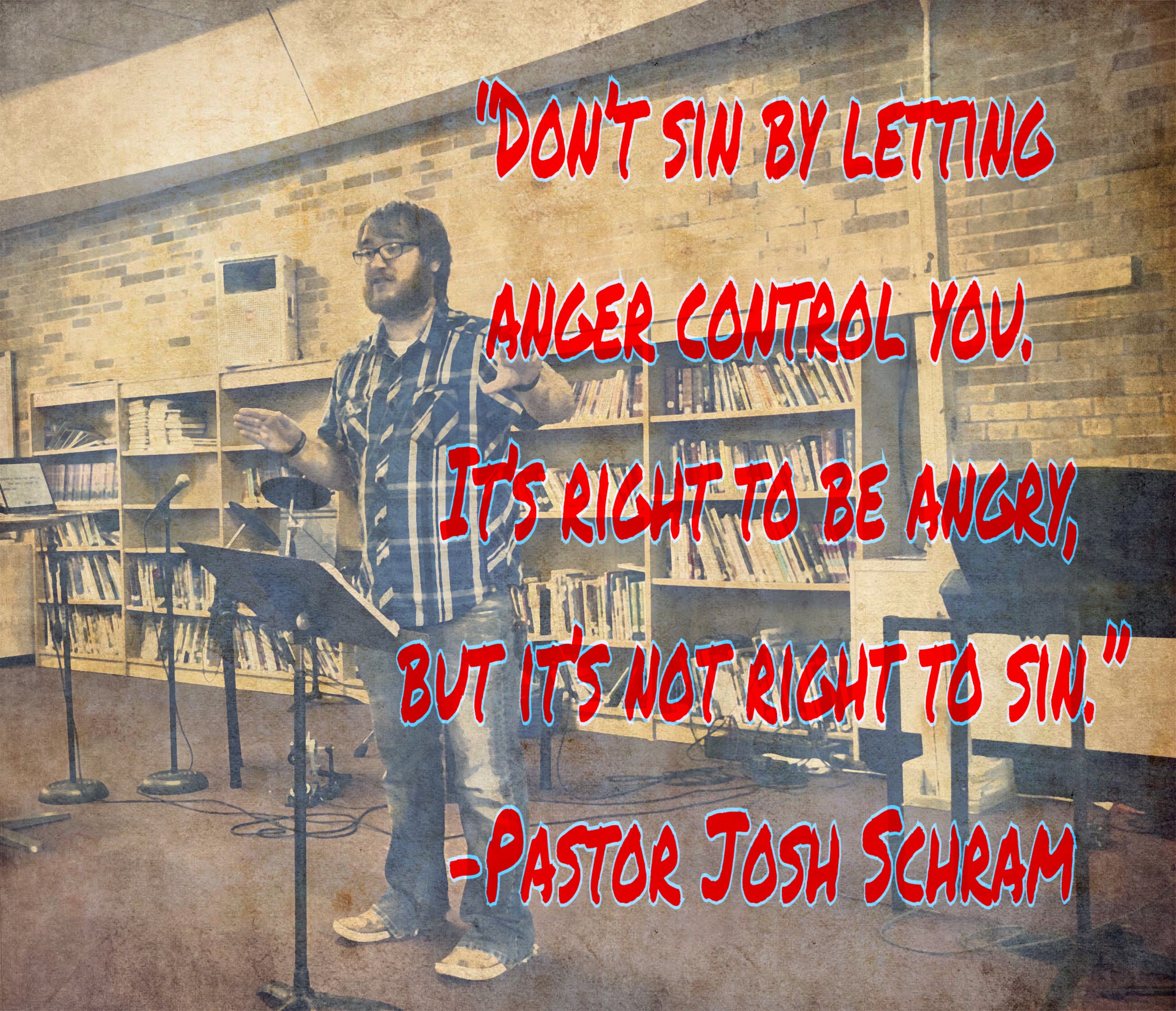
My friend Josh Schram shared these truths: 

  1. Don’t sin by letting anger control you. 
  2. It’s right to be angry, but it’s not right to sin. 
  3. When someone hurts us, it’s tempting to break God’s law. We can almost justify it, but it is a sin to give in to anger. 

“Search your heart and be silent”Selah. This pause gives us hope that we can “build your case before God and wait for His verdict.” 

In Romans 12:17-21, Paul gives similar counsel when dealing with enemies:  As far as it depends on you…

  • Don’t repay evil for evil. 
  • Do repay evil with doing what’s right. 
  • Don’t take revenge. 
  • Do let God handle it. 
  • Don’t mistreat your enemies. 
  • Do bless your enemies. 
  • Don’t be overcome by evil. 
  • Do overcome evil by doing good. 

Since David let his anger go, that also means he didn’t sin! His clear conscience meant he could lie down and sleep in peace. 

You cannot hold a grudge and peace in the same heart. 

Please join me next week as we continue our look at the Selahs in the Book of Psalms.