Are you looking for a Christmas gift for your pastor? Check out my book Shepherd Leadership. I have lots of new content every week, which you can check out on my YouTube channel.
“We rise no higher when we pull others down, yet when we stoop to serve, we conquer.” —Dick Brogden, in Proverbs: Amplified and Applied
“Truth is incontrovertible. Panic may resent it. Ignorance may deride it. Malice may distort it. But there it is.” —Winston Churchill
“Nothing is really work unless you would rather be doing something else.” —J.M. Barrie
“God has made His Word so precious that if I could not get another copy of it, I would not part with my Bible for all the world. There is life in the Word. There is power in it. I find Christ in it, and He is the One I need for spirit, soul, and body. It tells me of the power of His name and the power of His blood for cleansing.” —Smith Wigglesworth
“Christians can most directly affect the shape of our economy by practicing love for God and neighbor in all our transactions. Beyond that, we should make the most of every opportunity and means for influencing the shape of public policy so that honesty, fairness, justice, and love guide all the policies that bind us together as we the people.” —T.M. Moore
Christian apologist Sean McDowell goes head-to-head with ChatGPT—
Listen to the podcast of this post by clicking on the player below, and you can also subscribe on Apple, Spotify, or Audible.
Leaders earn some of their credibility when they lead through difficult or chaotic times. But it is also during these times that a leader can un-do all of the good things that he had already accomplished.
On a recent episode of The Craig And Greg Show, Greg Heeres and I discussed how leaders can learn to control their reaction. In this clip, I share one simple strategy that has been so helpful for my leadership growth.
This is just one example of the power of a leader’s storytelling. Check the full conversation Greg and I had on The Craig And Greg Show. I have lots of new content every week, which you can check out on my YouTube channel.
“We are all born ignorant, but one must work hard to remain stupid.” —Benjamin Franklin
George Jeffreys was born with a limiting speech impediment, but with the empowering of the Holy Spirit, George and his brother Stephen led incredible Pentecostal revivals in England and Wales. They were said to be the greatest evangelists since George Whitefield and John Wesley. Someone asked Jeffreys how long a revival should last, and he responded, “Thank God, a revival started in my heart 30 years ago, and it has never stopped; it will never end.” He continued by saying, “As long as Jesus is kept in the front, and made the center of fellowship and blessing and unity, the revival will never end.” Check out this mini biography about his life.
John Stonestreet uses the example of C.S. Lewis’ Aslan to talk about how God can speak to us through our pain. John writes, “Pain is never the point of God’s plans, any more than it is the purpose of physical exercise. Never pushing ourselves to the point that it hurts means never improving our health. On the other hand, seeking pain is more likely to do harm than to aid our wellbeing. In and of itself, pain is not good, but it is meaningful. Pain indicates that something is wrong and needs to be addressed.”
“The best way to make a dream come true is to wake up.” —Dame Anna Wintour
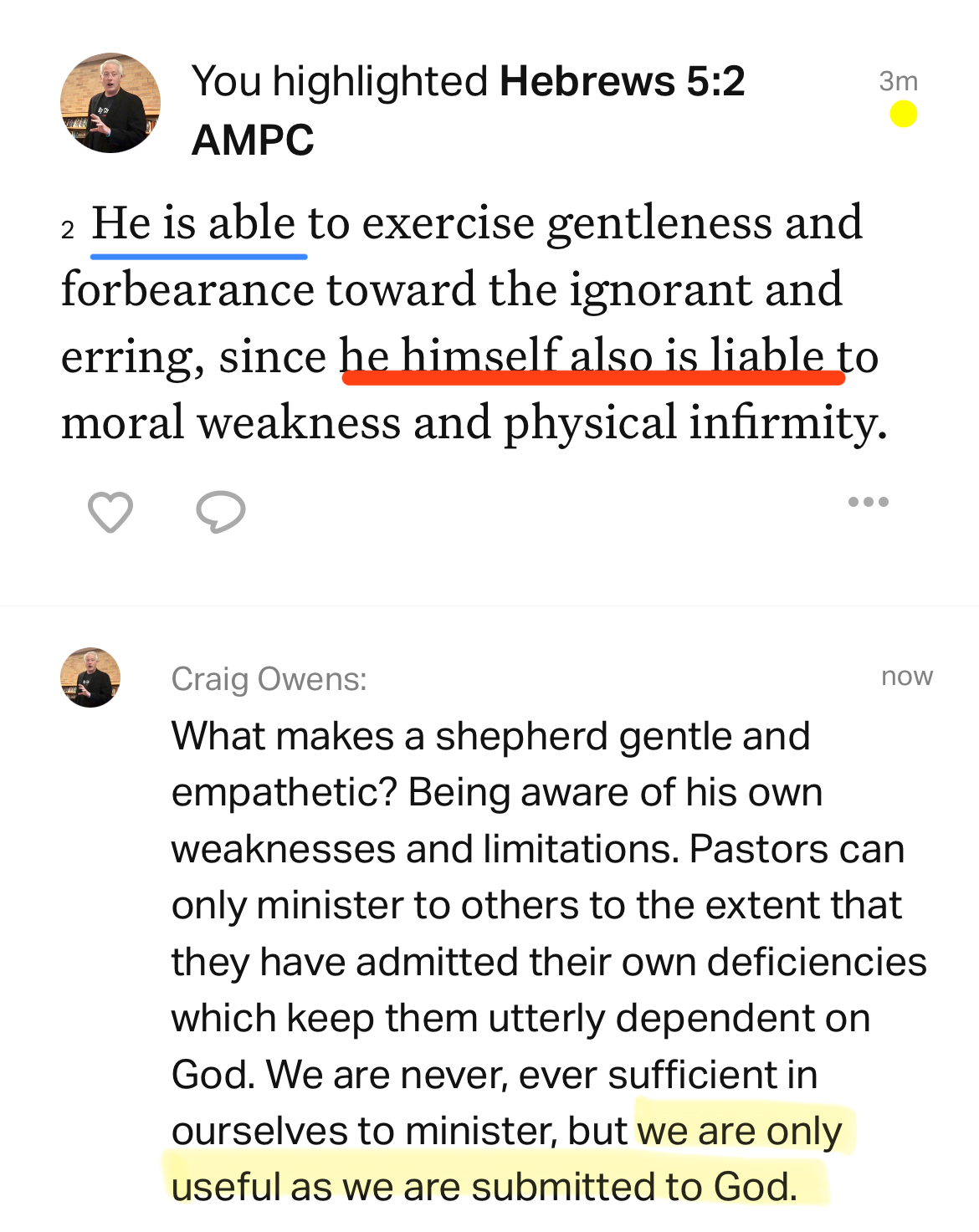
Because of the extensive prayer, research, and work I put into my book Shepherd Leadership, I am frequently drawn to passages of Scripture that reinforce the idea of pastors as shepherds. I was meditating on Hebrews 5:2 the other day, and I shared some of my thoughts with some of my pastor friends.
Listen to the podcast of this post by clicking on the player below, and you can also subscribe on Apple, Spotify, or Audible.
I think it is very instructive that Jesus began His three years of public ministry after thirty years of preparation, and that He began His daily ministry after an early-morning prayer session. If Jesus needed that kind of preparation time, what would make us think we could do with anything less?
Karl Vaters and I discussed Chapter 10 of my book Shepherd Leadership which is entitled “Can’t, Won’t, or Don’t” This chapter (and our conversation) covers the three main reasons leaders need to address to make sure they are being adequately prepared.
God made you uniquely YOU! You have been made on purpose and for a purpose. I have lots of new content every week, which you can check out on my YouTube channel.
“The wise recognize before the fight that adversity will come and therefore are not surprised by it. The wise recognize in the fight that adversity is a formidable foe and thus steel themselves for a long, hard struggle to the death. The wise recognize after winning a fight that the war is not over and so never let down their guard nor release their weapons.” —Dick Brogden, in Proverbs: Amplified and Applied
Astronomers have discovered planet-sized objects that are puzzling the best minds. In fact, they have had to create a new category for these objects: Jupiter Mass Binary Objects (JuMBOs). What is baffling the brightest minds is that these planets don’t orbit a star but appear to be gravitationally bound to other JuMBOs. My favorite line is this one: “The new phenomenon challenges current frameworks explaining how stars and planets form within nebula, with astrophysicists claiming such objects should not exist.” There is at least one who isn’t baffled: The One who created JuMBOs along with everything else in our universe.
T.M. Moore is in the midst of a series of posts about the Christian and the government. They are excellent! Here is just a short sample—“The Christian understands that government is a servant of God for good, and that God, therefore, must define the terms of goodness by which a government fulfills its appointed task. As Paul reminds us, the Law of God is holy and righteous and good (Romans 7:12). It is important, therefore, that Christians understand the Law of God and consider the best ways of bringing its influence to bear in the arena of public policy. … Public policy is not about what governments can do, but what they should do, that is, if they are to fulfill their callings as God’s servants for good. When it comes to applying the Law of God to public policy, Christians must make this first principle foundational in the logic with which they approach the work of influencing and shaping public policy.”
“The weak can never forgive. Forgiveness is an attribute of the strong.” —Mahatma Gandhi
Leaders are naturally wired to be either confident or humble. Both kinds of leaders need to remain coachable. Greg and I unpacked this idea on this episode of The Craig And Greg Show, and I also discuss it in greater depth in my book Shepherd Leadership.
Listen to the podcast of this post by clicking on the player below, and you can also subscribe on Apple, Spotify, or Audible.
In my book Shepherd Leadership I talk about some strong, godly men who gave into temptation at a moment of weakness—David who behaved so poorly toward Bathsheba and Uriah, Elijah who got depressed and suicidal, and Peter who denied knowing Jesus.
One common factor for all of these guys is that their moment of giving in came when they were alone. They were isolated from others who may have been able to help them overcome the temptations that tripped them up.
Have you ever heard of the law of the weakest link?
If I have a chain with links that can handle 400, 300, 250, 175, and 500 pounds, how much weight can the chain hold? You don’t really need a calculator for this one because the answer is the capacity of the weakest link: 175 pounds. This is why it’s to my advantage to not only strengthen myself, but to help others grow their strength as well.
In Galatians 6:2-5, the apostle Paul talks about the strength we need for ourselves and our fellow Christian brothers and sisters. First, he says that each of us should test our own actions. I can only know my breaking point if I’m tested, and the Holy Spirit knows how to do this perfectly. After this testing, Paul says then I can take pride in myself without saying, “Well, at least I’m better than him!”
Quite simply, Paul tells each of us that we must be able to carry our own loads. Why? Because only a strong Christian can help someone else with their load. We each have to get stronger individually so that we have strength for others!
This is just like what we’ve been learning in our look at the Songs of Ascent: the goal is for all of the pilgrims to get to Zion together!
In this series, we are going to learn about six spiritual disciplines. Much like a physical workout, the Holy Spirit will start with us where we are. Not everyone will be at the same level nor will everyone progress at the same rate. But all of us will need these four things.
(1) Discipline. This is saying no to the easy thing or the thing that brings only fleeting happiness so that I can say yes to the things that bring eternal joy.
(2) Stick-to-it-iveness. I have to be committed to this process for a lifetime.
(3) Grace for yourself. There are going to be moments of struggles, plateaus, and even stumbles. Those are all a part of the journey, so we must extend grace to ourselves to learn, repent, and move forward.
(4) Patience for others. As I just mentioned, we are all on our own journey and we all progress at different rates. Let’s be patient with each other.
All of these spiritual disciplines are to strengthen us individually so that we have something to share with other saints (2 Corinthians 1:3-6).
These spiritual disciplines shouldn’t become legalistic. Don’t make the way you do it the way everyone has to do it. After all, a 175-pound link will be different than a 250-pound link.
What I am calling spiritual disciplines, C.S. Lewis called religious practices. In a letter to a friend, he wrote about the safety and beauty that result from these pursuits—
“I think about the practices what a wise old priest said to me about a ‘rule of life’ in general—‘It is not a stair but a bannister’…i.e. it is, not the thing you ascend by but it is a protective against falling off and a help-up. I think thus we ascend. The stair is God’s grace. One’s climb from step to step is obedience. Many different kinds of bannisters exist, all legitimate. It is possible to get up without any bannisters, if need be: but no one would willingly build a staircase without them because it would be less safe, more laborious, and a little lacking in beauty.” (C.S. Lewis)
One of the loudest, most persistent advertising messages is about speed: Take action now, get immediate results as soon as you sign up, don’t miss out, act today! Because of this sentiment that appears all around us, many people often think that any life changes they make should bring about immediate and lasting results.
I’ve often joked that I wish I had the superpower to zap myself or a friend—“<Poof!> There, you’ve got it now. You’re all set!” Unfortunately, that’s usually not how it works.
Instead, we need to be ready for a lengthy process—possibly even a lifelong process—of the Holy Spirit helping us to make the micro-adjustments that are necessary.
Check out this part of my conversation with Jim and John as we discussed this idea.
If you would like to watch this full interview on the Leading From Alignment podcast, please go here.
I’ll be sharing more clips from this interview soon, so please stay tuned. My book Shepherd Leadership: The Metrics That Really Matter is available in print or ebook, and in audiobook through either Audible or Apple.
Listen to the podcast of this post by clicking on the player below, and you can also subscribe on Apple, Spotify, or Audible.
It has always been extremely heart-wrenching for me to see pastors and other ministry leaders get so frazzled that they throw in the towel. Many of them not only resign from the churches where they served, but they end up resigning their ministerial credentials too.
I know this breaks God’s heart as well.
When I was interviewed on The Church Lobby podcast, Karl Vaters wanted to discuss some preventative steps that pastors could take to avoid this ministry burnout.
Listen to the podcast of this post by clicking on the player below, and you can also subscribe on Apple, Spotify, or Audible.
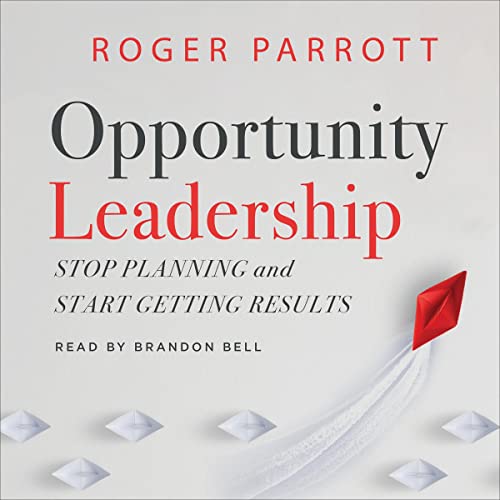
When I wrote my book, I was attempting to bring church leaders back to the biblical foundation for what it means to be a pastor. In a very similar fashion, Roger Parrott does this same thing for ministry leaders in his book Opportunity Leadership.
Parrott is the president of a vibrant Christian university. As anyone who has been in the arena of higher education will tell you, making long-range plans is at the foundation of everything the administration and faculty do. But Parrott asks where did we get this model? Is this something we see in the Bible?
Actually, we see verses that subordinate human plans to God’s plan. Verses like, “Many are the plans in a person’s heart, but it is the Lord’s purpose that prevails” (Proverbs 19:21) or, “They tried [planned] to enter Bithynia, but the Spirit of Jesus would not allow them to” (Acts 16:7). This is why Parrott makes the case that we are missing out on what God has in store for us because we only want Him to work on our carefully-made plans.
Parrott makes the case that their university has grown and seized opportunities because they were open and responsive to the doors God presented them, instead of missing out because they were blinded by their plans.
Obviously, switching to this model will take tremendous buy-in from the point leader all the way through the entire organization. So the bulk of Opportunity Leadership helps prepare Christian leaders to change their paradigm, prepare for the inevitable pushback, and help their teammates move forward.
I thoroughly enjoyed this book—finding myself saying, “Yes!” frequently as I was reading it—and I am confident all Christian leaders will benefit from reading this insightful work.
Listen to the podcast of this post by clicking on the player below, and you can also subscribe on Apple, Spotify, or Audible.
I read something which is really challenging my leadership paradigm. It’s a challenge to look at successful organizations through the lens of both a servant-hearted leader and a servant-hearted follower.