11 Quotes From “A Sketch Of The Life And Labors Of George Whitefield”

A Sketch of the Life and Labors of George WhitefieldYesterday I tweeted…

And that’s definitely true in the book J.C. Ryle wrote: A Sketch Of The Life And Labors Of George Whitefield. You can read my full book review by clicking here. Below are some of the quotes I highlighted in this interesting biography.

“Informing your opinion of the comparative merits of Christian men, never forget the old rule: ‘distinguish between times.’ Place yourself in each man’s position. Do not judge what was a right course of action in other times, by what seems a right course of action in your own.”

“In the thirty-four years of his ministry, it is reckoned that [Whitefield] preached publicly eighteen thousand times. … No preacher has ever retained his hold on his hearers so entirely as he did for thirty-four years.”

“He seemed to live for only two objects—the glory of God, and the salvation of immortal souls. He raised no party of followers who took his name. He established no system, like Wesley, of which his own writings should be cardinal elements. A frequent expression of his is most characteristic of the man: ‘Let the name of George Whitefield perish, so long as Christ only is exalted.’” 

“He was a man of extraordinary catholicity and liberality in his religion. He knew nothing of that narrow-minded policy which prompts a man to fancy that every thing must be barren outside his own camp, and that his party has got a monopoly of truth on heaven. He loved all who loved the Lord Jesus Christ in sincerity. He measured all by the measure which the angels of God use —‘Did they possess repentance towards God, faith towards the Lord Jesus Christ, holiness of conversation?’ If they did, they were as his brethren. His soul was with such men, by whatever name they were called.”

“Whitefield preached a singularly pure gospel. Few men ever gave their hearers so much wheat and so little chaff. … This, you may be sure, is the corner-stone of all preaching that God honors. It must be predominantly a manifestation of truth.”

“To make easy things seem hard is easy, but to make hard things easy is the office of a great preacher.” —Archbishop Usher

“He is the best orator who can turn men’s ears into eyes.” —Arabian Proverb

“It was no uncommon thing with him to weep profusely in the pulpit. Cornelius Winter goes so far as to say that he hardly ever knew him to get through a sermon without tears.”

“Once become satisfied that a man loves you, and you will listen gladly to anything he has got to say. And this was just one grand secret of Whitefield’s success.”

“He founded no denomination among whom his name was embalmed, and his every act recorded, as did John Wesley. He headed know mighty movement against a Church which openly professed false doctrines, as Luther did against Rome. He wrote no books which were to be the religious classics of the millions, like John Bunyan. He was a simple, guileless man, who lived for one thing only, and that was to preach Christ. If he succeeded in doing that effectually, he cared for nothing else. He did nothing to preserve the memory of his usefulness. He left his work with the Lord.”

“The truth, I believe, is, that the direct good Whitefield did to immortal souls was enormous. I will go farther. I believe it is incalculable.” 

Are You Irritated? Good!

Pearl oysterPastor Tom Kaastra shared a whole new way of looking at the irritations we sometimes have, by pointing us to an example in nature. God reveals Himself to us in the Bible and through nature. That’s why Francis DeSales said, “God has signed all created things. We can trace His footsteps through the natural world.”

So take a look at the oyster. God designed it with a heart, a mouth, a digestive system, a reproductive system, a nervous system, and all other things that allow it to survive. But He also gave it a way to thrive.

The oyster can be irritated by a foreign invasion. But… God has put within the oyster the power to turn an irritation into a valuable pearl!

It is the same for Christians. The same power that raised Christ from the dead dwells in us (see Romans 8:11). That power allows us to see that all things are working together for the good of those who love God (see Romans 8:28-29). As Pastor Tom said it, “God wants to Jesus-size us.”

Carl Jung said, “Everything that irritates us about others can lead us to an understanding of ourselves.” So God designs irritations on purpose to develop a valuable pearl in our lives that will bring Him glory.

Look at Joseph. His brothers sold him into slavery in Egypt (which ranks in my book as a major irritation!). But look how Joseph saw the pearl God developed—

And now, do not be distressed and do not be angry with yourselves for selling me here, because it was to save lives that God sent me ahead of you. For two years now there has been famine in the land, and for the next five years there will not to be plowing and reaping. But God sent me ahead of you to preserve for you a remnant on earth and to save your lives by a great deliverance. So then, it was not you who sent me here, but God. (Genesis 45:4-8, emphasis added)

So the next time you’re irritated, remind yourself, “Great! God is making a valuable pearl in my life!”

You can watch the video of Pastor Tom’s message below, and be sure to check out his website for other valuable lessons like this one.

What Does God Think About You?

Pastor Josh SchramJosh Schram, our youth pastor, brought an amazing message to us Sunday morning. I have included the link to his full message below, but here are a few of my take-aways from his message.

Often we think about God’s thoughts of us the way we think about ourselves. That means sometimes I think He really loves me, and sometimes I think His love for me has cooled off a bit.

TRUTH: God’s love for me is not conditional on my circumstances or on my status. His love is unconditionalHe couldn’t love me anymore than He already does!

In Luke 15, we see that the religious leaders didn’t like Jesus hanging around “sinners.” Why? Because those “sinners” should be getting the punishment they deserved, not getting Christ’s undivided attention (vv. 1-2).

When Jesus told His first two parables, it seems as if the Pharisees were more concerned about a lost coin or a lost sheep than they were about a lost person (vv. 3-10)! Do I feel that God is more concerned about a lost “thing” than He is about me?

To make the point perfectly clear, Jesus told the story of the lost son (vv. 11-32). The son deserved punishment. He came home covered in pig poop. But the son was STILL the father’s son and he loved his son no less than the day he left home!

The wrong way of thinking—God loves me less because I mess up.

The right way of thinking—God loves me unconditionally just as I am.

Check out this amazing message…

God Stamps His Children

God's sealFrom the pages of history we see how kings would finalize or enact a new law by using their signet ring to make their unique mark on the decree. Think about: there was nothing but words on a page, until the impression from the king’s ring made it a royal decree.

The King of Kings stamps His children as well. Anyone who places his or her faith in Jesus Christ receives God’s seal, marking that person as God’s royal possession!

The Hebrew letter taw means a stamp or inscription. It’s the final letter of the Hebrew Aleph-Beth, and its message seals up all that God’s Word symbolizes. In the last section of Psalm 119 called taw (verses 169-176), we read of someone who has made God’s Word an integral part of his life. Check this out…

  • God’s word answers his cry for help and brings him understanding (v. 169)
  • God’s promise delivers an answer to his prayer (v. 170)
  • God’s decrees lead the psalmist to praise God (v. 171)
  • God’s commands cause him to burst into song (v. 172)
  • God’s precepts bring him help (v. 173)
  • God’s law leads him to salvation (v. 174)
  • God’s laws bring sustaining and reviving life (v. 175)
  • God’s commands rescue him (v. 176)

In the New Testament, God’s seal is described this way—Now it is God who makes both us and you stand firm in Christ. He anointed us, set His seal of ownership on us, and put His Spirit in our hearts as a deposit, guaranteeing what is to come. (2 Corinthians 1:21-22)

Here’s one more cool thing about taw. This letter is made up of two other Hebrew letters: daleth and nun. This spells Dan. When the Israelites were in the wilderness, the tribe of Dan went last. Their job was to make sure no one got left behind.

Christians who have God’s seal of ownership on them, should live as holy rescuers. They serve by going last, and making sure no one gets left behind, but everyone hears the good news of God’s love.

Do you have God’s seal of ownership on you? What are you doing with it.

Here’s the video of the complete message on taw

If you have missed any of the messages in our P119 series, you can access them all by clicking here.

Live Blessed And Peaceful

SpockI think most people are familiar with Spock’s famous Vulcan hand signal that means “Live long and prosper.” But long before Star Trek, the origins of this idea were displayed in the pages of Scripture.

The Hebrew word for grace or favor is first used in relation to Noah: “BUT Noah found favor in the eyes of the Lord” (Genesis 6:8). The conjunction BUT at the beginning of this verse tells us that the favor Noah experienced is being contrasted to something exactly the opposite. Here’s what we read two verses earlier, “The Lord was grieved that He had made man on the earth, and His heart was filled with pain” (v. 6).

Noah had to make a choice: would he fear God, or would he fear man. It’s a choice we all have to make today. We have to weigh and decide:

  • Fear of God vs. fear of man
  • Pleasing God vs. pleasing myself or someone “important” to me
  • Humble reliance on God vs. self-reliance
  • Objective obedience to God vs. subjective agreement when it feels okay

In the section of Psalm 119 called shin (vv. 161-168), the psalmist wrestled with this as well. He decided that he wasn’t going to be afraid of government officials that could persecute him, BUT “my heart trembles at Your Word.” He decided that he wouldn’t look for worldly treasures, BUT he would “rejoice in Your promise” (v. 162). That he wouldn’t praise temporary things, BUT “I praise You for Your righteous laws” (v. 164). That he wouldn’t try to find satisfaction in the temporary, BUT he would bask in the “great peace [for them] who love Your law” (v. 165). On and on it goes…

  • …I wait for YOUR salvation
  • …I follow YOUR commands
  • …I obey YOUR statutes
  • …I obey YOUR precepts (vv. 166-168)

People that live this way experience the same favor and grace that Noah experienced.

The Lord BLESS you and keep you; the Lord make His face SHINE upon you and be GRACIOUS to you; the Lord turn His face toward you and give you PEACE. (Numbers 6:24-26)

You can live blessed and peaceful by choosing God above all else!

Next Sunday we wrap up our series on the 119th Psalm, and I would love it if you can join us!

Here is the video from yesterday’s message—

If you have missed any of the messages in our P119 series, you can access them all by clicking here.

Spurgeon: Speak Up For Your Master

C.H. Spurgeon“The servants of satan shame me; they shame me! There comes at night a message to some of you who are the servants of satan—‘The master is come, and calleth for thee.’ You leave your wife and your children without a tear, you go to your master’s house, and there are foul cups passing round, and you will drink, and drink still on; never denying your master; confessing him with many an oath; saying to your comrades many things which injure your poor souls; and yet you do it so bravely. You hardly know how you get home at night, but when the morning comes, and you wake, there is the redness of the eyes, the headache, and the sickness; but the next night when your master wants you, you go again; and so you will do year after year, even though delirium tears you like a whirlwind.

But here am I, a servant of God, and when my Master calls for me and bids me go and confess Him, I am tempted to be still, and when He tells me to speak to yonder man I would wickedly avoid the task; and whereas you confess your master and imprecate a curse upon your head, how often do some of us confess our Master as timidly as if we feared a curse, when instead thereof it is by confession that the curse is turned away! It is enough to make us Christians ashamed to think how sinners will confess their god! Hear them at night, as they reel home through the streets; they are not ashamed of their lord and master. Hear how they swear, and defy heaven! They are ashamed of nothing for their lord; and yet we, who have heaven for our reward, and such a Christ to serve, and One so good and gracious to us—look at us! What poor lovers of our Savior are we! What poor lovers of the souls of men!” —Charles Spurgeon (emphasis added)

I am convicted by this. How about you?

Tears And Humility

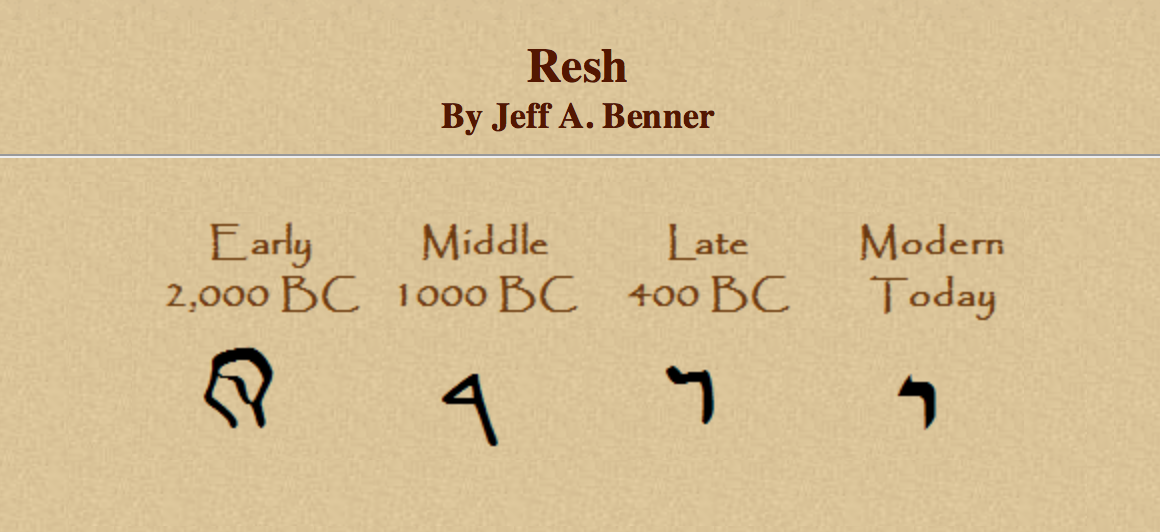
History of ReshJust has God sent His holy Son “below the line” to rescue us, so we who are in Jesus have been sent below the line to those who are staggering to death. If we are going to be effective rescuers, what must our attitude be?

John Bradford, when he saw a convicted criminal on his way to the gallows said, “There, but for the grace of God, go I.” He also said to those who questioned his deep emotional response when preaching, “You blame me for weeping, but how can I help it when you will not weep for yourselves, though your immortal souls are on the verge of destruction?”

Isn’t a humble, empathetic rescuer going to be more effective in reaching those staggering to their eternal demise than one who stands aloof, saying, “You got yourself into this mess”?

Resh (Psalm 119:153-160) shows us our posture: It signifies a head bowed; it means we are confidently humble. Confident that God delivers us, defends us, redeems us, preserves us, and saves us (vv. 153-154); but humble enough to know that we could never have earned this!

We have to have this confidently humble posture in order to be effective as His holy rescuers. We grieve for those who are without God because of what they face—

  • “Salvation” is only gibberish to the wicked because they’ve never looked it up in Your dictionary. (v. 155, MSG)
  • They don’t know His compassion is great (v. 156), nor how great is Your tender mercy and loving-kindness (AMP).
  • They become the foes who persecute Christians (v. 157). How they will grieve on Judgment Day, if they don’t repent!
  • Their actions are loathed (not them as a person!). What God said of the Israelites who went into captivity will be true for those who don’t accept Jesus before they die—Then in the nations where they have been carried captive, those who escape will remember Me—how I have been grieved by their adulterous hearts, which have turned away from me, and by their eyes, which have lusted after their idols. They will loathe themselves for the evil they have done and for all their detestable practices. (Ezekiel 6:9, emphasis added)

Tears and humility will keep us in the proper position to reclaim these lost treasures for our King! 

I will be continuing our series on Psalm 119 in our P119 Spiritual Workout next Sunday. Hope you can join me!

If you are interested in watching the entire message, the video is below—

If you have missed any of the messages in our P119 series, you can access them all by clicking here.

Throw Down!

In the spiritual battle Christians face, the enemy lies and slanders. Here is wise counsel from Charles Spurgeon on how to throw down against his onslaught!

C.H. Spurgeon“What multitudes of foes has our faith had to meet with; but how it has swallowed them all up. There were our old sins. The devil threw them down before us, and they turned to serpents. What multitudes! How they hiss in the air! How horrible are their deadly poison-fangs, the gaping jaws, their forked tongues! But the Cross of Jesus, like Aaron’s rod, destroys them all. Faith in Christ makes short work of all our sins, for it is written, ‘The blood of Jesus Christ His Son cleanseth us from all sin.’

“Then the devil stirs up another generation of vipers, and shows us our inbred corruptions, our neglects of duty, our slackness in prayer, our unbeliefs, our backslidings, our wanderings of heart; and sometimes you and I get so tormented by these reptiles, that we grow alarmed, and are half inclined to flee. Do not run, brother, but throw down Aaron’s rod, and it will swallow up all these serpents, even though they were poisonous as the cobra, or fierce as the rattlesnake. You shall overcome through the blood of the Lamb. Jesus is able ‘to save them to the uttermost that come unto God by Him.’ The battle is the Lord’s, and He will deliver them into your hands.

“The old enemy will throw down another host of serpents in the form of worldly trials, diabolical suggestions, temptations to blasphemy, ill thoughts of God, hard thoughts of His providence, rash thoughts of His promises, and such like, till you will be almost distracted. You will wonder how you can meet such a host as this. Remember to stand fast, and throw down Aaron’s rod—your simple trust and faith in Jesus Christ—and it must and shall swallow up all these rods.” —Charles Spurgeon, commenting on Exodus 7:12 (emphasis added)

14 Quotes From “The Printer And The Preacher”

The Printer And The PreacherI loved this book! It’s a great historical story of how Benjamin Franklin and George Whitefield’s lives intertwined at such a pivotal time in history. America exists the way it does politically and religiously today because of the influence of these two titans. You can read my full book review here. Below are a few quotes from this remarkable book.

“The Faith you mention has doubtless its use in the world…. But I wish it were more productive of good works than I have generally seen it: I mean real good works, works of kindness, charity, mercy, and public spirit; not a holiday-keeping, sermon-reading or hearing, performing church ceremonies, or making long prayers. … Your great Master thought much less of these outward appearances and professions than many of His modern disciples. He preferred the doers of the Word to the mere hearers…and those who gave food to the hungry, drink to the thirsty, raiment to the naked, entertainment to the stranger, and relief to the sick.” —Benjamin Franklin, in a letter to pastors

There are many who “perhaps fear less the being in Hell, than out of the fashion.” —Benjamin Franklin

“The alteration in the face of religion here is altogether surprising. Never did the people show so great a willingness to attend sermons, nor the preachers greater zeal and diligence in performing the duties of their function. Religion is become the subject of most conversations. No books are in request but those of piety and devotion; and instead of idle songs and ballads, the people are everywhere entertaining themselves with Psalms, hymns and spiritual songs. All of which, under God, is owing to the successful labors of the Reverend Mr. Whitefield.” —Benjamin Franklin, in a newspaper article

The Body of
B. Franklin
Printer;
Like the Cover of an old Book,
Its Contents torn out,
And stript of its Lettering and Gilding,
Lies here, Food for Worms.
But the Work shall not be wholly lost:
For it will, as he believ’d, appear once more,
In a new& more perfect Edition,
Corrected and Amended
By the Author. —Benjamin Franklin, the Epitaph he wrote for himself at age 22

“I have seen your Epitaph. Believe on Jesus, and get a feeling possession of God in your heart, and you cannot possibly be disappointed of your expected second edition finally corrected, and infinitely amended.” —George Whitefield 

“You blame me for weeping, but how can I help it when you will not weep for yourselves, though your immortal souls are on the verge of destruction?” —George Whitefield

Those who hear the gospel “have more need of heat than light. Would to God we had as much warmth in our hearts, as light in our understandings!” —George Whitefield

“If we are truly converted, we shall not only be turned and converted from sinful self, but we shall be converted from righteous self. That is the devil of devils: For righteous self can run and hide itself in its own doings, which is the reason self-righteous people are so angry with gospel preachers.” —George Whitefield

“Let your practice correspond to your profession.”—George Whitefield

“Oh pray, dear Mr. H., that God would always keep me humble, and fully convinced that I am nothing without Him, and that all the good which is done upon earth, God doth it Himself.” —George Whitefield, in a letter to Gabriel Harris, when his popularity was growing

“Will it not in the end destroy brotherly love, and insensibly take from us that cordial union and sweetness of soul, which I pray God may always subsist between us? … How glad would the enemies of the Lord be to see us divided? How many would rejoice, should I join and make a party against you? And in one word, how would the cause of our common Master every way suffer by our raging disputes about particular points of doctrines? … I write not this, honored Sir, from heat of spirit, but out of love. At present, I think you are entirely inconsistent with yourself, and therefore do not blame me, if I do not approve of all that you say.” —George Whitefield, in correspondence with John Wesley over doctrinal differences

“I find that you grow more and more famous in the learned world. As you have made a pretty considerable progress in the mysteries of electricity, I would now humbly recommend to your diligent unprejudiced pursuit and study the mystery of the new-birth. It is a most important, interesting study, and when mastered, will richly answer and repay you for all your pains. One at Whose bar we are shortly to appear, hath solemnly declared, that without it, ‘we cannot enter the kingdom of heaven.’ You will excuse this freedom. I must have aliquid Christi [something of Christ] in all my letters.” —George Whitefield, in a letter to Benjamin Franklin

“satan is angry. I am now mimicked and burlesqued upon the public stage. All hail such contempt! God forbid that I should glory, save in the Cross of Jesus Christ.” —George Whitefield, in a letter after a play was produced in London making fun of him

“Whitefield and Franklin were not just the two most famous people in America in their time—they were also the most significant. The effects of their lives and their work are still being felt today … If America was born as a Christian nation, it’s because many of its people were genuinely, powerfully Christians. It had less to do with the language in any founding documents and more to do with the fact that George Whitefield had been tromping from town to town, inviting people to hear the call of God. It had even less to do with church membership. God was grabbing lives. People’s hearts were flying open. No one was imposing Christianity on society. The power came from within.” —Randy Peterson

Holy Rescuers

QophThe Hebrew Aleph-Bet is nothing like the English alphabet. First of all, in English, letters are just letters; they don’t really mean anything. In Hebrew, every letter has its own definition and imagery. Second, in the English alphabet, the order of the letters doesn’t have any significance; but the order in Hebrew is of vital importance.

It is significant that qoph (vv. 145-152) comes after tsadhe (vv. 137-144) in Psalm 119. Tsadhe tells us about God’s righteousness, and how the Word gives us a reliable way to approach All-Righteous God as a humble, obedient servant. This must come before qoph, which encourages us to stay in the presence of Holy God for a specific reason.

Qoph is the second of two Hebrew letters that has two pen strokes that don’t touch. This is a reminder for us to stay close to God. But qoph is the only Hebrew letter that goes below the line. This is a reminder that God came down to rescue us!

Qoph is the first letter in the Hebrew word for holy. When Isaiah saw God, and heard the angels shouting, “Holy, Holy, Holy is the Lord God Almighty,” he saw himself unworthy to come into God’s presence, until his sin had been atoned for. After that, he was ready to be sent out as God’s messenger. (see Isaiah 6:1-8).

In the last book of the Bible, the picture in Heaven is similar, with angels still crying, “Holy!” (Revelation 4:8). As Christians, Jesus Christ has become our Atonement, so we can approach holy God’s throne with humble confidence.

Not only that, but Jesus sent us out as holy witnesses. He sent us “below the line.” Just like He came down to rescue us, He has commissioned us as holy rescuers (Proverbs 24:11-12; Jude 21-25).

As you stay close to God’s holiness, you become a more effective witness for Christ, a holy rescuer! What a privilege to be used by God in this way.

If you would like to watch the message I delivered yesterday on being holy rescuers, check this out—

If you have missed any of the messages in our P119 series, you can access them all by clicking here.