8 Quotes From “The World’s Last Night”

In seven essays expressly shared to get the reader to think in terms of eternity, C.S. Lewis masterfully practices his craft. Check out my full book review of The World’s Last Night by clicking here. Below is just a small sampling of a few of the outstanding quotes in this book.

“Simply to say prayers is not to pray; otherwise a team of properly trained parrots would serve as well as men.”

“Prayer is not a machine. It is not magic. It is not advice offered to God. Our act, when we pray, must not, any more than all our other acts, be separated from the continuous act of God Himself, in which alone all finite causes operate.”

“Scientists are mainly concerned not with believing things but with finding things out. And no one, to the best of my knowledge, uses the word believe about things he has found out. The doctor says he ‘believes’ a man was poisoned before he has examined the body; after the examination, he says the man was poisoned. No one says that he believes the multiplication table. No one who catches a thief red-handed says he believes that man was stealing. The scientist, when at work, that is, when he is a scientist, is labouring to escape from belief and unbelief into knowledge. Of course he uses hypotheses or supposals. I do not think these are beliefs.”

“Since most men, as Aristotle observed, do not like to be merely equal with all other men, we find all sorts of people building themselves into groups within which they can feel superior to the mass.”

“‘Good works’ in the plural is an expression much more familiar to modern Christendom than ‘good work.’ Good works are chiefly alms-giving or ‘helping’ in the parish. They are quite separate from one’s ‘work.’ And good works need not be good work, as anyone can see by inspecting some of the objects made to be sold at bazaars for charitable purposes. This is not according to our example. When our Lord provided a poor wedding party with an extra glass of wine all round, He was doing good works. But also good work; it was a wine really worth drinking.”

“Christ died for men precisely because men are not worth dying for; to make them worth it.”

“It would be difficult, and, to me, repellent, to suppose that Jesus never asked a genuine question, that is, a question to which He did not know the answer. That would make of His humanity something so unlike ours as scarcely to deserve the name. I find it easier to believe that when He said ‘Who touched Me?’ (Luke 7:45) He really wanted to know.”

“For what comes [after Christ’s Second Coming] is Judgment: happy are those whom it finds labouring in their vocations, whether they were merely going out to feed the pigs or laying good plans to deliver humanity a hundred years hence from some great evil. The curtain has indeed now fallen. Those pigs will never in fact be fed, the great campaign against White Slavery or Governmental Tyranny will never in fact proceed to victory. No matter; you were at your post when the Inspection came.”

Poetry Saturday—The Blessed Morrow

’Midst the darkness, storm, and sorrow,
One bright gleam I see;
Well I know the blessed morrow 
Christ will come for me.
’Midst the light, and peace, and glory
Of the Father’s home,
Christ for me is watching, waiting,
Waiting till I come. … 

Oh the blessed joy of meeting,
All the desert past!
Oh the wondrous words of greeting
He shall speak at last!
He and I together entering
Those fair courts above
He and I together sharing
All the Father’s love. —Gerhard Tersteegen

Poetry Saturday—The Hope Of His Coming

There is a balm for every pain,
A medicine for all sorrow;
The eye turned backward to the Cross,
And forward to the morrow.

The morrow of the glory and the psalm,
When He shall come;
The morrow of the harping and the palm,
The welcome home.

Meantime in His beloved hands our ways,
And on His Heart the wandering heart at rest;
And comfort for the weary one who lays
His head upon His Breast. —Gerhard Tersteegen

6 More Quotes From “Light & Truth—Revelation”

light-and-truth-revelationHoratius Bonar always gives lots of thought-provoking content in his commentaries, and his commentary on the Book of Revelation is no exception. Here are a few more quotes for you.

“What man needs, then, is Jesus; not mere knowledge or wisdom. What humanity—unconsciously and ignorantly, it may be—sighs for, is Jesus. What earth, ruined and accursed because of sin, groans for, is Jesus—nothing less than this. No other prophet or priest or king can meet the exigencies of the race and its dwelling, the earth, but Jesus only.”

“What is your hope? What is judgment to do for you? What is resurrection to bring? Look at the following alternatives, and ask which is to be yours: Everlasting gladness, or everlasting sorrow? Everlasting glory; or everlasting shame? Everlasting songs, or everlasting wailing? The marriage supper of the Lamb, or the perpetual banishment from all that is good and holy? The new heavens and earth, or the eternal wilderness, with its parched and burning wastes? The heavenly Jerusalem, with the Lamb as its light, or the blackness of darkness? The fruit of the tree of life and the waters of the celestial river, or the eternal hunger and the unquenchable thirst? (Luke 16:24). The first resurrection, or the second death? These are the alternatives before you; and there is no middle room.”

“The first book of Scripture and the last fit well into each other; the first two chapters of Genesis and the last two of Revelation fit together like the two halves of a golden clasp set in gems. Enclosed between the two is the history of six thousand years. And what a history! What a beginning, and what an ending! It began with the new, and it ended with the new—the strange checkered ‘old’ lying mysteriously between. ‘In the beginning God created the heavens and the earth.’ ‘I saw new heavens and a new earth.’”

“Such is the love of God. It is the love of Father, Son, and Holy Ghost. The Father chooses in His own sovereignty; the Son washes in His own blood; the Spirit purifies and prepares by His mighty power. Behold, what manner of love the Father hath bestowed on us! It is free love; sovereign love; eternal love; unchanging love; boundless love; love which not merely delivers from wrath, but which makes the delivered one an heir of God, nay, the bride, the Lamb’s wife.”

“Our title to all this surpassing and eternal glory is simply the blood of the Lamb. He has bought it for His Church; and it is hers forever. The nightless day, the unsetting sun, the incorruptible life, the undefiled inheritance, the new name, the heavenly city, the everlasting kingdom— all are hers; hers through ‘the blood of the everlasting covenant.’ She is to walk worthy of it here—worthy of such a crown, such a heritage, such a city, such a Bridegroom, such a joy. ‘Be holy;’ ‘be perfect;’ ‘walk worthy of the Lord.’”

“Christian parents! For which of the two worlds are you training your children? For this world, or that which is to come? Be assured that the same training will not do for both.”

If you haven’t checked out my review of Light & Truth—Revelation, please click here. You can also read the first set of quotes I shared from this book by clicking here.

Are You Expecting The Lord?

Horatius Bonar“Are you expecting the Lord? Are you living in this expectation? Is it a deep-seated, abiding, cherished hope? Is it a hope that tells upon your character, your life, your daily actings in public or private, your opinions, your whole man? Does it quicken you? Does it purify you? Does it keep you separate from the world? Does it keep you calm in the midst of earth’s most exciting events, or most untoward changes? Does it give you a new view of history as well as prophecy? …

“Let your expectation of the Lord’s coming be a calm and healthy one; not one that excites, but one that tranquilizes; not one that unfits for duty, but one that nerves you more firmly for it; not one that paralyzes exertion, but one that invigorates you for it; not one that makes you indifferent to present duty, but one that makes you doubly in earnest about everything that your hand findeth to do; not one that stops liberality, and prayer, and work, but one that increases all these a hundred fold; not one that dwells exclusively on the future’s dark side—the judgments that are at hand—but one that realizes the glory and the joy of Messiah’s approaching victory and triumphant reign.” —Horatius Bonar

6 More Quotes From “Light & Truth—Acts and the Larger Epistles”

Light & Truth [Acts]Horatius Bonar’s wisdom and insight in the Scriptures is still clear and relevant for us today. Here are some additional quotes I highlighted in his commentary. The reference in brackets is the passage in the Bible on which Bonar is commenting.

“We are described as feeble men, bearing on our shoulders a burden too heavy to be borne; the Holy Spirit comes up to us; not exactly to take away the burden; nor to strengthen us under it; but to put His own Almighty shoulder under it, in the room of, and along with ours; thus lightening the load, though not changing it; and bearing the heavier part of it with His own Almightiness. Thus it is that He ‘helps’ our infirmities; making us to feel both the burden and the infirmity all the while that He helps; nay, giving us such a kind and mode of help, as will keep us constantly sensible of both.” [Romans 8:26

“How real, how true, how fast must that love have been. Here is its sincerity demonstrated. Here are its dimensions measured. What is its height? The answer is, ‘He spared not His Son.’ What is its depth? ‘He spared not His Son.’ What is its length? ‘He spared not His Son.’ What is its breadth? ‘He spared not His Son.’ Nay, He delivered Him up. Nay, He laid our sins upon Him; He made Him a curse for us. The more that we meditate on this one gift, the more does its greatness display itself. It passeth all measurement and all understanding.” [Romans 8:32]

“Prayer takes for granted that God is full, and we are empty; that He is infinitely full, and we unspeakably empty. … Prayer takes for granted that there is a connection between His fullness and our emptiness. The fullness is not inaccessible. It is not too high for us to reach, or for it to stoop. It is not too great for us, nor too distant, so as to be incommunicable. There is a connection, and it has been established by God Himself; it is a divine medium of communication: ‘Ask, and you shall receive.’ Prayer takes for granted that we are entitled to use this channel.” [Romans 12:12

“If you are Christians then, be consistent. Be Christians out and out; Christians every hour, in every part, and in every matter. Beware of half-hearted discipleship, of compromise with evil, of conformity to the world, of trying to serve two masters. … Half-hearted Christianity will only dishonor God, while it makes you miserable. There is abundance of Christianity, so-called, in our day. Who does not call himself a Christian? But who cultivates the holiness, the blamelessness, the devotedness, the calm consistency of a follower of Christ? Who hates sin as it ought to be hated? Who separates from the world as he ought? Who follows Christ as He ought to be followed? Who walks in the footsteps of the holy Son of God?” [1 Corinthians 1:8]

“Let us walk worthy [of the blessings in Christ Jesus]; as men who really believe it; happy, holy, unworldly, zealous, generous, loving. Let us carry the consciousness of our calling into everything—great or small; into business, daily life, recreations, reading, education, everything; maintaining our true position before men; manifesting our proper character; letting the world know our prospects, and doing nothing inconsistent with what we profess to be now, and with what we shall be when the Lord comes.” [1 Corinthians 1:9]

“Thus, then, is our whole earthly life, in all its parts, to be regulated by the magnitude of the eternal. Things present must be subordinated to those which are to come, the seen to the unseen, the earthly to the heavenly. It is by the light of the coming glory that we must walk while here. It is from the clock of eternity that our time is to be always taken. Arrange your business, your recreations, your duties with reference to the invisible and unending future. Live, speak, work, move, as those who believe that the things which are seen are temporal, but the things which are not seen are eternal.” [1 Corinthians 7:29-31]

The first set of quotes I shared from this book can be read here. And my review of this book is posted here.

8 Quotes From “Light & Truth—Acts and the Larger Epistles”

Light & Truth [Acts]Horatius Bonar had great insight into the application of Scriptures. Check out my review of this commentary from Dr. Bonar by clicking here. Below are a few quotes that caught my attention. The reference in brackets after the quote is the biblical passage on which Bonar is commenting.

“Our Bible is of God; yet it is also of man. It is both divine and human. It comes to us from God’s Spirit; it comes also from man’s spirit. It is written in the language of the earth, yet its words are the words of him ‘Who speaketh it from heaven.’ Natural, yet supernatural; simple, yet profound; undogmatical, yet authoritative; very like a common book, yet very unlike also; dealing often with seeming incredibilities and contradictions, yet never assuming any need for apology, or explanation, or retraction; a book for humanity at large, yet minutely special in its fitnesses for every case of every soul; throughout its pages, from first to last, one unchanging estimate of sin as an infinite evil, get always bringing out God’s gracious mind toward the sinner, even in his condemnation of the guilt; such is the great Book with which man has to do, which man has to study, out of which man has to gather wisdom for eternity.” [Acts 1:1

“One of the great characteristics of the whole interval between Christ’s first and second coming is the world’s rage, secret and open, against the Father and the Son. … It is very useless anger. It accomplishes nothing. It is like an angry child striking a huge rock with its fist. It is the mere display of impotent hatred, or the temporary gratification of their dislike of God, and their rejection of His purpose regarding His Son. … It calls light darkness, and darkness light; good evil, and evil good; but the light and the darkness, the good and evil, still remain as they were. All the enlightenment of the age, all the appliances of modern progress, are impotent against God and His Christ, against His truth, and His church, and His Word.” [Acts 4:25]

“This is one of the many repetitions of the Pentecostal scene which occurred in early days. Most unscriptural is the statement of some that the giving of the Spirit at Pentecost was a thing done once for all, not to be repeated, and that we are not to pray for or expect such things again. The whole of the ‘Acts of the Apostles’ is a direct refutation of this piece of human fancy. Wherever the apostles went there was a repetition of Pentecost, whether at Jerusalem, or Samaria, or Antioch, or Corinth. Every conversion is the repetition of Pentecost; it is doing the same thing for an individual soul as was done for three thousand then, by a similar process, and by the same power—the power of the Holy Spirit. The Holy Ghost is the heritage of the church. The Old Testament saints possessed Him; and still more the New. This is our heritage, the heritage of every believing man.” [Acts 11:15

“Beware of seeking anything less than the baptism of the Holy Ghost. Our whole life is to be a reception of the Spirit. He is to be continually coming down on us, and filling us. Let us open our mouth wide that He may fill it. Let us beware of anything that would present itself as a substitute for the living Spirit. Many such things may we expect in these last days from satan as an angel of light.” [Acts 11:15]

“We are tempted in our day to be ashamed of the gospel. It is thought to be bare, unintellectual, almost childish by many. Hence, they would overlay it with argument and eloquence, to make it more respectable and more attractive. Every such attempt to add to it is being ashamed of it.” [Romans 1:16

“We must have a righteousness, else we cannot stand before God; we cannot have merely a religion.” [Romans 4:6-8]

“The prodigal did not work for the ‘best robe,’ but got it all ready-made from his father’s hands; Joseph did not work for his coat of many colors, but received it as the gift of his father’s love; Adam did not work for the skins with which the Lord God clothed him: so it is with the sinner in his approach to God, and in God’s approaches to him. ‘Righteousness without works’ is given him; nay, put upon him as a raiment, a divine raiment, to fit him for drawing near to God.” [Romans 4:6-8

“When the night is darkest, and the stars are hidden, and the clouds are black, then we think most of the clear fair day, and long for its dawn. When the storm is roughest, with the waves and wind roaring around the laboring vessel, then we are troubled, and look eagerly out for the glad and sunny calm. When winter binds the earth in its chain of frost, and wraps it in snow and ice, then we begin to ask for spring, with its flowers, and songs, and verdure. So with the saint, as represented by the apostle here. This is night, and storm, and winter to him; he is ever thinking of the day, and the calm, and the spring.” [Romans 8:19-23]

More quotes are here.

10 Benefits From Suffering

Horatius BonarCommenting on one of the opening passages in Paul’s second letter to the church at Corinth, Horatius Bonar shares ten benefits to Christians who will cling to God during times of suffering.

“The meaning and use of trial:

  1. It shows God to be in earnest with us. He does not let us alone. He takes great pains with our spiritual education and training. He desires fruit and progress.
  2. It assures us of His love.
  3. It draws us to prayer. When one member suffers all the others suffer with it. As soon as it is said, ‘such a brother or sister is in sorrow,’ all who hear of this begin to pray for the afflicted one. Thus sorrow becomes a magnet which attracts the prayers of the church.
  4. It knits us in sympathy to the whole body.
  5. It teaches us sympathy with brethren.
  6. It brings us into a mood more receptive of blessing. It makes our spirits tender, it softens our hearts, it makes our consciences alive, it empties us of adverse influences.
  7. It makes us prize the Word.
  8. It shuts out the world.
  9. It bids us look up.
  10. It turns our hope to the Lord’s great coming.”

10 Quotes From “Our Portrait In Genesis”

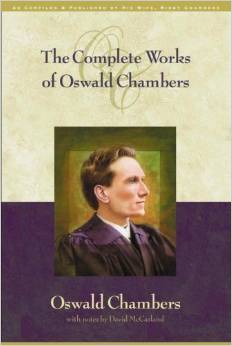
The Complete Works Of Oswald ChambersOswald Chambers has given us another valuable resource in Our Portrait In Genesis, as he walks through the first book of the Bible with us. You can read my full book review here. As usual, there are just way too many good quotes to share all at once, so here is the first batch of quotes from this book.

“It is not my faith laying hold of the Word, but the life in the Word laying hold on me.”

“We transgress a law of God and expect an experience akin to death, but exactly the opposite happens, we feel enlarged, more broad-minded, more tolerant of evil, but we are more powerless; knowledge which comes from eating of the tree of the knowledge of good and evil, instead of instigating to action, paralyzes.”

“No man can murder his brother who has not first murdered God in himself.” 

“It is ingrained in our thinking that competition and rivalry are essential to the carrying on of civilized life; that is why Jesus Christ’s statements seem wild and ridiculous. They are the statements either of a man or of God Incarnate. To carry out the Sermon on the Mount is frankly impossible to anyone but a fool, and who is the fool? The man who has been born again and who dares to carry out in his individual life the teaching of Jesus. And what will happen? The inevitable result, not the success he would otherwise have. A hard saying, but true.”

“Grace is the overflowing immeasurable favor of God; God cannot withhold, the only thing that keeps back His grace and favor is our sin and perversity.” 

“Faith un-tried has no character value for the individual. … Spiritual character is only made by standing loyal to God’s character no matter what distress the trial of faith brings.”

“We must be careful never to compromise over any promise of God when by reason of human limitation there has been only a partial fulfillment. Such a compromise is easily detected whenever you feel, ‘Oh well, I suppose that is all God meant.’ Every word God has spoken will be absolutely fulfilled; to climb down from that confidence is to be disloyal to God.”

“There is always the danger of becoming a fanatical adherent to what God has said instead of adhering to God who said it.”

“The only way to wait for the Second Coming is to watch that you do what you should do so that when He comes is a matter of indifference.” 

“It is a question of faith in God, the rarest thing, we have faith only in our feelings. I don’t believe God unless He will give me something in my hand whereby I may know I have it, then I say, ‘Now I believe.’ There is no faith there.”

Links & Quotes

link quote


In The Screwtape Letters, in which an older demon is writing to an apprentice demon, the ‘Enemy’ is God, and the ‘Father’ is the devil. “The Enemy’s demand on humans takes the form of a dilemma; either complete abstinence or unmitigated monogamy. Ever since our Father’s first great victory, we have rendered the former very difficult to them. The latter, for the last few centuries, we have been closing up as a way of escape. We have done this through the poets and novelists by persuading the humans that a curious, and usually shortlived, experience which they call ‘being in love’ is the only respectable ground for marriage; that marriage can, and ought to, render this excitement permanent; and that a marriage which does not do so is no longer binding. This idea is our parody of an idea that came from the Enemy. The whole philosophy of Hell rests on recognition of the axiom that one thing is not another thing, and, specially, that one self is not another self. My good is my good and your good is yours. What one gains another loses. Even an inanimate object is what it is by excluding all other objects from the space it occupies; if it expands, it does so by thrusting other objects aside or by absorbing them. A self does the same. With beasts the absorption takes the form of eating; for us, it means the sucking of will and freedom out of a weaker self into a stronger. ‘To be’ means ‘to be in competition.’” —C.S. Lewis, in The Screwtape Letters

“Commend me to the Christian who says, ‘I bless God I am saved; now what can I do for others?’ The first thing in the morning he prays, ‘God help me to say a word to some soul this day.’ During the day, wherever he may be, he is watching his opportunity, and will do good if he can. He is concerned about his children: it sometimes breaks his heart to think that they are not saved. If he happens to have an ungodly wife, it is his daily burden, ‘O God, save my wife!’ When he goes to a place of worship he does not expect the minister to make sermons always on purpose for him, but he says, ‘I shall sit here and pray God to bless the word,’ and if he looks round the chapel and sees one that he loves, he prays for him, ‘God send the word home to him.’ When service is over, a man of this kind will waylay the unconverted, and try to get a personal word with them, and see if he cannot discover some beginnings of grace in their souls. This is how earnest Christians live; and let me tell you, as a rule, though they have the griefs of other men’s souls to carry, they do not have much grief about their own; they are watering others and they are watered themselves also. May this be your work and mine!” —Charles Spurgeon

“Paul wrote to the Ephesians about the true character of a healthy, growing church. He said nothing about numbers of people, size of budget, variety of programs and facilities, or whether or not it had a great worship band. He emphasized two characteristics—unity and maturity—which are in short supply in America’s churches today (Ephesians 4:11-16).” —T.M. Moore

Dr. George O. Wood says, “If even the angels do not know, and Jesus did not know, why do we have so many ‘date-setters’ even today? You can research and discover that there have been numerous false prophecies in the past centuries where authors and so-called prophets set a date for the return of Christ. Date-setters will always be wrong; you can count on it.” Read the rest of his post about Christ’s return here.

I like this: 5 reasons the church should embrace science.

Fight The New Drug asks: Is there a difference between pornography and prostitution?