Stand-Up Christians

Listen to the podcast of this post by clicking on the player below, and you can also subscribe on AppleSpotify, or Audible. 

“I’ve searched all the parks in all the cities and found no statues of committees.” —G.K. Chesterton 

It’s true that no statues have been erected to committees or groups, but groups of people have been allowed to stand up because just one strong leader stood up for them. And history has shown that there never has been a greater servant leader—lifting and rescuing more people than we can count—than Jesus of Nazareth. 

Before He ascended back to heaven Jesus said to His followers, “As the Father has sent Me, I am sending you” (John 20:21). He has called us to stand up as His representatives in the world. Jesus didn’t send His followers out under their own power, but He directed them to first be empowered by the Holy Spirit (Acts 1:7-8). 

Last week I shared how Hannah’s persistence in prayer led to a revival in Israel. Hannah’s physical barrenness was a picture of Israel’s spiritual barrenness. When Hannah prayed, we read a key phrase: Hannah stood up (1 Samuel 1:9). She was really saying, “God do something IN me that will turn people to You!” 

And God literally did something IN her: she became pregnant, and the son that came from her was the spiritual leader Israel needed. 

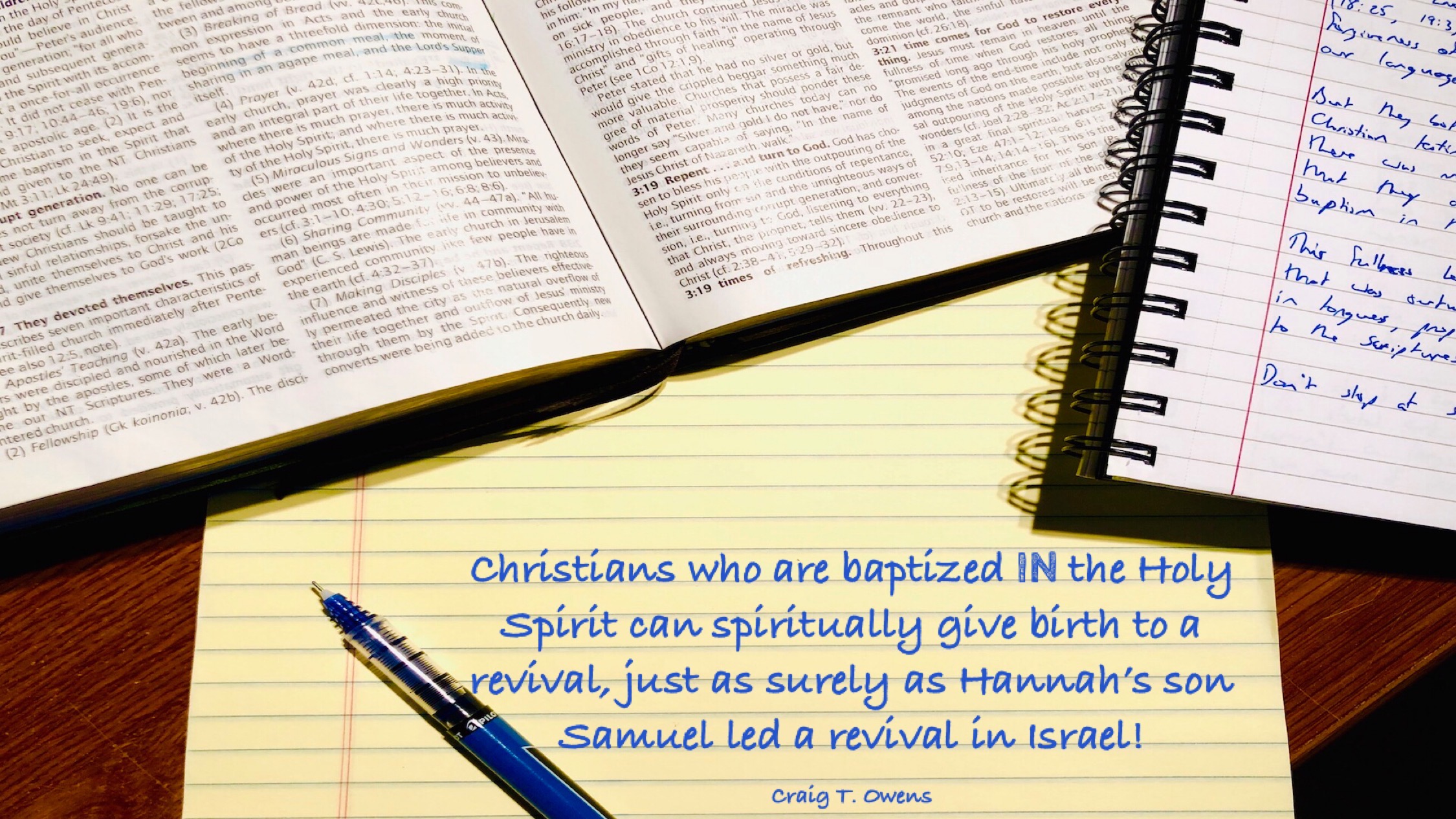
New Testament Christians can have a new life conceived IN them when they are baptized IN the Holy Spirit. They can then spiritually give birth to a revival, just as surely as Hannah’s son Samuel led a revival in Israel! Being baptized IN the Holy Spirit empowers us to be stand-up Christians.  

Consider the disciple Peter. On the night Jesus was arrested, Peter couldn’t stand up for Jesus, even though it was just two little servant girls who confronted him. Then Pentecost Sunday came, Peter was baptized IN the Holy Spirit, and this Spirit-empowered man now became a stand-up Christian (Matthew 26:69-72; Acts 2:1-4, 14). 

As Aimee Semple McPherson noted, “The Holy Spirit, when He endues you with power, puts a real ‘stand up for Jesus spirit’ within you, and removes your cowardice.” 

Peter not only stood up before a questioning crowd, he stood up to the same religious leaders who had Jesus crucified, and he stood up for the Gentiles who became Christians (Acts 4:5-10; 15:6-11).

In Peter’s first letter to the Church, he explained how Spirit-baptized Christians could…

  • stand up joyfully in trials (1:6-9; 4:7, 12-19) 
  • stand up for holiness in a wicked culture (1:13-16; 2:11-12)
  • stand up to be able to submit to and serve those in civic government positions (2:13-17)
  • stand up to serve your employer (2:18)
  • stand up like Jesus did to the people who revile and slander you (2:19-25)
  • stand up for your spouse’s salvation (3:1-7) 
  • stand up for your Church family (3:8-12) 
  • stand up to fear (3:13-14) 
  • stand up to give testimony to your faith in Jesus (3:15-17)
  • stand up to live counter-culturally (4:1-6)
  • stand up for the shepherds and the sheep in God’s family (5:1-5)
  • stand up to anxiety (5:6-7)
  • stand up against the devil’s growling (5:8-11) 
  • stand up for Jesus until the very end of life or until Jesus returns (5:12-14) 

All of this from a man who couldn’t stand up to a little servant girl! 

That’s why I’ve said it before and I’ll keep on saying it—Don’t stop at salvation! There is SO MUCH MORE for those who will receive the baptism IN the Holy Spirit. If you want to stand up for Jesus and stand up for others who are being pushed around by the devil, you must be empowered with the stand-up-for-Jesus spirit that only comes from the Holy Spirit. 

Will you let the Holy Spirit put that stand-up spirit in you?

If you have missed any of the other messages in this series, please click here to access them.

►► Would you please prayerfully consider supporting this ministry? My Patreon supporters get behind-the-scenes access to exclusive materials. ◀︎◀︎

10 Quotes From C.S. Lewis

Any day is a good day for some C.S. Lewis quotes! 

“To be ignorant and simple now—not to be able to meet enemies on their own ground—would be to throw down our weapons, and to betray our uneducated brethren who have, under God, no defense but us against the intellectual attacks of the heathen.” —C.S. Lewis 

“Good philosophy must exist, if for no other reason, because bad philosophy needs to be answered.” —C.S. Lewis 

“Do not waste time bothering whether you ‘love’ your neighbor; act as if you did.” —C.S. Lewis 

“If you do him a good turn, not to please God and obey the law of charity, but to show him what a fine forgiving chap you are, and to put him in your debt, and then sit down to wait for his ‘gratitude,’ you will probably be disappointed.” —C.S. Lewis 

“Good and evil both increase at compound interest. That is why the little decisions you and I make every day are of such infinite importance. The smallest good act today is the capture of a strategic point from which, a few months later, you may be able to go on to victories you never dreamed of. An apparently trivial indulgence in lust or anger today is the loss of a ridge or railway line or bridgehead from which the enemy may launch an attack otherwise impossible.” —C.S. Lewis 

“For many of us the great obstacle to charity lies not in our luxurious living or desire for more money, but in our fear—fear of insecurity.” —C.S. Lewis 

“The battle is between faith and reason on one side and emotion and imagination on the other.” —C.S. Lewis 

“Faith, is the art of holding on to things your reason has once accepted, in spite of your changing moods.” —C.S. Lewis 

“And as a matter of fact, if you examined a hundred people who had lost their faith in Christianity, I wonder how many of them would turn out to have been reasoned out of it by honest argument? Do not most people simply drift away?” —C.S. Lewis 

“A man who gives in to temptation after five minutes simply does not know what it would have been like an hour later. That is why bad people, in one sense, know very little about badness. They have lived a sheltered life by always giving in. We never find out the strength of the evil impulse inside us until we try to fight it: and Christ, because He was the only man who never yielded to temptation, is also the only man who knows to the full what temptation means—the only complete realist.” —C.S. Lewis

10 Quotes From “Coronavirus And Christ”

John Piper has given us a book that is so spot-on timely for this unusual time we are going through. Check out my full book review by clicking here. 

“I am a sinner. I have never lived a day of my life—not one—without falling short of God’s standards of love and holiness. So how can this be? How can God say, ‘You, John Piper, will be with Me—live or die’ [1 Thessalonians 5:9-10]? God didn’t even wait for the question before He answered. It’s because of Jesus.” 

“To be God is to cause His own counsel to stand—always. God does not just declare which future events will happen; He makes them happen. He speaks His word, and then He adds, ‘I am watching over My word to perform it’ (Jeremiah 1:12).” 

“Jesus expresses the sweetness of God’s sovereignty for His disciples as beautifully as anyone: ‘Are not two sparrows sold for a penny? And not one of them will fall to the ground apart from your Father. But even the hairs of your head are all numbered. Fear not, therefore; you are of more value than many sparrows’ (Matthew 10: 29–31). Not one sparrow falls but by God’s plan. Not one virus moves but by God’s plan. This is meticulous sovereignty. And what does Jesus say next? Three things: you are of more value than many sparrows; the hairs of your head are all numbered; fear not.” 

“Christians get swept away in tsunamis. Christians are killed in terrorist attacks. Christians get the coronavirus. The difference for Christians—those who embrace Christ as their supreme treasure—is that our experience of this corruption is not condemnation.” 

“God put the physical world under a curse so that the physical horrors we see around us in disease and calamities would become a vivid picture of how horrible sin is. In other words, physical evil is a parable, a drama, a signpost pointing to the moral outrage of rebellion against God.” 

Physical pain is God’s trumpet blast to tell us that something is dreadfully wrong in the world. Disease and deformity are God’s pictures in the physical realm of what sin is like in the spiritual realm.” 

“Jesus wants us to see the birth pains (including the coronavirus) as reminders and alerts that He is coming and that we need to be ready [Matthew 24:44].” 

“What God is doing in the coronavirus is showing us—graphically, painfully—that nothing in this world gives the security and satisfaction that we find in the infinite greatness and worth of Jesus.” 

“Paul does not view this experience of desperation as satanic or random [2 Corinthians 1:8-9]. It is purposeful. And God is the One whose purpose is mentioned: this life-threatening experience ‘was to make us rely not on ourselves but on God who raises the dead.’” 

“Jesus taught His followers to ‘let your light shine before others, so that they may see your good works and give glory to your Father who is in heaven’ (Matthew 5:16). What is often not noticed is that being the salt of the earth and the light of the world in this way was the more salty and the more bright because the good deeds were to be done even in the midst of suffering. …

“It is nor mere good deeds that give Christianity its tang and luster. It is good deeds in spite of danger.”

8 Quotes From “Warnings To The Churches”

This hard-hitting, no-pulled-punches book is directed primarily at pastors and other church leaders. However, I think anyone who loves Christ and His Bride will find much to ponder in Warnings To The Churches by J.C. Ryle. You can read my full book review by clicking here. 

“Go forward, beloved brethren, and fear not the adversary. Only abide in Christ and the victory is sure. Marvel not at the hatred of the gates of hell. ‘If you were of the world, the world would love you as its own’ [John 15:19]. So long as the world is the world, and the devil is the devil, there must be warfare, and believers in Christ must be soldiers! The world hated Christ, and the world will hate true Christians as long as the earth stands. As the great reformer, [Martin] Luther, said, ‘Cain will go on murdering Abel so long as the Church is on earth.’” 

“He who cannot lie has pledged His royal word that all the powers of hell shall never overthrow His Church. It shall continue, and stand, in spite of every assault. It shall never be overcome.” 

“Weak as this true Church may appear to the eye of man, it is an anvil which has broken many a hammer in times past, and perhaps will break many more before the end. He who lays hands on it is touching the apple of God’s eye!” 

“We corrupt the Word of God most dangerously when we throw any doubt on the absolute inspiration of any part of Holy Scripture.” 

“We corrupt the Word of God when we make defective statements as doctrines. We do so when we add to the Bible the opinions of the Church or of the Church Fathers, as if they were of equal authority. We do so when we take away from the Bible for the sake of pleasing men. We do so when from a feeling of false liberality, keep back any statement which seems narrow, or harsh, or hard. We do so when we try to soften down anything that is taught about eternal punishment or the reality of hell. We do so when we bring forward doctrines in their wrong proportions.” 

“May we never care what men say of us so long as we walk in the light of God’s Word! May we strive and pray to be wholly independent of, and indifferent to, man’s opinion, so long as we please God!” 

“Chosen as believers are by God the Father, justified as they are by the blood and righteousness of Jesus Christ, sanctified as they are by the Holy Spirit, believers are still only men—they are still in the body and still in the world. They are ever near temptation. They are ever liable to misjudge, both in doctrine and in practice. Their hearts, though renewed, are very feeble; their understanding, though enlightened, is still very dim. They ought to live like those who dwell in an enemy’s land, and every day to put on the armor of God. The devil is very busy: he never slumbers or sleeps.” 

“Like the fruit of which Eve and Adam ate, at first sight it looks pleasant and good, and a thing to be desired. ‘Poison’ is not written up on it and so people are not afraid. Like counterfeit coin it is not stamped ‘bad.’ It passes for the real thing, because of the very likeness it bears to the truth. Let us be on our guard against the very small beginnings of false doctrine.” 

10 Quotes From “The Knowledge Of The Holy”

A.W. Tozer helps us think long and deep about the greatness of God, opening windows of insight that many have not contemplated previously. Check out my full book review of The Knowledge Of The Holy by clicking here. 

“With our loss of the sense of Majesty has come the further loss of religious awe and consciousness of the divine presence. … The decline of the knowledge of the holy has brought on our troubles. A rediscovery of the majesty of God will go along way toward curing them.” 

“What comes into our minds when we think about God is the most important thing about us.” 

“The man who comes to a right belief about God is relieved of ten thousand temporal problems, for he sees at once that these have to do with matters which at the most cannot concern him for very long; but even if the multiple burdens of time may be lifted from him, the one mighty single burden of eternity begins to press down upon him with a weight more crushing then all the woes of the world piled one upon another. …

“But unless the weight of the burden is felt, the gospel can mean nothing to the man; and until he sees a vision of God high and lifted up, there will be no woe and no burden. Low views of God destroyed the gospel for all who hold them.” 

“Among the sins to which the human heart is prone, hardly any other is more hateful to God than idolatry, for idolatry is at bottom a libel on His character. … The essence of idolatry is the entertainment of thoughts about God that are unworthy of Him.” 

“The heaviest obligation lying upon the Christian Church today is to purify and elevate her concept of God until it is once more worthy of Him—and of her.” 

“When the Spirit would acquaint us with something that lies beyond the field of our knowledge, He tells us that this thing is like something we already know, but He is always careful to phrase His description so as to save us from slavish literalism.” 

“An attribute of God is whatever God has in anyway revealed as being true of Himself.” 

“We might be wise to follow the insight of the enraptured heart rather than the more cautious reasonings of the theological mind.” 

“If we ever think well it should be when we think of God.” 

“The harmony of His being is the result not of a perfect balance of parts but of the absence of parts.… An attribute, then, is not a part of God, it is how God is…. The divine attributes are what we know to be true of God. He does not possess them as qualities; they are how God is as He reveals Himself to His creatures.” 

Leaders Listen

“The moment you wake up each morning your wishes and hopes for the day rush at you like wild animals. And the first job of each morning consists in shoving them all back; in listening to that other Voice, letting that other, stronger, larger, quieter Life come flowing in.” —C.S. Lewis 

“God said, ‘Abraham!’ ‘Yes?’ answered Abraham. ‘I’m listening.’” —Genesis 22:1 

Then God came and stood before him exactly as before, calling out, ‘Samuel! Samuel!’ Samuel answered, ‘Speak. I’m Your servant, ready to listen.’” —1 Samuel 3:10 

“How much of God are we missing because we don’t stop to listen to the many voices God uses to speak to us?” —George Washington Carver 

“To answer before listening—that is folly and shame.” —Proverbs 18:13 

“Courage is what it takes to stand up and speak; courage is also what it takes to sit down and listen.” —Winston Churchill

A mark of a godly leader is one who listens to the counsel of other godly leaders. 

“Wise, godly leaders know they must listen to the counsel of wise, godly leaders.” —Craig T. Owens 

“Lead with your ears, follow up with your tongue, and let anger straggle along in the rear.” —James 1:19 

“There are none so blind as those who will not see, none so deaf as those who will not hear, none so ignorant as those who will not listen… and none so foolish as those who think they can change those who will not see, hear, or listen.” —Warren Bennis

“Correct the wise, and they will love you.” —Proverbs 9:8 

“What is a great man who has made his mark upon history? … He is a man who has looked through the confusion of the moment and has seen the moral issue involved; he is a man who has refused to have his sense of justice distorted; he has listened to his conscience until conscience becomes a trumpet call to like-minded men, so that they gather about him, and together, with mutual purpose and mutual aid, they make a new period in history.” —Jane Addams, in a speech about George Washington 

“People don’t lose intimacy when they stop talking, but when they stop listening. Leaders seldom realize how much their listening empowers the other person. Because they are leaders, the sheer act of listening speaks volumes that even a great speech can’t communicate. …   

“A leader’s communication must be consistent, clear, and courteous. But leaders must also be good listeners. When leaders don’t listen: They stop gaining wisdom. … Leaders listen; leaders learn; and then leaders lead.” —John Maxwell 

This is part 43 in my series on godly leadership. You can check out all of my posts in this series by clicking here.

A Praying Family

Not one word in Scripture is wasted: not one word is redundant or replaceable. When Jesus taught us to pray to a Heavenly Father, He taught us to say, “OUR Father.” That means we are all His children, with His Holy Spirit helping us to grasp this—The Spirit Himself testifies with our spirit that WE are God’s children. Now if WE are children, then WE are heirs—heirs of God and co-heirs with Christ… (Romans 8:16-17). 

Did you know that the word saints never appears in the singular in Scripture? No one person is singled out for his or her saintliness. Because we are saintS, praying together to OUR Father, this means accountability. For some people, accountability is a bad word. It seems to them to feel like someone is looking over their shoulder or checking up on them. But Christians should never feel this way! I like how Ken Blanchard defines this: “Accountability means: We owe each other for something we’ve agreed upon.” 

What have the saints of God agreed upon? That God is our Father, that Jesus is His Son and our Brother, and that the Holy Spirit is our Helper. We’ve agreed that if we are brothers and sisters in God’s family, we are mutually accountable to one another. 

In the context of the prayer Jesus taught us to pray, being mutually accountable means: 

  1. Power in our prayersgive US today our daily bread. Jesus talks about the power in agreement, and the apostle Paul emphasizes how the Holy Spirit helps believers harmonize in prayer with each other and with God’s will (Matthew 18:19-20; Romans 8:27). 
  1. Strengthening of our characterforgive US our debts, as WE also have forgiven our debtors. Jack Hayford points out that, “The believer’s best defense against self-deception is through mutual accountability to one another.” In order for our character to be strengthened, we have to allow others to speak into our lives—even the lovingly painful words (Proverbs 27:17, 6). 
  1. Protection from falling to temptationlead US not into temptation, but deliver US from the evil one. Samson became entangled with a prostitute when he was all by himself; Elijah became depressed when he sent his servant away; David fell into sin when he was alone; Peter denied Christ when all of the other disciples had run away. That’s why the writer of Hebrews counsels us to stick close to our Christian family members (Hebrews 10:21-25). 

In an earlier post, I noted that how we view God is going to determine what we pray and what we expect after we pray. Coming together and praying together will help us see God better. Just as the angels around the throne are always crying out to each other “Holy! Holy! Holy!”, when we come together we can show our fellow saints what we’ve learned about our holy Father’s love and power. This is both an encouragement to others and allows others to be an encouragement to us too. Then together we can pray more boldly and expect great things in response to our prayer. 

Being mutually accountable to the saints in prayer…

  • hallows God as our Father

  • glorifies Jesus as our Brother

  • honors the Spirit as our Helper

God never intended that you would have to walk through life alone. He wants us to share the journey with fellow saints—His family made up of our brothers and sisters. This praying family truly honors God’s name! 

Join me on Sunday as we continue to learn more about prayer. 

20 Facts & Tips About Your Body Clock

I really enjoyed reading The Secrets Our Body Clocks Reveal (you can read my full book review by clicking here). From this book, I’ve begun implementing a few of the tips I discovered. Here are a few of the facts and tips that I found interesting. 

  1. “Most of us reach our peak of alertness around noon. … We are least alert during the early morning hours—specifically, between 3:00 a.m. and 6:00 a.m.” 
  2. “Your immediate, or short-term, memory is best during the morning hours. … Your long-term memory is a different matter, however. Afternoon is the best time for learning material that you want to recall days, weeks, or even months later. … How well you remember things depends on when you learn them, not when you recall them.” 
  3. “On average, we tend to do best on cognitive tests—things that require the greatest mental effort—during the morning hours, particularly the late morning hours.” 
  4. “All of your senses—taste, sight, hearing, touch, and smell—are their keenest during the twilight hours of late afternoon and early evening.” 
  5. Tips for keeping your daily rhythms on beat: (1) get out in the sun for at least fifteen minutes each day, and (2) try to follow a regular daily routine.
  6. “Fortunately, there is another way to avoid the Monday morning blahs. Stay up as late as you like, but make sure you get up at your regular wake up time. In other words, don’t sleep in. And don’t take naps during the day. Then, when night rolls around again, you’ll find yourself able to fall asleep at or before your regular bedtime, and you’ll avoid pushing your cycle ahead.” 
  7. “Scientists have also discovered that short naps (twenty minutes or less) are just as revitalizing as long ones—and less disruptive to regular sleep rhythms. In addition, regular nappers wake up more refreshed than those who take only an occasional nap. When naps are part of the regular daily rhythm, they are less disruptive.” 
  8. “Generally, our moods peek around four hours after we awaken.” 
  9. “A regular exercise program can go along way toward easing the physical effects of stress. … The exercise program must be regular, however; sporadic physical activity, such as an occasional game of tennis or softball, or an activity that is not appropriate to your physical condition, can be a harmful stressor.” 
  10. “Melatonin’s daily rhythm is similar to that of legendary vampires: it appears at the onset of darkness and begins to disappear at the break of dawn. In other words, darkness triggers the chemical’s release; sunlight suppresses it. It should come as no surprise, therefore, that melatonin reaches its seasonal peak in the body during the dark winter months.” 
  11. “Beards tend to grow the most on Sunday and the least on Wednesday.” 
  12. “If you wake up in the morning with a temperature of 99° F, you are very likely coming down with a cold, the flu, or some other kind of illness. But if you have that same reading around dinner time, you may be in perfect health. The reason, of course, is that your temperature rises during the day. A high reading early in the day is a greater indication of illness than the same reading late in the day.” 
  13. “Take a commonplace drug like aspirin, for example. When swallowed at 7:00 a.m., aspirin stays in the body for up to twenty-two hours. When the same dose is taken at 7:00 p.m., it is completely out of the body within seventeen hours.” 
  14. “When you know your rhythms are out of sync, be aware that you are particularly vulnerable to illness. It is the time to be extra careful about keeping your distance from people with the flu or other viruses.” 
  15. “The best thing you can do for a tension headache is to learn how to relax. As soon as the headache begins, lie down, if possible, so you can take the strain off your neck, since this is the location of most of the muscles that tense up and cause a tension headache. Close your eyes and breathe deeply to return oxygen to your strained muscles. Better yet, ask a sympathetic friend or loved one to gently massage your neck and shoulders.”
  16. “Eat your biggest meal at breakfast, your next biggest at lunch, and your smallest at dinner.” 
  17. “About every ninety minutes, most people experience an urge to put something into their mouths. … Generally, it will pass in about fifteen minutes.” 
  18. “According to recent studies conducted at Northwestern University, both morning and night people perform simple mental tasks better during the morning hours after consuming the caffeine equivalent of one to three cups of coffee. But when the tasks become more complex, only night people do better under the influence of caffeine. For morning people, the higher dose of caffeine, the more mistakes they make.” 
  19. “Carbohydrates help calm and focus your mind.” 
  20. “Protein foods increase your alertness and help you feel more energetic. … Protein can be eaten either alone or with a carbohydrate food to energize the mind. For carbohydrates to have their calming effect, they must be eaten alone.” 

Susan Perry and Jim Dawson also shared what they uncovered about the importance of sleep. Click here to read about their research 

11 Quotes From “When The Darkness Will Not Lift”

John Piper has given us an extremely helpful book whether we ourselves are battling the darkness of depression, or someone close to us is. Please check out my full book review of When The Darkness Will Not Lift by clicking here. 

“This is the rock where we stand when the dark clouds gather and the floods lick at our feet: justification is by grace alone (not mixed with our merit), through faith alone (not mixed with our works) on the basis of Christ alone (not mingling His righteousness with ours), to the glory of God alone (not ours).” 

“Where should you start? Start at the easiest place for those in darkness. Start with despair. Despair of finding any answer in yourself. I pray that you will cease from all efforts to look inside yourself for the rescue you need. I pray that you will do what only desperate people can do, namely, cast yourself on Christ.” 

“You cannot isolate the spiritual from the physical for we are body, mind and spirit. The greatest and the best Christians when they are physically weak are more prone to an attack of spiritual depression then at any other time and there are great illustrations of this in the Scriptures.” 

“It will be of great advantage to the struggling Christian to remember that seasons of darkness are normal in the Christian life.” 

“One of the reasons God loved David so much was that he cried so much. … It is a beautiful thing when a broken man genuinely cries out to God.” 

“Faith is sustained by looking at Christ, crucified and risen, not by turning from Christ to analyze your faith. … Paradoxically, if we would experience the joy of faith, we must not focus much on it. We must focus on the greatness of our Savior.” 

“It follows from this that we should all fortify ourselves against the dark hours of depression by cultivating a deep distrust of the certainties of despair. Despair is relentless in the certainties of its pessimism. But we have seen again and again, from our own experience and others, that absolute statements of hopelessness that we make in the dark are notoriously unreliable. Our dark certainties are not sureties. While we have the light, let us cultivate distrust of the certainties of despair.” 

“Instead of only saying, ‘Just do your duty,’ we must say…that joy is part of your duty. The Bible says, ‘Rejoice always’ (1 Thessalonians 5:16). And in regard to the duty of giving, it says, ‘God loves a cheerful giver’ (2 Corinthians 9:7). In regard to the duty of service, it says, ‘Serve the Lord with gladness’ (Psalm 100:2). In regard to the duty of mercy, it says do it ‘with cheerfulness’ (Romans 12:8). In regard to the duty of afflictions, it says, ‘Count it all joy’ (James 1:2). We simply water down the divine command when we call someone to half their duty.” 

“In dealing with our sin we can make two mistakes. One is to make light of it. The other is to be overwhelmed by it.” 

“If we want the joy of seeing and savoring God in Christ, we must not make peace with our sins. We must make war.” 

“Sometimes the darkness of our souls is owing in some part to the fact that we have drifted into patterns of life that are not blatantly sinful but are constricted and uncaring. … Unconsciously we have become very self-absorbed and oblivious and uncaring toward the pain and suffering in the world that is far worse than our own.”

“Paradoxically, depressed persons may say that they must care for themselves and cannot take on the problems of the world, when in fact part of the truth may be that their depression is feeding on the ingrown quality of their lives. … Joy in Christ thrives on being shared. That is the essence of Christian joy: it overflows or dies.”

10 Quotes From “Cultivation Of Christian Character”

J. Oswald Sanders has given us a short but powerfully effective book for developing more Christlikeness in each and every Christian. Check out my full book review by clicking here. 

“In a word, spiritual maturity is Christlikeness.” 

“Christ set the standard in everything. He was never petulant, always calm; never rebellious, always obedient; never fearful, always courageous; never vacillating, always resolute; never pessimistic, always cheerful; never subtle, always sincere; never grasping, always generous; never acting from expediency, always from principle. He is the pattern of spiritual maturity.” 

“So then our spiritual maturity or immaturity is seen in the manner in which we react to the changing circumstances of life. … It has to be learned. Is it not striking that it is recorded of Christ that ‘though He were a Son, yet He learned obedience by the things which He suffered; and being made perfect, He became the author of eternal salvation’ (Hebrews 5:8-9)? He alone was fully mature. The rest of us are ‘going on to maturity.’ In all of us there are some expressions of our personality in which we react immaturely instead of as mature men of God.” 

“The highest manifestation of spiritual maturity is love. We are only as mature as we are mature in love.” 

“God forbid that we should ever cease to love the gospel in its simplicity, but we must not be content to stay there. We must go on to appreciate increasingly the gospel in its profundity.” 

“There is a place for a constructive contending for the faith. The church has degenerated sadly since Pentecostal days and the servant of the Lord has an important part to play in its revival.” 

“It is possible to get to heaven without living a consecrated life, but the journey there will be barren and disappointing, since consecration is the doorway to undreamed-of joy. Neglect it, fail to seek it, and life will be greatly impoverished. Welcome it, and life becomes inexpressibly enriched.” 

“When we dedicate our lives to God, He consecrate us to His service. We dedicate our lives to Him that He may work His will in us. He consecrates us to Himself that He might make us holy.” 

“It has been suggested that in consecration we bring our lives to God as a blank sheet of paper with our names signed at the bottom. Confident of His love, we invite Him to fill in the details as He will.” 

“It is a life separated to the glory of God. Inherent in the word ‘consecration’ is the idea of separateness. There must of necessity be separation from sin if there is to be separation to God. … The consecrated Christian hates evil, but he has a passion for the right and for the glory of God and Christ. He tests all his actions by the one standard, ‘Is this for the glory of God?’ He will do anything, suffer anything, if only God is glorified. Nothing is too costly to give to the Master.”