12 Lessons From The Good Samaritan

Listen to the podcast of this post by clicking on the player below, and you can also subscribe on iTunes or Spotify.

Dwight Moody was passionate about telling others how they could have a relationship with Jesus. In his book To The Work! he encourages other Christians to share this passion with him, and he counters any hesitations that Christians have to this work. Using the story Jesus told about the good Samaritan, Moody made these noteworthy observations: 

“Some people seem to think that all the world needs is a lot of sermons. Why, the people of this land have been almost preached to death. What we want is to preach more sermons with our hands and feet—to carry the Gospel to the people by acts of kindness. … 

“The Jews considered that the Samaritans had no souls; that when they died they would be annihilated. Their graves would be so deep that not even the sound of Gabriel’s trump would wake them on the resurrection morning. He was the only man under heaven who could not become a proselyte to the Jewish faith, and become a member of the Jewish family. …  

“You observe there are twelve things mentioned in the narrative that the Samaritan did. We can dismiss in a word all that the priest and the Levite did—they did nothing.

(1.) He ‘came to where he was.’ 

(2.) He ‘saw him;’ he did not, like the priest, pass by on the other side. 

(3.) He ‘had compassion on him.’ If we would be successful winners of souls we, too, must be moved with compassion for the lost and the perishing. We must sympathize with men in their sorrows and troubles, if we would hope to gain their affections and to do them good. 

(4.) He ‘went to him.’ The Levite went toward him, but we are told that he, as well as the priest, ‘passed by on the other side.’ 

(5.) He ‘bound up his wounds.’ Perhaps he had to tear up his own garments in order to bind them up. 

(6.) He poured in oil and gave some wine to the fainting man. 

(7.) He ‘set him on his own beast.’ Do you not think that this poor Jew must have looked with gratitude and tenderness on the Samaritan, as he was placed on the beast, while his deliverer walked by his side? All the prejudice in his heart must have disappeared long before they got to the end of their journey. 

(8.) He ‘brought him to an inn.’ 

(9.) He ‘took care of him.’ … 

(10.) When he departed on the morrow, the good Samaritan asked the host to care for him. 

(11.) He gave him some money to pay the bill. 

(12.) He said: ‘Whatever thou spendest more, when I come again I will repay thee.’ …  

“Do you want to know how you can reach the masses? Go to their homes and enter into sympathy with them; tell them you have come to do them good, and let them see that you have a heart to feel for them. When they find out that you really love them, all those things that are in their hearts against God and against Christianity will be swept out of the way.” 

To read my full book review of To The Work!, please click here. You can also check out some other quotes that I have shared from this book by clicking here. 

Think, Do, Evaluate, Propose

Listen to the podcast of this post by clicking on the player below, and you can also subscribe on AppleSpotify, or Audible.

The seed thought for me was this quote from John Maxwell: 

“Nothing you do will be perfect, so embrace the reality and benefits of failure by releasing yourself from the burden of not making mistakes.” 

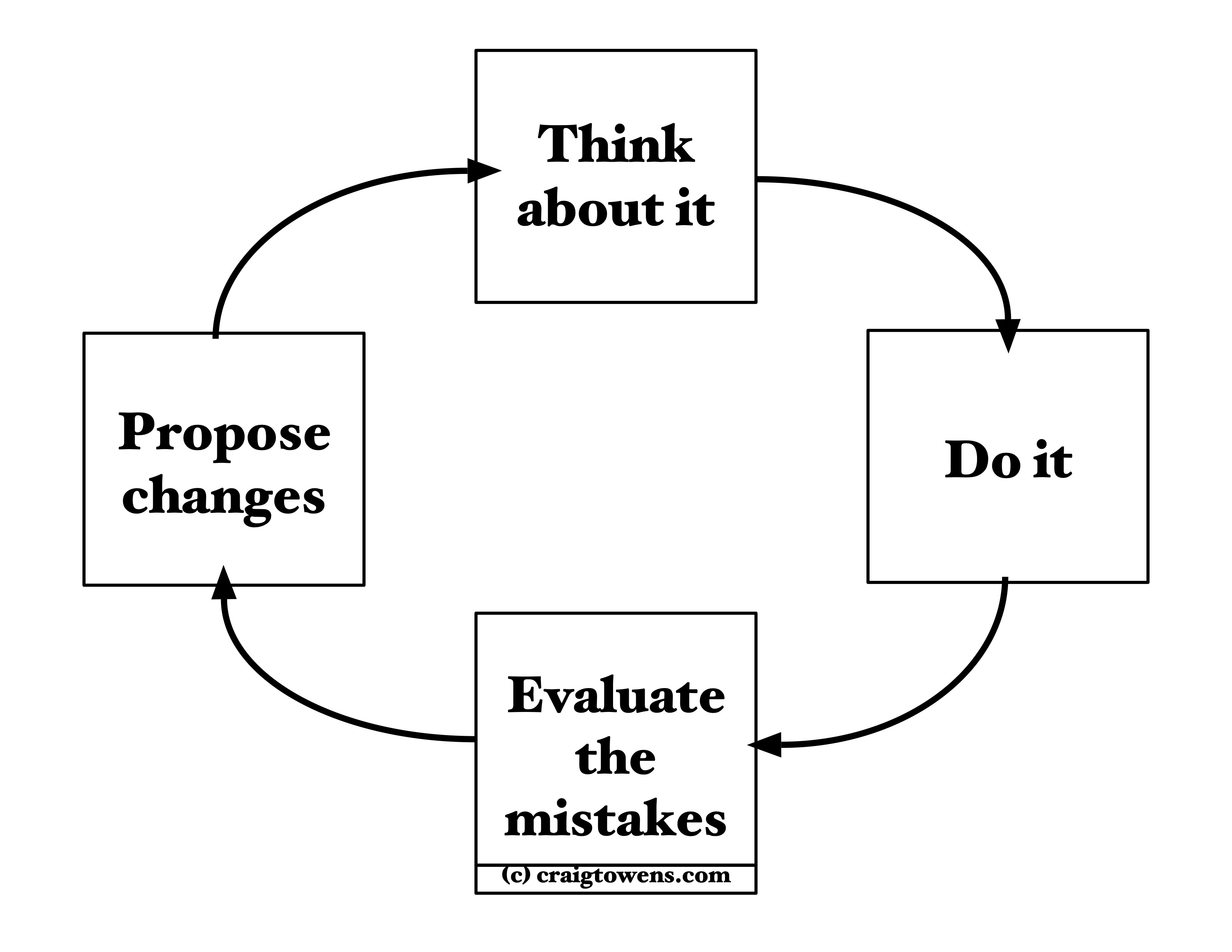
Here’s what I am endeavoring to implement: Think, Do, Evaluate, Propose. And then Repeat. 

THINK ABOUT IT—It’s important to put some thought into what you want to do before you do it, but we cannot camp-out here forever. I like to think in terms of goals I want to accomplish, whether those are for me personally or for organizations I lead. 

DO IT—At some point, I must launch out. Many people point out that Peter began to sink under the waves when he took his eyes off Jesus and began to look at the storm. But let’s not forget that Peter was the only one of the disciples who actually got out of the boat and walked on water! I often remind people who are hesitant to begin something that you cannot steer a parked car. We have to get moving first. 

EVALUATE THE MISTAKES—Let’s remove all doubt: you will make mistakes. But those mistakes are beneficial because it gives you something on which to work. Get some wise friends around you that can help you evaluate your mistakes. And always remember I failed ≠ I am a failure (here’s another post where I elaborate on this point). 

PROPOSE CHANGES—After evaluating your mistakes or shortcomings, you now have evidence that can be processed for your next attempt. This evidence can be taken back into the laboratory of the “Think” box as you prepare to try again, except now you are more informed than you were in your first attempt. 

REPEAT THE PROCESS AGAIN—No one is an overnight success, so keep trying again and again and again.

Leaders, walk through this process with your team members. Help guide their thinking, and then move them to action. Let them know that mistakes are okay because they have given you some invaluable feedback you can use as you make your proposals for your next attempt. 

Success is a continual run through the Think-Do-Evaluate-Propose cycle, with each revolution moving you closer to success. 

►► Would you please prayerfully consider supporting this ministry? My Patreon supporters get behind-the-scenes access to exclusive materials. ◀︎◀︎

The Screwtape Letters (book review)

Sun Tzu taught, “If you know the enemy and know yourself, you need not fear the result of a hundred battles.” With that maxim in mind, if you read The Screwtape Letters by C.S. Lewis, you will gain insight into the enemy’s tactics, unlike perhaps any other source. 

Lewis said this book was an easy book for him to write, but it gave him no joy to write it. Exposing the dark strategies of satan and his ugly cohort is indeed a joyless business. But even the apostle Paul tells us that we shouldn’t be unaware of the devil’s schemes. 

If you are a Christian and you read this book, you need to reverse your thinking. This book is a series of letters from Screwtape, a more experienced demon, to his nephew Wormwood who has just been given his first “patient” to seduce into hell. Whereas Christians call God their Father, in this book Screwtape refers to satan as “our Father” and God as “the Enemy.” 

Perhaps the most insightful part to me of this amazing book is the subtlety of the temptations which are employed to trip up Christians and keep seekers away from the truth. In fact, at several points Screwtape warns Wormwood that he is trying too hard to use something huge to bring down his patient when only the smallest of things will do the trick. 

I would encourage newer Christians to wait a while to read this book. In the meantime, read the Bible as much as you can—get to know the Real before you read about the counterfeit. For more mature Christians, however, this is an important book to read. 

(As a brief aside, in reading The Screwtape Letters this time through, I listened to the audiobook narrated by Joss Ackland and he delivered a phenomenal performance!) 

Clinging To God’s Words

When it comes right down to it, faith and fear both hinge on our beliefs: Fear believes something bad; faith believes something good. Fear is an invitation for us to evaluate in who or in what we have placed our trust.  

According to the dictionary, fear is a distressing emotion we feel whether the threat is real or imagined. Five hundred years ago, Michel de Montaigne said, “My life has been filled with terrible misfortune; most of which never happened.” Even more recently, an extensive study found that 85 percent of things people feared never happened!

According to the dictionary, faith is trust in something even without proof or evidence. That sounds tremendously close to the biblical definition of faith: Now faith is the assurance—the confirmation, the title deed—of the things we hope for, being the proof of things we do not see and the conviction of their reality—faith perceiving as real fact what is not revealed to the senses. (Hebrews 11:1 AMP) 

Mary is the second person to whom an angel says “Do not be afraid” in the First Advent story. Consider her story alongside Zechariah’s story and especially notice when these words were spoken. The angel Gabriel first tells Mary, “Greetings, you who are highly favored! The Lord is with you.” 

Mary’s initial response is being “greatly troubled.” This Greek word means an internal agitation that today psychologists would call “cognitive dissonance.” In other words, what Mary believed about herself didn’t line up with what God believed about her. Her next response is wondering how she could ever measure up to God’s high standard of her. 

It’s at this point that Gabriel says those key words, “Do not be afraid, Mary, you have already found favor with God.” She didn’t have to make herself worthy of God’s favor because she already had it! Now Mary just had to believe it. 

Fear is overcome by clinging to God’s words instead of the world’s words. 

Mary did indeed choose this. Her song (in vv. 46-55) is loaded with Old Testament references, and she concludes by singing to God, “You have helped Your servant Israel, remembering to be merciful to Abraham and his descendants forever, even as You said to our fathers.” 

Here’s the truth—

  • Your Word, Lord, is eternal; it stands firm in the heavens. (Psalm 119:89) 
  • God is not human, that He should lie, not a human being, that He should change His mind. Does He speak and then not act? Does He promise and not fulfill? (Numbers 23:19) 
  • And Jesus would tell us that clinging to God’s words puts us on the surest of foundations that no storm of life could ever shake (Luke 6:46-49)! 

Clinging to God’s words lets us realize God’s grace toward us. 

If you know Jesus as your Savior, you can insert your name in the same place where Gabriel said to Mary: “Do not be afraid, ____________, you have found favor with God!” 

If you have missed any of the messages in our Advent series Do Not Be Afraid, you can access the full list by clicking here. 

Thursdays With Spurgeon—The Initiation Of Power

This is a weekly series with things I’m reading and pondering from Charles Spurgeon. You can read the original seed thought here, or type “Thursdays With Spurgeon” in the search box to read more entries.

The Initiation Of Power 

     Whatever the Holy Spirit was at the first, He is that now, for as God, He remains forever the same. … We would greatly grieve the Holy Spirit if we supposed that His might was less today than in the beginning. …  

     If at the commencement of the gospel we behold the Holy Spirit working great signs and wonders, may we not expect a continuance of and, if anything, increased displays of His power as the ages roll on? … 

     It ought not to be forgotten that Pentecost was the feast of firstfruits. It was the time when the first ears of ripe corn were offered to God. If, then, at the commencement of the gospel harvest we see so plainly the power of the Holy Spirit, may we not most properly expect infinitely more as the harvest advances and, most of all, when the most numerous sheaves will be gathered? May we not conclude that if the Pentecost was thus marvelous, the actual harvest will be still more wonderful?

From Pentecostal Wind And Fire

When Jesus was approaching the Cross, He gathered His disciples together to tell them what was coming. One of the assurances He gave His followers was this: “I assure you, most solemnly I tell you, if anyone steadfastly believes in Me, he will himself be able to do the things that I do; and he will do even greater things than these, because I go to the Father” (John 14:12). 

The empowering force for these “greater things” would be the Holy Spirit indwelling the Christian (Matthew 3:11; Luke 24:49; Acts 1:8, 2:1-4). 

Pentecost wasn’t the culmination, it was the initiation. 

Pentecost was the launching point for followers of Jesus to be filled with dunamis power that would enable them to go into all the world and preach the gospel, and to have signs and wonders follow to confirm the preaching of the Word. 

As Spurgeon said, we greatly grieve the Holy Spirit when we attempt to put Him in a box as to what He can or can’t do today, or if we try to limit Him to one era of long-past history. The Holy Spirit is as vital for a Christian today as He was on that Pentecost Sunday described in Acts 2! 

Learning Perseverance

I have shared three lessons I learned going through dark times in my life (you can check them out here, here, and here), but we aren’t even close to exhausting all of the lessons that can be learned in the night. I want to teach you one principle that will allow for lifelong learning and application of these nighttime lessons. 

The apostle Paul shared how he had matured during his times of struggle. He told the Corinthians he realized that God had delivered him in the past, was delivering him now, and would continue to deliver him in the future (see 2 Corinthians 1:3-11). The key is to hang in long enough to actually see how God brings about the deliverance and teaches the lessons. 

Paul told the Corinthians, “No temptation has overtaken you except what is common to mankind. And God is faithful; He will not let you be tempted beyond what you can bear. But when you are tempted, He will also provide a way out so that you can ENDURE it (1 Corinthians 10:13). And the writer of Hebrews said, “So do not throw away your confidence; it will be richly rewarded. You need to PERSEVERE so that when you have done the will of God, you will receive what He has promised” (Hebrews 10:35-36). 

The Greek word translated “persevere” means keeping focused on the goal despite the struggles that it takes to get there. Jesus used this same Greek word at the conclusion of His parable of the sower: “The seed on good soil stands for those with a noble and good heart, who hear the Word, retain it, and by PERSEVERING produce a crop”; a crop that Jesus said was a hundred times more than what was sown (see Luke 8:5-15). 

I love riding my bike on the White Pine Trail by my house. My long rides have a really fun stretch where I am flying downhill! But as fun as that part is, I’m not really building anything of lasting value. However, when I am coming back uphill and I want to quit because my legs are burning and I can hardly breathe, that becomes a valuable struggle. I cannot build endurance by any other way than to push myself just a little bit farther each time. When I want to quit, I pedal just a few more feet. Gradually, the uphill becomes less daunting. 

A friend gave me a t-shirt I like to wear on my rides. When I put it on the blue-lettered message on the shirt says, “Do It!” but as I struggle uphill and the sweat begins to pour off my body, a new message emerges: “Don’t Quit! 

I have learned that easy roads teach very few valuable lessons. 

So here are three thoughts to help you persevere in your struggling times: 

  1. Keep your eyes on Jesus and on His eternal rewards (Hebrews 12:1-3; James 1:2-4, 12) 
  2. Keep persevering friends close by—notice the “let us” phrases the writer of Hebrews uses 
  3. On your worst day, don’t quit but commit to going one day longer (Romans 5:3-4) 

[check out all of the verses by clicking here]

Remember that as you struggle and persevere, you are not only building your own endurance, but you are strengthening yourself to be able to help others. So we can be thankful IN the night because God is building our endurance for the next night, and our endurance for our friend’s next night. 

If you have missed any of the other lessons in this series called Thankful In The Night, you can access the full list by clicking here. 

Learning Empathy

I’m an up-and-at-em, carpe diem kinda guy. Nothing gets me down for very long—I’m resilient and self-motivated. So I used to have a hard time relating to people who weren’t wired the same way. That is until I went through a time in my life where getting up-and-at-em was one of the hardest things I had to do each day.  

In the midst of this dark night, I would ask God, “Why is this happening to me? What did I do wrong?” But I heard the Holy Spirit gently but unmistakably remind me, “This isn’t about you!” 

The dictionary says that empathy is nearly a transliterated word from the Greek word empatheia. It means to be in suffering, but the emphasis is more on imaginative empathy. Something like, “If I was them and I was in that situation, I bet it might feel like this.” 

In the New Testament, a different Greek word is translated sympathy, which is also a transliterated word from the Greek sympatheō. This word means to enter into another’s suffering, but the emphasis is on experiential empathy. In other words, I don’t have to imagine how you might feel, but I know how you feel because I’ve gone through the same thing myself. 

Just as the Holy Spirit taught me this lesson, let me say the same thing to you: the dark night you are going through isn’t about you. It’s about learning empathy SO THAT you can help others persevere all the way to the end! 

Think about the dark night Jesus went through just before His crucifixion. He might have asked His Father, “Why is this happening to Me? What did I do wrong?” But He knew why He was going through this night: it was to prepare Him to be the perfect empathetic High Priest for all of us (check out these verses in Hebrews).  

When we invite Jesus to be our Lord and Savior, we become a part of His Body (1 Corinthians 12:13, 26). 

Dr. Paul Brand was a renowned hand surgeon and missionary who worked with leprosy patients in India for years. He learned that leprosy doesn’t mangle a person’s foot or hand, but their lack of ability to feel pain does. He wrote, “A body only possesses unity to the degree that it possess pain…. We must develop a lower threshold of pain by listening, truly listening, to those who suffer. … The body protects poorly what it does not feel.” 

Sometimes we have to go through the painful, dark nights so that we can learn to feel others’ pain so that we can learn empathy. 

Through those nights we can learn to hear what others aren’t saying, and feel what others aren’t expressing. We don’t have to ask, “Can I help?” but rather, “I’m here to help because I know what you’re going through.” 

You cannot truly empathize until you go through your own dark night. I can be thankful IN the night because God is growing my empathy so that I can help others! 

If you’ve missed any of the other messages in this series, you can check out the full list by clicking here. 

Thursdays With Spurgeon—Honey In My Mouth

This is a weekly series with things I’m reading and pondering from Charles Spurgeon. You can read the original seed thought here, or type “Thursdays With Spurgeon” in the search box to read more entries.

Honey In My Mouth

He will glorify Me, for He will take of what is Mine and declare it to you. All things that the Father has are Mine. Therefore I said that He will take of Mine and declare it to you. (John 16:14-15) 

     So we actually receive, through Jesus Christ, by the Spirit, what is in the Father!  

     Ralph Erskine, in the preface to a sermon upon the fifteenth verse, has a notable piece. He speaks of grace as honey for the cheering of the saints, for the sweetening of their mouths and hearts. But he says that in the Father, ‘The honey is in the flower….’ In the Son, ‘the honey is in the comb…. But then we have honey in the mouth. That is the Spirit taking all things and making application of them, by showing them to us and making us to eat and drink with Christ and share of these things….

From Honey In My Mouth

My grandfather had honeybees on his farm and I was fascinated by them. So much so that in my ecology class in college, I wrote my final research paper on the fascinating inner workings of the honeybee hive. My grandfather would often plant various crops so that the nectar from those flowers would give a distinct flavor to the honey. 

The nectar of a flower has everything in it to make honey except for one thing: a honeybee’s care. The nectar has to be transported back to the hive where it then undergoes the process of being transformed into honey—precise temperatures, storage, and evaporation processes are perfectly overseen by the bees until edible honey emerges. 

Ralph Erskine’s analogy of this nectar-to-honey process is very apropos to the things of God. Our Heavenly Father said that His thoughts are higher than our thoughts: they are inaccessible by our finite human minds (Isaiah 55:8-9). Jesus came as the revelation of all of the things of the Father, declaring to us all that God has for us. Jesus added, “I still have many things to say to you, but you cannot bear them now” (John 16:12), which is why the Holy Spirit illuminates the inspired Word of God.

Do you see the whole Trinity active in this process? The Father creates, the Son reveals, and the Spirit makes accessible (or, if you will, the Spirit makes edible). 

The Holy Spirit not only makes the things of God edible to us, but He gives us new tastebuds. No longer will the things of the world satisfy our tastes, no longer will we find any satisfaction in them, no longer will those earthly things nourish us. What the Father has created, and the Son has revealed, the Spirit will make real—and delicious!—to us.


Thursdays With Spurgeon—Poetic Groans

This is a weekly series with things I’m reading and pondering from Charles Spurgeon. You can read the original seed thought here, or type “Thursdays With Spurgeon” in the search box to read more entries.

Our Prayer Helper 

Likewise the Spirit also helps in our weaknesses. For we do not know what we should pray for as we ought, but the Spirit Himself makes intercession for us with groanings which cannot be uttered. (Romans 8:26) 

     A man’s heart is moved when he groans. A groan is a matter about which there is no hypocrisy. A groan comes not from the lips, but from the heart. A groan, then, is a part of prayer that we owe to the Holy Spirit, and the same is true of all the prayer that wells up from the deep fountains of our inner life. [see also Jeremiah 4:19; Isaiah 38:14; Psalm 77:4, 38:8-9] … 

     That which is thrown up from the depths of the soul, when it is stirred with a terrible tempest, is more precious than pearl or coral, for it is the intercession of the Holy Spirit! … 

     Beloved, what a different view of prayer God has from that which men think to be the correct one! You may have seen very beautiful prayers in print and you may have heard very charming compositions from the pulpit, but I trust you have not fallen in love with them. Judge these things rightly. I pray you never think well of fine prayers, for before the thrice-holy God it ill becomes a sinful supplicant to play the orator! … The tail feathers of pride should be pulled out of our prayers, for they need only the wing feathers of faith. The peacock feathers of poetical expression are out of place before the throne of God. … God looks at the heart. To Him fine language is as sounding brass or a tinkling cymbal, while a groan has music in it! 

From The Holy Spirit’s Intercession

God is not looking for well-polished prayers; He’s looking for real prayers. Let’s be honest: Not even the most educated person in the world has a vocabulary sufficient enough to accurately communicate with The Almighty God! 

Our Heavenly Father wants us to come to Him in simple, childlike anticipation. Notice I didn’t say childish anticipation—there is a huge difference. What Paul is telling us in Romans 8 is that the Holy Spirit can make the most eloquent, childlike, sincere prayer out of our deepest longings in our hearts. 

Jesus reminded us, “Your Father knows the things you have need of before you ask Him” (Matthew 6:8). Our Father wants to answer our prayers, and He has given us His Holy Spirit to help us pray in a way that He can answer. 

Don’t try to spruce up your vocabulary before you come to God in prayer. Just come to God in prayer, trusting that the Holy Spirit will make a beautiful prayer even out of your childlike groanings! The Holy Spirit turns our groans into prayerful poetry in our Heavenly Father’s ears!

Words To Winners Of Souls (book review)

Horatius Bonar has given us a collection of sermons preached to pastors, which have been collated in a book under the title Words To Winners Of Souls. 

Although these were words by a pastor to pastors, this shouldn’t be a book exclusively read by pastors. Anyone who wants to successfully share their Christian testimony with unsaved friends and loved ones can find much to digest in these sermons. That being said, this is still a must-read (and I don’t say that very often) for those in pastoral ministry. 

Bonar was a no-pulled-punches preacher! He spoke candidly and forcefully, but he also spoke out of a love for the Body of Christ and its ministers. Early on in this book he says, “We take for granted that the object of the Christian ministry is to convert sinners and to edify the body of Christ. No faithful minister can possibly rest short of this. Applause, fame, popularity, honor, wealth—all these are vain. If souls are not won, if saints are not matured, our ministry itself is vain.” Wow: “our ministry itself is vain”—you cannot get more gut-level honest than that! 

In this collection of messages, Bonar helps us diagnose what may be hindering our soul-winning practices, and he also proposes the remedy for those shortcomings. These words are honest and often hard to hear, but they are so needed for everyone who desires, as Jesus does, “that none should perish but all should come to repentance” (2 Peter 3:9). 

Pastors, please read this book! 

Parishioners, please get a copy of this book for your pastor and then offer to prayerfully read through it with him or her. I promise you: this book will pay eternal dividends. 

UPDATE: I have shared some quotes from this book here.