True Beauty vs. Pornography

God’s design for sex is truly the most beautiful thing that exists between two people. Its counterfeit is called pornography. Porn is simulated, imitated, and purchased; but no price tag can ever buy true beauty.

God demonstrates the purest love in Himself, when one part of the Godhead is the Lover and the other parts of the Godhead are the Beloved. The Lover is constantly discovering the beauty in the Beloved, and then praising that beauty. The Beloved then reciprocates back to the Lover. It’s a love dance! 

Humans are created in God’s image. We are first created to be God’s beloved. Then we are designed to be both lover and beloved in the bonds of marriage. True beauty—real, lasting beauty that pleases God—is discovered. It’s something that starts inside and radiates outside. A true lover takes the time to discover who the beloved truly is.

To see this in action, just look at some of the compliments between husband and wife in the Song of Songs—How beautiful you are, my darling! Oh, how beautiful! … How handsome you are, my lover! Oh, how charming! … Like a lily among thorns is my darling among the maidens. … My lover is mine and I am his. … All beautiful you are, my darling; there is no flaw in you.

True love that sees this kind of beauty cannot be imitated, purchased or simulated. If someone attempts to, it’s called pornography.

The dictionary gives this definition of pornography: sexually explicit materials whose purpose is to elicit sexual arousal. In other words, porn tries to imitate and simulate true beauty at a purchase price.

Jesus identified this sell-out of true love with the Greek word porneia (see Mark 7:14-23). This word means any sexual involvement outside the marriage between a husband and wife. Porneia comes from words that fill out its definition: things like prostitution, idolatry, and slavery.

Your body was not made for porneia but for God (1 Corinthians 6:13). You were made in His image: to be His Beloved, and He your Lover, and then to have a marriage relationship with another image-bearer of God, where you are both lover and beloved, and where you focus on true beauty.

Anything else is imitated, purchased, and simulated. It’s pornography. It’s idolatry.

Christians are told to fight many temptations, but there are only two that we are told not to fight, but to flee: pornography (1 Corinthians 6:18) and idolatry (1 Corinthians 10:14). So our prayer for the purity and enjoyment of God’s true beauty should be: Turn my eyes away from worthless things (Psalm 119:37).

Don’t sell out to the fake beauty in pornography. Discover true beauty exclusively in your spouse!

We’ll be looking at more relationship builders and killers, and I’d love to have you along for this journey of discovery.

11 Quotes From “Peace In The Face Of Cancer”

This book is a MUST READ for anyone who has been diagnosed with cancer, or is a caregiver to someone with cancer. Lynn Eib’s Peace In The Face Of Cancer will give you insight and encouragement for your journey. Check out my book review by clicking here, and then enjoy a few quotes below.

“We always want people to give us the benefit of the doubt or cut us some slack, but we have to admit, it’s not always easy to do the same for others—especially when our world as been rocked by something as life-threatening as cancer. Our emotions are fragile, our bodies are hurting, and our spirits can be wounded easily. … Nevertheless, if we want to find peace in the face of cancer, sometimes we will have to hear people’s hearts and ignore their words (and perhaps their actions, too).”

“There is a much more reliable source of truth and good news no matter what you’re facing. I guarantee it has the kinds of hopeful words you will want to reverberate through your brain. That source is the Word of God. (For example: Psalm 119:28; Proverbs 1:33)

“God designed us to need each other and to be able to offer one another our talents, our gifts, our insights, and our special brand of encouragement. Please don’t let those differences become a wedge in your relationships. One of the primary ways satan discourages families and friends facing cancer is to get us at odds with one another. Don’t let that deceiver win.”

“Be a friend. Be a shoulder. Be a hugger. Be an asset. Please just be there and God will be there.

If you do this you will be the giver of the greatest gift a suffering friend needs—presence without fixing; love without an agenda.”

“The most loving thing you may do for your loved one today is to be good to yourself. … Do something to lift your spirits so afterward you can once again lift someone else’s.”

“Please don’t surrender to cancer. Even if it ultimately takes your life or your loved one’s life, you never have to become submissive to it. Cancer is not in charge. Those errant cells are not calling the shots. This disease is not in control. God is.”

“Quit searching for life’s Ctrl+Z button and stop pretending you could be in charge of it all. Go ahead and give up the control stick and declare with the psalmist, ‘My future is in Your hands’ (Psalm 31:15). Trust the only One who is all-knowing, all-seeing, and all-powerful. He will lead you into all your tomorrows.”

“No matter what havoc cancer wreaks on your body, it does not have the final say. Those who have everlasting life never lose their battle with cancer because if God doesn’t take the cancer out of them on earth, He takes them out of the cancer and home to Heaven.” 

“Don’t fix your eyes on what is seen. Don’t fix them on pathology reports or CT scans or bloodwork or insurance bills or cancer statistics or anything else you can see. No matter what this life brings, fix your eyes on what is unseen.”

“Your purpose in life never changes. It is the same whether you or your loved one has a lot of cancer, a little cancer, or even no cancer. Your purpose in life—and mine—is to know God and love Him more, and to help others know God and love Him more.” 

I will be sharing more content from this phenomenal book soon. Stay tuned…

Who Can Bridge The Gap Between God And Man?

Listen to the podcast of this post by clicking on the player below, and you can also subscribe on AppleSpotify, or Audible. 

Mankind was created good and upright in God’s image and given dominion over everything God had created (see Genesis 1:26-28; Psalm 8:3-8). But man was not given dominion over himself (Genesis 2:15-17).

As Oswald Chambers said, “The temptation came to him on this line—‘Disobey, and you will become as God.’ Man took dominion over himself and thereby lost his lordship over everything else. According to the Bible, the disposition of sin is my claim to my right to myself” (see Genesis 3:1-7).

“And sure enough, they then had knowledge of good and evil, but it was from the standpoint of becoming evil and remembering how good they once were” (Nancy Guthrie). Their disobedience created an unbridgeable gulf between God and man. 

There were other consequences of their sin too:

  • Consequence #1—They realized they were naked, making them ashamed of themselves and ashamed to be in God’s presence.
  • Consequence #2—They feared God and tried to hide from Him.
  • Consequence #3—They couldn’t accept responsibility for what they did because that acceptance would mean they would also be responsible for bridging the gulf, something they were utterly unable to do.
  • Consequence #4—They were completely separated from God. Now there was nothing that they could do except work, have children, raise a family, and try to make the best of things.

Even in the midst of this despair, God foreshadowed the hope that would be their salvation. First, God promised that their offspring would one day crush satan’s head. Then God sacrificed an innocent animal and used those skins to make more permanent clothes for Adam and Eve, foreshadowing what Jesus would do.

Adam must have glimpsed this ray of hope because he then named his wife Eve, which means life!

But who could bridge this chasm? Who could be a mediator between God and man? The only possible candidate would have to be Someone who was both fully God and fully Man—that is Jesus Christ!

Only Jesus can fully and eternally cover our nakedness, remove our fear and shame, and present us without sin before His Father (see Jude 24 and Romans 5:6-11).

If, as Oswald Chambers says, sin is my claim to my right to myself, then salvation is God’s right to myself because I have surrendered to the reconciling work of Jesus.

“Believers in Christ are seen by God exactly as Christ is seen by God,” wrote Ann Voskamp, because those who believe in Jesus are clothed in His righteousness!

If you haven’t surrendered yourself to God’s right to you, what’s holding you back from doing that today? If you have surrendered yourself to God, don’t ever let satan lie to you about your nakedness, shame, or unworthiness—you are “Christ’s friend, God’s child, Spirit’s home!” (Ann Voskamp).

►► Would you please prayerfully consider supporting this ministry? My Patreon supporters get behind-the-scenes access to exclusive materials. ◀︎◀︎

Learning To Pray Without Ceasing

As for me, I call to God, and the Lord saves me. Evening, morning and noon I cry out in distress, and He hears my voice. (Psalm 55:16-17, emphasis added)

T.M. MooreT.M. Moore has an interesting suggestion based on these verses:

“Establishing set times for prayer—hours for prayer—in your daily schedule can be a first step toward praying always and without losing heart. Observing these hours of prayer doesn’t mean you need to pray for an hour each time; usually 10 or 15 minutes, sometimes more, will suffice to keep us focused on the Lord throughout the day and in continuous communication with Him.”

Here’s how I have tried to put this into action in my life. I have three alarms set in my iPhone as prayer reminders:

  • Early in the morning I dedicate my schedule and To Do lists to God, and ask Him to direct my steps and my stops.
  • At noon I pray through my prayer list for family and friends.
  • Just before bedtime I reflect back on my day and give God thanks for His blessings throughout my day.

Why don’t you try something like this, and see if it helps you learn to pray without ceasing. Feel free to share some things that have worked for you in the comments below so all of us can benefit from what you are learning.

#MOWT

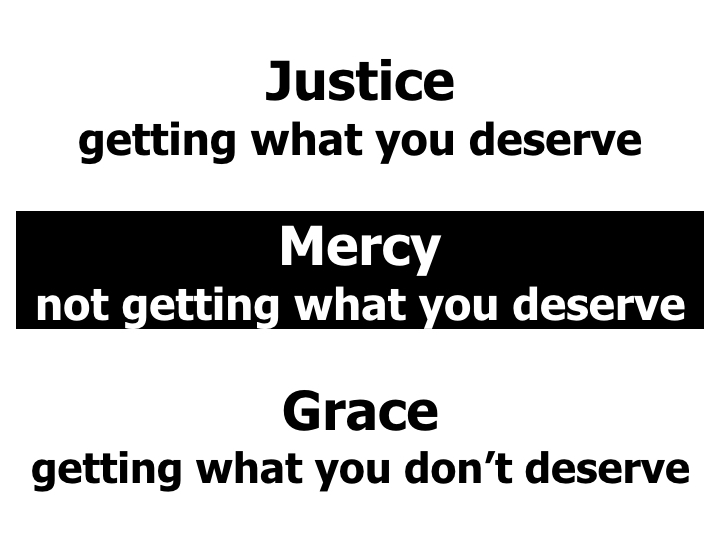
justice-mercy-graceLast week I blogged about justice, mercy, and grace. Justice is getting the penalty we deserve, mercy is not getting the penalty we deserve, and grace is getting blessings we don’t deserve.

If we are truly grace-full people, then we should be thank-full people as well. As we approach Thanksgiving Day, people are naturally thinking about things for which they can give thanks during this past year. But Christians should be the most full-of-thanks people on the planet, because we have been showered with so much grace! 

I’d like us to think about a word that I believe will increase our level of thankfulness: Appreciation. Appreciation goes beyond merely being thankful for blessings, as it sees the high value in those blessings, and then continually looks for ways to express even more gratitude for them. In other words, appreciation can begin a cycle of gratitude that grows and grows and GROWS!

Check out three parts to the definition of appreciation

[1] Gratitude; thankful recognition. Did you know that being grateful is actually good for you? Research has shown that increasing your gratitude levels increases your:

  • Physical health. “A state of gratitude, according to research by the Institute of HeartMath, also improves the heart’s rhythmic functioning, which helps us to reduce stress, think more clearly under pressure and heal physically. It’s actually physiologically impossible to be stressed and thankful at the same time” —Jon Gordon
  • Emotional health. Dr. Robert Emmons says gratitude decreases envy, resentment, and feelings of retaliation; and increases empathy, emotional resilience, and self-esteem.
  • Spiritual health. Notice how ingratitude is included in the list of a whole lot of ugliness (2 Timothy 3:1-4), but spiritual health is restored simply by being thankful (Ephesians 5:3-4).

[2] Estimating qualities and giving them their proper value. In order to determine value, we must have a standard of comparison. What’s your standard? Is it what your neighbor has? Is it what you don’t have? Or is it thankfulness for what God has given you? 

Max Lucado said, “To reflect on your blessings is to rehearse God’s accomplishments. To rehearse His accomplishments is to discover His heart. Gratitude always leaves us looking at God and away from dread.”

[3] Assessing the true worth of our blessings. Assessing leads to appreciation, and appreciation begins to give us a return on investment. I like how Jeff Anderson says it: “If you want to grow your faith, grow your gratitude. To grow your gratitude, take time to count your blessings.”

Remember: gratitude isn’t gratitude if it isn’t expressed. David made his gratitude known, and other afflicted people around him began to join with him in thanking God for His blessings (see Psalm 34:1-3). In other words, David’s thanksgiving went viral!

mowtHere’s how we can make our gratitude go viral: #MOWT. Let’s count our blessings every day, and let’s appreciate what God has done for us. Then let’s share our gratitude not only with God, but with others as well. Post it on Facebook or Twitter or Instagram with #MOWT: my one word thanks. Maybe include a photo and “family” #MOWT, or “protection” #MOWT, or even “paycheck” #MOWT.

Let’s give God so much glory for His grace gifts, that we tell the world about our appreciation!

Thursdays With Oswald—Making Saints

Oswald ChambersThis is a weekly series with things I’m reading and pondering from Oswald Chambers. You can read the original seed thought here, or type “Thursdays With Oswald” in the search box to read more entries.

Making Saints 

     It is not sufficient for a Christian to walk in the light of his conscience; he must walk in a sterner light, in the Light of the Lord. … 

     I am not judged by the light I have, but by the light I have refused to accept. … This is the condemnation, that the Light, Jesus Christ, has come into the world, and I preferred darkness, i.e., my own point of view. The characteristic of a man who begins to walk in the light is that he drags himself into the light all the time. He does not make excuses for things done in the dark, he brings everything to the light, and says, “This is to be condemned; this does not belong to Jesus Christ,” and so keeps in the light. … 

     The New Testament view of a saint is a more rugged type. You and I are a mixture of dust and Deity, and God takes that sordid human stuff and turns it into a saint by Regeneration. A saint does not mean a man who has not enough sin to be bad, but a man who has received from Jesus Christ a new heredity that turns him into another man. … 

     Conscience and character in the saint, then, means the disposition of Jesus Christ persistently manifested.

From The Shadow Of An Agony 

In order to become the saints God intends for us to be, Oswald Chambers says one big thing is required of Christians: Constantly bringing our thoughts and actions into the Light of Jesus.

I think this is what Paul means when he tells us to take captive every thought to make it obedient to Christ (2 Corinthians 10:5). And this is certainly what David invited when he prayed, Search me, O God, and know my heart; test me and know my anxious thoughts. See if there is any offensive way in me, and lead me in the way everlasting (Psalm 139:23-24).

I pray we will always be bringing our thoughts and actions into the Light, and never preferring the darkness of our own point of view!

The Delight Of Praise

C.S. Lewis at his desk“Just as men spontaneously praise whatever they value, so they spontaneously urge us to join them in praising it. ‘Isn’t she lovely? Wasn’t it glorious? Don’t you think that magnificent?’ The Psalmists in telling everyone to praise God are doing what all men do when they speak of what they care about.

“My whole, more general, difficulty about the praise of God depended on my absurdly denying to us, as regards the supremely Valuable, what we delight to do, what indeed we can’t help doing, about everything else we value. I think we delight to praise what we enjoy because the praise not merely expresses but completes the enjoyment; it is its appointed consummation. It is not out of compliment that lovers keep on telling one another how beautiful they are; the delight is incomplete till it is expressed. … This is so even when our expressions are inadequate, as of course they usually are. But how if one could really and fully praise even such things to perfection—utterly ‘get out’ in poetry or music or pain the upsurge of appreciation which almost bursts you? Then indeed the object would be fully appreciated and our delight would have attained perfect development. The worthier the object, the more intense this delight would be.” —C.S. Lewis, in Reflections On The Psalms

4 Tips For Making Better Goals

1 Corinthians 10.31I have noticed a lot of similarities between the September back-to-school rush, and New Year’s Day. Except instead of resolutions, in the fall most people set new goals, or try to readjust their schedules to take advantage of a new season.

This is an excellent idea, and the perfect time to do it.

In a psalm written by Moses, he tells us to understand the value of our days, and be as wise as we can with what we do with each day God has given us (Psalm 90:12).

The Apostle Paul echoes these thoughts:

Be very careful, then, how do you live—not as unwise but as wise, making the most of every opportunity, because the days are evil. Therefore do not be foolish, but understand what the Lord’s will is. (Ephesians 5:15-17)

One way for us to make the most of every day is to wisely set some goals. Here are four tips that I’ve discovered to help me.

(1) The fewer the goals, the better.

Craig Groeschel said, “To do more things, do less things better.” I totally agree. I would suggest limiting yourself to just 1-2 goals at a time. Then put these one or two goals on your calendar first. In other words: Don’t prioritize your schedule, but schedule your priorities.

(2) Don’t fall into the sacred/secular trap.

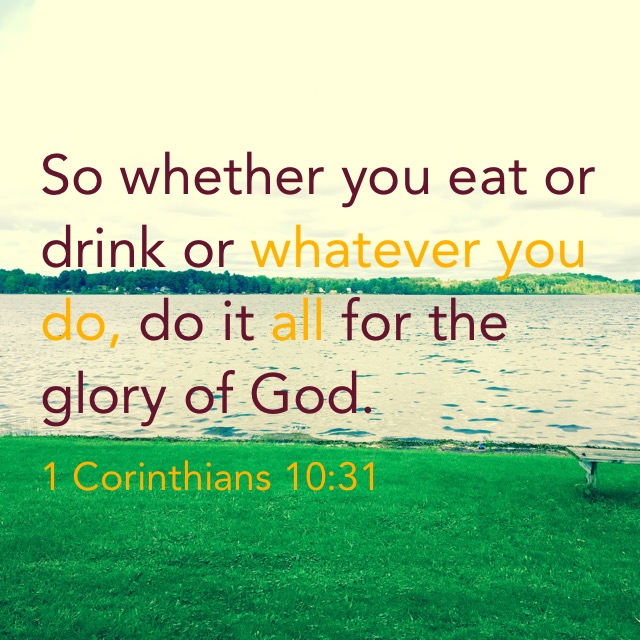
So many people—even Christians—think that there are spiritual goals and non-spiritual goals. But the Bible says, “So whether you eat or drink or whatever you do, do it all for the glory of God” (1 Corinthians 10:31). Every goal you set is a spiritual goal, because every goal should help you live your life wisely, in a way that honors and glorifies God.

(3) Make your goals S.M.A.R.T.

You may have heard these before, but I really like to use them. Make your goals:

  • Specific—not “I want to eat better” but “I want to eat two servings of fruits or vegetables each day.”
  • Measurable—have a way to track your progress toward your goal. How many pages did you read? how many calories did you eat? how many minutes did you work out?
  • Achievable—don’t set a goal to run 5 miles a day if you’ve only been a couch potato. Ramp your goals up little by little in a way that’s achievable for you.
  • Relevant—I like to ask a “so that?” question about each of my goals in make sure it’s moving me forward. “I want to exercise for 20 minute three times per week, so that my blood pressure comes down, so that I can live medicine-free, so that I can….” I think you get the idea. Keep going to make sure your goal is relevant for your life.
  • Time to review—set a date to revisit your goals and see if you need to adjust anything.

(4) Make a “stop doing” list.

You cannot do everything, so focus on the important, not the urgent. And remember not everything can stay on your calendar. For instance, if you want to read more in the evenings, you may have to eliminate some TV time; if you want to exercise in the mornings, you may have to eliminate that second cup of coffee.

Just a couple of verses after Moses challenges us to make the most of every day God has given us, he asks God for His helpMay the favor of the Lord our God rest upon us; establish the work of our hands for usyes, establish the work of our hands.

May God give you wisdom as you make new goals, and may He bless the work of your hands as you implement your new strategies.

7 Tips For A Better Night’s Sleep

Psalm 4.8It’s no secret that being tired can lead to a lot of not-so-nice consequences. Everything from automobile crashes, to poor work performance, to foot-in-mouth statements, to giving in to temptations, to health issues are all traced back to not getting enough peaceful sleep.

But did you know that sweet sleep is something God wants to give you?

Psalm 127 says, “God grants sleep to those He loves.” Guess what? God loves you, and wants you to have a peaceful night’s sleep!

Here are some benefits to getting solid sack time:

  1. Muscles are repaired—the body “turns off” muscles during sleep so they can repair themselves.
  2. The hormone leptin, that regulates your appetite, is adjusted.
  3. Your blood pressure is lowered.
  4. Your heart rate is lowered.
  5. The energy-producing cells we all need are restocked.
  6. Your immune system is re-energized.
  7. Memories are consolidated from short-term memory banks to long-term memories.
  8. The hormones that allow you to concentrate are replenished.
  9. Your “database” of decision-making options is re-calibrated.
  10. Bottom line—you get healthier physically, mentally, emotionally, relationally, and spiritually.

All of this God wants to give to those He loves. “God loves me, so I’m going to sleep peacefully tonight!”

The problem is we often sabotage God’s blessing of sweet sleep by our own poor decisions during the day. So here are seven things you can do to cooperate with God’s blessing of sleep:

  1. Reduce stress. Stress causes your body to release cortisol, which prepares your body for fight-or-flight. This means when you’re trying to quiet down for the night, your body is still screaming, “Go, go go!” Stress is mainly triggered by worrying over things outside of our control, so check out what Jesus said to us about not worrying—Matthew 6:25-34.
  2. Reduce late-day caffeine. Caffeine has a half-life of six hours, so if you are pouring it into your body late in the date, you might fall into bed exhausted but the caffeine is keeping your brain buzzing. As a result, you don’t have the normal deep sleep patterns.
  3. Eliminate emotional caffeine. Arguments with other people release cortisol and adrenaline in your bloodstream. If these disagreements are happening later in the day, your body is fighting against God’s plan for your tranquil sleep. So take care of any disagreements quickly (Ephesians 4:26).
  4. Exercise. Getting some movement into your daily routine flushes cortisol and adrenaline from your bloodstream.
  5. Go to bed and get up at the same time. There’s a reason God made the sun to rise and set at predictable times. Your body also functions best on a predictable schedule.
  6. Reduce “blue lights” close to bed time. The blue light waves of dawn tell our bodies to stop releasing melatonin, the sleepy hormone. The red light waves of dusk tell our bodies to increase melatonin so we can go to sleep. But when we’re staring into the blue light of our phones and tablets, our body is being sent a conflicting signal.
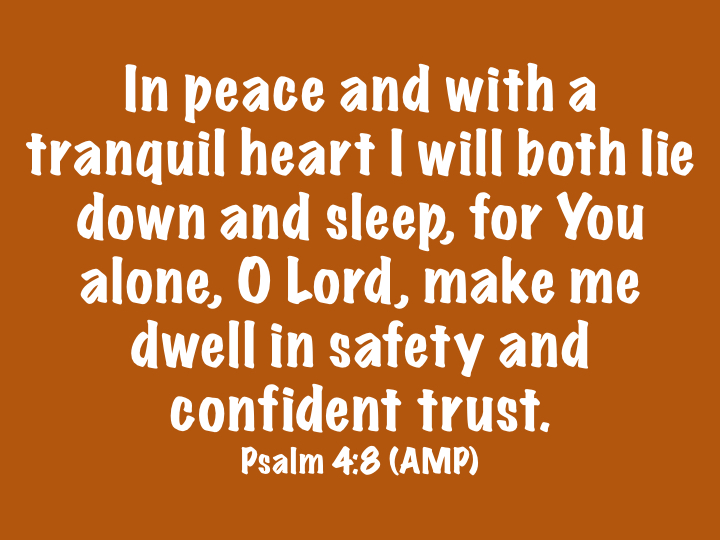
  7. Pray. Two great passages you can pray before bedtime are Psalm 4:8 and Proverbs 3:24. Claim those promises of sweet sleep!

God loves you. He wants to give you the blessing of peaceful sleep. If you’re going to sleep peacefully tonight, make sure you are not sabotaging what God wants to give you.

If you’ve missed any of the messages in this series, you can access the complete list by clicking here

Spend This Week For God

Joseph AlleineJoseph Alleine was very concerned about using every moment of his time to honor God. He wrote, “Give me a Christian that counts his time more precious than gold.” To help him do this, he built in reminders to his weekly journaling and prayer times.

At the beginning of each week he wrote in his journal—“Another week is now before us, let us spend this week for God.”

And each morning he wrote in his journal—“Let us live this one day well!”

The Bible instructs us to:

What can you do this week to make sure that you spend this week for God?