3 Lessons From A Devoted Dad

If you were to pick a man that would have been desperately devoted to Jesus as his Savior, Cornelius wouldn’t make anyone’s “top 10” list! 

Just take a look at all the strikes against this man. He was a… 

  • Gentile—to Jews, Gentiles were just the fuel to stoke the fires of hell. 
  • resident of the city of Caesarea—since this was the headquarters of the Roman government for Palestine, not many Jews would venture there. 
  • Roman—historians say only 10% of Romans in this era were monotheistic. 
  • centurion—not just any centurion, but an extremely powerful centurion from the Italian Regiment (not just a local mercenary who was in it for the money). And he took his name from Cornelius Sulla, a Roman general known both for his mercy and his ruthlessness.

All of this makes Cornelius a fully self-sufficient and a well-to-do man who was not likely to look for help from God. Nor was he the type of person that a Christian missionary might seek out. 

But clearly, something was missing in Cornelius’ life because he was completely countercultural in his pursuit after God. Not just his pursuit of God, but his quick understanding of exactly who Jesus was. 

Luke the historian describes Cornelius as:

  • devout and God-fearing. The Greek word for devout literally means “a right worshipper.” It’s a word Luke only uses three times in Acts, and two of those times are describing Cornelius. 
  • prayerful. The word Luke uses for him means someone who makes prayer personal and ongoing. 
  • generous. Cornelius took care of people who couldn’t take care of themselves. 

All of this got God’s attention (see Psalm 141:2; Revelation 5:8; Proverbs 19:17), and He sent an angel to direct Cornelius to Peter. 

When Peter came to Cornelius’ house, twice he said “as you know” (vv. 36, 37), showing us that Cornelius was aware that there was not only one true God, but that a relationship with Jesus was the only way to be in right relationship with God. As Peter spoke with Cornelius, his family, his relatives, his close friends, and even his fellow soldiers, the Holy Spirit baptized them just as He had done with the disciples of Jesus on the day of Pentecost. 

So here are 3 vital lessons for all men to learn from the life of Cornelius the centurion—

  1. Your devotion to God is influential. People around you do notice your devoted pursuit of God.
  2. Your openness to all that God has puts your family, friends, and coworkers in a place to receive God’s blessings too.
  3. God’s blessings flowing through you have lasting and far-reaching results. The outpouring of the Holy Spirit on Cornelius may have opened the door for Christian evangelism to Gentiles unlike anything that had happened before.

Dads, be devoted to God. Desire all He has for you, and all He has for those around you. Pursue Him no matter how many “strikes” there may be against you. 

If you missed any of the messages in this series, you can access the full list of messages by clicking here.
4 Holy Spirit-Enhanced Habits

According to Paul, there are only two ways people can live: in the flesh or in the Spirit. That is—(1) operating separate from God, or (2) with a soul/body that is operating with God’s full involvement. 

The trouble is: we’re always—as long as we’re alive—still in the flesh because we need these bodies to carry around our soul and spirit. But changes begin to occur first at salvation (when the connection of our spirit to God’s Spirit is reestablished), and even more so after being baptized in the Holy Spirit (when we are not trying to work out things on our own). 

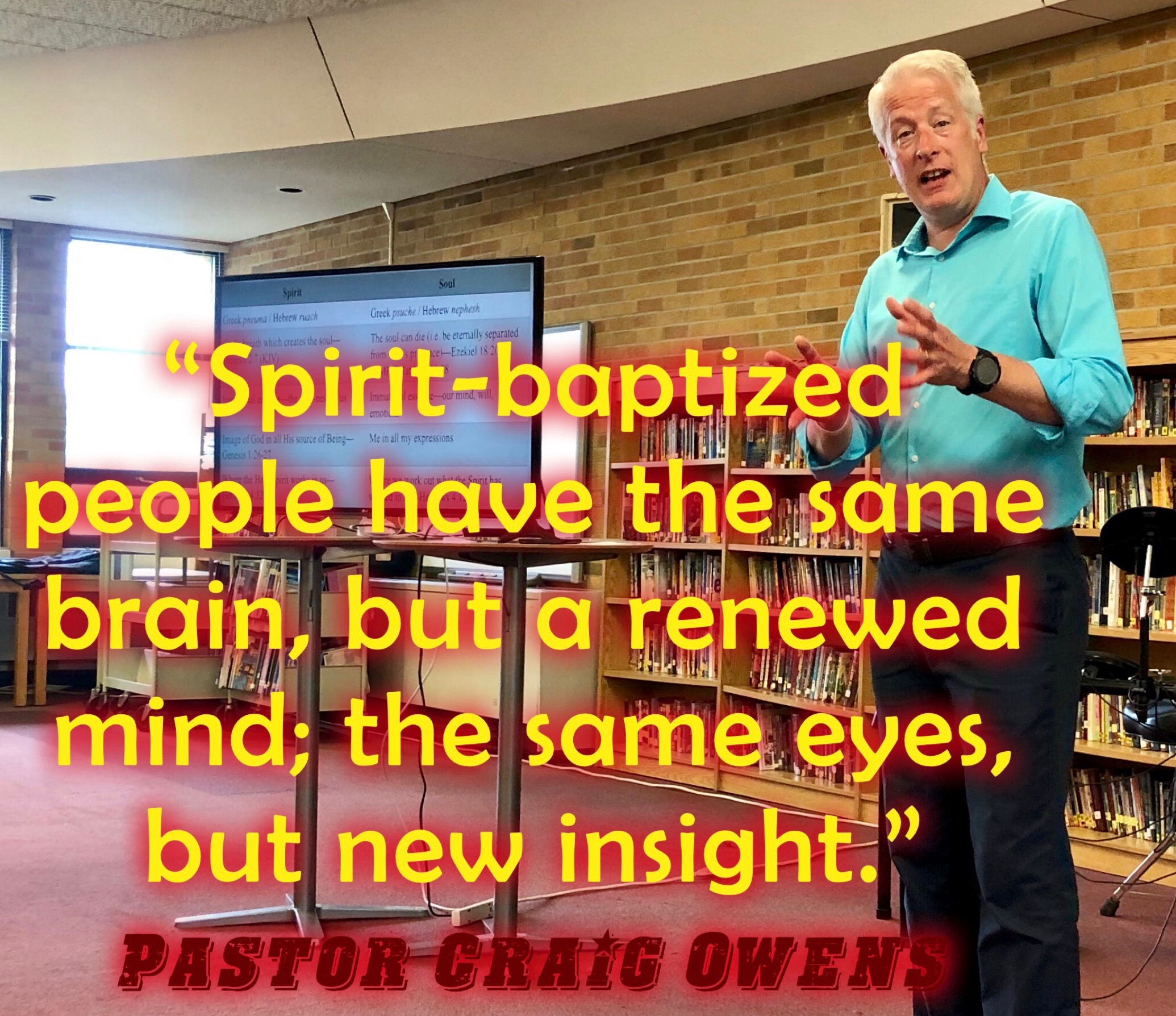
As a result, we have the same brain, but a mind that is being renewed; the same eyes, but insight that is being expanded; the same ears, but learning new ways to hear what the Holy Spirit is saying. 

Remember that Jesus promised that the baptism in the Holy Spirit would empower us TO BE His witnesses (Acts 1:8). Not just to do things differently, but to have our spirit so enlivened by the Holy Spirit that we are living, breathing, walking, talking witnesses of a life transformed.

Have you noticed that there wasn’t a steep “learning curve” for the disciples of Jesus following Pentecost? Part of that is due to four key habits that the Holy Spirit helped form in their lives. 

  1. Correct biblical application—We immediately see people going from “They didn’t understand from the Scriptures” to quickly applying biblical texts to their current situations. This is exactly what Jesus promised would happen (John 20:6-9; Acts 2:16, 25, 34; John 14:26). 
  1. Intercessory prayer—To intercede is to take someone else’s needs to God on their behalf. The Holy Spirit can help us apply Scripture to our prayers, and can even help us without words at all (Acts 4:24-26; Romans 8:26-27). 
  1. Creative thinking—Christians should be the most creative thinkers in the world (Psalm 119:99; Jeremiah 33:3; 1 Corinthians 2:10). 
  1. Healthy conflict resolution—We’re all different, so not seeing eye-to-eye is bound to happen, but Spirit-empowered Christians will be able to resolve conflicts faster and with better results (Acts 6:1-8; Acts 15:1-31). 

“Your life as a Christian should make unbelievers question their disbelief in God.” —Dietrich Bonhoeffer

Amen! Your life as a Christian that is living out daily habits that have been empowered by the Spirit should make everyone around you want to go deeper and deeper into all that the Holy Spirit has in store for them too. 

If you missed any of the messages in this series, you can access the full list of messages by clicking here

Forever Love

“His love endures forever” (NIV)
“His lovingkindness is everlasting” (NASB)
“His love never quits” (MSG)
“His faithful love endures forever” (NLT)
“His mercy and loving-kindness endure forever” (AMP)
“His loyalty continues forever” (EXP)
“His loyal love endures forever” (LEX)
“His loving-kindness continues forever” (TLB)
“His tender love for us continues on forever” (TPT)

The psalmist says this in every single verse of Psalm 136.

Get the point? Just in case you missed it—

You cannot outrun, use up, wear out, or lose God’s forever love!

A Very Present Help

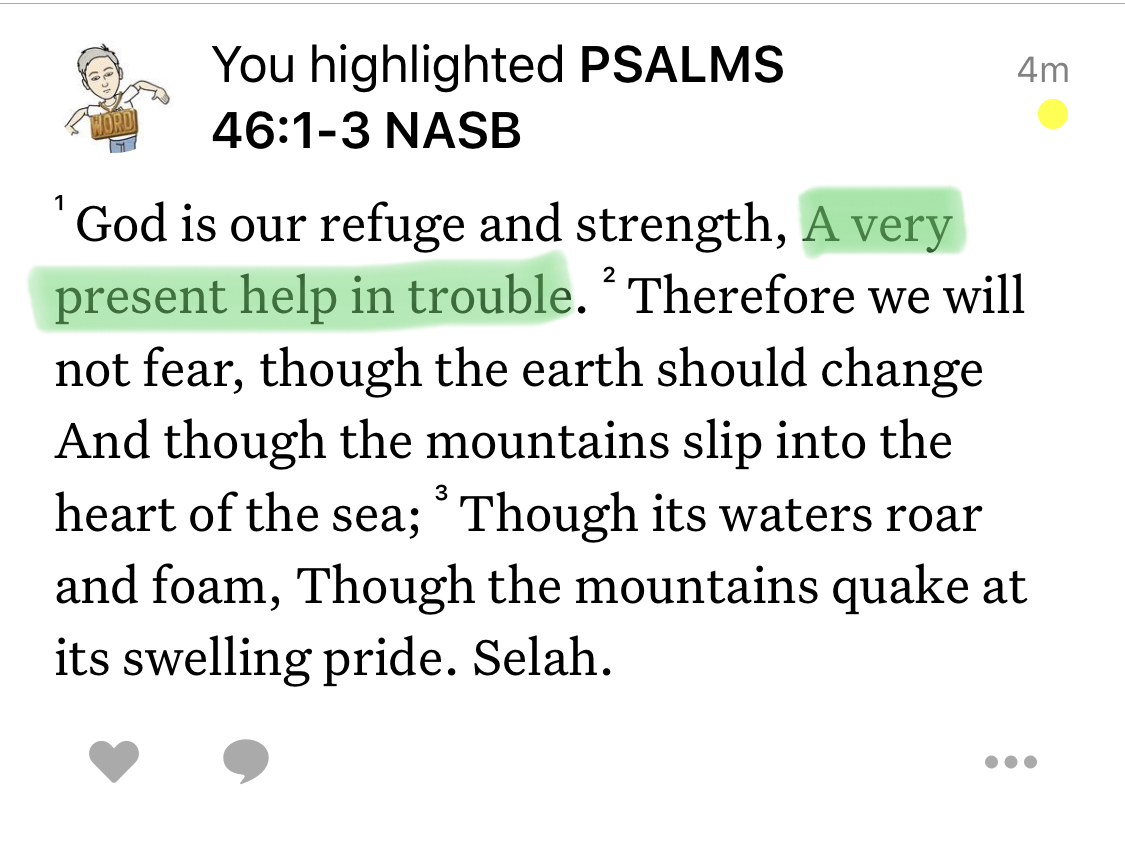
God is our refuge and strength, a very present help in trouble. (Psalm 46:1)

God is not just present—He is very present! 

God is not merely in the room with you, He is fully attentive to you. He’s never distracted, preoccupied, or disinterested. 

Regardless of the quaking or roaring around you, He is so very present that He knows your quietest sigh. You don’t have to look anywhere else for help because He is VERY present at this VERY moment. 

The rest of this psalm reiterates this promise:

  • God is in the midst
  • God will help
  • The Lord of hosts is with us
  • God is our stronghold 

God Himself speaks the words of the natural conclusion we should draw when we realize that He is VERY present at this VERY moment—

“Be still, and know that I am God!”

Don’t Stop At Salvation

The Holy Spirit is vital in everything concerning a Christian’s life. Dr. Donald Stamps emphatically said it this way: 

“It is essential that believers recognize the importance of the Holy Spirit in God’s redemptive purpose. Many Christians have no idea what difference it would make if there were no Holy Spirit in this world. Without the Holy Spirit there would be no creation, no universe, no human race (Genesis 1:2; Job 33:4). Without the Holy Spirit there would be no Bible (2 Peter 1:21), no New Testament (John 14:26; 15:26-27; 1 Corinthians 2:10-14), no power to proclaim the gospel (Acts 1:8). Without the Holy Spirit there would be no faith, no new birth, no holiness, no Christians at all in the world.” 

Sometimes I think we have in our mind that the “old” in Old Testament somehow means outdated or no longer applicable to our lives, and the “new” in New Testament should be our sole focus. But Jesus affirmed again and again that all of the Scriptures—what we now refer to as the Old Testament—all point to Him. 

The outpouring of the Holy Spirit on that Pentecost Sunday was not something new to the New Testament Christians. He was always a part of a believer’s life. Even 1000 years before Christ’s public ministry, David knew the importance of the Holy Spirit in both salvation, and in living a consistently holy lifestyle (Psalm 51:10-12, 143:10). 

The role of the Holy Spirit in Christ’s public ministry was foretold in the Old Testament Scriptures and then fulfilled in the New Testament era (see Isaiah 11:1-2; Luke 3:21-22; Isaiah 61:1-2; Luke 4:18-21). 

If Jesus needed the baptism in the Spirit to empower Him, direct Him, and give Him success, how much more do we need this?! That’s why Jesus imparted the Holy Spirit to His followers at their moment of salvation, but then admonished them to eagerly expect the baptism in the Holy Spirit as well (John 20:22; Luke 24:49; Acts 1:8). 

Quite simply Jesus is sayingDON’T STOP AT SALVATION

Jesus didn’t, the apostles didn’t, Paul didn’t, Apollos didn’t, the Ephesian Christians didn’t, I didn’t, and you shouldn’t either! 

Keep on going…

  1. Ask Jesus to forgive you of your sins
  2. Eagerly desire the baptism in the Spirit 
  3. Ask God to baptize you in His Spirit
  4. Expect that He will answer that prayer (Acts 2:38; Isaiah 44:3; John 7:37-39; Luke 11:13; Mark 11:24)

Join me again this Sunday as we continue to learn what it means for Christians today to be Pentecostal. 

If you missed any of the messages in this series, you can access the full list of messages by clicking here.
Raw Emotions In Worship

When someone was out to get David, he turned to God in prayer. And what prayers he prayed! 

He didn’t hold back. He came to God with all of his emotions right out in the open. Raw—but honest—emotions. 

God called David a man after His own heart, so apparently God loved the honesty even when David asked God to break their arms, turn them into jackal food, burn them with fire, give them black eyes, or even blot their names out of God’s book of life (Psalm 10:15; 63:9-10; 68:1-2; 69:22-28)!

Why do we hesitate to express ourselves like this, to tell God what’s really in our hearts? Do we think He doesn’t know? Do we think He’s going to fall off His throne in shock at our brutal honesty? He already knows what’s in our hearts, so the expression of it is for our benefit. We must get it out in His presence because that’s the only way and the only place where true, deep, lasting healing can happen. 

I love what R.T. Kendall reminds us: “Real worship takes place when we are unafraid to express what we feel. Worship ought to bring us to the point where we can be honest. We never need to repress what we feel when we are around Jesus. He will never scold us for our honesty. It doesn’t mean we are right, but if we are being honest, He can help us and bring us to see where we are wrong and to face the truth.” (emphasis mine)

When you hurt, get alone with God and then get real with God. He already knows what’s in your heart, so speak it out. You need to get that poison out of your system so that God can heal you.

Sabbathing

On the Wednesday of Christ’s Passion Week, all of the Gospel writers are in perfect agreement. Between all four of them, they write not one word about what happened on that day. That silence actually speaks volumes to us!  

Jesus is almost surely in Bethany (since that has become is nightly retreat this week), and He is taking a Sabbath rest. “Wait,” you might be saying, “sabbathing on Wednesday?! I thought that was supposed to be Saturday or Sunday?” 

The Sabbath is not a day; it’s an attitude of the heart. 

Jesus followed the example His Father set right at the beginning. 

The Israelites are to observe the Sabbath, celebrating it for the generations to come as a lasting covenant. It will be a sign between Me and the Israelites forever, for in six days the Lord made the heavens and the earth, and on the seventh day He rested and was refreshed. (Exodus 31:16-17)

Notice that God rested and was refreshed. The word rested means to stop working and celebrate. It’s a time to reflect on the work completed and celebrate what has been done. Then the Bible says God was refreshed, which literally means “God refreshed Himself.” He took a deep, satisfying, rejuvenating breath! 

Resting and being refreshed—or sabbathing—is not a luxury; it’s a necessity! 

Jesus understood this principle of sabbathing. Remember that He had only a limited time to accomplish all that the Father had for Him: “We must work the works of Him Who sent Me and be busy with His business while it is daylight; night is coming on, when no man can work” (John 9:4 AMP). If anyone was a Man on a mission, it was Jesus, and yet rest was vital to Him…

  • …from the very beginning of His life, Jesus practiced healthy habits
  • …He started each day in prayer 
  • …He rested and refreshed after expending Himself in ministry, and encouraged His disciples to do so as well (see Luke 2:52; Mark 1:35; 6:30-32, 45-46) 

Now—just before the intense, horrific, inhumane experience He is about to go through—Jesus is sabbathing. He is resting and refreshing His body, soul, and spirit. 

So what keeps us from sabbathing? 

  1. Guilt—“I feel guilty taking time off.” Remember that if Jesus did it, we should too. 
  2. Misplaced priority—“If I don’t do it, it won’t get done.” But remember Who is in charge. The psalmist reminds us, “The Lord is king!” (Psalm 99:1). 
  3. Fear—“If I ‘tune out’ what might I be missing?” Remember: Your Father is watching over you every single moment (see Psalm 121).  

If you want to experience more productivity in your life, don’t try to go 24/7—take a sabbath break. Stop working and celebrate what God has done, then take a deep breath of worship in God’s presence. Jesus demonstrated that sabbathing was vital for ministry success. 

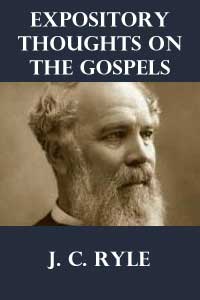
9 More Quotes From “Expository Thoughts On The Gospels”

Bishop J.C. Ryle wrote a commentary on the Gospels nearly 200 years ago, and it still stands as a phenomenal Bible study resource. Check out my full review by clicking here. 

“When do men make others stumble? … Professing Christians do it whenever they bring discredit on their religion by inconsistencies of temper, of word, or of deed. We do it whenever we make our Christianity unlovely in the eyes of the world by conduct not in keeping with our profession. The world may not understand the doctrines and principles of believers, but the world is very keen-sighted about their practice. … Men will judge by what they see far more than by what they hear.” 

“Every true-hearted Christian who tries to do good in the world must make up his mind to be treated like his Master. He must never be surprised to find that the self-righteous and the worldly-minded dislike His ways.” 

“We shall discover by experience that all is not gold that glitters, and all are not true Christians who make a loud profession of Christianity. The language of Christianity is precisely that part of religion which a false Christian finds it most easy to attain. The walk of a man’s daily life, and not the talk of his lips, is the only safe test of his character.” 

“It is not in reality an astonishing thing that there should rise up so many who call in question the truth of the Bible. The marvel is rather that in a fallen world the sect of the Sadducees should be so small.” 

“Here, if anywhere, we need the heart of a little child and the prayer ‘open my eyes’ (Psalm 119:18). Let us beware on the one side of that lazy indifference which turns away from all prophetical Scripture on account of its difficulties. Let us beware on the other side of that dogmatical and arrogant spirit which makes men forget that they are students, and talk as confidently as if they were prophets themselves.” 

“To suffer patiently for Christ is far more difficult than to work actively. To sit still and endure calmly is far more hard than to stir about and take part in a battle. Crusaders will always be found more numerous than martyrs.” 

“The true cure for a dull memory in religion is to get deeper love toward Christ, and affections more thoroughly set on things above. We do not readily forget the things we love, and the objects which we keep continually under our eyes. The names of our parents and children are always remembered. The face of the husband or wife we love is engraved on the tablets of our hearts. The more our affections are engaged in Christ’s service, the more easy shall we find it to remember Christ’s words.” 

“Let it be a settled principle in our minds, in reading the Bible, that Christ is the central sun of the whole Book. So long as we keep Him in view we shall never greatly err in our search for spiritual knowledge. Once losing sight of Christ, we shall find the whole Bible dark and full of difficulty. The key of Bible knowledge is Jesus Christ.” 

“He that desires to read his Bible with profit must first ask the Lord Jesus to open the eyes of his understanding by the Holy Spirit. Human commentaries are useful in their way. The help of good and learned men is not to be despised. But there is no commentary to be compared with the teaching of Christ. A humble and prayerful spirit will find a thousand things in the Bible which the proud, self-conceited student will utterly fail to discern.” 

You can also check out some other quotes that Bishop Ryle shared on the Gospels of Matthew, Mark, Luke, and John. 

Sunday In Jerusalem

The Sunday before Christ’s crucifixion is typically called “The Triumphal Entry.” But was it really? One thing’s for sure—Jesus didn’t come to Jerusalem the way the people expected! 

To fully get the picture of what’s happening we need to turn back the calendar several hundred years. Ever since Jerusalem fell to invading armies, the Jews hung on to the promise that God would restore their king and their kingdom. They were awaiting a descendant from the line of King David who would drive out their overlords and restore Jerusalem to its rightful place. 

They clung to a promise in Psalm 118 that included these words—“Lord, save us! Lord, grant us success! Blessed is He who comes in the name of the Lord. From the house of the Lord we bless you. The Lord is God, and He has made His light shine on us. With boughs in hand, join in the festal procession up to the horns of the altar” (vv. 25-27). 

But Jesus was prophesied to come as the Prince of Peace, gentle and unassuming, the Servant of all people (Isaiah 9:6; 42:1-3). Jesus simply didn’t do things the way the crowds expected! He was born in a manger in Bethlehem (not as a king in Jerusalem), and hailing from Nazareth caused people to mock, “Nazareth? Can anything good come from Nazareth?!” 

So on that Sunday as Jesus approached Jerusalem, it wasn’t as a conquering King but as a humble servant. As He came near, He wept a sobbing lament over Jerusalem (Matthew 23:37). 

The crowd took palm branches (as Psalm 118 suggested) and shouted, “Hosanna!” That word means “Save us,” but what they really meant was, “Save us NOW!” Jesus came riding a mule—a lowly work animal, not a war horse—to remove any fear people may have, and to show them His servant’s heart. 

Even His disciples didn’t get this. But the Pharisees sure did: They wanted Jesus to rebuke the crowd for their insolence and blasphemy! Many of the worshippers were eyewitnesses to the resurrection of Lazarus, so Jesus said to the Pharisees, “They have to give praise to God for this!” 

Jesus made His way to the temple but there were no sacrifices, no anointing, no coronation. Mark tells us Jesus simply “looked around at everything and then left.” 

Have you ever noticed that Jesus never rushes? He’s never early. He’s never late. He’s never confused. He’s never trying to catch up. 

This is because Jesus was in complete sync with His Father. Jesus said that everything He did was directed by His Father, and every word He spoke was given to Him by His Father. 

We, too, should be able to move in that same unrushed pace. Because of what Jesus did for us on Calvary, we may have the same “oneness” with our Father as Jesus did (John 14:20). 

Worry creeps into our lives when—like those cheering crowds in Jerusalem—we try to make our agenda happen on our timetable with our own resources. But when we look to Jesus, we see such a perfect peace as He relied on His Father. 

Christ’s passionate journey was out of love for us, so that we could know peace with God as we journey through life with Jesus. 

Join me this Sunday as we take a closer look at the Monday of Christ’s Passion Week. 

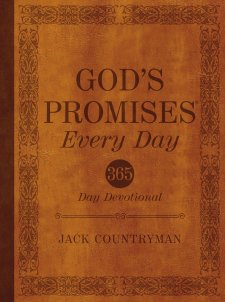
9 Quotes From “God’s Promises”

God’s Promises by Jack Countryman is a wonderful resource to help you use the Bible to enhance your prayer life and build your faith. Check out my full review of this fantastic book by clicking here.

“Each day we can look forward to God’s Spirit going before, clearing the way, leading the path, and giving us the guidance we need. … But God doesn’t stop at mere survival. He doesn’t just satisfy and strengthen. Though there will be difficulties and times of drought in our lives, God guides us to His living waters. He enables us to flourish ‘like a watered garden,’ where His blessings always bloom.” [Isaiah 58:11] 

“When life darkens our door with its troubles and trials, satan wants nothing more than for us to feel forsaken and alone—but we are not! God stands by our side; He guides, counsels, and comforts. Rest assured, no matter what you face in the coming year, nothing can separate you from the love of your Father (Romans 8:38-39). Therefore walk boldly into each new day, knowing that you follow the footsteps of the One who never leaves you.” [Deuteronomy 31:8] 

“Troubles are never pleasant at the time, but they quickly turn into tools when entrusted to God. Our Lord will take our times of troubles and trials—even the hard feelings we experience in them—then use them to teach us to fully rely on Him and His provision.” [Psalm 138:7] 

“Our God is a loving God, but He isn’t Santa Claus or a genie in a bottle. Our God loves to give good gifts, but in His economy the best gifts are not tangible or material. Yes, our God feels compassion when we hurt, but He still allows hardships into our lives that will refine our character and strengthen our faith. Against the backdrop of these truths, we can better understand the often-misread statement that God will give us the desires of our hearts. The real promise of this verse is that, as we pray, read His Word, and grow closer to the Lord, He will change our hearts so that what we desire for ourselves is what He desires for us.” [Psalm 37:4] 

“Mercy. We don’t deserve it. We haven’t done—can’t possibly do—anything to earn it. And yet we are promised that this unbelievably lavish gift is ours when we choose to follow Jesus. Why? Why would such a perfect and powerful God gives such a gift to ones so undeserving? He tells us in Titus 3:4: because of ‘the kindness and love of God our Savior toward man.’ And He not only gave us mercy, He also ‘poured out on us abundantly’ His own Spirit, to live and work within us, making us more and more like the Savior who died to save us.” [Titus 3:4-6] 

“Our God is not some fickle, capricious, changeable sort of God. He does not search out ways to be angry or displeased with His people. In fact, He so wants to be pleased with us that He gave us the example of His Son to follow.” [Ephesians 5:2] 

“When our burdens and sorrows seem too heavy for us to bear, God offers to carry them for us, inviting us to cast them upon Him (Psalm 55:22). And when the sorrow is so great that we feel we cannot put one foot in front of the other, God gives us this promise: ‘I will carry you; I will sustain you’ (Isaiah 46:4).” 

“Perhaps nothing is as devastating as being betrayed by someone you love and trust. Know that Jesus—betrayed by Judas, denied by Peter—fully understands. He will enable you to recover. The key, as hard as it is, is to pray for that person and ask God to bless him or her. When you pray to God—and you may have to do this again and again—you release the anger and disappointment that come with being betrayed. It is difficult to despise someone you lift up in prayer. And though retaliating is a natural response, it’s not a godly one. Praying is always the best option. Allow the Lord to receive your hurt and to replace it with His peace.” [Psalm 3:4, 6] 

“When we place our faith in Christ, the stormy seas of our lives—churned up by our own sins—are stilled. And while the storms may still rage around us in this sin-plagued world, they do not rage within us. That does not mean our troubles and tribulations are over, but it does mean we can rest in knowing God will see us through them.” [Romans 5:1]