I love reading, and I love sharing my love of good books with others! Here is a list of the books I read and reviewed in 2023. Click on a title to be taken to that review.
Listen to the podcast of this post by clicking on the player below, and you can also subscribe on Apple, Spotify, or Audible.
Say the word “confrontation” and many people cringe. “I try to avoid confrontations with others,” people will quickly say.
The origin of the word comes from a derivative of the word for “forehead.” The original intent of confrontation was simply putting the facts in front of someone’s face so that they could acknowledge them.
The problem for most of us (myself included) is two-fold:
I don’t like to be confronted with things I may be doing incorrectly or incompletely.
I don’t like making others defensive when I confront them with the things they may be doing incorrectly or incompletely.
As a result, we usually don’t confront others and they usually don’t confront us. Sadly, this can keep us from maturing in areas where we may be able to soar if we could only make some minor changes.
Christians should be especially open to confrontation from a brother or sister. After all, Solomon told us, “Wounds from a friend can be trusted, but an enemy only multiplies kisses” (Proverbs 27:6). And Jesus warned us, “Woe to you when all men speak well of you, for so did their fathers to the false prophets” (Luke 6:26 NKJV).
The best confrontation is self-confrontation in the presence of the Holy Spirit. After we have submitted to that loving spotlight, then we can proceed with our loving confrontation with our brothers and sisters.
Remember this:
The goals of Christian confrontation are restoration and maturity.
We want to see wandering saints return to God’s path, and we want those saints who are immature to blossom into Christ-like maturity that brings glory to God.
I have prepared a flowchart that can help you with a biblical framework for the work of confrontation. Please work through this flowchart slowly and prayerfully. Don’t rush any step, but make sure you can answer an honest “yes” to each question. When you get to the last step, keep in mind these three Ms:
Maturity—self-confrontation and confrontation of others should always be moving us toward maturity.
Mutual accountability—agree to stay involved in this process, with each of you remaining accountable to each other.
Listen to the podcast of this post by clicking on the player below, and you can also subscribe on Apple, Spotify, or Audible.
If we’re not careful, we can get so focused on our own appointments that we will miss out on the amazing opportunities God sends our way to show His love to others.
Put the good stuff from the Bible in your heart and mind regularly. When you do, the Holy Spirit can remind you of what you’ve studied and help you apply it to your daily situations. I have lots of new content every week, which you can check out on my YouTube channel.
“It pays to know the enemy—not least because at some time you may have the opportunity to turn him into a friend.” —Margaret Thatcher
John Stonestreet and Dr. Glenn Sunshine shared this, “The despicable and horrendous attacks by Hamas against civilians last week, including beheading children and kidnapping the elderly, seems a throwback to some distant, barbaric past of human history. We may have thought the world had long ago outgrown such barbarity, but it hasn’t. In fact, as shocking as it is, the kinds of atrocities carried out by the Hamas terrorists are the norms of warfare, at least throughout most of human history.” What changed this? Quite simply: a Christian worldview of just warfare.
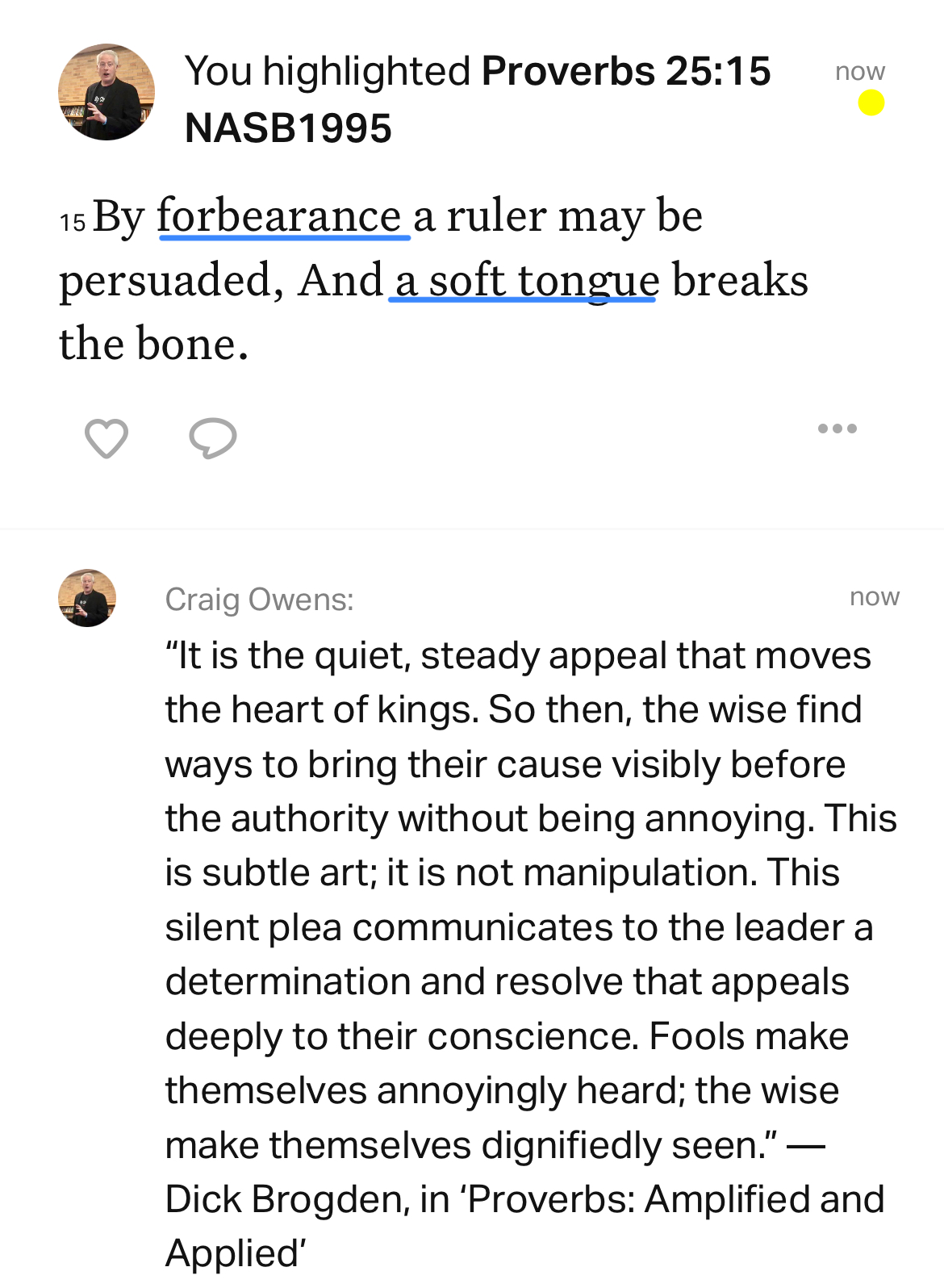
“It is the quiet, steady appeal that moves the heart of kings. So then, the wise find ways to bring their cause visibly before the authority without being annoying. This is subtle art; it is not manipulation. This silent plea communicates to the leader a determination and resolve that appeals deeply to their conscience. Fools make themselves annoyingly heard; the wise make themselves dignifiedly seen.” —Dick Brogden, in Proverbs: Amplified and Applied
God made you uniquely YOU! You have been made on purpose and for a purpose. I have lots of new content every week, which you can check out on my YouTube channel.
“The wise recognize before the fight that adversity will come and therefore are not surprised by it. The wise recognize in the fight that adversity is a formidable foe and thus steel themselves for a long, hard struggle to the death. The wise recognize after winning a fight that the war is not over and so never let down their guard nor release their weapons.” —Dick Brogden, in Proverbs: Amplified and Applied
Astronomers have discovered planet-sized objects that are puzzling the best minds. In fact, they have had to create a new category for these objects: Jupiter Mass Binary Objects (JuMBOs). What is baffling the brightest minds is that these planets don’t orbit a star but appear to be gravitationally bound to other JuMBOs. My favorite line is this one: “The new phenomenon challenges current frameworks explaining how stars and planets form within nebula, with astrophysicists claiming such objects should not exist.” There is at least one who isn’t baffled: The One who created JuMBOs along with everything else in our universe.
T.M. Moore is in the midst of a series of posts about the Christian and the government. They are excellent! Here is just a short sample—“The Christian understands that government is a servant of God for good, and that God, therefore, must define the terms of goodness by which a government fulfills its appointed task. As Paul reminds us, the Law of God is holy and righteous and good (Romans 7:12). It is important, therefore, that Christians understand the Law of God and consider the best ways of bringing its influence to bear in the arena of public policy. … Public policy is not about what governments can do, but what they should do, that is, if they are to fulfill their callings as God’s servants for good. When it comes to applying the Law of God to public policy, Christians must make this first principle foundational in the logic with which they approach the work of influencing and shaping public policy.”
“The weak can never forgive. Forgiveness is an attribute of the strong.” —Mahatma Gandhi
Leaders are naturally wired to be either confident or humble. Both kinds of leaders need to remain coachable. Greg and I unpacked this idea on this episode of The Craig And Greg Show, and I also discuss it in greater depth in my book Shepherd Leadership.
Listen to the podcast of this post by clicking on the player below, and you can also subscribe on Apple, Spotify, or Audible.
Sometimes, as I look back on my life, I wonder how I ended up where I ended up. It certainly hasn’t been a journey that I could have mapped out.
Nor would I have wanted to try.
God has so perfectly and lovingly led me to positions and experiences that have taught me invaluable lessons. These are lessons I would have missed out on had I been the one in charge of my path.
As I was meeting with a group of pastors online, I shared a brief story about one of the unexpected paths God brought me to.
There are two places in the Bible that have really helped me. First is the wise words of King Solomon: “Trust in the Lord with all your heart and lean not on your own understanding; in all your ways submit to Him, and He will make your paths straight” (Proverbs 3:5-6).
The other verse is this, “And we know that in all things God works for the good of those who love Him, who have been called according to His purpose” (Romans 8:28). This promise assures me that not one experience in my life—pleasant or unpleasant—has been wasted. God is using all these things for my good and for His glory.
So, the next time you find yourself wondering how you ended up where you ended up, be assured that God has a plan and a purpose for your life and that He is overseeing every step of your journey.
Listen to the podcast of this post by clicking on the player below, and you can also subscribe on Apple, Spotify, or Audible.
I’m not a fan of rollercoasters, but I know a lot of people who really like them. Some even travel all over the world to experience unique rollercoasters. The anticipation as the cars climb slowly up the big hill, knowing that there’s no stopping this thing now! Then the rush of emotions, a deep breath and a laugh at the end (usually laughing at our friends’ responses while on the ride), and then we just walk away. The moment of anticipation leading up to the big drop was usually longer and more intense than the ride itself.
Not only do people travel all over to find rollercoasters, some people seem to have their emotions perpetually on rollercoasters.
One of the telltale signs of someone with an immature mental health is the way every situation gets blown out of proportion before anything even happens. Then as an event unfolds, their exaggerations continue: the molehills are mountains, every valley is the valley of the shadow of death, the night is a nightmare, the “crisis” is lasting forever, no one has ever gone through what they’re going through, and the list goes on.
To break out of this habit requires us developing emotional capacity. John Maxwell describes it like this: “Emotional capacity is the ability to handle adversity, failure, criticism, change, and pressure in a positive way.” Just as athletes have to develop lung capacity or muscle capacity, developing emotional capacity takes time, patience, and diligence.
Increased emotional capacity is not escaping from our problems or even learning coping skill. Escapism never allows us to confront the things that are keeping our emotional capacity immature. On the other hand, maturing emotional capacity is learning to pause to get perspective so that we can avoid turning every mountain into a molehill, and every challenge into a do-or-die battle.
Let me illustrate this by looking at two emotions which seem to be the most rollercoaster-ish.
(1) The first rollercoaster emotion is anger
Out-of-proportion anger can either burn everyone around us when we explode, or it can eat away inside us if we hold it in. Neither of these are healthy emotional responses. Jesus got angry at the religious crowd that was keeping people away from God’s kingdom, but He didn’t ride the rollercoaster that led to a sinful expression of His anger.
God asked Jonah a very helpful question: Have you any right to be angry? (Jonah 4:4). When we feel the Holy Spirit asking us this question, our defiant first response is almost always, “Yes! I didn’t do anything wrong! It was all him!” Solomon would counsel us to cross-examine that thought (Proverbs 18:17).
Sometimes God will bring someone else across our path to help us pause to get perspective—to flatten the rollercoaster. For instance, God used Abigail to help David (see the story in 1 Samuel 25). However the Holy Spirit cross-examines us, we need to learn to truly listen. James told us:
My dear brothers and sisters, take note of this: Everyone should be quick to listen, slow to speak and slow to become angry, because human anger does not produce the righteousness that God desires. (James 1:19-20)
(2) The second rollercoaster emotion is fear
Fear usually causes us to fight or flight. Those are the natural responses, but the supernatural response is to pause to evaluate. I love the reminder that F.E.A.R. means false evidence appearing real.
As with anger, our first pause to get perspective on this potential rollercoaster that can plunge us into a deep, dark valley should be to cross-examine the false evidence of fear.
When the group of ladies came to the tomb of Jesus on the Sunday following His crucifixion, they were already battered and bruised in their emotions. Finding an empty tomb brought even more fear in their hearts. But there is a keyword in this account that will help us:
In their fright the women bowed down with their faces to the ground, but the men [angels] said to them, “Why do you look for the living among the dead? He is not here; He has risen! Remember how He told you, while He was still with you in Galilee: ‘The Son of Man must be delivered over to the hands of sinners, be crucified and on the third day be raised again.’” Then they remembered His words. (Luke 24:5-8)
The Holy Spirit can help us remember the truth in God’s Word to counteract the fear-inducing false evidence (2 Timothy 1:7; John 14:26), but we must pause to listen to this evidence before this rollercoaster emotion picks up speed.
The bottom line: Don’t try to escape your strong emotions. Pause. Cross-examine the evidence with the help of God’s Word, the Holy Spirit, and a friend to get a healthy perspective. This can help you flatten the rollercoaster before your emotions run away with you.



 I love reading, and I love sharing my love of good books with others! Here is a list of the books I read and reviewed in 2023. Click on a title to be taken to that review.




 Craig T. Owens