What If Jesus Had Been Physically Weak?

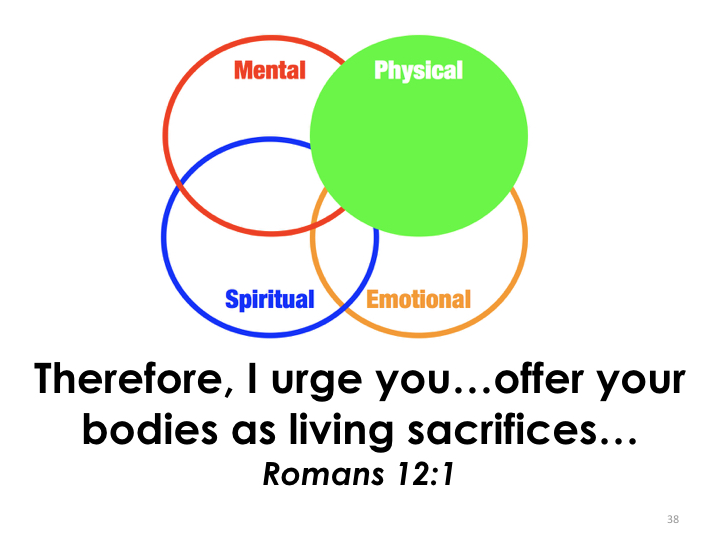
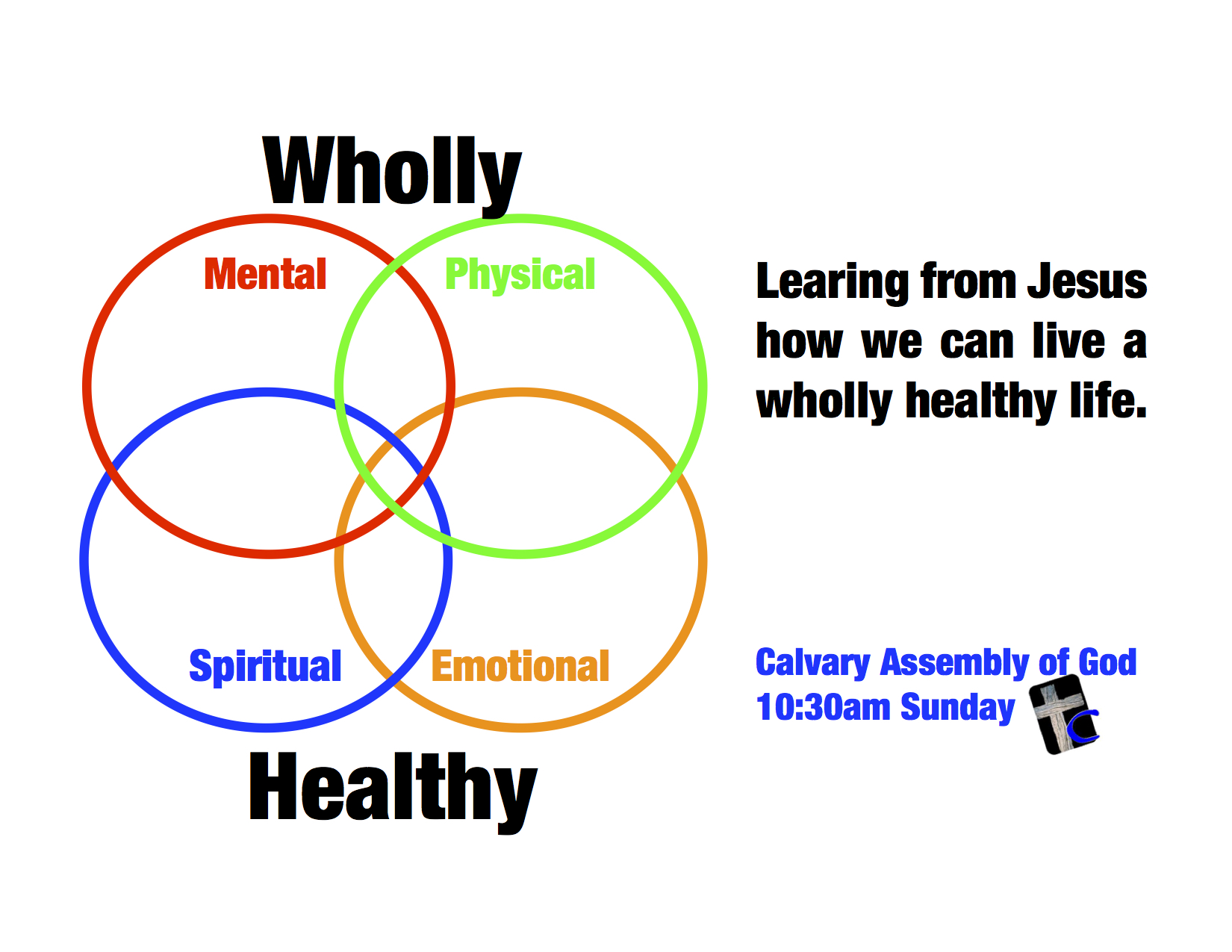
physical-healthWe have been exploring the whole health of Jesus, as Dr. Luke recorded it in Luke 2:52. In this verse Luke tells us that Jesus grew in wisdom (mental health), stature (physical health), in favor with God (spiritual health) and in favor with men (emotional/social health). Being unhealthy in any one of these areas will ultimately pull down the health in all of the areas.

The life of Jesus shows us that we, too, must strive to live wholly healthy lives.

Yesterday at Calvary Assembly of God, Scott asked a challenging question: “What if Jesus hadn’t been strong enough to make it to the top of Calvary’s hill?”

Think about the excruciating torture Jesus went through—

  • He was sleep deprived.
  • He was dehydrated from His intense prayer time in Gethsemane, where He sweat blood.
  • He was emotionally depleted from having all of His friends abandon and deny Him.
  • He was beaten multiple times by temple guards and Roman soldiers.
  • He was brutally whipped to the point that His back muscles and nerves were exposed.
  • He had thorns crushed into His scalp.
  • He had His beard ripped out.
  • He had to carry a 60- to 90-pound wooden crossbeam nearly 650 yards uphill.

All of this took place before He had metal spikes slammed through His wrists and ankles, and then was hoisted up rudely into the air to be suspended from His Cross.

Jesus went through all of that for you and me. In making it all the way to the point where He said, “It is finished,” He fulfilled every prophesy concerning His death.

The only way Jesus could have made it through this is if He was at optimal physical health.

If Jesus had died from exhaustion or heart attack or loss of blood before He was actually nailed to the Cross, how many of the prophesies would have been left unfinished? He needed to keep His physical body in tip-top shape throughout His entire earthly life in order to be ready for this one crucial moment.

Being physically weak makes it difficult for us to…

  • …think clearly (mental health)
  • …concentrate on the things of God (spiritual health)
  • …control our emotions and respond appropriately to other people (emotional/social health)

So we, like Jesus, must work on our physical health. God has a plan for your life. In order for you to fulfill all God has in mind, you must be wholly healthy. Are you taking care of your physical body? If you’re not, you are slowly robbing all of the other areas of your life of the strength they need.

If you’re not as physically healthy as you could be, what are you willing to do differently?

Check out this 3-minute clip where Scott asks us what physical health changes we’re willing to make for God’s glory…

How To Be Wholly Healthy

healthy-growthA man named Luke recorded a couple of amazing things about the life of Jesus. As both a doctor and an historian, Luke was an excellent “noticer.”

In first-century biographies, a person’s early life usually wasn’t mentioned. So it’s not uncommon that two of the four Gospel writers don’t pick up Jesus Christ’s life story until He was about 30 years old. Even Matthew, who did record something about the birth of Jesus, didn’t go into much detail.

Luke, however, notices two important things.

First, in covering the first 12 years of Christ’s life Luke says, “The Child grew and became strong…” (Luke 2:40).

healthy-growth-001The Greek word Luke uses for grew means a continual process of increasing. Sometimes we mistakenly think this means a continual movement on a graph upward and to the right. But I’ll give you one instance where this is not the case—when we record someone’s height, we do so in feet not in years. In other words, we say someone is 6’4” tall, but we don’t say they are 6-years and 4-months fall. We understand there is a limit to that sort of growth.

What Luke is referring to is a different kind of continual increasing. All of us go through four quadrants as we learn:

  • unconscious incompetence—we’re no good in an area but we don’t even know it
  • conscious incompetence—we know that we’re no good in an area
  • conscious competence—we’re good in an area but we still have to think about what we’re doing
  • unconscious competence—we’ve gotten so good in an area that we no longer need to think about it

healthy-growth-003When Luke said Jesus grew, he meant not upward and to the right, but a continual cycle of learning what He didn’t know and increasing His competence in that area. When Luke said Jesus grew and became strong, he was saying that Jesus learned how to apply the lessons He was continually learning.

Second, in covering Christ’s next 18 years Luke says, “Jesus grew (Luke 2:52), but he uses an entirely different word. This Greek word means to be hammered out, as a blacksmith hammers metal into shape. Notice that Jesus is not the One doing the hammering, but He is the One submitting to His Father’s hammering. He is letting God the Father shape Him into what He needs to be.

Luke says that Jesus grew in…

  1. …wisdom—mental health
  2. …stature—physical health
  3. …favor with God—spiritual health
  4. …favor with men—emotional (or social) health

In other words, Jesus was growing in a wholly healthy way. God wants us to be wholly healthy too. He wants us to continually allow Him to point out areas where we are lacking, and then submit to His guidance on how we can improve in those areas.

I’ll be exploring these four areas—mental, physical, spiritual and emotional—over the next few weeks. But in the meantime, why don’t you pray the prayer David prayed and ask God’s Spirit to search out any areas where you are falling short of optimal health. And then submit to God’s work of helping you get wholly healthy in every area of your life.


Wholly Healthy

wholly-healthyHave you ever been tiptoeing through your house in the dark and stubbed your pinky toe? When that happens, is it only your pinky toe that hurts? No! It seems like your whole body gets into the action!

This is a simple way to understand that what affects one part of our life affects all parts of our life. We can’t simply quarantine one part that is having difficulty because that one part will eventually spread its pain everywhere else.

Humans were created as beings with several integrated parts. We have a physical body, we have a mind, we have emotions, and we have a God-breathed soul. If one of these parts becomes diseased, eventually all of the other parts will be affected, unless something is done to bring healing.

If we are dis-eased in any area, our health will be compromised in all areas.

Fortunately for us, Doctor Luke noted something about the health of Jesus during His earthly life. What Luke shows is how God intends for all of us to live—wholly healthy.

Modern medical science and psychology show us what the Bible pointed out long ago: We are integrated beings, and every part needs to be functioning optimally so that our whole being can function optimally.

Join us this Sunday as we begin a new series called Wholly Healthy. You will not only learn the importance of being aware of your health in four key areas, but you will also learn some practical thoughts for maintaining your optimal health.

If you missed any of the messages in this series, check them out here:

#MOWT

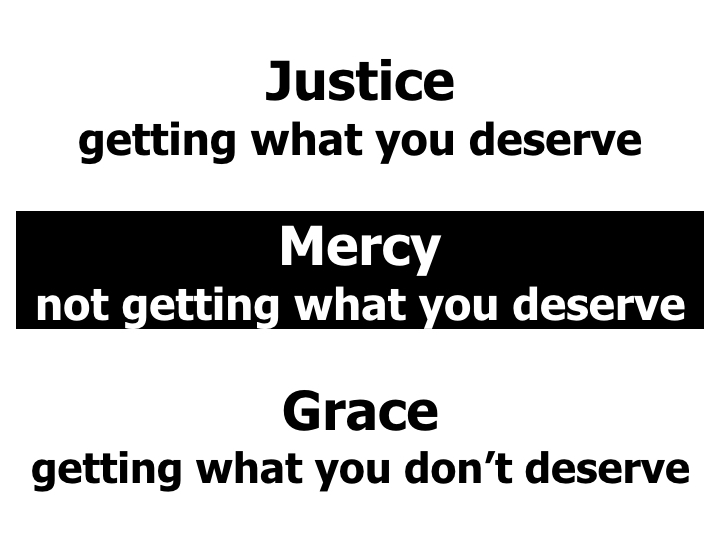
justice-mercy-graceLast week I blogged about justice, mercy, and grace. Justice is getting the penalty we deserve, mercy is not getting the penalty we deserve, and grace is getting blessings we don’t deserve.

If we are truly grace-full people, then we should be thank-full people as well. As we approach Thanksgiving Day, people are naturally thinking about things for which they can give thanks during this past year. But Christians should be the most full-of-thanks people on the planet, because we have been showered with so much grace! 

I’d like us to think about a word that I believe will increase our level of thankfulness: Appreciation. Appreciation goes beyond merely being thankful for blessings, as it sees the high value in those blessings, and then continually looks for ways to express even more gratitude for them. In other words, appreciation can begin a cycle of gratitude that grows and grows and GROWS!

Check out three parts to the definition of appreciation

[1] Gratitude; thankful recognition. Did you know that being grateful is actually good for you? Research has shown that increasing your gratitude levels increases your:

  • Physical health. “A state of gratitude, according to research by the Institute of HeartMath, also improves the heart’s rhythmic functioning, which helps us to reduce stress, think more clearly under pressure and heal physically. It’s actually physiologically impossible to be stressed and thankful at the same time” —Jon Gordon
  • Emotional health. Dr. Robert Emmons says gratitude decreases envy, resentment, and feelings of retaliation; and increases empathy, emotional resilience, and self-esteem.
  • Spiritual health. Notice how ingratitude is included in the list of a whole lot of ugliness (2 Timothy 3:1-4), but spiritual health is restored simply by being thankful (Ephesians 5:3-4).

[2] Estimating qualities and giving them their proper value. In order to determine value, we must have a standard of comparison. What’s your standard? Is it what your neighbor has? Is it what you don’t have? Or is it thankfulness for what God has given you? 

Max Lucado said, “To reflect on your blessings is to rehearse God’s accomplishments. To rehearse His accomplishments is to discover His heart. Gratitude always leaves us looking at God and away from dread.”

[3] Assessing the true worth of our blessings. Assessing leads to appreciation, and appreciation begins to give us a return on investment. I like how Jeff Anderson says it: “If you want to grow your faith, grow your gratitude. To grow your gratitude, take time to count your blessings.”

Remember: gratitude isn’t gratitude if it isn’t expressed. David made his gratitude known, and other afflicted people around him began to join with him in thanking God for His blessings (see Psalm 34:1-3). In other words, David’s thanksgiving went viral!

mowtHere’s how we can make our gratitude go viral: #MOWT. Let’s count our blessings every day, and let’s appreciate what God has done for us. Then let’s share our gratitude not only with God, but with others as well. Post it on Facebook or Twitter or Instagram with #MOWT: my one word thanks. Maybe include a photo and “family” #MOWT, or “protection” #MOWT, or even “paycheck” #MOWT.

Let’s give God so much glory for His grace gifts, that we tell the world about our appreciation!

Thursdays With Oswald—The Harmony Of Health

Oswald ChambersThis is a weekly series with things I’m reading and pondering from Oswald Chambers. You can read the original seed thought here, or type “Thursdays With Oswald” in the search box to read more entries.

The Harmony Of Health

     Health, or physical harmony, is a perfect balance between our organism and the outer world. … The great error of the healthy-minded cult is that it ignores a man’s moral and spiritual life. … The attitude to sickness in the Bible is totally different from the attitude of people who believe in faith-healing. The Bible attitude is not that God sends sickness or that sickness is of the devil, but that sickness is a fact usable by both God and the devil. 

   Happiness or moral harmony is a perfect balance between our inclination and our environment. … The Bible reveals that a man can have physical health at the cost of his moral welfare, and happiness at the cost of spiritual welfare. 

   Holiness, or spiritual harmony, is a perfect balance between our disposition and the law of God. … 

   The devil tries to make us think that when we have entered into the sanctified life, all is done; it is only begun. We have entered into Jesus Christ’s finished work, but remember, says Paul, you have attained to nothing yet; everything is perfectly adjusted, now began to attain and to “grow up into him in all things. These three things develop slowly together: first, the basis of spiritual holiness; second, the building of moral happiness; and third, the decoration of physical health. A full-grown man in Christ Jesus is one who has become exactly like Christ Jesus. “Till we all come…unto the measure of the stature of the fullness of Christ” (Ephesians 4:13). 

From The Philosophy Of Sin

Quite simply Oswald Chambers identifies health as a perfect balance:

  • Physical health balances outside germs against inside defenses.
  • Emotional health balances outside circumstances with inside coping mechanisms.
  • Spiritual health balances God’s law (outside) with our obedience to that law (inside).

Furthermore, Chambers says that Jesus Christ is our measuring stick. We must study God’s Word, and watch Jesus closely to see how He lived out the perfect balance of the Scriptural principles so that we can attain “unto the measure of the stature of the fullness of Christ.”

7 Tips For A Better Night’s Sleep

Psalm 4.8It’s no secret that being tired can lead to a lot of not-so-nice consequences. Everything from automobile crashes, to poor work performance, to foot-in-mouth statements, to giving in to temptations, to health issues are all traced back to not getting enough peaceful sleep.

But did you know that sweet sleep is something God wants to give you?

Psalm 127 says, “God grants sleep to those He loves.” Guess what? God loves you, and wants you to have a peaceful night’s sleep!

Here are some benefits to getting solid sack time:

  1. Muscles are repaired—the body “turns off” muscles during sleep so they can repair themselves.
  2. The hormone leptin, that regulates your appetite, is adjusted.
  3. Your blood pressure is lowered.
  4. Your heart rate is lowered.
  5. The energy-producing cells we all need are restocked.
  6. Your immune system is re-energized.
  7. Memories are consolidated from short-term memory banks to long-term memories.
  8. The hormones that allow you to concentrate are replenished.
  9. Your “database” of decision-making options is re-calibrated.
  10. Bottom line—you get healthier physically, mentally, emotionally, relationally, and spiritually.

All of this God wants to give to those He loves. “God loves me, so I’m going to sleep peacefully tonight!”

The problem is we often sabotage God’s blessing of sweet sleep by our own poor decisions during the day. So here are seven things you can do to cooperate with God’s blessing of sleep:

  1. Reduce stress. Stress causes your body to release cortisol, which prepares your body for fight-or-flight. This means when you’re trying to quiet down for the night, your body is still screaming, “Go, go go!” Stress is mainly triggered by worrying over things outside of our control, so check out what Jesus said to us about not worrying—Matthew 6:25-34.
  2. Reduce late-day caffeine. Caffeine has a half-life of six hours, so if you are pouring it into your body late in the date, you might fall into bed exhausted but the caffeine is keeping your brain buzzing. As a result, you don’t have the normal deep sleep patterns.
  3. Eliminate emotional caffeine. Arguments with other people release cortisol and adrenaline in your bloodstream. If these disagreements are happening later in the day, your body is fighting against God’s plan for your tranquil sleep. So take care of any disagreements quickly (Ephesians 4:26).
  4. Exercise. Getting some movement into your daily routine flushes cortisol and adrenaline from your bloodstream.
  5. Go to bed and get up at the same time. There’s a reason God made the sun to rise and set at predictable times. Your body also functions best on a predictable schedule.
  6. Reduce “blue lights” close to bed time. The blue light waves of dawn tell our bodies to stop releasing melatonin, the sleepy hormone. The red light waves of dusk tell our bodies to increase melatonin so we can go to sleep. But when we’re staring into the blue light of our phones and tablets, our body is being sent a conflicting signal.
  7. Pray. Two great passages you can pray before bedtime are Psalm 4:8 and Proverbs 3:24. Claim those promises of sweet sleep!

God loves you. He wants to give you the blessing of peaceful sleep. If you’re going to sleep peacefully tonight, make sure you are not sabotaging what God wants to give you.

If you’ve missed any of the messages in this series, you can access the complete list by clicking here

11 Ways To Be A Good Minister

© Lori Oxford Photography

Here are 11 ways to “be a good minister of Christ Jesus” (1 Timothy 4:6)—

  1. Know the Scripture well enough to point out false doctrines (vv. 1-6a)
  2. Be a good teacher (v. 6b)
  3. Train myself to be godly (v. 7)
  4. Take care of my physical health (v. 8)
  5. Put my hope solidly in God (vv. 9, 10)
  6. Set an example worth following (vv. 11, 12)
  7. Use the Scriptures in everything I preach (v. 13)
  8. Turn my God-given gifts into strengths (v. 14)
  9. Have a good work ethic (v. 15a)
  10. Be consistently growing (v. 15b)
  11. Carefully and prayerfully evaluate my doctrine (v. 16)

7 Quotes On Brain Health From “Brain-Savvy Leaders”

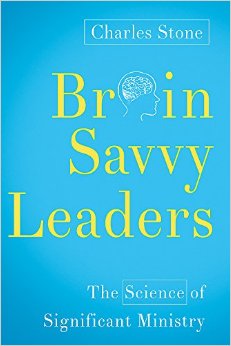
Brain-Savvy LeadersCharles Stone gave us a very practical book in Brain-Savvy Leaders (you can read my full review by clicking here). Obviously out brain works best when we’re healthy, so check out some quotes from this book on brain health.

“Gratefulness is actually good for brain and body health.”

“At the end of our chromosomes lie protective caps called telomeres that are linked to longevity. Apparently, the longer your telomeres, all else being equal, the longer you live. Long-term stress shortens them, and mindfulness apparently helps lengthen them. For a Christian, mindfulness practices, such as meditation on Scripture and reflective prayer, which we often do in our devotional time, may possibly help us live longer.”

“The hypothalamus acts as a controller to the master hormone gland, the pituitary gland. … Chronic stress can damage our body and even kill neurons in the hippocampus. However, since the hippocampus is one of the few structures that can grow neurons, called neurogenesis, when stress decreases and cortisol levels out, the brain can regrow neurons here.”

“When we feel bored we don’t get as much oxygen and blood flow. When the brain lacks engagement over long periods of time (we are bored), dendrites can atrophy. When that happens, we can lose brain real estate.”

“Neuroscientists have found that stuffing, denying, or a ignoring our emotions reinforces them, affects short-term memory, increases blood pressure, and robs our brain’s prefrontal cortex of the mental energy it needs.”

“Chronic anxiety and stress cause what scientists call allostatic load…. When our body secretes too much cortisol over long periods of time, these problems can affect us: impaired immunity, weight gain, greater emotional reactivity, heart problems, decreased memory, and diminished brain functioning.”

“Exercise increases a key protein necessary for a healthy brain.”

I shared some quotes about how we learn from Brain-Savvy Leaders earlier, and you can read them here.

Links & Quotes

link quote

“Reading the Bible is a good preparative for prayer, as prayer is an excellent means to render reading effectual.” —George Whitefield

“God would have remained hidden afar off if Christ’s splendor had not beamed upon us.” —John Calvin

“In selecting men for office, let principle be your guide. Regard not the particular sect [party] of the candidate—look to his character. … It is alleged by men of loose principles or defective views of the subject that religion and morality are not necessary or important qualifications for political stations. But the Scriptures teach a different doctrine. They direct that rulers should be men ‘who rule in the fear of God, able men, such as fear God, men of truth, hating covetousness.’” —Noah Webster

“During the gold rush, the people who made the most money were the ones selling the shovels.” —Russell Brunson

Husbands, here are 8 things your wife should expect from you.

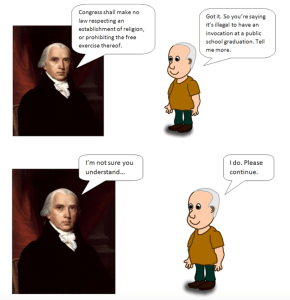
James Madison & the Bill of RightsMurray Vassar has another great cartoon. Click the picture or here to see the rest…

Seth Godin always makes me think. Like this post called Opposition

The opposite of creativity is fear.
And fear’s enemy is creativity.
The opposite of yes is maybe.
Because maybe is non-definitive, and both yes and no give us closure and the chance to move ahead.
Perfect is the enemy of good.
Us is not the enemy of them. Us is the opposite of alone.
They can become us as soon as we permit it.
Everything is the opposite of okay. Everything can never be okay. Except when we permit it.
The right is not the opposite of the left. Each side has the chance to go up, which is precisely the opposite of down.
Dreams are not the opposite of reality. Dreams inform reality.

[VIDEO] John Maxwell makes me think, too. Here he does it with a bit of humor—

Links & Quotes

link quote

“Be not satisfied, my dear friends, with being saved; desire to know how you are saved, why you are saved, the method by which you are saved. It is a rock on which you stand, I know, but think upon the questions—how you were put upon that rock, by whose love you came there, and why that love was set on you. I would to God that all the members of this church were not only in Christ Jesus, but understood Him, and knew by the assurance of the understanding whereunto they have attained.” —Charles Spurgeon

“I get the impression that some Christians think there are two kinds of history, two kinds of time. First, there is Bible time, and Bible history. Things happened in the Bible that were unique, and that we don’t expect to see happen in normal time and history, where we live, you know, today. Things like God doing extraordinary acts of deliverance, help, and support, or extraordinary empowerments for witness or service. Like Moses leading the people out of Egypt, or Joshua leading them to subdue the land of promise, or David leading an entire nation to build a glorious temple for the Lord. That was then, many Christians seem to think; this is now. But when we think this way we may be cutting ourselves off from one of the most powerful resources for visionary leadership, and that is the promise of the past … Visionary leaders understand that God has done remarkable, nearly incredible things in the past, and they reach back and recall those mighty works of God in order to encourage His people in the present. They recognize that the straight line of the covenant continues from Scripture through Church history right down to our day.” —T.M. Moore

“The psalmist does not yield. He battles unbelief with counterattack. In essence, he says, ‘In myself I feel very weak and helpless and unable to cope. My body is shot and my heart is almost dead. But whatever the reason for this despondency, I will not yield. I will trust God and not myself. He is my strength and my portion’ [Psalm 73:26]. … God has put these testimonies in the Bible so that we might use them to fight the unbelief of despondency.” —John Piper

Yesterday I posted a book review about our brains. Here is 11 things you need to know to keep your brain healthy.

“If homosexuals are bullied, we need to protect them. If they’re unjustly discriminated against, we need to help them. If they’re treated with contempt, the person hurting them should be stopped. If a family member comes out as gay and then is belittled, harmed, or vilified, then the offending family needs to be corrected. If Christians ridicule people who identify as gay or lesbian, they need to admonished. If a church doesn’t welcome seekers of all stripes (including people who identify as gay, lesbian, or bisexual), then it needs to change. But none of these circumstances are reasons to reinterpret Scripture to affirm homosexuality” (emphasis mine). Read more in Bad Reasons To Adopt Pro-Gay Theology.