8 More Powerful Relationship Quotes

Keep Your Love OnI have shared a couple of sets of quotes from Danny Silk’s book Keep Your Love On! (which you can read here and here). I have also posted a review on this book here.

This book is a must-read for pastors or counselors who do marriage or family counseling. This is also an excellent book to read if you have a relationship in your life that you would like to see healed or strengthened. Check out a few more quotes below.

“If you cannot communicate your needs to another person clearly, it is obviously going to be very difficult for that person to meet them. That’s why one of the primary tasks of reaching maturity is learning how to express thoughts, feelings, and needs. Those who never learn this skill, however, expect relationships to function without it. They say things like, ‘Well, if you love me, then you will just know what I need. Didn’t you notice that that bothered me? Haven’t you been paying attention? I can’t believe you don’t know that about me.’ Where does this desire or expectation that loved ones have a telepathic ability to know our feelings and needs come from? It comes from powerlessness and fear. It comes from dreaming that everything will turn out magically without actually having to communicate. Powerless people want to win the lottery, get their dream girl/guy with minimal effort, lose weight without exercise, and get their needs met without ever having to say a word.”

“The reason we can’t get our needs met without expressing them is that we were designed to have our needs met through a relational exchange. God made us this way. … Think about it. God, the one Person in the universe Who knows all things, and knows us incomparably better than we know ourselves, never says, ‘Well, obviously I know your needs, so you don’t need to tell Me about them.’ Instead, He repeatedly tells us to ask Him for what we need, and gives us some of the most profound, beautiful, and honest language for doing so—like the Lord’s Prayer, and most of the Psalms. He won’t meet our needs outside of a connection where we have to show up and crack our hearts open to Him, because that very connection is what we need to have our needs met in the first place.”

“If you want to protect your connection and build trust by always communicating respectfully, then your guiding rule must be, ‘It’s my job to tell you about me, and your job to tell me about you.’ The best tool for telling another person about you is an ‘I message.’ The basic structure of the ‘I message’ is: ‘I feel [emotion] when [described experience] and I need to feel [emotion].’” 

“As you construct an ‘I message,’ make sure that you are really expressing a feeling, not an opinion. … If you start to say, ‘I feel like…’ you should stop and check yourself—because what is most likely going to follow is not a feeling, but a judgment. And a judgment statement is actually an expression of mistrust, not trust.”

“Intimacy—‘into-me-see’—is created between two people who can say, ‘We can be ourselves together because you can see into me and I can see into you.’ The experience of intimacy—of being completely known and accepted, and completely knowing and accepting in return—is the most satisfying experience we can have as humans. Intimacy in a safe place brings euphoria. Remember the Garden of Eden? Paradise was the place where a man and a woman were unafraid to be vulnerable and intimate with each other in every way. The problem is that most of us are scared to death to be vulnerable in relationships. The reason is simple: In being vulnerable, we reach for our greatest need while risking our greatest pain.”

“Fear of rejection and shame sets us up to fall for the enemy’s counterfeits. Ever since sin entered the world and humanity became disconnected from God, we have been looking for ways to get our needs met outside of relationship or any scenario where we are required to be vulnerable and risk our hearts. We have always desperately sought the benefits of intimacy without wanting to pay the price. And the enemy continues to offer us the euphoric experiences we think we can control—things like alcohol, drugs, sex, Internet pornography, shopping, carbohydrates, adrenaline, or cash. We use these things to give ourselves a euphoric release and take care of our needs. But the counterfeits always have ugly repercussions, like drunk drivers killing innocent people, young kids destroying their brains, men ignoring the beautiful real women beside them in favor of the images, serious debt, morbid obesity and the host of diseases that accompany it, thrill seekers slowly becoming numb to reality, and selfish jerks not caring who they step on to get what they want. Counterfeits never come through.”

“Every respectful conversation needs one speaker and one listener at all times. … The listening role is the true servant role in a respectful conversation. The listener affirms, ‘Right now, this conversation is about you and your needs. I am here to help you figure them out and find a way to help you get them met.’ But in the end, the listener is really the winner. If I listen well, I will have two vital pieces of information—what you need and what I need to do. With these two pieces of information, I start to identify and take ownership of the problem and create an effective solution.”

“A skilled listener with a servant’s heart is the deadliest weapon against the fear-bombs that threaten connection.”


Links & Quotes

link quote

“Why, do you not believe there may be as much pride in rags as in an alderman’s gown? Is it not just as possible for a man to be proud in a dust cart, as if he rode in her Majesty’s chariot? A man may be just as proud with half a yard of ground as Alexander with all his kingdoms, and may be just as lifted up with a few pence as Croesus with all his treasure. Pray against pride, dear friends, wherever you may be. Pride will grow on a dunghill, as well as in the king’s garden. Pray against pride and vainglory, and God give you grace to keep it under!” —Charles Spurgeon

“How numerous are the tears of unbelief! We manufacture troubles for ourselves by anticipating future ills which may never come…. We get supposing what we should do if such-and-such a thing occurred, which thing God has determined never shall occur. We imagine ourselves in positions where providence never intends to place us, and so we feel a thousand trials in fearing one.” —Charles Spurgeon

“Usually, an adolescent wants ‘freedom’ but not ‘responsibility.’ Real maturity and genuine leadership are only transferred from adult to student, however, when kids receive both of these elements. We’ve not truly helped a young person mature until we’ve passed on ownership.” Reader from Tim Elmore’s post The Single Most Important Ingredient for Maturity.

Eric Metaxas points out that Planned Parenthood is trying to clean-up the image of its founder Margaret Sanger. But the facts about Ms. Sanger are quite alarming.

Ever feel like you are going through hell? Check out what David Wilkerson says in his post Out Of The Belly Of Hell.

The new HumanitarianismMurray Vassar shows us what the new humanitarianism looks like. Sadly true.

[VIDEO] Bobby Conway has a really good answer to the question what’s the big deal about premarital sex—

Links & Quotes

link quote


In The Screwtape Letters, in which an older demon is writing to an apprentice demon, the ‘Enemy’ is God, and the ‘Father’ is the devil. “The Enemy’s demand on humans takes the form of a dilemma; either complete abstinence or unmitigated monogamy. Ever since our Father’s first great victory, we have rendered the former very difficult to them. The latter, for the last few centuries, we have been closing up as a way of escape. We have done this through the poets and novelists by persuading the humans that a curious, and usually shortlived, experience which they call ‘being in love’ is the only respectable ground for marriage; that marriage can, and ought to, render this excitement permanent; and that a marriage which does not do so is no longer binding. This idea is our parody of an idea that came from the Enemy. The whole philosophy of Hell rests on recognition of the axiom that one thing is not another thing, and, specially, that one self is not another self. My good is my good and your good is yours. What one gains another loses. Even an inanimate object is what it is by excluding all other objects from the space it occupies; if it expands, it does so by thrusting other objects aside or by absorbing them. A self does the same. With beasts the absorption takes the form of eating; for us, it means the sucking of will and freedom out of a weaker self into a stronger. ‘To be’ means ‘to be in competition.’” —C.S. Lewis, in The Screwtape Letters

“Commend me to the Christian who says, ‘I bless God I am saved; now what can I do for others?’ The first thing in the morning he prays, ‘God help me to say a word to some soul this day.’ During the day, wherever he may be, he is watching his opportunity, and will do good if he can. He is concerned about his children: it sometimes breaks his heart to think that they are not saved. If he happens to have an ungodly wife, it is his daily burden, ‘O God, save my wife!’ When he goes to a place of worship he does not expect the minister to make sermons always on purpose for him, but he says, ‘I shall sit here and pray God to bless the word,’ and if he looks round the chapel and sees one that he loves, he prays for him, ‘God send the word home to him.’ When service is over, a man of this kind will waylay the unconverted, and try to get a personal word with them, and see if he cannot discover some beginnings of grace in their souls. This is how earnest Christians live; and let me tell you, as a rule, though they have the griefs of other men’s souls to carry, they do not have much grief about their own; they are watering others and they are watered themselves also. May this be your work and mine!” —Charles Spurgeon

“Paul wrote to the Ephesians about the true character of a healthy, growing church. He said nothing about numbers of people, size of budget, variety of programs and facilities, or whether or not it had a great worship band. He emphasized two characteristics—unity and maturity—which are in short supply in America’s churches today (Ephesians 4:11-16).” —T.M. Moore

Dr. George O. Wood says, “If even the angels do not know, and Jesus did not know, why do we have so many ‘date-setters’ even today? You can research and discover that there have been numerous false prophecies in the past centuries where authors and so-called prophets set a date for the return of Christ. Date-setters will always be wrong; you can count on it.” Read the rest of his post about Christ’s return here.

I like this: 5 reasons the church should embrace science.

Fight The New Drug asks: Is there a difference between pornography and prostitution?

Links & Quotes

link quote

“A Christian mind asks questions, probes problems, confesses ignorance, feels perplexity, but does these things within the context of a profound and growing confidence of the reality of God and of his Christ.” —John R.W. Stott

“How can we expect to chase satan out of our churches, our homes, our troubled children, if we don’t pray? How can parents expect God to impart spiritual power to them when they argue, fight and gossip in front of their kids? How can they expect to possess authority when they go out drinking, and then fly into a rage when they learn their kids smoke pot?” —David Wilkerson

“An increase of love, a more perfect apprehension of Christ’s love is one of the best and most infallible gauges whereby we may test ourselves whether we have grown in grace or not. If we have grown in grace, it is absolutely certain that we shall have advanced in our knowledge and reciprocation of the love of Christ.” —Charles Spurgeon

“Actions have consequences! In the book of Genesis we read how Joseph placed his loyalty above lust when he was tempted by Potiphar’s wife. His primary concern was the preference of God when he said, ‘How can I do this great wickedness, and sin against God’ (Genesis 39:9)? The lesson we learn from Joseph is surprisingly simple: Do what pleases God. Your co-workers want to include a trip to a gentleman’s club on the evening agenda. What do you do? Do what pleases God. Your date invites you to conclude the evening with drinks at his place. How should you reply? Do what pleases God. You don’t fix a struggling marriage with an affair, a drug problem with more drugs, debt with more debt. You don’t get out of a mess by making another one. You’ll never go wrong doing what is right. Just do what pleases God.” —Max Lucado

Seth Godin has a great point: We usually tell people how to do things, but rarely do we tell them why to do things. Check out Seth’s insight here.

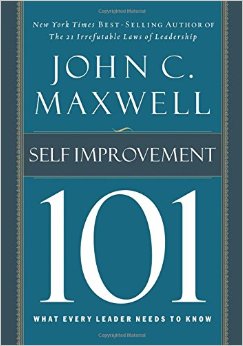
Self-Improvement 101 (book review)

Self-Improvement 101As with all of the books in John Maxwell’s 101 series, Self-Improvement 101 is a quick-hitting introduction to the power of making personal changes.

When you attend college, the 101 level classes are the introductions to a subject that could be very deep and involved. That’s exactly what John Maxwell intended to do with all of his 101 books—give us just enough information to entice us to go deeper.

Self-Improvement 101 will introduce you to some of the concepts that Dr. Maxwell deals with in more depth (think a 301 or 401 level class) in his other books. He tells us the benefits that come from making improvements, the first steps we can take on the road to improvement, and hints at how we can live a life of continual improvement.

If you’d like to make some changes in your life, Self-Improvement 101 could be a great starting point for you, and could be a great introduction to some of John Maxwell’s other outstanding books.

I am a Thomas Nelson book reviewer.

The Counselor Brings Reproof

Search meNo one likes being rebuked, but it is necessary. In fact, it is vital for healthy growth. As a Dad, I didn’t look forward to the times I had to rebuke my children. But what’s the alternative? What happens if I just let misbehavior slide? We must rebuke those we love if we want them to mature.

The Counselor—the Holy Spirit—not only teaches us, but He reproves us as well because of His love for us. And we all need it!

  • The human heart is the most deceitful of all things, and desperately wicked. Who really knows how bad it is? (Jeremiah 17:9)
  • For I know that in me (that is, in my flesh,) dwelleth no good thing… (Romans 7:18)

This knowledge of my wickedness becomes even more painful when I think that Jesus calls us to perfection (Matthew 5:48). I can’t “do” perfect on my own. But thankfully Jesus didn’t tell us to “do” perfect things, but to BE perfect.

The Holy Spirit reproves us—that is, He shows us where we are deviating from the mark—so that we can BE perfectly at one with Jesus, with our lives demonstrating Christ’s perfect nature.

Warning: the enemy wants to pervert The Counselor’s reproof. He wants to whisper to you that God is mad at you, that you’ve blown it too many times, that you’ll never be good enough.

Just like Jesus countered all of satan’s temptations with the Spirit-breathed Scripture, you need to do the same thing. You tell him, “My Father loves me so much that He sent His One and Only Son to die on a Cross for me! He wants me to display the glory of Jesus in my life because that’s what brings Him pleasure. He only reproves me because He loves me. If He didn’t care about me, He would leave me alone!”

Because He loves you and wants the very best for you, here’s what you can boldly pray:

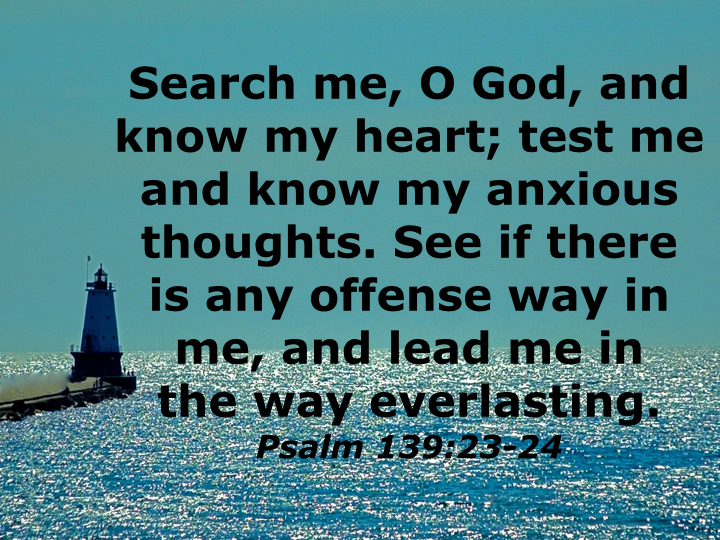
Search me, God, and know my heart; test me and know my anxious thoughts. See if there is any offensive way in me, and lead me in the way everlasting.

I will be continuing my series on the Holy Spirit as our Counselor this Sunday. If you are in the Cedar Springs area, please come join us!

Links & Quotes

link quote

Parents: you need to keep up to speed with the texting shorthand your children are using. Stay informed and stay involved! Here is a very helpful article on texting acronyms.

“We do not grow in grace and the knowledge of Christ by leaps and bounds but some try. They bounce from one mountain peak of Christian experience to another. Every year or so they make a new start, turn a new leaf, have a new thrill. Children do not grow by suddenly gaining a few inches or adding a few pounds now and then. They grow gradually, daily, by food, rest, and exercise. Christian growth comes the same way by feeding on the Word, resting in the Lord, and exercising unto godliness. It has been said that nothing is more detrimental to Christian experience than too many Christian ‘experiences.’” —Vance Havner

[VIDEO] For all the high school and college graduates, Kid President has some great advice for you—

Poetry Saturday—Failure Doesn’t Mean

Pray = LiveLord, are You trying to tell me something? For…
Failure does not mean I’m a failure;
     It does mean I have not yet succeeded.
Failure does not mean I have accomplished nothing;
     It does mean I have learned something.
Failure does not mean I have been a fool;
     It does mean I had enough faith to experiment.
Failure does not mean I’ve been disgraced;
     It does mean I dared to try.
Failure does not mean I don’t have it;
     It does mean I have to do something in a different way.
Failure does not mean I am inferior;
     It does mean I am not perfect.
Failure does not mean I’ve wasted my time;
     It does mean I have an excuse to start over.
Failure does not mean I should give up;
     It does mean I must try harder.
Failure does not mean I’ll never make it;
     It does mean I need more patience.
Failure does not mean You have abandoned me;
     It does mean You must have a better idea. Amen. —Anonymous

12 Quotes From “Rise”

RiseTrip Lee has given parents, teachers and anyone who mentors teens and 20-somethings an excellent resource in his book Rise. I read this book for myself, and now I’m reading it and discussing it with my teenage son. You can read my full book review by clicking here. Below are just a few of the quotes I especially appreciated in Rise.

“There are great benefits to living for Jesus in the present. Now is the time when we have the most strength. Now is the time when we have the most energy. Now is the time when we can give it everything we have. Now is the time to get up and live.”

“Every decision we make is a small piece of a larger puzzle. And without looking at the big picture for reference, we’ll place the pieces incorrectly every time. It’s tragic to treasure a moment in time more than an entire lifetime.”

“It’s loving of me to stop my son when he tries to put his finger in a socket or put a penny in his mouth. It’s loving of Jesus to tell me to say no to myself when I’m doing the wrong thing. … Let’s be clear, though. He’s not saying you can’t be yourself. He’s not calling you to ignore your personality and abandon your interests. Instead, He’s saying, ‘Submit all those things to Me.’ Your personality and your interests are His, and following Him shapes those things to bring you joy and bring God glory.” 

“One of our problems is that we think we belong to ourselves. Our assumption is that we are the masters of our lives and we get to make all the big decisions. That’s a myth. I belong to God. First, because He created me (Psalm 139:13), and second, because He purchased me (1 Corinthians 6:19-20). And that has serious implications for how I invest each hour of my day. I don’t have the right to rob God of time.”

“We allow our desire for approval to push us in directions we wouldn’t go otherwise. The answer is to be more content with the acceptance of Jesus, while praying that God would make us more passionate about pleasing Him than pleasing other people. … One of the quickest ways to ensure compromise is to obsess over what other people think of you.”

“Confession of sin can only be perceived as your enemy if you have a goal other than God’s glory. If your goal is your glory, then confessing your sin works against that goal and therefore should be avoided. But if you’re living for the glory of God, confessing your sin to the right people will only help.”

“With Christians or non-Christians, when we pretend, we are using them instead of loving them. Instead of saying or doing what would be most beneficial for them, we say or do what makes us look good. We’re using them to get to that end goal, the magical feeling of acceptance and approval, that sweet ego stroke. And that will eventually crush us and crush them.”

“The mature Christian doesn’t just ask, ‘What can I do?’ but ‘What can I do to glorify God?’”

“A Christian’s job is to live in such a way that shows off the real Jesus, the all-powerful, Almighty, sinner-loving King of the universe.”

“One of the reasons we struggle is because we forget that Jesus is the Lord of all. When I say Lord of all, I don’t just mean Lord of all people; I mean Lord of all things and spheres of life. It’s easy for us to section off our lives into little quadrants. There’s the fun stuff, the family stuff, the boring stuff, and the spiritual stuff. But the Bible doesn’t recognize any area of our lives that’s not spiritual. God made every sphere of life, He rules over every sphere of life, and He can be glorified in every sphere of life. This means everything is sacred.”

“The symptom of an encounter with the compassion of Jesus is compassion for others.”

“People go to hell because they haven’t seen the glory of God in the Gospel and trusted in Christ. Seeing the glory of God matters, and we want them to see it. Where the glorious light of Christ is not seen, sins are not forgiven and souls are not saved. This is why we share the Good News. The end goal of evangelism is that people would see the glory of God and worship Him forever.”

17 Final Quotes From “Not Knowing Where”

Not Knowing WhereI’ve been sharing some of the amazing quotes from Oswald Chambers’ book Not Knowing Where. Here is the last set of quotes from this book.

“The natural life is not spiritual, it can only be made spiritual by deliberately casting it out and making it the slave instead of the ruler. … Jesus Christ cannot give me a meek and quiet spirit, I have to take His yoke upon me; that is, I have to deliberately discipline myself. … If we do not resolutely cast out the natural, the supernatural can never become natural in us.”

“Remember, Abraham had to offer up Ishmael before he offered up Isaac. Some of us are trying to offer spiritual sacrifices before we have sacrificed the natural. The only way we can offer a spiritual sacrifice to God is to do what He tells us to do, discipline what He tells us to discipline.”

“Common sense is not faith and faith is not common sense; they stand in the relation of Ishmael and Isaac, of the natural and spiritual, of individuality and personality, of impulse and inspiration. Faith in antagonism to common sense is fanaticism, and common sense in antagonism to faith is rationalism. The life of faith brings the two into right relationship.”

“We have the idea that the body, individuality, and the natural life are altogether of the devil; they are not, they are all of God, designed by God, and it is in the human body and in the natural order of things that we have to exhibit our worship of God. The danger is to mistake the natural for the spiritual, and instead of worshiping God in my natural life to make my natural life God.”

“How am I going to find out what the will of God is? In one way only, by not trying to find out. If you are born again of the Spirit of God, you are the will of God, and your ordinary common sense decisions are God’s will for you unless He gives an inner check. When He does, call a halt immediately and wait on Him. Be renewed in the spirit of your mind that you may make out His will, not in your mind, but in practical living. God’s will in my common sense life is not for me to accept conditions and say—‘Oh well, it is the will of God,’ but to apprehend them for Him, and that means conflict, and it is of God that we conflict. Doing the will of God is an active thing in my common sense life.”

“As Abimelech rebuked Abraham when he was in the wrong (see Genesis 20), and Abraham in his turn rebuked Abimelech, so in the same way the children of men from time to time rebuke the children of God, and the children of God rebuke the politics of natural men. Compromise with each other or unity between them is immoral. Arbitration until He comes Whose right it is to reign is the God-ordained program.”

“The very nature of faith is that it must be tried; faith untried is only ideally real, not actually real. Faith is not rational, therefore it cannot be worked out on the basis of logical reason; it can only be worked out on the implicit line of living obedience.”

“God does not further our spiritual life in spite of our circumstances, but in and by our circumstances.”

“To say ‘Here I am’ when God speaks, is only possible if we are in His presence, in the place where we can obey.” 

“God never fits His Word to suit me; He fits me to suit His Word.”

“True faith does not so much take God at His Word as take the Word of God as it is, in the face of all difficulties, and act upon it, with no attempt to explain or expounded.”

“The path to God is never the same as the path of God. When I am going on with God in His path, I do not understand, but God does; therefore I understand God, not His path.”

“Christ died in the stead of me. I, a guilty sinner, can never get right with God, it is impossible. I can only be brought into union with God by identification with the One Who died in my stead. No sinner can get right with God on any other ground than the ground that Christ died in his stead, not instead of him.” 

“The maturity of character before God is the personal channel through which He can bless others. If it takes all our lifetime before God can put us right, then others are going to be impoverished.”

“The genius of the Spirit of God is to make us pilgrims, consequently there is the continual un-at-home-ness in this world (cf. Philippians 3:20).”

“It is impossible for a saint, no matter what his experience, to keep right with God if he will not take the trouble to spend time with God. In order to keep the mind and heart awake to God’s high ideals you have to keep coming back again and again to the primal source.”

“Bitterness and cynicism are born of broken gods; bitterness is an indication that somewhere in my life I have belittled the true God and made a god of human perfection.”

You can read other quotes I’ve shared from Not Knowing Where by clicking here, here, and here.

And my book review of Not Knowing Where is here.