Don’t Misuse God’s Name

Representing God's nameYou’ve heard the old nursery rhyme: Sticks and stones may break my bones but words will never hurt me. We all know this isn’t true: words do hurt, and names that people call us may leave lasting wounds.

Words and names are important to God. God used His word to create the universe (God said, “Let there by light”); Jesus was called The Word (see John 1:1); God has named people and even renamed them to reflect their character or destiny.

The most important name of all is God’s own name, so the Third Commandment says, “You shall not misuse the name of the LORD your God…” (Exodus 20:7). How can we misuse God’s name? There are five ways—

(1) As emptiness or nothingness

  • Are our words empty? Do we use filler phrases like “Oh my God!” that neither talk to Jehovah or about Jehovah? We shouldn’t use God’s name unless we’re talking to Him or about Him in a respectful way.

(2) In vanity

  • In reality this means calling ourselves a Christian, but speaking in an un-Christlike way.
  • “Giving God a ‘bad name’ might diminish or demolish people’s belief, respect, and awe for God, a tragedy for a world that needs holiness. … It is a major responsibility to represent God; one which should not be taken lightly.” —Dr. Laura Schlessinger

(3) Being insincere

  • Are our promises empty, or is our word our bond? If we have to use phrases like “I swear to God that I will…” then that means we cannot be trusted on our own merits. When we claim to be Christians but cannot be trusted, we undermine the trustworthiness of God in the minds of other people.
  • “The godly man, therefore, will make promises cautiously but keep them conscientiously once they are made, knowing that irresponsibility and unreliability here are great and grievous sins.” —J.I. Packer
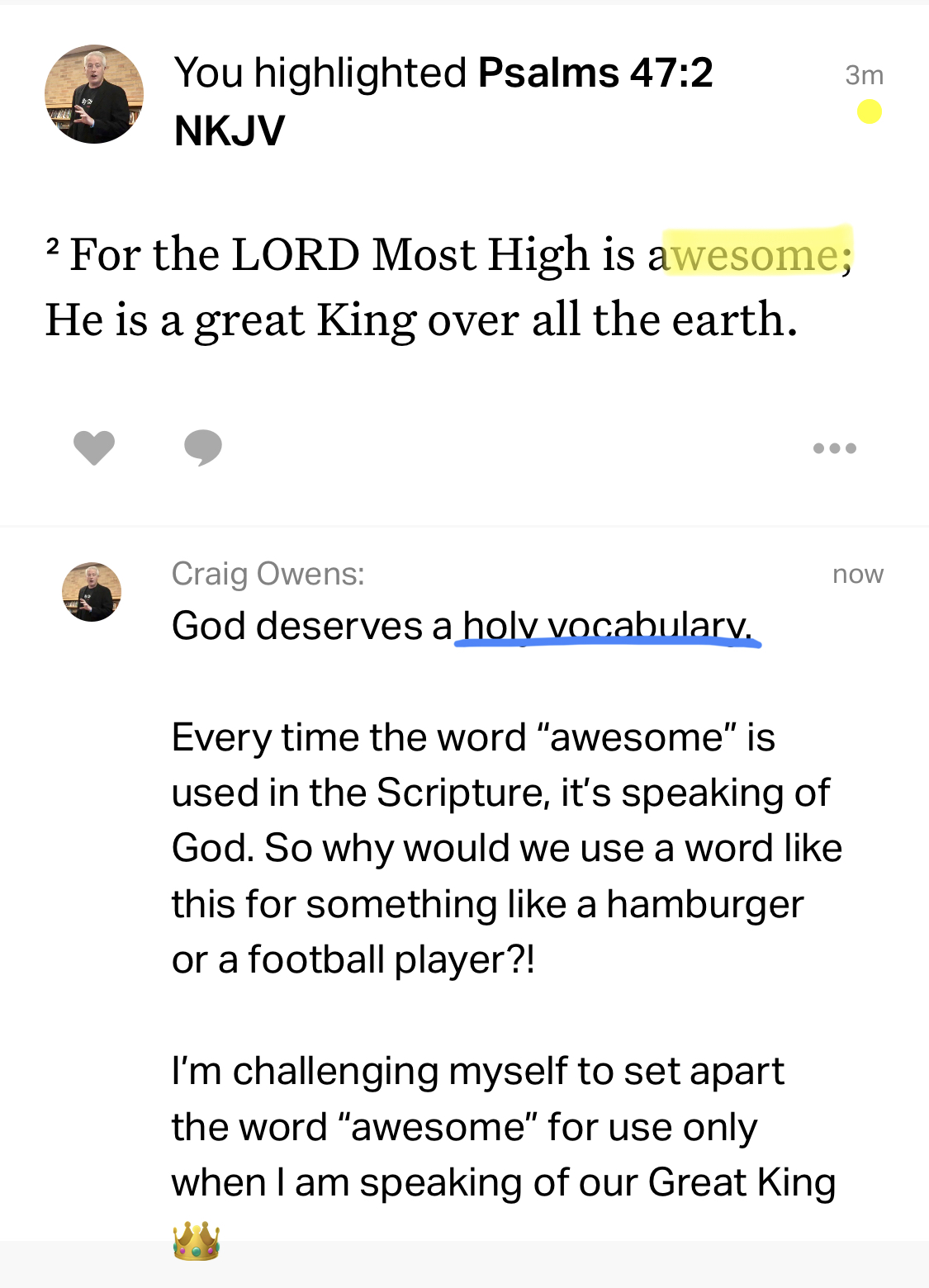
(4) Having an unholy vocabulary

  • Holy means something set apart for a special use. Perhaps there are words we use to describe God that we are also using for lesser things. It might be good to listen to how the Holy Spirit would challenge us to have a unique vocabulary to talk to or about our unique God.

(5) Worthlessness of conduct

  • As the cliche goes, “What you do speaks so loudly that I cannot hear what you are saying.” So we need to make sure that we both talk like Jesus talked and live like Jesus lived.

Anything less than these standards just may be misusing God’s holy name and character by misrepresenting Him or giving Him a “bad name.” What do you think?

If you have missed any of the messages in our series The Love In The Law, you can find them all by clicking here.

Links & Quotes

link quote

Some good reading & watching from this weekend…

“A leader’s role is to raise people’s aspirations for what they can become and to release their energies so they will try to get there.” —David Gergen

A powerful reminder about noticing the overlooked people: My Grocery Store Stripper.

This is so repulsive! 10 quotes that reveal how profitable abortion is.

I am a big believer in studying history. Here are 7 ways Christian history benefits you.

A great post for married couples and parents from Pastor Dave Barringer—Too Busy: The Art Of Abusing With Neglect.

I love this life-affirming message in OneRepublic’s song I Lived

“Mercy, King, Mercy!”

C.H. SpurgeonI love this passage from one of Charles Spurgeon’s sermons—

“Edward the Second, one of our kings, was exceedingly enraged against one of his courtiers; out hunting one day, he threatened the courtier with the severest punishment. There was a river between them at the time, and the courtier thinking that he was perfectly safe, ventured to offer some jeering remark against the king—telling him that at any rate he would not be likely to chastise him until he got at him. The king, feeling his anger hot within him, told him that the water should not long divide them, leaped into the middle of the stream, and with some difficulty gained the other side.

“The courtier in great alarm fled in terror, and the king pursued him with might and main, spurring his horse to the utmost. Nor did his anger cease; he carried his drawn sword in his hand with the intention of killing him. At last the courtier, seeing that there was no hope for any escape, knelt down upon the grass, and laying bare his neck, said, ‘I heartily deserve to die; mercy, King, mercy!’ The king sent back the sword into the scabbard in a moment, and said, ‘Whilst you sought to escape me I determined to destroy you, but when I see you humble at my feet I freely forgive you.’

“Even so it is with the King of heaven. Sinners, you say there is this life between you and God; but how soon will the white horse of Justice pass the stream, and then, flee as you may today, He will surely overtake you. He now is swift to destroy; let it be yours on your knees to make confession of your sin and say, ‘I deserve Thy wrath, great King;’ and if to this you are enabled to add the plea of the precious blood of Christ, the sword of justice will return into its scabbard, and He will say, ‘I am just, and yet the justifier of the ungodly.’”

Smashing Idols

Puny idolsWhen looking at God’s commandments, we must look at them through a lens of love. If God—the Lawgiver—is love, then all of His laws must be saturated in His love.

So what happens when we look at the Second Commandment through this lens? The wording is simple: “You shall not make for yourself an idol…” (Exodus 20:4-6). If the First Commandment says, “I love you so much that I want to be the One and Only God you have a relationship with” then the Second Commandment says, “Because of this loving relationship, don’t try to make Me smaller to fit your worldview, but let Me by fully Me!

This idolatry starts in our minds, long before we ever create anything with our hands. Idolatry is a mental state that says, “I can define the Creator. I can figure out all of His dimensions. I can predict what He’s going to do. God operates just as I expect Him to.”

But God says, “My thoughts are nothing like your thoughts. And My ways are far beyond anything you could imagine” (Isaiah 55:8).

The Apostle Paul warned us of exchanging God’s uncontainable glory and majesty for something that we can neatly contain in our box: …they exchanged the glory of the immortal God for images … they exchanged the truth of God for a lie, and worshiped and served created things rather than the Creator… (Romans 1:21-25).

William Barclay offers this commentary about the flimsiness of idols: “In Greek the word idol has in it the sense of unreality. Plato used it for the illusions of this world as opposed to the unchangeable realities of eternity.” Our puny thoughts about God can create the idols that keep us from the reality of God. 

So how do we avoid this idolatry? Quite simply: we smash every mental idol!

…We refute arguments and theories and reasonings and every proud and lofty thing that sets itself up against the true knowledge of God; and we lead every thought and purpose away captive into the obedience of Christ… (2 Corinthians 10:5).

So… what idols do you need to smash?

If you have missed any of the messages in our series The Love In The Law, you can find them all by clicking here.

12 Quotes From “The Love Of God”

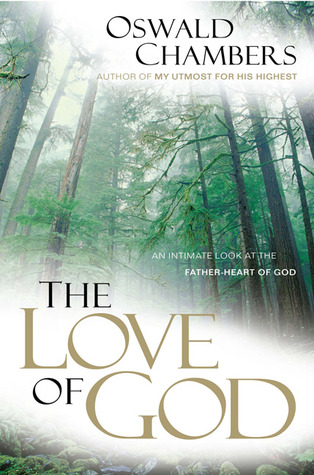
The Love Of GodOswald Chambers has a way of writing about biblical truths that satisfy both the head and the heart. You can read my review of Chambers’ book The Love Of God by clicking here. Below are just a few of the many, many quotes I highlighted in this amazing book.

“In the future, when trial and difficulties await you, do not be fearful, whatever and whoever you may lose faith in, let not this faith slip from you—God is Love; whisper it not only to your heart in its hour of darkness, but here in your corner of God’s earth and man’s great city, live in the belief of it; preach it by your sweetened, chastened, happy life; sing it in consecrated moments of peaceful joy, sing until the world around you ‘is wrought to sympathy with hopes and fears it heeded not.’ The world does not bid you sing, but God does. Song is the sign of an unburdened heart; then sing your songs of love unbidden, ever rising higher and higher into a fuller conception of the greatest, grandest fact on the stage of Time—God is Love.”

“God did not create man as a puppet to please a despotic idea of His own, He created us out of the superabundant flow of overflowing love and goodness, He created us susceptible of all the blessedness which He had ordained for us.”

“Drink deep and full of the love of God and you will not demand the impossible from earth’s loves, and the love of wife and child, of husband and friend, will grow holier and healthier and simpler and grander.”

“Love is difficult to define, but the working definition I would like to give is that ‘Love is the sovereign preference of my person for another person, embracing everyone and everything in that preference.’”

“The majority of us are unnoticed and unnoticeable people. If we take the extraordinary experience as a model for the Christian life, we erect a wrong standard without knowing it.” 

“God will use any number of extraordinary things to chisel the detail of His ‘lily work’ in His children. He will use people who are like hedgehogs, He will use difficult circumstances, the weather; He will use anything and everything, no matter what it is, and we shall always know when God is at work because He produces in the commonplace something that is inspiring.”

“A Christian is one in whom the indwelling Spirit of God shines out all the time.”

“Our Lord did not say to His disciples: ‘I have had a most successful time on earth, I have addressed thousands of people and been the means of their salvation; now you go and do the same kind of thing.’ He said: ‘If I then, your Lord and Master, have washed your feet; you also ought to wash one another’s feet.’ We try to get out of it by washing the feet of those who are not of our own set. We will wash the heathen’s feet, the feet in the slums; but fancy washing my brother’s feet! my wife’s! my husband’s! the feet of the minister of my church! Our Lord said one another’s feet. It is in the ordinary commonplace circumstances that the unconscious light of God is seen.”

“The reason we are going through the things we are is that God wants to know whether He can make us good bread with which to feed others. The stuff of our lives, not simply of our talk, is to be the nutriment of those who know us. … It is in the solitary life that we prove whether we are willing to be made the unadvertised life for the community to which we belong—whether we are willing to be made bread or to be simply the advertisement for bread? If we are to be made bread, then we must not be surprised if we are treated in the way Our Lord was treated.”

“For a man to lay down his life is not to lay it down in a sudden crisis, such as death, but to lay it down in deliberate expenditure as one would lay out a pound note. Not—‘Here it is, take it out in one huge martyrdom and be done with it.’ It is a continual substitution whereby we realize that we have another day to spend out for Jesus Christ, another opportunity to prove ourselves His friends.”

“The test of spiritual life is the power to descend; if we have power to rise only, there is something wrong. … Spiritual selfishness makes us want to stay on the mount; we feel so good, as if we could do anything—talk like angels and live like angels, if only we could stay there. But there must be the power to descend; the mountain is not the place for us to live, we were built for the valleys. … We never live for the glory of God on the mount, we see His glory there, but we do not live for His glory there; it is in the valley that we live for the glory of God. … The reason we have to live in the valley is that the majority of people live there, and if we are to be of use to God in the world we must be useful from God’s standpoint, not from our own standpoint or the standpoint of other people. … As disciples of Jesus we have to learn not only what Our Lord is like on the Mount of Transfiguration, but what He is like in the valley of humiliation, where everything is giving the lie to His power, where the disciples are powerless, and where He is not doing anything.”

“We shall find that the spheres God brings us into are not meant to teach us something but to make us something.”

10 Quotes From “The Furious Longing Of God”

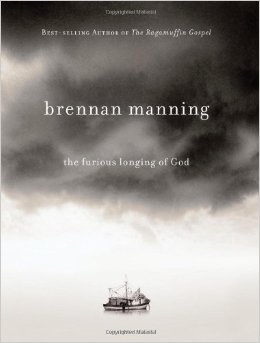
Furious Longing Of GodI love the way Brennan Manning writes! It’s so gut-level real. His words both convict me and encourage me to go deeper into God’s love. You can read my full book review of The Furious Longing Of God by clicking here. Below are some of the quotes I especially appreciated.

“The God I’ve come to know by sheer grace, the Jesus I met in the grounds of my own self, has furiously loved me regardless of my state—grace or disgrace. And why? For His love is never, never, never based on our performance, never conditioned by our moods—of elation or depression. The furious love of God knows no shadow of alteration or change. It is reliable. And always tender.”

“The foundation of the furious longing of God is the Father who is the originating Lover, the Son who is the full self-expression of that Love, and the Spirit who is the original and inexhaustible activity of that Love, drawing the created universe into itself.”

“Pagan philosophers such as Aristotle arrived at the existence of God via human reason and referred to Him in vague, impersonal terms: the uncaused cause, the immovable mover. The prophets of Israel revealed the God of Abraham, Isaac, and Jacob in a warmer, more compassionate manner. But only Jesus revealed to an astonished Jewish community that God is truly Father.” 

“The degree of Abba’s love for me is in direct proportion to His love for Jesus. For example, I can love the mailman with twenty percent and my best friend with ninety percent. But with God, there is no division, no more and no less. God loves me as much as He loves Jesus. Wow!”

“First, if we continue to picture God as a small-minded bookkeeper, a niggling customs officer rifling through our moral suitcase, as a policeman with a club who is going to bat us over the head every time we stumble and fall, or as a whimsical, capricious, and cantankerous thief who delights in raining on our parade and stealing our joy, we flatly deny what John writes in his first letter (4:16)—‘God is love.’ In human beings, love is a quality, a high-prized virtue; in God, love is His identity. Secondly, if we continue to view ourselves as moral lepers and spiritual failures, if our lives are shadowed by low self-esteem, shame, remorse, unhealthy guilt, and self-hatred, we reject the teaching of Jesus and cling to our negative self-image.”

“Healing becomes the opportunity to pass off to another human being what I have received from the Lord Jesus; namely His unconditional acceptance of me as I am, not as I should be. He loves me whether in a state of grace or disgrace, whether I live up to the lofty expectations of His gospel or I don’t. He comes to me where I live and loves me as I am.”

“To affirm a person is to see the good in them that they cannot see in themselves and to repeat it in spite of appearances to the contrary.”

“Jesus said the world is going to recognize you as His by only one sign: the way you are with one another on the street every day. You are going to leave people feeling a little better or a little worse. You’re going to affirm them or deprive them, but there’ll be no neutral exchange.”

“The question is not can we heal? The question, the only question, is will we let the healing power of the risen Jesus flow through us to reach and touch others, so that they may dream and fight and bear and run where the brave dare not go?” 

“How is it then that we’ve come to imagine that Christianity consists primarily in what we do for God? How has this come to be the good news of Jesus? Is the kingdom that He proclaimed to be nothing more than a community of men and women who go to church on Sunday, take an annual spiritual retreat, read their Bibles every now and then, vigorously oppose abortion, don’t watch x-rated movies, never use vulgar language, smile a lot, hold doors open for people, root for the favorite team, and get along with everybody? Is that why Jesus went through the bleak and bloody horror of Calvary? Is that why He emerged in shattering glory from the tomb? Is that why He poured out His Holy Spirit on the church? To make nicer men and women with better morals? The gospel is absurd and the life of Jesus is meaningless unless we believe that He lived, died, and rose again with but one purpose in mind: to make brand-new creations. Not to make people with better morals, but to create a community of prophets and professional lovers, men and women who would surrender to the mystery of the fire of the Spirit that burns within, who would live in ever greater fidelity to the omnipresent Word of God, who would enter into the center of it all, the very heart and mystery of Christ, into the center of the flame that consumes, purifies, and sets everything aglow with peace, joy, boldness, and extravagant, furious love.”

Loving Obedience

Love and obeySuppose you had to do a secret project on a remote island. In fact, the island is so remote that it doesn’t even have a name or show up on a map. I am your only point of contact, and the only one with the latitude and longitude coordinates to come get you. You have a satellite phone to use. If I truly cared about you, I would give you the precise sequence of digits to reach me. If I didn’t care about you, I’d let you call any number you wanted to call: perhaps you would eventually reach someone who could help you.

The most loving thing I could do for you is to make sure you knew the one number to call in order to get the help you needed. 

This is exactly how God starts the Ten CommandmentsAnd God spoke all these words: “I am the LORD your God, who brought you out of Egypt, out of the land of slavery. You shall have no other gods before Me.”

How confusing and utterly unloving it would be if God said, “Call any number you want to see if you can find the help you need.” Instead, in His great love for us God says, “I am the only One you will ever need!”

Notice the wording here: “…I am the LORD your God…”

  • I AM—all that you need.
  • the—not one among many, but the One and Only.
  • LORD—God’s covenant name: Jehovah, His name of personal relationship.
  • your—this is a you-Me relationship, not a you-it relationship.
  • God—the All-Powerful, All-Loving One.

This First Commandment is the orientating commandment. When we see all of God’s commandments are rooted in His love (by the way, God uses the phrase the LORD your God five times in the Ten Commandments), everything else in our lives and attitudes is properly aligned.

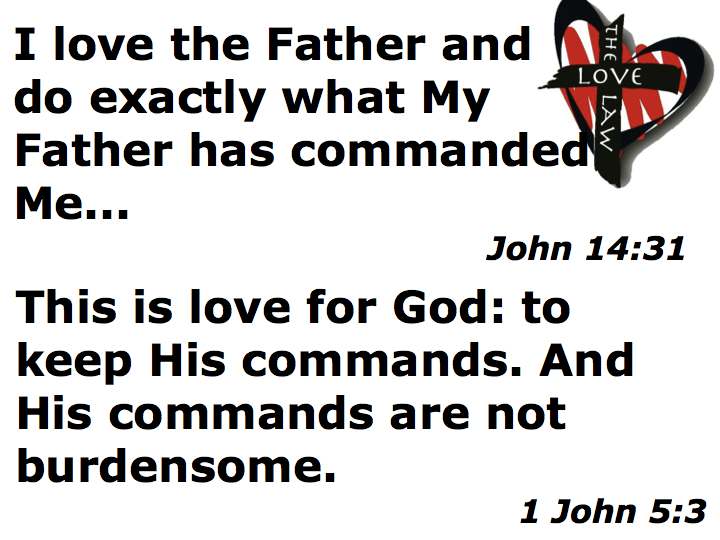
Jesus demonstrated this for us. He said He loved His Father and therefore obeyed all of His commands (John 14:31). Christ’s obedience was motivated and aligned by love. The Apostle John said this loving obedience is to be the distinguishing characteristic for us too:

This is love for God: to keep His commands. And His commands are not burdensome. (1 John 5:3)

We honor God and obey the First Commandment best when we know He is the One Who loves us enough to say, “I am the only One you need. Don’t look to anyone or anything else, but just come to Me!”

If you have missed any of the messages in our series The Love In The Law, you can find them all by clicking here.
Links & Quotes

link quote

Some good reading & watching from this weekend…

“Godly men do expel the aerial powers, ejecting them from their possession by exorcisms, not by pacification: and they break their temptations by prayer not unto them but unto God against them. For the devils neither conquer nor chain any man but by the fellowship of sin. And so His name that took on Him humanity and lived without sin, confounds them utterly.” —Augustine

[VIDEO] John Maxwell talks to us about how to handle pressure.

“What we need is a zealous hunger for God, an avid thirst after righteousness, a pain-filled longing to be Christlike and holy. We need a zeal that is loving, self-effacing and lowly.” —A.W. Tozer

Yummy: 10 foods to lower bad cholesterol.

[VIDEO] Another great tribute to Derek Jeter.

Grateful that the Kurds are standing up to ISIS and defending Christian.

More evidence that so-called “climate change” is more hype than substance, as an actor (not a scientist) is appointed by the United Nations as their representative.

“I saw regenerate souls among the Baptists, among the Presbyterians, among the Independents, and among the church folks—all children of God, and yet all born again in a different way.” —George Whitefield, during his 1740 trip to America

Links & Quotes

link quote

Some good reading & watching from today…

[VIDEO] John Maxwell has a good reminder about envy.

Watch human nature; we are so built that if we do not get thrilled in the right way, we will get thrilled in the wrong. If we are without the thrill of communion with God, we will try to get thrilled by the devil, or by some concoction of human ingenuity.” —Oswald Chambers

The study ‘provides the best evidence to date that fMRI can be used to identify consciousness in vegetative patients,’ says Russell Poldrack, a cognitive neuroscientist at Stanford University.” An amazing study that proves that vegetative patients are fully aware of their surroundings.

I am a big fan of The Overview Bible Project’s work. This is a great case study on Melchizedek.

Monergism has lots of free ebooks for you… go get ’em!

“The Gospel can be summed up by saying that it is the tremendous, tender, compassionate, gentle, extraordinary, explosive, revolutionary revelation of Christ’s love.” —Catherine de Hueck Doherty

Links & Quotes

link quote

Some good reading & watching from today…

“The true measure of ministry effectiveness is the extent to which we are able to lead God’s people into greater love for Him and His Kingdom.” —T.M. Moore

“Tragedy is that our attention centers on what people are not, rather than on what they are and who they might become.” —Brennan Manning

“The most terrible poverty is loneliness and the feeling of being unloved.” —Mother Teresa

“Holiness is not the luxury of the few; it is a simple duty, for you and for me.” —Mother Teresa

The devil does not need to bother about us as long as we remain ignorant of the way God has made us and refuse to discipline ourselves; inattention and our own slovenliness will soon run away with every power we have.” —Oswald Chambers 

“There is something which we can do which God does. He does good to all His creatures, and we can do good also. He bears witness to His Son Jesus, and we can bear witness too.” —Charles Spurgeon

[VIDEO] Ken Davis always cracks me up. Check out this clip Arm Vs. Airbag.

Why do people get so annoyed over anything that looks “religious” to them. For people who claim God doesn’t exist, atheists get awfully mad at Him!