“When the Lord chose His twelve disciples, it was ‘that they might be with Him and that He might send them out to preach’ (Mark 3:14). A life in fellowship with Him prepared them for the work of preaching. …
“The law of their first calling remained unchanged: their unbroken fellowship with Him was the secret of their power to preach and to testify of Him. …
“The same principle stands for all His servants, for all time: without the experience of His presence with us, our preaching has no power. The secret of our strength is the living testimony that Jesus Christ is every moment with us, inspiring, directing and strengthening us. …
“But remember that this power is never meant to be experienced as if it were our own. It is only as Jesus Christ as a living Person dwells and works with His divine energy in our own hearts and lives that there can be power in our preaching as a personal testimony. …
“For it’s only when His servants show in their lives that they obey Him in all His commands can they expect the fullness of His power and His presence to be with them. Only when they themselves are living witnesses to the reality of His power to save and to keep from sin can they expect to experience His abiding presence, and the power to train others to the life of obedience that He asks.
“The living experience of the presence of Jesus is an essential element in preaching the gospel. If this becomes clouded, work becomes a human effort, without the freshness and power of the heavenly life. Nothing can bring back the power and blessing but a return to the Master’s feet so that He may breathe into the heart, in divine power, His blessed word, ‘I am with you always!’” —Andrew Murray
Listen to the podcast of this post by clicking on the player below, and you can also subscribe on Apple, Spotify, or Audible.
I hope you’ve noticed so far that the parts of Christ’s model prayer that we’ve looked at so far are both an acknowledgement of the holiness of God and the greatness of His Kingdom, and also a request for us to be empowered to live in a way that makes those things known to Earthlings.
One of the ways we live to make these things seen is found in the next phrase: Your will be done on earth as it is in Heaven (Matthew 6:10).
In A Christmas Carol, Charles Dickens shows us a scene where the Ghost of Christmas Present has taken Scrooge to his nephew’s home. After dinner, these young adults begin playing games. Dickens says, “For it is good to be children sometimes, and never better than at Christmas, when its mighty Founder was a child Himself.”
Jesus loved children! Being around “the littles” lately at on our school campus, I have a whole new appreciation for this. Because Jesus loved children, their parents wanted them around Him, and He wanted them around too (see Matthew 19:13-15; Mark 10:14-16; Luke 18:15-17).
Children are loud, busy, adventurous, and easily distracted. But they are also loving, trusting, curious, innocent, and easily comforted. And Jesus loved to bless them!
What does this have to do with “Your will be done on earth as it is in Heaven”? Jesus taught us to address our praying to “Our Father.” That means we are to interact with Him as His children.
Children love to do the will of their parents. They’re not trying to earn their approval, but joyfully obeying out of innocence. When we obey God as loving children, we are doing His will on earth as it is done in Heaven!
So once again, this is both an acknowledgement and a request.
In Psalm 131, David uses this same picture of a contented child for us.
Childlike is lovingly dependent. Childish is selfishly independent. Childlike is trusting someone wiser. Childish is believing I know best.
Our prayer request should always be, “Father, may I trust You and obey You as an innocent child.”
After I wrote the best-selling book Shepherd Leadership, I started naturally gravitating toward anything shepherd related. A Shepherd Looks at Psalm 23 was the perfect fit for me! But I think anyone will enjoy these beautiful insights on Psalm 23. Check out my full book review here.
Here are some quotes that especially caught my eye—
“Sheep do not ‘just take care of themselves’ as some might suppose. They require, more than any other class of livestock, endless attention and meticulous care. … From early dawn until late at night this utterly selfless Shepherd is alert to the welfare of His flock. … Above all, He is very jealous of His name and high reputation as the Good Shepherd. He is the Owner who delights in His flock. For Him there is no greater reward, no deeper satisfaction, than that of seeing His sheep contented, well fed, safe, and flourishing under His care. This is indeed His very ‘life.’ He gives all He has to it. He literally lays Himself out for those who are His. He will go to no end of trouble and labor to supply them with the finest grazing, the richest pasturage, ample winter feed, and clean water. He will spare Himself no pains to provide shelter from storms, protection from ruthless enemies and the diseases and parasites to which sheep are so susceptible.”
“A flock that is restless, discontented, always agitated and disturbed never does well. … When one startled sheep runs in fright, a dozen others will bolt with it in blind fear, not waiting to see what frightened them.”
“In the course of time I came to realize that nothing so quieted and reassured the sheep as to see me in the field. The presence of their master and owner and protector put them at ease as nothing else could do, and this applied day and night. … When my eyes are on my Master they are not on those around me. This is the place of peace.”
“Only those intimately acquainted with sheep and their habits understand the significance of a ‘cast’ sheep or a ‘cast down’ sheep. This is an old English shepherd’s term for a sheep that has turned over on its back and cannot get up again by itself.”
“Sheep are notorious creatures of habit. If left to themselves, they will follow the same trails until they become ruts; graze the same hills until they turn to desert wastes; pollute their own ground until it is corrupt with disease and parasites. … No other class of livestock requires more careful handling, more detail direction, than do sheep.”
My Patreon supporters had early access to these quotes, plus I have shared many more quotes from this book with these friends.
My newest book When Sheep Bite is releasing soon. You can pre-order a copy for yourself here.
Mental health tip: Stop beating yourself up because of what you did or didn’t do in the past. Learn from it and keep moving forward. Check out a whole series of posts and videos on a Christian’s mental health. I have lots of new content every week, which you can check out on my YouTube channel.
“God cannot part with His grace, or goodness, or strength, as an external thing that He gives us, as He gives the raindrops from heaven. No; He can only give it, and we can only enjoy it, as He works it Himself directly and unceasingly. And the only reason that He does not work it more effectually and continuously is, that we do not let Him. We hinder Him either by our indifference or by our self-effort, so that He cannot do what He would.” —Andrew Murray, Waiting on God
The unlimited genius of our All-wise Creator is seen so clearly in the unique and beautiful design of each snowflake. Check out these amazing photographs!
“You don’t have to be a fantastic hero to do certain things—to compete. You can be just an ordinary chap, sufficiently motivated to reach challenging goals.” —Sir Edmund Hillary
Biblical archaeologist Joel Kramer takes viewers into a hidden cave to show them an ancient Christian inscription that offers direct extra-biblical, archaeological evidence for Jesus.
When I wrote my first book, my publisher asked me to write on “servant leadership,” but the more I dove into the topic, the more I kept coming back to Jesus as the ultimate example. But then I noticed that Jesus not only called Himself a shepherd, but many of the Old Testament prophecies foretelling His arrival also used shepherding terms. It was then that I pivoted to entitle my book Shepherd Leadership.
Ever since I immersed myself in the research for that book, I’ve been especially attentive to all things related to shepherding. In going through books from my Mom’s library, I stumbled upon A Shepherd Looks at Psalm 23 by Phillip Keller.
Oh my! I wish I would have discovered this amazing little book while I was writing my book! What a depth of insight I have gleaned from someone who looks after actual sheep!
As the title denotes, Keller uses the well-known Psalm 23 to give us so many eye-opening insights into our Good Shepherd. He goes phrase by phrase—“the Lord is my Shepherd,” “I shall not want,” “He makes me lie down in green pastures,” and so on—with each phrase adding a new level of intimacy with this One who cares for us so profoundly.
And as an added bonus for me, it was so sweet to see the highlights and notations my Mom had made as she read this book. This made A Shepherd Looks at Psalm 23 a double blessing for me.
(P.S. Check out some quotes I’ve shared from this book here.)
Listen to the podcast of this post by clicking on the player below, and you can also subscribe on Apple, Spotify, or Audible.
We said our protocol in approaching Almighty God in prayer is found in just two words: Our Father.
Notice the transition: your Father (3x in Matthew 6:6, 8) to Our Father (6:9). How does this happen? Jesus makes it possible and the Holy Spirit continually reminds us of Christ’s completed work (Hebrews 2:11; John 14:13-14; Romans 8:15-16).
It’s not just “our Father” but “our Father in Heaven.” Let’s remember that our Father is both All-loving and All-powerful. The phrase in Heaven reminds us of His absolute sovereignty. “Our God is in heaven; He does whatever pleases Him” (Psalm 115:3). What pleases Him? To give us His kingdom (Luke 12:32).
Then there’s another phrase that is vital: Our Father in Heaven, hallowed be Your name.
Hallowed means both to acknowledge His greatness and to keep Him separate from any profane things. What is profane? The dictionary says it is irreverence or contempt for God. The opposite of profane is holiness—something set apart exclusively for God. This is not something better than something else, but something exclusively that will bring glory to our Father in Heaven.
The root word for hallowed is “holy.” We see this literally translated in the name Holy Spirit. It is a word also referring to Jesus when He is called “the Holy One of God” (see Mark 1:24). The angel uses the word twice when he says, “The Holy Spirit will come on you, and the power of the Most High will overshadow you. So the Holy One to be born will be called the Son of God” (Luke 1:35).
And that same word translated hallowed and holy is also translated saints. Literally that means “holy ones” or set apart people.
Jesus is teaching us that our prayer is BOTH an acknowledgment of how God’s name is to be hallowed AND a request that He would empower us to pray and live in ways that makes that happen.
This means our attitude needs to be focused on God’s reputation not my reputation (as in Matthew 6:5, 7:21-23).
We hallow God’s name when our prayer and daily lifestyle bring Him the supreme glory that is due exclusively to His awesome name! When we keep our eyes and hearts on Him, He will provide everything else we need (see Matthew 6:32-33).
To follow along with all of the message in this prayer series called Kingdom Praying, please click here.
Listen to the podcast of this post by clicking on the player below, and you can also subscribe on Apple, Spotify, or Audible.
Every monarch or president on the planet has certain protocols for anyone who interacts with them. There are requirements on how to walk into the room, titles that have to be used, the way you have to act, things you can or can’t say, and the list goes on and on.
So it’s natural to think that this is how we also have to approach the Sovereign King of the Universe. But this King so desires intimate conversation with His people that Jesus gave us this simple protocol: “Our Father” (Matthew 6:9-13).
Jesus told us that He wanted us to dispense with the world’s expected protocols. He said that when we approach God, those protocols are gone. In the preceding verses, He told us that we pray…
…NOT for show or else we are called hypocrites—putting on an act or performance to earn applause or approval.
…NOT with “alien” vocabulary or else we are pagans—adopting manners that aren’t our own as a means to be accepted.
The prayers of Jesus seldom sound like our modern idea of “prayer.” Instead, they sound more like an everyday conversation when He’s talking to His Father, and the sound like commands when He’s casting out demons or healing diseases (see examples in Matthew 8:3, 13, 26, 32; John 11:40-44).
Jesus also reminded us that we pray because…
He told us to
He wants us to seek God’s Kingdom
He wants us to receive God’s Kingdom
He wants us to live in the power of God’s Kingdom every single moment
Let me repeat: our protocol for prayer is nothing like the world’s protocols for interacting with rulers. Our protocol is simply coming to our Heavenly Father in simple, childlike love and anticipation.
Kingdom praying should be as natural as talking to the most loving Father you can imagine!
Check out the others messages in our series Kingdom Prayingby clicking here.
Jesus made it clear time and time again that He came to reveal the Kingdom of God to us. He described what the Kingdom was like and told us that He came to be the means by which we could enter God’s Kingdom.
He also told us how God’s children could access the power and privileges of our Heavenly Father through the means of prayer. He assured us with words like, “Do not be afraid, little flock, for your Father has been pleased to give you the Kingdom” (Luke 12:32).
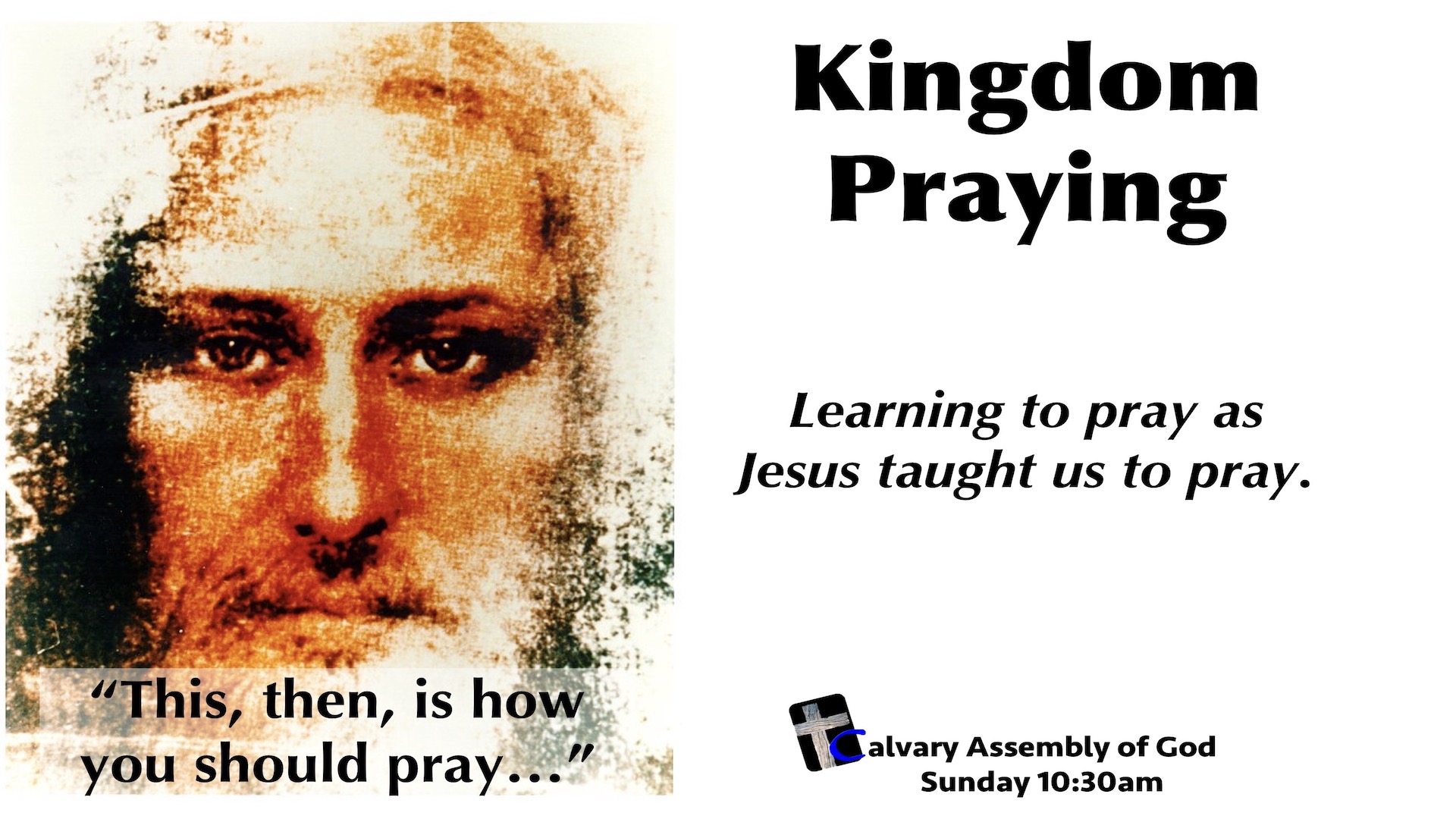
Jesus said quite simply that we had access to our Father through prayer. And then to make sure we didn’t miss out on this awesome privilege, He instructed us, “This, then, is how you should pray” (Matthew 6:8).
Please join me this Sunday as we go point-by-point through this Kingdom-accessing model prayer. We will learn just how truly expansive and all-encompassing this short prayer is.
Listen to the podcast of this post by clicking on the player below, and you can also subscribe on Apple, Spotify, or Audible.
The apostle Peter said he wrote two letters to the church “as reminders to stimulate you to wholesome thinking” (2 Peter 3:1). And Paul reminded his young friend Timothy to “keep reminding [your congregation] of these things” (2 Timothy 2:14).
In the spirit of those great apostles, I have made it a practice to take time at the end of each year to look back on all that we have learned in the previous year, and then to look forward to where God may be leading Calvary Assembly of God in this upcoming year.
Clicking on each series title will take you to a list of all of the sermons in that series.
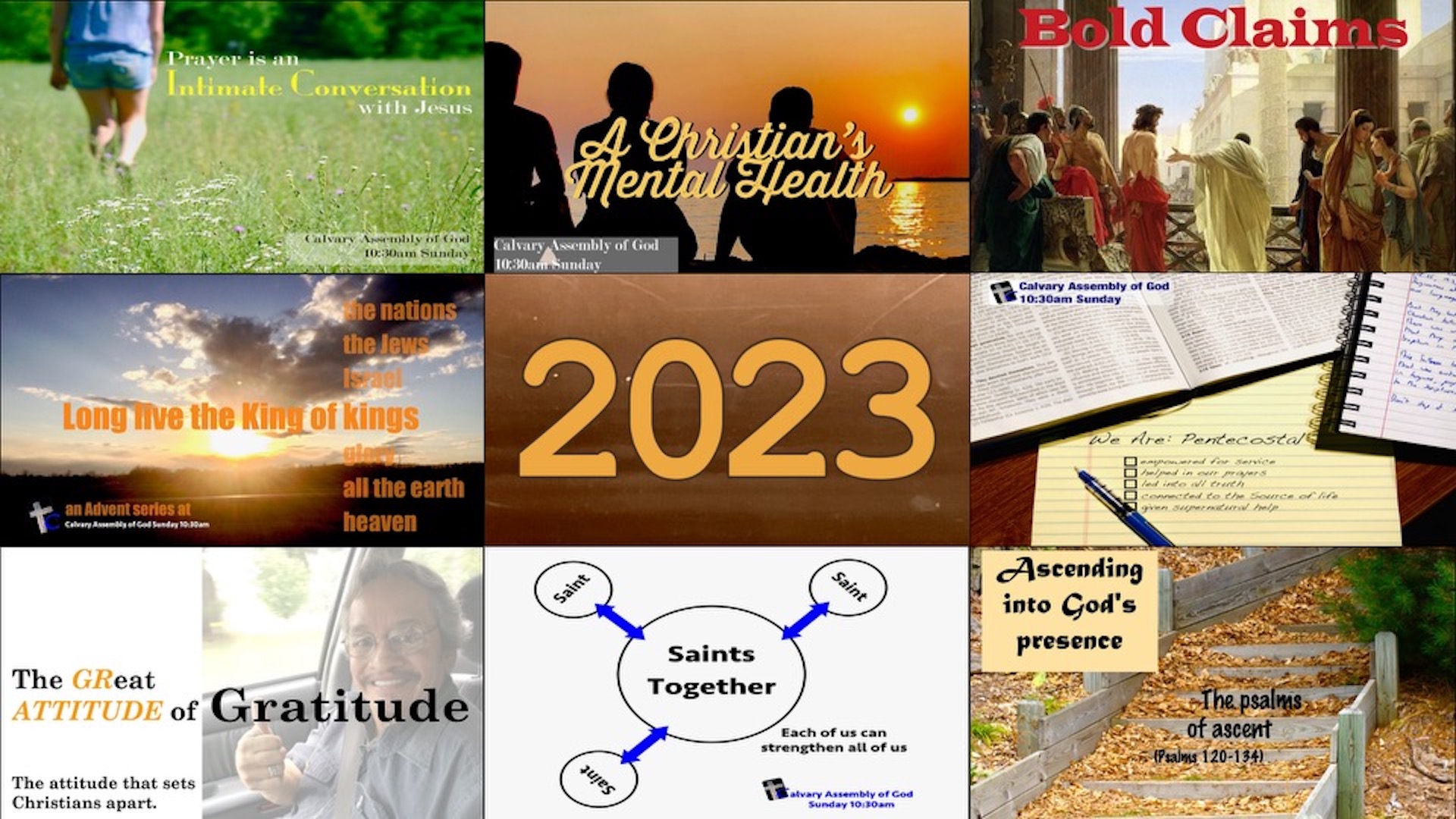
Intimate Conversation—The dictionary defines the word “intimate” with these phrases: associated in close personal relations, characterized by warm friendship, and closely personal. These words perfectly describe the relationship God wants to have with His children through prayer. Pete Briscoe said, “Prayer is an intimate conversation with the One who passionately loves you and lives in you.” The One who loves you so passionately desires to walk with you and share intimate knowledge with you. Prayer is not something formal, cold, or mechanical, but it is vibrant, warm, engaging, and life-changing.
A Christian’s Mental Health—I don’t think there is any arguing that Jesus was the healthiest individual who ever walked planet Earth. Some may want to push back with, “Of course He was because He didn’t have any problems to deal with!” But the writer of Hebrews tells us that Jesus experienced everything you and I will ever experience (Hebrews 2:17), so His deity didn’t exclude Him from the stressors that His humanity would have to face. And yet, He handled all of these things successfully. Luke the physician observed the growth of Jesus and tells us that it all began with Jesus having a robust mental health. From that foundation, everything else—physical, spiritual, relational—all could develop properly. We must learn from this example and pay careful attention to our own mental health.
Bold Claims—“That’s a pretty bold claim. Are you prepared to back that up?” I’ll bet you have heard something like that said to you, and maybe you have even said that yourself to someone else who made a big, audacious statement. After Jesus is arrested by the religious leaders—an arrest that will ultimately lead to Jesus being crucified on the Cross—there are some incredibly bold claims spoken by key people in this part of the Story. For the most part, these are claims that we don’t read earlier in any of the Gospels, but as this story is heading toward its most crucial moment, we have these audacious statements pronounced. But here’s the most important part: These bold claims weren’t just made, but they were backed up with proof as well.
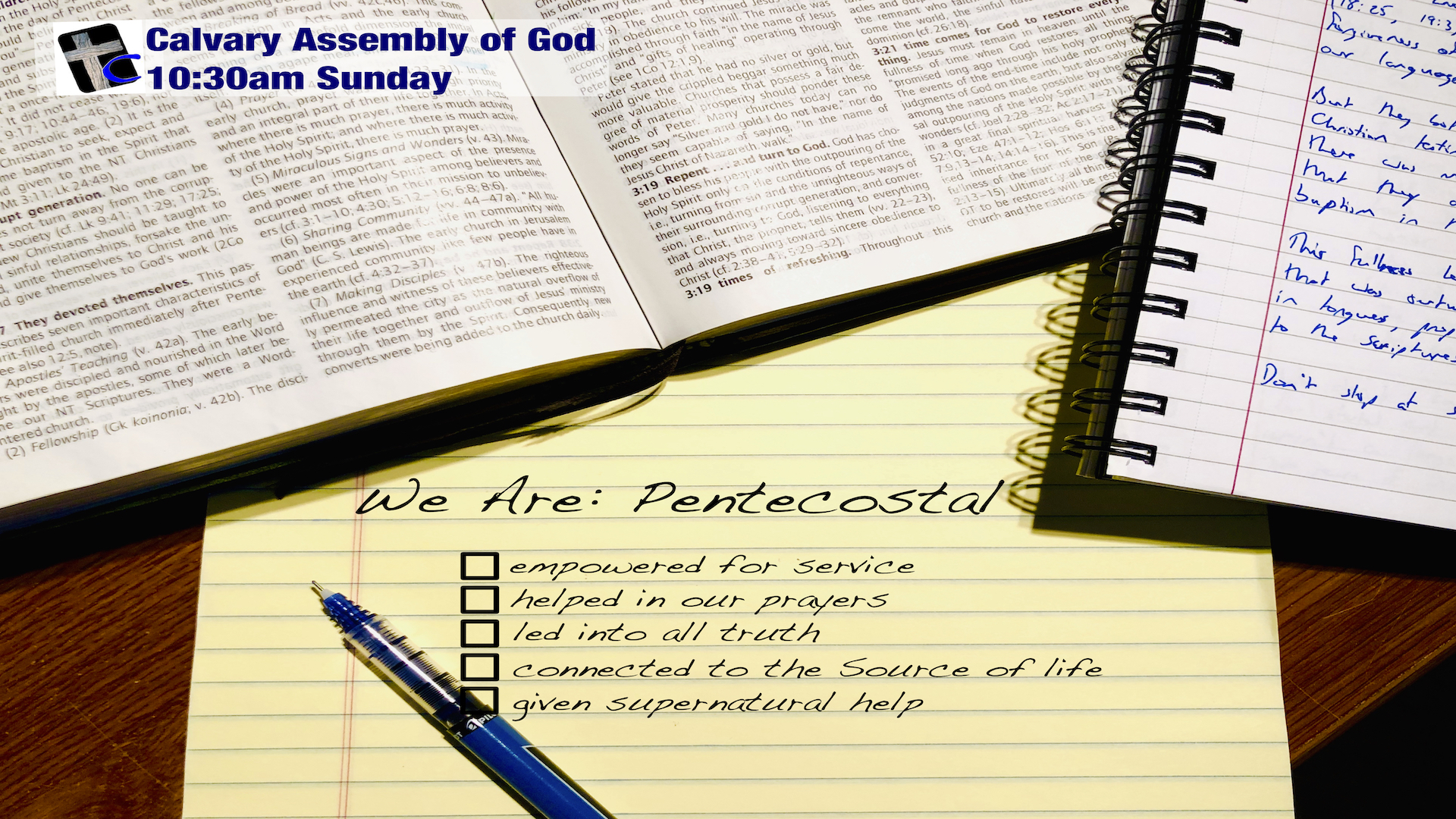
We Are: Pentecostal—Pentecost for over 1500 years was a celebration in Jerusalem that brought in Jews from all over the world. But on the Day of Pentecost that came just ten days after Jesus ascended back into heaven, the meaning of Pentecost was forever changed! Followers of Jesus—now empowered by an infilling of the Holy Spirit—began to take the good news of Jesus all over the world. These Spirit-filled Christians preached the Gospel and won converts to Christ even among hostile crowds, performed miracles and wonders, stood up to pagan priests and persecuting governmental leaders, and established a whole new way of living as Christ-followers. We, too, can be Pentecostal followers of Jesus Christ today.
Ascending—Every year, Jews from around the world made four pilgrimages up to Jerusalem for various feasts and sacrifices. These journeys reminded them of God’s goodness as they went to the Temple to worship, and they helped refocus on God’s ways as they returned to their regular routines. Jerusalem is over 2500 feet above sea level, so the pilgrimage there was a physical workout as well as a spiritual workout. These workouts were beneficial for God’s people, preparing them to minister in their cities in the following months. The Book of Psalms contains 15 songs that these pilgrims would sing to and with each other as they traveled up to Jerusalem. These Psalms of Ascent are still instructive for Christians today.
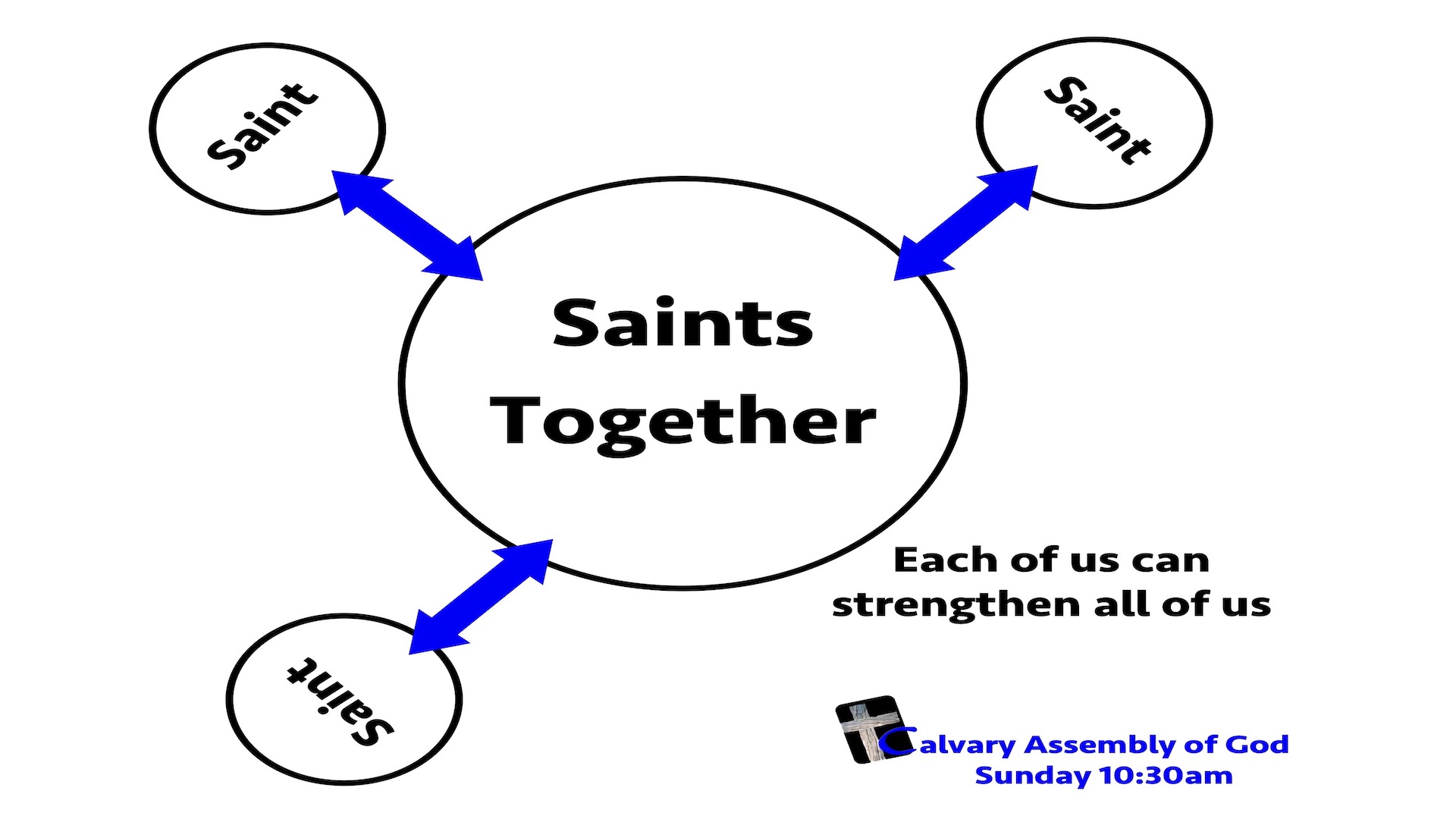
Saints Together—Throughout the New Testament the word “saints” is always in the plural form. This is a clear indication that none of us can develop into the full-fledged Christians we were meant to be on our own. We all need each other. More specifically, we all need the most mature version of each other. A key component of an individual saint’s development is the time spent alone being forged by the discipline of the Holy Spirit. Maturing saints then come together with each other to continue to strengthen and sharpen everyone in the church. Strong individual saints make a strong church, and a strong church makes strong individual saints! Let’s learn about six important spiritual disciplines that each individual saint must put into practice so that they can use their newly developed strengths to help other saints in their own development.
The Great Attitude Of Gratitude—There’s something about gratitude that distinguishes people. Think about it: would you rather hang around with grumblers or grateful people? The gratitude of Paul and Silas certainly made them stand out from the crowd when they were in Philippi. Wrongly accused, beaten, and thrown in prison, but instead of bellyaching, they were praising God. Later on, when Paul wrote his letter to the Christians in Philippi, the theme of gratefulness permeates his letter. The distinguishing mark is actually in the title: The GReat ATTITUDE spells out GRATITUDE!
Long Live The King Of Kings—Throughout human history, whenever a king died, the people would say something like, “The king is dead. Long live the king!” They would say this because the next king ascended to the throne immediately after his predecessor died. Except when a nation had been defeated, the cry, “The king is dead” was unanswered by, “Long live the king!” Israel must have felt like this. After being defeated by Nebuchadnezzar and spending 70 years in exile, it appeared to many that the line of kings was broken. Even after retuning to their homeland, Israel continued to live under the thumb of other powerful nations. And yet, some still clung to the glimmer of the promise God had made about an eternal King sitting on Jerusalem’s throne. The First Advent of Jesus revealed to us in the Gospels reassures us that the promise of an eternal King is true. Jesus came to earth to reveal His majesty to us. The First Advent is so important because it bolsters our faith for the imminent Second Advent when Jesus will return as the King of kings! Christmas is a great time to be reminded that even now we can confidently declare, “Long live the eternal King of kings!”
2024 promises to be an exciting year! If you don’t have a home church in the northern Kent County area, I would love to have you join us!
Listen to the podcast of this post by clicking on the player below, and you can also subscribe on Apple, Spotify, or Audible.
I once worked with a guy that was the epitome of “all talk and no action.” After a while people just stopped listening to him or believing anything he said. But something worse is someone who says he will do something but doesn’t have the power to finish what he started. In that case, you may have believed him and not taken any steps of your own, so when he finally admits defeat, you are totally unprepared to step in to help finish the task.
I think that comes close to the two attitudes people had prior to the First Advent of Jesus in Bethlehem. Some people thought all of God’s promises had just become “all talk and no action.”
But after Jesus began His public ministry, His skeptics may have originally thought He was also“all talk and no action,” but when they saw how the people responded to Him, they realized He at least had the power to sway a crowd. But they certainty didn’t think He could finish what He started.
The religious elite—the Sanhedrin—had their own plans in the works, and it appeared to them that Jesus was just going to get in the way. So they hatched a plan to have Pontius Pilate, the Roman governor, have Jesus crucified. As Jesus is hanging on the Cross, you can hear the skepticism and derision in the voices of these religious elite—
In the same way the chief priests, the teachers of the law and the elders mocked Him. “He saved others,” they said, “but He can’t save Himself! He’s the King of Israel! Let Him come down now from the Cross, and we will believe in Him. He trusts in God. Let God rescue Him now if He wants Him, for He said, ‘I am the Son of God.’” (Matthew 27:41-43)
After all, they had experienced “messiahs” before (Acts 5:35-37) so they thought this Jesus from Nazareth was just the next in a long line of pretenders. “King of Israel, indeed! Ha!”
But when someone tells you what they are going to do, and then they actually do it, skeptics are turned into believers. We see this happen in people like Nathaniel, a whole village of Samaritans, and one of the thieves that was crucified alongside Jesus (John 1:43-51; John 4:9-42; Luke 23:39-42)
Even though Jesus told His disciples exactly what was going to happen to Him in Jerusalem—and then it did!—they were still skeptical of the claims of His resurrection until they saw it for themselves (Matthew 20:18-19; John 20:3-8).
Skeptics need to see and hear for themselves that Jesus has the power to do what He says He will do. We are the ones that preach this Good News to them by the way we live.
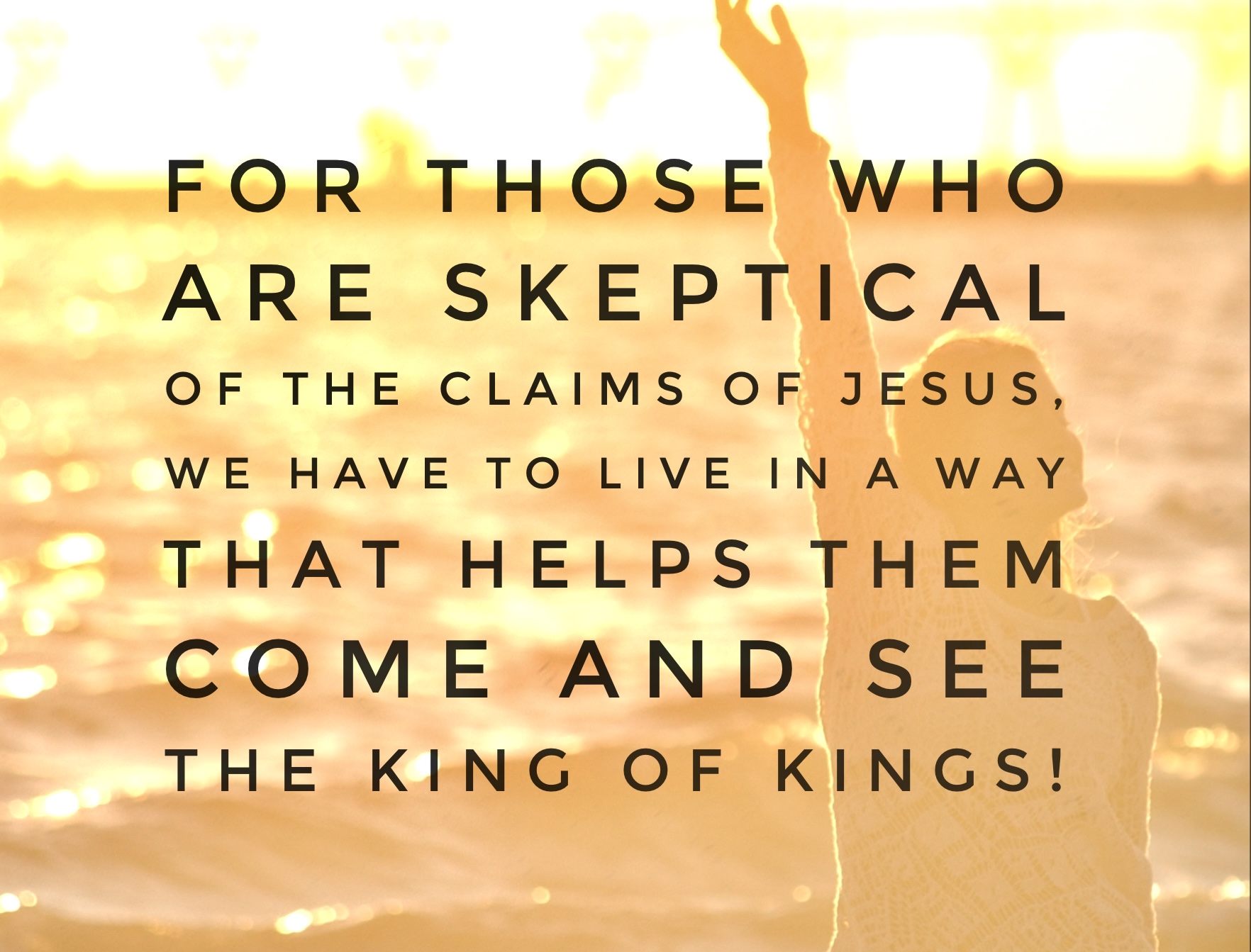
We have to live as good citizens of the King of kings so that people will “come and see” what a good and loving King He is. For those who are skeptical of the claims of Jesus the King, we have to live in a way that makes it real. We have to help them see the King of kings!
Advent isn’t just a long-ago event that we fondly remember. The First Advent is proof that God has the power to keep His word. And just as wehave seen the First Advent, so we will see the Second Advent.



 “When the Lord chose His twelve disciples, it was ‘that they might be with Him and that He might send them out to preach’ (Mark 3:14). A life in fellowship with Him prepared them for the work of preaching. …












 Craig T. Owens