“Our human minds cannot comprehend the immensity of [Christ’s] task and His sacrifice. We simply know that it was to save us, and that Jesus’ suffering is the most blessed influence the world has ever known.” —Dr. Henry Halley, Halley’s Study Bible
The Hill, though high, I covet to ascend, The Difficulty will not me offend; For I perceive the Way to life lies here. Come, pluck up Heart, let’s neither faint nor fear;
Better, though difficult, the Right Way to go,
Than wrong, though easy, where the End is Woe. —Christian in John Bunyan’s The Pilgrim’s Progress
“Nearly half the Law of God is devoted to directing God’s people in how to worship Him. And while the specific practices of that portion of God’s Law have been replaced (Hebrews 7:11-18), the emphasis on worship and the idea that worship and life are related remains. The more faithful we are in worshiping the Lord the more we will love our neighbors with the justice His Law prescribes.” —T.M. Moore
The deaths of Nadab and Abihu is a tragic story, but I think there are some important leadership insights to be gleaned from it. I shared an exclusive video with my Patreon supporters. Will you prayerfully consider joining?
Listen to the podcast of this post by clicking on the player below, and you can also subscribe on Apple, Spotify, or Audible.
“Who gave You this authority,” the chief priests twice demanded of Jesus in Luke 20:1-8.
Worldly minded people are always looking for a résumé of accomplishments or the stamp of approval from a superior, so they can demand the unquestioned loyalty from those who report to them. In other words, they are looking for authority from their position that allows them to prove to others that they are in charge.
The “chief priests and the teachers of the law, together with the elders” (v. 1) had earned their positions, or so they thought. They are, therefore, asking Jesus to, “Prove it!” They want to know why Jesus gets to say and do the things He says and does.
Jesus had every right to flex on them! But He knew that His words and deeds spoke for themselves. He “knew that the Father had put all things under His power” (John 13:3) so there was nothing for Him to prove to anyone.
In my book When Sheep Bite, I have a chapter about sheep questioning the authority of their shepherd. In that chapter I wrote—
When our conversation with criticizing sheep hasn’t gone well, and when those unhealthy sheep begin to gossip and then slander, it’s inevitable that they will eventually began to question your authority as a shepherd. Perhaps they think you’re too young and naive, or too old and out of touch. They may question your motives, or the vision you’ve imparted for the church, or your ability to follow through on what you have already shared. Whatever the case, these biting sheep seem to be implying that they know better than you do how this pasture should be run. During times like these, it is tempting to want to “prove” that we are qualified, that we do know what we’re doing, and that we can indeed successfully pursue the vision we’ve articulated for them. Once again, it’s natural to want to say, “I’ll show you just how qualified I am!”
Before we respond, we need to recognize the source of our authority. … Far greater than positional authority is moral authority. This is authority that comes not merely from a title or position, but from who conferred that title or position on the leader. If God has called us and appointed us to this pasture, that is all the authority we need.
Jesus didn’t answer the “Prove it!” demand, but went right on teaching and serving. We need to remember that there is only One to whom we must give an answer. There is only One who can say to us either, “Depart for Me,” or “Well done, good and faithful servant!”
A mark of a godly leader is one who is quietly confident of his moral authority.
As a result, that leader no longer feels the need to prove anything.
This is part 78 in my series on godly leadership. You can check out all of my posts in this series by clicking here.
Listen to the podcast of this post by clicking on the player below, and you can also subscribe on Apple, Spotify, or Audible.
A large crowd surrounded Jesus. “He welcomed them and spoke to them about the kingdom of God, and healed those who needed healing. Late in the afternoon the Twelve came to Him and said, ‘Send the crowd away so they can go to the surrounding villages and countryside and find food and lodging, because we are in a remote place here.’ He replied, ‘You give them something to eat’” (Luke 9:11-13).
Why did the crowds seek out Jesus? They came to Him because they knew He had wisdom, healing, and food for them. As disciples of Jesus, we never know when people will be around us that are in need. In fact, the closer we walk with Jesus, the more needy people will begin to gravitate toward us.
Jesus never intends that we simply give them a verbal blessing like, “Go, be filled and be warm” (James 2:16).
Jesus wants us to give them something substantial.
This means we need to both prepare and stock up ahead of time (be proactive) and we need to be sensitive to the prompting of the Holy Spirit in each encounter we have with a needy person (be reactive).
Jesus also instructed us to have available both old and new treasures to share with people around us (Matthew 13:52). The old speaks to being proactive, and the new is reactive to each thing that we are learning and experiencing.
That means I also want to leave every person better than they were before we crossed paths.
In order to do this, I have to have something substantial—something eternally significant—to give to them. When needy people show up, it is too late for me to prepare.
I want to be always ready. That means I need to be always abiding with my Savior. I need to be learning at the feet of Jesus, filled with the power of the Holy Spirit, and saturated in the love of God, so that I always have something good to give.
Jesus, when you tell me, “Give them something to eat,” I want to give them You. Help me to proactively prepare so that I am ready to react in a way that glorifies You every single time.
As we get closer to the death and resurrection of Jesus, there are an increasing number of prophecies that are fulfilled in these events. Jesus appears to have been very attentive to making sure that each and every one of these prophecies were fulfilled to the smallest detail.
Near the beginning of His public ministry, Jesus noted that not one iota—or “one jot or tittle” in the Old English vocabulary—of any of God’s promises would be left unfulfilled (Matthew 5:18). It’s amazing that Jesus so carefully attended to all of these, but it’s also important to ask ourselves what these fulfilled prophecies mean to us today.
This is what we are going to be unpacking in our series Jots and Tittles. I hope you can join us, but if you have missed any of the messages in this series, you will be able to find them all right here—
Many of the examples Jesus used to tell us about the Kingdom of God seem like such small things. But those small beginnings have irresistible growth potential!Check out more thoughts in my series of posts called Kingdom Praying. I have lots of new content every week, which you can check out on my YouTube channel.
My wife is a school teacher and I also work quite a bit in our local schools. I think T.M. Moore is spot-on in his analysis of the breakdown in our current educational system: “This commitment to the Law and Word of God as foundational to the education of the young was everywhere practiced throughout the pre-revolutionary period in colonial America. It was unthinkable in the colonies that young people should be submitted to any instruction for any length of time without being taught the commandments and statutes of God, including the Gospel of Jesus Christ. Parents insisted on it, colonial and local statutes required it, and local school boards dutifully saw to it in all their schools.Since the middle of the previous century, assailed by specious invocations of ‘the separation of Church and State,’ educational policy in America has increasingly denied a place to God, His commandments, and His Word in the public-school curriculum. Generations of American children have grown up in a ‘disenchanted’ world (Charles Taylor), a world in which God, spiritual things, and the Law of God are deemed to be irrelevant if not oppressive, or at least a nuisance. The present crisis of morality, culture, and social upheaval is only the most visible consequence of that policy.”
David Mathis shared some thoughts about the healthy pace of ministry Jesus demonstrates for us. He said, “Let’s sit together at the feet of Jesus, and consider the pace and patterns of His life and ministry. He was not idle. Nor was He frenzied. From all we can tell from the Gospels, Jesus’s days were full. I think it would be fair to say He was busy, but He was not frantic. He lived to the full, and yet He did not seem to be in a hurry. In Jesus, we observe a human life with holy habits and patterns: rhythms of retreating from society and then reentering to do the work of ministry. Even as God Himself in human flesh, Jesus prioritized time away with His Father. He chose again and again, in His perfect wisdom and love, to give His first and best moments to seeking His Father’s face.“ These words resonate with me, because they are thoughts that I considered quite extensively for my book Shepherd Leadership.
I love reading stories like these that show how a relationship with Jesus utterly transforms a person’s life! “Opal W. Eubanks joined the Mississippi Highway Patrol during the race riots of 1964. A large, broad-shouldered white man, he relished the opportunity to strike fear in the hearts of African-Americans who were in trouble with the law. By his own admission, he was a foul-mouthed sinner who liked ‘rough stuff.’ A radical conversion to Christ in the early 1970s altered the course of Eubanks’ life, and his hardened heart became tender toward African-Americans in his rural community. He and his wife, Thelma, ultimately pioneered an Assemblies of God congregation consisting mostly of African-Americans, which they pastored for 21 years.”
The Greek word for “teaching” in Mark 9:31 means an ongoing dialogue. It’s an imperfect verb here because it is an activity that is never fully completed. Jesus wants us to abide with Him—to dialogue with Him—to continually learn from Him. The New Living Translation says it this way, ”For He wanted to spend more time with His disciples and teach them.” This is just as true for us today!
J. Warner Wallace addresses the claims that the Old Testament prophets actually foretold that Jesus would be the Messiah. I love considering the apologetics for the death and resurrection of Jesus Christ, and this video will become an added resource for me in the future.
We’ve added things that we think should be in our prayer vocabulary. But kingdom praying should be as natural as talking to the most loving Father you can imagine! Check out more thoughts in my series of posts called Kingdom Praying. I have lots of new content every week, which you can check out on my YouTube channel.
“Obstacles don’t have to stop you. If you run into a wall, don’t turn around and give up. Figure out how to climb it, go through it, or work around it.” —Michael Jordan
In the post-Flood rock layers, fossils are often found of animals that were much larger than are currently observed. This has been called giantism. “Evolutionists claim that adaption occurs as random mutations make some organisms better fitted for their environment, and the less-fit organisms then die off. … This supposed, random, trial-and-error process requires long periods of time waiting for the ‘right’ random mutation to occur. In contrast, ICR gives credit to Jesus. He designed organisms with built-in sensors that enable them to detect changes in their environment. Internal genetic programming then allows these organisms to rapidly adapt to these changes in predictable ways. Such adaptation is often too rapid for natural selection to be the correct explanation. This design-based paradigm of adaptation is called continuous environmental tracking (CET).” This is an excellent article.
“If the stone falls on the pot, alas, for the pot; if the pot falls on the stone, alas for the pot.” —Jewish proverb, based on Psalm 118:22 and Luke 20:17-18
…ears consecrated to hear God’s voice and the voice of the people
…hands dedicated to ministering in love and obedience
…feet that only walk in God-directed paths
Godly leaders don’t minister to please people, but to lead people to God. So godly leaders are ever aware that in all they do, they must hear God say, “Well done, good and faithful servant.”
Listen to the podcast of this post by clicking on the player below, and you can also subscribe on Apple, Spotify, or Audible.
The prayer that Jesus taught His follower is a prayer for citizens of the Kingdom of Heaven. These are not just some magical words to pray whenever we don’t know what to pray.
We come to a part of the prayer that has confused some people. Jesus instructed us to pray, “And lead us not into temptation, but deliver us from the evil one” (Matthew 6:13).
So some people have asked, “Does God tempt us?”
No, He doesn’t! The temptations flare up when the ungodly desires within us are given an opportunity to seize what we think will make us happy (see James 1:13-15).
All three of the synoptic Gospels tell us that Jesus was led by the Holy Spirit to the place where the devil would tempt Him (Matthew 4:1; Mark 1:12-13; Luke 4:1-2).
Jesus went through all of this so that He would be assured that He was fully equipped for the intense scrutiny He was going to undergo for the next 3+ years. At the end of that time neither the Sanhedrin, Pontius Pilate, nor Herod Antipas could find any semblance of sin in His life.
The word Jesus uses for temptation in Matthew 6:13 comes from the root word peirazo, which means to assay. We don’t use that word too often today, but it means a testing, an experiment, or a trial, to prove something’s fidelity, integrity, or virtue.
Just like an assayer would test a rock for the quality and quantity of a precious metal found in it, so we are tested to determine our fitness for what God has in store for us. Remember that the beginning of this prayer is a desire for God’s name to be hallowed and His Kingdom to be made visible through our lives.
Hebrews 5:9 says that Jesus was perfected (the Greek word is telios), which is exactly what Jesus wants for us—Be prefect [telios] even as your Heavenly Father is perfect [telios] (Matthew 5:48).
In order to know this perfecting process, we have to be tested and assayed (James 1:12, 2-4).
Like all of the other phrases in this prayer, this one is both an acknowledgment (I will face temptations) and a petition (I need Your help to overcome the temptation). This is not necessarily a prayer to keep us from temptation, but to keep us through the temptation. We want to be empowered to pass the test.
A loving teacher prepares us for the test, gives us the test, and then gives us the results so that we know we are prepared for the next level. So remember that this prayer is addressed to our loving Heavenly Father. He prepares us for the test so that we can pass the test. We never walk an unknown path—we never are given a test unless He has fully prepared us for it.
So let me give you four thoughts to consider:
Don’t rush ahead because that’s pride. Jesus went when the Holy Spirit led Him.
Don’t lag behind because that’s fear. Think of the Israelites who fearful of the “giants” in the land and wouldn’t move forward.
Don’t be discouraged by a temporary failure. The phrase immediately before this says, “Forgive us our debts.” If you fall short, ask for forgiveness and move forward again.
Do give in to the righteousness Jesus has made available for you. This is what will help you stand firm in your time of testing (1 Peter 1:6-7).
Just like Jesus, our Father wants to perfect you and lead you up to higher levels.
If you’ve missed any of the previous messages in this series looking at the model prayer Jesus taught us, you can find them all here.
Unforgiveness keeps our eyes on our offenders and off our God. Free yourself by forgiving those who have hurt you. You can check out this full sermon here. I have lots of new content every week, which you can check out on my YouTube channel.
“At the moment of truth, there are either reasons or results.” —Chuck Yeager
As I have shared before, I am so impressed with the He Gets Us social media campaign! Some people are still trying to figure out exactly what this campaign is. Sean McDowell and his podcast partner Scott Ray had a great conversation with Ed Stetzer about this. Check out the video!
Some people have been critical of the He Gets Us commercials that aired during the Super Bowl, but I thought they were outstanding! This is a social media outreach designed and funded by some of the most biblically-grounded, evangelistically-minded people I know. It is a social media campaign. It is not designed as a sermon (which is why there are no Bible verses shown in the commercial). The idea is to get past the barriers and misconceptions skeptics have come to believe about Jesus, and then be enticed to go to the hegetsus.com website. It is at this site that the Gospel message is introduced and visitors are given Bible verses and other materials to go deeper.
John Stonestreet wrote, “Before it was the corporate creation of greeting card companies, it was a day to remember third-century Christian martyr Valentinus of Rome.” This post is a good reminder of what Christians really should be remembering on Valentine’s Day, as well as the higher definition of love.
“The important thing is to learn a lesson every time you lose.” —John McEnroe
Listen to the podcast of this post by clicking on the player below, and you can also subscribe on Apple, Spotify, or Audible.
There is a way we can keep the door cracked open for the devil to whisper his slander to us, and there is a way to slam the door shut! Jesus said one of the best ways to shut the door on the slanderous lies of the devil is to forgive people who have injured us.




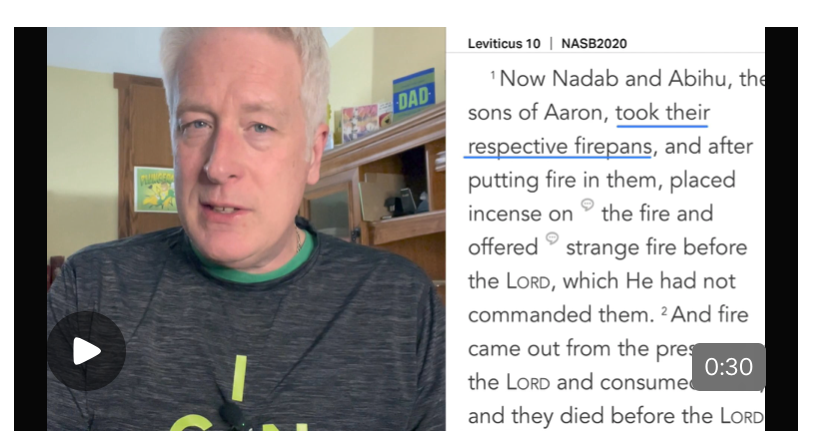 The deaths of Nadab and Abihu is a tragic story, but I think there are some important leadership insights to be gleaned from it. I shared an exclusive video with my Patreon supporters. Will you prayerfully consider joining?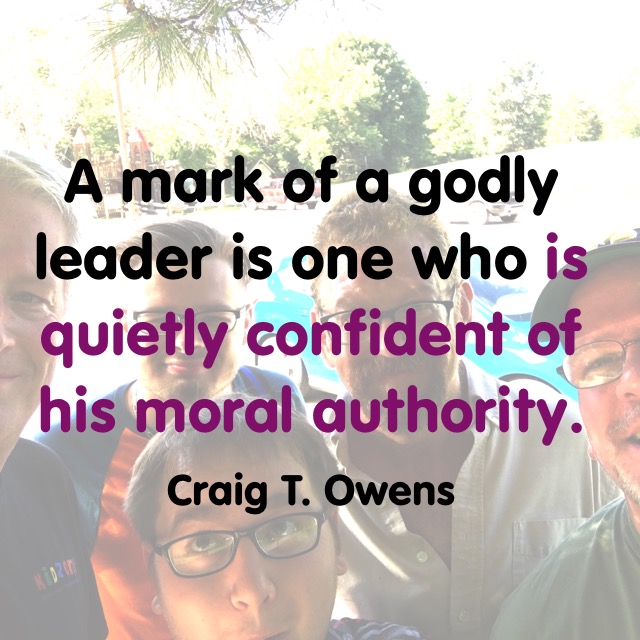







Links & Quotes
February 24, 2024 — Craig T. OwensWe’ve added things that we think should be in our prayer vocabulary. But kingdom praying should be as natural as talking to the most loving Father you can imagine! Check out more thoughts in my series of posts called Kingdom Praying. I have lots of new content every week, which you can check out on my YouTube channel.
“Obstacles don’t have to stop you. If you run into a wall, don’t turn around and give up. Figure out how to climb it, go through it, or work around it.” —Michael Jordan
In the post-Flood rock layers, fossils are often found of animals that were much larger than are currently observed. This has been called giantism. “Evolutionists claim that adaption occurs as random mutations make some organisms better fitted for their environment, and the less-fit organisms then die off. … This supposed, random, trial-and-error process requires long periods of time waiting for the ‘right’ random mutation to occur. In contrast, ICR gives credit to Jesus. He designed organisms with built-in sensors that enable them to detect changes in their environment. Internal genetic programming then allows these organisms to rapidly adapt to these changes in predictable ways. Such adaptation is often too rapid for natural selection to be the correct explanation. This design-based paradigm of adaptation is called continuous environmental tracking (CET).” This is an excellent article.
“If the stone falls on the pot, alas, for the pot; if the pot falls on the stone, alas for the pot.” —Jewish proverb, based on Psalm 118:22 and Luke 20:17-18
Godly leaders don’t minister to please people, but to lead people to God. So godly leaders are ever aware that in all they do, they must hear God say, “Well done, good and faithful servant.”
Share this: