Prepared To Pass The Test

Listen to the podcast of this post by clicking on the player below, and you can also subscribe on AppleSpotify, or Audible. 

The prayer that Jesus taught His follower is a prayer for citizens of the Kingdom of Heaven. These are not just some magical words to pray whenever we don’t know what to pray. 

We come to a part of the prayer that has confused some people. Jesus instructed us to pray, “And lead us not into temptation, but deliver us from the evil one” (Matthew 6:13). 

So some people have asked, “Does God tempt us?” 

No, He doesn’t! The temptations flare up when the ungodly desires within us are given an opportunity to seize what we think will make us happy (see James 1:13-15). 

All three of the synoptic Gospels tell us that Jesus was led by the Holy Spirit to the place where the devil would tempt Him (Matthew 4:1; Mark 1:12-13; Luke 4:1-2). 

Jesus went through all of this so that He would be assured that He was fully equipped for the intense scrutiny He was going to undergo for the next 3+ years. At the end of that time neither the Sanhedrin, Pontius Pilate, nor Herod Antipas could find any semblance of sin in His life. 

The word Jesus uses for temptation in Matthew 6:13 comes from the root word peirazo, which means to assay. We don’t use that word too often today, but it means a testing, an experiment, or a trial, to prove something’s fidelity, integrity, or virtue. 

Just like an assayer would test a rock for the quality and quantity of a precious metal found in it, so we are tested to determine our fitness for what God has in store for us. Remember that the beginning of this prayer is a desire for God’s name to be hallowed and His Kingdom to be made visible through our lives. 

Jesus endured His intense time of testing for you and me. The writer of Hebrews tells us that Jesus underwent every temptation we would ever face, without once giving in and sinning. He did all of this so He could be the perfect High Priest that knows how to intercede for us in our time of testing (Hebrews 2:14; 4:15; 2:10, 18; 5:7-9, 4:16). 

Hebrews 5:9 says that Jesus was perfected (the Greek word is telios), which is exactly what Jesus wants for us—Be prefect [telios] even as your Heavenly Father is perfect [telios] (Matthew 5:48).

In order to know this perfecting process, we have to be tested and assayed (James 1:12, 2-4). 

Temptations reveal hidden sins in our lived, and temptations keep us humbly reliant on God (Psalm 19:12; 1 Corinthians 10:12-13; James 4:1-7). 

Like all of the other phrases in this prayer, this one is both an acknowledgment (I will face temptations) and a petition (I need Your help to overcome the temptation). This is not necessarily a prayer to keep us from temptation, but to keep us through the temptation. We want to be empowered to pass the test. 

A loving teacher prepares us for the test, gives us the test, and then gives us the results so that we know we are prepared for the next level. So remember that this prayer is addressed to our loving Heavenly Father. He prepares us for the test so that we can pass the test. We never walk an unknown path—we never are given a test unless He has fully prepared us for it. 

So let me give you four thoughts to consider:

  1. Don’t rush ahead because that’s pride. Jesus went when the Holy Spirit led Him.
  2. Don’t lag behind because that’s fear. Think of the Israelites who fearful of the “giants” in the land and wouldn’t move forward. 
  3. Don’t be discouraged by a temporary failure. The phrase immediately before this says, “Forgive us our debts.” If you fall short, ask for forgiveness and move forward again. 
  4. Do give in to the righteousness Jesus has made available for you. This is what will help you stand firm in your time of testing (1 Peter 1:6-7).

Just like Jesus, our Father wants to perfect you and lead you up to higher levels. 

If you’ve missed any of the previous messages in this series looking at the model prayer Jesus taught us, you can find them all here. 

►► Would you please prayerfully consider supporting this ministry? My Patreon supporters get behind-the-scenes access to exclusive materials. ◀︎◀︎
The Path Ahead Of Me

Listen to the podcast of this post by clicking on the player below, and you can also subscribe on AppleSpotify, or Audible. 

I think it’s safe to say that most of us would feel much more secure if we knew exactly where life was taking us. That way, perhaps we could be ready for what lies ahead. It would certainly help to decrease our anxiety if we knew we were ready for what was coming next. 

In Luke 19, Jesus is on the path toward Jerusalem and Calvary. And in just a 5-verse section, the word “ahead” is used three times.

First, we read that Jesus “went on ahead” toward Jerusalem (v. 28). He knew exactly what was awaiting Him there; in fact, He had told His disciples numerous times the precise details of what was ahead. Even though His experience was going to be excruciating, for the joy that was even further ahead (see Hebrews 12:2), Jesus persevered. 

Next we read that Jesus sent two of His disciples “to the village ahead of you” to retrieve the donkey colt that was awaiting Him (v. 30). What is unspoken here is that Jesus had obviously spoken to the colt’s owners ahead of time about what He would require.

Finally, we read that those two disciples “who were sent ahead” found everything just as Jesus had said it would be (v. 32). 

I find this to be so comforting! What all of this means is:

I never walk an unknown path! 

  1. Jesus has already walked this path, and is fully aware of all that is ahead of me. 
  2. Jesus has prepared me ahead of time to walk this path. He doesn’t prepare the path for me, but He prepares me for the path. 
  3. Jesus has already spoken to others ahead of time to help resource me along this path. 

Phillip Keller pointed out, “Sheep are notorious creatures of habit. If left to themselves, they will follow the same trails until they become ruts; graze the same hills until they turn to desert wastes; pollute their own ground until it is corrupt with disease and parasites. … No other class of livestock requires more careful handling, more detail direction, than do sheep.” So Keller explains how good shepherds visit paths and pasturing areas ahead of time to make sure they know how to lead their sheep. 

David gives us these reassuring words about our Good Shepherd: “He guides me in paths of righteousness for His name’s sake” (Psalm 23:3). 

Let me say it again: You and I never walk an unknown path. But as we obediently and confidently walk ahead with our Good Shepherd, every single step is doing God’s will on earth as it has already been done in Heaven! 

With those thoughts in mind, may you walk confidently today, my friend! 

►► Would you please prayerfully consider supporting this ministry? My Patreon supporters get behind-the-scenes access to exclusive materials. ◀︎◀︎

Walking Intimately

Listen to the podcast of this post by clicking on the player below, and you can also subscribe on AppleSpotify, or Audible. 

There’s an interesting verb used with both Enoch and Noah that denotes intimate fellowship—the word is “walked.”

Enoch walked with God; and he was not, for God took him. (Genesis 5:24) 

These are the records of the generations of Noah. Noah was a righteous man, blameless in his generation. Noah walked with God. (Genesis 6:9)

David uses this same verb when he prays, “Vindicate me, Lord, for I have walked in my integrity, and I have trusted in the Lord without wavering. Examine me, Lord, and put me to the test; refine my mind and my heart. For Your goodness is before my eyes, and I have walked in Your truth” (Psalm 26:1-3). 

And Solomon uses the same verb to say that anyone who walks in righteous integrity leaves a legacy of righteousness for his family: “A righteous person who walks in his integrity—how blessed are his sons after him” (Proverbs 20:7). 

There is something important that is implied in this walking. God tells us what it is in this question: How can two walk together unless they agree to do so? (Amos 3:3). 

But make no mistake, God doesn’t agree with whatever path I choose to walk, but I must agree to walk God’s path. 

I must agree that God’s path is best, despite what everyone else is doing—“Then the Lord saw that the wickedness of mankind was great on the earth, and that every intent of the thoughts of their hearts was only evil continually” (Genesis 6:5). Yet Noah didn’t walk with the wicked, but he was commended because he walked with God. 

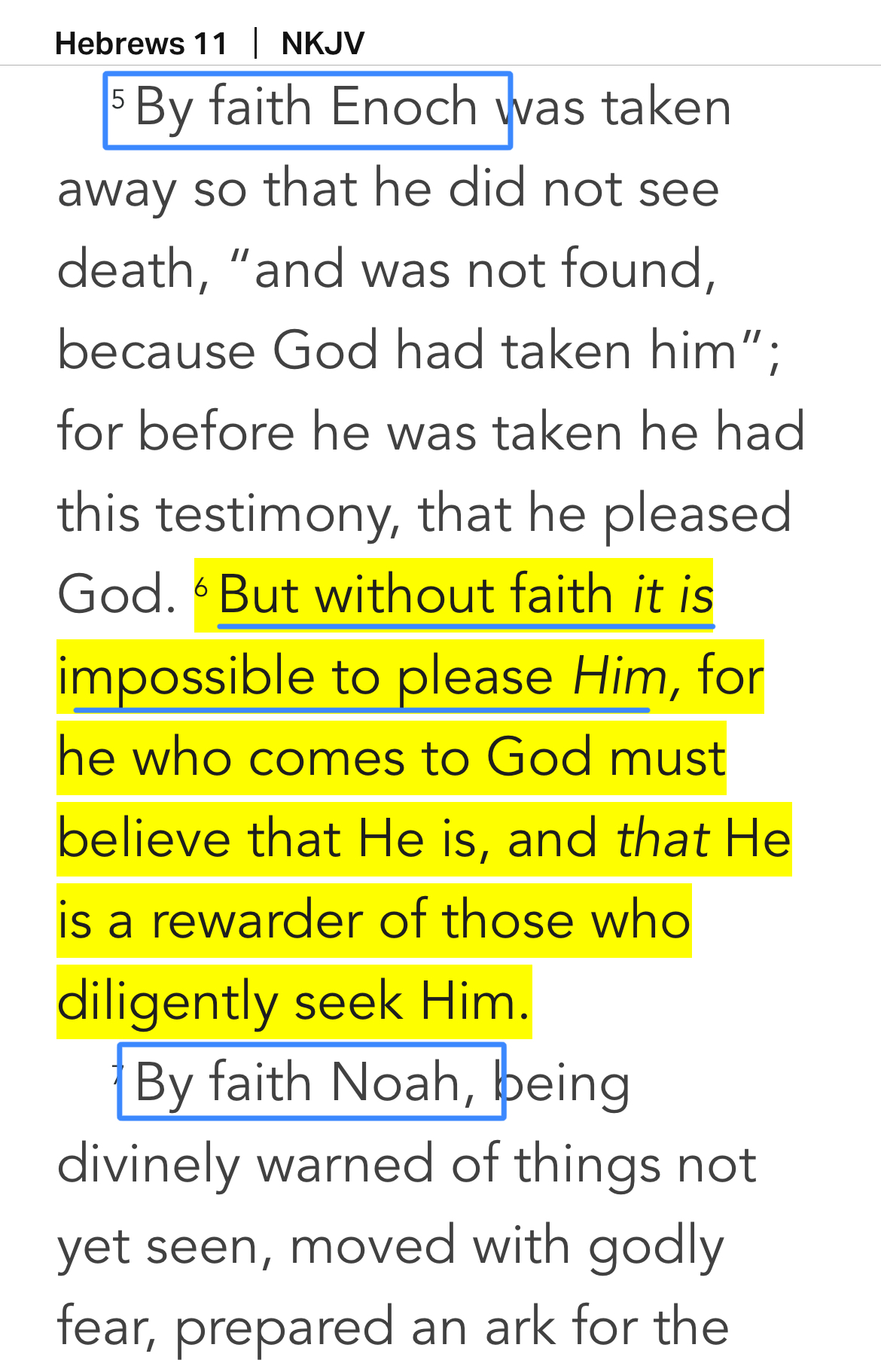
In the New Testament, Enoch and Noah are listed as back-to-back examples of faith (Hebrews 11:5, 7). The verse that connects these two men speaks of the faith-filled integrity that kept them walking with God—

And without faith it is impossible to please Him, for the one who comes to God must believe that He exists, and that He proves to be One who rewards those who seek Him. (Hebrews 11:6) 

That word “seek” means to diligently crave. Enoch and Noah and David show us examples of men who diligently craved walking with God above all else. Their faithful, diligent walking made them stand out from all those around them. 

What about us? Hebrews 11:6 says we can follow their example. We can choose to walk with God by faith. We can diligently crave Him above all else. When we walk righteously with God, He “rewards those” who do—for ever and ever! 

►► Would you please prayerfully consider supporting this ministry? My Patreon supporters get behind-the-scenes access to exclusive materials. Like this exceptional Bible study tool to help with Creation apologetics. ◀︎◀︎

Praying To Hallow God’s Name

Listen to the podcast of this post by clicking on the player below, and you can also subscribe on AppleSpotify, or Audible. 

We said our protocol in approaching Almighty God in prayer is found in just two words: Our Father. 

Notice the transition: your Father (3x in Matthew 6:6, 8) to Our Father (6:9). How does this happen? Jesus makes it possible and the Holy Spirit continually reminds us of Christ’s completed work (Hebrews 2:11; John 14:13-14; Romans 8:15-16). 

It’s not just “our Father” but “our Father in Heaven.” Let’s remember that our Father is both All-loving and All-powerful. The phrase in Heaven reminds us of His absolute sovereignty. “Our God is in heaven; He does whatever pleases Him” (Psalm 115:3). What pleases Him? To give us His kingdom (Luke 12:32). 

Then there’s another phrase that is vital: Our Father in Heaven, hallowed be Your name. 

Hallowed means both to acknowledge His greatness and to keep Him separate from any profane things. What is profane? The dictionary says it is irreverence or contempt for God. The opposite of profane is holiness—something set apart exclusively for God. This is not something better than something else, but something exclusively that will bring glory to our Father in Heaven.

The root word for hallowed is “holy.” We see this literally translated in the name Holy Spirit. It is a word also referring to Jesus when He is called “the Holy One of God” (see Mark 1:24). The angel uses the word twice when he says, “The Holy Spirit will come on you, and the power of the Most High will overshadow you. So the Holy One to be born will be called the Son of God” (Luke 1:35). 

And that same word translated hallowed and holy is also translated saints. Literally that means “holy ones” or set apart people. 

Jesus is teaching us that our prayer is BOTH an acknowledgment of how God’s name is to be hallowed AND a request that He would empower us to pray and live in ways that makes that happen. 

This means our attitude needs to be focused on God’s reputation not my reputation (as in Matthew 6:5, 7:21-23). 

Our Father in Heaven, hallowed be Your name” is both an attitude of prayer and a lifestyle. 

We hallow God’s name when our prayer and daily lifestyle bring Him the supreme glory that is due exclusively to His awesome name! When we keep our eyes and hearts on Him, He will provide everything else we need (see Matthew 6:32-33). 

To follow along with all of the message in this prayer series called Kingdom Praying, please click here. 

►► Would you please prayerfully consider supporting this ministry? My Patreon supporters get behind-the-scenes access to exclusive materials. Like this exceptional Bible study tool to help with Creation apologetics. ◀︎◀︎

Done With Intentional Sinning

The writer of Hebrews assures us that Jesus had to be made like us in every way so that He could experience every temptation that plagues us.

If Jesus hadn’t come to earth in the flesh and lived here victoriously over sin, we would have a loophole to keep on sinning. But He did indeed live a sinless life, die to pay our penalty, and was resurrected to indwell and empower us to overcome sinful lusts. 

So, since Christ suffered in the flesh for us, for you, arm yourselves with the same thought and purpose—patiently to suffer rather than fail to please God. For whoever has suffered in the flesh—having the mind of Christ—is done with intentional sin—has stopped pleasing himself and the world, and pleases God—so that he can no longer spend the rest of his natural life living by his human appetites and desires, but he lives for what God wills. (1 Peter 4:1-2 AMPC)

What a gift Jesus has purchased for us: Freedom from the ensnaring power of sin!

Gratitude Is A Medicine

Listen to the podcast of this post by clicking on the player below, and you can also subscribe on AppleSpotify, or Audible. 

Gratitude is our shield against the negativity, and gratitude is also our sword against the ambushers. But using these pieces of our armor is exhausting, which means we also need a way to recover from the attacks of negativity. 

Jesus began His public ministry with a sermon that prompted Luke to record that “everyone spoke well of Him.” But in less than 60 seconds, after Jesus outlined how His ministry would unfold, Jesus is being criticized to the point where those same praising people are now ready to throw Jesus off a cliff (Luke 4:18-29)! 

Elbert Hubbard wrote, “If you have something others don’t, know something others don’t, or do something others aren’t doing, then, rest assured, you will be criticized. … To avoid criticism say nothing, do nothing, and be nothing.” 

Even though Hubbard is probably right, Christians don’t have the option to “say nothing, do nothing, be nothing,” because Jesus has called us to go into all the world, preach the Good News, and be salt and light. That means we will be victims of criticism. We can use our shield and sword of gratitude, but we are also going to need some medicine to help us recover too.

“Sticks and stones may break my bones but words will never hurt me” is a lie. Words do hurt. 

Jesus told us these stinging words would be thrown at us like sticks and stones in Luke 6:22. When we are criticized, we have to be careful not to get embittered. How does that happen? We are naturally self-protective, so criticized people become critical and cynical unless they can be healed and have joy restored. If we hold on to our hurts, bitterness can fester in our hearts (Hebrews 12:14-15). 

Look at David in Psalm 69. He acknowledged the attacks from his enemies and how it made him feel, but then he applies the healing medicine of gratitude—

But as for me, afflicted and in pain—may Your salvation, God, protect me. I will praise God’s name in song and glorify Him with thanksgiving. (Psalm 69:29-30) 

Our healing is in our thanking! 

Medical research has shown that gratitude improves physical health—it reduces stress and resets the heart’s healthy rhythm. This is just as true spiritually: gratitude is our medicine. 

You may be thinking, “How can I bless critical people? How can I be grateful when I’m surrounded by such hostility?”  

David also wrote Psalm 23 for us. This is the psalm that begins, “The Lord is my Shepherd, I shall not be in want.” But notice especially the words of verse 5: “You prepare a table before me in the presence of my enemies. You anoint my head with oil; my cup overflows.” 

It is precisely in the presence of enemies that God invites us to abide with Him and to receive His medicine of anointing. But I also see that our Good Shepherd doesn’t just give us adequate blessings, but overflowing blessings—enough for me and more to share with those around me. 

In the New Testament Greek, one word for “bless” is eulogeo which literally means “good words.” Jesus, Paul, and Peter all tell us that when we are victims of the sticks and stones of negative words, we are to respond by saying good words both to God and to those who are hurling evil words at us (Matthew 5:43-44; 1 Corinthians 4:12; 1 Peter 3:9). 

Peter shows us exactly how Jesus did this when He was hanging on the Cross and enduring the sneers, mocking words, and insults from those surrounding Him (1 Peter 2:21-23; Luke 23:35-39). Instead of throwing evil words back at them, Jesus blessed them by saying, “Father, forgive them for they do not know what they are doing” (Luke 23:34). 

Learn a lesson from our Lord
Often silence cuts like a sword
When we stand upon the Rock
We needn’t bother when fools mock

Bantering with fools just won’t do
Unless you want to be foolish too
To the wisest words they won’t listen
But joy in airing their own opinion

Our Lord knew just what to do
When mockers hurled words untrue
He entrusted things to the King
Who perfectly records everything

Help us follow the example You gave
To not engage with those who rave
May not our hasty words undo

Because we have been forgiven, we can forgive. Because we have been blessed with overflowing blessings, we can bless. Our healing is in our thanking! 

If you’ve missed any of the messages in this series on power of gratitude, you can check them all out by clicking here. 

►► Would you please prayerfully consider supporting this ministry? My Patreon supporters get behind-the-scenes access to exclusive materials. ◀︎◀︎

Gratitude Is A Sword

Listen to the podcast of this post by clicking on the player below, and you can also subscribe on AppleSpotify, or Audible. 

It would be nice if complainers were satisfied just complaining to themselves, but they’re not. Do you know the cliché misery loves company? It’s just as true for complainers: They really want others to join them in their bellyaching! 

I think a good word for what these negative people do is ambush. The dictionary says that means to lie in wait with hostile intent. Jesus told His followers that this ambushing behavior was going to happen. In Luke 6:22, He uses the word “when” not “if”—

Blessed are you when people hate you, when they exclude you and insult you and reject your name as evil, because of the Son of Man. 

We see this vividly portrayed in the life of Daniel. This man had done nothing but helpful things since the moment he arrived in Babylon. He faithfully served foreign kings, never wanted any recognition for himself, saved lives, interpreted dreams, and explained confusing things. He had a great work ethic and impeccable integrity. But the complainers still wanted to ambush him (see Daniel 6:1-5). 

One psalmist described these ambushers in terms of a hunting lion: His mouth is full of lies and threats; trouble and evil are under his tongue. He lies in wait near the villages; from ambush he murders the innocent. His eyes watch in secret for his victims (Psalm 10:7-8). 

Doesn’t this sound like what the devil does too? Be alert and of sober mind. Your enemy the devil prowls around like a roaring lion looking for someone to devour (1 Peter 5:8). 

I already shared with you that gratitude is our shield for defense, but the Bible tells us that gratitude is also our sword for offense! 

Jerusalem was surrounded by three armies that were lying in wait to ambush the Israelites. After God told the people of Jerusalem that He would deliver them, King Jehoshaphat sent out his army with the worshippers at the front of the ranks. Then listen to how worship not only thwarted the ambushers but boomeranged their evil plans back on themselves—

As they began to sing and praise, the Lord set ambushes against the men of Ammon and Moab and Mount Seir who were invading Judah, and they were defeated. The Ammonites and Moabites rose up against the men from Mount Seir to destroy and annihilate them. After they finished slaughtering the men from Seir, they helped to destroy one another. (2 Chronicles 20:22-23) 

When we worship God and sing our grateful praise to Him, we put the sword of God in our mouths. And there isn’t a more effective sword against the darkness than the (S)Word of God (Hebrews 4:12; Revelation 1:16; Ephesians 6:17)! 

Paul told the church at Colosse that singing our praise to God with other saints was an encouragement to all who heard those worshipful songs (Colossians 3:15-17). 

So when the ambushers are surrounding you, use your thankful songs as a shield, as a sword, and as an encouragement to others! 

If you’ve missed any of the other messages in our series The Great Attitude of Gratitude, you can find them all here.

►► Would you please prayerfully consider supporting this ministry? My Patreon supporters get behind-the-scenes access to exclusive materials. ◀︎◀︎

Links & Quotes

This is just one example of the power of a leader’s storytelling. Check the full conversation Greg and I had on The Craig And Greg Show. I have lots of new content every week, which you can check out on my YouTube channel.

“We are all born ignorant, but one must work hard to remain stupid.” —Benjamin Franklin

George Jeffreys was born with a limiting speech impediment, but with the empowering of the Holy Spirit, George and his brother Stephen led incredible Pentecostal revivals in England and Wales. They were said to be the greatest evangelists since George Whitefield and John Wesley. Someone asked Jeffreys how long a revival should last, and he responded, “Thank God, a revival started in my heart 30 years ago, and it has never stopped; it will never end.” He continued by saying, “As long as Jesus is kept in the front, and made the center of fellowship and blessing and unity, the revival will never end.” Check out this mini biography about his life.

John Stonestreet uses the example of C.S. Lewis’ Aslan to talk about how God can speak to us through our pain. John writes, “Pain is never the point of God’s plans, any more than it is the purpose of physical exercise. Never pushing ourselves to the point that it hurts means never improving our health. On the other hand, seeking pain is more likely to do harm than to aid our wellbeing. In and of itself, pain is not good, but it is meaningful. Pain indicates that something is wrong and needs to be addressed.”

“The best way to make a dream come true is to wake up.” —Dame Anna Wintour

Because of the extensive prayer, research, and work I put into my book Shepherd Leadership, I am frequently drawn to passages of Scripture that reinforce the idea of pastors as shepherds. I was meditating on Hebrews 5:2 the other day, and I shared some of my thoughts with some of my pastor friends.

Links & Quotes

Healthy leaders look in the mirror first before they confront a teammate on something that needs to change. Check out the full conversation Greg and I had on The Craig and Greg Show about defeating the two-headed leadership killer of ignorance and arroganceI have lots of new content every week, which you can check out on my YouTube channel.

“I am often, I believe, praying for others when I should be doing things for them. It’s so much easier to pray for a bore than to go and see him.” —C.S. Lewis, Letters to Malcolm: Chiefly on Prayer

“The greatest weapon against stress is our ability to choose one thought over another.” —William James

The most empowered and empowering person is the one who remains in Jesus.

“Whereas three or more incidents of intense stress within a year (say, serious financial trouble, being fired, or a divorce) triple the death rate in socially isolated middle-aged men, they have no impact whatsoever on the death rate of men who cultivate many close relationships.” —Daniel Goleman, Richard Boyatzis & Annie McKee, Primal Leadership

T.M. Moore has an outstanding series of posts on how Christians should interact with the governments in the lands in which they live. I highly recommend this series to you. T.M. wrote, “We have seen that justice is a jewel of many facets. In its obligatory facet, justice requires that we love our neighbors simply because they are made in the image of God. We must regard them, and do with them, as we wish to be regarded and done with ourselves. In its preventive facet, justice demands that we use forethought in all our actions to make sure, as far as possible, that our neighbor or his property is not injured by what we do. Distributive justice encourages us to share generously with our neighbors and others in need. Restorative justice comes into play when the balance of neighbor love has become disturbed and the one guilty of disturbing it is required to set things right again. Each of these forms of justice, grounded in the Law of God, is very much a part of life in our society today. It is simply mindless or prejudicial to insist that we should have no input from Scripture or the Law of God, either in the public square or in the making of public policy. Our nation was founded on Biblical principles of justice, and to deny this is to rewrite history past and to put in jeopardy history to come.”

The Greek word translated as “consider” in Hebrews 3:1 means to observe closely, to consider attentively, to fix your eyes or mind upon it. In its context, this verb is usually directing us to the end result of being in awe, kindling a renewed faith, and being rejuvenated with a new resolve to move forward. This is what happens especially when we consider Jesus❣️

The Lens For Difficult Biblical Passages

Listen to the podcast of this post by clicking on the player below, and you can also subscribe on AppleSpotify, or Audible. 

If you’ve ever found sections of the Bible difficult to understand, I’ve got a few thoughts to help you out.

Check out this episode of The Podcast.

Resources mentioned in this video:

►► Would you please prayerfully consider supporting this ministry? My Patreon supporters get behind-the-scenes access to exclusive materials, like this recent video where I explain how God reveals previously-unknown truths to us. Become a supporter today and get instant access to everything I have already shared with my supporters. ◀︎◀︎