Thursdays With Spurgeon—Never Give Up On Grace And Mercy

This is a weekly series with things I’m reading and pondering from Charles Spurgeon. You can read the original seed thought here, or type “Thursdays With Spurgeon” in the search box to read more entries.

Listen to the podcast of this post by clicking on the player below, and you can also subscribe on iTunes or Spotify.

Never Give Up On Grace And Mercy

Therefore He is also able to save to the uttermost those who come to God through Him, since He always lives to make intercession for them. (Hebrews 7:25) 

     My friends, it is one thing to go to church or chapel. It is quite another thing to go to God. …

Coming to God is not what some of you suppose, that is, now and then sincerely performing an act of devotion but giving to the world the greater part of your life. You think that if sometimes you are sincere, if now and then you put up an earnest cry to heaven, God will accept you. And though your life may be still worldly and your desires still carnal, you suppose that for the sake of this occasional devotion God will be pleased, in His infinite mercy, to blot out your sins. I tell you, sinners, there is no such thing as bringing half of yourselves to God and leaving the other half away. …  

     If I should see a sinner staggering on his progress to hell, I would not give him up, even when he had advanced to the last stage of iniquity. Though his foot hung trembling over the very edge of perdition, I would not cease to pray for him. And though he should in his poor drunken wickedness go staggering on till one foot was over hell and he was ready to perish, I would not despair of him. Till the pit had shut its mouth upon him I would believe it is possible that divine grace might save him. See there! He is just upon the edge of the pit, ready to fall. But before he falls, free grace bids, ‘Stop that man!’ Down mercy comes, catches him on her broad wings, and he is saved—a trophy of redeeming love. 

From Salvation To The Uttermost 

My friend, if you don’t have a personal relationship with God through the forgiving work that Jesus accomplished on the Cross, I implore you to come to Him before another minute passes. When Jesus said from this Cross, “It is finished,” He told you that He paid in full your debt that would have kept you separated from God forever. 

Now you just need to come to Him in faith. Simply pray something like this: “God, I acknowledge that I am a sinner separated from You. But I believe that Jesus paid the penalty for all of my sins when He died on the Cross. Because of that payment, I am asking You to forgive me and bring me into a full relationship with You. I pray this in the name of Jesus. Amen.” 

And let me speak to you, my Christian brother or sister who has been praying earnestly for the salvation of someone dear to you. Let me encourage you to not give up! God’s mercy and God’s grace are so swift that even with the last breath they can swoop in to save. Never cease to pray for them and know that Jesus is interceding for them before God’s throne too!

►► Would you please prayerfully consider supporting this ministry? ◀︎◀︎

 

Poetry Saturday—Eternal Spirit

Listen to the podcast of this post by clicking on the player below, and you can also subscribe on Apple or Spotify.

Eternal Spirit, we confess
And sing the wonders of Your grace!
Your power conveys our blessings down
From God the Father and the Son.
Enlightened by Your heavenly ray,
Our shades and darkness turn to day.
Your inward teachings make us know
Our danger and our refuge, too.
Your power and glory work within,
And break the chains of reigning sin,
Does our imperious lusts subdue,
And forms our wretched hearts anew.
The troubled conscience knows Your voice,
Your cheering words awake our joys;
Your words allay the stormy wind,
And calm the surges of the mind.

*Spurgeon used this poem as a conclusion to his sermon entitled Human Depravity and Divine Mercy. I was unable to find this poem attributed to anyone else, so I am assuming it was written by Spurgeon himself. 

►► Would you please prayerfully consider supporting this ministry? ◀︎◀︎

The Craig And Greg Show: Leaders And Laughter

On this episode of “The Craig And Greg Show” we talk about: 

  • sometimes leaders and laughter don’t together, but sometimes humor can bring about the ice breaker that teams need
  • leaders need to practice laughter  
  • how Greg used to prepare himself for meetings while he was on the road
  • I share that leaders need to lighten up even before in-office meetings
  • people want to follow leaders not just to win, but to have fun along the way too
  • how do leaders find the appropriate use of humor? Greg shares two important words to keep in mind
  • leaders need to get on the same page with their teammates, and the best way to do this is to laugh at ourselves
  • in a previous episode, we talked about love languages, which is also key in the appropriate use of humor 
  • laughing is good for your health—both physical health and emotional health
  • we wonder about the statute of limitations on some pranks with which we may have been involved
  • laughter triggers endorphins in us but also triggers the mirror neurons in others
  • we announce a really fun contest!

Check out this episode and subscribe on YouTube so you can watch all of the upcoming episodes. You can also listen to our podcast on Spotify and Apple.

Thursdays With Spurgeon—Never Beyond God’s Love

This is a weekly series with things I’m reading and pondering from Charles Spurgeon. You can read the original seed thought here, or type “Thursdays With Spurgeon” in the search box to read more entries.

Listen to the podcast of this post by clicking on the player below, and you can also subscribe on iTunes or Spotify.

Never Beyond God’s Love

Lost, perishing sinners, hear the voice of God, for it speaks to you. 

“Where art thou? for I am come to seek thee.” 

“Lord, I am in such a place that I cannot do anything for myself.” 

“Then I am come to seek thee and do all for thee.” 

“Lord, I am in such a place that the law threatens me and justice frowns upon me.” 

“I am come to answer the threatenings of the law, and to bear all the wrath of justice.” 

“But, Lord, I am in such a place that I cannot repent as I would.” 

“I am come to seek thee, and I am exalted on high to give repentance and remission of sins.” 

“But, Lord, I cannot believe in Thee, I cannot believe as I would.” 

“A bruised reed I will not break, and a smoking flax will I not quench; I am come to give thee faith.” 

“But, Lord, I am in such a state that my prayers can never be acceptable.” 

“I am come to pray for thee, and then to grant thee thy desires.” 

“But, Lord, Thou dost not know what a wretch I am.” 

“Yes, I know thee. Though I asked thee the question, ‘Where art thou?’ it was that thou mightest know where thou art, for I know well enough.” 

“But, Lord, I have been the chief of sinners; none can have so aggravated their guilt as I have.” 

“But wherever thou mayest be, I have come to save thee.” 

“But I am an outcast from society.” 

“But I am come to gather together the outcasts of Israel.” 

“O but I have sinned beyond all hope.” 

“Yes, but I have come to give hope to hopeless sinners.” 

“But, then I deserve to be lost.” 

“Yes, but I have come to magnify the law and make it honorable, and so to give thee thy deserts in the person of Christ, and then to give thee My mercy because of His merits.” —Charles Spurgeon

My friend, there isn’t anything you can do to make God love you any less or any more—God IS Love. You are never beyond His love! 

There is never a hole so deep, or a burden so heavy that God cannot rescue you—God IS All-mighty. You are never beyond His rescue! 

You cannot escape the powerful love of your Heavenly Father. Jesus purchased your salvation with His blood, and the Holy Spirit is calling to your heart today. Will you come to Him in faith? O, please, my friend, receive God’s love today! 

►► Would you please prayerfully consider supporting this ministry? ◀︎◀︎

 

Poetry Saturday—Depth Of Mercy

Listen to the podcast of this post by clicking on the player below, and you can also subscribe on Apple or Spotify.

Depth of mercy! can there be
Mercy still reserved for me?
Can my God His wrath forbear,
Me, the chief of sinners, spare?

I have long withstood His grace,
Long provoked Him to His face,
Would not hearken to His calls,
Grieved Him by a thousand falls.

Kindled His relentings are:
Me He now delights to spare;
Cries, “How shall I give thee up?”
Lets the lifted thunder drop.

There for me the Savior stands,
Shows His wounds and spreads His hands.
God is Love; I know, I feel;
Jesus weeps, but loves me still. ―Charles Wesley

►► Would you please prayerfully consider supporting this ministry? ◀︎◀︎

Poetry Saturday—Arise, My Soul, Arise

Listen to the podcast of this post by clicking on the player below, and you can also subscribe on Apple or Spotify.

Arise, my soul, arise,
shake off your guilty fears;
The bleeding sacrifice,
in my behalf appears;
Before the throne my Surety stands,
My name is written on His hands.

He ever lives above,
for me to intercede;
His all redeeming love,
His precious blood, to plead;
His blood atoned for every race,
And sprinkles now the throne of grace.

Five bleeding wounds He bears;
received on Calvary;
They pour effectual prayers;
they strongly plead for me:
“Forgive him, O forgive,” they cry,
“Nor let that ransomed sinner die!”

The Father hears Him pray,
His dear anointed One;
He cannot turn away
the presence of His Son;
The Spirit answers to the blood,
The Spirit answers to the blood
And tells me I am born of God.

My God is reconciled;
His pardoning voice I hear;
He owns me for His child;
I can no longer fear
With confidence I now draw nigh,
And “Father, Abba, Father,” cry. —Charles Wesley

►► Would you please prayerfully consider supporting this ministry? ◀︎◀︎

Biblical Mindfulness

Listen to the podcast of this post by clicking on the player below, and you can also subscribe on Apple or Spotify.

I have always been mindful of Your unfailing love…. (Psalm 26:3).

The dictionary defines “mindful” as simply being aware. Unfortunately, many psychologists today have constricted this term to mean simply being aware of the present moment, especially one’s own emotions in the present moment. 

In the New Living Translation, this verse has David saying to God, “I am always aware of Your unfailing love.” God’s unfailing love is an eternal attribute of God, and David says he is perpetually contemplating this attribute. But notice how David applies mindfulness not just to his present moment, but to his past and future as well. In fact, David invites God to examine his heart and mind to verify that David is always properly mindful of God’s love.

Notice the past, present, and future tenses David uses—

Past (v. 1):

  • I have led a blameless life 
  • I have trusted in the Lord without wavering 

Present (vv. 3, 7, 11):

  • Your love is ever before me 
  • I walk continually in Your truth
  • I proclaim aloud your praise
  • I lead a blameless life

Future (v. 12):

  • In the great assembly I will praise the Lord

Notice that between David’s claim that he has led a blameless life and that he is still leading a blameless life, we read his request for God to, “Test me, O Lord, and try me, examine my heart and my mind.” David was perpetually mindful of God’s awareness of both his thoughts and his lifestyle.

Being mindful of God’s love means looking back in gratitude to recall God’s past provision, looking around in worship to see God’s ongoing involvement, and looking ahead in hope to anticipate God’s unending grace. 

Unlike modern-day psychology which tells us mindfulness is a narrowing of our thoughts, biblical mindfulness is an expanding of our thoughts. Biblical mindfulness sees God’s past work and His future grace, and brings those to bear on our present circumstances. 

Thursdays With Spurgeon—Talking Back To Your Old Family

This is a weekly series with things I’m reading and pondering from Charles Spurgeon. You can read the original seed thought here, or type “Thursdays With Spurgeon” in the search box to read more entries.

Listen to the podcast of this post by clicking on the player below, and you can also subscribe on iTunes or Spotify.

Talking Back To Your Old Family

     When a man is adopted into a family and comes thereby under the regime of his new father, he has nothing whatever to do with the old family he has left behind and he is released from subjection to those whom he has left. And so, the moment I am taken out of the family of satan, the prince of this world has nothing to do with me as my father and he is no more my father. I am not a son of satan; I am not a child of wrath. 

     …When the law comes to a Christian with all its terrible threats and horrible denunciations, the Christian says, ‘Law! Why do you threaten me? I have nothing to do with you. I follow you as my rule, but I will not have you to be my ruler. I take you to be my pattern and mold, because I cannot find a better code of morality and of life, but I am not under you as my condemning curse.’ …  

     If one man adopts another child into his family, he cannot give it his own nature as his own child would have had. And if that child whom he will adopt should have been a fool, it may still remain so. He cannot make it a child worthy of him. But our heavenly Father, when He comes to carry out adoption, gives us not only the name of children, but the nature of children, too. He gives us a nature like His well-beloved Son, Jesus Christ.

From Adoption

Charles Spurgeon was called “the prince of preachers” for good reason! His word pictures are so biblically-accurate and so easy to recall, that anyone can grasp the concepts he shares from the Scripture. I have two takeaways from this portion of his sermon: 

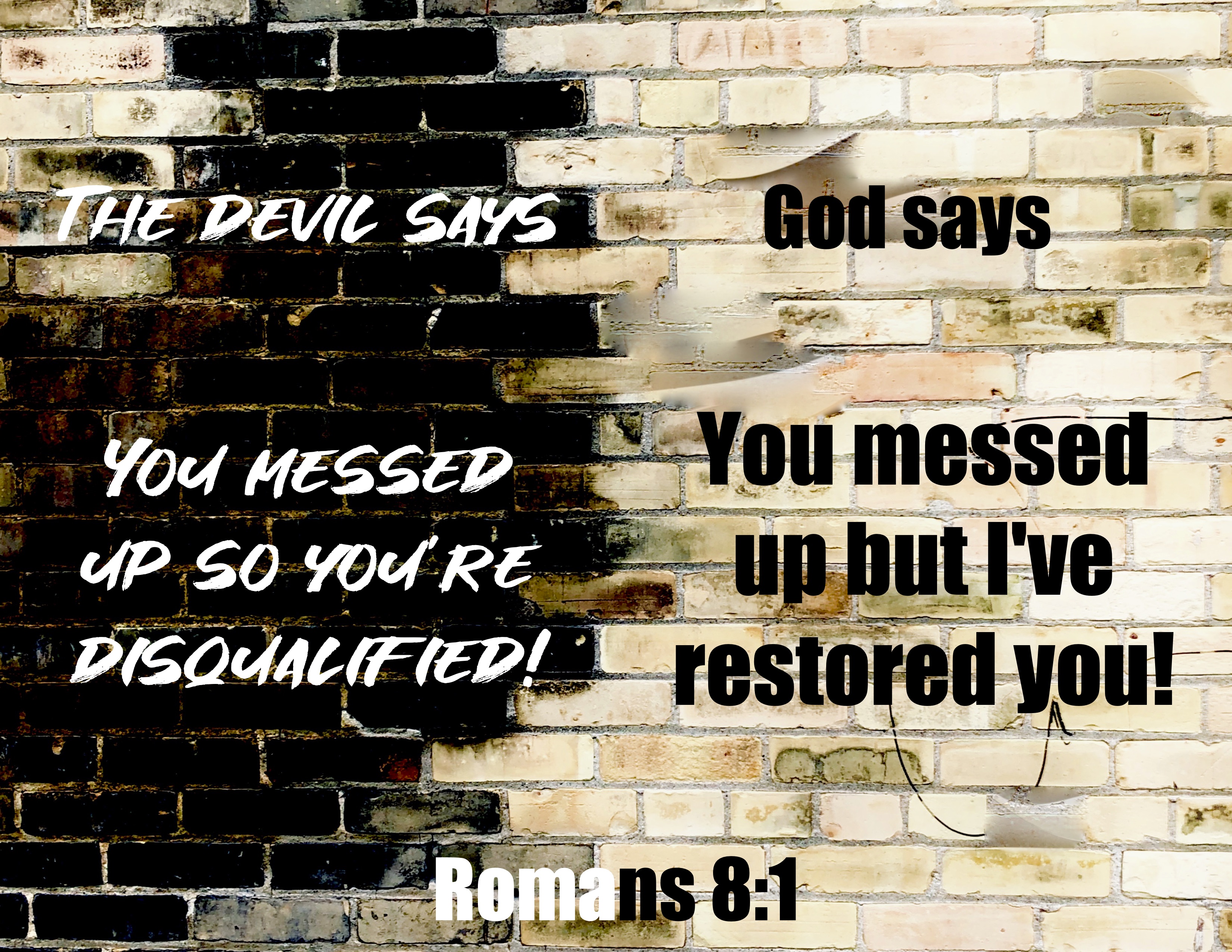
First, we need to talk back to our old family. The name “satan” means accuser: he accuses, condemns, slanders, and does his best to separate. When a Christian has been adopted into God’s family, there is no condemnation for the one who now calls God, “Abba Father” (see Romans 8:1-17). 

This is where we need to call out satan’s lies. I mean literally call them out. We need to talk back to the devil and tell him the truth, just as Spurgeon said in his example of talking back to the Law. Let me say it again: literally speak the truth out loud. The devil needs to hear it and your own ears need to hear it too: “I am no longer subject to your jurisdiction. You have no say over me any longer. I am a child of God. My sins have been forgiven and forgotten; therefore, there are no grounds left for any condemnation!”


Second, we need to talk back to our old nature. After being adopted into God’s family, the Holy Spirit undertakes a process to conform us to the image of Jesus. This process is called sanctification, but I like to call it saint-ification. 

This is where we call out what we used to be. And, again, I challenge to literally speak these words out loud. Don’t say, “I’m so impatient,” but tell yourself (out loud!), “I am becoming the patient saint Jesus wants me to be.” Don’t say, “I’ll never get this right,” but tell yourself, “I am learning more and more about Christ’s nature with each attempt.” Talk back to these old habits from your old family, and tell them about the new saintly habits the Holy Spirit is developing in you. 

The book of Revelation tells us that the saints overcame the slanderous devil by the blood of Jesus and by the words of their testimony. Speak out those life-affirming words every time that slanderer tries to make you forget into whose family you have been adopted!

“These Things”

Listen to the podcast of this post by clicking on the player below, and you can also subscribe on Apple or Spotify.

…whoever does these things will never be shaken (Psalm 15:5). 

David says “these things” are what allow us to come into God’s presence, but we cannot consistently nor completely do “these things” without the help that can only come from being in God’s presence. So I have to already be doing “these things” in order to get into His presence in order to get empowered to do “these things”?! 

That seems like a classic, no-win, Catch-22! 

So… how do I get into God’s presence in the first place?

Simple: I can’t. 

Only Jesus can. 

Thankfully, He made it possible for me to come in: He became the Door! 

Only by Jesus can I come in. Only in Jesus can I be empowered. Only with Jesus can I consistently do “these things.” 

What are “these things” that David listed that both allow me to come into God’s presence and then keep me in God’s presence? David said we must…

  1. …walk blamelessly before God. Or as Jesus said, “Be perfect, therefore, as your heavenly Father is perfect” (Matthew 5:48). I am blameless in God’s sight only when I am in Jesus.  
  2. …speak truthfully: from the heart, no slander on my tongue, no unkind words in my mouth, no gossip on my lips. 
  3. …live courageously: honoring what is good and opposing what is evil. 
  4. …keep my oaths: making my yes mean yes, not making any excuses, helping others to do the same. 

“These things” both glorify God and keep me in God’s presence. And “these things” attract others to His presence too. But I don’t try to do “these things” in my own strength—that would make me God—nor just as a religious To-Do List—that would make me a Pharisee. But I take a cue from the apostle Paul—

But whatever I am now, it is all because God poured out His special favor on me—and not without results. For I have worked harder than any of the other apostles; yet it was not I but God who was working through me by His grace (1 Corinthians 15:10). 

It is grace—a free gift of God—that enables me to do “these things” not in my own strength, but in His strength! 

I don’t try harder to do “these things” that keep me secure in God’s presence, but I trust more profoundly in His grace that continually empowers me to successfully do “these things” every single day.

Thursdays With Spurgeon—Adopted By God

This is a weekly series with things I’m reading and pondering from Charles Spurgeon. You can read the original seed thought here, or type “Thursdays With Spurgeon” in the search box to read more entries.

Listen to the podcast of this post by clicking on the player below, and you can also subscribe on iTunes or Spotify.

Adopted By God

Blessed be the God and Father of our Lord Jesus Christ, who has blessed us with every spiritual blessing in the heavenly places in Christ, just as He chose us in Him before the foundation of the world, that we should be holy and without blame before Him in love, having predestined us to adoption as sons by Jesus Christ to Himself, according to the good pleasure of His will. (Ephesians 1:3-5) 

     It is at once a doctrine of Scripture and of common sense that whatever God does in time, He predestined to do in eternity. …  

     Adoption is that act of God whereby men who were by nature the children of wrath, even as others, and were of the lost and ruined family of Adam, are from no reason in themselves, but entirely of the pure grace of God, translated out of the evil and dark family of satan and brought actually and virtually into the family of God. … This is an act of pure grace. …  

     [God] found a rebellious child, a filthy, frightful, ugly child. He took him to His bosom and said, ‘Evil though you are, you are comely in my eyes through my Son Jesus. Unworthy though you are, yet I cover you with His robe, and in your Brother’s garments I accept you.’ …  

     His only begotten and well-beloved Son was quite enough for Him. … And His own omnipotence was adequate enough to have created a race of beings far superior to us. He stood in no need whatever of any to be His darlings. It was, then, an act of simple, pure, gratuitous grace—and of nothing else—because He will have mercy on whom He will have mercy and because He delights to show the marvelous character of His condescension.

From Adoption

I love that thought that “whatever God does in time, He predestined to do in eternity.” When Adam and Eve sinned, God wasn’t scrambling to fix the sin problem. When He said that a remedy for sin was coming (Genesis 3:15), He was talking about a plan that was already in place. 

When John the Baptist said of Jesus, “Behold the Lamb of God who takes away the sin of the world!” (John 1:29), he was only announcing what was a fact from before time began, where the apostle John described Jesus as “the Lamb slain from the foundation of the world” (Revelation 5:12, 13:8)! And the apostle Paul said God “chose us in [Jesus] before the foundation of the world”! 

Friends, think of what this means: God saw a relationship with you—saw you adopted into His family—before you were born, even before the universe was created! What indescribable love! What amazing grace! 

Do you realize your value in God’s eyes? He didn’t have to send Jesus, but He did. He didn’t have to lavish His love on you, but He does. He didn’t have to adopt you into His family, but what He has done in time, He predestined to do in eternity—from before He even said, “Let there be light” at the moment of creation. 

Don’t ever buy into the lies of satan that you’re nothing special, when, in fact, you mean more to God than you can possibly comprehend!