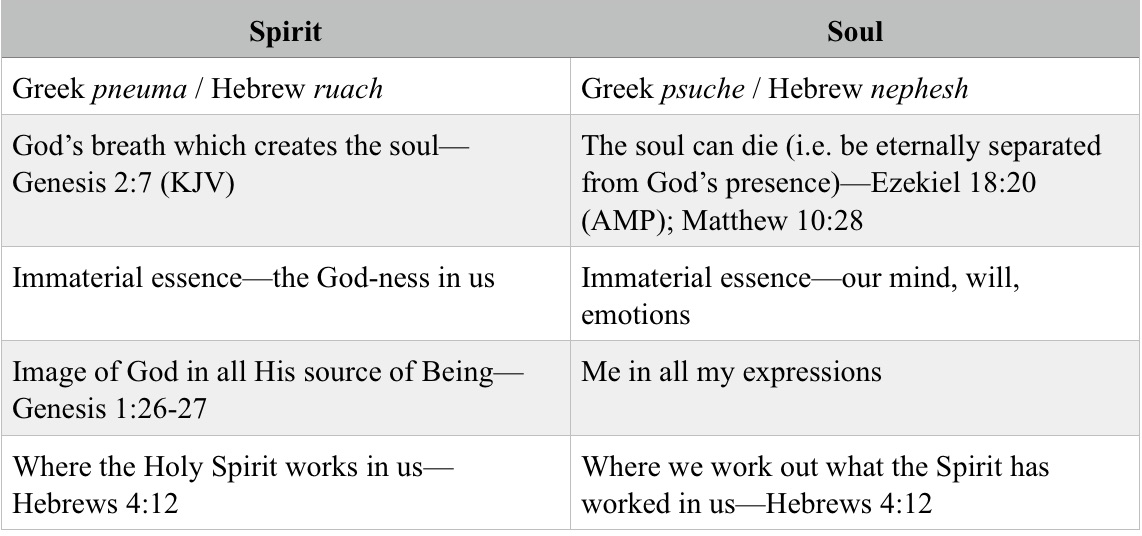
If I were to ask you to define the material/physical part of you versus the immaterial part of you, it probably wouldn’t be too difficult. Obviously, we can touch the physical part but we cannot touch the immaterial part.
But human as a three-part being—we have a body, a soul, and a spirit. So if I were to now ask you to describe the “dividing line” between the two immaterial parts of us (the soul and the spirit), you would probably have a more difficult time coming up with a definition.
Both terms are used throughout the Bible. Sometimes it seems the words soul and spirit are almost used interchangeably, but they are most assuredly two separate parts of what makes us us.
Please check out this chart that I shared with my friends at Calvary Assembly of God, and perhaps even take a few minutes to watch the video below. If you would like to download a PDF version of this chart, you may do so by clicking here →Soul and spirit side-by-side←
I am always blessed to sit under the ministry of Jeff Hlavin! These are some of my notes from his message Calvary Assembly of God on Sunday, but you really should watch the whole message.
The kingdom of heaven is like a treasure hidden in the field, which a man found and hid; and from joy over it he goes and sells all that he has, and buys that field.Again, the kingdom of heaven is like a merchant seeking fine pearls, and upon finding one pearl of great value, he went and sold all that he had, and bought it. (Matthew 13:44-46)
There are at least two possible perspectives about the meaning and the application of these two parables:
First Perspective: Jesus is the One who finds and seeks.
The field is the world, and Jesus paid the price for the whole field/world to be His.
Second Perspective: We are the ones doing the discovering.
Jesus provides Himself as the Treasure of treasures. So taking up our cross to follow Him is not a morbid thing. There is overwhelming joy because of the extravagant treasure that is ours when we do so!
1. It’s about our response to discovering His Kingdom.
2. It’s about our appropriate response to His Kingdom.
3. It’s about the whole-hearted appropriate response which the Kingdom of God requires.
4. It’s about the value of His Kingdom.
5. It’s about the primacy of His Kingdom.
Three Observations:
Both individuals are alike in that…
Both of them know there is more to life than what they have. Neither one of them considers what they’re doing as a sacrifice because of what they’re gaining!
Both of them recognize what is missing when they find it.
Both of them recognize that what they have found is of far more inestimable value than everything else they have.
What goes in the blank? Not wealth, health, position, prestige, popularity, success. We turn all those good and legitimate things into God’s rival when our focus is on any one of them.
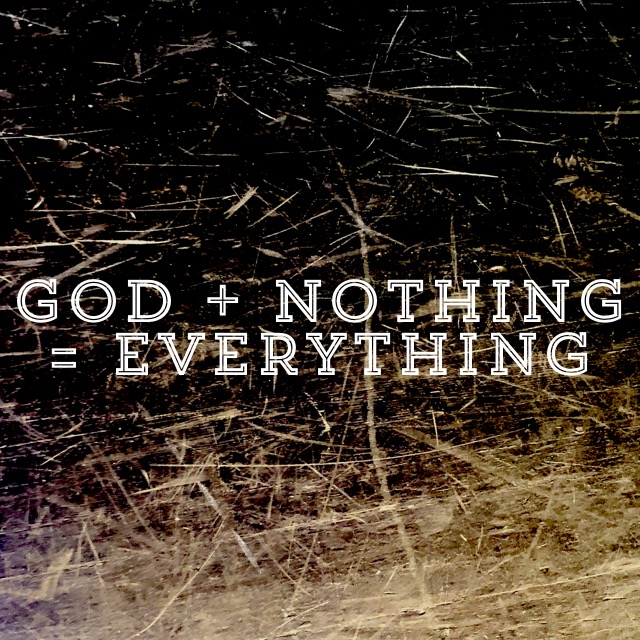
Bottom line—NOTHING can go in that blank. All we need is God.
“Your Father knows what you need” (Matthew 6:8). If you need wealth to complete His purpose for your life, He will give it to you. If you don’t, He will withhold it. But He will always give you your daily bread.
If you need a prominent position, He will place you there; if you don’t, He will withhold that position. In either place, we still submit as faithful servants to holy God.
If success will allow me to bring glory to God, He will give me success; if falling flat on my face will allow me to bring glory to God, He will knock me down.
If physical health will allow me to share the Gospel with others, God will keep me healthy; if I can serve Him best from a place of physical limitation, I can still do all things through Christ who strengthens me.
“My God is able to supply all your needs” (Philippians 4:19). He gives me all that I need to fulfill His plans for me. “So do not worry” about your bank balance, your standing in the community, your health, your family, or anything else. His grace is sufficient for you.
This is a weekly series with things I’m reading and pondering from Oswald Chambers. You can read the original seed thought here, or type “Thursdays With Oswald” in the search box to read more entries.
Hear And Do
The emphasis in these verses [Matthew 7:24-29] is laid by our Lord on hearing and doing. … We hear only what we listen for. Have we listened to what Jesus has to say? Have we paid any attention to finding out what He did say? Most of us do not know what He said. If we have only a smattering of religion, we talk a lot about the devil; but what hinders us spiritually is not the devil nearly so much as inattention. We may hear the sayings of Jesus Christ, but our wills are left untouched, we never do them. …
Pay attention to His words, and give time to doing it. Try five minutes a day with your Bible. The thing that influences us most is not the thing that we give most time to, but the thing that springs from our own personal relationship, that is the prime motive that dominates us. …
“Build up your character bit by bit by attention to My words,” says Jesus, then when the supreme crisis comes, you will stand like a rock. … If a man has built himself up in private by listening to the words of Jesus and obeying them, when the crisis comes it is not his strength of will that keeps him, but the tremendous power of God. … All you build will end in disaster unless it is built on the sayings of Jesus Christ; but if you are doing what Jesus told you to do, nourishing your soul on His word, you need not fear the crisis whatever it is. …
There is a tendency in all of us to appreciate the sayings of Jesus Christ with our intellects while we refuse to do them. …
The Holy Spirit’s voice is as gentle as a zephyr, the merest check; when you hear it do you say, “But that is only a tiny detail, the Holy Spirit cannot mean that, it is much too trivial a thing”? The Holy Spirit does mean that, and at the risk of being thought fanatical you must obey. … What does it matter what anyone thinks of us as long as Jesus Christ thinks we are doing the right thing, as long as we can hear Him say, “Well done, good and faithful servant”?”
From Studies In The Sermon On The Mount
Hear/read God’s Word → Listen to how the Holy Spirit tells me to apply it to my life → Then apply it to my life → Repeat this process again tomorrow…
The foundational claim of Christianity is Jesus died AND rose to life again. The Apostle Paul says that if the resurrection didn’t happen, anyone who claims to be a Christian is in a world of hurt (1 Corinthians 15:3-4, 14, 17-20).
“But resurrected from the dead?! Really? I believe in facts. I believe in the laws of science.” Me too! But I also believe that the supernatural is not the opposite of belief in the natural. Just like Paul said, “Why should any of you consider it incredible that God raises the dead?” (Acts 26:8).
Noted astronomer Allan Rex Sandage said, “It is my science that drove me to the conclusion that the world is much more complicated than can be explained by science. It was only through the supernatural that I can understand the mystery of existence.”
And C.S. Lewis added, “How can anything be seen to be an exception till the rules are known? … Nothing can seem extraordinary until you have discovered what is ordinary. Belief in miracles, far from depending on an ignorance of the laws of nature, is only possible in so far as those laws are known.”
Let me give you a simple example. Suppose I divide $5 evenly between two of my buddies. The laws of mathematics dictate that both of them will have $2.50. But what if one of my friends, through some sleight of hand, steals some of my other friend’s money? The fact that one of them now has more than half doesn’t change that mathematical law that $5 divided evenly is two sets of $2.50.
The mathematician as a mathematician doesn’t know how likely one friend is to steal some of the other friend’s money. For that answer, he has to ask someone else. The changing of the outcome does not negate the laws. In fact, the more certain we are of the laws of mathematics the more clearly we know that something outside of them “interfered.”
Concerning Jesus, there are three undeniable facts—
It appears the laws of biology have been interfered with, that a supernatural miracle has occurred. The supernatural fact that Jesus was resurrected does not change the biological fact that death is irreversible. We just didn’t expect the outside influence. Just like we didn’t expect one friend to steal money from another friend.
What does this mean for you and me? It means that you can trust God’s word. All of it! Jesus told us that He would die by crucifixion and that He would be resurrected three days later (John 10:18; Matthew 20:19).
If that word came true, we can also trust this word: We can have our sins forgiven and receive God’s gift of eternal life—just as Christ was raised from the dead through the glory of the Father, we too may live a new life (Romans 6:4).
The law of sin says: All of us have sinned and fallen short of God’s standard. The unbreakable law of sin is that the penalty for unforgiven sin is eternal death. That law cannot be broken, unless there is a Supernatural interference—a miracle!
Jesus interfered. He took our sins upon Himself. He supernaturally switched places with us and let the death penalty fall on Himself. And if we believe in that, we can have our sins forgiven and receive what we didn’t expect—eternal life with God!
What a God we have! And how fortunate we are to have Him, this Father of our Master Jesus! Because Jesus was raised from the dead, we’ve been given a brand-new life and have everything to live for, including a future in heaven—an inheritance that is kept in heaven for you, pure and undefiled, beyond the reach of change and decay (1 Peter 1:3-4 MSG & NLT)
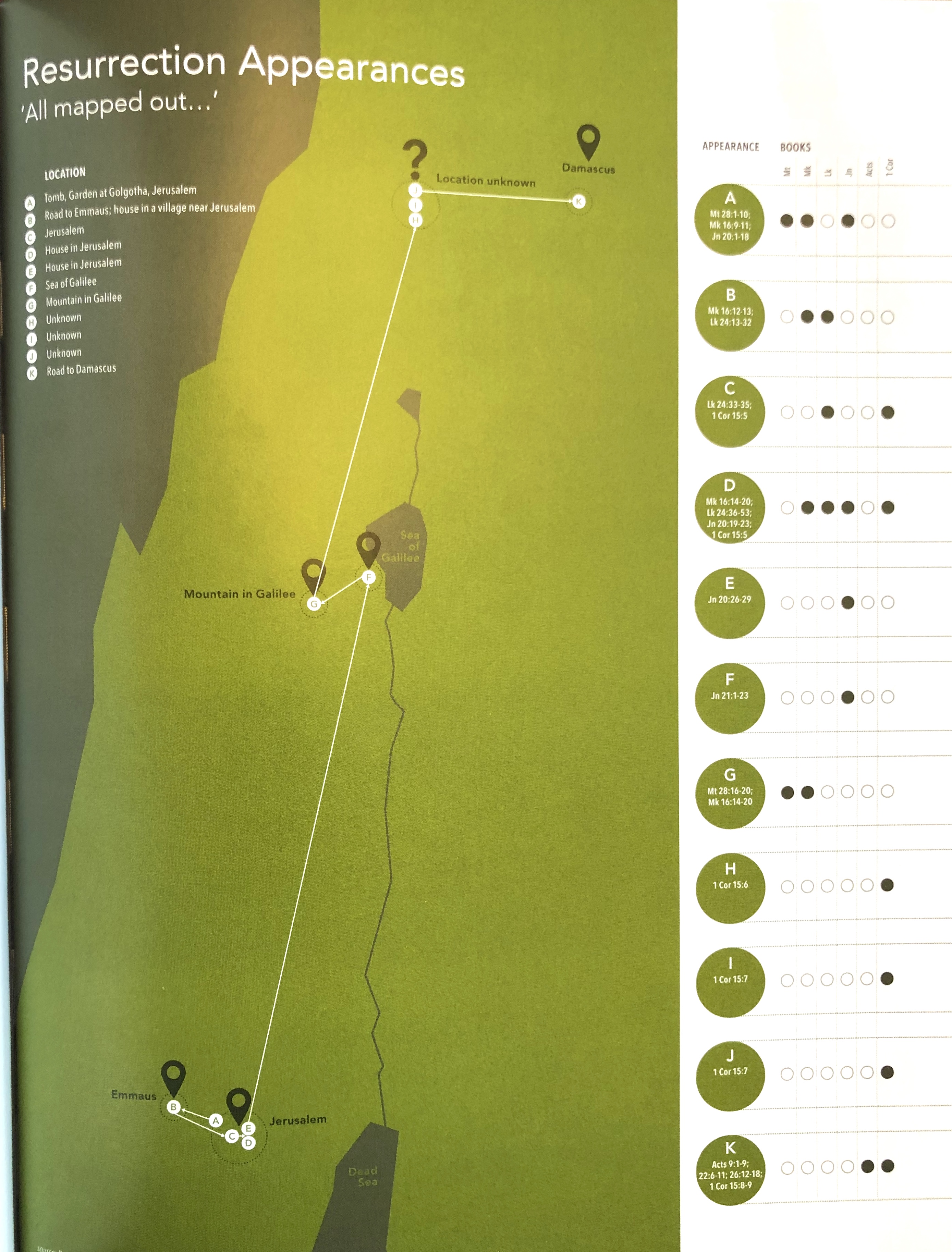
The appearances of Jesus after His resurrection aren’t just limited to the four Gospels (Matthew, Mark, Luke, and John), but also in the books of Acts and 1 Corinthians. Check out this infographic from The Infographic Bible by Karen Sawrey.
(click the image to zoom in)
Jesus appeared at…
A—an empty tomb in the Garden at Golgotha in Jerusalem (Matthew 28:1-10; Mark 16:9-11; John 20:1-18)
B—on the road to Emmaus (Mark 16:12-13; Luke 24:13-32)
This is a weekly series with things I’m reading and pondering from Oswald Chambers. You can read the original seed thought here, or type “Thursdays With Oswald” in the search box to read more entries.
Do You Have The Goods Or Just The Label?
Our Lord makes the test of goodness not only goodness in intention, but the active carrying out of God’s will. Beware of confounding appearance and reality, of judging only by external evidence. …
The baptism of the Holy Ghost turns men into the incarnation of what they preach until the appearance and the reality are one and the same. … He does in us what Jesus did for us. …
Human nature is fond of labels, but a label may be the counterfeit of confession. It is so easy to be branded with labels, much easier in certain stages to wear a ribbon or a badge than to confess. Jesus never used the word testify; He used a much more searching word—confess. ‘Whosoever therefore shall confess Me before men…’ [Matthew 10:32-33]. The test of goodness is confession by doing the will of God. ‘If you do not confess Me before men,’ says Jesus, ‘neither will your Heavenly Father confess you.’ Immediately we confess, we must have a badge, if we do not put one on, other people will. Our Lord is warning that it is possible to wear the label without having the goods; possible for a man to wear the badge of being His disciple when he is not. Labels are all right, but if we mistake the label for the goods we get confused.
Some people only wear the labels—they use the name “Christian” without ever surrendering to the lordship of Jesus. Oswald Chambers reminds us that these are the people to whom Jesus will say, “I never knew you” (Matthew 7:21-23).
Listen to the Holy Spirit. He can make sure that your preaching your living are one and the same. You and I don’t want to just testify that we are disciples of Jesus, but we want to be the living incarnation of all that Jesus did and taught.
Labels are fine (if other people put them there), but just make sure you have the goods! I’ll say it again: Listen to the Holy Spirit and immediately obey what He points out to you.
Listen to the podcast of this post by clicking on the player below, and you can also subscribe on Apple, Spotify, or Audible.
Jesus is on His passionate journey toward the Cross. Every step on this journey is a step of love.
After Jesus finished His last supper with His disciples, they all went to one of their favorite places to pray—the Garden of Gethsemane. It was a place they all knew well. Including Judas, who had been looking for an opportunity to turn Jesus over to the religious authorities when He was out of the public eye.
Jesus knew this time was coming (Matthew 10:33-34; John 13:1, 3; 18:4), and His knowing prompted His serving. So we can say that His foot-washing service was as much a reminder to Himself as it was to His followers.
But let us never forget that through all of this horrific, inhumane mistreatment and torture, Jesus remains the King of kings, the Son of God. In fact, very God Himself.
The Jewish religious leaders knew this too (John 8:54-59; 10:31-33). And without “knowing it” the soldiers that came to arrest Jesus knew it as well.
Just look at the absolute authority of the King of kings. Grown men—religious leaders and hardened soldiers—fall to their knees at just three words: “I am He.”
Christ’s kingdom has overruling authority. It collects no taxes, it has no standing army, it requires no checks-and-balances because its Sovereign IS Truth and Love. This unequaled, unrivaled power was contained in Jesus—“You would have no authority over Me unless it was given you from above.”
Which makes His submission to Pilate and others even more amazing! One word from Him could have crushed legions and toppled governments—yet for love’s sake, He submitted. Let that sink in—Sovereignty submitted.
What appeared to be the cruelty of man was the sovereignty of God.
No one can take My life from me. I sacrifice it voluntarily. For I have the authority to lay it down when I want to and also to take it up again. For this is what My Father has commanded. (John 10:18)
“Christ’s death was not the death of a martyr, who sinks at last overwhelmed by enemies, but the death of a triumphant conqueror, who knows that even in dying He wins for Himself and His people a kingdom and a crown of glory.” —J.C. Ryle
Christ has bought us out from under the doom of that impossible system by taking the curse for our wrongdoing upon Himself. For it is written in the Scripture, “Anyone who is hanged on a tree is cursed” (as Jesus was hung upon a wooden Cross). (Galatians 3:13 TLB)
Sovereign love submitted to the cruelty of man SO THAT you and I could be saved from the inescapable doom that will inevitably crash down on us. Jesus loved us so much that He allowed the Cross to happen to Him.
The question now remains—what are you doing with this sovereign love?
Do you know Jesus as your Savior? Have you received this gift He willingly, lovingly purchased for you on the Cross?
This is a weekly series with things I’m reading and pondering from Oswald Chambers. You can read the original seed thought here, or type “Thursdays With Oswald” in the search box to read more entries.
Do You Pass The Tests?
In these verses [Matthew 7:15-20] Jesus tells His disciples to test preachers and teachers by their fruit. There are two tests—one is the fruit of the life of the preacher, and the other is the fruit of the doctrine. The fruit of a man’s own life may be perfectly beautiful, and at the same time he may be teaching a doctrine which, if logically worked out, would produce the devil’s fruit in other lives. It is easy to be captivated by a beautiful life and to argue that therefore what he teaches must be right. Jesus says, “Be careful, test your teacher by his fruit.” The other side is just as true, a man may be teaching beautiful truth and have magnificent doctrine while the fruit in his own life is rotten. We say that if a man lives a beautiful life, his doctrine must be right; not necessarily so, says Jesus. Then again we say because a man teaches the right thing, therefore his life must be right; not necessarily so, says Jesus. Test the doctrine by its fruit, and test the teacher by his fruit.
From Studies In The Sermon On The Mount
Yes, we should test our teachers and preachers by: (1) the fruit of their life, and (2) the fruit of their doctrine. But all Christians should also make sure our own lives pass the same test.
Chambers goes on to share these thoughts—
“It is appallingly easy to pretend. If once our eyes are off Jesus Christ, pious pretense is sure to follow. … We have to beware of pretense in ourselves. It is an easy business to appear to be what we are not.”
“If we say we are right with God, the world has a perfect right to watch our private life and see if we are so. … Fruit-bearing is always mentioned as the manifestation of an intimate union with Jesus Christ (John 15:1-5). … Jesus Christ makes publicity the test; He lived His own life most publicly (John 18:20). … It is God’s law that men cannot hide what they really are. If they are His disciples it will be publicly portrayed.”
“God’s spiritual open air is the Bible. The Bible is the universe of revelation facts; if we live there our roots will be healthy and our lives right.”
We need to always listen to the voice of the Holy Spirit when we ask, “Am I passing these two tests of true fruitfulness?”
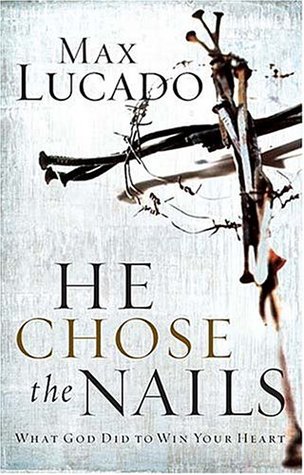
Max Lucado takes us in for a closer look at the Cross and all that Jesus did there for us. Please check out my full book review and then read this book—you will be glad you did!
“Maybe you’ve never spit on anyone, but have you gossiped? Slandered? Have you ever raised your hand in anger or rolled your eyes in arrogance, have you ever blasted your high beams in someone’s rearview mirror? Ever made someone feel bad so you would feel good? That’s what the soldiers did to Jesus. When you and I do the same, we do it to Jesus too. ‘I assure you, when you did it to one of the least of these My brothers and sisters, you were doing it to Me!’ (Matthew 25:40 NLT). How we treat others is how we treat Jesus. …
“Allow the spit of the soldiers to symbolize the filth in our hearts. And then observe what Jesus does with our filth. He carries it to the Cross. Through the prophet He said, ‘I did not hide My face from mocking and spitting’ (Isaiah 50:6). Mingled with His blood and sweat was the essence of our sin.”
“‘He canceled the record that contained the charges against us. He took it and destroyed it by nailing it to Christ’s Cross’ (Colossians 2:14 NLT). Between His hands and the wood there was a list. A long list. A list of our mistakes: our lusts and lies and greedy moments and prodigal years. A list of our sins. Dangling from the Cross is an itemized catalog of your sins. The bad decisions from last year. The bad attitudes from last week. There, in broad daylight for all of heaven to see, is a list of your mistakes. … The list God has made, however, cannot be read. The words can’t be deciphered. The mistakes are covered. The sins are hidden. Those at the top are hidden by His hand; those down the list are covered by His blood. Your sins are ‘blotted out’ by Jesus (KJV). ‘He has forgiven you all your sins: He has utterly wiped out the written evidence of broken commandments which always hung over our heads, and has completely annulled it by nailing it to the Cross’ (Colossians 2:14 Phillips).”
“Seats at God’s table are not available to the sloppy. But who among us is anything but. Unkempt morality. Untidy with truth. Careless with people. Our moral clothing is in disarray. Yes, the standard for sitting at God’s table is high, but the love of God for His children is higher. So He offers a gift.… a seamless robe… a robe worn by His Son, Jesus.”
“What appeared to be the cruelty of man was actually the sovereignty of God. Matthew tells us: ‘And when Jesus had cried out again in a loud voice, He gave up His spirit. At that moment the curtain of the temple was torn into from top to bottom’ (27:50-51). It’s as if the hands of heaven had been gripping the veil, waiting for this moment.”
“Why is the Cross the symbol of our faith? To find the answer look no farther than the Cross itself. Its design couldn’t be simpler. One beam horizontal—the other vertical. One reaches out—like God‘s love. The other reaches up—as does God’s holiness. One represents the width of His love; the other reflects the height of His holiness. The Cross is the intersection. The Cross is where God forgave His children without lowering His standards.”
“‘Just look what they did to me!’ we defy and point to our hurts. ‘Just look what I did for you,’ Jesus reminds and points to the Cross. Paul said it this way: ‘If someone does wrong to you, forgive that person because the Lord forgave you’ (Colossians 3:13). You and I are commanded—not urged, commanded—to keep no list of wrongs.”
“Knowing His last deeds would be forever pondered, don’t you think Jesus chose them carefully? Deliberately? Of course He did. There were no accidents that day. Jesus’ last moments were not left up to chance. God chose the path; He selected the nails. Our Lord planted the trio of crosses and painted the sign. God was never more sovereign than in the details of the death of His Son. … The message: ‘I did it for you. I did it all for you.’”



 If I were to ask you to define the material/physical part of you versus the immaterial part of you, it probably wouldn’t be too difficult. Obviously, we can touch the physical part but we cannot touch the immaterial part.