Listen to the podcast of this post by clicking on the player below, and you can also subscribe on Apple, Spotify, or Audible.
The word amazement shows up numerous times throughout the Gospels. As you might expect, it’s almost always associated with something Jesus said or did. He would heal someone, calm a storm, silence His detractors, or teach persuasively, and the people stood amazed!
But there are two instances where Jesus Himself is amazed.
The first time is when a Roman centurion sends a message to Jesus by way of a servant. This centurion asks Jesus to speak a word of healing over another one of his servants. He says that just a word from Jesus will be sufficient, and he doesn’t need Jesus to personally come to his house.
When Jesus heard this, He was amazed. “Turning to those who were following Him, He said, ‘I tell you the truth, I haven’t seen faith like this in all Israel!’” (Matthew 8:10; Luke 7:9).
Because of this centurion’s faith, his servant was immediately healed!
The second time Jesus was amazed was when He was visiting His hometown. There He discovered people with whom He had grown up that refused to believe that He was who He claimed to be. As a result, Jesus “was amazed at their unbelief” (Mark 6:6).
So either Jesus is amazed at our faith in Him, or He is amazed at our unbelief in Him. When I have faith in Jesus—when I believe He is who He says He is, and that He is willing to do what He says He will do—He is amazed at my faith and can do miracles on my behalf. But when I doubt, when I allow my unbelief to seize my heart, I exclude myself from the miracles He wants to do.
Jesus will be amazed at you. Will He be amazed at your faith in Him? Or will He be amazed at your unbelief in His power that is waiting to be released on your behalf? I pray that Jesus will always be amazed at our faith in Him.
Listen to the podcast of this post by clicking on the player below, and you can also subscribe on Apple, Spotify, or Audible.
The word “amazed” shows up numerous times throughout the Gospels, almost always associated with something Jesus said or did. He would heal someone, calm a storm, silence His detractors, or teach persuasively. And the people marveled!
But there are two instances where Jesus Himself is amazed, where the Bible says He marveled at what someone said.
The first is when a centurion asked Jesus for help, but said he didn’t need Jesus to be personally present. He told Jesus that just a word from Him would be more than enough to heal a sick servant. Jesus was amazed at this man’s faith, and as a result, the servant was healed (Matthew 8:10; Luke 7:9)!
The second time that Jesus was amazed was when He was visiting His hometown and the people with whom He grew up didn’t believe He was who He claimed to be. As a result, Jesus was amazed and the Bible says He was unable to do many miracles there (Mark 6:6). How sad!
It’s still true today. Either Jesus will be amazed at our faith or He will be amazed at our unbelief. When we have faith in Him—when we stand amazed and in awe and in expectation of His power—He is amazed and can perform miracles. But when we push Jesus away and say, “We can take care of this ourselves,” Jesus is also amazed. But this type of amazement results in Jesus being unable to unleash His miraculous power on our behalf.
Let’s learn this amazing lesson, and always stand amazed at who Jesus is and what Jesus can do. When we are amazed, and our faith grows stronger, Jesus will be amazed at our faith and will move on our behalf in amazing ways!
Listen to the podcast of this post by clicking on the player below, and you can also subscribe on Apple, Spotify, or Audible.
We said last week that nobody likes to be around a complainer, although many complainers would say they’re not complaining but just sharing facts. In their mind, they have a legitimate right to let everyone know how they’ve been short-changed, gotten a bad deal, or experienced something that no one else has gone through.
Have you ever heard your kids say, “I’m starving”? And perhaps you think, “Do you really know what starving is?” Or what about people waving their very expensive phones around as they complain, “Isn’t there any WiFi here?!”
This isn’t a glass half-full or half-empty thing. This is really closing your eyes to the fact that many people don’t even have a glass, or if they do have a glass, they don’t have access to the water that they need.
I was delivering some Christmas toys to a family and I discovered they had lost everything they owned. When I came to their house their furniture was mismatched, their food and clothes were donated, and their kids only had a couple of simple toys to play with. And yet this family was happy to be together!
That sort of puts things in perspective, doesn’t it?
We have to choose grumbling or gratefulness, but as E.M. Bounds noted, “Gratitude and murmuring never abide in the same heart at the same time.” So if you are complaining about what you don’t have, you cannot be grateful for what you do have.
There is a fascinating story told in all four Gospels of a woman named Mary. She was an uninvited guest at a house where Jesus and His disciples had been invited to dinner. Jesus was not there because someone was grateful to have Him in his home, but because Simon the Pharisee and his cronies were trying to find a reason to accuse Jesus of wrongdoing.
Simon was so focused on his “gotcha” moment that he completely overlooked his host duties. He didn’t wash Jesus’ feet, nor greet Him with a kiss, nor anoint Him with perfume, as the custom of the day demanded. But Mary, standing behind Jesus at the dinner table, washed Jesus’ feet with her tears, kissed His feet, and anointed Him with an entire bottle of costly perfume! She did all of this out of gratitude for what she had received from Jesus.
First, I would like you to consider what Mary didn’t have:
a seat at the table—even though the dinner was in her hometown of Bethany, her brother Lazarus was invited to the meal, and her sister Martha was serving the meal
a good reputation—twice Simon the Pharisee said, “Does Jesus even know what kind of woman she is? Does He know she is a sinner?”
the acceptance or approval of others—even the disciples thought her gesture of anointing Jesus with so much perfume was a wasted extravagance
Next, let’s look at what Simon did have:
an elevated position as a Pharisee
considerable wealth—he had servants and a home large enough for a big dinner party
healing from leprosy—the Gospels refer to him as “Simon the leper” which tells us that he had been healed of his leprosy
Now, let’s consider what the disciples did have:
an enviable position as disciples of Jesus
a dinner invitation to Simon’s house
access to the financial resources that people gave to Christ’s ministry
and let us never overlook the fact that they had access to Jesus Himself like no one else had
Finally, let’s look at what Mary did have:
forgiveness—Luke says this about her, “A woman who HAD lived a sinful life”
Gratitude is truly a great attitude. Grateful people stand out because they don’t grumble about what they don’t have, but they are focused on what they do have.
Mary knew that she didn’t have the outward marks of success or favor or approval, but she did have the assurance that she had been forgiven. For that, she was more than willing to give everything she had to Jesus in thankful worship!
And as a result, look what Mary now has:
the kind words of Jesus—He assured her that she was forgiven (Luke 7:47)
Jesus as her defender—He told His disciples, “Leave her alone” (John 12:7)
an eternal testimony—Jesus said that wherever the Gospel was preached, people would tell Mary’s story (Matthew 26:13)
I think a good way to sum up the distinguishing way grateful people live is like this: They don’t grumble about what they don’t have, but they are extremely grateful for what they do have.
When you find grumbling slipping out of your mouth, remind yourself of just how much you have been given. Even if you think to yourself, “I don’t have much,” you can be assured that you have Jesus, and He is more than enough! And with that assurance, let your gratitude be lifted up in extravagant, fragrant praise to God.
We have a new kitten in our home and the places she shows up cracks me up!
In the Wall Street Journal, Andy Kessler said that without the discoveries and influence of Michael Faraday, “there would be no modern economy.” John Stonestreet built on this by explaining that “Faraday is an example of how Christians can balance the constructive purposes of science with an accurate understanding of scientific authority.” Indeed, Faraday’s Christian faith made his scientific findings even more powerful.
“For many years, evidence has been found showing that humans were surprisingly intelligent in times that were only supposed to reveal simple, ‘primitive’ man in his brute, evolving condition.” Now a new discovery has shown a surgical amputation that took place about 7000 years ago.
There’s a cool story in three of the Gospels where some creative, persistent friends took their paralyzed friend to Jesus. The Bible notes that “when Jesus saw *their* faith” He healed their friend. Wow! Which of your friends or family are too weak to pray for themselves? Who do you know that feels paralyzed and cannot get to Jesus? Be that friend who has faith for someone else. And be sure to check out more of my Monday Motivation videos too.
We have seen it in countless science fiction movies, but is it possible for artificially intelligent machines to take over the world? This is a great video from Science Uprising—
If you have known someone who has battled cancer, you know that their liver is quite vulnerable to metastatic cancer since everything in our body is filtered through the liver at some point. Researchers have discovered the mechanism by which this metastasis happens, opening the door for defensive measures that can be employed. Let’s pray for divine insight for these researchers!
Is Christianity rational? Cold-case detective J. Warner Wallace explains how Christianity stands up to intense scrutiny—
Listen to the podcast of this post by clicking on the player below, and you can also subscribe on Apple, Spotify, or Audible.
I had a great time on the Thriving In Ministry podcast with Kyle Willis while his podcast partner Dace Clifton was on sabbatical.
From all of the podcasts and interviews they had done, Kyle shared with me how so many pastors find it difficult to take a Sabbath break. Kyle noted that a pastor’s day of rest seems to bump into everyone else’s day of work.
That passage in Mark 6 that I mentioned is instructive for leaders in a couple of ways. First, Jesus was looking out for His teammates. He saw that they were tired and He called them to a place of rest. Good shepherds are always tuned in to the needs of the flock around them. As David said in Psalm 23, the Good Shepherd knows when to lead us to quiet pastures and still waters.
Second, I see that Jesus was also tuned in to Himself. Even though He was trying to get to a quiet place, He took time to minister in teaching and food to a crowd that was described as “sheep without a shepherd.” When this time was finished, Jesus took time alone to pray (Mark 6:46).
I think sometimes leaders have sabotaged their own health and effectiveness by saying things like, “This is quitting time” or “This is my day off.” Instead, we should listen to the Holy Spirit giving us insight like, “Take a break now. It’s time to go to a quiet pasture. It’s time to recharge in prayer.”
Leaders, don’t stick rigidly to your schedule but stay tuned in to yourself. Listen for the unmistakable voice of the Holy Spirit giving you wisdom. I have a section of five chapters in my book Shepherd Leadership that deal with every aspect of a leader’s health. Please pick up a copy today.
I’ll be sharing more clips from this Thriving In Ministry interview soon, so please stay tuned. Shepherd Leadership: The Metrics That Really Matter is available in print or ebook, and in audiobook through either Audible or Apple.
Listen to the podcast of this post by clicking on the player below, and you can also subscribe on Apple, Spotify, or Audible.
I am always interested when I see contrasts in the Bible. Things like:
Live this way, not that way
These people are blessed, these people have trouble
If you do this, you won’t have this
So an interesting contrast caught my eye in the story where Jesus calms the storm (Matthew 8:23–27). Jesus is sleeping peacefully in the middle of a storm that is described as “furious [where] the waves swept over the boat.” The disciples were anything but peaceful—they thought they were going to drown—so they yelled for Jesus to wake up.
Before Jesus calmed the storm, He says, “You of little faith, why are you so afraid?”
That’s the phrase that caught my attention. Notice the contrast between “little faith” and “so afraid.” In other words, small faith means big fear!
Strong’s Greek dictionary defines “little faith” as “dread (by implication) faithless.” So it appears there is an inverse proportion between faith and fear.
The word that Jesus used for “afraid” is only used here and in the same story in Mark 4:40, and in Revelation 21:8 which lists people who will be excluded from entrance into heaven.
The phrase “so afraid” (or “O ye of little faith” in the King James Version) is just one word in Greek: olgiopistos. The root word pistos is faith, but I find the prefix oligos very descriptive. It means:
small in quantity
short in time
slight in intensity
In other words, it is faith that is immature, or hasn’t been used much, or hasn’t been applied to a particular circumstance. This word olgiopistos is used five times in the New Testament, and only used by Jesus.
In addition to this story, it is used in Matthew 6:30 and Luke 12:28 when Jesus tells us not to worry about the things that God will provide for us—things like food, clothing, and shelter. Jesus uses this word for Peter when he began to sink in the water after walking a few steps toward Jesus. And Jesus uses it in Matthew 16:8 when He warns His disciples about the “yeast” of the Pharisees and Sadducees that can creep into their hearts and spoil their faith. (Check out all of these verses here.)
In mathematical circles, this relationship between faith and fear is one that would be called inversely proportional. When our faith is high, our fear is low; when our fear is high, our faith is low. I also think it is very eye-opening that the mathematical symbol for inverse proportionality (∝) is the same symbol called ichthus that the early church used to represent Jesus.
Faith and fear cannot coexist in the same heart. Sometimes our faith is small in quantity because we haven’t fed our faith with God’s promises. Sometimes our faith is short in time because we want things done on our time schedule. And sometimes our faith is slight in intensity because we are unsure if God can “come through” in this particular situation.
Whatever the case, when we feel any fear, we need to ask for faith. We need to return to God’s Word and be assured that His promises are applicable regardless of the situation we are in. As our faith grows, our fear has to diminish!
Listen to the podcast of this post by clicking on the player below, and you can also subscribe on Apple, Spotify, or Audible.
Perhaps you’ve heard the phrase, “The best laid plans of mice and men often go awry.”
This is a line from a poem written by Robert Burns in 1785 called To A Mouse. The story behind the poem is Burns had been plowing his field and destroyed a nest that a mouse had been working all day to build. His poem was written as an apology. The famous line from the Scottish poet actually is written like this—
The best laid schemes o’ Mice an’ Men
Gang aft agley,
An’ lea’e us nought but grief an’ pain,
For promis’d joy!
That phrase “gang aft agley” means often go awry.
Do you ever feel this way? Like your perfectly planned agenda got derailed before you even finished breakfast? Or that your To Do list never quite gets “To Done” by the end of the day?
I had a great time on the Thriving In Ministry podcast with Kyle Willis while his podcast partner Dace Clifton was on sabbatical. We had planned to discuss how to help pastors get some rest so they could be at their optimal health, but our best laid plans definitely “gang aft agley”! We had multiple technical issues before we could even start recording, and then just as we talked about how pastors could find a way to rest, well, this happened…
Ah yes! Plans gone awry, indeed!
But here is an important principle for all of us to remember. The Bible says this: We can make our plans, but the Lord determines our steps (Proverbs 16:9). That means the thing that I call “an interruption” may be something or someone God has sent my way.
I used to really struggle with this, saying things like, “My plans never work out.” Until one day I heard the distinct voice of the Holy Spirit ask me, “Whose plans?”
Now listen, you who say, “Today or tomorrow we will go to this or that city, spend a year there, carry on business and make money.” Why, you do not even know what will happen tomorrow. What is your life? You are a mist that appears for a little while and then vanishes. Instead, you ought to say, “If it is the Lord’s will, we will live and do this or that.” (James 4:13-15)
Pastor, look at the life of Jesus. He often tried to get away for a time of rest, but people with needs showed up. His well-laid plans appeared to go awry. But He had compassion on them because He viewed them “like sheep without a shepherd” (Matthew 9:36; Mark 6:34). Jesus then found time to sabbath later.
Don’t view people with needs as an interruption or as something that derails your plans, but thank God for sending them your way. Then listen to the Holy Spirit showing you how and when you can get the rest you need to be energized to accomplish the rest of the items on your agenda.
I’ll be sharing more clips from this Thriving In Ministry interview soon, so please stay tuned. Shepherd Leadership: The Metrics That Really Matter is available in print or ebook, and in audiobook through either Audible or Apple.
Listen to the podcast of this post by clicking on the player below, and you can also subscribe on Apple, Spotify, or Audible.
We just finished a 2-week look at Psalm 88 & Psalm 89 which reminded us of the reality of temporary darkness and the certainty of eternal light. We said our dark days are meant to get our attention to rely on God’s covenant promise.
Something else we should be aware of: Whenever we run to or return to Jesus, the enemy of our souls prepares an attack (1 Samuel 7:3-10; 1 Peter 5:8).
The next psalm with a Selah is David’s prayer in Psalm 140. Selah appears 3 times in this short, 13-verse psalm.
We’ve said that Selah can mean a pause to carefully consider, a pause to observe the contrasts, or a pause to prepare for a crescendo. The Selahs after verses 3 and 5 don’t appear to fit the second or third definitions, but why would David ask us to pause to consider what wicked men are doing? I believe it is because we need to pause to contemplate two vital things, which I’ll share with you in a moment.
But first, notice the wicked men and evil times that David is confronting. He speaks of evildoers, violent people, wicked men, arrogant people, and slanderers (vv. 1, 4-5, 8, 11).
Surrounding the first two Selahs, check out David’s prayer for God to…
…rescue me (v. 1a)—get me out of here, or take the evil away from me
…protect me (v. 1b, 5b)—don’t let me be defeated or even diminished
…keep me (v. 4a)—we might say David is asking God to “watch my six” or guard the places I cannot see (notice the words net and traps in v. 5b)
The first Selah lesson we should take away is:There, but for the grace of God, go I.
If I hadn’t accepted Jesus as my Savior and had a new nature imparted to me, I would be doing exactly what these wicked people are doing. Paul tells Timothy what evil people will do, and he tells the Corinthian Christians that they used to be those same kinds of people (2 Timothy 3:1-5; 1 Corinthians 6:11).
When I see evil men, men of violence, and wicked people who are proud and slandering, I need to Selah to pray that the light and love of Jesus will be revealed to them.
The second Selah lesson we should take away is: God is doing something in my life through wicked men and evil times.
The words the Holy Spirit prompted David to pen have a richer definition than what I previously shared with you. Check this out…
…rescue me (v. 1a) also means make me strong and well-armed for battle
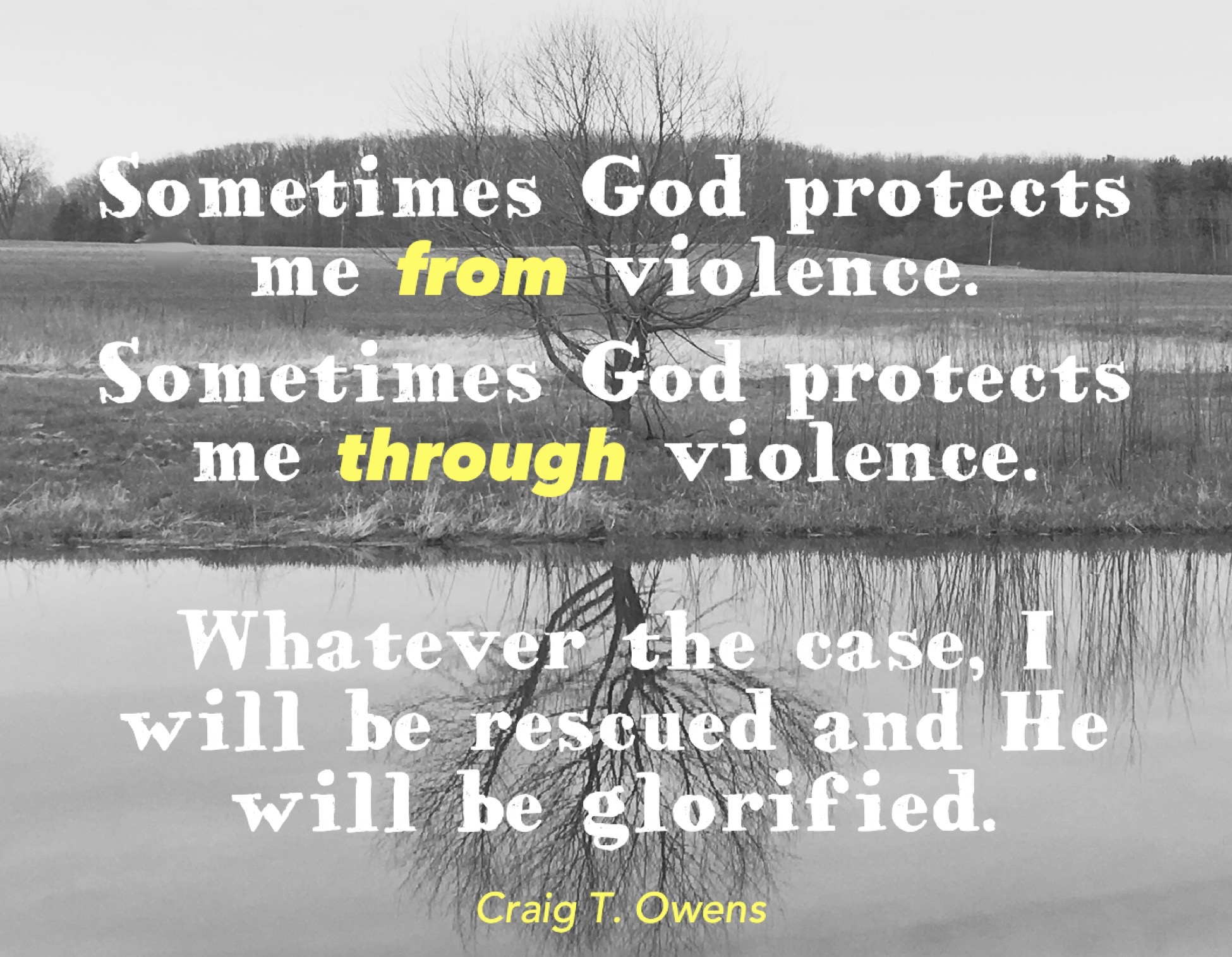
Sometimes God protects me from violence. Sometimes God protects me through violence. Whatever the case, I can be assured that I will be rescued and He will be glorified.This prayer in Psalm 140 is a prayer for protection so that we can be fruitful for God’s kingdom.
We need to Selah during the evil times we live in and whenever we have to endure wicked attacks.
Selah to thank God that you have been redeemed from that evil lifestyle by your faith in Jesus, and then pray for your attackers (Matthew 5:44).
Selah to thank God that He is using even evil people to make you more fruitful, to arm you for battle, and to glorify His name (Mark 13:9).
This is a weekly series with things I’m reading and pondering from Charles Spurgeon. You can read the original seed thought here, or type “Thursdays With Spurgeon” in the search box to read more entries.
Listen to the podcast of this post by clicking on the player below, and you can also subscribe on Apple, Spotify, or Audible.
God Means What He Says
…For the mouth of the Lord has spoken (Isaiah 1:20).
You talk about God as being ‘love,’ and if you mean by this that He is not severe in the punishment of sin, I ask you what you make of the destruction of Jerusalem? Remember that the Jews were His chosen nation and that the city of Jerusalem was the place where His temple had been glorified with His presence. Brethren, if you roam from Edom to Zion and from Zion to Sidon and from Sidon to Moab, you will find, amid ruined cities, the tokens that God’s words of judgment are sure. Depend on it, then, when Jesus says, ‘These will go away into everlasting punishment’ (Matthew 25:46), it will be so. When He says, ‘If you do not believe that I am He, you will die in your sins’ (John 8:24), it will be so. …
It is of no avail to sit down and draw inferences from the nature of God and to argue, ‘God is love, and therefore He will not execute the sentence upon the impenitent.’ He knows what He will do better than you can infer. He has not left us to inferences, for He has spoken pointedly and plainly. He says, ‘He that believes not shall be damned’ (Mark 16:16), and it will be so, ‘for the mouth of the Lord has spoken.’ Infer what you like from His nature. But if you draw an inference contrary to what He has spoken, you have inferred a lie and you will find it so. …
I know why you do not believe in the terrible threats. It is because you want to be easy in your sins. … Yet if you do not believe its loving warnings nor regard its just sentences, they are true all the same. If you dare its thunders, if you trample on its promises, and even if you burn it in your rage, the Holy Book still stands unaltered and unalterable. ‘The mouth of the Lord has spoken.’ Therefore, I pray you, treat the sacred Scriptures with respect and remember that ‘these are written that you may believe that Jesus is the Christ, the Son of God, and that believing you might have life through His name’ (John 20:31).
From The Infallibility Of Scripture
Spurgeon delivered this sermon on March 11, 1888. Nearly 2000 years earlier, Asaph delivered a similar message from God—
“Call upon Me in the day of trouble; I will deliver you, and you shall glorify Me.” But to the wicked God says: “What right have you to declare My statutes, or take My covenant in your mouth, seeing you hate instruction and cast My words behind you?When you saw a thief, you consentedwith him, and have been a partaker with adulterers. You give your mouth to evil, and your tongue frames deceit. You sit and speak against your brother; you slander your own mother’s son.These things you have done, and I kept silent; you thought that I was altogether like you; but I will rebuke you, and set them in order before your eyes. Now consider this, you who forget God, lest I tear you in pieces, and there be none to deliver:Whoever offers praise glorifies Me; and to him who orders his conduct aright I will show the salvation of God.” (Psalm 50:15-23)
Commenting on this passage from Psalm 50, T.M. Moore wrote, “Surely, this is the most fundamental error of thinking humans ever make: To think of God, spiritual things, worship, human life, the world, and everything else from our vantage point rather than His. … Asaph could see what was happening. And even though the nation was safe, strong, and surfeited with wealth, he knew that, spiritually, things were going awry. The people had persuaded themselves that God was just like them, that He thought like they did, and so was agreeable to their doing things their own way, indulging all their base desires, and pursuing their schemes for success—all the while continuing an outward show of faith.”
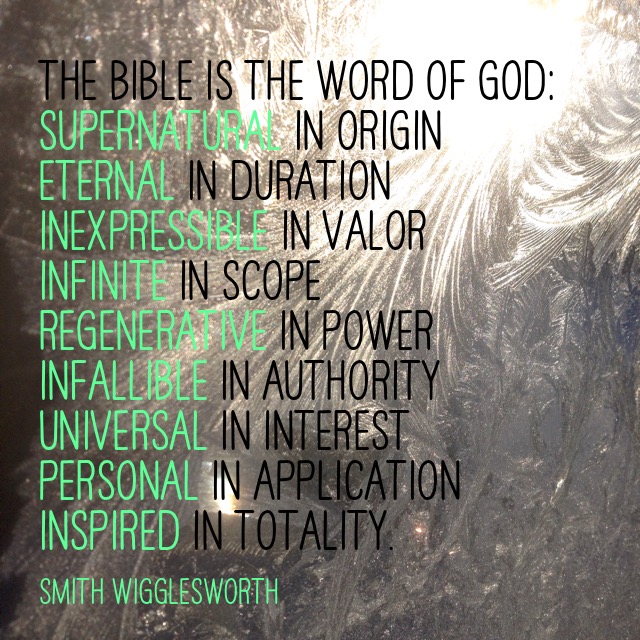
Let us take the Bible as what it truly is: Words the mouth of God has spoken. Let us not play games with them, changing the message to words we like. But if the Word of the Lord makes us uncomfortable, let us repent and return to Him. It is those who accept God’s Word as His Word, and obey it, that will see the salvation of God.
Listen to the podcast of this post by clicking on the player below, and you can also subscribe on Apple, Spotify, or Audible.
“When you become a leader, you lose the right to think about yourself.” —Gerald Brooks
Sadly, I encounter far too many “leaders” (at least they are leaders in title only) who think being a leader means they have more rights. It might be the right to a better parking place, or to be first in line, or to ignore some of the rules that others have to follow.
That certainly wasn’t the attitude of the apostle Paul in 1 Corinthians 9, a chapter which the NIV gives the heading ‘Paul Gives Up His Rights’:
Since we have planted spiritual seed among you, aren’t we entitled to a harvest of physical food and drink? If you support others who preach to you, shouldn’t we have an even greater right to be supported? But we have never used this right. We would rather put up with anything than be an obstacle to the Good News about Christ. (1 Corinthians 9:11-12 NLT)
Paul said the natural thing was for those in leadership to feel entitled to certain rights, but the spiritual thing is to turn those rights into responsibilities toward the people around us.
Spiritual leadership is not about gaining more rights, it’s about fulfilling God-given responsibilities. In fact, the higher you progress in a leadership role, the fewer rights you have. Godly servant leaders gladly trade rights for responsibilities.
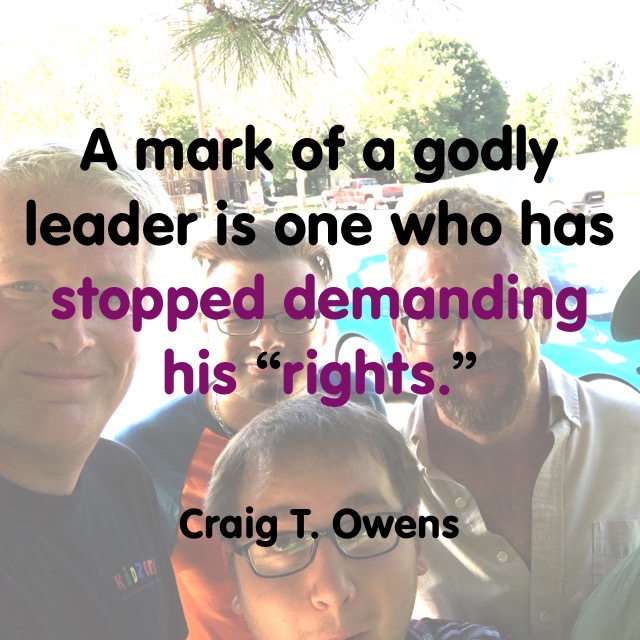
A mark of a godly leader is one who has stopped demanding his “rights.”
To trade our rights for responsibilities is a sacrifice. But I don’t mean a sacrifice that comes with a “Woe is me!” feeling. God will only ask us to sacrifice what is holding us back. God wants to use His leaders to minister to His people. He will not give us a larger position if we are only going to use that for our own benefit.
Consider the rights Jesus had because He was fully God. Yet He made the ultimate rights-for-responsibilities sacrifice by going to the Cross in our place. “The Son of Man did not come to be served, but to serve, and to give His life as a ransom for many” (Mark 10:45).
Leaders, I encourage you to ask the Holy Spirit to show you where you may be clinging to your rights, and how you can exchange those rights for responsibilities to the people God has placed under your care.
This is part 65 in my series on godly leadership. You can check out all of my posts in this series by clicking here.



 The word amazement shows up numerous times throughout the Gospels. As you might expect, it’s almost always associated with something Jesus said or did. He would heal someone, calm a storm, silence His detractors, or teach persuasively, and the people stood amazed!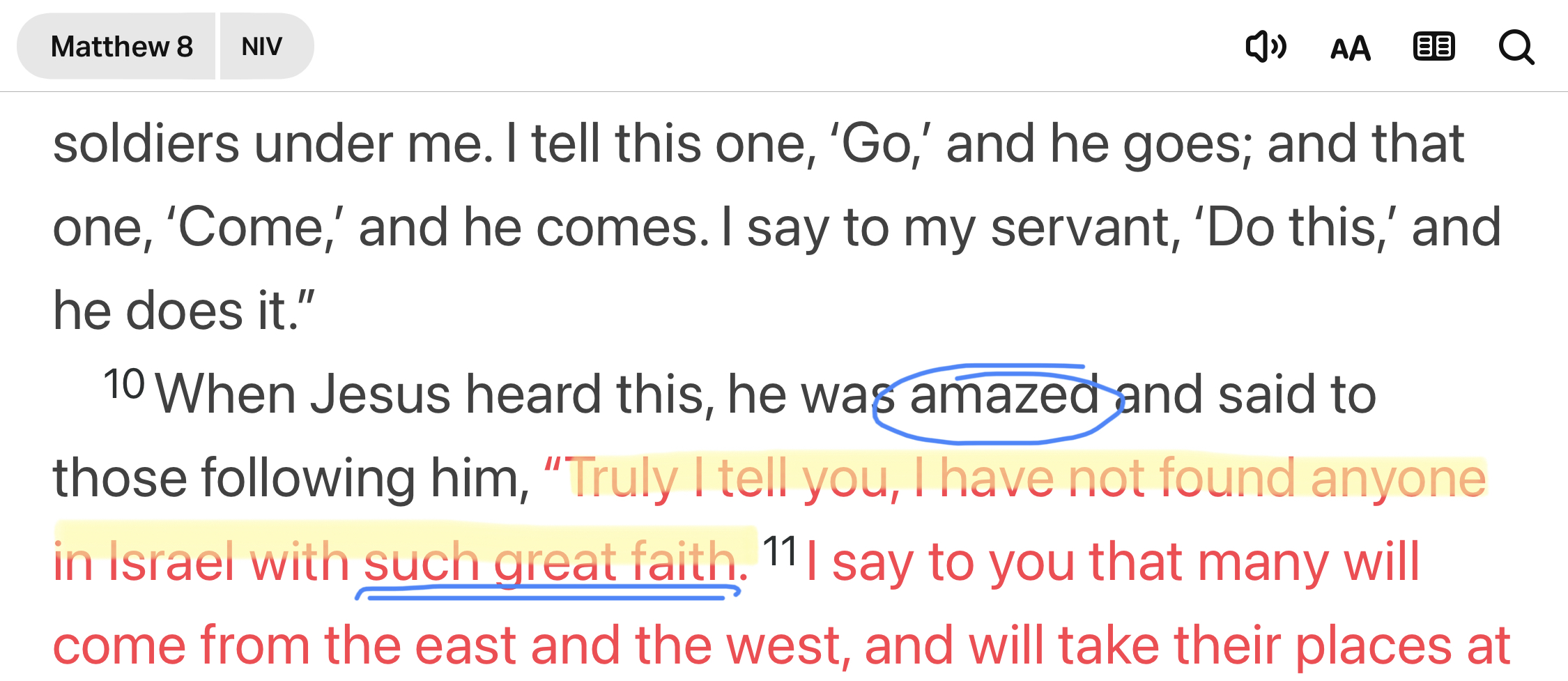









 Craig T. Owens