Links & Quotes

The armor of God is not for us to fight in but to shield us while we pray. Prayer is the weapon!

I have a lot of new video content on my YouTube channel every week. Please check it out and subscribe so you don’t miss anything.

“Psychologists, since the beginning of the discipline, have argued about the essence of what it means to be human. Some, like [Sigmund] Freud, insist that we are motivated by physical pleasure, while others, like Victor Frankl or Abraham Maslow, believe that some higher purpose…. Human beings, made in the image and likeness of God, only realize their full potential and pleasure as they participate in the very being of God and know and experience the pleasure He takes in Himself and His glory.” —T.M. Moore 

“If you are persevering in faith today, you owe it to the blood of Jesus. The Holy Spirit, who is working in you to preserve your faith, is honoring the purchase of Jesus. God the Spirit works in us what God the Son obtained for us. The Father planned it. Jesus bought it. The Spirit applies it—all of them infallibly.” —John Piper

“The Hebrew word Davar (דבר, pronounced ‘daw-var’) reveals something profound about God’s Word—it’s not merely information, but transformation. … Throughout Scripture, God’s Word consistently proves both living and active. It has the power to create worlds (Genesis 1), transform lives (Psalm 119:105), and accomplish God’s purposes (Isaiah 55:11).” —Dave Adamson 

More fascinating archeology that supports the Bible’s historicity. This is a look at the library of letters found at Tell el-Amarna in Egypt. “The most obvious connection between the Amarna Letters and biblical history is that some of the letters appear to be describing, in real-time, the attacks of the Israelites during the period of the conquest. Remember, the initial conquest battles took a period of some 5–6 years, but the attempts by various tribes to conquer their allotted territories lasted into the period of the Judges. The letters from the rulers of some of the very cities named in the biblical conquest calling for help from the attacking ʿapîru/ḫa-bi-ru, provide a poignant backdrop to this period of biblical history.”

“Because I am your constant Companion, there should be a lightness to your step that is observable to others. Do not be weighed down with problems and unresolved issues, for I am your burden-bearer.” —Jesus in Sarah Young’s Jesus Calling, based on Psalm 31:19–20; John 16:33

The Benefits Of The Right Kind Of Pastoral Stress

I was very honored to be asked to share these thoughts on KarlVaters.com. I was able to interview Karl about his latest book De-Sizing The Church.

(Photo by Official Presidio of Monterey | Flickr)

Jesus was “made like His brothers in every way” (Hebrews 2:17), which means He was not immune to the ravages of stress, yet He never let that stress overwhelm Him.

No one wants more stress. But attempting to avoid all stress can carry negative results that we seldom take into account.

In this guest article, Craig T. Owens (whom I interviewed in The Church Lobby, Episodes 43 and 82 ) writes about how managing the right type of stress (called eustress) can be a benefit, especially in positions of responsibility, like pastoring.

— Karl Vaters

As a pastor, I’m sure your life is practically stress-free. I mean, what do we have to do with our days except commune with God in our quiet study time, and then descend from the mountain to share the words God has given us? Then we can bask in the approval of our congregations as we watch them seamlessly integrate our sermons into their daily lives.

What’s that you’re saying? It’s not like that for you?

Anyone who has been a pastor for any length of time knows how demanding a job it is to be a shepherd of the flock God has placed under our care. And then frequently our shepherding work becomes even more challenging when we have to attend to the needs of obstinate sheep, or heal from the bites of angry sheep.

At times, we may dream about a more stress-free pasture.

But we actually do ourselves, our flock, and the world around us a huge disservice if we are striving for a stress-free life.

The Power To Persevere

First, I don’t think that is even possible. Adam and Eve in the perfection of the Garden of Eden faced a stressful decision. And Jesus, the Perfect Man, was constantly dealing with the stressors that pushed in on Him.

But more importantly, stress is vital for our healthy growth. Recent studies have shown that moderate levels of stress keep our brain sharp. In fact, the study went on to state that a brain that is striving for zero stress (if that’s even possible) begins to become less adept at problem solving. In our attempts to totally eliminate stress, we are actually squeezing out our ability to adapt, overcome, and soar when we face future problems.

In this case, I am talking about the healthy stress that doctors call eustress. Whenever we face a challenge, our body releases a hormone called cortisol that prepares our mind and body for action. In other words, God designed a way for us to be successful in stressful times.

Eustress is the push against the forces that would ultimately pull down our physical health, our relationships, our mental health, and a host of other things if we simply opt to “go with the flow.”

I read this in a recent article from an organization called Fight The New Drug:

“In a world that often sells ways to avoid stress, it’s crucial to remember that stress can be healthy in moderation. Stress and anxiety can trigger neural and chemical processes in your body designed to help you respond to challenges. Stress researcher Daniela Kaufer explains that ‘some amounts of stress are good to push you to the level of optimal alertness for behavioral and cognitive performance.’ Her research on stress in rats has even demonstrated that intermittent stressful events can create new brain cells in the rats that actually improve their future mental performances.”

I love how modern-day psychology validates what the Bible has already told us! The Bible makes it clear that persevering through the stressors that come against us can make us stronger, healthier, and better equipped for the next challenge. We are also fortified to help others through their times of stress (James 1:2-4; Romans 5:3-5; 2 Corinthians 1:3-5).

(Check out all of the Scriptures in this article by clicking here.)

The Greek word in the Bible translated “persevere” means keeping focused on the goal despite the struggles that it takes to get there. Jesus used this same Greek word at the conclusion of His parable of the sower: “The seed on good soil stands for those with a noble and good heart, who hear the Word, retain it, and by persevering produce a crop,” a crop that Jesus said was a hundred times more than what was sown (see Luke 8:5–15).

The Holy Spirit will push us further than we think we can go to develop the spiritual muscles and endurance we need to shepherd the sheep under our care during their trying times. He knows that persevering produces a huge crop.

Easy Roads Teach Few Lessons

I love riding my bike on the White Pine Trail by my house. My long rides have a really fun stretch where I am flying downhill! But as fun and stress-free as that part is, I’m not really building anything of lasting value. However, when I am coming back uphill and I want to quit because my legs are burning and I can hardly breathe, that becomes a valuable struggle.

I cannot build endurance by any other way than to persevere, to push myself just a little bit more each time. When I want to quit, I pedal just a few more feet. Gradually, the uphill becomes less daunting.

A friend gave me a t-shirt that I like to wear on my rides. When I put the shirt on, the blue-lettered message says, “Do It!” but as I struggle uphill and the sweat begins to pour off my body and drench my shirt, a new message emerges: “Don’t Quit!”

I have learned that easy roads teach very few valuable lessons. But persevering through the stressors not only strengthens me, but it builds an empathy for others that I would have otherwise missed.

The poet Epictetus noted this about the mighty Hercules:

“What would have become of Hercules do you think if there had been no lion, hydra, stag or boar—and no savage criminals to rid the world of? What would he have done in the absence of such challenges?

“Obviously he would have just rolled over in bed and gone back to sleep. So by snoring his life away in luxury and comfort he never would have developed into the mighty Hercules.

“And even if he had, what good would it have done him? What would have been the use of those arms, that physique, and that noble soul, without crises or conditions to stir into him action?”

—Epictetus, The Discourses

So the next time you are thinking about avoiding something that causes stress in your life, why don’t you reframe that thought. Instead, think about how you can become stronger, healthier, and more empathetic toward others because you are committed to successfully navigating that stressful situation.

Don’t ask God to get you out of that stressful situation, but ask Him to help you get something out of that stressful situation.

Eustress, Not Distress

Please notice that I have been talking about the good stress (eustress), but there is also a dangerous stress which doctors call distress. If we are trying to overcome a challenge in our own strength alone, instead of relying on God’s supernatural help, or if we are allowing stress to keep us from our healthy habits, eustress can disintegrate into distress.

The stress hormone cortisol is naturally flushed from the body in two ways: physical exercise and proper sleep. Isn’t it interesting that when we are experiencing higher than usual amounts of stress that two of the areas that seem to disappear from our lives are time for exercise and nights with solid, uninterrupted sleep?

When we allow eustress to become distress, everything suffers. Our physical health is compromised, we have an increasingly difficult time coming up with creative solutions, our patience with difficult people is strained, and we find ourselves fighting irritability.

How Jesus Did It

Earlier I mentioned the stressors that Jesus faced, but notice that we never see Him responding inappropriately, acting in an unhealthy way, or “stressed out” by the needs of the sheep around Him. Keep in mind that Jesus was “made like His brothers in every way” (Hebrews 2:17), which means He was not immune to the ravages of stress, yet He never let that stress overwhelm Him. He never even allowed eustress to cross the line into distress.

How did Jesus keep stress in balance? I see so many healthy habits in His life. For instance, I see not only the regular habit of prayer to start His day (Mark 1:35), but I see Him withdrawing for a time of prayer or even a nap when He completed a stressful time of ministry (Luke 5:16).

Jesus encouraged His disciples in this as well. The disciples were excited to tell Jesus about their latest ministry but the activity around Jesus was so hectic that they couldn’t even find time to get a bite to eat, let alone take a deep breath to recover from their ministry. “Come with Me by yourselves to a quiet place and get some rest,” Jesus told them. And then “they went away by themselves to a solitary place” (Mark 6:30-32).

To keep yourself from becoming distressed, be deliberate about maintaining your healthy habits during your times of eustress. Eat healthy, get proper exercise, get a good night’s sleep, spend extra time in your Bible study and prayer time, and schedule time with healthy friends. All of these things will help you leverage all of the benefits of eustress, making you a stronger, more consistent and empathetic leader.

The Roots Of Endurance (book review)

Listen to the podcast of this post by clicking on the player below, and you can also subscribe on AppleSpotify, or Audible. 

I always glean so many valuable lessons when I read the autobiographies or biographies of notable people of history. The Roots Of Endurance is the third installment in John Piper’s excellent series “The swans are not silent.” 

This book looks at the lives of John Newton, Charles Simeon, and William Wilberforce. Unlike the other books in this series, these men were all contemporaries and all of them had at least a passing relationship with each other. In fact, their lives and accomplishments were an encouragement to each other. 

Pastor John makes the case in this book that in order to endure through difficult times successfully, we must have a deep root into the joy of the Lord. This root nourishes our hearts to persevere successfully through long trials. These three men exhibit this endurance beautifully. John Newton had to endure his own struggles with his past, Charles Simeon contended with an obstinate congregation, and William Wilberforce battled pro-slavery forces in Parliament for years before the abolition of the slave trade was enacted.

All three of these men endured successfully because they trusted God so deeply. These roots of trust went deep and helped them to persevere for God’s glory.

As I have mentioned in my other book reviews from the series, anyone who enjoys biographies of godly leaders or the study of church history will thoroughly enjoy The Roots Of Endurance. 

If you would like to check out the other books in this series that I have previously reviewed, please click here, here, or here.

►► Would you please prayerfully consider supporting this ministry? My Patreon supporters get behind-the-scenes access to exclusive materials. ◀︎◀︎

Persistent And Insistent Prayer

Listen to the podcast of this post by clicking on the player below, and you can also subscribe on Apple or Spotify.

When I first began this series on prayer, I challenged all of us to make prayer a habit. I suggested putting up “Have I prayed about it?” Post-It Notes all over the place to get us thinking about prayer continually. 

“Have I prayed about it?” is a great start. But then I need to ask, “How long have I prayed about it?” or maybe even, “How long am I willing to pray about it?” 

Thomas Merton wrote, “What is the use of praying if at the very moment of prayer we have so little confidence in God that we are busy planning our own kind of answer to our prayer?” In other words, why do we go through the motions of praying and then strike out on our own? Or why do we pray for a little bit and then think, “Oh, perhaps God isn’t interested in this prayer”? 

In Romans 12:12, the apostle Paul challenged us to never stop praying:

  • faithful in prayer (NIV) 
  • constant in prayer (AMP) 
  • prayerful always (TLB) 
  • continuing steadfastly (NKJV) 

This verb emphasizes the –ing part. Even though this is a verb, it’s what is known as a “verbal noun”: the noun pray is the same thing as the verb praying. 

This Greek word is defined as: devoted, giving unremitting care to something, being courageous in perseverance, and staying at constant readiness. I would sum it up this way—

Prayer that is both persistent and insistent! 

When Jesus teaches us that the motive for our prayer is, “Your kingdom come, Your will be done,” He is also implying that this requires continuous—persistent and insistent—involvement. With every prayer, we are persistently and insistently advancing God’s Kingdom and God’s glory. 

One of my favorite stories in the Gospels is of a persistent and insistent mother. Her daughter was in desperate need, and she simply would not take “no” for an answer. She insistently kept asking Jesus for a miraculous touch, and Jesus finally said, “Woman, you have great faith! Your request is granted.”

I’m also moved by the insistent and persistent prayer of Nehemiah. He prayed, “Give Your servant success today by granting him favor in the presence of [King Artaxerxes].” He prayed this every day for over 4 months. The king finally noticed Nehemiah’s downcast face, asked him what was wrong, and then “because the gracious hand of my God was upon me, the king granted my requests.”  

Nehemiah kept praying for 120 days or more, believing every day God would open the door of favor. In the meantime, God was moving things into place so that when Artaxerxes finally noticed Nehemiah’s downcast face, and Nehemiah shared what was on his heart, the king granted every single request! 

Friends, don’t be timid in your prayers and don’t give up praying. P.U.S.H.—Pray Until Something Happens. Pray for God’s glory to be seen, for His kingdom to advance on earth, and for His will to be done. 

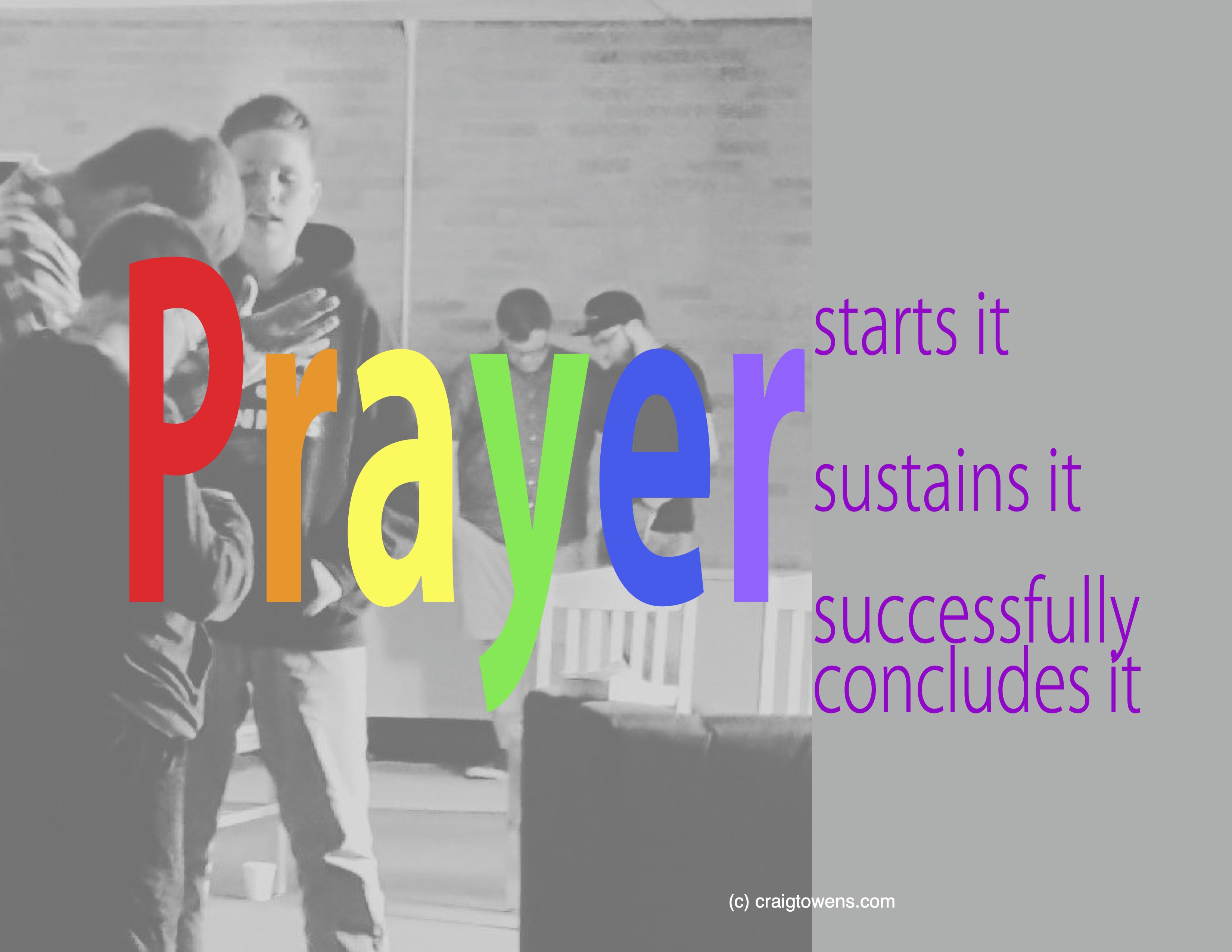
Prayer starts it, prayer sustains it, prayer successfully concludes it! 

Let me say it again: DON’T STOP PRAYING! 

If you missed any of the messages in our Be A First Responder series, you may access all of them by clicking here.

Would you please prayerfully consider supporting this ministry?

Learning Perseverance

I have shared three lessons I learned going through dark times in my life (you can check them out here, here, and here), but we aren’t even close to exhausting all of the lessons that can be learned in the night. I want to teach you one principle that will allow for lifelong learning and application of these nighttime lessons. 

The apostle Paul shared how he had matured during his times of struggle. He told the Corinthians he realized that God had delivered him in the past, was delivering him now, and would continue to deliver him in the future (see 2 Corinthians 1:3-11). The key is to hang in long enough to actually see how God brings about the deliverance and teaches the lessons. 

Paul told the Corinthians, “No temptation has overtaken you except what is common to mankind. And God is faithful; He will not let you be tempted beyond what you can bear. But when you are tempted, He will also provide a way out so that you can ENDURE it (1 Corinthians 10:13). And the writer of Hebrews said, “So do not throw away your confidence; it will be richly rewarded. You need to PERSEVERE so that when you have done the will of God, you will receive what He has promised” (Hebrews 10:35-36). 

The Greek word translated “persevere” means keeping focused on the goal despite the struggles that it takes to get there. Jesus used this same Greek word at the conclusion of His parable of the sower: “The seed on good soil stands for those with a noble and good heart, who hear the Word, retain it, and by PERSEVERING produce a crop”; a crop that Jesus said was a hundred times more than what was sown (see Luke 8:5-15). 

I love riding my bike on the White Pine Trail by my house. My long rides have a really fun stretch where I am flying downhill! But as fun as that part is, I’m not really building anything of lasting value. However, when I am coming back uphill and I want to quit because my legs are burning and I can hardly breathe, that becomes a valuable struggle. I cannot build endurance by any other way than to push myself just a little bit farther each time. When I want to quit, I pedal just a few more feet. Gradually, the uphill becomes less daunting. 

A friend gave me a t-shirt I like to wear on my rides. When I put it on the blue-lettered message on the shirt says, “Do It!” but as I struggle uphill and the sweat begins to pour off my body, a new message emerges: “Don’t Quit! 

I have learned that easy roads teach very few valuable lessons. 

So here are three thoughts to help you persevere in your struggling times: 

  1. Keep your eyes on Jesus and on His eternal rewards (Hebrews 12:1-3; James 1:2-4, 12) 
  2. Keep persevering friends close by—notice the “let us” phrases the writer of Hebrews uses 
  3. On your worst day, don’t quit but commit to going one day longer (Romans 5:3-4) 

[check out all of the verses by clicking here]

Remember that as you struggle and persevere, you are not only building your own endurance, but you are strengthening yourself to be able to help others. So we can be thankful IN the night because God is building our endurance for the next night, and our endurance for our friend’s next night. 

If you have missed any of the other lessons in this series called Thankful In The Night, you can access the full list by clicking here. 

God’s Promise IS Coming

When God made His promise to Abraham, since there was no one greater for Him to swear by, He swore by Himself, saying, “I will surely bless you and give you many descendants.” And so after waiting patiently, Abraham received what was promised. (Hebrews 6:13-15)

After waiting patiently…

God’s promise did come, but Abraham had to wait a long, long time! One translation says that Abraham waited long and endured patiently. Another says, Abraham stuck it out and got everything that had been promised to him. 

God’s promises DO come to those who patiently endure UNTIL the promise comes. 

Hang on.
Don’t fret.
Keep focused. 
Don’t lose heart.
Endure! 
Endure patiently.
Stick it out.
Don’t give up.
Keep going.
Don’t stop.
Persevere until it comes.

God has determined to show us the abundance of His promises, the faithfulness of His word, the trustworthiness of His promises. 

Ask Abraham. He’ll tell you that it’s so worth it to hang on until God fulfills His word.

God’s counsel is unchangeable. 
His wisdom is profound.
His treasures are immeasurable.
His delights are beyond comparison.
His hope is secure
His word endures.
His promises are sure.

Don’t give up. Patiently endure another day. God’s promise IS coming!

Thursdays With Oswald—His!

Oswald ChambersThis is a weekly series with things I’m reading and pondering from Oswald Chambers. You can read the original seed thought here, or type “Thursdays With Oswald” in the search box to read more entries.

His!

     “They were Yours; You gave them to Me” (John 17:6). It is this aspect of a disciple’s life that is frequently forgotten. We are apt to think of ourselves as our own, of the work as our work. A great point in spiritual nobility has been reached when we can really say, “I am not my own.” … The Son of God is the Highest of all, yet the characteristic of His life was obedience. We have to learn that God is not meant for us, it is we who are meant for God. … “Do you not know…you are not your own” [1 Corinthians 6:19]. 

     His! Does that apply to us? Have we realize that our body is not our own, but His—“the temple of the Holy Ghost”! Have we realized that our hearts and affections are not our own, but His? If so, we shall be careful over inordinate affection. Have we realized that all the ambitions of life are His? We are out for one thing only, for Jesus Christ’s enterprises. …  

     “Since you have kept My command to endure patiently” [Revelation 3:10]. This is not the patience of pessimism, nor of exhaustion, but the patience of joyfulness because God reigns. It may be illustrated by likening the saint to a bow and arrow in the hand of God. God is aiming at His mark, He stretches and strains until the saint says—“I cannot stand anymore,” but God does not heed. He goes on stretching until His purpose is in sight, then He lets fly, and the arrow reaches His mark. … 

     It takes the endurance which comes from a vision of God to go on without seeing results. We are not here for successful service, but to be faithful. Had Jesus any results? Before we go into work for Him we must learn that the disciple is not above his master. We cannot be discouraged if we belong to Him, for it was said of Him—“He shall not fail nor be discouraged” [Isaiah 42:4]. Discouragement is “disenchanted egotism.” “Things are not happening the way I expected they would, therefore I am going to give it all up.” To talk like that is a sure sign that we are not possessed by love for Him, but only by love for ourselves. Discouragement always comes when we insist on having our own way. 

From So Send I You

Can Jesus say of you that you are His? Are you trying to make your own way, or are you simply following Jesus? Are you letting God stretch you until He is ready to release you, or are you becoming exhausted and discouraged in the waiting? Is your love for Jesus absolute, or does it come with conditions?

Thursdays With Oswald—God’s Plan For Building Spiritual Muscles

Oswald ChambersThis is a weekly series with things I’m reading and pondering from Oswald Chambers. You can read the original seed thought here, or type “Thursdays With Oswald” in the search box to read more entries.

God’s Plan For Building Spiritual Muscles

     If a man has used his arm only for writing, and then becomes a blacksmith, he will groan for days with the tremendous pain in the deltoid muscle until by practice the time comes when there is no more pain because the muscle has become rightly adjusted to its new work. 

     The same thing happens spiritually, God begins to teach us how to walk and over and over again we begin to howl and complain. May God save us from the continual whine of spiritual babes—“Teach us the same things over and over again, don’t give us the revelations of God which are painful, give us the ‘simple gospel,’ what we have always believed, don’t tell us of things we have never thought about before, because that causes pain” (Hebrews 5:12). Of course it does. 

     Thank God there is a pain attached to being saved, the pain of growing until we come to maturity where we can do the work of a son or daughter of God. … 

     Look back over your life in grace, whether long or short, and ask yourself which are the days that have furthered you most in the knowledge of God—the days of sunshine and peace and prosperity? Never! The days of adversity, the days of strain, the days of sudden surprises, the days when the earthly house of this tabernacle was strained to its last limit, those are the days when you learned the meaning of this passion of “Go.” 

From The Philosophy Of Sin

The only way to build physical muscles is to push them beyond their comfort level.

The only way to build physical stamina is to run farther than you have run before.

The only way God can build our spiritual muscles—and our spiritual stamina—is to push us beyond our comfort zone, to challenge us to go deeper and farther than we’ve gone before. Don’t push Him away. God loves you too much to leave you where you are!

Poetry Saturday—The Friends Beside Us

Oswald ChambersWhen the powers of hell prevail
   O’er our weakness and unfitness,
Could we lift the fleshly veil,
   Could we for a moment witness
      Those unnumbered hosts that stand
      Calm and bright on either hand—
Oh! what joyful hope would cheer!
   Oh! what faith serene would guide us!
Great may be the danger near,
   Greater are the friends beside us. —Anonymous, quoted by Oswald Chambers in Not Knowing Where


Therefore, since we are surrounded by such a great cloud of witnesses, let us throw off everything that hinders and the sin that so easily entangles, and let us run with perseverance the race marked out for us. Let us fix our eyes on Jesus, the Author and Perfecter of our faith, Who for the joy set before Him endured the Cross, scorning its shame, and sat down at the right hand of the throne of God. Consider Him Who endured such opposition from sinful men, so that you will not grow weary and lose heart. —Hebrews 12:1-3

How Bad Guys Can Help You

Bad guysThe Old Testament prophet Jeremiah never held back when God told him to speak up. As you might imagine, this didn’t make Jeremiah too popular among the people who weren’t doing things God’s way. In fact, many of them started a plot on how they could eliminate Jeremiah.

God gave Jeremiah the heads-up on the bad guys who were trying to take him out (Jeremiah 11:18), to which Jeremiah said, “Go get ‘em, God!” (11:20). God promised Jeremiah that He would indeed take care of them (11:21-22). So Jeremiah pulled up a chair to watch how God was going to punish them. I’m not sure exactly what Jeremiah thought would happen, but one thing I do know: he certainly thought it would happen right away.

“God? Hello! Are You going to take care of these bad guys? Didn’t You say You’d get ‘em? I’m waiting. Anytime now You can zap ‘em with lightning … or make them fat and ugly … or at least give them bad breath and make them lose their jobs. Anything? Hello? Hey, what is going on here?! Not only are you not punishing them, it looks like things are actually going better for them! What in the world are You doing?!?” (12:1-2)

Ever been there where it looks like the bad guys are not only getting away with their badness, but even being blessed in the process?

God told Jeremiah that He was using these bad guys to actually help Jeremiah. God had big plans for Jeremiah’s life, but He needed Jeremiah to be stronger and have greater endurance. God said it this way—

If you have raced with men on foot and they have worn you out, how can you compete with horses? If you stumble in a safe country, how will you manage in the thickets? (12:5)

God reassured Jeremiah that the evildoers would indeed be punished but—and this is the important thing—God would do it in His own time (12:13).

In the meantime, God was going to use these bad guys to bless Jeremiah with increased strength and endurance, if Jeremiah would allow God to mold him and teach him.

Do you have some bad guys in your life? Hang in there! God doesn’t waste a thing. He is using even these evil people to bless you and accomplish His plans (Romans 8:28).