Thursdays With Oswald—Conscience

Oswald ChambersThis is a weekly series with things I’m reading and pondering from Oswald Chambers. You can read the original seed thought here, or type “Thursdays With Oswald” in the search box to read more entries.

Conscience 

     Conscience is that innate faculty in a man’s spirit that attaches itself to the highest the man knows, whether he be an atheist or a Christian. The highest the Christian knows is God: the highest the atheist knows is his principles. … 

     When conscience begins to be awakened by God, we either become subtle hypocrites or saints, that is, either we let God’s law working through conscience bring us to the place where we can be put right, or we begin to hoodwink ourselves, to affect a religious pose, not before other people, but before ourselves, in order to appease conscience—anything to be kept out of the real presence of God because where ever He comes, He disturbs. … 

     The majority of us have caught on the jargon of holiness without the tremendous panging pain that follows the awakening to holiness. The Spirit of God brings us to face ourselves steadily in the light of God until sin is seen in its true nature. If you want to know what sin is, don’t ask the convicted sinner, ask the saint, the one who has been awakened to the holiness of God through the Atonement; he is the one who can begin to tell you what sin is. … It is only as we walk in the light as God is in the light that we begin to understand the unfathomable depths of cleansing to which the blood of Jesus Christ goes (1 John 1:7). … 

     When a man begins his life with God there are great tracts of his life that he never bothers his head about, but slowly and surely the Spirit of God educates him down to the tiny little scruple. Every crook and cranny of the physical life, every imagination and emotion is perfectly known to God, and He demands that all these be blameless. … The marvel of the Atonement is just this very thing, that the perfect Savior imparts His perfections to me, and as I walk in the light as God is in the light, every part of bodily life, of affectionate life and of spirit life are kept unblameable in holiness; my duty is to keep in the light, God does all the rest.

From The Philosophy Of Sin

Quick question: What are you going to do the next time the Holy Spirit disturbs your conscience?

Thursdays With Oswald—6 Questions About Your Relationship With Jesus

Oswald ChambersThis is a weekly series with things I’m reading and pondering from Oswald Chambers. You can read the original seed thought here, or type “Thursdays With Oswald” in the search box to read more entries.

6 Questions About Your Relationship With Jesus

“How much more shall the blood of Christ, Who through the enteral Spirit offered Himself without blemish unto God, cleanse your conscience from dead works to serve the living God?” (Hebrews 9:14)

     Our right to ourselves in every shape and form was destroyed once and for ever by the death of Jesus, and we have to be educated into the realization of what this means in all its fullness. We have to come to a relationship to the Cross in thought as well as in life. … 

     We are here with no right to ourselves, for spiritual blessing for ourselves; we are here for one purpose only—to be made servants of God as Jesus was. …

   “How much more” does the death of Jesus mean to us today than it ever has before? Are we beginning to be lost in wonder, love and praise at the marvelous loosening from sin, and are we so assimilating the nature of Jesus that we bear a strong family likeness to Him?

     The most devout among us are too flippant about this great subject of the death of Jesus Christ. When we stand before the Cross, is our every common pious mood stripped off? … 

     How does all the profound thought underlying the death of Jesus touch us? The writer to the Hebrews instantly connect it with conscience—“How much more shall the blood of Christ,…cleanse your conscience from dead works to serve the living God?” Has conscience the place in our salvation and sanctification that it ought to have? … 

     Are you thankful to God for your salvation and sanctification, thankful He has purged your conscience from dead works? Then go a step further; let Jesus Christ take you straight through into identification with His death until there is nothing left but the light at the foot of the Cross, and the whole sphere of the life is hid with Christ in God. 

From The Philosophy Of Sin

I challenge you: take some time to thoughtfully answer these questions.

Is Christ Real To Me?

John WesleyJohn Wesley was deeply introspective about his faith in Jesus Christ. He once wrote—

“I did go thus far for many years…using diligence to eschew all evil, and to have a conscience void of offense; redeeming the time; buying up every opportunity of doing all good to all men; constantly and carefully using all the public and all the private means of grace; endeavoring after a steady seriousness of behavior, at all times, and in all places; and, God is my record, before Whom I stand, doing all this in sincerity; having a real design to serve God; a hearty desire to do His will in all things; to please Him who had called me to ‘fight the good fight,’ and to ‘lay hold of eternal life.’ Yet my own conscience beareth me witness in the Holy Ghost, that all this time I was but almost a Christian.”

To help keep himself on the right path, Wesley came up with this list of questions he regularly asked himself. This is a list any Christian would do well to read through regularly—

  1. Am I consciously or unconsciously creating the impression that I am better than I am? In other words, am I a hypocrite?
  2. Am I honest in all my acts and words, or do I exaggerate?
  3. Do I confidentially pass onto another what was told me in confidence?
  4. Am I a slave to dress, friends, work, or habits?
  5. Am I self-conscious, self-pitying, or self-justifying?
  6. Did the Bible live in me today?
  7. Do I give it time to speak to me everyday?
  8. Am I enjoying prayer?
  9. When did I last speak to someone about my faith?
  10. Do I pray about the money I spend?
  11. Do I get to bed on time and get up on time?
  12. Do I disobey God in anything?
  13. Do I insist upon doing something about which my conscience is uneasy?
  14. Am I defeated in any part of my life?
  15. Am I jealous, impure, critical, irritable, touchy or distrustful?
  16. How do I spend my spare time?
  17. Am I proud?
  18. Do I thank God that I am not as other people, especially as the Pharisee who despised the publican?
  19. Is there anyone whom I fear, dislike, disown, criticize, hold resentment toward or disregard? If so, what am I going to do about it?
  20. Do I grumble and complain constantly?
  21. Is Christ real to me?

Thursdays With Oswald—Beware Of The ‘Yes-but’

Oswald ChambersThis is a periodic series with things I’m reading and pondering from Oswald Chambers. You can read the original seed thought here, or type “Thursdays With Oswald” in the search box to read more entries.

Beware Of The ‘Yes-but’ 

   Beware of the “yes-but,” of putting your prudence-crutch under the purpose of God when you find His engineering of things has nearly unearthed your own little bag of tricks. Whenever you debate with a promise of God, watch how you begin to maneuver by your own prudence—but you can’t sleep at night. Whenever you maneuver it keeps up a ferment because it indicates a determination not to confess where you know you are wrong, and when we experience misgiving on account of wrong-doing which we do not intend to confess we are always inclined to put a crutch under God’s promise—“Now I see how I can make atonement for my wrong-doing.” Nothing can act as an atonement for wrong saving an absolutely clean confession to God. To walk in the light with nothing folded up is our conscientious part, then God will do the rest.

From Our Portrait In Genesis

I love that phrase, “Beware of the ‘yes-but.’” How many times do we say, “Yes, Lord, I will obey You, but…”? Or we excuse our sin by saying, “Yes, I know this wrong, but…”?

How quickly we can get freedom and experience new joy if we will simply confess: “Yes, Lord, I will obey you” and “Yes, I will repent from this sin.” Not a “yes-but,” but simply a “Yes, Lord” is all that it takes.

Thursdays With Oswald—Quick Snippets

Oswald ChambersThis is a periodic series with things I’m reading and pondering from Oswald Chambers. You can read the original seed thought here, or type “Thursdays With Oswald” in the search box to read more entries.

Quick Snippets 

(Normally I share a longer passage from Oswald Chambers, but his book Disciples Indeed contains so many short, power-packed statements, that I wanted to share a few of those with you.) 

  • “If we understood what happens when we use the Word of God, we would use it oftener.” 
  • “Everything the devil does, God over-reaches to serve His own purpose.”
  • “There is nothing so still and gentle as the checks of the Holy Spirit if they are yielded to, emancipation is the result; but let them be trifled with, and there will come a hardening of the life away from God.”
  • “My conscience makes me know what I ought to do, but it does not empower me to do it.”
  • “In the moral realm if you don’t do things quickly you will never do them.”
  • “Second thoughts on moral matters are always the deflections.”
  • “The greatest test of Christianity is the wear and tear of daily life, it is like the shining of silver, the more it is rubbed the brighter it grows.”
  • “We have to do more than we are built to do naturally; we have to do all the Almighty builds us to do.”
  • “When I began to be satisfied with where I am spiritually, instantly I begin to degenerate.

Which of these is your favorite?

Links & Quotes

link quote

“Being in love is a good thing, but it is not the best thing. There are many things below it, but there are also things above it. You cannot make it the basis of a whole life. It is a noble feeling, but it is still a feeling. Now no feeling can be relied on to last in its full intensity, or even to last at all. Knowledge can last, principles can last, habits can last; but feelings come and go. And in fact, whatever people say, the state called ‘being in love’ usually does not last.” —C.S. Lewis, in Mere Christianity

“There must be nothing about our religion of our own inventing; it is for us to lay thought, and judgment, and opinion at the feet of Christ, and do what He bids us, simply because He gives the command.” —Charles Spurgeon

“The storms of life are no longer our point of reference when Jesus is our focal point.” —Dutch Sheets

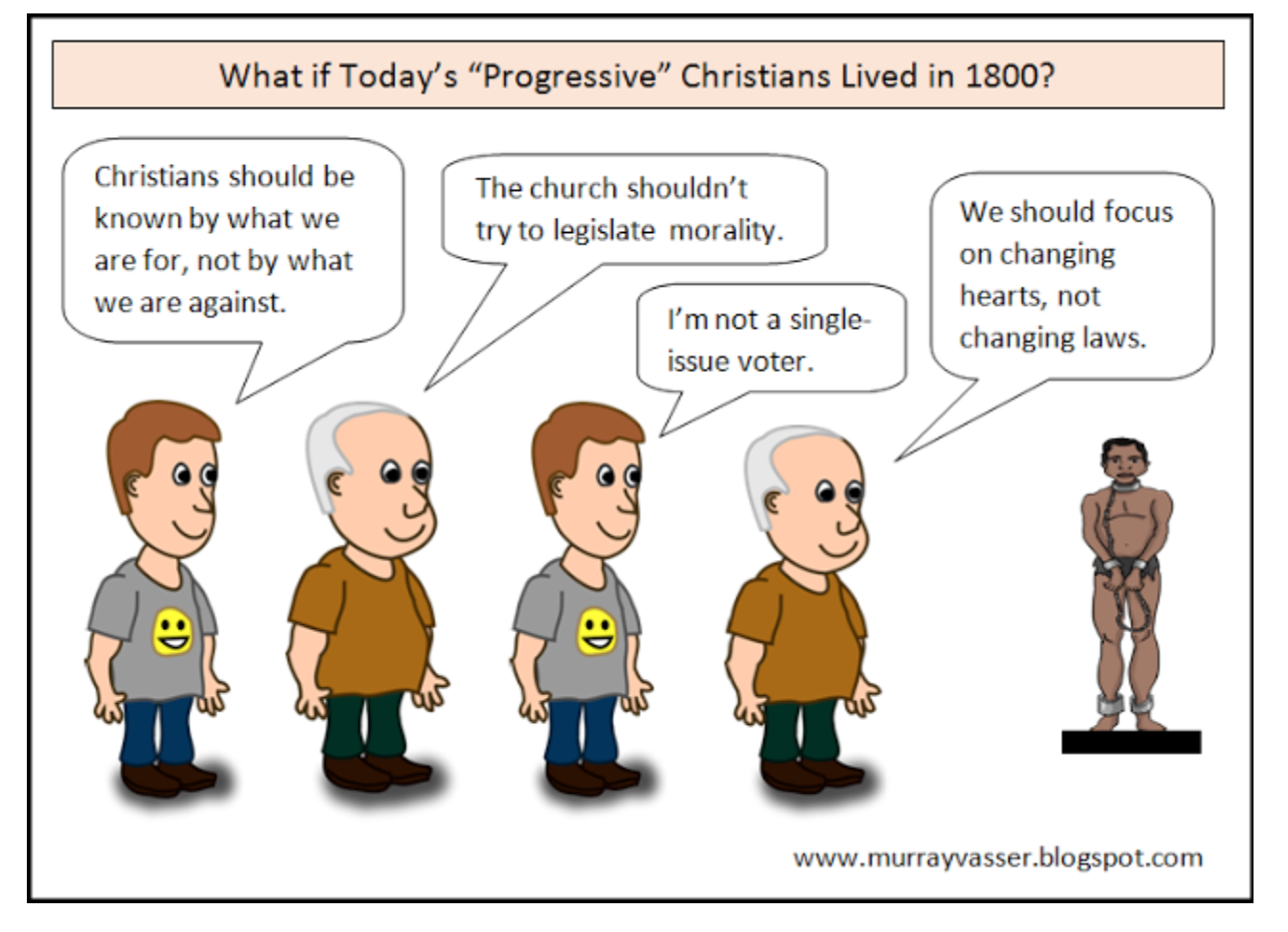
Progressive Christians in 1800sMurray Vassar reminds Christians to speak up for morality!

“Policy, however, Sir, is not my principle, and I am not ashamed to say it. There is a principle above everything is political . . . And, Sir, when we think of eternity, and of the future consequences of all human conduct, what is there in this life that should make any man contradict the dictates of his conscience, the principles of justice, the laws of religion, and of God.” —William Wilberforce

Two imprisoned Christian pastors have been released from their prison sentence in Sudan. Kudos to the ACLJ!

J.Warner Wallace asks a great question: Can naturalism/evolution account for human dignity?

John Piper has a weighty post that is worth your time to read: satan and sodomy.

Links & Quotes

link quote

“When something drops into your life that seems to threaten your future, remember this: The first shock waves of the bomb are not sin. The real danger is yielding to them. Giving in. Putting up no spiritual fight. And the root of that surrender is unbelief—a failure to fight for faith in future grace. A failure to cherish all that God promises to be for us in Jesus.” —John Piper

“The ultimate test of man’s conscience may be his willingness to sacrifice something today for future generations whose words of thanks will not be heard.” —Gaylord Nelson

My fellow pastors, may this be said of us: “Even now the Lord is raising up godly watchmen to speak for Him in these times. These shepherds are grieving, weeping and repenting as they seek God’s face. And I believe they’re hearing and understanding the Lord’s message behind the present events. Moreover, they’re not afraid to proclaim dire warnings, because they know they’ve heard from God. They’re compelled to speak of His purposes behind our calamities.” —David Wilkerson

“Who is doing exploits for God today? Where is the enemy being driven back? That is the great yearning of all spiritually-minded people. They are not enchanted with polished sermons and slick organizational technique. Where are the mighty men and women anointed by God to truly make a difference?” —Jim Cymbala

Good read for anyone in church leadership: 10 Fine Lines Of Church Leadership Tension.

Medical science validates what Scripture tells us: Unforgiveness can be lethal.

In the United States, roughly 10% of people struggle with dyslexia. Here are some helpful ways to make your materials more dyslexic-friendly for them.

J. Warner Wallace shares 6 pieces of evidence that point to our  universe having a beginning.

[VIDEO] Probably the best baby announcement I have seen yet—

Links & Quotes

link quote

“Building the Church is the Lord Jesus’ primary agenda before He returns. However, for many of the followers of Christ, working to build the Church is just another thing on their ‘to-do list’ which they may or may not get to during the course of any given week. We can become so distracted by work, family, diversions, and avocations that we have precious little time or strength left for the work Jesus is most interested in pursuing. So, as long as the devil can distract us from the work of building Christ’s Church, he doesn’t need to employ more spectacular or drastic measures.” —T.M. Moore

“‘Why has sex become man’s chief stumbling block?’ But has it? Or is it only the most recognizable of the stumbling blocks? I mean, we can mistake pride for a good conscience, and cruelty for zeal, and idleness for the peace of God et cetera. But when lust is upon us, then, owing to the obvious physical symptoms, we can’t pretend it is anything else. Is it perhaps only the least disguisable of our dangers.” —C.S. Lewis

“The mystery of sanctification is that the perfections of Jesus Christ are imparted to us, not gradually, but instantly, when by faith we enter into the realization that Christ is made unto us sanctification. … It is not power to live like Jesus; it is Christ living in us, and it is His life that is seen.” —Oswald Chambers

“Even while we kill and punish we must try to feel about the enemy as we feel about ourselves—to wish that he were not bad, to hope that he may, in this world or another, be cured: in fact, to wish his good. That is what is meant in the Bible by loving him: wishing his good, not feeling fond of him nor saying he is nice when he is not.” —C.S. Lewis

9 More Quotes From “The Blood Of The Cross”

The Blood Of The CrossThere were way too many quotes from The Blood Of The Cross by Horatius Bonar that I wanted to share, so here is the second installment. You can read the first set of quotes by clicking here, and you can read my review of this must-read book by clicking here.

“It is not my looking to the blood in conjunction with my looking to my own act of seeing that brings this peace. It is my simple and direct looking to the blood. It is in looking that I am blessed; not in thinking about my looking. To look to the blood is to be cleansed; to look away from the blood, or too self, or to the world, or to sin, is to arrest the cleansing process and to neutralize the healing power. The more I see of the matchless value of that blood, and understand the substitution of life for life, which that blood proclaims, and to which it is ever pointing, the more will my peace be like a river.”

“The Lamb has been slain, the Lamb of God, as it is written, ‘It pleased the Lord to bruise Him’ (Isaiah 53:10). His blood has been shed, and sprinkled, and accepted; and that shed blood is for the remission of sin, and for reconciling us to God. That blood is intended to set us in the place of the innocent; to bring us nigh to God just as if we had never separated; to be our recommendation to God, so that coming with it as our plea, we may expect to be treated by God as HE is treated Whose blood we thus recognize and rest on.”

“To come with anything else than the blood as our introduction is most certainly to secure or for ourselves rejection; but to come with it alone is to ensure that blessed welcome which the blood has never yet failed to obtain for the vilest sinner that ever went to God with it as his only plea.”

“That blood is valuable enough to answer for yours, and God is willing to accept the exchange. Nay, it was He Who first proposed it; it is He Who is pressing this exchange upon your notice and entreating you to receive it, so that there maybe nothing left for you to pay.”

“It loses none of its efficacy by time or repetition. It is the same in this age as when it was shed at first. It is the same today as when first we applied to it for healing and for cleansing. Nothing can rob it of its potency. It has cleansed millions; it can cleanse millions more; it has washed out stains, in number past calculation, in dye most thoroughly crimson. Yet it is unpolluted. It has taken on no stain. It is still as able to pacify the conscience and to release the soul from guilt.”

“Realizing these things, the saint moves on his joyful course. The blood is ALL to him. It is his peace; it is his medicine; it is his daily comforter. And resting in it he rejoices in hope hope of the glory to be revealed.”

“Thou hast gone near enough to the gates of hell; yet go not in. Turn back. It is not yet too late. Even thou mayest be saved. The gate of light stands as widely open as the gate of darkness. The way of life, the narrow way, is as free to thee as is the way of death. There is still forgiveness. And the glad tidings of it are as glad as ever. No sin of thine has altered that gladness or made the tidings a forbidden joy to thee. We can tell you as truly as ever that ‘these things are written that thou mightest believe that Jesus is the Christ, and that believing thou mayest have life through His name’ (John 20:31).”

“That nonconductor is unbelief. It interposes between the soul and all heavenly blessing, all divine intercourse. It may seem a thing too slight to effect so great result; yet it does so inevitably. It shuts off the communication with the source of all glad tidings. It isolates man, and forbids the approach of blessing. That conductor is faith. In itself it is nothing, but in its connection everything. It restores in a moment the broken communication; and this, not from any virtue in itself, but simply as the conducting link between the soul and the fountain of all blessing above.”

“In Jesus there is salvation—salvation without a price—salvation for the most totally and thoroughly lost that this fallen earth contains. Go and receive it.”

8 Quotes From “The Blood Of The Cross”

The Blood Of The CrossAs I said in my book review of The Blood Of The Cross by Horatius Bonar (which you can read by clicking here), I have never read such a penetrating look at the beyond-all-measurement value of the blood Jesus Christ shed on the Cross. An absolutely fascinating read! There are way too many quotes from this book to share them all now, so this is the first set of quotes I’d like to share with you.

“Nothing now will keep us, but certainty. Such a storm will need a sure anchor. A man may cheat his soul into tranquility when days are prosperous and skies are blue. He may say, ‘I hope it will go well with me at last,’ and sit down contented with his meager hope. But when heaven and earth are shaken, he cannot but tremble. His peace gives way at the first ruffle of the tempest. He had no certainty to lean upon, and his false security was broken in an hour. … It is not yet too late. The Cross is still standing on the earth. The Crucified One is still upon the mercy seat. If the favor of God has hitherto been a dark uncertainty, it may yet been made sure. The way of reconciliation through the blood is as open as ever.”

“If God and we, then, are at variance, how is this variance to cease? Is it by His adopting our judgment, or by our adopting His? It cannot be the former. … What thank you, then, of the blood of Christ? Is that which is so precious in God’s eyes as precious in yours? Has the controversy between Him and you upon this point been solidly adjusted? And are you at one with Him in His estimate of the blood of His dear Son? If so, it is well. For this is faith; and it is by this faith that you are saved.”

“Most men imagine that they know its value sufficiently already, and that what they need is not a higher estimate of the blood, but a deeper impression wrought in them by the estimate which they now possess. But is it so? Is this the whole evil? Is this its root? No. Whatever they may now suppose that they have, let them know this, that it is just in their estimate of the blood that they are deficient.”

“The new estimate which God enables us to form of this at once infuses peace. If that estimate which God had given of it be true, then all that is needful for our peace has been accomplished. That infinitely precious blood sheds peace and sunshine into our souls. We see that blood as God sees it, and our consciences are unburdened—our souls are set at rest. … The blood of His Cross has finished our peace. And that finished peace is all we need to banish every fear.”

“What does God thinks of this blood? He counts it as infinitely precious—more precious than all corruptible things such as gold and silver. Its value can only be measured by the greatness of Him from Whom it flowed.”

“If a sinner of old might come into the courts of the Lord as an accepted worshipper, simply because presenting to God the blood of bulls and goats, may not a sinner now come into the real, the immediate presence of Jehovah, with still greater certainty of acceptance, simply making mention of that divine blood which has flowed from the Lamb of God—the Word made flesh—Who made His soul an offering for sin, and gave His life a ransom for the sins of many (Isaiah 53:10; Matthew 20:28)?”

“And now it is safe for the sinner to enter in, and it is honorable for God to admit him. The sanctuary is not defiled by his entrance, for the blood is there to prevent this. He does not need to be alarmed, or shrink back, for that blood which opens the way gives him also liberty and boldness in coming in, removing that terror of a guilty conscience which would keep him back, and enabling him to come ‘with a true heart, and in full assurance of faith, having his heart sprinkled from an evil conscience, and his body washed with pure water’ (Hebrews 10:22).”

“It is the sprinkling of the blood upon the soul (which takes place so soon as we take God’s Word for its efficacy) that makes it fit for being the tabernacle of the Holy One. It is the sight of this blood that makes the sinner feel safe and happy in such near contact with God; for otherwise how could he feel at home with such a Guest—the unholy with the Holy?”

** Look for another set of quotes from this book later this week. **