Listen to the podcast of this post by clicking on the player below, and you can also subscribe on Apple, Spotify, or Audible.
The apostle Paul begins a lengthy series of commands for Christians with a simple statement: “Love must be sincere” (Romans 12:9).
Let’s define a couple of those key words. “Love” (Greek: agape) is not self-focused but others-serving. And “sincere” (anypokritos) means genuine, not hypocritical; or as the Amplified Bible says, “a real thing.”
Love is the motivating force for us to be able to carry out every one of the commands listed in verses 9-21 with God-honoring sincerity.
Love clings to what is good and drives away evil
Love is devoted to God and to its neighbor
Love honors others more than itself
Love is zealous
Love serves God in everything
Love is joyful in hope
Love is patient in affliction
Love is faithful in prayer
Love is hospitable to its neighbors
Love blesses persecutors
Love rejoices with those who rejoice
Love mourns with those who mourn
Love finds a way to live in harmony with others
Love is not proud
Love never repays evil for evil
Love always does what is right
Love lives at peace with everyone
Love doesn’t seek revenge
Love serves its enemies
Love overcomes evil with good
This is a great list—a lofty, noble, Christ-glorifying list!
How do I know if I am fulfilling these mandates? Quite simply, I could ask myself, “What does it sound like if I replace the word ‘love’ in those statements with my own name?” Do each of those statements sound accurate if I do that?
If not, that means I need to continue to offer my body as a living sacrifice (Romans 12:1) so that the Holy Spirit can continue to sanctify me.
Timothy D. Padgett asks, “Is there such a thing as Judeo-Christianity?” This is an interesting read, but I especially liked this passage: “This is key. When we speak of Judeo-Christianity, we’re not talking about salvation. We are talking about philosophy, even worldview. A Christian worldview must be just that: Christian. A faithful Jew apart from Christ is no more saved than a devout Muslim or an honest atheist, and any philosophy that leaves out the Incarnation will lack its ultimate hope.”
“A human being without a friend is like a beast: for he lacks someone with whom he can share his joy in prosperity and his sadness in adversity, to whom he may unburden his mind when he is preoccupied, with whom he may talk whenever he has had a particularly sublime or illuminating insight…That person is completely alone who has no friend.” —Aelred of Rievaulx
John Stonestreet and Dr. Glenn Sunshine point out that there are some “who believe that AI is a vehicle through which trans-dimensional, non-human intelligences are communicating with us.” Their post is called The Rise of Technopaganism. Of course, this is nothing new: The apostle Paul addressed mankind creating its own god and worshiping it, just as some are now doing with AI.
“It’s better to look ahead and prepare than to look back and regret.” —Jackie Joyner-Kersee
You and I will learn lessons in the hard times that we could learn no other way. Then God will use those lessons so we can help minister to others in their hard times. Check out my sermon about interceding for other saints.
ICR’s Dr. Randy Guliuzza says, “Convergent evolution is the fabricated conjecture evolutionists invoke to explain very similar characteristics between creatures that could not have been inherited from a common ancestor and that evolutionists will never accept as having been produced by an intelligently designed internal programming that is specified for common purposes.” This particular article is about bats which have always had the ability to fly. Not one fossil record shows any flightless bats because God created them as flying mammals.
In the early 1900s, Albert Norris was a missionary in India, observing firsthand the spiritual and physical hardships the people faced there. In an article in the Pentecostal Evangel, Norris wrote, “A Christianity that coldly sits down, and goes on its routine of formal work, and allows its fellowmen to starve, or to be obliged to go through all the hard sufferings and exposure connected with famine, without effort to help them, might as well quit its preaching.”
In answering a question about using AI to write a sermon, John Piper answers with an emphatic “no.” I agree! One of the reasons Piper shares: “One of the qualifications for being an elder-pastor-preacher in the Bible is the gift or the ability to teach, didaktikos (1 Timothy 3:2). That means you must have the ability, the gift, to read a passage of Scripture, understand the reality it deals with, feel the emotions it is meant to elicit, be able to explain it to others clearly, illustrate and apply it for their edification. That’s a gift you must have. It’s your number-one job. If you don’t have it, you should not be a pastor.”
“You don’t try to forget the mistake, but you don’t dwell on it. Don’t let it have any of your energy, or any of your time, or any of your space.” —Johnny Cash
No one likes to be mistreated—especially when the one that hurts us is one we would have thought of as an ally or even a friend.
These slights become even more painful when they take place inside the Christian community. When sheep bite sheep, our natural response is to lash out to try to even the scales of justice. But the Bible consistently and clearly calls Christians to pursue a supernatural response.
Join me for a highly practical series of messages on how you can respond in a Christ-honoring way when you are bitten by another sheep in God’s pasture.
(By the way, if you are a church leader dealing with biting sheep, my book When Sheep Bite is a great resource for you.)
Listen to the podcast of this post by clicking on the player below, and you can also subscribe on Apple, Spotify, or Audible.
Politics are a reality for anyone who lives under a human government. But Christians need to be cautious that we don’t put more weight on temporal politics than we do on the eternal Kingdom of God.
You can check out the full sermon that this clip came from here.
And I’ve shared quite a bit about praying for those in governmental leadership positions:
“Your failures are your accomplishments because it makes you prepared for whatever it is that you are going to do next.” —Lee Daniels
One of my favorite Christmas movies is Miracle on 34th Street, where a well-timed letter to Santa Claus arrives at the courthouse to tip the scales of justice for Kris Kringle. The US Postal Service reports that they still get thousands of letters addressed to Santa each year. Have you ever wondered what happens to them. The Smithsonian has the heart-warming story.
“The more we learn from God’s Word about how creation praises and reveals Him, the better able we will be to explain His revelation to others. But we’re not content for people merely so experience some revelation of God from the things He has made. We want them to know Jesus. For that, we’ll have to lead them to the Scriptures. The better we know the Scriptures and are daily immersed in them, the more we will see Jesus there and be made like Him. The more we are made like Him, the more we will see Him in all His works, and the more our hope will grow and be visible to others, some of whom may ask a reason for the hope that is within us.” —T.M. Moore
“No priest, no theologian stood at the manger of Bethlehem. And yet all Christian theology has its origin in the wonder of all wonders: that God became human. Holy theology arises from knees bent before the mystery of the divine Child in the stable. Without the holy night, there is no theology.” —Dietrich Bonhoeffer
“Early Pentecostals generally viewed the observance of the ‘church calendar’ as remnants of liturgical traditions. Apart from Easter and Christmas, there were few days that Pentecostal churches set aside for special services. One exception was New Year’s Eve, when a ‘Watchnight Service’ would be held, typically starting around 7 p.m. and lasting until after midnight.” Check out the notable history of people “praying in the New Year.”
Scott Hubbard writes, “Spiritual health yesterday does not guarantee spiritual health today. So, at the end of a new year, on the edge of another, let’s stop to take some spiritual vitals. How healthy is your soul?” He then gives us six biblically-based questions to help us assess the healthiness of our soul.
Listen to the podcast of this post by clicking on the player below, and you can also subscribe on Apple, Spotify, or Audible.
I take some time at the end of each calendar year for a quick recap of everything we have learned during this year at Calvary Assembly of God. I do this because I want to make sure we are all on the same page with each other before we move into a new year. And I also think it’s very important that we are continually reminded and reassured of what God has done for us. In our series on gratitude we talked about the dangers of forgetting to remember and re-tell the blessings of God. We see in the letters from the apostles both a re-telling of their own words, and reusing and amplifying the words of Jesus and other apostles.
You can click on the sermon series title to find a list of all of the sermons in that series. Clicking on those individual sermons will give you a short written recap of that message, and it will also give you the link to watch the video of the full sermon.
Kingdom Praying. Jesus made it clear time and time again that He came to reveal the Kingdom of God to us. He described what the Kingdom was like and told us that He came to be the means by which we could enter God’s Kingdom. He also told us how God’s children could access the power and privileges of our Heavenly Father through the means of prayer. He assured us with words like, “Do not be afraid, little flock, for your Father has been pleased to give you the Kingdom” (Luke 12:32). Jesus said quite simply that we had access to our Father through prayer. And then to make sure we didn’t miss out on this awesome privilege, He instructed us, “This, then, is how you should pray” (Matthew 6:8).
Jots and Tittles. As we get closer to the death and resurrection of Jesus, there are an increasing number of prophecies that are fulfilled in these events. Jesus appears to have been very attentive to making sure that each and every one of these prophecies were fulfilled to the smallest detail. Near the beginning of His public ministry, Jesus noted that not one iota—or “one jot or tittle” in the Old English vocabulary—of any of God’s promises would be left unfulfilled (Matthew 5:18). It’s amazing that Jesus so carefully attended to all of these, but it’s also important to ask ourselves what these fulfilled prophecies mean to us today.
Takin’ Him to the Streets. Just before Jesus ascended to Heaven, He told His followers that they would have the joyful responsibility of taking the good news of forgiveness and eternal life to all the highways and byways of every nation. Later on, Paul would get more specific about all of the groups to which he was taking the message of Jesus (see Luke 24:46-47; 1 Corinthians 9:20-22). That commission is still in effect for Christians today: We are to share the gospel with everyone—from easy street to skid row, from Wall Street to Main Street, and every street in between. The streets on which you live and work are different from the streets where I travel. In fact, all of us live on different streets, but everyone we meet on every street needs to hear about Jesus. In this new series of messages, we are going to learn how the Holy Spirit can help us be ready to take Jesus to those on each street where God sends us.
Ascending. Every year, Jews from around the world made four pilgrimages up to Jerusalem for various feasts and sacrifices. These journeys reminded them of God’s goodness as they went to the Temple to worship, and they helped refocus on God’s ways as they returned to their regular routines. Jerusalem is over 2500 feet above sea level, so the pilgrimage there was a physical workout as well as a spiritual workout. These workouts were beneficial for God’s people, preparing them to minister in their cities in the following months. The Book of Psalms contains 15 songs that these pilgrims would sing to and with each other as they traveled up to Jerusalem. These Psalms of Ascent are still instructive for Christians today.
Living in your Gift Zone. God created each and every human being uniquely. We all come in different shapes and sizes, but we all share one thing in common: He created each of us with a unique personality and a unique gift package. By unique, I truly mean that we are all one-of-a-kind creations that have never existed in all of history! Here’s another thing we all have in common: We usually live in a comfort zone that is far smaller than our gift zone. Living this way keeps us from soaring through life in the way that God intended. He wants each of us to know our gifts, and to use our gifts in a way that benefits our world and brings Him glory. It starts with believing that we are indeed gifted by our Creator. Then we must have the courage to step out of our comfort zone into the much larger gift zone God has given us.
Is that in the Bible? A meme that makes me chuckle every time I see it is a “quote” attributed to Abraham Lincoln in which he says, “The problem with quotes found on the internet is that they are often not true.” (Not to spoil the joke for you, but unless Lincoln knew how to time travel to the future, I don’t think he knew about the modern internet!). I love this meme because it captures something that so many people fall into: a quick acceptance of a statement without verifying its source or thinking through the implications of the statement’s truthfulness. In this series I think you may be surprised to discover just how many phrases we call biblical aren’t, and how many phrases there are that we never realized are actually in the Bible.
Be Thankful. It’s so easy to spot the negative things. It’s so easy to gripe about the bad stuff with others. It’s so easy to complain about what’s wrong with the world. But the Bible repeatedly calls the saints of God to rise above this downward pull of negativity. In fact, for those who have a relationship with their Heavenly Father, who call Jesus their Savior, and who call the Holy Spirit their Counselor, there is really only one way to live: Grateful!
Christ’s Advents. The word Advent means the appearing—something that bursts onto the scene. At this time of year we are actually thinking about TWO Advents. We look backward in gratitude to celebrate the first Advent of Jesus when He was born in a manger in Bethlehem. And then we look forward in joyful expectation to the second Advent of Jesus when He will return to earth again as King of kings. As Christians live in this time between the two Advents, our celebration and expectation should bring four noticeable attributes from our lives: hope, peace, joy, and love.
This next year promises to be another amazing time of learning and growing. If you live in northern Kent County and don’t have a home church, I would love for you to visit us!
Christians aren’t celebrating just one Advent, but two. The First Advent of Jesus gives us cause to celebrate, but the expectation of His Second Advent gives us reason to anticipate. Let’s make sure we are always celebrating both of Christ’s Advents. Check out the full sermon on hope.
I have lots of new content every week, which you can check out on my YouTube channel.
“When we elevate the end over the means, we miss out, because often God does some of His greatest work along the way. For Him, it’s all about the process, and less about the final destination.” —The King Is Coming reading plan on YouVersion
“If you want a religion to make you feel really comfortable, I certainly don’t recommend Christianity.” —C.S. Lewis, in God In The Dock
I had never even heard of the heart cockle until I read this article. This amazing mollusk has a symbiotic partnership with a type of plankton that lives inside the shells. This plant needs photosynthesis to live and produce the food which the heart cockle needs to survive. But how does sunlight get through the solid shell of the heart cockle? Not surprisingly, our All-wise Creator designed the heart cockle with little “windows” perfect for letting in just the right amount of sunlight the S. corculorumrequires. Amazing!
The Reader’s Digest uncovers some bizarre laws surrounding the Christmas season. For instance, “In 1643, England passed an ordinance ‘encouraging’ citizens to treat Christmas as a solemn holiday, rather than a celebratory feast. By the next year, Christmas had been banned altogether. Christmas remained illegal in England until 1660. … In 1659, the Puritan government of the Massachusetts Bay Colony went so far as to outlaw Christmas in order to discourage ‘disorderly’ behavior that might be ‘offensive to God.’ Anyone who failed to show up for work or participated in feasting would be fined five shillings. The Christmas ban lasted until 1681 and Massachusetts didn’t make Christmas an official holiday until 1856.”
“The future of our country and the quality of our lives is not determined primarily by who is in public office. Politicians are the fruit of the tree, they are not the tree. Our future will be determined by the strength of our families, and we all have control over that. Be great husbands, wives, parents, friends, and neighbors. Live for others, and live as if your kids, and God, are always watching. God is always watching, and our kids are watching more than we realize. Find things to be grateful for and resist the temptations to complain. Go out of your way to make someone else’s life better and yours will be too, even if you don’t like who is in the White House. If our joy is dependent upon a political outcome, we’ll never be happy.” —Joseph Backholm
Listen to the podcast of this post by clicking on the player below, and you can also subscribe on Apple, Spotify, or Audible.
It is nearly impossible to overstate how fearful Christians in the first century were of the Jewish zealot named Saul of Tarsus. Saul called himself “extremely zealous for the traditions of my fathers” (Galatians 1:14) as he sought to seek out and destroy all who were followers of The Way.
Not only was he personally bent on his ruthless mission, but he had the full sanctioning of the Sanhedrin (Acts 8:3, 9:1-2). This was the religious body that had successfully goaded Pontius Pilate into crucifying Jesus.
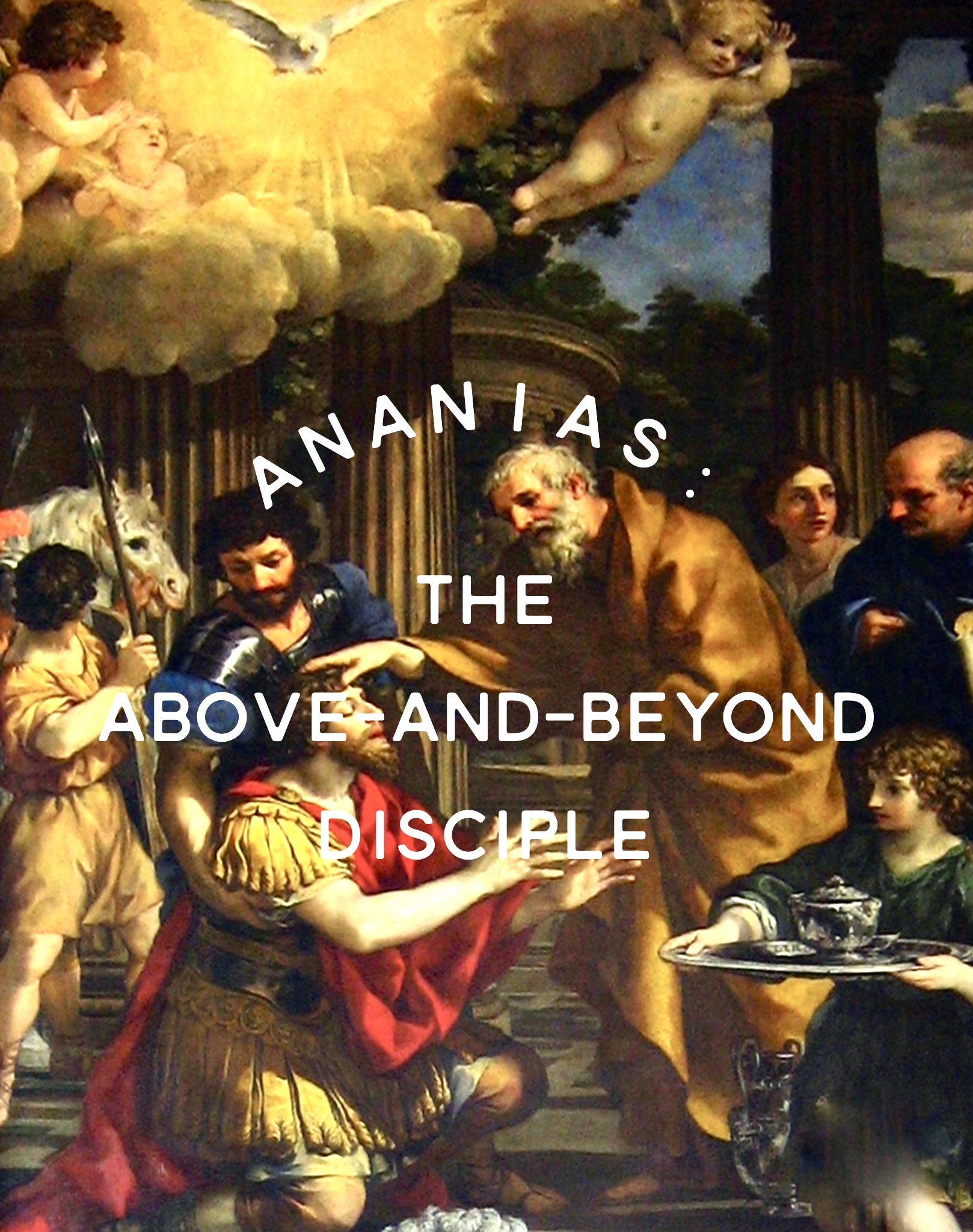
So you can imagine the apprehension in Ananias’ heart when Jesus calls him to visit with Saul after he had encountered Jesus for himself. Ananias said, “I’ve heard all about this man and the harm he has done. And I also know he has come to my city with the authority to drag Christians off to prison” (Acts 9:13-14).
Ananias’ interaction with Jesus seems to me to echo the prayer that Jesus prayed in the Garden of Gethsemane. It is as if Ananias is praying, “Is there another way? But not my will but Yours be done, Lord” (see Luke 22:42).
Ananias is called a disciple of Jesus (Acts 9:10), and Paul even refers to him later as “a devout observer of the law and highly respected by all the Jews” (22:12). In other words, Ananias is an early church leader. What he does or doesn’t do here will set the pace for other Christians.
So I love the fact that Ananias didn’t just begrudgingly do only what Jesus instructed him, but he said and did only what Christ’s love could empower him to say and do.
Jesus told Ananias to lay his hands on Saul and pray for the restoration of his sight (9:12). Ananias did more. He laid his hands on him in such a loving way (9:17), that Luke uses the same word as when Jesus laid His hands on people for their healing (c.f. Luke 13:13). Ananias even called him “brother Saul” (9:17).
Jesus told Ananias to simply pray for Saul’s physical healing, but Ananias did more: he prayed for Saul to be baptized in the Holy Spirit as well (9:17, 22:13).
Jesus told Ananias what His plan was for Saul’s ministry, but He didn’t tell Ananias that he had to repeat that to Saul. Ananias did more: He reaffirmed to Saul what Jesus had already said to him and encouraged him to get up, be baptized, and began to do what Jesus had told him to do (9:15-16, 22:14-16).
When Ananias called Saul “brother,” he used the term that fellow Christians used for each other (Philippians 4:1; Hebrews 2:11; 1 John 3:14). That means that Ananias is the first one to recognize the genuine conversion of Saul the persecutor to Paul the Christian.
When the love of Jesus is in us, we will not be looking for ways to begrudgingly obey what Jesus tells us, but we cannot wait to lavishly do more loving things out of the overflow of Christ’s love in us. What a fantastic example Ananias has give all of us who call ourselves Christians!
Listen to the podcast of this post by clicking on the player below, and you can also subscribe on Apple, Spotify, or Audible.
John Stonestreet used an interesting term (pre-political) that got me thinking about how many government programs would be unnecessary if the Church was doing what Jesus called the Church to do.
Here’s the full quote from John Stonestreet: “Christian political engagement should hit its fever pitch notduring elections. The only way to relieve the political pressures of our day is to build up the pre-political aspects of our life together, especially the family and the Church. When we care well for our children, our neighbors, and our communities, the state doesn’t have to.”



 The apostle Paul begins a lengthy series of commands for Christians with a simple statement: “Love must be sincere” (Romans 12:9).





 Craig T. Owens