Studies In The Sermon On The Mount (book review)

Many people have called Christ’s Sermon on the Mount the most profound sermon ever preached. It would be hard to argue that conclusion! Reading the Sermon is one thing, but living it out is something entirely different. Oswald Chambers helps us live out these amazing words in his book Studies In The Sermon On The Mount. 

Not only did Chambers provide us with an excellent commentary on this Sermon, but his life showed his devotion to practicing what he preached. At a memorial service for Chambers in December 1917, a close friend described Oswald’s life as “the finest commentary on the Sermon on the Mount I know.” May that be said of all Christians! 

This is one of the finest commentaries I have read on this life-patterning sermon that Jesus gave us. It’s a great read, but it is also quite challenging at times. To be honest, Chambers’ thoughts are so deeply profound at points that it takes several readings to grasp the implications. But it is worth your effort! 

A colleague of Chambers—J.F. Knapp, who founded God’s Bible School in Cincinnati, OH, where Chambers taught for seven months in 1907—described it better than I could: 

“‘But,’ says some simple soul, ‘I don’t understand [Chambers].’ The more is the pity. Leave then the evening newspaper, the book of religious wonder-tales, the high-flown writing watered with adjectives, but empty of thought or power, and read these pages again and again until the truth soaks through to your innermost consciousness. … To heed the words of our Lord’s Sermon on the Mount as interpreted by Oswald Chambers will transform holiness people into holy people, and faithless verbosity into Christian humility. Unto which glorious result God speed the day!”

To Knapp’s words I can only add “Amen!” If you want to understand the Sermon On The Mount better, you shouldn’t miss out on this premier Oswald Chambers book. 

He Chose The Nails (book review)

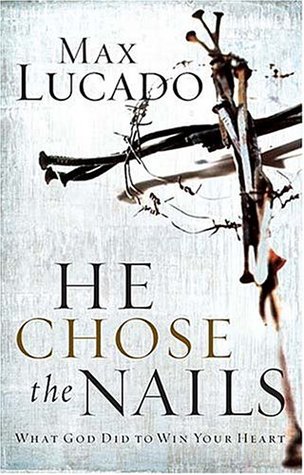
Max Lucado has an inimitable style of writing that immediately draws us into his subject—in this book the focal point is what Jesus did for us on the Cross—gets us to look at it in a new light, and then helps us walk away with a fuller understanding. The title of this book is really the answer to the sub-title—Q: What did God do to win your heart? A: He Chose The Nails.
In keeping with the theme of God answering the book’s question of how He won your heart, all but two of the chapters use statements from God as their title. Statements like “I will bear your dark side,” and “I forgive you,” and “I understand your pain,” and “I will love you forever.” In each chapter, Max takes us nearer to the Cross and to the Savior who bled and died there to show us how much God loves us. 

This is a book that can easily be read together with your family or a group of friends; especially if you then utilize the study guide questions for each chapter at the back of the book. This is a book that could be read rather quickly, but because Max paints such a vivid picture of God’s unexpected love you will want to read slowly and savoringly. This is a book that could be read at any time, but I would recommend you read it during the days and weeks approaching Good Friday and Resurrection Sunday. 

Whether reading alone or with friends, reading quickly or slowly, reading it during the Lenten season or at another time, I can promise you that your heart will beat more strongly with the assurance of God’s overwhelming, mind-blowing love for you. 

The Essential Jonathan Edwards (book review)

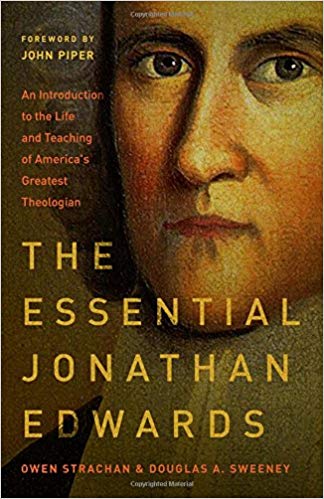
Some have called Jonathan Edwards the greatest American theologian, and I think it would be very hard to dispute that. Not only was he a brilliant thinker, but Edwards was also a prolific speaker and writer. So Owen Strachan and Douglas Sweeney have taken on a monumental challenge in attempting to give us an accurate glimpse of this important man in their book The Essential Jonathan Edwards. 

The first part of the book is a short biography of Edwards’ life. The biography is told alternating between the biography of Strachan and Sweeney and the words Edwards recounted in his sermons and memoirs. 

The remainder of the book attempts to give the reader a sense of Edwards’ thoughts on topics such as the beauty of God’s creation, the joy of experiencing God’s pleasure, the essential nature of the Christian life, and the after-life. These topics are covered in the same way as the biographical portion—alternating between the actual words of Jonathan Edwards and the summation of Strachan and Sweeney. 

I found this book a bit frustrating. I would have preferred a more traditional biography of this great man or a collection of Edwards’ sermons verbatim. But the alternation between Edwards’ words and Strachan and Sweeney’s thoughts didn’t flow very well for me. 

My recommendation would be to either read George Marsden’s full or shortened biographies of Edwards, or simply read a collection of Edwards’ sermons. 

I am a Moody Press book reviewer.

The Way Of The Warrior (book review)

When I was a kid, I couldn’t wait for “Martial Arts Theater” on Saturday afternoons! My friends and I would gather at my house with our snacks and watch a movie with outstanding martial arts action, and then run outside to try to practice what we had just watched. In these movies, I was always intrigued by the reluctant hero—the guy who had enough skill to snap your neck with his little finger, but who didn’t want to fight. When the bad guys finally crossed the line, our hero would instantly spring into action to restore peace. These are the memories that came flooding back into my mind as I read Erwin McManus’ latest book The Way Of The Warrior.

The warrior is a peaceful man living in a hostile world. He is prepared to fight, but will only fight when it is the only option to restore peace in his community. The warrior is nobody’s fool, but neither does he flaunt his knowledge before fools. The warrior doesn’t seek honor for himself, but fights to secure a better future for those he loves. 

In short, the warrior is vividly portrayed on the pages of Scripture as the kind of man God delights to bless. McManus interweaves all of these concepts masterfully in his book. As I read, I found my mind flipping between images of my childhood martial arts movies, and heroes in the Bible, and the opportunities I have right now to be a warrior for peace. 

Like the ancient samurai, McManus instructs us in the eight codes of the God-honoring warrior. This type of warrior fights only for peace, seeks to become invisible, finds honor in serving others, gains mastery over his own thoughts, owns defeat, harnesses and channels his strengths, becomes one with all that’s around him, and stands unmoving in his pain. 

As is the case with all of McManus’ books that I have read, I find myself invigorated mentally, emotionally, and spiritually. After reading The Way Of The Warrior, I have a clearer picture of the type of warrior God has called His men to be. 

Guys, this is an excellent book for you to read on your own, but I would highly recommend that you read with other warriors. The concepts in this book will spark some much-needed conversation about how godly men should live in today’s culture.

I am a Waterbrook book reviewer. 

God’s Promises Every Day (book review)

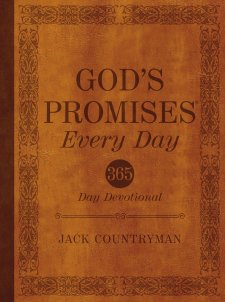
Psychologists tell us that babies are only born with two innate fears, yet many people’s lives are constricted because of numerous fears that they have allowed to creep in. A great way to begin defeating those fears is by learning what God has to say about them, and a great place to begin that journey is with Jack Countryman’s book God’s Promises Every Day.

It’s not very effective to simply tell ourselves, “Don’t be afraid of that.” Instead, we need something with more authority—like God Himself. The Bible is jam-packed with promises that God has given us; promises that will counteract our limiting fears. 

Jack Countryman has put together a marvelous resource to bolster your fight against crippling fears every single day. Each day’s reading begins with a short portion of Scripture, followed by just a couple of short paragraphs unpacking the truth in that Scripture, and then concluding with a one-sentence-long prayer based on that biblical truth. 

Short, but very powerful and effective! The Bible itself says that faith is built by hearing and applying God’s Word, and that’s exactly what God’s Promises Every Day makes so accessible to us.

It’s interesting to note that Jesus refuted every one of satan’s attack by quoting a portion of Scripture. Reading this book every day will similarly arm you to attack the temptations and fears that the enemy wants to throw at you as well. 

I am a Thomas Nelson book reviewer. 

Jesus Through Middle Eastern Eyes (book review)

Taking a journey with a tour guide who knows the terrain and the customs is always so much more rewarding than simply following the directions of some far-removed travel agent. In journeying through the four Gospels of the New Testament, a premier tour guide is close by in Kenneth Bailey and his book Jesus Through Middle Eastern Eyes. 

All of us bring our own paradigms with us wherever we go. There is a certain way we see the world, and everything gets processed through those lenses. My natural bias, when I pick up the New Testament is to read it through my lenses of a 21st-century American. But Jesus lived in a specific time and place in world history. He lived as a Jewish man in Israel during the time the Roman Empire held sway over world affairs. 

If I try to read about a 1st-century Eastern world through 21st-century Western eyes, I will be missing so much of the richness. Kenneth Bailey lived and taught and was immersed in the middle eastern culture for decades. So with his western understandings and middle-eastern insights, he treats us to vistas of Scripture that I hadn’t seen before. 

Bailey is a first-rate scholar, but by no means is this book an academic study. On the contrary, Bailey’s scholarship will make the accounts of the life of Jesus come to life before your eyes! You will be noticing nuances and insights that you probably missed in all your previous readings. 

If you want to experience the Gospels in a new, exciting way, I cannot recommend strongly enough that you take Jesus Through Middle Eastern Eyes along with you for the journey! 

Dangerous Prayers (book review)

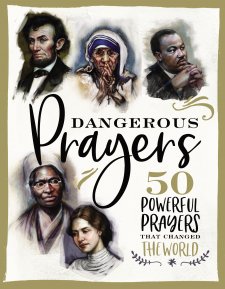
Prayer changes things. That makes prayer dangerous and the pray-ers themselves a danger to anything that opposes the kingdom of God. Dangerous Prayers is a collection of powerful prayers and a brief biography of those who prayed them. 

Growing up, a constant refrain rang in my ears from my parents whenever I faced a problem: “Have you prayed about it?” I’m not sure why we make prayer our last resort instead of our first response, but it often seems that some of the most heartfelt, passionate prayers are offered up in the darkest of times. 

Dangerous Prayers offers a short biography of some world-changing people who changed the world in large part because of their desperate dependence on God’s help, as seen in the frequent and bold prayers they prayed. Many of these prayers were prayed in dark places—prisons, before the executioner, in the midst of war, in unimaginable poverty, or staring down the evils of slavery. These men and women repeatedly turned to God, and God repeatedly strengthened them to accomplish amazing things. Some of the answers to prayer came in their lifetimes, and some prayers were only answered long after they had died. 

Dangerous Prayers is an excellent coffee table book. By that, I mean it’s a great book to leave out in the open as a conversation-starter. Parents could read these short biographies and prayers with their children, and friends could use them as a bridge from past history to current events. But more than anything, keep Dangerous Prayers close at hand will—I sincerely hope—cause you to turn to prayer frequently and boldly. 

I am a Thomas Nelson book reviewer. 

Defiant Joy (book review)

I’m always intrigued by oxymorons. You probably know what these are—when two seemingly opposite things are put together to make something memorable. Like a fine mess, or deafening silence, or seriously funny. Or defiant joy.

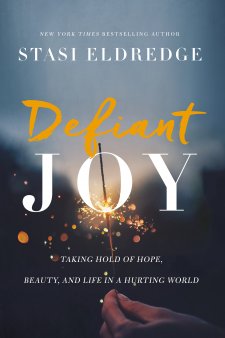
Usually “joy” is paired with descriptives like pleasurable, or bubbly, or uncontainable. But “defiant”? Stasi Eldredge makes the case that we need to fight to hang on to joy—that our pursuit of joy against all odds should be, as her book is entitled, Defiant Joy. 

Stasi shares many of her painful life lessons that led her to the conclusion that joy has to be clung to tenaciously or it can be stripped away quickly. Defiantly clinging to joy doesn’t mean a bury-your-head-in-the-sand denial view of life. It is facing the challenges squarely and honestly, and still recognizing that the joy Jesus gives is greater than those circumstances. 

In fact, one of the first quotes Stasi shares in her book is this truism from C.S. Lewis: “Joy is the serious business of Heaven.” Talk about a powerful oxymoron! 

I so appreciate the transparency and candor Stasi exhibits as she pulls back the curtains of her own battles for joy. She honestly shares her darker moments with us, tells us where she’s still working, where’s she had breakthroughs, and the applicable lessons we can all use. 

I’m sure everyone one of us will have to face joy-threatening circumstances. The principles in Defiant Joy will help you overcome those circumstances while still tenaciously clinging to joy. Read this book for yourself or read it with a friend going through a difficult time. You’ll be glad you did.

I’m a Thomas Nelson book reviewer. 

Book Reviews From 2018

11 Quotes On The Gospel Of Mark

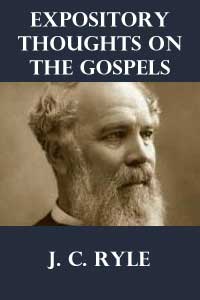
Alongside my daily Bible study time in the Gospels of the New Testament, I have been reading J.C. Ryle’s Expository Thoughts On The Gospels. You can check out my review of this book by clicking here. 

These are a few of the quotes I especially appreciated from Ryle’s comments on the Gospel of Mark. 

“We should always read the Old Testament with the desire to find something in it about Jesus Christ.” [cf John 5:39] 

“It will always be found that when prayers are few, grace, strength, peace, and hope are small. We shall do well to watch our habits of prayer with a holy watchfulness. Here is the pulse of our Christianity. Here is the true test of our state before God. Here true religion begins in the soul, when it does begin. Here it decays and goes backward, when a man backslides from God. Let us walk in the steps of our blessed Master in this respect as well as in every other. Like Him, let us be diligent in our private devotion. Let us know what it is to ‘depart into solitary places and pray.’” 

“What extravagant importance is attached to trifles by those who are mere formalists in religion!” 

“Christ’s service does not exempt His servants from storms.” 

“The assaults of persecution from without have never done half so much harm to the church as the rise of false doctrines within. False prophets and false teachers within the camp have done far more mischief in Christendom than all the bloody persecutions of the emperors of Rome. The sword of the foe has never done such damage to the cause of truth as the tongue and the pen.” 

“Incredible is the bondage in which men live to the opinion of the world! Let us all pray daily for faith and courage to confess Christ before men. … In spite of laughter, mockery, and hard words, let us boldly avow that we serve Christ.” 

“It is a dreadful fact, whether we like to allow it or not, that pride is one of the commonest sins which beset human nature. We are all born Pharisees. We all naturally think far better of ourselves than we ought. We all naturally imagine that we deserve something better than we have. It is an old sin. It began in the garden of Eden, when Adam and Eve thought they had not got everything that their merits deserved. It is a subtle sin. It rules and rains in many a heart without being detected, and can even wear the garb of humility. It is a most soul-ruining sin. It prevents repentance, keeps men back from Christ, checks brotherly love, and nips in the bud spiritual desires. Let us watch against it, and be on our guard. Of all garments, none is so graceful, none wears so well, and none is so rare as true humility.” 

“It is not so much the having money, as the trusting in it, which ruins the soul. Let us pray for contentment with such things as we have.” 

“Above all, let all who desire to walk in Christ’s steps labor to be useful to others. … Let them never forget that true greatness does not consist in being an admiral, or a general, a statesman, or an artist. It consists in devoting ourselves, body, and soul, and spirit to the blessed work of making our fellow man more holy and more happy. … Let us strive to leave the world better, holier, happier than it was when we were born.” 

“The dark ages of Christendom were times when the Bible was kept back from the people. The Protestant Reformation was mainly effected by translating and circulating the Bible. The churches which are most flourishing at this day are churches which honor the Bible. The nations which enjoy the most moral light are nations in which the Bible is most known. … The godliest families are Bible-reading families. The holiest men and women are Bible-reading people.” 

“Let us remember that for our sakes Jesus voluntarily endured the most painful, horrible, and disgraceful death. Surely the thought of this love should constrain us daily to live not unto ourselves but unto Christ.” 

You can read the quotes I shared from Ryle’s thoughts on the Gospel of Matthew by clicking here.