Listen to the podcast of this post by clicking on the player below, and you can also subscribe on Apple, Spotify, or Audible.

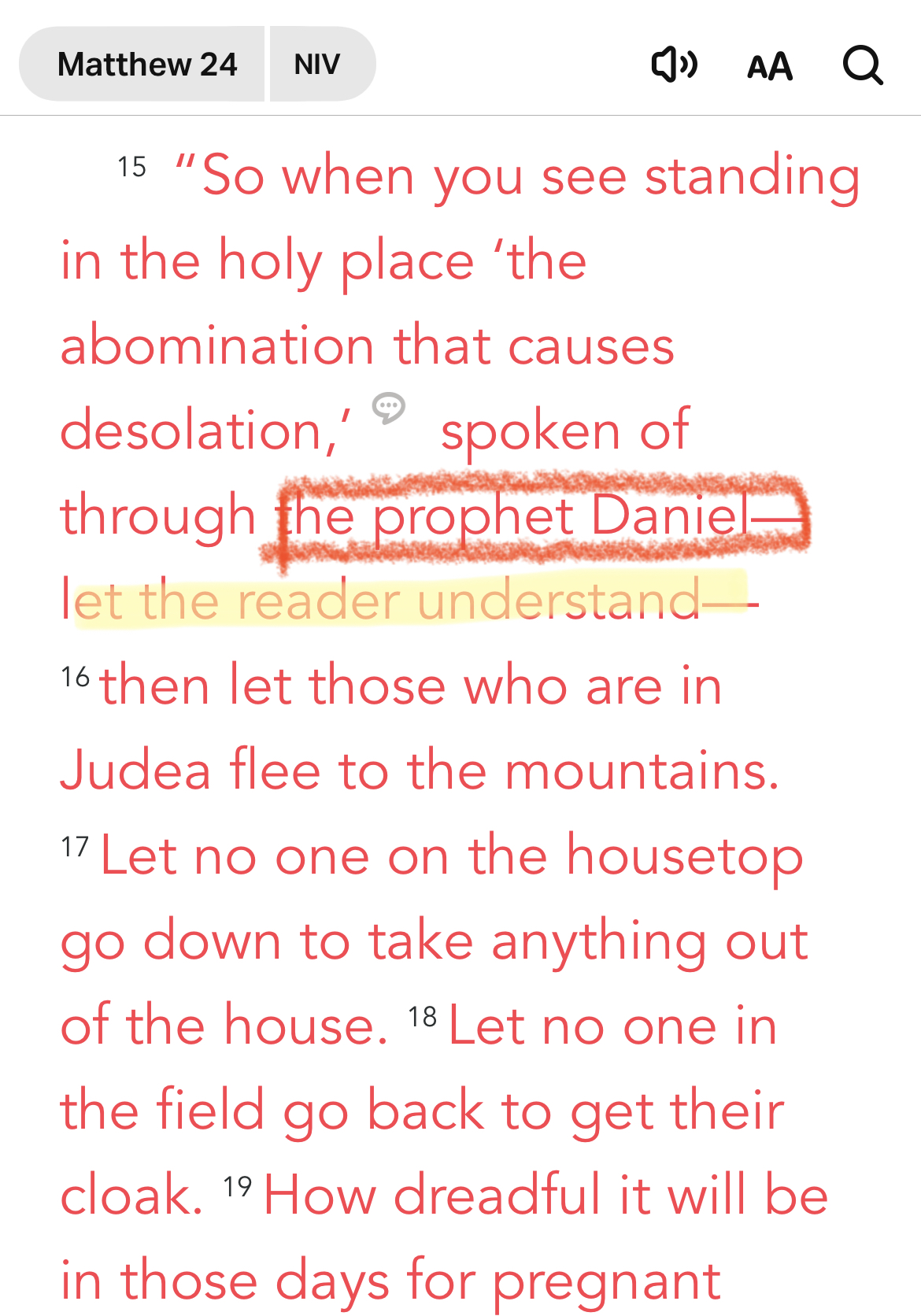
When Jesus said, “Let the reader understand,” He was saying He wants us to be able to understand and apply every Scripture we read. Check out this teaching video—
And although I didn’t mention it in the video, you can check out five different kinds of Bible studies I have shared here and here.
I’m excited to hear about your Bible study journey. If you have questions or other resources to share, please get in touch with me or leave a comment below.
Listen to the podcast of this post by clicking on the player below, and you can also subscribe on Apple, Spotify, or Audible.
I love reading, and I love sharing my love of good books with others! Here is a list of the books I read and reviewed in 2022. Click on a title to be taken to that review.
Don’t rush through your Bible reading time. Slow down to savor the good stuff. And if there’s something you don’t understand, ask the “Chef”—the Holy Spirit loves to make God’s Word clear to you.
On a recent Breakpoint broadcast, John Stonestreet reported, “Even while many nations pump the brakes on radical transgender ideology and healthcare practices, Americans at both the state and federal level continue to push culture-wide affirmation, social transition of minors, hormone therapies, and harmful surgeries. Advocates frequently claim that so-called and misnamed ‘gender-affirming’ treatments—including surgery—‘save lives,’ that gender dysphoria is a permanent condition even among minors, and that regret by those who undergo such treatments are minimal or non-existent. Increasingly, research suggests otherwise.”
“Hazael’s historicity has never truly been in doubt; there are far too many inscriptions from the ancient world testifying to his existence.” Check out this archeological biography of King Hazael who appears several times in the Bible.
John Piper explains that there are three levels of how to live with material things. He then dives deeper into what the purpose of prosperity really is.
T.M. Moore has a stern word for pastors: “If we are faithful in telling the whole truth of the Gospel, not everyone will be thrilled with our preaching. We need to make sure Jesus is. When it comes to sin, let’s not mince words, and let’s not act like it’s not the big deal it is. No progress in faith can be made where sin is not consistently and thoroughly confessed, repented of, and forsaken.”
Immature people only want to do the bare minimum, but mature people want to do more than is expected of them. Jesus called these people those that went the second mile. That was a topic in my most recent Monday Motivation series.
I am a big fan of The Babylon Bee. If you haven’t checked out their satirical wit, please do so! One post that caught my eye this week is called What Your Favorite Book Of The Bible Says About You. Wow, did this one make me laugh! If you would like to check out some real Bible studies, I have some here and here.
Cold-case detective and Christian apologist J. Warner Wallace discusses how Jesus impacted other world religions—
The drought in north Texas has revealed some more dinosaur tracks, raising some new questions about these massive animals that roamed Earth.
The devil loves to try to pervert the conviction of the Holy Spirit into condemnation. Here is the freeing truth we can stand on: There is NO condemnation for those who are in Christ Jesus.
This is a weekly series with things I’m reading and pondering from Charles Spurgeon. You can read the original seed thought here, or type “Thursdays With Spurgeon” in the search box to read more entries.
Listen to the podcast of this post by clicking on the player below, and you can also subscribe on Apple, Spotify, or Audible.
Delightful Judgments
My soul is consumed with longing for Your laws at all times. (Psalm 119:20)
Search God’s Word and you will have before your eyes the ultimate judgment of unerring truth, the last decree from the supreme authority from which there is no appeal! The Bible contains the verdict of the Judge of all the earth, the judgments of God who cannot lie and cannot err.
Thus, God’s Word is rightly called His ‘judgments.’ It is a Book not to be judged by us, but to be our judge—not a word of it may be altered or questioned. But to it we may constantly refer as to a court of appeal whose sentence is decisive. …
Our judgments must be daily more and more conformed to the judgments of God that are laid down in Scripture. And there must be in our spirit a longing after holiness until we delight in the Law of the Lord and meditate therein both day and night. We will grow to the likeness of that which we feed upon, heavenly food will make us heavenly minded! The Word of God received into the heart changes us into its own nature and, by rejoicing in the decisions of the Lord, we learn to judge after His judgment and to delight ourselves in that which pleases Him.
From Holy Longings
The 119th Psalm is an amazing chapter—176 verses arranged as a love letter to both God’s Word and the God who gave us His Word. Every one of these verses extol the value and beauty of God’s commands, decrees, precepts, statues, law, and judgments.
As Spurgeon pointed out, “judgment” does not mean a sentence of guilt pronounced against us, but a standard for determining the rightness or lawlessness of something. God’s Word is the final judgment on sin and righteousness.
The psalmist who penned this beautiful prose more than likely had only the first five books of our Bible—Genesis, Exodus, Leviticus, Numbers, and Deuteronomy—and yet he finds such delight in these words because of the awesome God they reveal. Look at his delight…
I delight in Your decrees (v. 16)
Your statues are my delight (v. 24)
I delight in Your commands (v. 47)
I delight in Your law (v. 70)
Your commands give me delight (v. 143)
As Spurgeon said, the more we delight in God’s Word, the more we will meditate on it; the more we meditate on it, the more it will change our hearts to make lifestyle judgments that are pleasing to God.
No matter whether you’ve never really studied the Bible, or you are an “old pro” with a well-worn Bible close at hand, may we all continue to grow in our delight of God’s Word and our reverence of the God revealed to us in the Word.
If you would like some Bible studies to help get you started, check out:
We have been studying the different sets of gifts listed in the New Testament. These gifts are to bring maturity and health to the church. Previously we have looked at:
Near the end of this lesson, I shared something that I hadn’t included in the handouts, but I promised to share it—
LOVE for God fill us with love for others → there is JOY in knowing His nearness → PEACE comes in the face of anxiety-causing tribulations → which gives me PATIENCE with others who are anxious without God → then I can have KINDNESS to draw them to God → and GOODNESS that is expressed in kind deeds → and my FAITHFULNESS that creates a sense of stick-to-it-iveness → and GENTLENESS that gives me courage to stand up for what’s right → my SELF-CONTROL keeps the fruit of the flesh in-check → which gives me greater LOVE for God and others…
“This is one of the rewards of reading the Old Testament regularly. You keep on discovering more and more what a tissue of quotations from it the New Testament is; how constantly Our Lord repeated, reinforced, continued, refined, and sublimated the Judaic ethics, how very seldom He introduced a novelty.” —C.S. Lewis, Reflections On The Psalms
The folks at Fight The New Drug provide excellent research on the dangers of pornography as well as many helpful resources for folks to break free from a porn addiction. Pornography often attracts people when they are emotionally drained, but viewing porn actually increases feelings of loneliness and isolation.
If we ever start to think the Church is one or two ministers and a whole bunch of parishioners, it really won’t be a Church. According to Ephesians 4, all Christians should be ministers.
You can check out the full message that this clip is from by clicking here.
Here is a word of encouragement for anyone in a time of spiritual warfare—
Wow, this post from T.M. Moore on how we respond to God’s “call” is a much-needed reminder. In the post, he wrote,
“Probably most Christians treat the calling of God as a kind of punctuated equilibrium. He breaks into their lives to ‘call’ them to some activity or task, but only from time to time, and only for that activity or task. He ‘calls’ us to believe the Gospel, and we do. He ‘calls’ us to this or that church, and we go. He ‘calls’ us to some ministry or other Christian activity, and so we participate. He ‘calls’ us to make a special gift, go on a mission trip, send a note of encouragement to a friend, and so forth. Our lives run on their own schedules, so whenever God ‘calls’ us to do something, we’ll try to get it done.
“But most of the time, other things have prior claims on our lives. We have jobs, families, friends, responsibilities, things we like to do or must do. We can’t respond to every calling from God because, well, there just isn’t enough time. We say, when friends press us to consider this or that Christian opportunity, ‘If God calls me to it, I will.’ But aren’t we just using the language of piety to relieve the discomfort of pressure to do something we’d rather not do?
“We are called of God. Of this there is no doubt. But for most Christians, the way they understand God’s calling is not the same as the way God issues it. And they have not yet learned to value His calling as He intends, as the defining and guiding value of our lives.”
Question marks invite a conversation; whereas, periods or exclamation points tend to end the conversation. Clearly, God enjoys dialogue.
God sometimes asks questions to get Zechariah to evaluate his surroundings or the prevailing culture. Sometimes God asks Zechariah a question to get him to clarify what he is seeing or thinking.
But without a doubt, most of the questions are posed by Zechariah to either God or to the angelic messenger who sometimes serves as Zechariah’s guide. Not once does God nor the angel tell Zechariah to hold his tongue. Zechariah’s questions are never belittled nor treated as though they were a bother. Nor are his questions ignored.
Rather, every single question is answered.
God enjoyed talking with Adam and Eve in the garden of Eden, He walked and talked with Enoch, He listened to the questions asked by Job and the psalmists, and here He engages Zechariah in conversation too.
Prayer is never designed to be a monologue—with us just speaking to God—nor is Bible reading designed to be a monologue—with just God speaking to us. Both prayer and Bible reading are used by the Holy Spirit to keep a dialogue active and engaging. You and I should never be afraid to approach God with our questions, nor should we be afraid to listen to the questions God asks us.
The dialogue between us and God builds an intimacy that cannot be developed in any other way. So keep asking those questions!
Listen to the podcast of this post by clicking on the player below, and you can also subscribe on Apple, Spotify, or Audible.
I’m a bit of a nut about the exactness of words, so one of my pet peeves is the incorrect use of imply and infer. “Imply” is something I do as the speaker; “infer” is something you do as the listener. Or you might say implying is like throwing and inferring is like catching.
A big problem arises when I infer something that you didn’t imply. Or even worse, when I infer something based on something you didn’t say. People will often say something like this, “Since Jesus didn’t specifically talk about ________ then it must be okay.” In logic, this would be called an argument from ignorance: concluding that an action must be acceptable because it has not been specifically stated to be unacceptable.
Statement #10 in our series asking “Is that in the Bible?” is—Love your neighbor. Is that in the Bible? Yes!
Later on, Jesus would add to this Deuteronomy 6:5—Love the Lord your God with all your heart and with all your soul and with all your strength—to answer the question about the greatest commandment of all.
In Leviticus 19, the Hebrew word for love means love in the broadest sense of the word, and neighbor means a friend or a fellow citizen. Unfortunately, the rabbis inferred that someone not a Jew was therefore an enemy and therefore not worthy of love. They further inferred that the opposite of love was hate.
Matthew Henry commented, “They were willing to infer what God never designed.”
Statement #11 is—Hate your enemy. Is that in the Bible? Yes, in the fact that it appears in print in Matthew 5:43, but it doesn’t appear in the Scripture that Jesus knew. It had become so ingrained in the thinking of people that they now assumed it was in the Bible.
In many ways, the Old Testament laws were easier to live out because they were all external and easy to measure, like don’t murder or don’t sleep with someone who isn’t your spouse. But Jesus made it a heart issue—He said lust is the same as adultery and hate is the same as murder.
Jesus also made love for enemies a heart issue. The word He used for love in the Greek is agape—the same word describing God’s love for His enemies in John 3:16—For God so LOVED the world, that He gave His one and only Son, that whoever believes in Him would not perish but would have everlasting life.
Jesus said our enemies were really our neighbors and were worthy of sacrificial love because they, too, were loved by God.
Matthew 5:44 is shortened in the NIV and has a footnote explaining that the longer verse was not seen in the earlier manuscripts. But given the fact that Jesus demonstrated everything found in the longer version of this verse, I think we are safe in using it. So let’s look at the response Jesus calls us to from the NKJV: But I say to you, love your enemies, bless those who curse you, do good to those who hate you, and pray for those who spitefully use you and persecute you.
Here’s what Jesus says it means for us to love our enemies:
(2) Help the haters. Jesus said we are to do those things that are beautiful and excellent—like the Good Samaritan did for his enemy-turned-neighbor (see Luke 10:25-37).
(3) Pray for the persecutors. Talk to God about them; don’t talk to others about them.
This response from Christians toward people whom others would call an enemy is totally unexpected by the world. This unexpected response will begin to draw enemies toward Jesus (1 Peter 2:12). If we will treat enemies and neighbors, they may soon become brothers and sisters in the family of God!
When the world hits us Christians out of hate, let’s respond with unexpected love: blessing those who curse us, helping those who hurt us, and praying for those who persecute us.